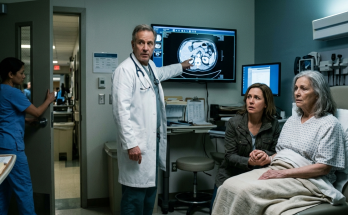
The second crash was louder than the first.
A woman shouted somewhere beyond the locked consultation room, followed by the sharp scrape of furniture moving across tile.
Dr. Levin killed the small emergency lamp.
Darkness returned.
“Everybody stay quiet.”
My mother leaned against me. Her breathing had become shallow, each inhale controlled as though even the movement of her abdomen hurt.
Richard moved toward the door.
I caught his sleeve.
“What are you doing?”
“Listening.”
“You stay where I can see you.”
Even in the dark, I felt him react.
“You think I brought them?”
“I don’t know what to think.”
“That’s fair.”
His answer disarmed me more than denial would have.
Footsteps passed the far end of the corridor.
Then stopped.
Mom whispered, “We have to leave.”
Dr. Levin said, “The front exit isn’t safe.”
“There’s another one.”
He turned toward her.
“How would you know?”
She pointed toward the back wall.
“Older medical buildings were required to have a secondary emergency passage before the renovations. My husband worked construction. He taught me to notice things like that.”
For a second, hearing her mention Dad tightened my chest.
Dr. Levin crossed the room and examined the wall.
A tall storage cabinet covered most of it.
Together, he and Richard shifted the cabinet aside. Behind it was a narrow service door painted the same beige as the wall.
Dr. Levin stared at Mom.
“You were right.”
“Move,” Richard said.
The passage smelled of dust and old plaster. Emergency lights glowed at long intervals, barely enough to show the concrete floor. Mom could not walk quickly. I hooked her arm over my shoulders while Dr. Levin supported her other side.
Richard followed behind us.
Halfway down the passage, voices sounded somewhere behind.
Male voices.
Low.
Organized.
Nobody was shouting now.
That frightened me more.
Richard stopped.
“Keep going.”
I turned. “What?”
“I’ll stay here.”
“No.”
“Sarah.”
“You just admitted you married me because your father ordered you to. You think I’m going to leave you alone behind us and assume you’re helping?”
His expression tightened, but he nodded.
“You shouldn’t trust me.”
The honesty landed harder than another defense.
He reached into his trouser pocket.
I stepped backward instinctively.
He slowly withdrew a small brass key.
Old.
Worn smooth around the edges.
He held it out.
I did not take it.
“What is that?”
“Your father’s house.”
I stared at him.
“My father’s house was sold after he died.”
“No.”
My mother lifted her head.
Richard continued. “The sale was forged.”
“That’s impossible.”
“My father arranged it.”
The corridor seemed to narrow.
“Why?”
“He wanted control of the property because he thought the ledger was hidden there.”
“Then who owns it?”
Richard looked at Mom.
She gave the smallest nod.
“I do,” she said.
I stared at her.
“You let me believe we lost the house.”
“I needed you to believe it.”
“Why?”
“Because if you thought it was gone, you’d never go looking there.”
All the lies surrounding me had different motives, but they were still lies.
I hated that I could understand hers.
“Where is the deed?”
Mom’s mouth tightened.
“In the porcelain angel.”
The image came immediately: a white ceramic angel on her mantel, one wing slightly chipped, a decoration I had seen my entire childhood.
“You hid a property deed in a figurine?”
“Your father did.”
Richard pressed the key into my palm.
“He hid more than that.”
My fingers closed around the cool brass.
“What?”
“The original ledger.”
Footsteps echoed behind us.
Closer.
Richard looked over his shoulder.
“Go.”
I grabbed his arm.
“What happens to you?”
He met my eyes.
For a second I could see the man I had lived beside for seven years—the man who made coffee too strong, left cabinet doors open, slept with one foot outside the blanket, knew how I liked eggs and which songs made me change the radio station.
Then I saw the stranger beneath those details.
“I’ll slow them down.”
“Why?”
His face softened.
“Because whatever you believe about how our marriage began, I need you alive.”
I could not answer.
Dr. Levin pulled me forward.
We kept moving.
At the end of the passage, a metal door opened behind the building.
Rain hit my face.
Dr. Levin’s car stood near the far edge of the lot.
We hurried toward it.
Mom stumbled twice.
Each time she caught herself without complaint.
Behind us, a door slammed.
I looked back.
Richard had not followed.
We reached the car.
Dr. Levin helped Mom into the rear seat, then drove before I had fully closed my door.
The clinic disappeared behind curtains of rain.
My hands shook around the brass key.
Mom watched me.
“Did he know where the ledger was?”
“I don’t think so.”
“He knew enough.”
“Yes.”
“Why didn’t you tell me any of this?”
She looked out the window.
“Because people around your father kept dying, losing jobs, losing homes, changing their stories. I thought silence was the only thing I could give you.”
“And marrying Richard?”
“I tried to stop you.”
“You never told me why.”
“I couldn’t prove anything then.”
“You could have told me what you suspected.”
She turned toward me.
“You loved him.”
“That wasn’t your decision to make.”
“No.”
Her answer came without defense.
“I was wrong.”
That stopped my anger from finding somewhere easy to land.
Dr. Levin spoke from the front.
“We need a hospital.”
Mom immediately said, “No.”
He glanced at her in the mirror. “Mrs. Bennett, you have a foreign device in your abdomen that appears to be shifting.”
“And someone just cut power to your clinic.”
“That strengthens my argument for medical care.”
“It strengthens mine for avoiding any place connected to the people who put that thing inside me.”
I turned toward her.
“Who put it there?”
She looked down.
“I don’t know.”
“But you said Richard knew.”
“He knew about it. That doesn’t mean he implanted it.”
“When did it happen?”
She pressed her fingers together.
“Seven years ago.”
The same number kept returning.
Seven years of marriage.
Seven years of Meridian Recovery.
Seven years since the device.
“What happened?”
“I was taken.”
Dr. Levin looked at her in the mirror.
“Kidnapped?”
“For several hours.”
My mouth went dry.
“You never told police?”
“I did.”
“What happened?”
“They found me sitting beside a road.”
She rubbed her temples as though forcing memory through a locked door.
“I couldn’t remember where I had been.”
“What did the hospital say?”
“That I was dehydrated and disoriented.”
“And the device?”
“They didn’t find it.”
“When did you?”
“Later.”
“How?”
“Another scan.”
Richard’s panic now made terrible sense.
“Three years ago?”
She nodded.
“Dr. Halpern.”
I stared out at the blurred city lights.
“Did Richard see the object then?”
“Yes.”
“What did he do?”
“He took me home before I could ask enough questions.”
“And you let him?”
“He told me that if I continued digging, you would be the one who paid for it.”
A cold rage settled behind my ribs.
Dr. Levin turned onto the highway outside town.
“Where exactly is this house?”
Mom gave him directions.
It stood beyond the older industrial district, where neighborhoods thinned into long stretches of dark road. By the time we reached it, the rain had weakened to a fine mist.
The house appeared behind overgrown trees.
I recognized it immediately.
Smaller than memory.
Sad enough to hurt.
Boards covered two windows. Ivy climbed one wall. The porch sagged slightly near the steps.
I had spent my childhood there.
I had believed it belonged to strangers for more than twenty years.
Mom touched my arm.
“Still ours.”
Dr. Levin stared at us.
“This night keeps getting stranger.”
The brass key turned stiffly in the lock.
Inside, the air smelled of damp wood, dust and abandonment.
My flashlight swept across furniture covered in sheets.
Then across the fireplace.
A porcelain angel stood on the mantel.
The same chipped wing.
I looked at Mom.
“How?”
“Your father made two.”
Of course he had.
Even his hiding places contained misdirection.
I lifted the angel carefully.
The base twisted loose.
Inside was a tightly rolled document.
The deed.
Mom’s name appeared beneath my father’s.
My hands shook.
“He protected the house.”
“He tried.”
Richard’s statement about the original ledger returned.
I searched the hollow base again.
Nothing.
“Where is it?”
Mom pointed toward the fireplace bricks.
“Your father liked layers.”
One brick near the lower corner came free.
Behind it sat a small metal box.
The brass key opened that too.
Inside lay a thick notebook.
A USB drive.
Several photographs.
And an envelope addressed in my father’s handwriting.
SARAH — ONLY WHEN IT IS SAFE.
My knees nearly gave way.
I sat on the dusty floor.
For twenty-six years, my father’s handwriting had existed only on old birthday cards and a few notes Mom kept in a drawer.
Now it was speaking directly to me.
I opened the notebook first.
Names filled the pages.
Property addresses.
Amounts.
Initials.
Dates.
Some names had titles beside them.
Judge.
Detective.
Attorney.
Bank officer.
Councilman.
Developer.
The pattern became horrifyingly clear.
These were people paid to move properties through fraudulent sales, ignore complaints, bury investigations or pressure elderly owners into surrendering homes.
Dr. Levin crouched beside me.
“My God.”
I turned pages faster.
Edward Collins appeared repeatedly.
Daniel Voss too.
Then I found Richard.
R. COLLINS.
My stomach dropped.
Beside his name was a payment entry.
“He was part of it.”
Mom sat carefully in a nearby chair.
“I told you he helped them.”
The room blurred.
Then something else caught my eye.
At the bottom of one page, my father had written a note.
If anything happens to me, Sarah must not know until she is safe.
I covered my mouth.
Mom crossed the room and lowered herself beside me despite the pain.
“He loved you.”
“Everybody keeps saying they lied because they loved me.”
She flinched.
I regretted it immediately, but I did not take it back.
I turned another page.
Another handwritten line.
The final evidence is not in the house.
I stared.
“What does that mean?”
Mom looked toward Dr. Levin.
Then at the CT image still stored on his tablet.
Understanding moved through me slowly.
“No.”
She nodded.
“The capsule.”
My father’s ledger was not the end of the evidence.
Something more complete had survived.
Inside my mother.
I looked at her.
“How did it get there?”
She took a long breath.
“After your father died, I was followed for years. Sometimes I saw cars parked outside. Sometimes there were calls. Twice men entered the house while I was gone.”
“You said you were kidnapped seven years ago.”
“Yes.”
“What happened?”
“I remember leaving the grocery store.”
She closed her eyes.
“Then nothing.”
“How long?”
“Almost eight hours.”
“When you woke up?”
“Beside a road outside town.”
Dr. Levin asked, “Any injuries?”
“A cut near my side. Bruising. They told me I’d probably fallen.”
She touched the area where the pain had been worst.
“Months later, discomfort started.”
“And eventually you discovered the capsule.”
“Yes.”
“Why didn’t you have it removed?”
“Because someone sent me another black envelope.”
My skin prickled.
“What did it say?”
Mom looked at me.
YOUR DAUGHTER LIVES WHILE THE SECRET STAYS BURIED.
I closed my eyes.
Richard had not been the only one living with threats.
My phone suddenly rang.
All three of us jumped.
Richard.
I stared at the screen.
Mom whispered, “Answer.”
I put it on speaker.
“Richard?”
His breathing was rough.
“Sarah.”
“Where are you?”
“Listen carefully.”
Sirens sounded behind him.
“They know about the house.”
I stood.
“We have the ledger.”
“Good.”
Something in his voice felt strange.
Not surprised.
Relieved.
“Where are you?”
“The warehouse.”
My hand tightened around the phone.
“What warehouse?”
A pause.
“The one where your father died.”
Mom covered her mouth.
“Why are you there?”
“Because there’s one thing my father never managed to destroy.”
“What?”
“The surveillance recording.”
I could barely speak.
“Of my father’s death?”
“Yes.”
A sound cracked through the phone.
Not static.
A gunshot.
Richard gasped.
“Richard?”
The line remained open for one second longer.
Then went dead.
Click here to continue reading: PART 5: The Gunshot Sent Us Back Toward the Warehouse, Where My Father’s Last Night Had Been Waiting Behind a Locked Steel Door
My Mother Bent Over in Pain, and My Husband’s Strange Anger Finally Made Me Stop Believing His Excuses
Part 4 of 16