My mother’s spoon slipped from her fingers and struck the kitchen tile just before she folded over the table, one arm pressed hard against her abdomen. The sound was small, almost delicate. Her gasp was not. I was beside her before the spoon stopped spinning, catching her shoulder as her knees buckled beneath her.
“Mom. Look at me.” I crouched until our faces were level. “Where does it hurt?” Her skin had gone the grayish color people get when pain has pushed beyond anything they can politely hide. She breathed through her nose, lips pressed together, then pointed to the right side of her abdomen. “Same place,” she whispered. “Only worse.”
From the doorway, Richard sighed. Not with concern. With irritation. My husband stood there in his white shirt and dark trousers, jacket hanging from one finger, looking as though this were an inconvenience squeezed between meetings. “Sarah, we’ve done this before,” he said. “Your mother gets worked up, her stomach bothers her, and suddenly the entire household has to stop.”
I stared at him. “She can barely stand.”
“She was standing perfectly well ten minutes ago.”
My mother lifted her head. Even in pain, she looked at him with something sharper than anger. “You always say that.”
Richard’s jaw tightened. “Because it’s always true.”
I had heard versions of that exchange for months. Since my mother, Margaret Bennett, had begun complaining of abdominal pain, Richard had treated every episode as proof of her tendency to dramatize. He called it nerves. Indigestion. Attention-seeking. He spoke with enough confidence that I had sometimes wondered whether I was being overprotective. That possibility shamed me now.
Mom tried to straighten and failed. I put an arm around her waist. Beneath my hand she felt alarmingly light. She had lost weight over the past several months, though she insisted she was eating. I suddenly remembered how often I had seen her push food around a plate, how she had begun refusing coffee in the morning because it “sat wrong,” how she sometimes gripped the edge of a chair when she thought nobody was watching.
“We’re going to a doctor,” I said.
Richard’s response came too quickly. “No.”
The word stopped me more effectively than a shout. I turned. “What do you mean, no?”
He shifted his jacket onto his other hand. “I mean we don’t need another pointless visit. She’s already seen doctors. They told her nothing serious was wrong.”
Mom’s fingers tightened around my wrist. “That isn’t what they told me.”
Richard looked at her. For perhaps half a second, something passed across his face. Not annoyance this time. Alarm.
Then it disappeared.
“What are you talking about?” I asked.
My mother lowered her eyes. “Nothing.”
Richard walked into the kitchen and picked up the fallen spoon. His movements were controlled, almost overly careful. “Exactly. Nothing. She’s tired, she probably ate something that upset her stomach, and you’re encouraging her to panic.”
I stood. “Why are you so determined to keep her away from a doctor?”
His head came up. “I’m not.”
“You just told me not to take her.”
“I’m saying use some judgment.”
“My judgment says she needs help.”
He gave a short laugh. “Your judgment changes whenever your mother makes that face.”
The cruelty of it stunned me. Mom heard it too. Her shoulders drew inward, but she didn’t defend herself. That hurt worse than anything Richard had said. Margaret Bennett had never been a fragile woman. She had raised me after my father died when I was nineteen. She had worked through grief, debt, leaking roofs and jobs that paid too little. I had watched her sew a split coat sleeve before a night shift because she could not afford a replacement. This was not a woman who enjoyed appearing helpless.
I reached for my handbag. “We’re leaving.”
Richard stepped in front of me.
He did not touch me. He simply positioned himself between me and the hallway, and that tiny movement changed the atmosphere in the room.
“Sarah.”
I had been married to him for seven years. I knew his irritated voice, his charming voice, the smooth business voice he used when speaking to contractors and attorneys. I had even heard him furious. This voice was different. Quiet. Controlled. Afraid.
“Move,” I said.
His eyes flicked toward my mother. “If she goes in, they’ll run every test imaginable. Do you know what that does to an elderly person?”
“She’s seventy-five, Richard. Not ninety-five.”
“Radiation. Contrast dye. Procedures. You think more tests are automatically better?”
“You’re suddenly an expert?”
“I’m trying to keep you from overreacting.”
Mom gave a dry little laugh behind me.
Richard turned. “What?”
She studied him. Pain had made her eyes watery, but there was nothing confused about them. “You haven’t changed.”
My stomach tightened.
Richard became absolutely still.
“What does that mean?” I asked.
Mom looked at me, then away. “Get your coat, Sarah.”
“Mom, what did you mean?”
“Later.”
Richard’s hand closed around the back of a chair. “Margaret.”
She met his gaze. “Don’t.”
One word. Softly spoken. Yet Richard released the chair.
That frightened me more than their argument.
I helped Mom into her coat while Richard paced toward the window. Outside, rain had begun tapping against the glass. He stood with his back to us for a few seconds, then said, “Which hospital?”
“I haven’t decided.”
“Sarah.”
I zipped my mother’s coat. “Why?”
“So I know where my wife is.”
“You’ll know when I know.”
He turned. “Take your phone.”
“Obviously.”
“And leave the location sharing on.”
I looked at him.
Until then, our shared phone locations had seemed ordinary. Convenient. Something married people did when one was driving late or meeting the other somewhere. Now the request sounded different.
“Why does that matter?”
His answer arrived a beat late. “Because I’m worried about you.”
“You don’t seem worried about her.”
He rubbed his forehead. “I have a meeting. I can’t do this right now.”
Mom murmured, “Then don’t.”
Richard stared at her again. The silence stretched until I took my mother toward the front door.
He called after us. “Sarah.”
I stopped.
“If they suggest imaging, call me first.”
The uneasiness that had been gathering inside me turned cold.
“Why?”
“Because I want to know what they’re doing.”
“To my mother?”
“To our family.”
I opened the door without answering.
Rain struck us immediately, blowing beneath the porch roof. Mom leaned heavily against me as we crossed to the car. By the time I settled her into the passenger seat, she was trembling. I buckled her belt, then crouched outside the open door.
“Tell me the truth. Have you been in this much pain before?”
Her gaze went toward the house.
Richard was standing behind the living-room window, watching.
“Yes,” she said.
“When?”
“Three years ago.”
“Why didn’t you tell me?”
“I tried.”
I frowned. “I would remember.”
“You were away for two days with Richard.”
A memory stirred. A property conference in another city. Richard had booked a surprise weekend after it ended.
“What happened?”
Mom pulled her coat closed. “Please drive.”
I got behind the wheel. Before starting the engine, I looked back at the house. Richard was no longer at the window.
My phone buzzed.
WHERE ARE YOU TAKING HER?
I read the message twice.
I had not even left the driveway.
Instead of replying, I switched off location sharing.
Mom saw me do it.
“Good,” she whispered.
I turned toward her. “Mom, you’re scaring me.”
She shut her eyes. “I’ve been scared for years.”
The clinic I chose was across town, not the hospital nearest our house. I told myself it was because the emergency department there was usually overcrowded. The truth was simpler: I did not want Richard to guess where we were.
The waiting room smelled of disinfectant and burned coffee. Mom sat hunched beside me while I filled out forms. Under previous abdominal procedures, she marked NONE. Under surgeries, NONE again. When I asked whether she had ever had a serious injury, she shook her head.
A nurse took one look at her and moved us ahead.
The examining doctor was a calm, silver-haired man who introduced himself as Dr. Levin. He asked Mom to describe the pain. She said it had come and gone for years but had changed recently—deeper now, sometimes sharp enough to wake her, sometimes accompanied by nausea.
“Years?” I repeated.
She would not look at me.
Dr. Levin palpated her abdomen carefully. When his fingers reached the lower right side, Mom jerked so hard that the paper beneath her crackled.
“That’s enough,” he said. “I’d like imaging.”
My pulse jumped.
“What kind?”
“A CT scan to start.”
Mom’s eyes found mine.
Richard’s warning returned with uncomfortable clarity.
If they suggest imaging, call me first.
Dr. Levin noticed our silence. “Is there a concern?”
I shook my head. “No. Do it.”
Mom reached for me before the nurse wheeled her away.
“Sarah.”
“What?”
“If they find something strange, don’t call Richard.”
I stared at her.
“Why would you say that?”
Her lips trembled. “Because I made that mistake once.”
The nurse was waiting. I wanted to stop everything and demand the entire story, but Mom’s face tightened with another wave of pain.
“Go,” I said. “We’ll talk afterward.”
She held my gaze for one more second.
Then the doors closed behind her.
I sat alone for nearly forty minutes. My phone vibrated repeatedly.
Richard.
Richard.
Richard.
Six missed calls. Then nine. Then eleven.
His messages changed from irritated to urgent.
CALL ME.
WHERE ARE YOU?
SARAH ANSWER YOUR PHONE.
DID THEY SCAN HER?
That last question made my throat tighten.
He did not ask whether she was all right.
He asked whether they had scanned her.
I powered off the phone.
When Dr. Levin finally returned, his expression had changed. He carried a tablet but did not sit down.
“Mrs. Collins?”
I stood.
“Is my mother okay?”
“She’s stable.”
Stable was not reassuring.
“What did you find?”
He hesitated.
“I want you to come with me.”
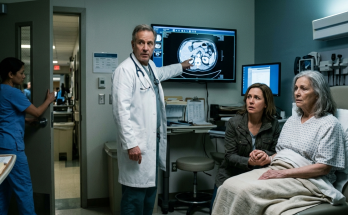
He led me into a small consultation room where Mom sat on the edge of an examination table. Her face was pale. A CT image glowed on a monitor beside her.
Dr. Levin enlarged one section.
“There is an object here.”
I leaned closer.
At first I saw only shades of gray. Then he pointed.
A dense, dark shape lay deep inside my mother’s abdomen.
Not a tumor.
Not a stone.
Something with straight edges.
Something manufactured.
“What is that?”
“We don’t know yet.”
Mom made a small sound.
I turned.
She was not looking at the scan.
She was looking at the doorway behind me.
I followed her gaze.
Richard stood there.
Rain darkened the shoulders of his coat. His chest rose and fell as though he had run through the building.
I had never told him where we were.
Dr. Levin frowned. “Can I help you?”
Richard ignored him.
His eyes stayed fixed on the monitor.
Mom slowly rose from the examination table.
“You found us,” she said.
Richard’s face lost all color.
And my mother, who had spent months saying almost nothing about him, whispered the words that changed the meaning of my entire marriage.
“You knew that thing was inside me.”
Click here to continue reading: PART 2: The Object in My Mother’s Scan Wasn’t What Terrified Me Most—It Was the Way Richard Recognized It
My Mother Bent Over in Pain, and My Husband’s Strange Anger Finally Made Me Stop Believing His Excuses
Part 1 of 16