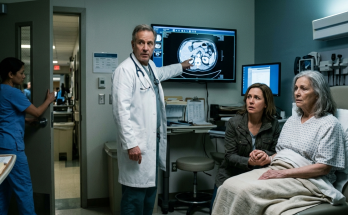
By the time I reached Mom’s room, Vale, Dr. Levin and two federal technicians were already there.
A monitor sat on the rolling tray beside her bed.
Mom looked pale but alert.
Richard remained near the door.
He had stopped assuming he belonged beside me.
That hurt in a way I was not ready to examine.
“What message?”
Vale held up an enlarged image of the capsule.
“The outer casing contained a microscopic sealed channel.”
“Data?”
“Not exactly.”
“What?”
“A thin polymer strip.”
Dad liked paper.
Even inside advanced technology, somehow he had left something physical.
“How could he have put it there? He died years before the implant.”
Vale shook his head.
“He didn’t.”
I frowned.
Mom said, “The message was originally hidden in the material Daniel used to reconstruct the Haven index.”
I stared.
“Samuel?”
One technician nodded.
“Samuel encoded it.”
Dad had given Samuel instructions before he died.
Instructions that survived until Daniel forced him to reconstruct the safe-house map.
“He slipped Dad’s message into the device design.”
“Yes.”
“Without Daniel knowing.”
“Yes.”
I almost smiled.
Dad had managed to use his enemies’ own implant to carry something they never intended.
“What does it say?”
The technician placed the strip image onscreen.
The writing had been machine-magnified and reconstructed.
Dad’s handwriting.
Again.
Margaret, if this reaches you, then Samuel was forced to rebuild the Haven map and someone used you to carry it.
Mom covered her mouth.
He had anticipated even that possibility.
Not the exact device.
The pattern.
Dad continued:
I am sorry.
Those words broke something in Mom.
She began crying quietly.
If they use you, survive first. Evidence comes second.
I looked at Vale.
“The safety mechanism.”
He nodded slowly.
“We wondered why the implant’s reservoir had a secondary release path.”
“What?”
“The protocol Bell used included a manual bypass that made removal possible.”
“Dad designed that?”
“Not the device.”
Samuel’s hidden instructions had apparently included a requirement that any reconstruction medium be recoverable without killing the host.
Vale said, “Daniel likely believed it was a technical redundancy.”
“But it was there because Dad told Samuel that human life mattered more than preserving evidence.”
“Yes.”
Mom laughed through tears.
“That sounds like Thomas.”
The message continued.
Sarah must never become the next container.
My throat tightened.
Dad knew how systems treated bodies.
As leverage.
As storage.
As collateral.
Not his daughter.
Never.
If she learns the truth, let her choose what to do with it. Do not choose for her because you are afraid.
Mom shut her eyes.
The words struck both of us.
Her silence.
Richard’s lies.
Every person who had decided ignorance was protection.
Dad, somehow, had understood the danger in that too.
He had done it himself when I was young.
But his final instruction rejected it.
Let her choose.
The last lines were shorter.
The Haven network was never meant to last forever.
People are not evidence.
Get them free.
Then go home.
No grand command.
No revenge.
No demand that I dedicate my life to finishing his.
Get them free.
Then go home.
I sat beside Mom.
She wiped her face.
“He always knew how to make me feel guilty.”
“Apparently from beyond the grave.”
She laughed.
Then winced.
“Don’t make me laugh.”
“You started it.”
Richard remained at the door.
Mom looked at him.
“You heard?”
“Yes.”
“Choice.”
He nodded.
“Yes.”
She turned to me.
“So choose.”
The next weeks were not cinematic.
Nobody walked into a courtroom and ended three decades of corruption in one speech.
Real collapse was slower.
Ugly.
Administrative.
Federal subpoenas.
Search warrants.
Frozen accounts.
Suspended judges.
Seized records.
Grand jury testimony.
People who had hidden behind titles began hiring defense attorneys.
Others came forward before warrants reached them.
Some admitted what they had done.
Some blamed Edward.
Some blamed Daniel.
Some blamed Wren.
Some insisted they had been coerced.
Many had been.
That did not erase the harm.
But it complicated punishment.
Dad had been right about that too.
People were not categories.
Wren was charged federally with racketeering, obstruction, conspiracy, civil rights violations and multiple offenses tied to the concealment of Rebecca’s disappearance and other crimes.
The recovered clinic records opened a homicide investigation into Edward’s death.
Wren’s own recorded statements, medical access records and surveillance placed him at the clinic.
His attorneys attacked everything.
Chain of custody.
Old evidence.
Witness memory.
Federal authority.
They lost enough motions for the case to continue.
Daniel accepted a cooperation agreement only after learning Wren intended to sacrifice him.
He did not receive immunity.
No one thought he deserved it.
He pleaded to charges connected to Dad’s murder, witness intimidation, kidnapping, fraud and conspiracy.
The plea required him to identify burial sites and victims.
He tried to bargain over each one.
Prosecutors stopped letting him.
Laura received protection while cooperating.
Her fate remained uncertain.
She had helped Wren and Daniel for years.
She had also been kidnapped, coerced and threatened.
She gave investigators enough evidence to free people whose names had never appeared in Dad’s records.
Samuel testified by video.
His health deteriorated quickly afterward.
But he lived long enough to see the first property restitution order signed.
Raymond Ellis’s old house could not be returned to him.
He was gone.
But the title fraud was formally vacated.
His family received compensation.
Eleanor called Mom crying.
Mom cried too.
Miriam confessed publicly to what she had done at the clinic.
Because Edward had not died from her action, the legal consequences were different than she expected.
But she still faced charges related to falsifying records afterward.
She did not fight them.
“I spent too long letting Wren own the truth,” she told investigators.
That sentence stayed with me.
Truth could become another form of captivity when hidden too long.
Dr. Arthur Vale surrendered his medical license.
He cooperated fully.
His testimony helped identify three other physicians who had falsified records for the network.
When I asked why he had finally decided to talk, he said, “Because Margaret survived long enough for me to stop pretending silence was neutral.”
Mom recovered slowly.
The incision healed.
The pain that had ruled her life disappeared almost immediately after surgery.
She complained about hospital food with enough energy that everyone agreed she was improving.
One afternoon, I found her eating pudding and staring at the empty place on her abdomen where a dressing had been removed.
“What?”
“I carried their secrets for seven years.”
“You carried Dad’s map too.”
“I’m not sure that improves the experience.”
“No.”
She looked at me.
“I should have told you.”
“Yes.”
“I thought keeping you ignorant kept you safe.”
“I know.”
“Did it?”
“No.”
She nodded.
“I know that now.”
I sat beside her.
“I understand why you did it.”
“That’s not the same as forgiving me.”
“No.”
She took another spoonful of pudding.
“Annoyingly mature.”
“Don’t ruin it.”
Richard faced his own investigation.
That mattered.
He had helped Edward retrieve records.
Broken into Mom’s house.
Taken medical information.
Hidden evidence.
Destroyed documents.
Administered medication to his father intending to cause death.
Even though Edward survived that dose and was later killed by Wren, the act could not simply vanish.
Richard did not ask for it to.
His attorneys negotiated around cooperation, coercive family history and the extraordinary circumstances of Edward’s condition.
He pleaded guilty to several lesser offenses connected to evidence destruction and unlawful access.
The most serious homicide-related charge was not brought after medical and legal review concluded the evidence did not support causation and the end-of-life circumstances were too complex for the theory Daniel wanted.
He lost his business licenses.
He paid fines.
He entered a cooperation agreement.
He also testified against Daniel and Wren.
Before his plea hearing, he came to my apartment.
Not our house.
I had moved out.
Temporarily, I told everyone.
Even myself.
He stood in the doorway with no bag.
No flowers.
No gesture designed to repair what could not be repaired quickly.
“I signed the disclosure.”
“What disclosure?”
“Everything I own tied to Dad’s companies.”
“And?”
“Any asset connected to fraudulent transfers goes into restitution.”
“That must be most of it.”
“Yes.”
“You’ll lose the house.”
“Yes.”
“The cars.”
“Yes.”
“Investments.”
“Yes.”
I almost smiled.
“You’re becoming very good at yes.”
“I had years of practice saying the wrong thing.”
I stepped aside.
He entered.
We sat at my small kitchen table.
“What do you want from me?”
“Nothing.”
“That’s new.”
“I want to tell you what I’m doing.”
“Okay.”
“I’m selling everything not seized.”
“For restitution?”
“Mostly.”
“What else?”
He looked embarrassed.
“Legal fees.”
“Reality remains annoyingly practical.”
“Yes.”
I studied him.
“Are you expecting me to forgive you?”
“No.”
“Do you want me to?”
“Yes.”
That honesty mattered.
“Do you expect us to stay married?”
“No.”
“Do you want us to?”
His eyes filled.
“Yes.”
I looked away.
Love had not disappeared when trust did.
That would have been easier.
I still knew how he drank coffee.
Still knew the expression he made when pretending not to be nervous.
Still remembered soup on his shirt and my backward sweater.
Those memories were not fake because his original motives had been complicated.
But neither did good memories erase deception.
“I don’t know.”
He nodded.
“I know.”
“No. Listen.”
He did.
“I don’t know if I can build a marriage with you again.”
His eyes stayed on mine.
“But I’m not deciding today.”
“Okay.”
“That is not hope.”
“I know.”
“It’s not punishment either.”
“I know.”
“It’s choice.”
He breathed out.
“Yes.”
Dad would have liked that.
Months passed.
The old Bennett house became central to the restitution foundation federal prosecutors allowed victims’ families to create.
Not a museum.
Mom refused.
“Your father would hate strangers looking at his socks behind glass.”
Instead, the house became an office where families could bring old property records for review.
Volunteer attorneys helped reopen fraudulent transfers.
Retired investigators assisted.
Samuel’s financial maps guided dozens of claims.
They called the program Haven.
Not because I chose it.
Eleanor did.
The name stuck.
One morning, workers removed the fireplace brick where Dad’s ledger had been hidden.
Behind the cavity, they found one final object.
A photograph.
Mom.
Dad.
Me at eight years old.
I was missing both front teeth.
Dad had written on the back:
HOME IS PEOPLE WHO GET TO CHOOSE EACH OTHER.
I stood in the empty living room holding it.
Mom came beside me.
“He wrote that?”
“Yes.”
“Sentimental old fool.”
“You’re crying.”
“Dust.”
“There’s no dust.”
“Then leave me alone.”
I laughed.
She leaned against me.
Outside, volunteers carried filing boxes toward the porch.
Not stolen deeds.
Restoration claims.
Different paperwork.
Different purpose.
Richard arrived later.
He had been volunteering twice a week under conditions set by the restitution board.
Mom had objected at first.
Then made him repaint the back office.
Twice.
“The first color looked criminal,” she explained.
He accepted that.
I watched him carry a box inside.
He saw me.
Stopped.
Did not assume he should come closer.
That, more than any apology, showed me he had changed.
“You found something?”
I held up the photograph.
He read the back.
His mouth tightened.
“He was right.”
“Usually inconveniently.”
Richard looked toward the fireplace.
“I spent half my life letting my father choose who I was.”
“And the other half?”
“Pretending I wasn’t.”
I nodded.
“That sounds about right.”
He looked at me carefully.
“What happens now?”
The old version of him would have suggested an answer.
The old version of me might have accepted one to avoid uncertainty.
I looked around the house.
Dad’s house.
Mom’s house.
Mine.
Not because of forged paperwork.
Because the truth had finally returned ownership to the people from whom it had been taken.
Wren’s trial had not started yet.
Daniel’s sentencing was months away.
Some victims would never recover their property.
Some crimes were too old to prosecute.
Some names in the ledger belonged to dead people.
Justice had arrived late and incomplete.
But incomplete was not meaningless.
Mom was alive.
Rebecca Wren had a grave with her name on it.
Raymond Ellis’s family had their truth.
Samuel had seen his records become evidence instead of leverage.
Richard was answering for his choices without carrying crimes Daniel had fabricated.
And my father was no longer a man who had simply collapsed one ordinary day from a heart attack.
He had been flawed.
Secretive.
Stubborn.
Brave.
Afraid.
Human.
He had tried to protect people.
He had failed some.
Saved others.
And left behind one final instruction more useful than revenge.
Let her choose.
I looked at Richard.
“I’m having dinner with Mom tonight.”
He waited.
“You can come.”
His eyes changed.
“Are you sure?”
“No.”
He smiled faintly.
“That sounds familiar.”
“It’s not forgiveness.”
“I know.”
“It’s dinner.”
“I know.”
“Mom may insult you.”
“I assume she will.”
“She may make you wash dishes.”
“That would be merciful.”
I almost smiled.
Then did.
Not because everything was repaired.
Because not everything needed to be decided in one moment.
He followed me onto the porch.
Mom was already shouting at a volunteer about the placement of a filing cabinet.
The afternoon light moved across the yard.
For years, every truth in our family had been hidden inside something.
A wall.
A tape.
A ledger.
A marriage.
A body.
Now the front door stood open.
People walked in carrying their own stories.
Nobody searched them.
Nobody tracked them.
Nobody told them what they were allowed to know.
Dad’s photograph stayed in my hand.
Home is people who get to choose each other.
I finally understood what made that different from loyalty built on fear.
Choice had to survive truth.
Anything else was control.
Richard stopped at the bottom of the porch steps.
He waited for me to decide whether he should come farther.
I held out my hand.
Not a promise.
Not absolution.
A choice.
He took it.
And together, without pretending the past was gone, we walked into the house where the truth had finally stopped hiding.
The End
Read more original stories on Feel Every Story.
My Mother Bent Over in Pain, and My Husband’s Strange Anger Finally Made Me Stop Believing His Excuses
Part 16 of 16