The Boy With the Black Key
PART 1 — The Boy in the Green Hoodie
The Reed & Vale showroom did not feel like a place for children.
It was built for silence, money, and people who never had to ask the price before touching something.
Polished marble flooring stretched across the entire room, reflecting the soft blue LED lights hidden beneath the display platforms. Black, silver, and pearl-white luxury cars sat under cinematic ceiling lights, their bodies shining like sculpture. The air smelled faintly of leather, new tires, expensive perfume, and fresh coffee from the private client lounge upstairs.
Outside the glass walls, late afternoon sunlight struck the city buildings and bounced back into the showroom in sharp, golden reflections.
Inside, every sound felt too loud.
The quiet click of heels.
The faint echo of shoes on marble.
The soft hum of air conditioning.
The delicate clink of espresso cups from the lounge.
Near the center of the showroom sat a black luxury car with no visible logo.
It was low, elegant, and powerful, with a body so polished the ceiling lights slid across it like water. It was not on the main display platform. It stood alone near the center, roped off only on one side, as if it was not for regular customers.
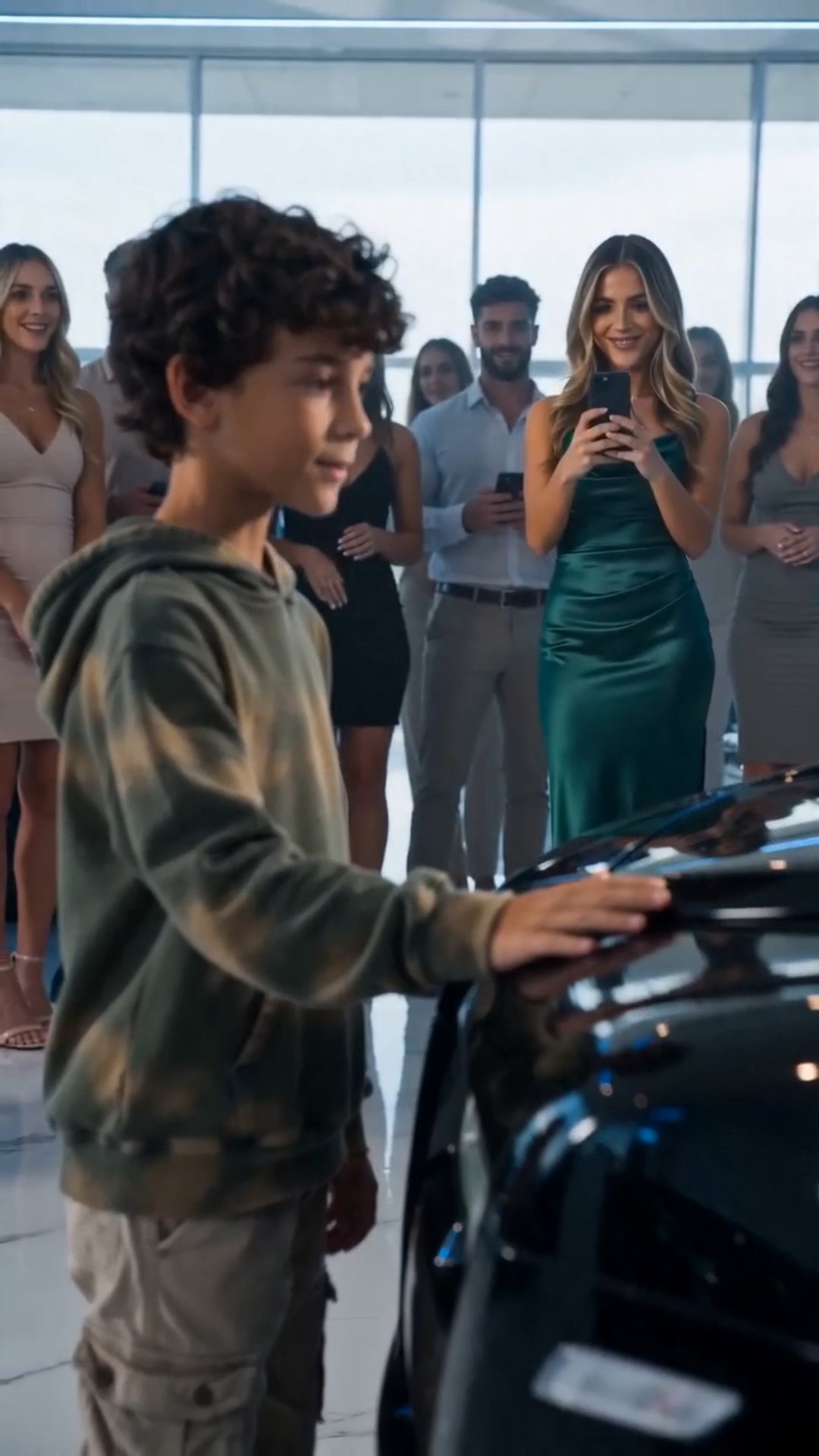
Eleven-year-old Mason Reed stood in front of it.
He wore a faded forest green hoodie, worn beige cargo pants, and old white sneakers that had been cleaned carefully but could not hide their age. His short dark brown curls fell slightly over his forehead, and his warm brown eyes studied the car with quiet fascination.
He did not run.
He did not shout.
He did not press his face against the glass.
He simply stood there, one hand tucked inside his hoodie pocket, the other slowly reaching toward the hood.
His fingers touched the car gently.
Not carelessly.
Not like a boy trying to leave fingerprints.
Like someone greeting something familiar.
Behind him, Chloe Bennett lifted her phone.
She was twenty-one, elegant, and very aware of it. Her emerald green satin evening dress caught the showroom lights with every movement. Her long light brown waves fell over one shoulder, and her nude heels clicked sharply against the marble as she stepped closer to her group of friends.
They were all dressed like people who had come to be seen buying expensive things.
Designer jackets.
Clean sneakers that cost more than rent.
Watches too heavy for their wrists.
Phones in their hands, screens blank but ready to record.
Chloe had come to the showroom because her father was considering leasing a new sports sedan for her graduation gift. She had spent the morning pretending to be bored by everything under two hundred thousand dollars.
Then she saw Mason.
A small boy in an old hoodie touching the black car.
Her lips curved.
Not into a smile.
Into an opportunity.
“Look at this,” she whispered to her friends, raising her phone. “Some kid wandered in from the parking lot.”
One of her friends laughed quietly.
“Is he lost?”
“Probably looking for the restroom,” another said.
Mason did not turn around.
He was focused on the car.
The hood was cool beneath his palm. He could see his reflection in the black paint: messy curls, serious eyes, hoodie sleeves slightly too long.
He remembered the first time his father had shown him the design sketches.
“This one is not about speed,” his father had said. “It is about restraint. Real power doesn’t need to introduce itself loudly.”
Mason had liked that sentence.
He liked quiet things that turned out to matter.
He was still looking at the curve of the hood when Chloe walked toward him.
Her friends followed at a lazy distance, already amused.
The nearest sales associate noticed them and hesitated. He looked toward the back office, then toward Mason, but said nothing.
The showroom manager, Mr. Grant Hale, was upstairs in a private meeting.
No one else seemed sure whether to interfere.
Chloe stopped behind Mason and looked him up and down.
Faded hoodie.
Worn cargo pants.
Old sneakers.
No parent nearby.
No salesman attending him.
No reason, in her mind, for him to be near that car.
“Hey,” she said.
Mason turned.
Chloe pointed at the hood.
“Don’t touch that car.”
Her voice carried just enough for nearby customers to hear.
Mason blinked.
“I’m sorry?”
“That ride costs more than your entire family’s worth.”
Her friends laughed.
A few customers looked over, uncomfortable but curious.
Mason’s hand slipped away from the hood. His cheeks warmed slightly, but he did not answer rudely.
“I just wanted to look at it.”
Chloe tilted her head with exaggerated pity.
“People like you wouldn’t even dream of driving something like this.”
Mason looked down at his sneakers.
He was used to adults underestimating him.
He was not used to being mocked by someone barely older than a college student who looked at him like poverty was contagious.
“I wasn’t hurting it,” he said quietly.
Chloe laughed again.
“That’s not the point. You don’t belong next to it.”
The sentence landed harder than she expected.
Not because Mason believed her.
Because the showroom suddenly felt full of eyes.
A man near a silver coupe pretended to inspect the door handle while listening. A woman in a cream coat lowered her coffee cup. Chloe’s friends lifted their phones higher.
Mason took a breath.
His father had told him that anger was expensive.
“You have to decide,” Daniel Reed used to say, “whether the person insulting you has earned the cost of your reaction.”
Chloe had not.
So Mason stayed calm.
He looked at the car again.
Then at Chloe.
“This car belongs to me.”
For half a second, nobody laughed.
Then Chloe’s friends erupted.
One of them bent forward, clutching his stomach.
Another covered his mouth and said, “No way.”
Chloe’s smile widened.
“Sure,” she said. “Do you own the whole showroom too?”
The laughter grew louder.
Mason did not smile.
He reached into the pocket of his faded green hoodie and pulled out a matte black smart key.
It had no visible logo.
No shining emblem.
No dramatic decoration.
Just a smooth black surface with one subtle button beneath his thumb.
Chloe’s laughter faded slightly.
Mason pressed it once.
The black car responded immediately.
The headlights flashed softly.
The side mirrors unfolded with quiet precision.
A low electronic chime echoed through the showroom.
Silence fell.
Chloe’s smile twitched.
Her friends lowered their phones.
Mason slipped the key back into his palm and looked at her.
“I don’t own the whole showroom,” he said.
Before Chloe could recover, the private office door opened at the far end of the room.
Mr. Grant Hale, the showroom manager, walked quickly across the marble floor.
He was around forty-five, with short silver-gray hair, a charcoal tailored suit, a burgundy tie, and the composed urgency of someone who understood exactly who mattered.
He stopped in front of Mason.
Then he bowed his head slightly.
“Young Mr. Reed,” he said respectfully, “your father has finished the meeting.”
The entire showroom froze.
Chloe went pale.
Mason looked up at the manager calmly.
“Thank you, Mr. Hale.”
The boy in the faded hoodie turned back toward Chloe.
For the first time, she looked at him and saw not a poor child near an expensive car.
But someone she had judged far too quickly.
PART 2 — Young Mr. Reed
Chloe’s phone lowered slowly to her side.
The showroom felt different now.
The same blue LED lights glowed beneath the cars. The same marble floor reflected everyone’s shoes. The same polished vehicles sat in silence beneath the ceiling lights.
But the air had shifted.
A moment ago, Mason had been a child everyone was willing to watch being humiliated.
Now he was Young Mr. Reed.
And people were suddenly very interested in pretending they had not laughed.
Mr. Hale glanced toward Chloe, then toward the phones in her friends’ hands.
His expression remained professional, but his eyes sharpened.
“Is everything all right here?”
Mason looked at Chloe.
She opened her mouth.
Nothing came out.
One of her friends tried to laugh it off.
“We were just joking.”
Mason looked at him.
“You were recording.”
The young man’s smile vanished.
Chloe quickly slipped her phone behind her back.
“I didn’t know who you were.”
Mason’s face stayed calm.
That answer seemed to disappoint him more than an insult would have.
Mr. Hale turned to her.
“Miss Bennett, that is not an apology.”
Chloe’s cheeks flushed.
Her father, Richard Bennett, had taught her many things about social survival. Never apologize first. Never admit too much. Never let anyone in a room believe they are above you.
But none of those lessons helped when an eleven-year-old boy in old sneakers stood quietly with more authority than she could fake.
“I’m sorry,” Chloe said stiffly.
Mason studied her.
“For what?”
Her jaw tightened.
“For what I said.”
“What did you say?”
The question was quiet.
Not cruel.
But it forced the room to remember.
Chloe looked around.
Customers were watching. Sales associates had stopped pretending to adjust displays. Her friends looked anywhere but at her.
“I said…” She swallowed. “I said the car cost more than your family’s worth.”
Mason nodded.
“And?”
She looked at the floor.
“And that people like you wouldn’t even dream of driving it.”
Mr. Hale’s expression darkened.
Mason did not look angry.
That made the moment harder for everyone.
“My dad says people usually say ‘people like you’ when they don’t want to admit what they really mean.”
Chloe’s face went red.
“I didn’t mean—”
“You did,” Mason said.
The words were not loud.
They were worse.
They were accurate.
A door opened upstairs.
Footsteps approached from the private client staircase.
Daniel Reed appeared at the top landing.
He was in his early forties, wearing a simple navy suit without a tie. He had the calm confidence of a man who had nothing to prove and the tired eyes of someone who had worked too long to reach a place others assumed he was born into.
Beside him walked an older executive holding a folder.
Daniel looked down and immediately read the showroom.
His son.
Chloe.
The friends.
The phones.
The manager’s tight posture.
A father does not need a full report to understand when his child has been wounded.
Daniel came down the stairs slowly.
Mason did not run to him.
He stood still.
That told Daniel even more.
“Mason,” he said.
“Dad.”
Daniel stopped beside his son and rested one hand lightly on his shoulder.
Not possessive.
Protective.
“What happened?”
Mr. Hale started to speak.
Mason answered first.
“She thought I didn’t belong near the car.”
Daniel looked at Chloe.
Only then did recognition cross her face.
Not of him personally.
Of the name.
Reed.
Reed & Vale.
The logo was not displayed on the car, but the building carried it. The showroom carried it. The private plaque behind the reception desk carried it.
Her eyes widened.
Daniel Reed was not just a client.
He was the Reed in Reed & Vale.
Not the founder, exactly. His father had started the first service garage thirty years earlier. Daniel had expanded it into a luxury automotive group, then into custom vehicle design, then into private acquisitions for collectors who did not want their names tied to purchases.
This showroom was one of his flagship locations.
Chloe had mocked the owner’s son inside his own building.
Daniel looked at her for a long moment.
“What is your name?”
She straightened instinctively.
“Chloe Bennett.”
“Bennett.”
His eyes shifted toward Mr. Hale.
“Richard Bennett’s daughter?”
Mr. Hale nodded.
“Yes, sir. Mr. Bennett has an appointment regarding a vehicle lease.”
Daniel looked back at Chloe.
That made her nervous.
“My father is a client here,” she said quickly.
Daniel’s expression did not change.
“My son is family here.”
The sentence cut through the showroom softly but completely.
Chloe’s friends stepped back half a pace.
Mason looked at the floor again.
Daniel noticed.
He crouched slightly so he was at eye level with his son.
“Are you okay?”
Mason nodded.
But Daniel knew the difference between okay and not wanting to make a scene.
“Did you respond?”
“I told her the car was mine.”
Daniel looked at the black vehicle.
For the first time, a small smile touched his mouth.
“Technically, it is registered to the trust until you’re older.”
Mason shrugged.
“You said I could call it mine.”
“I did.”
Chloe stared at them.
“The car is his?”
Daniel stood.
“It was commissioned for him. Not because he needs a car at eleven, obviously. Because it was designed around a concept he created with our team.”
Mason looked embarrassed.
“Dad.”
Daniel squeezed his shoulder.
“No, this part matters.”
He turned to the showroom.
“My son drew the first sketch of this car in a hospital waiting room.”
The room went even quieter.
Mason’s face changed.
He did not like that part of the story.
But Daniel continued carefully.
“His mother was receiving treatment. He was scared. So he drew cars. Quiet ones. Strong ones. Cars that looked calm even when they were built to survive pressure.”
Chloe’s expression shifted.
Something like shame finally touched her face.
Daniel looked at the black car.
“This model began as his drawing. Our design team refined it. The prototype is his. He chose the matte black key because he didn’t want a logo.”
“Why?” one of Chloe’s friends whispered before stopping himself.
Mason answered without looking at him.
“Because if something is yours, it doesn’t have to shout.”
Daniel’s eyes softened.
Mr. Hale lowered his gaze, almost smiling.
Chloe looked as if the sentence had struck her harder than if Mason had insulted her back.
Daniel turned to Mr. Hale.
“Where is Mr. Bennett?”
“In the private lounge, sir. He was taking a call.”
“Please ask him to join us.”
Chloe stiffened.
“Is that necessary?”
Daniel looked at her.
“Yes.”
PART 3 — The Lease That Vanished
Richard Bennett came down from the private lounge with the confident irritation of a man interrupted during something important.
He was in his late forties, dressed in a tailored beige blazer, crisp shirt, and expensive loafers. His face carried the polished smile of someone who used charm as a form of pressure. He held his phone in one hand and a coffee cup in the other.
“Daniel,” he said warmly, before noticing the tension. “Everything all right?”
Daniel did not shake his hand.
“Your daughter had an exchange with my son.”
Richard glanced at Chloe.
“What kind of exchange?”
Chloe quickly stepped forward.
“Dad, it was nothing. I made a joke.”
Mason looked at her.
Richard relaxed slightly.
“A joke?”
Mr. Hale spoke this time.
“Miss Bennett mocked Young Mr. Reed’s clothing, suggested he did not belong in the showroom, and recorded him without consent.”
Richard’s smile faded just enough.
He looked at his daughter.
“Chloe.”
She whispered, “I didn’t know who he was.”
Daniel’s eyes hardened.
“There it is again.”
Richard blinked.
“Excuse me?”
Daniel stepped beside Mason.
“She is not sorry she humiliated a child. She is sorry the child had a last name.”
Richard’s face tightened.
“Daniel, let’s not exaggerate. Young people say foolish things.”
“Do they learn them alone?”
The question landed cleanly.
Richard’s eyes cooled.
“Careful.”
Mr. Hale looked up sharply.
Daniel did not move.
The showroom watched silently.
Richard lowered his voice.
“My family has done business here for years.”
“No,” Daniel said. “Your family has spent money here for years. That is not the same as doing business.”
Richard’s jaw flexed.
“Are you really going to risk a client relationship over a childish misunderstanding?”
Daniel looked at Mason.
Then at Chloe.
Then at the black car under the lights.
“I grew up sweeping floors in my father’s first garage,” he said. “Men like you brought cars in and tossed keys at me without looking at my face. Some told me to be careful because the car was worth more than my house.”
Richard shifted uncomfortably.
Daniel continued.
“I learned then that money doesn’t create class. It only reveals what people do when they think there are no consequences.”
Chloe’s friends were no longer smiling.
Richard looked around at the audience and realized the room was not with him.
He changed tactics.
“Mason,” he said, forcing warmth into his voice. “I apologize on my daughter’s behalf. She can be impulsive, but I’m sure she meant no harm.”
Mason looked at him.
“She can apologize for herself.”
Someone near the silver coupe coughed to hide a laugh.
Chloe looked humiliated.
Richard shot her a warning glance.
She turned to Mason.
“I’m sorry.”
This time, her voice was quieter.
Still not complete.
Mason did not answer immediately.
Daniel did not tell him what to say.
Finally, Mason nodded once.
“I hear you.”
Not I forgive you.
Not it’s okay.
Just I hear you.
Richard tried to smile.
“Good. Then perhaps we can move forward.”
Daniel turned to Mr. Hale.
“Mr. Bennett’s lease request?”
Mr. Hale’s expression remained neutral.
“Pending final approval.”
Daniel nodded.
“Decline it.”
Richard froze.
“I’m sorry?”
“Decline it.”
“For what reason?”
“Brand discretion.”
Richard’s face darkened.
“That is absurd.”
Daniel remained calm.
“So was assuming my son’s worth was measured by his hoodie.”
“This is petty.”
“No,” Daniel said. “Petty would be insulting your daughter’s appearance in front of strangers and recording her reaction. I’m simply deciding who gets access to my company’s private inventory.”
Richard took a step closer.
“You think this will hurt me? I can buy from anyone.”
Daniel nodded.
“Yes. And you should.”
The room held its breath.
Richard looked at the manager.
“Grant, surely—”
Mr. Hale straightened.
“Mr. Reed’s decision is final.”
Chloe whispered, “Dad, let’s go.”
But Richard was not done.
His pride had become louder than his judgment.
“You know what your problem is, Daniel?” he said. “You still think like a garage boy.”
The showroom went completely silent.
Mason looked at his father.
For the first time, Daniel’s face changed.
Not anger.
Memory.
He looked at Richard for a long moment.
Then smiled faintly.
“You’re right.”
Richard blinked, thrown off.
Daniel continued.
“I do think like a garage boy. That means I know the value of every person who cleans, fixes, polishes, parks, builds, sells, and protects what arrogant people like you only point at.”
He turned to the showroom staff.
“That is why this company exists.”
Then he looked back at Richard.
“And that is why you are leaving.”
Mr. Hale gestured politely toward the exit.
“Mr. Bennett.”
Richard’s face flushed with rage.
Chloe moved quickly toward the door, her friends following in embarrassed silence.
As she passed Mason, she paused.
For a second, he thought she might say something cruel.
Instead, she looked at the black car, then at his old sneakers.
“I was wrong,” she said.
Mason studied her.
“Yes.”
Chloe nodded, accepting the weight of it.
Then she left.
Richard stormed after her.
The glass doors opened.
Late afternoon light flooded the marble floor.
Then the Bennett family was gone.
Mason released a breath he had been holding.
Daniel looked down at him.
“You handled that better than most adults would have.”
Mason shrugged.
“I was scared.”
“I know.”
“You were?”
Daniel smiled.
“I’m your father. I’m scared every time the world is unkind to you.”
Mason leaned into him for half a second.
Just half.
Enough.
Then he looked at the black car.
“Can we still drive it someday?”
Daniel laughed softly.
“Someday when your feet reach the pedals.”
Mason considered that.
“Can we sit in it now?”
Daniel held out his hand.
“Lead the way.”
PART 4 — The Car With No Logo
That evening, after the showroom closed, Mason sat in the driver’s seat of the black car.
The engine was off.
His feet did not reach the pedals.
The showroom lights reflected across the windshield in clean blue lines. Outside, the city had moved into dusk, and the glass walls mirrored the interior so perfectly it looked like the cars extended forever.
Daniel sat in the passenger seat.
Neither spoke for a while.
Mason held the matte black key in both hands.
“Do you think she meant it?” he asked.
“Chloe?”
Mason nodded.
“When she said she was wrong.”
Daniel thought carefully.
“I think she realized she was wrong. That is not always the same as changing. But it is where change can begin.”
Mason looked at the dashboard.
“I didn’t like how everyone watched.”
“I know.”
“No one said anything.”
Daniel looked through the windshield toward the empty showroom.
“People often wait for someone with power to decide what is right before they act on what they already know.”
Mason turned the key in his hands.
“That’s sad.”
“Yes.”
“Do you do that?”
Daniel’s answer did not come quickly.
“Sometimes,” he said.
Mason looked surprised.
“You?”
Daniel smiled faintly.
“Especially me. Owning things doesn’t make you brave automatically.”
Mason looked at him.
“Then what does?”
“Practice.”
Mason absorbed that.
Daniel looked at the black hood stretching in front of them.
“When I was your age, I hated showrooms.”
“But you own them.”
“That’s partly why.”
Mason waited.
Daniel leaned back.
“My father was a mechanic. Brilliant man. Hands always rough. Shirt always stained. He could listen to an engine for five seconds and know what was wrong. But men in suits treated him like he was invisible.”
Mason looked down.
“Like Chloe treated me.”
“Yes.”
“Did you ever say anything?”
“Not enough.”
Daniel’s voice softened.
“I was young. Angry. Embarrassed. I thought if I got rich enough, no one would ever look down on us again.”
“Did it work?”
Daniel looked at his son.
“No.”
Mason frowned.
“But you are rich.”
Daniel smiled sadly.
“Money can change what people say to your face. It doesn’t always change what they believe.”
Mason ran one finger over the key.
“So what does?”
“How you use the money. Who you protect. What you refuse to reward.”
The empty showroom seemed to listen.
“That’s why you declined Mr. Bennett’s lease?”
“Yes.”
“Was that revenge?”
Daniel considered lying, then chose not to.
“A little.”
Mason smiled.
Daniel added, “But mostly it was a boundary.”
“What’s the difference?”
“Revenge tries to make someone feel small because they made you feel small. A boundary says, you don’t get access to me while treating people that way.”
Mason looked toward the glass doors where Chloe had left.
“I didn’t want her to feel small.”
“I know.”
“I just wanted her to stop acting like I was.”
Daniel’s eyes warmed.
“That is why the car is yours.”
Mason looked embarrassed.
“Dad.”
“I mean it.”
He touched the dashboard lightly.
“This car began with your idea. Quiet strength. No logo. No shouting. No proving. That is who you are.”
Mason smiled faintly.
“I’m not strong.”
Daniel leaned closer.
“You stayed calm when someone tried to shame you in public. That is strength.”
Mason’s eyes lowered.
“I wanted to cry.”
“That is also allowed.”
For the first time that day, Mason looked like the child he was.
Daniel reached over and wrapped an arm around him.
Mason leaned into his father fully this time.
The black car surrounded them in silence.
Not cold silence.
Safe silence.
The next morning, Daniel called a full staff meeting.
Everyone from senior sales consultants to cleaning staff gathered near the central display.
Mason stood at the edge beside Mr. Hale, still in his green hoodie, because Daniel had told him not to change clothes to make other people comfortable.
Daniel stood in front of the black car.
“Yesterday,” he said, “my son was mocked in this showroom while several adults watched.”
The staff lowered their eyes.
“I am not saying this to shame everyone. I am saying it because silence is a policy too, even when it isn’t written down.”
Mr. Hale looked particularly affected.
Daniel continued.
“Our company sells expensive vehicles. That does not mean we sell dignity only to people dressed like they can afford it.”
He looked across the room.
“From today forward, every person who walks through these doors is treated with respect. Child, mechanic, driver, assistant, billionaire, tourist, student, delivery worker. If someone is browsing, they are welcome. If someone is lost, we help. If someone is rude, we address it. If someone mocks another person’s appearance, we do not wait for the victim to have a powerful last name.”
Mason looked up at his father.
Daniel’s voice strengthened.
“We will not become the kind of place my father used to dread entering.”
After the meeting, several employees approached Mason.
A young receptionist apologized for not speaking up.
A sales associate said he should have intervened sooner.
Mr. Hale waited until the others left.
“Young Mr. Reed,” he said, voice careful, “I failed you yesterday.”
Mason looked at him.
“You came over.”
“After the key. I should have come before.”
Mason considered that.
Then nodded.
“Okay.”
Mr. Hale smiled faintly.
Not forgiveness exactly.
But a chance.
Six months later, Reed & Vale launched a youth design scholarship for students from trade schools, public schools, and low-income communities. Mason helped choose the name.
No Logo Initiative.
Daniel laughed when he first heard it.
“Very subtle.”
Mason shrugged.
“You said real power doesn’t shout.”
The program brought young people into showrooms not as visitors to be tolerated, but as future designers, mechanics, engineers, and business owners. They learned from technicians, sat in design meetings, toured service bays, and built model concepts of cars they imagined.
Mason’s black car remained in the showroom.
Not as a symbol of wealth.
As a reminder.
Beside it, a small plaque was placed after Mason reluctantly approved the wording.
It did not mention Chloe.
It did not mention the incident.
It simply read:
Quiet strength belongs here.
Years passed.
Mason grew taller.
His curls stayed unruly.
His sneakers improved only slightly because he still preferred comfort over appearance.
By sixteen, he was working in the service bay during summers, learning from mechanics who respected him because he listened more than he spoke. By eighteen, he could diagnose engine issues faster than some older technicians.
He still carried the matte black key.
Not every day.
Only when he needed to remember.
Chloe Bennett changed too, though not immediately.
For a while, she disappeared from Reed & Vale circles completely. Then, nearly three years after the showroom incident, a letter arrived addressed to Mason.
It was handwritten.
Mason almost threw it away.
Daniel told him he did not have to read it.
He read it anyway.
Chloe wrote that she had watched the old video many times, though she hated herself in it. She wrote that she had grown up believing money was proof of worth because everyone around her acted like it was. She wrote that none of that excused what she said.
Near the end, she wrote:
I said I didn’t know who you were.
The truth is worse.
I thought I knew who you were just by looking at you.
Mason folded the letter.
He did not write back right away.
A month later, he sent one sentence.
I hope you look longer now.
Years later, Mason stood in that same showroom as a young man, beside the black car he had once been too small to drive.
A group of students from the No Logo Initiative gathered around him.
One boy wore a faded hoodie.
One girl had oil stains on her sleeves from her father’s repair shop.
Another student stood apart from the group, clearly overwhelmed by the luxury around him.
Mason noticed.
He walked over.
“First time in a place like this?”
The student nodded, embarrassed.
“I feel like I shouldn’t touch anything.”
Mason looked at the black car.
Then he handed the student the matte black key.
“Press the button.”
The boy stared.
“What?”
“Go ahead.”
The student pressed it.
The headlights flashed softly.
The mirrors unfolded.
The showroom lights glided across the black paint.
The student’s face lit up.
Mason smiled.
“When I was eleven, someone told me people like me wouldn’t even dream of driving something like this.”
The students went quiet.
Mason looked around the showroom.
“She was wrong. But the bigger problem was that the room let her say it.”
He placed one hand on the hood of the car.
“So here is the rule. If you can dream it, you can stand next to it. If you can learn, you can build it. If you can respect it, you can touch it.”
The boy in the faded hoodie looked at the car, then at Mason.
“Even if we can’t afford it?”
Mason smiled.
“Especially then.”
Through the glass doors, late afternoon light reflected off the city street.
The marble floor glowed softly.
The blue LEDs hummed beneath the cars.
And the black car with no logo stood silent at the center of the room.
Not shouting.
Not proving.