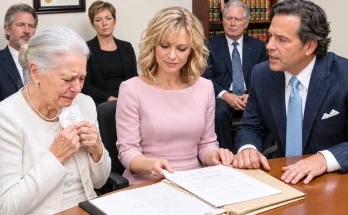
I didn't open Emma's letter at the church.
I couldn't.
I kept it inside my handbag during the rest of the service.
Every few minutes, my fingers moved toward the bag.
I needed to know what she had written.
But I was frightened of knowing.
There was no good answer waiting inside that envelope.
Only more things my daughter had lived through without me.
When the funeral service ended, the men carrying Emma's coffin moved slowly toward the doors.
I followed them.
Ruth stayed close enough that our sleeves touched.
I remember the sound of shoes on the church floor.
I remember somebody crying behind me.
I remember looking at the handles on the coffin and thinking how strange it was that something so ordinary could become the last thing connecting me to my child.
The cemetery was cold.
It was November, and the trees had already lost most of their leaves.
Wind moved through the branches above us.
I stood beside the grave, holding my handbag with both hands.
Emma was going to be buried beside the future she had never been allowed to live.
Her little Oliver was with her.
I tried to listen to the minister.
He spoke gently about love and about the way people remained part of us after they were gone.
I wanted to believe every word.
But I kept thinking about the blue blanket.
I had imagined wrapping my grandson in it after Emma brought him home.
I had imagined his small fingers opening and closing against the wool.
Now the blanket would never leave that coffin.
I looked across the grave.
Evan was standing on the other side.
His face looked serious enough.
A stranger might have mistaken him for a devastated husband.
But I had heard him inside the church.
I had seen the way he reacted when Mr. Halden mentioned the inheritance.
I couldn't forget it.
Celeste hadn't come to stand beside the grave.
She was waiting near Evan's car.
I was glad she stayed there.
I didn't think I could bear to look at her while we buried Emma.
When the final words were spoken, people began to approach me.
Some hugged me.
Some touched my arm.
Some said things I couldn't remember even a minute later.
I knew they meant well.
I just couldn't take in anything they were saying.
Ruth asked whether I wanted to leave.
I shook my head.
"Not yet."
She didn't argue.
We stood there as other people slowly walked away.
I knew Emma was gone.
I had known since the hospital called.
But standing beside that grave made it different.
I couldn't protect her from anything anymore.
Not from pain.
Not from betrayal.
Not even from the cold.
I was still looking down when I heard Evan approach.
"Margaret."
I knew what he wanted before he spoke again.
He had that impatient look he used to get when somebody delayed an answer he expected to receive.
"We have to sort out the estate situation."
I stared at him.
"Now?"
He glanced around.
"There are things that need attention."
I looked back at Emma's grave.
"Then arrange a meeting with her lawyer."
He let out a breath.
"I need to know what we're dealing with."
I almost asked him whether he had heard a single word the minister had said.
Instead, I kept my voice low.
"I'm not discussing property beside my daughter's grave."
He frowned.
"You're acting like I have no rights."
"I haven't said that."
"That's how you're treating me."
I looked straight at him.
"I'm asking you to leave me alone for one afternoon."
For a moment, he seemed ready to continue.
Then he shook his head.
He walked away without saying goodbye.
I watched him cross the cemetery.
Celeste was waiting beside a white Mercedes.
Evan climbed into the passenger seat.
She leaned toward him and kissed his cheek.
I stood there watching the car until it turned out of sight.
Ruth made a small, upset sound.
"How can he behave like that?"
I didn't answer immediately.
My handbag was pressing against my stomach.
Emma's letter was inside.
"I don't know how I'm supposed to live with seeing it," I said.
Ruth took my arm.
We finally left the cemetery.
That evening, my kitchen felt too quiet.
Ruth had offered to stay.
I told her I wanted some time alone.
She didn't like the idea, but she respected it.
I made tea.
Then I forgot to drink it.
The cup sat beside me while the steam disappeared.
I took Emma's envelope out of my handbag and placed it on the table.
Pale blue paper.
Her handwriting.
My name.
I could remember her writing letters to Thomas when she was small.
Sometimes she would leave little notes on the kitchen counter.
Sometimes she would draw hearts beside our names.
The letters became neater as she grew older.
But I could still recognize her hand anywhere.
I sat there for nearly an hour.
I picked the envelope up.
Put it down.
Turned it over.
I kept imagining Emma writing it.
Had she been crying?
Had she been alone?
Had Evan been in the next room?
I didn't know.
What frightened me most was the possibility that she had written it because she believed she might need someone to protect her after she was gone.
I finally opened the envelope.
Six pages.
All handwritten.
The first sentence was an apology.
Emma said she was sorry for keeping so much of her life hidden from me.
I put the paper down.
Then I covered my face.
I didn't want her apologies.
I wanted my daughter back.
I wanted her sitting across from me with her hands around a warm cup.
I wanted to tell her she had nothing to be sorry for.
After a while, I wiped my eyes and started again.
Emma explained when she had first discovered Evan's affair.
About four months before her death.
At first, he had denied being involved with anyone.
When she challenged him with things she had found, he finally admitted there was another woman.
But even then, he hadn't accepted responsibility.
He told Emma she had become difficult since the pregnancy.
He complained that she was tired all the time.
He said their conversations weren't interesting anymore.
He acted as though being pregnant with his child was a personal failure on her part.
I stopped reading.
I remembered Emma telling me how tired she felt after teaching.
She had a classroom full of five-year-olds.
She spent her days bending down to tie shoes, settling arguments, and helping children learn new words.
Then she went home with swollen feet and a growing baby.
I used to tell her to put her feet up.
I assumed Evan would make her dinner.
I assumed he would be kind.
That word bothered me.
Assumed.
I had assumed far too much.
Emma wrote that Evan compared her to Celeste.
He said Celeste took his work seriously.
She understood the things he wanted to accomplish.
Emma didn't.
I looked at the wall above my kitchen table.
There was a photograph of Emma holding her teaching certificate.
Thomas had been standing beside her that day.
He looked so proud.
He had never cared whether Emma earned a large salary.
He cared that she loved what she did.
Now I was reading that her own husband had made her feel inadequate for being exactly the person we had raised her to be.
I wanted to tear the pages apart.
Not because I didn't believe them.
Because I couldn't stand what they told me.
I made myself continue.
On the third page, Emma began writing about Willow Lane.
I sat straighter.
That house had belonged to Thomas's family long before Emma was born.
His parents had lived there.
Later, Thomas had spent years repairing it.
I remembered him returning home with paint on his hands.
I remembered him complaining about a window that wouldn't close properly.
I remembered the way he stood in the front yard after finishing the work, looking at the house with quiet satisfaction.
When Emma turned seven, he planted a magnolia tree near the front path.
She had been so excited that she wanted to water it every morning.
Thomas told her the tree would take time to grow.
Emma had asked how much time.
He told her to be patient.
I smiled at the memory.
Then I looked down at the letter.
Emma explained that Evan wanted the house sold.
He had been talking about putting money into a new business project.
Willow Lane was valuable.
Selling it would have given him access to an amount of money he couldn't easily find elsewhere.
But Emma refused.
She wanted to keep the house.
It was the last property her father had personally left to her.
She rented it out rather than selling it.
The income wasn't her main reason for keeping it.
She wanted it preserved.
I knew that.
I had never questioned her decision.
Emma wrote that Evan became increasingly angry after she refused his proposal.
He continued bringing up the sale.
He acted as though her attachment to the house was childish.
Then she discovered something.
Documents from a real estate agency.
Evan had been making inquiries about selling Willow Lane.
Without telling her.
I read the paragraph twice.
My hands had started shaking again.
Emma had contacted Mr. Halden.
She asked him to check the property paperwork.
He found a document connected to a possible transaction.
It appeared to give Evan permission to act for Emma in the sale.
And it contained a signature that looked like hers.
Except Emma hadn't signed it.
I pressed my palm against the page.
I knew her handwriting.
I knew how careful she was with important documents.
She wasn't somebody who would sign away her father's house and then forget doing it.
Emma wrote that the lawyer was helping her investigate.
She didn't know who had prepared the questionable authorization.
She didn't know how far the attempt had progressed.
But she wanted the property protected.
Especially if she was unable to finish handling the problem herself.
I read that part again.
Then once more.
I couldn't stop thinking about the timing.
Emma had gone to a lawyer.
She had questioned a property transaction.
She had started making arrangements about her estate.
And within days, she was dead.
I wasn't ready to make accusations.
The police had told us her car accident happened on a wet road.
I had accepted that.
There had been no reason, at the time, to imagine anything else.
But sitting at my kitchen table, I realized how much I hadn't known.
I had known Evan was ambitious.
He liked talking about business.
He sometimes complained that his plans required more money than he had available.
I remembered listening politely while he explained ideas I didn't fully understand.
I had never thought to ask what happened when those plans failed.
Emma must have known more.
She had been living with him.
I kept reading until I reached the end of the sixth page.
There were things my daughter wanted me to understand.
Not excuses.
Not accusations made in anger.
She had tried to put the facts in order.
I recognized that about her.
Emma had always been careful.
Even as a little girl, she wanted to explain things properly.
If two children in her class argued, she listened to both of them.
If somebody made a mistake, she asked what had happened before deciding what to do.
Now she had done the same thing with her marriage.
She had questioned herself.
She had looked for answers.
Then she had begun taking steps to protect herself.
I laid the six pages across my kitchen table.
The tea beside them had gone cold.
I thought about Evan at the funeral.
His confidence.
His anger.
The way he demanded to see my private envelope.
He hadn't acted like a man surprised by his wife's financial arrangements.
He had acted like somebody whose expectations had suddenly been disrupted.
I couldn't prove what those expectations were.
But I knew one thing.
Emma hadn't trusted him with Willow Lane.
And she had been right to seek legal help.
I gathered the pages carefully.
I put them back in their envelope.
Then I took out Mr. Halden's contact information.
I had no idea what would happen to my daughter's estate.
I didn't know whether the suspicious document had caused any damage.
I didn't know what Evan might try next.
But I wasn't going to ignore what Emma had written.
The following morning, I would speak with her lawyer.
I would ask him to show me everything he could.
I had failed to understand how much my daughter was carrying while she was alive.
I couldn't change that.
But I could listen to her now.
Click here to continue reading: PART 3: The Lawyer Showed Me a Signature My Daughter Never Wrote, and I Remembered the Phone Call I Had Failed to Answer
My Daughter Was Lying in Her Coffin When Her Husband Challenged the Lawyer and Revealed What Mattered Most to Him
Part 2 of 15