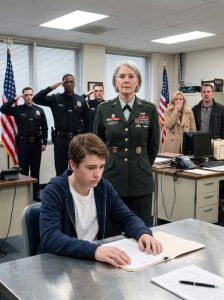
My grandson called me from the District Attorney’s Office at 2:47 a.m., desperately whispering that his stepmother was blaming him for everything—even though she was the one who started it all, and his own father took her side. Exactly twenty minutes later, I walked through the station doors. The young officer working the desk caught sight of me, froze instantly, and muttered, “Commander Hayes?” That was the precise moment her arrogant confidence began to crumble.

My grandson called me from the District Attorney’s Office at 2:47 a.m., desperately whispering that his stepmother was blaming him for everything—even though she was the one who started it all, and his own father took her side. Exactly twenty minutes later, I walked through the station doors. The young officer working the desk caught sight of me, froze instantly, and muttered, “Commander Hayes?” That was the precise moment her arrogant confidence began to crumble.

Part 1: The Call at 2:47 A.M.

“Grandma… I’m at the District Attorney’s Office. Lydia says I started everything, but she’s the one who began it. Dad believed her.”

Eleanor Grant opened her eyes before her mind fully returned to the room. The clock read 2:47 a.m. After thirty-two years in Chicago’s Major Crimes Unit, she knew one thing with absolute certainty: nothing good came through the phone at that hour.

Noah,” she said, sitting up. “Breathe for me. Where are you?”

A choked sob came through the line.

“At the Lincoln Park station. They brought me here because Lydia said I pushed her down the stairs.”

Eleanor’s fingers tightened around the phone. “And what did she do to you?”

“She came at me in the hallway with the candlestick. I tried to move away, but it caught me near my eyebrow. They had to cover it.”

The bedroom went silent.

Eleanor was no longer simply a retired grandmother with reading glasses beside her bed and pain cream for her knee. In that instant, Commander Grant returned—the woman who had questioned kidnappers, cracked liars with three questions, and recognized staged scenes before anyone touched the evidence.

“Listen carefully,” she said, voice firm. “Do not say another word. Do not sign anything. Stay where there are cameras and witnesses. I’m on my way.”

“I’m scared.”

Something inside her cracked, but her tone stayed steady.

“You are not alone, sweetheart.”

She dressed in five minutes: dark pants, gray sweater, old sneakers. Before leaving, she opened a drawer and took out a worn leather wallet. Her old badge was inside. She did not carry it anymore, but tonight she was not arriving as a frightened civilian. She was coming as the only person Noah had trusted enough to call when everyone else had chosen not to believe him.

As Eleanor drove along Lake Shore Drive, she remembered the seven-year-old boy who came to live with her after his mother died. Noah used to sleep with the light on. He asked whether his mom could still see him from heaven. Every Sunday, he clung to Eleanor when his father, Mark, arrived to take him home.

Years later, Mark married Lydia.

At first, Eleanor tried to be fair. She invited Lydia to lunch, bought her a blouse for Christmas, and thanked her for taking Noah to school. Then the comments started.

“Noah has become so rebellious.”

“Noah knows exactly how to manipulate his father.”

“Noah doesn’t want us to be a real family.”

And Mark repeated every word as if it were truth.

Eleanor watched her grandson fade. He stopped calling. He stopped asking for weekends. Whenever he did ask, Lydia always had a reason he could not come.

But suspicion was not proof.

And Eleanor knew a convincing lie could destroy a boy if someone did not arrive before it was too late.

Part 2: Commander Grant Returns

When Eleanor entered the District Attorney’s Office, the smell of old files, disinfectant, and burnt coffee hit her at once.

A young officer looked up. “Can I help you?”

“I’m here for Noah Grant.”

“Family member?”

Eleanor opened the worn leather wallet and placed her badge on the counter.

The young man froze. “Commander Grant?”

“Retired,” she said. “Not dead.”

At the far end of the waiting room, Noah sat in a plastic chair. A bandage covered his left eyebrow. His face was pale, and his hands trembled inside his hoodie sleeves.

A few feet away, Mark stood with crossed arms and a clenched jaw. Beside him, Lydia cried without a single tear falling. She looked perfect—perfect hair, perfect clothes, one hand pressed to her side like she had survived something terrible.

Eleanor watched her for three seconds.

Too calm.

Too practiced.

“Mom, you shouldn’t have come,” Mark said.

“My grandson called me from the District Attorney’s Office at three in the morning,” Eleanor replied. “Of course I came.”

“He attacked Lydia.”

Noah dropped his head. “That’s not true.”

“That’s enough,” Mark snapped.

Eleanor stepped between her son and grandson. She did not yell. She did not make a scene. She simply moved, and Mark fell silent.

“Noah,” she said, “start at the beginning.”

Lydia gave a small, dismissive laugh. “You’re actually going to believe a teenager who’s been acting out for months?”

Eleanor turned toward her. “I am going to listen to everyone. That includes you.”

Lydia blinked, suddenly less comfortable.

Noah took a long breath. “I told Dad I wanted to spend the weekend with you. He went upstairs to change. Lydia followed me into the hallway and told me I was ruining their marriage.”

“That is a lie,” Lydia snapped.

Eleanor kept her eyes on Noah. “Go on.”

“She said if I kept trying to see you, she would convince Dad to send me to relatives in Ohio. I told her I just wanted to leave the house. Then she picked up the candlestick.”

Lydia stood. “That’s absurd!”

Eleanor looked at her. “You say he pushed you.”

“Yes.”

“With which hand?”

Lydia frowned. “What?”

“Which hand did he use to push you?”

“Both.”

Noah said quietly, “One of my hands was on my eyebrow.”

Silence spread through the room.

For the first time, Mark hesitated.

Barely.

But he hesitated.

A captain stepped out of an office and moved toward the front desk. When he heard Eleanor’s name, recognition crossed his face.

“Commander.”

“Captain Miller.”

“Please come into my office.”

Inside, Miller lowered his voice. “There’s a problem.”

“What problem?”

“The hallway cameras at the house aren’t working. A malfunction was reported at 11:08 p.m.

Eleanor’s eyes narrowed.

The emergency call came in at 2:39 a.m.

Far too convenient.

Through the office window, she saw Lydia in the waiting area. Lydia was not looking at Mark or Noah. She was staring directly at the office, as if she had been waiting for that exact information.

Then Noah slowly moved his hand toward his backpack.

When Lydia saw his fingers searching inside it, every bit of color left her face.

Part 3: The Recording

Eleanor and Captain Miller returned to the waiting room together. The atmosphere had changed. It no longer felt like an ordinary family dispute. The officers were paying attention now.

Noah sat with his backpack between his feet, fingers shaking over the zipper.

Lydia sprang up. “That backpack belongs to me too. I bought school supplies for him. He has no right to go through it.”

Eleanor said nothing.

She only looked at Noah.

“What do you have in there, sweetheart?”

“My phone.”

Mark frowned. “What does that have to do with this?”

Noah pulled out a cracked phone. “I didn’t know if it saved.”

Lydia moved toward him. “Give it to me.”

Her voice was no longer sweet.

It was desperate.

Captain Miller lifted one hand. “Ma’am, do not come any closer.”

Noah tried to unlock the phone. He missed once, then again. On the third try, the screen opened.

There was an audio file.

No one moved.

“Noah,” Captain Miller said carefully, “did you record something tonight?”

Noah nodded. “I didn’t mean to at first. I was texting Grandma earlier. Then Lydia started talking in the hallway, and I hit record because I knew nobody would believe me.”

For the first time in years, uncertainty crossed Mark’s face.

Lydia’s hands curled at her sides. “This is ridiculous. He could have edited anything. Teenagers fake things all the time.”

Eleanor kept her eyes on Noah. “Play it.”

He pressed the screen.

At first came muffled movement, then a door closing. Then Lydia’s voice came through, low and sharp, stripped of the sweetness she had worn in the waiting room.

“You think running to your grandmother makes you safe?”

Mark looked up.

Lydia whispered, “That is not me.”

But the room was already listening.

Noah’s recorded voice sounded smaller than the boy sitting there now.

“I just want to go for the weekend.”

Lydia’s voice returned.

“No. You want to make your father choose between us. You’ve been doing it since the day I married him.”

“That’s not true,” recorded Noah said. “I just miss Grandma.”

“You miss being treated like a poor little orphan,” Lydia snapped. “That ends tonight.”

The real Lydia stepped back.

The recording continued.

“If you keep trying to leave this house, I will make sure your father believes you are unstable. I will make sure he sends you away. Do you understand me?”

David—Mark—slowly lowered his arms.

Noah’s recorded voice trembled. “Please stop.”

Then came a sudden rush of sound. Not dramatic, not sensational, but enough for every adult in that room to understand something had happened in the hallway.

Noah cried out, “Why would you do that?”

Lydia’s voice hissed, breathless now, “Look what you made me do.”

The audio stopped.

The silence afterward was worse than the file.

Eleanor watched Mark. She knew the difference between a man hearing something and a man finally understanding it. For years, he had heard complaints, excuses, and carefully shaped stories from a woman who knew where his guilt lived.

Now he had heard his child.

Not through Lydia.

Not through fear.

Not through someone else’s report.

Through Noah’s own trembling voice.

Mark turned toward Lydia. “What did you do?”

Lydia’s face changed. The helpless look vanished for a second, replaced by irritation she could not hide fast enough.

“You’re seriously going to believe a recording over your wife?”

Mark stared at her. “I heard you.”

“You heard what he wanted you to hear.”

“No,” Eleanor said quietly. “He heard what happened before anyone had time to rewrite it.”

Captain Miller stepped between them. “Mrs. Grant, we’ll need your full statement again.”

“I already gave my statement.”

“Yes,” Miller said. “And now we have additional information.”

Lydia looked at Mark. “Say something.”

For a second, Eleanor feared he would do what he had done for years: explain, defend, doubt the boy.

But Mark looked at Noah instead.

This time, Noah did not lower his head.

“Dad,” he said, barely above a whisper, “I told you before.”

Mark’s face crumpled.

“I know,” he said.

Noah’s eyes filled, but he did not cry. “You never believed me.”

Mark took one step forward, then stopped, as if he knew he no longer had the right to assume his son wanted him close.

“I’m sorry.”

“You said I was trying to ruin your marriage.”

“I was wrong,” Mark said.

Lydia made a sharp sound. “Oh, please. Now I’m the monster? I cooked for him. I drove him to school. I bought his supplies. I gave up my life raising someone else’s child.”

Noah flinched.

Eleanor’s eyes narrowed.

“There it is.”

Lydia glared at her. “What?”

“The part you never said when Mark was listening.”

Captain Miller ordered the phone secured as evidence. Noah looked frightened again.

“Do I have to give it up?”

“For now,” Miller said gently. “But it will be documented, and you’ll get it back when we can release it.”

Eleanor crouched beside Noah. “You did the right thing.”

“I was scared it didn’t record.”

“But it did.”

“I thought nobody would believe me.”

Eleanor took his hand. “I believed you before you had the file.”

That was when Noah finally broke.

Not loudly.

He folded forward just enough for Eleanor to place a hand on the back of his head. For the first time that night, he stopped sitting like a boy forced to defend himself against adults.

Mark watched from three feet away, helpless.

Eleanor did not invite him closer.

Some distances had to be crossed slowly.

Part 4: Not Tonight

Lydia was moved into a separate room. She objected, then objected louder, then tried to speak to Mark privately. Captain Miller refused.

“No private conversations right now.”

Lydia waited for Mark to protest.

He did not.

For the first time, she looked afraid of losing control.

When she was led away, the waiting room seemed to exhale.

Mark sat across from Eleanor and Noah, elbows on his knees, staring at the floor.

“I didn’t know,” he said.

Eleanor turned to him. “That is not enough.”

“I know.”

“No, Mark. Not knowing is what happens when information is hidden from you. Noah tried to tell you. That means this was not just something you missed. It was something you chose not to see because seeing it would have cost you comfort.”

Mark’s eyes reddened. “I thought he was angry. I thought he didn’t want me to be happy.”

“He wanted to be safe,” Eleanor said.

The words sat between them like a verdict.

Captain Miller returned with a softer expression. “Noah, we’re going to take a formal statement. Your grandmother can stay with you if you want.”

“I want her to stay.”

After that, they would discuss temporary arrangements for the night.

Mark straightened. “He can come home with me.”

Noah’s hand tightened around Eleanor’s.

The answer was clear before anyone spoke.

Eleanor looked at her son. “Not tonight.”

Mark closed his eyes.

For a long time, he said nothing.

Then he nodded.

“Okay.”

That single word cost him more than pride, but pride had already cost Noah too much.

In a small interview room, Noah told the story again. He explained how Lydia’s comments had started small. How she smiled in front of Mark and changed the moment he left. How she misplaced his assignments, then called him irresponsible. How she canceled plans with Eleanor and claimed Noah had changed his mind. How she waited until Mark was tired, grieving, or distracted before saying Noah had been disrespectful.

He did not exaggerate.

That was what hurt Eleanor most.

He told the truth in the flat voice of someone who had learned not to expect rescue.

When he finished, he looked smaller.

“Am I in trouble?”

Captain Miller closed his notebook. “Based on what we know, you are not being treated as the person who caused this. You are a young man who called for help after a serious family situation. We still have procedures, but I want you to understand that.”

Noah nodded, though he did not fully believe kindness yet.

Eleanor signed the paperwork to take him home for the night. Mark did not argue. He only stood when they came out, looking at his son like a man facing a door he should have opened years ago.

“Noah,” he said.

Noah stopped.

Mark’s voice broke. “I failed you.”

Noah did not rush into forgiveness. He did not comfort his father because his father was hurting. He only said, “I know.”

Mark nodded as if he deserved that answer.

“I’m going to fix it.”

“You can’t fix it by saying that.”

“I know.”

“You have to actually choose me.”

“I will.”

Noah’s jaw trembled. “You already had chances.”

The words were soft, but they struck deepest.

Mark had no defense.

Eleanor placed a hand on Noah’s shoulder.

“Come on, sweetheart.”

They walked out into the cold early morning.

The city was quiet in that hour before dawn, when streets look washed clean but nothing has truly been forgiven yet. Noah sat in Eleanor’s passenger seat with his backpack on his lap, staring through the windshield.

For several blocks, he said nothing.

Eleanor did not force him.

Some witnesses needed questions.

Some children needed silence.

Finally, Noah whispered, “Do you think Mom would be disappointed in Dad?”

Eleanor’s hands tightened on the wheel.

“No,” she said carefully. “I think she would be disappointed that you were left to carry this alone. But I also think she would be proud of you for telling the truth.”

He turned to the window.

“I tried to be good.”

“I know.”

“I cleaned my room. Got good grades. Stopped asking to come over because it made everything worse. I thought if I stayed quiet, Dad would stop being mad at me.”

“Being quiet never should have been the price of being loved.”

Noah covered his face with one hand.

“I missed you.”

Eleanor pulled to the curb.

Not because she had to.

Because she could not keep driving through that sentence.

She put the car in park and turned toward him.

“I missed you every day.”

“I thought maybe you stopped trying.”

“I never stopped. Lydia blocked calls. She made excuses. Your father believed them. But I never stopped waiting.”

Noah looked at her then, truly looked.

“Can I stay with you for a while?”

Eleanor reached for his hand.

“As long as you need.”

Part 5: Truth Stops the Lie

By the time they reached Eleanor’s house, dawn had begun to pale the sky. Noah paused in the doorway like he feared the home might reject him after all those years away.

Eleanor opened it wider.

The hallway lamp still worked.

The same one he used to leave on when he was little.

“You kept it?”

“I changed the bulb,” she said. “Not the promise.”

His face folded with grief too old for him.

That morning, Noah slept in the guest room beneath the same blue quilt he had used as a child. Eleanor sat in the kitchen with a cup of coffee she did not drink, listening to the quiet return around him.

At 8:15 a.m., Mark called.

“How is he?”

“Asleep.”

“Can I come over?”

“No.”

“Mom.”

“Not today.”

“I need to talk to him.”

“You need to give him one day where he does not have to manage your guilt.”

The silence told her the words had landed.

“I deserve that,” Mark said.

“You deserve more than that. But this is not about what you deserve.”

“I know.”

“Good. Then start proving it.”

In the days that followed, truth disturbed everything. Lydia’s earlier statements did not match the recording. The hallway camera malfunction was traced to an online request from her tablet before midnight. A neighbor remembered Noah sitting alone on the front steps earlier that week, though Lydia had told Mark he refused to come to dinner. A school counselor confirmed Noah had tried to talk about tension at home, then stopped when he feared it would get back to his father.

None of it was theatrical.

But together, it formed a shape no one could ignore.

Mark moved into a hotel. He filed for a protective order keeping Lydia away from Noah while the investigation continued. He began family counseling, not because Eleanor demanded it, but because Noah did.

“I don’t want promises,” Noah told him during their first supervised conversation. “I want someone else to explain why what happened mattered.”

Mark agreed.

Three weeks later, Mark came to Eleanor’s house with a cardboard box.

Noah was doing homework at the kitchen table. He stiffened when he saw his father.

Mark noticed.

For once, he did not pretend not to.

“I brought some of your things,” he said. “The ones you asked for. Your sketchbooks. The blue hoodie. Your mom’s photo album.”

Noah stood quickly. “You found it?”

“It was in the closet behind storage bins.”

Noah opened the box with shaking hands.

The photo album sat on top. Dark blue cover. Silver corners. His mother’s handwriting on the first page.

For my Noah, so you remember how loved you are.

He pressed his hand flat over the page and closed his eyes.

Eleanor looked away.

Some moments deserved privacy, even when they happened in front of you.

Mark stood by the door. “I should have known it was missing.”

Noah did not answer.

“I’m not asking you to forgive me today.”

Noah looked up. “What are you asking?”

Mark’s voice shook. “To keep showing up. Even if you tell me no. Even if it takes years. Even if all I get to do is bring boxes and sit in waiting rooms until you believe I’m not leaving again.”

Noah held the album against his chest.

“You left while living in the same house.”

Mark closed his eyes. “Yes.”

No excuse.

No explanation.

Just yes.

Eleanor saw Noah absorb it.

Not forgive it.

Absorb it.

That was the first crack where healing might grow.

Part 6: The Porch Light

Months passed. The legal case moved slowly, but Noah no longer had to live inside Lydia’s version of the story. He returned to school, spent weekends with Eleanor again, and learned to sleep without listening for footsteps in the hall. He kept his phone charged, not because he was afraid, but because he had learned the value of keeping his own record when others tried to erase him.

Mark sold the house. He said he could not ask Noah to return to a place where so many painful memories had been painted over with excuses.

They found a smaller apartment near Noah’s school. Mark asked before decorating Noah’s room. Asked before moving his things. Asked before making plans. The questions were awkward at first because they reminded everyone how long Noah’s choices had been treated as problems.

But awkward was better than silence.

Almost a year after the call, Noah came to Eleanor’s house for Sunday dinner.

Mark came too.

It was the first time Noah had invited him instead of merely allowing him.

Eleanor made roast chicken, mashed potatoes, green beans, and the apple pie Noah’s mother used to request on birthdays. No one said that part out loud. They all knew.

After dinner, Noah helped Eleanor carry plates to the sink while Mark stood in the doorway, unsure whether to help or stay out of the way.

Noah glanced at him.

“You can dry.”

Mark picked up a towel like he had been handed something sacred.

They washed dishes in quiet rhythm: water running, plates passing, the small domestic music of people trying again.

Later, Noah stepped onto the porch with Eleanor. The air was cool, and the porch light glowed above them.

“You know,” he said, “when I called you that night, I almost hung up.”

“Why?”

“I thought you might not answer.”

Eleanor’s throat tightened.

“I will always answer.”

“I know that now.”

He leaned against the railing, taller than the little boy she remembered, yet still carrying that child somewhere inside.

“Dad’s trying.”

“Yes. He is.”

“I’m still mad.”

“You’re allowed.”

“Sometimes I feel bad for being mad.”

“Don’t. Anger is not always a wall. Sometimes it is the part of you that knows you deserved better.”

Noah nodded slowly.

“Did you ever get scared when you were Commander Grant?”

“Many times.”

“You never looked scared.”

“That was part of the job.”

“What did you do with it?”

“I listened to it. Fear can make you careless if you deny it. But if you respect it, it can tell you where the danger is.”

Noah thought about that.

“I was scared of telling the truth.”

“I know.”

“But I was more scared of nobody ever knowing.”

Eleanor reached for his shoulder.

“And now they know.”

Inside, Mark was still drying dishes, pretending not to watch them through the window.

Eleanor saw him anyway. She saw the regret, patience, and ache of a father finally understanding that love was not proven by demanding trust, but by becoming trustworthy when no one owed him belief.

Noah saw him too.

After a moment, he opened the door.

“Dad?”

Mark looked up. “Yeah?”

“After you’re done, can we look through Mom’s album?”

The towel stilled in Mark’s hands. His eyes filled, but he blinked quickly.

“Yeah,” he said. “I’d like that.”

Eleanor stayed on the porch a little longer after they went inside.

The night was calm.

No phone ringing at 2:47 a.m.

No frantic whisper.

No waiting room full of accusations.

Just the quiet aftermath of truth.

It had not fixed everything.

Truth rarely does that all at once.

It had not erased the years Noah lost, the moments Mark failed, or the patience Eleanor spent watching her grandson fade behind a door she could not force open.

But it had done one necessary thing.

It stopped the lie from becoming permanent.

And sometimes, Eleanor thought, that was where every rescue truly began.

Not with sirens.

Not with shouting.

Not even with a badge laid on a counter.

But with one frightened boy finding the courage to press record.

And one grandmother answering the phone.

THE END

Leave a Reply

Your email address will not be published. Required fields are marked *