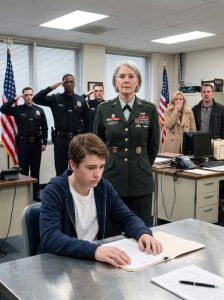
My grandson called me from the District Attorney’s Office at 2:47 a.m., desperately whispering that his stepmother was blaming him for everything—even though she was the one who started it all, and his own father took her side. Exactly twenty minutes later, I walked through the station doors. The young officer working the desk caught sight of me, froze instantly, and muttered, “Commander Hayes?” That was the precise moment her arrogant confidence began to crumble.
Part 1: The Call at 2:47 A.M.
“Grandma… I’m at the District Attorney’s Office. Lydia says I started everything, but she’s the one who began it. Dad believed her.”
Eleanor Grant opened her eyes before her mind fully returned to the room. The clock read 2:47 a.m. After thirty-two years in Chicago’s Major Crimes Unit, she knew one thing with absolute certainty: nothing good came through the phone at that hour.
“Noah,” she said, sitting up. “Breathe for me. Where are you?”
A choked sob came through the line.
“At the Lincoln Park station. They brought me here because Lydia said I pushed her down the stairs.”
Eleanor’s fingers tightened around the phone. “And what did she do to you?”
“She came at me in the hallway with the candlestick. I tried to move away, but it caught me near my eyebrow. They had to cover it.”
The bedroom went silent.
Eleanor was no longer simply a retired grandmother with reading glasses beside her bed and pain cream for her knee. In that instant, Commander Grant returned—the woman who had questioned kidnappers, cracked liars with three questions, and recognized staged scenes before anyone touched the evidence.
“Listen carefully,” she said, voice firm. “Do not say another word. Do not sign anything. Stay where there are cameras and witnesses. I’m on my way.”
“I’m scared.”
Something inside her cracked, but her tone stayed steady.
“You are not alone, sweetheart.”
She dressed in five minutes: dark pants, gray sweater, old sneakers. Before leaving, she opened a drawer and took out a worn leather wallet. Her old badge was inside. She did not carry it anymore, but tonight she was not arriving as a frightened civilian. She was coming as the only person Noah had trusted enough to call when everyone else had chosen not to believe him.
As Eleanor drove along Lake Shore Drive, she remembered the seven-year-old boy who came to live with her after his mother died. Noah used to sleep with the light on. He asked whether his mom could still see him from heaven. Every Sunday, he clung to Eleanor when his father, Mark, arrived to take him home.
Years later, Mark married Lydia.
At first, Eleanor tried to be fair. She invited Lydia to lunch, bought her a blouse for Christmas, and thanked her for taking Noah to school. Then the comments started.
“Noah has become so rebellious.”
“Noah knows exactly how to manipulate his father.”
“Noah doesn’t want us to be a real family.”
And Mark repeated every word as if it were truth.
Eleanor watched her grandson fade. He stopped calling. He stopped asking for weekends. Whenever he did ask, Lydia always had a reason he could not come.
But suspicion was not proof.
And Eleanor knew a convincing lie could destroy a boy if someone did not arrive before it was too late.

Part 2: Commander Grant Returns
When Eleanor entered the District Attorney’s Office, the smell of old files, disinfectant, and burnt coffee hit her at once.
A young officer looked up. “Can I help you?”
“I’m here for Noah Grant.”
“Family member?”
Eleanor opened the worn leather wallet and placed her badge on the counter.
The young man froze. “Commander Grant?”
“Retired,” she said. “Not dead.”
At the far end of the waiting room, Noah sat in a plastic chair. A bandage covered his left eyebrow. His face was pale, and his hands trembled inside his hoodie sleeves.
A few feet away, Mark stood with crossed arms and a clenched jaw. Beside him, Lydia cried without a single tear falling. She looked perfect—perfect hair, perfect clothes, one hand pressed to her side like she had survived something terrible.
Eleanor watched her for three seconds.
Too calm.
Too practiced.
“Mom, you shouldn’t have come,” Mark said.
“My grandson called me from the District Attorney’s Office at three in the morning,” Eleanor replied. “Of course I came.”
“He attacked Lydia.”
Noah dropped his head. “That’s not true.”
“That’s enough,” Mark snapped.
Eleanor stepped between her son and grandson. She did not yell. She did not make a scene. She simply moved, and Mark fell silent.
“Noah,” she said, “start at the beginning.”
Lydia gave a small, dismissive laugh. “You’re actually going to believe a teenager who’s been acting out for months?”
Eleanor turned toward her. “I am going to listen to everyone. That includes you.”
Lydia blinked, suddenly less comfortable.
Noah took a long breath. “I told Dad I wanted to spend the weekend with you. He went upstairs to change. Lydia followed me into the hallway and told me I was ruining their marriage.”
“That is a lie,” Lydia snapped.
Eleanor kept her eyes on Noah. “Go on.”
“She said if I kept trying to see you, she would convince Dad to send me to relatives in Ohio. I told her I just wanted to leave the house. Then she picked up the candlestick.”
Lydia stood. “That’s absurd!”
Eleanor looked at her. “You say he pushed you.”
“Yes.”
“With which hand?”
Lydia frowned. “What?”
“Which hand did he use to push you?”
“Both.”
Noah said quietly, “One of my hands was on my eyebrow.”
Silence spread through the room.
For the first time, Mark hesitated.
Barely.
But he hesitated.
A captain stepped out of an office and moved toward the front desk. When he heard Eleanor’s name, recognition crossed his face.
“Commander.”
“Captain Miller.”
“Please come into my office.”
Inside, Miller lowered his voice. “There’s a problem.”
“What problem?”
“The hallway cameras at the house aren’t working. A malfunction was reported at 11:08 p.m.”
Eleanor’s eyes narrowed.
The emergency call came in at 2:39 a.m.
Far too convenient.
Through the office window, she saw Lydia in the waiting area. Lydia was not looking at Mark or Noah. She was staring directly at the office, as if she had been waiting for that exact information.
Then Noah slowly moved his hand toward his backpack.
When Lydia saw his fingers searching inside it, every bit of color left her face.

Part 3: The Recording
Eleanor and Captain Miller returned to the waiting room together. The atmosphere had changed. It no longer felt like an ordinary family dispute. The officers were paying attention now.
Noah sat with his backpack between his feet, fingers shaking over the zipper.
Lydia sprang up. “That backpack belongs to me too. I bought school supplies for him. He has no right to go through it.”
Eleanor said nothing.
She only looked at Noah.
“What do you have in there, sweetheart?”
“My phone.”
Mark frowned. “What does that have to do with this?”
Noah pulled out a cracked phone. “I didn’t know if it saved.”
Lydia moved toward him. “Give it to me.”
Her voice was no longer sweet.
It was desperate.
Captain Miller lifted one hand. “Ma’am, do not come any closer.”
Noah tried to unlock the phone. He missed once, then again. On the third try, the screen opened.
There was an audio file.
No one moved.
“Noah,” Captain Miller said carefully, “did you record something tonight?”
Noah nodded. “I didn’t mean to at first. I was texting Grandma earlier. Then Lydia started talking in the hallway, and I hit record because I knew nobody would believe me.”
For the first time in years, uncertainty crossed Mark’s face.
Lydia’s hands curled at her sides. “This is ridiculous. He could have edited anything. Teenagers fake things all the time.”
Eleanor kept her eyes on Noah. “Play it.”
He pressed the screen.
At first came muffled movement, then a door closing. Then Lydia’s voice came through, low and sharp, stripped of the sweetness she had worn in the waiting room.
“You think running to your grandmother makes you safe?”
Mark looked up.
Lydia whispered, “That is not me.”
But the room was already listening.
Noah’s recorded voice sounded smaller than the boy sitting there now.
“I just want to go for the weekend.”
Lydia’s voice returned.
“No. You want to make your father choose between us. You’ve been doing it since the day I married him.”
“That’s not true,” recorded Noah said. “I just miss Grandma.”
“You miss being treated like a poor little orphan,” Lydia snapped. “That ends tonight.”
The real Lydia stepped back.
The recording continued.
“If you keep trying to leave this house, I will make sure your father believes you are unstable. I will make sure he sends you away. Do you understand me?”
David—Mark—slowly lowered his arms.
Noah’s recorded voice trembled. “Please stop.”
Then came a sudden rush of sound. Not dramatic, not sensational, but enough for every adult in that room to understand something had happened in the hallway.
Noah cried out, “Why would you do that?”
Lydia’s voice hissed, breathless now, “Look what you made me do.”
The audio stopped.
The silence afterward was worse than the file.
Eleanor watched Mark. She knew the difference between a man hearing something and a man finally understanding it. For years, he had heard complaints, excuses, and carefully shaped stories from a woman who knew where his guilt lived.
Now he had heard his child.