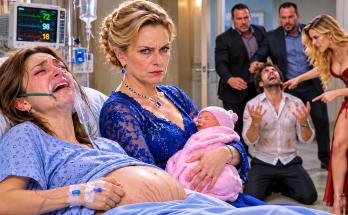
For most of that Thursday, I kept returning to the same question.
Why?
Why had Ethan chosen that moment?
Why had he waited until I was seriously ill?
Why had he brought divorce papers to the hospital instead of speaking to me when I was well enough to understand what was happening?
I wanted an explanation.
Something that would make his behavior less cruel.
Something that would connect the man I had married with the man standing beside my hospital bed.
But I was beginning to understand that an explanation would not necessarily change anything.
He had made his decision.
He wanted a divorce.
He did not want to take care of me while I recovered.
And he wanted me to leave the house with Lily.
Those were the facts.
I could keep searching for the reasons behind them.
Or I could begin dealing with what they meant.
It was difficult to make that change.
I had loved Ethan for nine years.
I had believed we were building a family.
And only three days earlier, I had given birth to our daughter.
I wanted to believe there was still some part of him that remembered what we had shared.
I wanted him to look at Lily and feel the same tenderness I felt.
I wanted him to remember painting the nursery.
The yellow walls.
The crib we had struggled to assemble.
The ordinary anticipation of becoming parents.
I wanted those memories to matter enough to change his mind.
But wanting something did not make it true.
I had learned that lesson in the Army.
I had simply forgotten to apply it to my marriage.
I remembered the first time Ethan complained about my career.
It had always been a difficult subject between us.
He said I spent too much time working.
He said I was away too often.
Sometimes he was right that the demands were hard.
There were deployments and responsibilities that affected our home life.
I did not dismiss those difficulties.
But I had also believed he understood that military service was not something I could treat casually.
I had obligations.
People depended on me.
And I had spent years earning the responsibilities I held.
I was proud of my work.
That pride did not mean I loved Ethan less.
I had believed both things could exist.
My career.
My marriage.
Our family.
When I became pregnant with Lily, I thought we were moving toward something we both wanted.
I remembered discussing the nursery.
I remembered preparing the house.
I remembered the small excitement of making space for a child who had not yet arrived.
Those memories had seemed to prove that our marriage was still strong.
Now I understood that I had been using them to reassure myself.
They were real memories.
But they did not tell me everything Ethan had been feeling.
He claimed he had been unhappy for years.
I could not know whether that was true.
I could only know that he had chosen to say it when I was lying in a hospital bed.
That timing mattered.
I had just learned that my heart muscle was severely weakened.
The doctors were treating me for heart failure.
I needed medication and monitoring.
And I was frightened about whether I would live long enough to raise our daughter.
Ethan knew those things.
He had heard me explain them.
Yet he had decided that the divorce needed to happen immediately.
I thought about the brown envelope.
The metal clasp.
The way it slid across the white sheet.
That movement had been so ordinary.
A piece of paper moving across a bed.
But it had divided my life into two parts.
Before it landed, I had still believed my husband might help me through the illness.
After it landed, I understood that he was preparing to leave.
I wished I could forget the sound of his voice.
The way he complained about the possibility of caring for a sick wife.
The way he spoke about money.
The way he told me to take Lily and go.
I could not forget.
And perhaps I should not have tried.
Some things needed to be remembered accurately.
Not to keep the pain alive forever.
But to prevent me from rewriting the truth when I became lonely or frightened.
I knew myself well enough to recognize that danger.
I had already spent years making excuses for him.
I might do it again if I allowed myself to focus only on the good memories.
The nursery.
The anniversaries.
The Thanksgiving dinners.
Those things had happened.
They mattered.
But they did not erase what happened in the hospital.
I needed to hold both truths at once.
We had shared happy moments.
And Ethan had treated me with terrible cruelty when I became ill.
One fact did not cancel the other.
That was a painful kind of clarity.
I looked toward the place where my father had confronted Ethan.
The lawyers had come because I asked for them.
The lockbox file had been requested because the house mattered.
And my father had made it the first issue to examine.
I understood why.
Ethan had tried to turn his desire into a settled decision.
He wanted the house.
Margaret supported him.
Therefore, in their minds, I was supposed to leave.
But that was not how serious decisions should be made.
Not when documents existed.
Not when a newborn child was involved.
Not when one spouse was medically vulnerable.
I knew better than to accept a confident statement without examining the evidence.
That was why I had asked for the file.
I had not known exactly what would happen when my father arrived.
I had not planned a dramatic confrontation.
I was too sick to plan much of anything.
But I knew the documents were important.
I wanted Rebecca involved.
I wanted the house examined.
And I wanted someone beside me who would not treat Ethan's demands as automatically correct.
My father had understood.
When he looked at Ethan and told the lawyers to start with the house, I felt the direction of the conversation change.
It was no longer simply a question of whether Ethan wanted to leave me.
He had already answered that.
The question was what he could properly demand.
I did not need to know every answer immediately.
In fact, I had learned how dangerous it could be to rush.
I was physically exhausted.
I had experienced a frightening cardiac episode.
I needed to remain under medical supervision.
And I had just been told that my marriage was ending.
That was not a condition in which I should make major decisions without advice.
I thought about how differently Dr. Patel had treated me.
He had explained my diagnosis patiently.
He had answered my questions.
He had not demanded that I understand everything at once.
He had given me information and allowed me to respond.
That was what respect looked like.
He did not pretend the situation was harmless.
He was honest about the danger.
But he still treated me as a person capable of understanding.
Ethan had done the opposite.
He had treated my physical weakness as a reason to dismiss me.
That difference became clearer every time I thought about it.
I was not incapable of making decisions.
I was ill.
Those were different things.
I might need help reading documents.
I might need time to recover.
I might need my parents to speak for me when breathing became difficult.
But my illness did not make my interests disappear.
And it did not mean Ethan's wishes became more important.
I remembered Margaret's phone call.
She had been so sure my father would simply come and collect me.
She had not imagined that he might ask what I needed.
She had treated the situation as though I were a problem to be removed.
I wondered whether she had ever stopped to think about Lily.
My daughter was only three days old.
She depended on me.
And because I was sick, she also depended on the people willing to help me recover.
Margaret had not offered that help.
She had offered an insult.
I could not change that.
But I could stop expecting kindness from someone who had shown me none.
That was another difficult adjustment.
For years, I had wanted my husband's family to accept me.
I had tried to be respectful.
I had tried to keep family gatherings peaceful.
I had tried not to make ordinary disagreements larger than they needed to be.
I wanted Lily to be born into a family where people cared about one another.
Now I was seeing the limits of that hope.
Margaret's loyalty to Ethan had become an excuse for cruelty.
She seemed to believe that supporting her son meant treating me as disposable.
I did not agree.
I could love Lily fiercely without believing she would always be right.
If she hurt someone, I hoped I would be honest enough to tell her.
If she made a mistake, I hoped I would help her take responsibility.
Love was not supposed to remove every limit.
It was supposed to make us care more deeply about what happened to one another.
I thought about that while looking at Lily.
Her little face was peaceful.
She knew nothing about the people arguing around her.
She did not know what a divorce was.
She did not understand the meaning of a house document.
She did not know why her mother had oxygen tubing against her cheeks.
She only knew the immediate world around her.
Warmth.
Comfort.
The small rhythms of being cared for.
I wanted to protect that world.
I wanted to keep her safe while the adults dealt with what had happened.
That responsibility gave me a different way to think about Ethan's demands.
I could no longer judge them only by how much they hurt me.
I had to ask what they would mean for Lily.
Where would she live?
How would I manage her care during recovery?
What would happen to the nursery we had prepared?
Those questions mattered.
And none of them had been answered by Ethan telling me to leave.
He had spoken as though taking Lily with me was a simple solution.
As though I could walk out of the hospital, carry her somewhere else, and begin a new life without difficulty.
But my heart condition made ordinary tasks dangerous.
I could not even walk comfortably to the bathroom when the symptoms began.
The doctors were still adjusting medication.
I needed rest.
I needed monitoring.
There was nothing simple about what he was demanding.
He seemed unwilling to consider that.
But the lawyers could.
My parents could.
And I could, once I had enough strength to participate properly.
I did not need to accept a rushed answer.
I thought about the medical emergency again.
The alarm had sounded so suddenly.
I remembered the red numbers on the monitor.
The heavy pressure in my chest.
The way my vision narrowed until I could barely focus.
I had been terrified.
For those moments, I stopped thinking about the divorce.
I stopped thinking about the house.
I only wanted to breathe.
That experience changed the scale of everything else.
Ethan's cruelty still mattered.
The documents still mattered.
The house still mattered.
But none of those questions could be addressed if I did not survive.
My treatment had to come first.
I needed to listen to Dr. Patel.
I needed to accept that recovery would take time.
And I needed to allow other people to carry responsibilities that I was not physically able to manage.
That was hard for me.
I had spent my adult life being the reliable person.
The one others called when things became complicated.
Now I was the one calling for help.
I had to accept that without shame.
My father had shown me how simple that could be.
When I asked him to come, he did not accuse me of being weak.
He did not complain that I was creating a problem.
He did not ask whether I could handle it myself.
He told me he was coming.
And he brought my mother.
He contacted Rebecca.
He arrived with another lawyer.
He took my request about the lockbox file seriously.
That was care expressed through action.
I had been waiting for Ethan to show me something similar.
I had wanted him to demonstrate that our marriage mattered.
But he had made a different choice.
And I needed to stop waiting for him to become someone else.
That realization did not make me feel triumphant.
It made me sad.
Deeply sad.
I had wanted my marriage to survive.
I had wanted Lily to grow up in the home Ethan and I prepared together.
I had wanted to recover with my husband beside me.
Those hopes were ordinary.
There was nothing foolish about wanting them.
But I could not build my next decisions on hopes that Ethan had already rejected.
I had to deal with what was real.
The diagnosis.
The treatment.
The papers.
The house.
My daughter.
Those were the things in front of me.
I could not solve everything that afternoon.
I could not make my heart recover immediately.
I could not undo the things Ethan and Margaret had said.
And I could not predict what the lawyers would establish once the documents were fully examined.
But I could make one decision.
I would not sign the papers simply because Ethan wanted a quick ending.
I would not agree to leave our home without understanding the facts.
And I would not allow my illness to become proof that I deserved less consideration.
I looked at the envelope.
Then I looked at Lily.
The contrast was painful.
One represented a marriage being abandoned.
The other represented a life I desperately wanted to protect.
I could not make Ethan love me again.
But I could still love my daughter.
I could still accept the treatment that gave me a chance to recover.
And I could still insist that the decisions affecting our future be made carefully.
That was enough for the moment.
I thought about my father's instruction one last time.
Start with the house.
It had not been a declaration of victory.
It had been a decision to examine the truth.
And after three days of fear, humiliation, and uncertainty, truth was exactly what I needed.
I was not ready to celebrate.
I was still sick.
Still frightened.
Still grieving the marriage I had believed in.
But I was no longer waiting for Ethan to rescue me.
I had stopped asking why he did not want to save our marriage.
The question had consumed too much of the little strength I possessed.
I needed that strength for something else.
For treatment.
For recovery.
For Lily.
And for the decisions that would determine what happened to us next.
My father had come when I called.
The lawyers were there.
The house documents could be examined.
And I had finally accepted that protecting my future did not require Ethan's permission.
Click here to continue reading: PART 13: While My Father Examined the House Documents, I Finally Understood That My Illness Had Revealed the Truth About My Marriage
Three Days After My Daughter Was Born, I Learned My Heart Was Failing and My Marriage Was Not What I Believed
Part 12 of 15