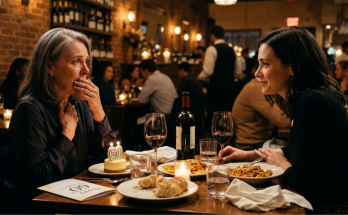
I drove home from my sixty-second birthday dinner with the photograph beside me.
Sarah had placed it inside a white envelope.
The same color as the envelope I had given her two years earlier.
I kept thinking about that.
Two envelopes.
Two birthdays.
Two very different conversations.
The first had contained documents showing that the old house belonged to me.
The second contained a photograph of Sarah and me laughing beneath the maple tree.
I hadn't expected either evening to become so important.
But both had changed the way I understood my family.
When I reached the cottage, I parked in the driveway.
For a moment, I stayed in the car.
The house looked peaceful.
The blue shutters framed the windows.
The porch stood empty.
Beyond it, I could see the garden.
I had lived there long enough that the place felt familiar.
It no longer seemed like a new beginning.
It was simply home.
I picked up my handbag.
Then I walked inside.
The little wooden clock was ticking.
My husband's photograph stood on the mantel.
Beside it was the graduation picture Sarah had brought during her first visit.
I placed my keys on the table.
Then I removed the new photograph from its envelope.
I looked at it again.
Sarah and I were laughing.
Neither of us appeared worried about money.
Neither was trying to convince the other to change a decision.
We were standing together in a garden I had chosen.
I smiled.
Then I turned the picture over.
I read Sarah's message again.
She had finally understood that a home wasn't only about ownership.
It was about how people treated one another.
That didn't make the legal documents from my sixtieth birthday less important.
Those papers had protected my rights.
They had shown Sarah and Greg that I was still the owner of the property.
They had provided a lawful way to end an arrangement that had become unfair.
I needed them.
But they couldn't make my daughter respect me.
They couldn't force her to apologize.
They couldn't teach Greg gratitude.
They couldn't repair years of hurt.
Those changes had to come from the people involved.
And not everyone had chosen to change.
Greg never gave me the apology I once hoped for.
He never admitted that living in my house for three years had been an extraordinary benefit.
He never acknowledged how much money I had spent supporting him and Sarah.
Even after they moved out, he tried to claim compensation for work he said he had done.
I remembered the letter from the law office.
I remembered Thomas explaining the claim.
I remembered looking at the old receipts and photographs.
For a moment, I could almost hear Greg complaining about the garage again.
He had used that space for exercise equipment.
I had parked outside.
He had enjoyed the arrangement.
Then, after the sale, he wanted me to pay him for it.
I shook my head.
It seemed almost unbelievable now.
But it had happened.
And the records had mattered.
Thomas had answered the claim.
The matter had been resolved.
Greg had no valid entitlement to the sale proceeds.
I hadn't needed to shout.
I hadn't needed to threaten him.
I had simply provided the truth.
That was something I was proud of.
Not because I wanted to defeat Greg.
Because I had handled the situation without becoming the person he accused me of being.
I hadn't changed locks while anyone was at work.
I hadn't put belongings outside.
I hadn't cut off services.
I had followed the legal process.
I had respected the rules even when I was angry.
And when the old house was finally empty, I hadn't celebrated their departure.
I remembered walking through those rooms one last time.
The kitchen.
The living room.
The small bedroom beside the laundry closet.
The master bedroom my husband and I had shared.
And the doorway where Sarah's height had been marked as she grew up.
That doorway had nearly broken my heart.
I remembered touching the pencil marks.
I remembered crying.
For a moment, I had wanted to keep the house simply because it held those memories.
But I had understood something important.
The happy years didn't disappear because I sold the building.
My husband had still lived there.
Sarah had still grown up there.
We had still celebrated birthdays and Christmas mornings.
We had still paid off the mortgage together.
Those things remained part of my life.
I didn't need to keep the property to prove they mattered.
I walked toward the mantel.
I looked at my husband's photograph.
For years after his death, I had worried about how to preserve everything we built.
I thought keeping the old house meant keeping our marriage close.
Then I realized our marriage had been more than walls and furniture.
It had been the way we worked together.
The way we saved.
The way we made decisions.
The way we cared for Sarah.
And the way we planned for a future we hoped to share.
He hadn't lived long enough to enjoy all of that future.
But I had.
I was still here.
I still had the right to enjoy the years ahead.
I touched the wooden clock.
He had given it to me on our twenty-fifth anniversary.
The wood was smooth beneath my fingers.
I remembered opening it.
I remembered how pleased he looked.
He knew I liked practical gifts.
Something useful.
Something that would last.
I smiled.
The clock had followed me from the old house to the cottage.
It was still keeping time.
And I was still living.
That thought stayed with me.
I had spent so much of my retirement looking backward.
Remembering my husband.
Remembering Sarah as a child.
Remembering what the house had once been.
Those memories mattered.
But I couldn't live inside them forever.
I had a future too.
I looked around the room.
The cottage was modest.
Two bedrooms.
A small kitchen.
A fireplace.
A porch.
A garden.
Nothing about it was designed to impress anyone.
I had bought it because it suited my life.
And I had been happy there.
I thought about my first afternoon in the kitchen.
The old baking sheets.
The flour.
The lemons.
The cake that tasted much too strongly of zest.
I had laughed when I tasted it.
I remembered how strange that felt.
Laughing alone.
Not because someone had made a joke.
Not because I was trying to keep everybody cheerful.
Simply because I had made a cake badly and found it funny.
That little moment had meant more than I understood at the time.
I had stopped measuring every action by whether someone else approved.
I had begun enjoying things for myself.
I walked into the kitchen.
The old baking sheets were still in their cabinet.
They remained scratched.
The edges were dark from use.
Sarah had once thrown them away because she thought they were worn out.
I had retrieved them.
I kept them because they had belonged to my mother.
They reminded me of afternoons spent baking when I was young.
They were valuable to me.
That was enough.
I opened the cabinet.
I looked at them.
Then I closed it again.
I no longer needed to defend why I kept them.
I thought about how many small choices had changed.
I chose when to wake up.
I chose what to cook.
I chose which friends to invite.
I chose what to plant.
I chose how to spend money.
I chose when to travel.
I chose when to say yes.
And I chose when to say no.
For most people, those might sound like ordinary freedoms.
They were.
That was precisely why losing them had hurt so much.
I had owned a four-bedroom house.
Yet I hadn't felt comfortable using the rooms.
I had savings.
Yet I felt guilty spending money on myself.
I had a daughter.
Yet I was lonely.
I had worked for decades.
Yet I was living as though my only purpose was to make life easier for two younger adults.
I hadn't noticed how far things had gone until I began preparing to leave.
I remembered my first meeting with Thomas.
He had asked whether I wanted to protect my relationship with Sarah or protect myself.
At the time, I thought those goals were in conflict.
I was frightened that choosing myself would mean losing my daughter.
I imagined her refusing to speak to me.
I imagined Greg convincing her that I was cruel.
I imagined spending my retirement alone.
Those fears had been real.
But they hadn't been the whole truth.
I learned that I could refuse an unfair arrangement without refusing my daughter.
I could stop paying her bills without stopping loving her.
I could move to another home without disappearing from her life.
And I could forgive her without returning to the circumstances that hurt me.
I hadn't understood any of that when I first opened my purse at the restaurant.
I only knew I couldn't continue.
The white envelope had given me a way to make my decision clear.
But the decision had been made before I prepared those papers.
It began the day I admitted I was unhappy.
It grew when I spoke with Thomas.
It became stronger when I reviewed my finances.
And it finally became real when I bought the cottage.
The envelope didn't create my courage.
It showed Sarah and Greg that I had acted on it.
I thought about Sarah.
She had changed.
Not all at once.
Not perfectly.
But enough that I could see the difference.
After the restaurant, she had been angry and frightened.
She had asked whether the old house would eventually become hers.
She had believed a possible inheritance gave her some claim over my present life.
I had been hurt by that.
I remembered sitting at the cottage table during her first visit.
The lemon cake between us.
The graduation photograph on the mantel.
She had apologized.
Then she had asked about the property.
I had felt the old disappointment return.
But I hadn't let it turn into another argument.
I had told her my estate was mine to arrange.
I had reminded her that I needed to protect my future.
She hadn't liked hearing it.
Still, she had stayed in my life.
That mattered.
I thought about the will Thomas had helped me update.
I had made my choices carefully.
Sarah would receive something after my death.
But I hadn't arranged my estate according to pressure.
I hadn't promised property simply because someone expected it.
And I hadn't left my retirement security exposed.
Part of what remained would support a local organization helping older people facing financial abuse and housing insecurity.
I felt good about that decision.
I had been fortunate to own my house outright.
I had an attorney I trusted.
I had enough money to purchase another home.
Many older people didn't have those advantages.
Some were dependent on relatives.
Some had nowhere else to go.
Some were frightened of losing the people they loved if they refused to hand over money.
I understood that fear.
I had lived with a smaller version of it.
I wanted the charitable arrangement to help people who needed support.
It was something my husband would have appreciated.
He believed people should help when they were able.
But he also believed in being responsible.
I thought we had found a way to honor both values.
I returned to the living room.
Then I sat in my chair.
I took the new photograph from the table.
I studied Sarah's smile.
She looked different from the woman who sat across from me on my sixtieth birthday.
Her face was more relaxed.
She seemed more confident.
She was building a life she could afford.
She had found a smaller apartment.
She had found better work.
She was attending financial counseling.
And she had begun making decisions without expecting me to solve every problem.
I was proud of her.
Not because she had become wealthy.
Not because everything was easy.
Because she was taking responsibility for herself.
I remembered the afternoon she came to the cottage after Greg lost his job again.
She had asked whether they could move in.
For a moment, I had felt frightened.
I imagined repeating the same three years.
Then I said no.
I offered to help her review her budget.
I offered to help her find housing support information.
I offered reasonable assistance where I could afford it.
But I didn't offer my home.
Sarah had been disappointed.
Then she came over.
We sat at the kitchen table.
We wrote down her expenses.
Rent.
Utilities.
Car payments.
Credit cards.
Subscriptions.
Restaurant meals.
She had been shocked by the total.
For the first time, she began seeing the financial problem as something she needed to understand.
When she left, she thanked me.
Then she thanked me for refusing to let them move in.
I had nearly cried.
That was the moment I began believing my boundaries might actually help her.
I had always thought giving was the most loving thing.
Now I understood that sometimes saying no gave someone the opportunity to grow.
It didn't mean abandoning them.
It meant allowing them to carry responsibilities that belonged to them.
I thought about the day Sarah told me she and Greg were separating.
I remembered the message on my phone after I returned from the coast.
I had been frightened for her.
I didn't want her marriage to end painfully.
I didn't want her to feel alone.
But when she came to my porch, I listened.
I didn't offer money.
I didn't tell her what decision to make.
I didn't call Greg.
I simply sat beside her while she spoke.
For the first time, that was enough.
I remembered how she thanked me afterward.
Not for solving anything.
For listening.
That had changed something between us.
We were no longer trapped in the same roles.
She wasn't always the daughter asking to be rescued.
I wasn't always the mother expected to rescue her.
We could be two adults who loved each other.
That was the relationship I had wanted.
I looked down at the bracelet on my wrist.
Sarah had given it to me on my sixty-first birthday.
The inscription still meant a great deal to me.
I remembered her handwritten letter.
She had admitted that she became comfortable accepting everything I gave.
She had stopped noticing my sacrifices.
She had stopped asking whether I was happy.
Then she told me she was grateful I had finally stood up for myself.
I had read the letter twice.
I had cried.
For years, I had wanted her to understand those things.
Now she had written them in her own words.
But even that letter wasn't the final proof.
The proof came afterward.
In the phone calls.
In the visits.
In the way she handled her money.
In the way she asked what I wanted.
In the way she arrived at my cottage without expecting to stay.
In the way she treated dinner as something she wanted to give rather than something I was expected to provide.
Those small choices had rebuilt trust.
Slowly.
I wasn't pretending everything was perfect.
There were still moments when Sarah expected too much.
There were still conversations that reminded me of the old arrangement.
Sometimes she became defensive.
Sometimes I felt myself becoming too cautious.
We had to keep learning.
But we could disagree now without turning the disagreement into a threat.
I no longer feared that saying no meant losing her.
And increasingly, Sarah no longer treated no as proof that I didn't love her.
That was enough for me.
I didn't need our relationship to return to what it had been when she was little.
She wasn't a child anymore.
I wasn't the mother who could solve every problem.
We were both older.
We had both been hurt.
We had both made mistakes.
And we were learning how to be together in a different way.
I looked again at the photograph from dinner.
I thought about placing it on the mantel.
There was room beside the graduation picture.
I stood.
Then I carried it across the room.
I placed the new photograph where I could see it.
Three pictures now.
My wedding day.
Sarah's graduation.
And the two of us laughing in my garden.
I stepped back.
They didn't tell the entire story.
Photographs never do.
They showed happy moments.
They didn't show the arguments.
They didn't show the years of worry.
They didn't show the hotel room where I woke alone after my sixtieth birthday.
They didn't show the legal documents.
They didn't show the tears.
But I knew those things had happened.
I didn't need to display them.
I could remember the pain without allowing it to control every happy moment that followed.
I looked at the three photographs.
My life hadn't turned out exactly as I planned.
My husband was gone.
The old house had been sold.
Sarah's marriage had ended in separation.
Greg had moved away.
And I had started again in a little cottage.
There had been losses.
Real ones.
I wasn't going to pretend otherwise.
But there had been gains too.
I had regained my independence.
I had protected my retirement.
I had found peace in my own home.
I had renewed friendships.
I had traveled to the coast.
I had made a garden.
And I had rebuilt a healthier relationship with my daughter.
Those things mattered.
I thought about the woman I had been at sixty.
She had felt old because two younger adults told her she was becoming a burden.
She had felt powerless because they treated her kindness as something they could control.
She had felt guilty for wanting privacy.
She had felt selfish for wanting to spend her own money.
I wished I could tell her what I knew now.
I would tell her that sixty wasn't the end of anything.
I would tell her that age didn't erase her rights.
I would tell her that love didn't require surrender.
I would tell her she didn't have to buy affection by paying bills.
And I would tell her that she was allowed to enjoy the life she had worked so hard to build.
I walked into the kitchen.
I made tea.
Then I carried it onto the porch.
The evening was quiet.
The roses moved gently in the breeze.
The maple tree stood beyond them.
I sat in my chair.
For a while, I watched the sky.
I remembered the first evening I sat there after moving in.
I had been uncertain.
I worried Sarah might never forgive me.
I worried the legal process would become difficult.
I worried about whether I had made the right financial decisions.
I worried about being alone.
Now I knew something I hadn't understood then.
Being alone in a peaceful home wasn't the same as being lonely.
I enjoyed the quiet.
I enjoyed knowing that I could invite people over when I wanted company.
I enjoyed knowing that after they left, the house would still belong to me.
I didn't have to surrender the spare bedroom.
I didn't have to move my belongings.
I didn't have to explain why I kept old baking sheets.
I didn't have to ask permission to buy groceries or visit the coast.
The freedom was ordinary.
That made it precious.
I took a sip of tea.
Then my phone buzzed.
I picked it up.
Sarah had sent a message.
She thanked me for dinner.
She told me she had enjoyed the evening.
Then she said she loved me.
I smiled.
I typed a reply.
I told her I loved her too.
I always had.
I placed the phone beside me.
I thought about the white envelope from my sixtieth birthday.
At the time, I believed the most important thing inside it was the legal notice.
That notice mattered.
Without it, I might have remained trapped in an arrangement that kept hurting me.
But the real change had begun before the envelope ever reached the restaurant table.
It began when I stopped asking myself how much more I could give.
And started asking what I needed to keep.
My dignity.
My security.
My peace.
My right to choose.
Those things didn't make me less of a mother.
They made it possible for me to remain a mother without losing myself.
I had finally understood that forgiveness didn't require returning to the same situation.
I could forgive Sarah for hurting me.
I could accept that Greg might never apologize.
I could remember the old house with love.
I could let it go.
And I could continue living.
That was the lesson I wanted to carry into the years ahead.
I was sixty-two years old.
I had a modest cottage.
A garden.
A retirement plan.
Friends who cared about me.
A daughter who was learning to respect me.
And a future that still held things I wanted to do.
I didn't need a larger house.
I didn't need more money than I could reasonably use.
I didn't need anyone to tell me I was valuable because I could pay their expenses.
I had spent too many years believing that being needed was the same as being loved.
Now I knew better.
Love could be a phone call asking about roses.
It could be an afternoon planting flowers.
It could be a handwritten apology.
It could be a photograph from an ordinary day.
It could be a daughter paying for dinner because she wanted to make her mother happy.
And it could also be a mother saying no when saying yes would hurt them both.
I looked at the stars appearing above the garden.
I thought about my husband.
I thought about Sarah.
I thought about the woman I had been two years earlier.
Then I smiled.
The first white envelope hadn't destroyed my family.
It had ended the arrangement that was slowly destroying me.
And the second white envelope reminded me that love could survive that change.
I finished my tea.
Then I went inside.
I checked the photographs on the mantel one last time.
The clock continued ticking.
The cottage was quiet.
Tomorrow, I would wake up in my own bedroom.
I would make breakfast in my own kitchen.
I would decide how to spend my day.
Perhaps I would work in the garden.
Perhaps I would call Margaret.
Perhaps I would make another lemon cake.
I didn't need to decide tonight.
For years, other people had made plans for my life without asking what I wanted.
Now the choices belonged to me.
I was still Sarah's mother.
I still loved my family.
But I was also a woman with dreams, memories, boundaries, and years ahead of her.
At sixty-two, I was no longer waiting for anyone to give me permission to enjoy those years.
I had finally given myself that permission.
And I intended to keep it.
The End
Read more original stories on readdramaus.
I Turned Sixty Expecting a Quiet Birthday Dinner, but My Daughter Had Already Decided I No Longer Belonged in My Own House
Part 15 of 15