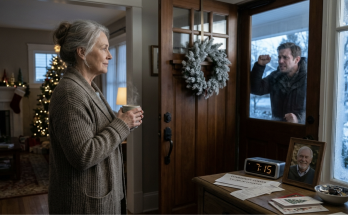
Harvey looked away from me.
Again.
I had asked him a simple question.
When he brought those papers to our kitchen table, had he explained that they could be used to support adding his mother to the condo deed?
He hadn't answered.
I watched him sitting across from me.
His hands rested near his knees.
The grocery bag he had brought was still on the kitchen counter.
I could see part of it from my chair.
Cinnamon rolls.
Something I liked.
Something he remembered.
A few weeks earlier, that small kindness would have pleased me.
Now I couldn't stop thinking about the documents.
I didn't want to feel that way.
I didn't want every ordinary gesture to remind me of something Harvey had concealed.
But trust had become complicated.
And I was beginning to understand how difficult ordinary married life could feel when a person no longer knew which explanations to believe.
I waited another moment.
Harvey remained quiet.
I didn't ask again.
I had already given him enough opportunities to explain.
The question was clear.
He knew what I meant.
I wasn't asking whether he loved his mother.
I wasn't asking whether he had wanted to help her.
I wasn't even asking whether he thought his decision was reasonable.
I was asking whether he had told me what I was signing.
That was all.
And somehow, that was the question he wouldn't answer.
I looked down at my hands.
They were folded in my lap.
I remembered those same hands holding a pen at our old kitchen table.
That memory had become painfully clear since the title company called.
Harvey's blue mechanic's shirt.
My coffee cup.
The stack of papers.
His casual manner.
I remembered being told the insurance information needed updating before the move.
I hadn't been worried.
I had no reason to think my husband was asking for anything beyond routine paperwork.
At least, that was what I believed.
Looking back, I wished I had taken my time.
I wished I had moved the coffee cup aside.
I wished I had read every page.
But wishing couldn't change what happened.
I had signed.
And afterward, a document bearing what appeared to be my signature had been submitted to support an ownership change I never knowingly approved.
Those were the facts I had.
I didn't yet know everything the documents would prove.
Daniel had made that clear.
He had been careful with his words.
The limited financial authorization didn't automatically allow Harvey to do anything he wanted with my property.
Its scope mattered.
Its validity mattered.
The circumstances surrounding the signature mattered.
And the way the document had actually been used mattered.
I appreciated that Daniel hadn't tried to give me an answer before he had the evidence.
I wished Harvey had shown the same respect for facts.
At closing, he had acted as though the revised deed was simply something our family had arranged.
His mother had treated my questions as unnecessary.
His sister had believed I already knew.
Yet the original agreement showed something different from the ownership arrangement Harvey tried to complete.
That agreement was supposed to be our beginning.
Harvey and me.
Two names.
Two contributions.
One home.
My contribution was $180,000.
His was $60,000.
The total was $240,000.
I could still picture those figures.
They hadn't changed.
The meaning of them hadn't changed either.
I had been willing to place most of the purchase price into a home I expected to share with my husband.
That wasn't a small act of trust.
It was one of the largest financial decisions I had made since Leroy died.
And Harvey had treated my consent as something he could assume.
I looked toward the screened porch.
The lake was visible beyond it.
For a moment, I thought about the larger condo.
It had two bedrooms.
It had seemed like the right place for the next stage of our marriage.
I had imagined us enjoying the view.
I had even bought two matching rocking chairs.
I remembered how pleased I had been with that purchase.
It seemed such a simple thing.
Two chairs for two people who wanted to grow older together.
I hadn't thought about ownership documents when I bought them.
I had thought about mornings.
Coffee.
A quiet conversation.
The kind of ordinary comfort I believed we had earned.
Now the chairs reminded me of how differently Harvey and I had understood our future.
I had pictured sharing a home.
He had arranged for his mother to acquire a legal interest in it.
I didn't object to Dorcas being his mother.
I didn't object to him loving her.
I didn't believe elderly parents should be forgotten.
But a home purchased largely with my money wasn't something Harvey could promise to another person without consulting me.
I had explained that at closing.
I had explained it again in this living room.
I was tired of explaining.
Not because the subject was unimportant.
Because it seemed Harvey understood the words but didn't want to accept what they meant.
I thought about Dorcas crying.
The tissue she had pulled from her purse.
The way she spoke about being treated badly.
At ninety-one, she deserved consideration.
I believed that then.
I believed it now.
But I also remembered the question I had asked her.
Did she know where the $180,000 came from?
She had believed Harvey and I sold my house together.
That was incorrect.
The house belonged to me before our marriage.
Leroy and I had bought it.
We had built our family life there.
I had spent twenty-eight years making mortgage payments and keeping it maintained.
After Leroy died, I stayed.
Seven years had passed since his death.
I had learned how to live without him.
I had learned to make financial decisions alone.
I had learned to handle the quiet.
Then I married Harvey.
And eventually, I decided I wanted a smaller home.
The decision came from hope.
Not pressure.
I had believed another marriage could mean companionship without losing the independence I had worked to maintain.
Selling the house had been difficult.
I still remembered standing outside it with Leroy on the day we bought it.
The photograph from that day was one of the few things I could hold in my hand that seemed to contain an entire part of my life.
I brought it to the closing office.
I hadn't planned to show it.
But Dorcas's assumptions about the money made me feel that I needed to.
I placed it on the table.
I wanted them to understand that the money wasn't simply an amount on a bank statement.
It represented years.
Work.
A marriage.
A family.
And the home I had kept after losing my husband.
Harvey had looked at that photograph.
He had heard my explanation.
Yet I still hadn't received a direct answer about the authorization.
I looked back at him.
He was only a few feet away.
I wanted to ask whether he remembered how much that old house meant to me.
But I didn't.
He already knew.
That was what troubled me.
Harvey hadn't been ignorant of my history.
He hadn't mistaken my contribution for a small amount.
He knew I had sold a valuable property to make this move possible.
He knew I had worked for what I had.
And he knew I wanted a peaceful home.
I had no way of knowing every thought that went through his mind when he arranged the revised deed.
I couldn't claim to understand intentions he hadn't explained.
But I could understand the documents.
The ownership change was real.
My lack of approval was real.
And the title company had received an additional authorization that needed examination.
Those facts didn't depend on Harvey's intentions.
They remained true whether he described his actions as kindness, family duty, or a misunderstanding.
I thought about his sister.
She had stood at closing and defended Dorcas.
She believed her mother's sacrifices should count for something.
I agreed that raising children involved sacrifices.
I knew that from experience.
I had raised two children of my own.
There were long days.
Long nights.
Expenses that seemed endless.
Responsibilities that didn't disappear because I felt tired.
But I had never believed that raising my children entitled me to make secret decisions with someone else's money.
I had also never believed that my children's future should be considered without my knowledge.
When I told Harvey's sister that my children mattered too, I meant it.
They were part of the life I had built.
They were part of my responsibilities.
And I couldn't ignore the possibility that a decision about my property could affect what I eventually left behind.
I didn't need to be angry with Dorcas to understand that.
I simply needed to remember whose money was involved.
Harvey shifted slightly.
I looked at him.
For one moment, I hoped he might finally answer.
But he didn't.
I kept quiet.
I thought about how easy it had been for him to offer to remove Dorcas's name at closing.
The moment I withdrew my contribution, he wanted to return the deed to its original arrangement.
He had sounded urgent.
As though changing the names back would solve everything.
But by then, the problem was larger than the ownership document.
It was the secrecy.
It was the assumption that I wouldn't read.
It was the statement his sister had repeated.
It was the authorization.
And now there were the bank statements I had discovered.
I hadn't mentioned those to Harvey.
Daniel was reviewing them.
I wanted to know exactly what the bank records established before making accusations.
Still, I couldn't forget the $8,500 transfer.
Harvey had told me he needed money for truck repairs.
The statement showed that amount going to his sister's account.
I had checked it more than once.
I remembered the other transfers too.
Nearly $27,000 over eighteen months.
Money leaving our joint savings account for accounts connected to Harvey's family.
I couldn't remember approving those individual payments.
That didn't automatically settle the legal questions.
The account was joint.
I understood that account rules mattered.
But it left me with another painful uncertainty.
How many times had I accepted an explanation without checking?
I looked toward the counter.
The cinnamon rolls were still there.
I thought about the difference between a thoughtful gesture and an honest financial arrangement.
Harvey had remembered what I liked for breakfast.
But remembering something kind didn't make the paperwork less important.
I didn't want to punish him.
I didn't want to embarrass his mother.
I didn't want to turn our marriage into an endless argument about figures.
I wanted to know what had happened.
I wanted him to understand why I had stopped the purchase.
Most of all, I wanted to feel that I could believe him again.
But trust couldn't be restored simply because I missed it.
Harvey had said he wanted us to return to normal.
I understood the longing behind those words.
I wanted normal too.
But the old normal had included my unquestioning acceptance of his explanations.
That was something I could no longer offer.
I looked at my wedding ring.
I still wore it.
The marriage hadn't been settled by the cancelled purchase.
I hadn't made a final decision about our future.
But I had made a decision about my money.
I would read every document.
I would ask questions.
And I would not allow somebody to make me feel unreasonable for wanting to know what my signature meant.
I looked at Harvey again.
He had heard my question.
He knew exactly what I was asking.
I let the silence remain.
I didn't intend to answer for him.
Click here to continue reading: PART 10: The Eight Thousand Five Hundred Dollar Transfer Kept Returning to My Mind Because Harvey Had Given Me a Completely Different Explanation
I Sat Across From My Husband at the Closing Table and Watched Him Realize I Knew About His Secret
Part 9 of 15