I kept thinking about that evening in the kitchen.
Three weeks earlier.
Harvey had come to the table carrying papers.
He was wearing his old blue mechanic's shirt.
I remembered the shirt because he wore it around the house so often.
I remembered my coffee cup sitting beside the documents.
And I remembered how little attention I had given the stack.
He had told me the insurance information needed updating before our move.
I hadn't questioned why he was handling it.
Harvey was my husband.
We had shared a home for three years.
I assumed that when he asked me to sign something, he was telling me the truth about what it contained.
I could hardly believe how ordinary the moment had been.
No argument.
No raised voices.
No warning that anything was wrong.
Just a man placing papers before his wife.
I had asked whether there was anything important I needed to read.
Harvey had laughed.
He told me it was routine and that I only needed to sign the marked places.
So I did.
I hadn't been unable to understand the papers.
I hadn't been confused by the idea of insurance.
I simply believed the man standing beside me.
Looking back, that was what hurt.
He had relied on the trust that belonged inside a marriage.
And now I had reason to wonder what he had done with it.
I sat at my new kitchen table for nearly an hour after the title company's call.
My phone lay beside me.
I kept looking at it.
Part of me wanted to call Harvey immediately.
I wanted to ask why he had submitted a document claiming I approved a change I had never discussed with him.
I wanted to hear what explanation he would invent.
But I didn't call.
I knew my emotions wouldn't help me understand the paperwork.
I needed facts.
I needed somebody who knew how to examine the documents properly.
So I called Daniel Mercer.
Daniel was an attorney I had known for years.
He had handled Leroy's estate after my first husband died.
Later, when I married Harvey, Daniel helped me prepare my financial documents.
He understood that I had entered my second marriage with property and savings of my own.
I trusted him to explain what the papers meant.
When he answered, I told him about the closing.
I explained the original agreement.
The revised deed.
Dorcas's name.
My refusal to release the $180,000.
Then I told him about the call from the title company.
He listened.
He didn't interrupt when I mentioned the signature.
He didn't tell me that I was overreacting.
I appreciated both things.
When I finished, he asked me to bring every document I could find.
Especially anything Harvey had asked me to sign during the weeks before the condo purchase.
"I'll bring what I have," I said.
"Good. And Lorene?"
"Yes?"
"Don't raise the signature issue with Harvey until we've reviewed the records."
I looked at the phone.
"Why not?"
"First we need to know what that paper actually says. Then we need to determine whether the signature is valid and how the document was used."
I understood.
He wasn't telling me that Harvey was innocent.
He wasn't telling me Harvey was guilty.
He was telling me not to mistake a suspicion for proof.
I thought about the kitchen table again.
"Daniel, I don't think this started with the revised deed."
There was a short pause.
"Then we'll look at the earlier paperwork too."
I hung up.
For the first time since the title company called, I felt a little steadier.
I still didn't know what Harvey had done.
But I knew where to begin looking.
The following morning, I went to Daniel's office.
I carried two folders and a small envelope.
I had gathered everything I could find that related to the property purchase and the documents Harvey had brought home.
I hadn't slept much.
Every time I closed my eyes, I saw my name on papers I didn't remember reading.
I kept asking myself the same question.
How much authority had I given him without knowing?
When Daniel greeted me, I placed the folders on his desk.
He began with the closing documents.
He read carefully.
Sometimes he returned to a page he had already examined.
Sometimes he made a note.
I sat across from him and watched.
The room was quiet except for the movement of paper.
I found myself thinking about the closing office.
I had sat across another table while someone reviewed documents.
But that morning felt different.
At closing, Harvey had wanted the questions to end.
Here, Daniel was trying to answer them.
After examining the title company's papers, he turned to the documents Harvey had asked me to sign.
He sorted them into separate groups.
Some related to insurance.
Others contained medical information.
Then he picked up another document.
He read it more slowly.
I could tell he had noticed something important.
"What is it?" I asked.
He placed the paper where I could see it.
"This isn't an insurance form."
I leaned forward.
"What is it?"
He explained that it was a limited financial authorization.
The language appeared to allow Harvey to communicate with certain financial institutions and deal with particular transactions for me.
I stared at the page.
That wasn't what Harvey had told me.
I remembered his blue shirt.
His casual voice.
The way he had pushed the papers toward my coffee cup.
"He said the whole stack was about insurance," I told Daniel.
"Did he explain that this authorization was included?"
"No."
"Did you read it when you signed?"
I looked down at my hands.
"No."
The answer embarrassed me.
I had always taken pride in keeping my financial affairs in order.
I saved statements.
I filed receipts.
I read important letters.
Yet I had signed that document without understanding it.
Not because I lacked the ability.
Because I had trusted Harvey.
Daniel didn't scold me.
He continued examining the wording.
There was my signature.
I recognized the shape of it.
Seeing it on that page made my stomach tighten.
Below the signature, the document referred to certain property transactions.
I pointed toward the paragraph.
"Could Harvey use this to sell my house?"
Daniel considered the question.
"That isn't something we can conclude from this page alone. The authorization has limits, and we need to check exactly what those limits are."
I nodded.
I didn't find the answer comforting.
But I appreciated that he wouldn't guess.
He also explained that the document's validity and the way it had been used would need to be reviewed.
A signature didn't settle every question.
Neither did a title that sounded official.
We needed the full records.
Daniel made phone calls.
He contacted the title company to request the original submitted documents.
He also reached out to the bank.
I listened as he described what needed to be reviewed.
I realized how much of my fear came from not knowing.
The law had its own language.
The paperwork had its own language.
But the question underneath all of it was simple.
Had Harvey used my trust to gain control over decisions I never intended him to make?
By lunchtime, Daniel had made the initial requests.
Then he asked me something I hadn't expected.
"Has Harvey asked you to contribute money toward his mother's expenses?"
I thought about it.
"Yes."
"Often?"
"More than once."
"What kinds of expenses?"
I began remembering the conversations.
Medical bills.
Repairs connected with his sister's house.
A refrigerator that needed replacing.
None of those requests had seemed extraordinary by themselves.
Harvey was close to his family.
I understood that.
Sometimes people needed help.
I had never believed marriage meant turning away from relatives who were struggling.
But Daniel was asking me to look at the amounts.
Not the explanations.
"Do you know how much money was involved?" he asked.
I hesitated.
"Not without checking."
"Do you still have the statements?"
I almost smiled.
"Daniel, I keep all my bank records."
He nodded.
"Then bring them. We need to see what the accounts actually show."
I left his office with another task.
I needed to examine the money.
Not what Harvey remembered spending.
Not what he said his family needed.
The transactions themselves.
That evening, I went to the filing cabinet.
It was one of the familiar things I had kept through the changes in my life.
I had used it while raising my children.
I had used it while paying the mortgage.
And I had used it after Leroy died, when I had to manage everything that remained.
I opened the drawer.
The statements were there.
So were the receipts.
I began sorting them by date.
I expected to find records of the expenses Harvey had mentioned.
I knew there had been family requests.
I knew money had gone toward them.
But I hadn't expected what I found.
One statement showed a withdrawal of $8,500 from our joint savings account.
I remembered that amount.
Harvey had talked about needing repairs on his truck.
I remembered accepting his explanation.
I remembered thinking the expense was unfortunate but necessary.
Now I looked at the transaction information more closely.
The money hadn't gone where I expected.
The receiving account belonged to his sister.
I stared at the page.
Then I checked the date.
I wanted to be sure I wasn't confusing it with another payment.
I looked again.
Eight thousand five hundred dollars.
His sister's account.
Not a truck repair payment.
I put the statement aside.
Then I examined the earlier months.
Another transfer appeared.
Then another.
Each one made me look more carefully at the next page.
I had been reviewing our finances as though they were ordinary household accounts.
Now I was seeing a pattern I hadn't understood.
The transfers went to accounts connected with Harvey's family.
They stretched across eighteen months.
When I added the amounts, the total was close to $27,000.
I checked again.
I didn't want to accuse anyone because I had made an arithmetic mistake.
But the figures didn't change.
Nearly twenty-seven thousand dollars.
I sat back in my chair.
For a while, I couldn't look at the statements anymore.
I had thought the greatest financial danger was the $180,000 Harvey wanted directed into the condo with his mother on the deed.
Now I had found money that had already left a joint account.
And I couldn't remember approving those individual transfers.
I knew the difference between remembering an expense and authorizing a transaction.
I wasn't going to pretend the records proved everything by themselves.
It was a joint account.
I needed to understand who had initiated the transfers and what the bank agreement permitted.
But Harvey had told me the $8,500 was for his truck.
That was something I remembered clearly.
I had not forgotten the conversation.
I looked at the statement again.
The money had gone to his sister.
I put all the relevant records together.
I kept the dates in order.
I checked the figures one last time.
Then I closed the file.
I felt sick.
Not because I had never lost money before.
Because I was starting to understand that I might have been given explanations that concealed where our money was going.
I thought about the cake I had baked for Harvey.
I thought about the two rocking chairs.
I thought about the way he had sat beside me at closing, acting as though the revised deed was a harmless family decision.
And I wondered how many other conversations I needed to remember differently.
The next morning, I returned to Daniel.
I handed him the statements.
He took his time examining them.
I showed him the $8,500 transaction first.
Then I showed him the other transfers.
I told him what Harvey had said about the truck.
I told him which payments I didn't remember approving.
Daniel didn't rush to a conclusion.
He explained that the transfers would need a separate review.
The bank's account terms mattered.
The authorization details mattered.
We needed to know who initiated the payments.
And we needed to establish whether the transactions complied with the rules governing the account.
I listened carefully.
"Can we learn where the money ended up?" I asked.
"We can seek the records through the appropriate process," he said.
I looked at the statements spread across the desk.
I hadn't wanted to become someone who had to investigate her own husband.
I hadn't wanted our marriage to end up in an attorney's office.
I had wanted a small home by a lake.
Coffee.
Two chairs.
A peaceful life.
I pressed my hands together.
"Daniel, I'm not interested in punishing anybody just to hurt them."
He looked at me.
"I need to know what happened to the money."
He nodded.
"Then that's what we'll work on establishing."
I felt relieved that he understood.
I wasn't asking him to invent an accusation.
I was asking him to help me understand the records.
And I wasn't going to stop asking just because the answers might hurt.
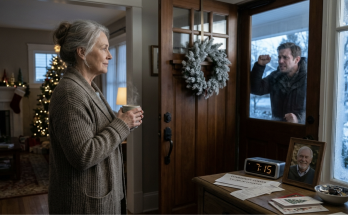
Three days later, Harvey came to my new condo.
I had been watering the flowers on the porch.
When I heard the knock, I looked through the glass.
He was standing outside with a grocery bag.
For a moment, I just watched him.
He looked like the man I had known for three years.
The same face.
The same familiar manner.
There was nothing about him that suggested the stack of questionable documents or the transfers lying in Daniel's office.
I opened the door.
"Good morning, Harvey."
He smiled.
"Morning, honey."
He lifted the bag.
"I picked up those cinnamon rolls you always enjoy."
I looked at the bag.
I had eaten those rolls with him before.
They reminded me of ordinary mornings.
That was the difficult thing about Harvey.
The man who could be thoughtful about a favorite treat was also the man who had arranged a change to our condo documents without telling me.
I hadn't figured out how to hold those two truths together.
"Thank you," I said.
He glanced past me.
"Would it be all right if I came in?"
I hesitated.
Then I moved aside.
He entered the living room and looked around.
"This is a pleasant place."
"It is."
He studied the rooms.
"It's a lot smaller than the other condo."
"Yes."
He put the grocery bag on the counter.
For a moment, neither of us spoke.
I wondered whether he had come to apologize.
I wondered whether he knew about the title company's call.
And I wondered whether he had any idea I had spent the previous days reviewing our bank statements.
He turned toward me.
"Lorene, I've missed you."
I looked at him.
I had missed parts of our life too.
I missed the easy conversations.
The ordinary routines.
The comfort of thinking I could trust the person beside me.
But I couldn't say that without remembering why we were standing apart.
He continued.
"I know I handled things badly at the closing."
I waited.
"I shouldn't have added Mama without talking to you."
That was the first time he had said it so plainly.
Still, I needed to know what he meant.
"What exactly do you believe you did wrong?"
He looked uncomfortable.
"The deed. I should have discussed it with you first."
I nodded slowly.
Then I asked about the other document.
"The authorization you sent to the title company. What about that?"
His expression shifted.
He looked at me as though he hadn't expected the subject to come up.
"What authorization?"
"The one saying I'd approved your mother's addition to the ownership paperwork."
He blinked.
"That was just part of the paperwork."
I felt my hands go still.
There was that word again.
Just.
As though a legal document could be made unimportant by calling it routine.
I kept my voice level.
"Harvey, did I ever tell you that you could put Dorcas on the deed?"
He turned toward the window.
"I figured you understood what I was doing."
"That's not what I asked."
He sighed.
"You signed the papers, Lorene."
I looked at him for a long moment.
He had finally said the part that mattered.
He was relying on the signatures.
Not on a conversation we had actually shared.
Not on my agreement.
The signatures.
"Did you explain those papers to me?" I asked.
He said nothing.
I remembered the kitchen.
The coffee cup.
The blue mechanic's shirt.
His assurance that the documents concerned insurance.
I remembered my pen moving across pages because I believed I could trust him.
And I remembered the authorization Daniel had found.
The document with my name and a paragraph concerning financial and property transactions.
I folded my arms.
"When you handed me those forms, did you tell me you intended to use them to support a change in who would own the condo?"
Harvey looked away.
I didn't fill the silence for him.
I had spent three years trying to make things easier whenever conversations became uncomfortable.
This time, I wanted an answer.
An actual answer.
Not a reminder that Dorcas was ninety-one.
Not a speech about what wives should share.
Not another claim that everything was ordinary paperwork.
I stood in the living room of the condo I had purchased in my own name and waited for my husband to explain what he had done with mine.
Click here to continue reading: PART 5: Harvey Stood in My New Living Room With Cinnamon Rolls While I Waited for Him to Explain the Papers He Had Hidden
I Sat Across From My Husband at the Closing Table and Watched Him Realize I Knew About His Secret
Part 4 of 15