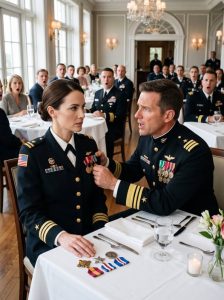
Part 1: The Date That Wasn’t a Date
The first thing Commander Adrian Vale did when I arrived at the restaurant was look at his watch. Not glance—look. “Seven minutes late,” he said. I stood beside the white-clothed table, still holding my coat. Behind him, the Harbor Room windows reflected amber lights along the Chesapeake Bay. The restaurant smelled of grilled lemons, polished wood, and expensive seafood.
“There was an accident near the bridge,” I said.
Adrian leaned back. “A disciplined person plans for contingencies.” He smiled as if the smile turned the insult into charm.
I smiled too. “Then I’m lucky you’ve already found my first flaw.” His eyes flickered; he could not decide whether I had submitted or mocked him. That hesitation told me enough.
My mother had sent me Adrian’s résumé before his phone number: Navy commander, destroyer executive officer, Annapolis graduate, medals, promotion board soon, divorced, no children, “traditional values.” She had underlined the last part. Two nights earlier, she pressed a red dress against my chest, saying, “He’s exactly what you need, Serena. A strong man. Decisive.” To my family, my Department of Defense work was a vague clerical embarrassment. My mother imagined gray offices, filing cabinets, and me carrying coffee for decorated men. I stopped correcting her years ago. That night, I wore the red dress—not because she had won, but because people reveal more when they think you dressed for their approval.
Adrian kissed the air near my cheek and guided me to my chair with his hand at my back, using slightly more pressure than necessary. “Your mother says you work somewhere around the Pentagon.”
“Near it.”
“Administrative?”
“Sometimes.”
He laughed. “That usually means yes.”
When the waiter came, Adrian waved away one menu. “She’ll have the sea bass. No butter. Reserve Chardonnay.”
The waiter looked at me. “I’m allergic to sea bass,” I said.
Adrian’s smile tightened. “Since when?”
“Since my immune system formed an opinion.”
His face went briefly empty, then polite again. “Fine. She’ll have salmon.”
“I’ll order for myself.” The waiter escaped.
For twenty minutes, Adrian explained leadership to me. He called his crew “kids,” his department heads “soft,” and newer officers “fragile.” “They run to counselors and inspectors every time someone raises his voice.”
“Inspectors?”
“Professional parasites.”
I lifted my water glass to hide my expression. He leaned forward. “Most investigators have never commanded anything more complicated than an office printer.”
“Have you been investigated?” I asked.
His eyes sharpened. “Why would you ask that?”
“Because you sound familiar with the process.”
A cold smile returned. “You ask a lot of questions for a clerk.” Before I could answer, his phone lit beside his plate—only for a second, but long enough for me to read: HARBOR MASTER: She still won’t withdraw it. Says she kept copies.
Adrian flipped the phone facedown and placed his hand over mine. His palm was warm, his grip firm enough to feel like restraint. “Tonight,” he said quietly, “I’d prefer you let me lead.”
I looked at his hand, then his face. Somewhere near the bar, a camera shutter clicked. When I turned, a woman in a navy coat was already walking out the door.

Part 2: The Warning
Adrian either did not notice the woman leave, or pretended not to. His hand remained over mine as the waiter poured wine. The pressure increased whenever I shifted—a small correction disguised as intimacy.
“Tell me what you actually do,” he said.
“I review problems.”
“What kind?”
“The kind people create when they think no one important is watching.”
He laughed. “Dramatic.”
“Most paperwork is, when you know what it means.”
My phone vibrated in my purse—one short pulse, then two. That pattern belonged to exactly three people. I ignored it.
Adrian lifted his glass. “To new beginnings.”
“To clear expectations.”
He watched me over the rim. “Your mother warned me you were independent.”
“She makes it sound contagious.”
Then he said gently, “Linda thinks you’ve wasted your potential.” That was his method: establish hierarchy, frame judgment as concern, and wait for gratitude.
“And what do you think?” I asked.
“A woman like you needs structure.”
“A woman like me?”
“Smart. Guarded. Overlooked. You’ve built an identity around not needing anyone. That usually comes from disappointment.” It was close enough to truth that it might have unsettled me—if I had not spent ten years interviewing men who mistook manipulation for insight.
My phone vibrated again. Adrian glanced toward my purse. “Are you expecting someone?”
“No.”
“Then turn it off. Phones are rude at dinner,” he added with a smile.
“So is ordering for someone without asking.”
His jaw flexed. “Are we revisiting every small mistake?”
“Depends. Are they mistakes or habits?”
His phone lit again. He snatched it up so fast his fork scraped the plate. I saw one word: Reassigned. He typed beneath the table, then excused himself. “Stay here.” The phrase was automatic.
I waited until he disappeared, then checked my phone. The message was from Jonas Vale, a senior analyst who could rebuild fraud schemes from shipping labels and cafeteria receipts: Unknown female photographed Mercer at 19:42. Facial match pending. Separate development: junior officer from Harwood requested emergency contact with us. Says Mercer knows someone is reviewing him. A second message appeared: He may believe tonight is a loyalty test arranged by your mother.
I read that twice. My mother knew Adrian through a military spouses’ charity. She collected officers the way other women collected antique china. But she had pushed this date with unusual force: selected my clothes, chosen the restaurant, told me not to discuss work. Maybe she only wanted to impress him. Or maybe Adrian believed she had promised him something.
When he returned, the charm was still there, but tension pulled at its edges. “Everything all right?” I asked.
“Crew issue.” He poured more wine. “My officers sometimes forget where loyalty belongs.”
“To the Navy?”
His eyes settled on mine. “To their commander.” Then he reached across the table and turned my purse so the clasp faced away from me. It was tiny, almost childish. But it told me he knew exactly where I kept my phone—and maybe far more about me than he was pretending.

Part 3: The Missing Coin
My mother called at seven the next morning.
She did not ask how I was.
She asked what I had done to Adrian.
I stood barefoot in my kitchen while rain crawled down the windows.
“What did he say I did?”
“He said you interrogated him.”
“He ordered my dinner and told me to turn off my phone.”
“Serena, men like Adrian are used to respect.”
“Women like me are too.”
She sighed.
Then she mentioned a reception that night at Fort Severn for Rear Admiral Curtis Blake, an old friend of my father’s. She had not told me Adrian would be there.
“He said it might help you understand his world,” she said.
“I understand his world.”
“No, sweetheart. You understand forms. Adrian understands responsibility.”
I asked exactly what she had told him about me.
She admitted she sent him my public résumé—the bland one that listed program analysis, compliance coordination, and administrative oversight, but not my clearance authorities or operational assignments.
Then I asked about my father.
She hesitated.
“I may have shown him a photograph.”
My father, Chief Daniel Mercer, had left me a cedar footlocker after he died. One photograph inside was not harmless. It showed him aboard a carrier with a small group whose names rarely appeared together in public records.
On the back, in his handwriting, were six words:
Truth is rank no one outranks.
“Where is the photograph now?” I asked.
“Grant—Adrian—has it. He wanted it restored.”
“You gave it to him?”
“You never cared about those old things.”
My secure phone buzzed.
Jonas’s voice came through.
“We identified the woman from the restaurant. Lieutenant Naomi Bell. Former navigation officer aboard Harwood. Transferred six months ago after filing a complaint against Mercer.”
“Why was she photographing him?”
“She says she was documenting contact between Mercer and you.”
“Why would she care?”
“Because Mercer keeps a private list of people he thinks are investigating him.”
A chill moved through me.
“Am I on it?”
“No. Your father is.”
I looked toward the cedar footlocker beneath my living room window.
It had been locked since the day he died.
That morning, for the first time in twenty-three years, the lid stood open.
Part 4: My Father’s Warning
I crossed the apartment without saying goodbye to my mother.
The brass latch on the footlocker hung crooked. Splinters marked the wood near the lock.
Someone had forced it.
Nothing else in my apartment looked touched. Whoever entered knew exactly what they wanted.
My father’s dress blues remained folded beneath yellowed tissue. His ribbons sat in a velvet case. Deployment letters were tied with blue cord. But the photograph was gone.
So was the narrow mahogany coin box.
My pulse changed.
Jonas heard my silence.
“What was in the box?”
“Coins. Mostly.”
“Mostly?”
“Get building security footage before it’s overwritten.”
Then I called my supervisor, Deputy Inspector General Helen Cross.
I did not call ordinary police first. Whoever had done this might be waiting for exactly that kind of paper trail.
Helen answered on the second ring.
“Talk.”
I explained the break-in, the photo, the missing box, and my mother’s role.
Helen asked one question.
“Was the gold coin inside?”
“Yes.”
A silence.
Then: “Come in.”
At headquarters, Helen waited in a conference room with three photos of Adrian Vale.
One showed him boarding the Harwood. One showed him at a reception with my mother. The third showed him outside my apartment building three weeks earlier, speaking to Martin Cole, my mother’s neighbor.
Martin had installed my apartment lock after a string of break-ins.
Helen slid me a page.
“Cole served under Mercer eight years ago. He left the Navy after a sealed disciplinary action.”
“What kind?”
“Evidence tampering.”
Then she asked about the coin.
My father had once worked as an enlisted liaison for a classified assessment cell. Its members entered commands without warning, tested vulnerabilities, and exposed failures before enemies could exploit them.
The cell no longer officially existed.
Its insignia—a red compass over a black wave—was stamped into a handful of solid gold coins.
The bearer did not outrank officers ceremonially.
But the authority attached to that coin could stop deployments, freeze promotions, and open doors no commander wanted opened.
“My father gave it to me before he died,” I said.
Helen pushed a sealed envelope toward me.
My name was written in my father’s hand.
“I found this in a restricted archive this morning. It was scheduled to be delivered only if that coin disappeared.”
Inside was one line:
Serena, if someone takes the coin, it means the wrong man finally learned what it can unlock.
Beneath it was a number sequence.
No explanation.
No signature.
My father had trusted me to understand.
At first, I did not.
Then I broke it into dates: August 14, November 3, September 20.
Unofficial records showed my father entered Fort Severn on August 14, boarded the Harwood’s predecessor vessel on November 3, and met Admiral Blake on September 20.
Tonight’s reception was for Blake.
Adrian had invited my mother.
“Mercer doesn’t want the coin for symbolism,” I said.
“No,” Helen replied.
“He thinks it opens something at Fort Severn.”
“Or he knows it does.”
Then Jonas entered with the apartment footage: Martin Cole entering with a contractor credential and leaving with a tool case.
He also showed us Naomi Bell’s photo of Adrian’s private list.
Near the bottom was a name that should not have been there:
S. Blackwood.
My operational alias.
Very few people knew it.
My mother certainly did not.
Helen said, “You cannot attend that reception as planned.”
“I have to.”
“Mercer knows who you are.”
“Then why go through with the date?”
“Maybe he was testing you.”
“Or confirming whether I knew he had the coin.”
Helen studied me.
“You’re emotionally involved.”
“He used my mother.”
“Your mother volunteered.”
The truth landed without softness.
Then Helen added one more thing.
“Your father died because he asked questions too often.”
My father supposedly died in a highway accident caused by ice.
Helen’s expression told me the road had never been the whole story.
Part 5: The Box in My Mother’s House
At 5:30, I arrived at my mother’s house in a charcoal suit.