The first thing I noticed was the smell.
Hospitals had always made me uneasy.
Not because I was unfamiliar with injuries.
I had seen enough of them.
But because the people lying in those beds were no longer in control of what happened next.
Doctors made decisions.
Machines measured things.
Families sat beside closed doors and waited.
I had never been good at waiting.
That morning, I walked through Massachusetts General Hospital wearing the same dark fleece jacket and tactical trousers I had traveled in.
My boots made a dull sound against the polished floor.
I had barely noticed the people around me.
I was looking for one room.
412\.
The number had been given to me after I arrived.
I repeated it silently as I followed the corridor.
Four-one-two.
Four-one-two.
It was easier to think about a room number than about the words the nurse had used.
Critical condition.
Physical trauma.
Emergency surgery.
I had heard those words in other circumstances.
They were different when they belonged to somebody you loved.
A nurse standing near the desk looked up as I approached.
"Captain Thorne?"
"Yes."
"She's in there."
She pointed toward the room.
I stopped outside the glass.
For one second, I could not make myself move.
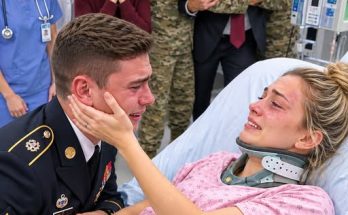
Tessa was lying in the bed.
Her skin looked pale beneath the hospital lights.
There were tubes near her arms.
A monitor beside the bed showed a steady pattern.
The blankets covered most of her body.
But I could see enough.
She had been hurt badly.
I had pictured her frightened.
I had pictured her awake.
I had imagined her telling me that something terrible had happened, but that she would be all right.
Instead, she lay still.
I pressed my hand against the doorframe.
That was when I saw the medical equipment beside her.
I watched the monitor.
I listened to the little electronic sounds.
Each one told me that her heart was still beating.
I had never been so grateful for an ordinary sound.
A doctor approached from farther down the corridor.
His face was tired.
He looked like a man who had been working for too many hours without enough sleep.
"Captain Thorne?"
I turned.
"I'm her husband."
"I know. I'm the attending physician."
He introduced himself, but I barely registered the name.
"How is she?"
"She's survived surgery. We're monitoring her very closely."
"Will she recover?"
"We're doing everything we can."
I knew what that answer meant.
It was not a promise.
It was the most he could honestly tell me.
I looked through the glass again.
"What happened to her?"
He lowered his voice.
"She arrived with serious injuries."
"What kind?"
"Internal trauma. Fractures. Significant damage that required emergency treatment."
I looked at him.
"Fractures where?"
"Both arms showed injuries consistent with someone trying to protect themselves."
I felt my jaw tighten.
"Trying to protect herself from what?"
He hesitated.
"We can describe the injuries, Captain. We can't determine everything that caused them."
I understood the difference.
I had spent years working with information that had to be verified before anybody acted on it.
But I also understood what defensive injuries looked like.
I had seen them before.
The doctor was watching me carefully.
Then I asked the question I had been avoiding since the call.
"What about our baby?"
He took a breath.
It was a small movement.
But I saw it.
"I'm very sorry."
I looked at him without speaking.
"The pregnancy couldn't be saved."
For a moment, I thought I had misunderstood.
I knew the words.
I understood every one of them.
But my mind refused to put them together.
"Our baby?"
He nodded.
"I'm sorry, Captain."
I turned back toward the room.
Tessa had been six months pregnant.
Six months of preparing.
Six months of appointments I had tried to attend whenever I was home.
Six months of watching her become more careful when she stood up or sat down.
Six months of imagining a child whose face I had not yet seen.
And now that child was gone.
I rested my hand against the glass.
I had lost men before.
Men I had trained with.
Men whose families I had called.
Men whose names I could still remember without trying.
I knew grief.
At least, I thought I did.
But I had never experienced anything like standing outside a hospital room and learning that my child would never come home.
There would be no crib to finish assembling.
No small clothes to fold.
No first cry.
I closed my eyes.
Just once.
When I opened them, the doctor was still there.
"Can I sit with her?"
"Of course."
I entered the room.
The door closed quietly behind me.
I pulled a chair close to her bed.
Her hand lay beside the blanket.
I took it carefully.
It was warm.
That nearly broke me.
Warm meant she was still here.
I held on to it.
"Tessa," I said.
She did not answer.
"It's Elias."
The monitor continued its steady rhythm.
"I'm home."
I waited.
There was no movement.
I looked at her face.
I wanted her to open her eyes.
I wanted her to tell me I had misunderstood everything.
But the room remained quiet.
I stayed beside her until I heard voices outside.
At first, I ignored them.
Then I recognized one.
Silas Sterling.
I turned toward the glass.
He was standing near the elevators with his sons.
All eight of them.
The same men I had seen in the photograph.
They were wearing expensive suits.
Caleb had a paper coffee cup in one hand.
Another brother was checking his watch.
Nobody looked as though they had been sitting beside a hospital bed all night.
I felt something change inside me.
It was not rage at first.
It was attention.
The kind of attention I had learned to give small details when lives depended on them.
I looked at Caleb's hand.
Even from the room, I could see something was wrong with his knuckles.
I stood.
Then I stepped back into the corridor.
Silas saw me almost immediately.
His expression changed.
He straightened his jacket.
Then he walked toward me with the familiar confidence of a man accustomed to being welcomed wherever he went.
"Elias."
I stopped a few feet away.
He gave a slow shake of his head.
"This is a dreadful situation."
I said nothing.
"Tessa has always been a little too emotional. You know how she gets."
I looked at him.
"Tell me what happened."
He sighed.
"There was an accident at the house."
"What accident?"
"She lost her footing on the marble staircase."
I waited.
He continued.
"Pregnancy can affect a woman's balance. It all happened very quickly."
I could hear his words.
But I kept thinking about what the doctor had told me.
Defensive fractures.
Internal injuries.
A woman trying to protect herself.
Silas gave another tired sigh.
"We've all had a difficult night."
I looked past him.
Caleb was watching me.
His mouth held a faint smile.
I had seen that expression before.
At family dinners.
At the wedding rehearsal.
Whenever he thought somebody else was powerless.
"She fell down the stairs?" I asked.
"That's what happened," Silas replied.
"Who was there?"
His face tightened.
"Why does that matter?"
"Because I'm asking."
Caleb stepped forward.
"You're making this more complicated than it needs to be."
I turned toward him.
His left hand held the coffee cup.
His right hand hung near his side.
The skin across the knuckles was scraped.
There were bruises around two fingers.
I looked at them long enough for him to notice.
He moved his hand behind his jacket.
Too late.
"An accident," I said.
"Yes," Caleb replied.
He sounded irritated now.
"Sometimes people fall. You can't turn everything into a military investigation."
I did not answer.
Silas glanced toward the nurses' desk.
He lowered his voice.
"We don't need a scene."
I looked at the eight brothers again.
None of them seemed interested in going into Tessa's room.
None asked whether she had awakened.
None asked what the doctors had told me.
They were more concerned with what I might do.
That told me something.
Not everything.
But something.
Caleb took another step toward me.
"Look, Thorne. I know you're upset."
I waited.
"But don't start acting like you can challenge this family."
Silas said nothing.
Caleb continued.
"My father has attorneys who deal with problems before they become public."
"What problem?"
He gave a short laugh.
"You, if you decide to make one."
I looked toward Tessa's room.
Through the glass, I could see the chair I had been sitting in.
Her hand was still beside the blanket.
I turned back.
"You're talking about my wife."
Caleb shrugged.
"She's our sister."
"Then why aren't you worried about her?"
His smile disappeared for a moment.
Silas stepped between us.
"Enough."
But Caleb was not finished.
He leaned slightly toward me.
"You wear a uniform. That's your whole life. You follow orders and collect a government paycheck."
I watched him.
"Don't confuse that with having power here."
He glanced at his father.
"We have the resources to handle this. You don't."
Silas seemed satisfied to let him speak.
That was another detail I remembered later.
A father could have told his son to stop.
Silas did not.
Caleb lifted his injured hand without thinking.
For an instant, the bruises were clear.
Then he noticed me looking.
His expression changed again.
"Maybe you should take whatever benefits the Army gives you and move on."
I felt my hands grow still.
The kind of stillness that came before an operation.
I had spent years training myself not to react simply because somebody wanted a reaction.
Caleb wanted me angry.
He wanted me to swing at him in a hospital corridor.
Then he could point to the violent soldier who had lost control.
He could call security.
He could call his lawyers.
And the conversation would no longer be about Tessa.
I knew that.
So I stayed where I was.
"Is that what you think happens now?" I asked.
Caleb frowned.
"What?"
"You decide what happened to her, and I accept it?"
Silas answered before his son could.
"The family will take care of the situation."
I looked at him.
"The family?"
He nodded.
"That's right."
I thought about Tessa lying unconscious behind the glass.
About the baby we had lost.
About the photograph in my pocket.
Then I thought about the family who had supposedly been taking care of her while I was gone.
I could not remember ever feeling so ashamed of my own absence.
Not because I had abandoned her.
I had been serving my country.
But because I had assumed the people around her would behave like human beings.
I had given Silas more credit than he deserved.
He mistook my silence for uncertainty.
"Elias, you need to be sensible."
I looked at his face.
He was calm.
Not frightened.
He believed this conversation would end the same way all his difficult conversations ended.
With somebody giving in.
I had seen men like him in different countries.
They wore different clothes.
They spoke different languages.
But their confidence came from the same place.
They believed consequences were meant for other people.
Caleb folded his arms.
"You're out of your depth."
I looked at him.
"Maybe."
He gave a satisfied little smile.
Then I continued.
"But you don't know what I do when somebody threatens my family."
He laughed.
"What are you going to do? Call a few Army friends?"
I did not answer immediately.
I thought about the photograph from the hospital cafeteria.
I thought about the bruises on his hand.
And I thought about the nursery camera I had installed months earlier.
The camera they did not know existed.
I had not come to the hospital intending to confront nine men.
I had come to see my wife.
But I could no longer pretend their behavior meant nothing.
There were too many things that did not fit.
Too many answers given before I had finished asking questions.
Too much confidence from people who should have been grieving.
I stepped closer to Caleb.
Not enough to touch him.
Just enough that he stopped smiling.
"You think my job makes me powerless," I said.
He stared at me.
"You think because I don't own banks or companies, I can't do anything."
Silas moved beside us.
"Elias, don't embarrass yourself."
I ignored him.
"I don't need your permission to find out what happened."
Caleb's jaw tightened.
"You're making a mistake."
I looked at his bruised knuckles one last time.
"No," I said. "I think I've already made one."
He looked confused.
I turned toward Tessa's room.
"I trusted you people to leave her alone."
For the first time, none of them answered.
That silence mattered.
I had heard enough.
I reached toward my wrist.
Beneath the cuff of my jacket was the watch I wore during operations.
It was not something Silas would have recognized.
To him, expensive watches were decorations.
Mine had another purpose.
I touched the small control on its side.
My voice was low.
"The perimeter is hot."
Then I lowered my hand.
Silas stared at me.
"What did you just say?"
I looked at the closed elevator doors behind him.
The hospital corridor had not changed.
The nurses were still working.
The monitors were still sounding inside the rooms.
But I had made a decision.
I would not allow the Sterlings to decide what happened to Tessa.
I would not accept their explanation simply because they had money.
And I would not let Caleb's laughter be the last thing I remembered from that hallway.
Silas was still waiting for an answer.
I gave him none.
Because the next answer was not going to come from me.
Click here to continue reading: PART 3: My Father-in-Law Thought His Money Could Silence Me, Until His Son Received a Call That Changed Everything in the Hospital Corridor
I Was Thousands of Miles From Home When a Hospital Nurse Called and Told Me My Pregnant Wife Was Fighting for Her Life
Part 2 of 15