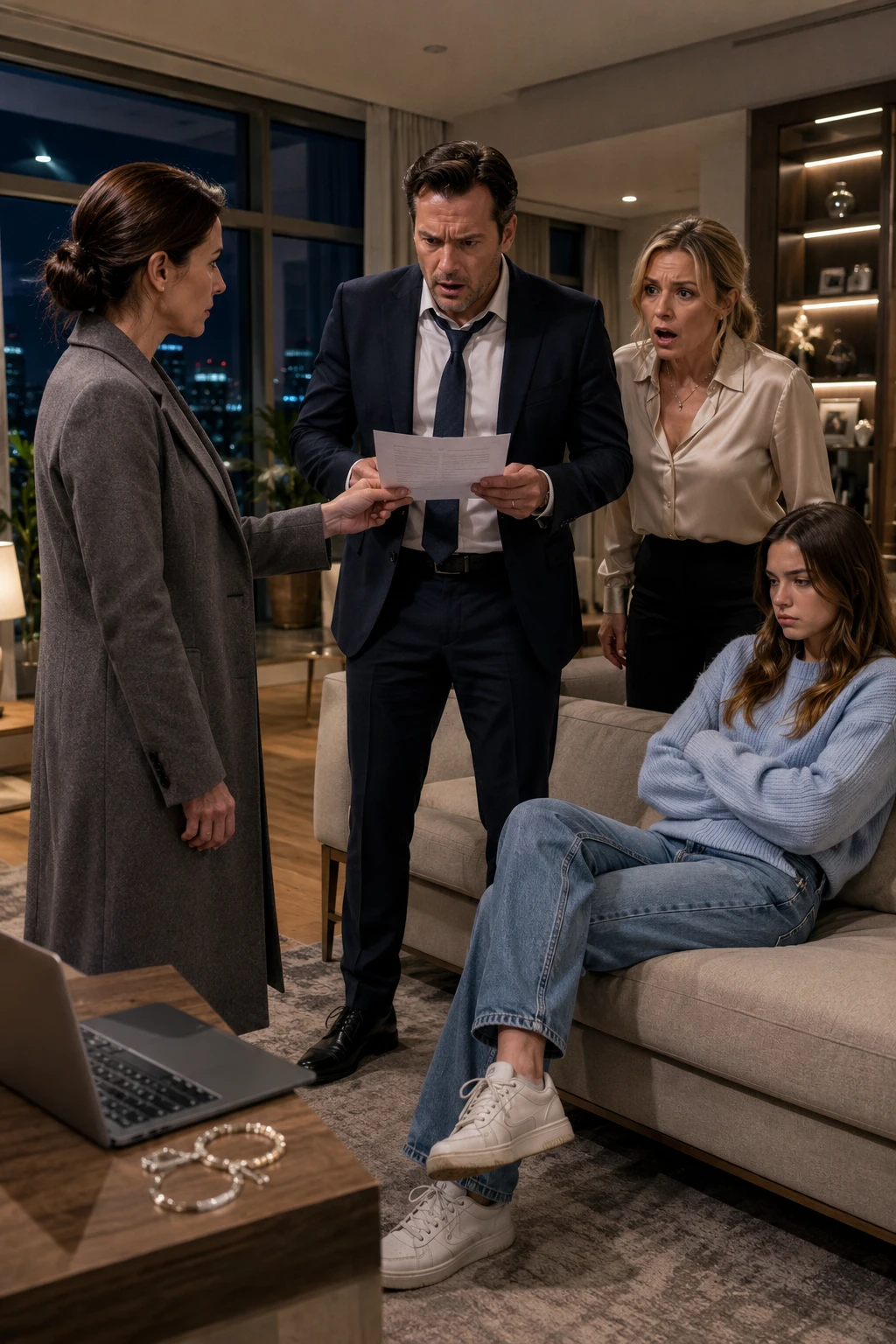
The sound of the bracelet breaking was almost nothing.
A tiny metallic snap.
Barely louder than the clink of ice inside my brother’s champagne glass.
But I knew instantly that something much larger had just shattered.
“Oops.”
My sixteen-year-old niece Sophie stared at the two glittering pieces lying on the patio stones.
Then she laughed.
“It was probably worthless anyway.”
Her phone was still recording.
A bright ring light stood beside her chair, illuminating her face while dozens of strangers watched her livestream.
Ten minutes earlier, Sophie had slipped the bracelet from my wrist without asking.
“Mom thinks this probably came from a yard sale,” she had said, holding it beneath her camera.
I had reached toward her.
“Sophie, please give it back.”
She smiled at the screen.
“Relax, Aunt Claire.”
Then she tried to force the narrow platinum bracelet over her hand.
It didn’t fit.
Instead of stopping, she twisted harder.
And now the bracelet my grandmother had worn for more than forty years lay broken at my feet.
Nobody apologized.
My brother Eric stood near the grill in a crisp designer shirt, sipping champagne as though nothing had happened.
My sister-in-law Vanessa frowned, but not at Sophie.
At me.
“Claire, don’t make that face,” she said. “It’s old-fashioned. You can probably sell the platinum.”
I crouched and gathered the pieces.
The tiny engraved clasp felt cold in my palm.
My mother had given me that bracelet two weeks before she died.
“Some things aren’t valuable because of what they cost,” she had whispered from her hospital bed. “They’re valuable because somebody loved you enough to keep them safe.”
I had kept it safe for twenty-two years.
Sophie destroyed it in less than twenty seconds.
Eric sighed.
“Please don’t turn brunch into some giant family conflict.”
I looked at him.
Then Vanessa.
Then Sophie, who was already reading comments beneath her video.
Something inside me became completely still.
Not angry.
Still.
“I’m leaving,” I said.
Eric barely looked up.
“Fine. See you next weekend. Mom’s birthday, remember?”
I walked through their expensive kitchen, past the marble counters and oversized refrigerator, and out to my car.
I didn’t slam the door.
I didn’t cry.
I drove home in silence.
That calmness frightened me more than rage ever could have.
Because during that drive, I finally understood something.
They did not love me.
They loved having access to me.
My apartment was quiet when I returned.
No ring lights.
No loud music.
No Vanessa filming brunch content for social media.
I made tea, opened my laptop, and created a spreadsheet.
At the top, I typed:
EVERYTHING THEY FORGOT.
Eric’s unpaid property taxes: $39,500.
Vanessa’s failed boutique expenses: $27,000.
House deposit: $76,000.
Emergency transfers never repaid: $18,400.
And those were merely the obvious numbers.
When Dad died, Eric had inherited his construction business.
I had inherited almost nothing.
At least, that was what Eric believed.
Our father had been old-fashioned. He thought sons should inherit businesses and daughters should be “looked after.”
Unfortunately for Eric, he had no idea how to operate what Dad left him.
Within eighteen months, vendors were threatening lawsuits.
I quietly negotiated payment plans.
When his first major project collapsed, I covered payroll.
When the IRS began asking questions, I paid the accountant who untangled his records.
Eric thanked me at first.
Then eventually he behaved as if those rescues had never happened.
But the biggest secret wasn’t on the spreadsheet.
I opened another website.
The donor portal for the Hawthorne School of Music.
Sophie had attended Hawthorne for three years.
She was genuinely gifted.
Even at ten, she could hear a melody once and reproduce it almost perfectly on violin.
Her parents enjoyed telling everyone she had earned a mysterious merit sponsorship.
They loved that story.
It sounded glamorous.
An anonymous patron discovering their daughter’s talent.
The truth was less magical.
I was the anonymous donor.
Annual tuition and specialized training:
$58,000.
For three years, I had paid every dollar.
I had remained anonymous because I did not want Sophie to feel indebted to me.
Her parents were irresponsible, but she was a child.
I wanted her to build something independent of them.
Maybe discipline would teach her gratitude.
Maybe music would give her depth.
Maybe being surrounded by serious artists would prevent Vanessa’s obsession with status from infecting her.
I searched Sophie’s account.
SOPHIE M. — YOUNG ARTIST SPONSORSHIP
Status: Fully funded.
Future term: Pending donor renewal.
Beside my keyboard, I placed the broken bracelet.
I stared at it for a long time.
Then I clicked:
DISCONTINUE AFTER CURRENT PERIOD.
A warning appeared.
Are you certain?
I clicked yes.
Future sponsorship:
NOT RENEWED.
I closed the laptop.
And finished my tea.
Vanessa called Monday morning.
“Claire, thank God. We have a disaster.”
I said nothing.
“The conservatory called. Sophie’s sponsor pulled out.”
“That sounds difficult.”
“Difficult? It’s humiliating. Sophie has rehearsals scheduled. They want proof we can cover next term.”
“How much?”
“You know how much. Nearly sixty thousand.”
Nearly.
Interesting.
They had never even bothered to learn the exact amount.
“Eric can’t make sense of the documents,” Vanessa continued. “And I have a brand partnership meeting today. I need you to call Hawthorne and straighten this out.”
“No.”
Silence.
“What?”
“I can’t help you.”
“Claire, this is Sophie’s future.”
“I understand.”
“Then act like her aunt.”
I nearly laughed.
Instead, I asked, “Has Sophie mentioned anything else from brunch?”
Vanessa paused.
“What is that supposed to mean?”
“The bracelet.”
“Oh, for God’s sake.”
There it was.
Not regret.
Annoyance.
“She said she was sorry.”
“She did not.”
“She’s sixteen, Claire.”
“Old enough to know not to take something from someone’s body and break it for entertainment.”
Vanessa’s voice turned icy.
“If you’re holding a grudge against a child, that says more about you than her.”
I ended the call.
For the next two days, my phone exploded.
Eric called from work.
Vanessa left voicemails.
Sophie texted me.
None of her messages apologized.
The first said:
Mom says you know people at Hawthorne. Can you fix this?
The second:
Also you still owe me that professional bow for my birthday.
The third included a link.
A violin bow costing $4,300.
Tuesday night, Vanessa went public.
She posted a video of herself crying.
“Someone has chosen to punish a talented young musician,” she said dramatically. “We don’t know why. We’re devastated.”
Thousands of people watched.
She suggested the conservatory’s donor database might have been hacked.
Then she hinted that “certain jealous relatives” had always struggled with Sophie’s success.
I closed the video.
Thursday evening, someone pounded on my apartment door.
Eric entered first.
Vanessa followed, eyes swollen beneath smeared mascara.
Sophie came in last, scrolling through her phone.
“The conservatory gave us forty-eight hours,” Eric said. “We need proof of about sixty grand or she loses her place.”
“Fifty-eight thousand,” I said.
He stared at me.
Vanessa stepped forward.
“The letter says the donor also raised concerns regarding character and conduct. What does that even mean?”
Sophie collapsed onto my sofa.
“This is ridiculous. I didn’t even do anything.”
I watched her shoes touch my rug.
Then I looked at Eric.
“This wasn’t an administrative error.”
His face tightened.
“What are you saying?”
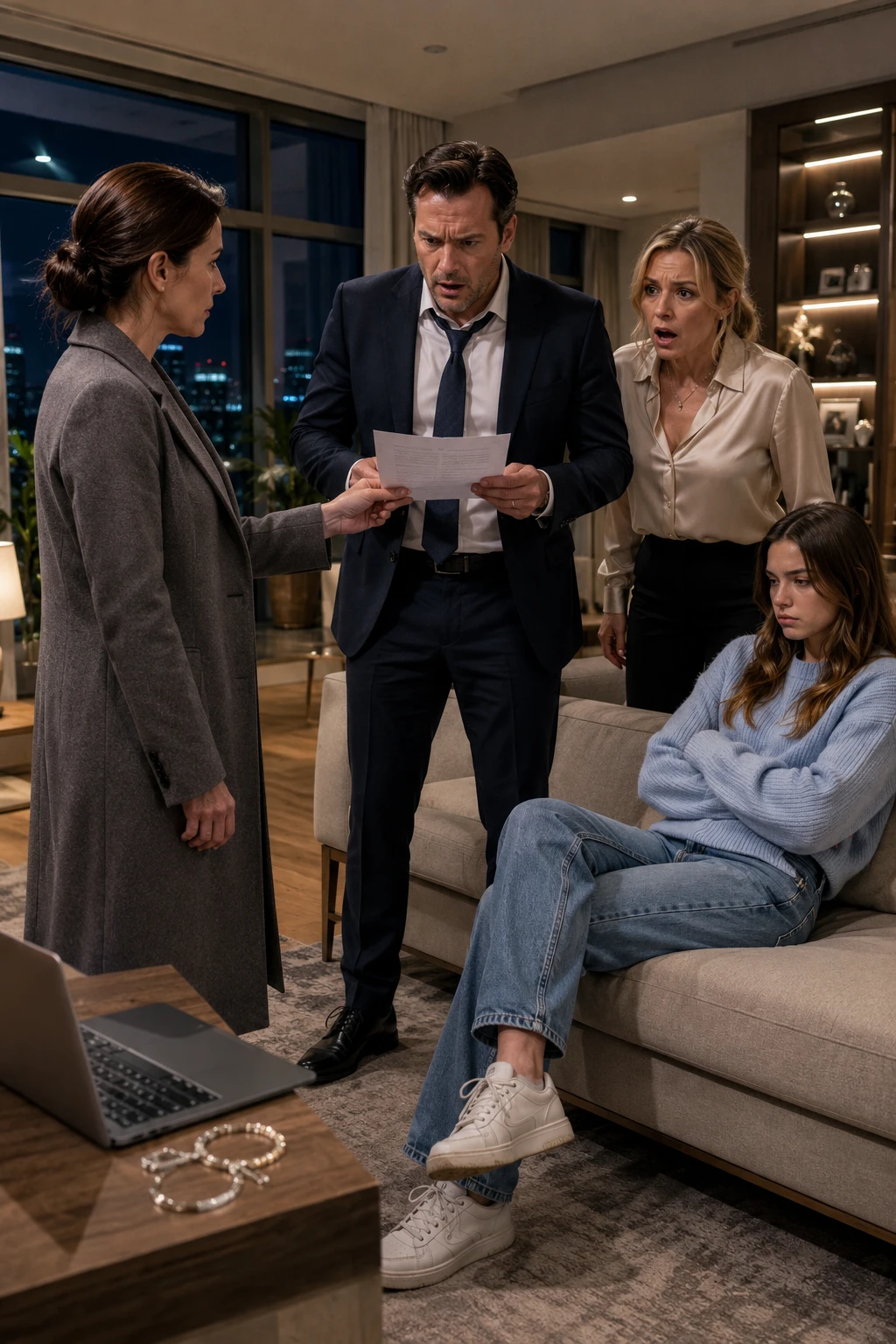
I walked to my desk and lifted a printed page.
“The form terminating the sponsorship.”
Vanessa frowned.
“How did you get that?”
I handed it to Eric.
His eyes moved down the document.
At first, confusion.
Then disbelief.
Then fear.
At the bottom was the donor signature.
Mine.
He slowly raised his head.
“You?”
“For three years.”
Vanessa snatched the document.
“No.”
“Yes.”
“You paid Hawthorne?”
“Every semester.”
Sophie finally lowered her phone.
“All of it?”
“One hundred seventy-four thousand dollars so far.”
The room went silent.
Vanessa looked physically ill.
“You canceled because of that stupid bracelet?”
“No.”
I met Sophie’s eyes.
“I canceled because the bracelet finally showed me what my help had created.”
Sophie stood.
“That makes no sense.”
“It means you believed everything came automatically. The school. The lessons. Trips. Equipment. You never wondered who paid.”
“I thought I earned the scholarship!”
“You earned admission. You did not earn anonymous tuition.”
Her face flushed.
Vanessa stepped between us.
“This is cruel.”
“What’s cruel,” I said, “is laughing while destroying something your aunt’s dying mother gave her.”
Sophie crossed her arms.
“So what? You’re going to ruin my career?”
“No.”
I shook my head.
“Your parents are free to pay your tuition.”
Vanessa gave a bitter laugh.
“With what?”
That single sentence answered more than she realized.
I opened my desk drawer.
Inside was another folder.
Eric noticed immediately.
“What’s that?”
I set it down.
“Everything else I’ve been paying for.”
The first page contained their property tax history.
The second contained transfers.
The third contained copies of personal loans.
Eric flipped pages faster.
His face drained of color.
Vanessa stared.
“What is all this?”
“You told everyone your boutique investors rescued you,” I said. “That was me.”
I pointed to another line.
“When your mortgage nearly defaulted? Me.”
Another.
“The kitchen renovation after Eric promised you the business had a huge quarter?”
Eric swallowed.
“Claire—”
“Me.”
Sophie stared at her parents.
“You said Dad got a bonus.”
Nobody answered.
Vanessa suddenly became furious.
“So what? You helped your family. People help family.”
“Correct.”
I closed the folder.
“But family doesn’t treat the person helping them like garbage.”
Eric sat down heavily.
“What do you want?”
That question hurt more than I expected.
Not “I’m sorry.”
Not “How did we become this?”
What do you want?
As if kindness had always been a negotiation.
“I want nothing,” I said.
“That’s not true.”
“It is.”
I looked at all three of them.
“I’ve stopped paying.”
Vanessa went pale.
“Stopped paying what?”
“Everything.”
Eric stood.
“The property taxes?”
“Yes.”
“The business credit line?”
“Yes.”
“You guaranteed that line.”
“I terminated my personal guarantee thirty days ago.”
His jaw dropped.
“You can’t do that.”
“I already did.”
Vanessa whispered, “The SUV?”
“The lease is in your name.”
Sophie looked frightened now.
“What about my school?”
“You already know.”
Eric stared at me like a drowning man.
Then his expression changed.
Not remorse.
Suspicion.
“Why now?”
I frowned.
“What?”
“You’ve been helping us for years. Why would a bracelet suddenly make you cut off everything?”
I said nothing.
Eric moved closer.
“There’s something you’re not telling us.”
Vanessa looked between us.
Then she whispered, “Eric…”
He turned toward her.
“What?”
Her face had gone white.
“Maybe she knows.”
The room shifted.
I stared at Vanessa.
“Knows what?”
Neither spoke.
Then Sophie quietly said, “Mom?”
Vanessa backed toward the sofa.
Eric swore under his breath.
I felt cold.
“What are you hiding?”
Eric looked at Vanessa.
Vanessa looked at Eric.
Then my brother said, “Claire, there’s something about Dad’s estate.”
My stomach tightened.
“What about it?”
He rubbed his forehead.
“Dad didn’t leave me the company outright.”
I waited.
“He left it in trust.”
“I know.”
“No.”
Eric looked directly at me.
“You don’t.”
The following morning, I met our father’s former attorney, Leonard Shaw.
He was seventy-eight now, semi-retired, with white hair and a memory sharper than most people half his age.
When I told him what Eric had said, Leonard closed his office door.
Then he sighed.
“I wondered how long this would take.”
“What?”
He opened a filing cabinet.
“Your father amended his estate plan four months before he died.”
I stared at him.
“I never saw an amendment.”
“You weren’t meant to. Not initially.”
He placed a sealed envelope on the desk.
My name was written across it in Dad’s handwriting.
CLAIRE.
My hands began to shake.
Inside was a letter.
Claire,
If Eric becomes the man I hope he will become, destroy this letter.
If he becomes the man I fear he may become, Leonard will know when to give it to you.
I stopped reading.
Leonard spoke gently.
“Keep going.”
Dad explained that the construction company had been placed into a ten-year stewardship trust.
Eric controlled operations.
But ownership?
That was another matter.
My heart pounded.
I reached the final paragraph.
The company belongs 60% to Claire and 40% to Eric. Claire’s ownership is silent until either ten years pass or Eric breaches the stewardship conditions.
I looked up.
“What breach?”
Leonard slid another document toward me.
There were several.
Fraud.
Misuse of corporate credit.
Failure to maintain taxes.
Taking undisclosed personal loans secured against company equipment.
I stared at Leonard.
“He did all of this?”
“Over the past three years.”
My chest tightened.
“How do you know?”
“Because your brother’s lender contacted the trust last month.”
I thought of Eric’s panic.
The folder.
Vanessa’s fear.
Then Leonard said something that made the entire room tilt.
“Claire, Eric’s breach automatically activated your controlling ownership two weeks ago.”
I could barely speak.
“Controlling?”
“You now own sixty percent of the company.”
I sat back.
The company Dad built over thirty-two years.
The company Eric bragged was his.
The company whose failures I had quietly financed.
It had legally belonged mostly to me all along.
But Leonard wasn’t finished.
“There’s one more thing.”
He produced a small flash drive.
“Your father recorded a video.”
That night, I watched it alone.
Dad appeared on screen sitting behind his old office desk.
He looked thinner than I remembered.
Tired.
But unmistakably himself.
“Claire,” he began, “if you’re watching this, Eric failed.”
Tears immediately blurred my vision.
“I made a mistake with both of you,” he continued. “I gave Eric responsibility because I thought pressure would turn him into a man. I kept your ownership hidden because I knew you would rescue him.”
I froze.
“You always rescue everyone.”
Dad smiled sadly.
“And that is your weakness.”
I covered my mouth.
“I need you to understand something. Love does not require you to finance someone else’s refusal to grow.”
Then he leaned toward the camera.
“And Sophie…”
I stopped breathing.
Dad knew Sophie?
Of course he did.
But his expression changed.
“If Eric ever tells you Sophie’s future is your responsibility, ask Leonard for the second file.”
The video ended.
I called Leonard immediately.
“What second file?”
There was a long silence.
Then he said, “Come tomorrow.”
The second file contained a DNA report.
I stared at the names.
Sophie Young.
Eric Young.
Probability of biological paternity:
0.0%.
I read it twice.
Then a third time.
“No.”
Leonard’s expression remained grave.
“Your father discovered it accidentally after Sophie required genetic screening related to a childhood medical issue.”
“Eric isn’t her father?”
“No.”
“Does Eric know?”
Leonard hesitated.
“I believe so.”
That explained Vanessa’s fear.
Their shared glance.
Their panic.
But why would Dad include this in my inheritance instructions?
I turned the page.
Another name appeared.
My entire body went cold.
Biological father: Daniel Mercer.
I knew that name.
Everyone in our town once had.
Daniel Mercer had been Dad’s business partner.
And my fiancé.
Twenty years earlier.
The man who died in a boating accident three months before our wedding.
I stopped breathing.
“That’s impossible.”
Leonard lowered his eyes.
“The genetic sample used for comparison came from Daniel’s preserved medical records. Your father requested the analysis after seeing an unusual hereditary marker.”
I could barely hear him.
Vanessa had known Daniel?
Then I calculated Sophie’s age.
Sixteen.
Daniel died twenty years ago.
The numbers didn’t work.
I looked at Leonard.
“She can’t be his daughter.”
“No,” he said quietly.
“She isn’t.”
He turned one final page.
Maternal genetic match: Claire Bennett.
My vision blurred.
“What?”
“You should sit down.”
“I am sitting.”
My voice sounded strange.
Leonard swallowed.
“Sophie is not Vanessa’s biological daughter.”
The room disappeared around me.
“What are you saying?”
“Seventeen years ago, before Daniel died, you underwent fertility treatment.”
Memories struck me like glass.
Daniel and I had wanted children.
I had undergone egg retrieval because a medical issue might affect future fertility.
After his death, I was told the embryos had been destroyed at my request.
I had signed paperwork through a haze of grief.
Leonard continued.
“Your father discovered that one embryo had not been destroyed.”
I stared at him.
“No.”
“It was implanted later.”
“Into Vanessa?”
“Yes.”
I stood so quickly the chair hit the wall.
“No.”
My lungs refused to work.
“That means…”
Leonard’s eyes filled with tears.
“Sophie is biologically your daughter.”
I don’t remember leaving the office.
I remember sitting in my car.
I remember gripping the steering wheel.
I remember screaming once.
Just once.
Then silence.
Every memory of Sophie rearranged itself.
Her birth.
Vanessa refusing to let anyone hold her for long.
Dad’s strange attachment to her.
The anonymous request from him shortly before he died, asking me to “always make sure Sophie has opportunities.”
My instinctive need to protect her.
The conservatory.
The tuition.
Everything.
I had thought I was helping my niece.
I had unknowingly been protecting my own child.
That evening, Eric and Vanessa came to my apartment again.
This time, I already knew.
I placed the DNA report on the table.
Vanessa saw it.
Her knees nearly gave out.
Eric whispered, “Claire…”
“How?”
Neither answered.
I slammed my palm against the table.
“How did you get my embryo?”
Vanessa began crying.
Eric looked shattered.
Finally, Vanessa spoke.
“Daniel gave it to us.”
I froze.
“What?”
“He didn’t die believing you still wanted children.”
She swallowed.
“Before the accident, you two had argued. You told him you weren’t sure you could handle motherhood after everything happening with your mother.”
I remembered.
One terrible argument.
One sentence spoken from fear.
Vanessa continued.
“Daniel thought you would destroy the embryos.”
“So he stole one?”
“He transferred legal authority to Eric.”
Eric covered his face.
“I was supposed to preserve it,” he said. “Not use it.”
I looked at Vanessa.
“But you did.”
She nodded.
“We couldn’t conceive.”
My entire body trembled.
“So you stole my child.”
“No!” Vanessa cried. “We raised her! We loved her!”
“You lied to me for sixteen years!”
Eric stepped forward.
“Dad found out later. He made us promise never to tell you unless Sophie was in danger.”
I laughed bitterly.
“In danger?”
Then I thought of Dad’s video.
Love does not require you to finance someone else’s refusal to grow.
Suddenly I understood.
Dad had not simply protected me financially.
He had been waiting.
Waiting to see whether Eric and Vanessa would become worthy parents.
They hadn’t.
I looked toward Sophie.
She stood in the hallway.
She had heard everything.
Her phone was not in her hand.
For the first time since I could remember, there was no screen between us.
Her face was pale.
“You’re my mother?”
Vanessa began sobbing.
“Sophie—”
But Sophie looked only at me.
I had imagined anger.
Shock.
Hatred.
Instead she slowly reached into her pocket.
And placed something on the table.
My bracelet.
Repaired.
Not perfectly.
The platinum links were slightly uneven.
But the clasp had been restored.
“I took it to Mr. Alvarez,” she whispered. “The jewelry repair shop near school.”
I stared at her.
“I used the money from selling my violin bow.”
Vanessa gasped.
“You sold your bow?”
Sophie ignored her.
Tears ran down her face.
“I thought the bracelet was stupid because Mom told me you were obsessed with old things.”
Vanessa flinched.
Sophie continued.
“But after you canceled Hawthorne, I went online and found Grandma’s wedding pictures.”
She swallowed.
“She was wearing it.”
I picked up the bracelet.
My hands shook.
Sophie looked at me.
“I’m sorry.”
Two words.
The words I had wanted from the beginning.
But now they meant something entirely different.
“I don’t care about Hawthorne,” she said. “I mean, I do. But… I’m sorry about you.”
My chest broke open.
I moved toward her.
Then stopped.
Because she deserved a choice.
Sophie closed the distance herself.
She wrapped her arms around me.
I held her.
My daughter.
My niece.
A stranger I had loved without understanding why.
Behind us, Vanessa collapsed onto the sofa.
Eric stared at the floor.
There would be lawyers.
Therapy.
Court hearings.
Years of questions.
Nothing about what came next would be simple.
But one thing became clear almost immediately.
Sophie chose to remain enrolled at Hawthorne.
Not through my sponsorship.
Not through Eric.
She auditioned again for the conservatory’s competitive merit fellowship.
Three months later, she won it.
On her own.
The annual award?
Exactly $58,000.
When the acceptance letter arrived, she brought it to my apartment.
She smiled through tears.
“This one really is mine.”
I hugged her.
“Yes,” I said.
“It is.”
A year later, Eric lost control of Dad’s company after the trust formally transferred voting authority to me.
I did not destroy him.
I made him earn his way back.
Vanessa eventually admitted publicly that her stories about the “cruel anonymous donor” had been lies.
Her influencer following collapsed.
For once, consequences arrived without me paying to soften them.
And on the night of Sophie’s first major solo performance, I sat in the front row.
She walked onto the stage carrying a modest replacement bow she had bought herself.
Around her wrist was my grandmother’s repaired platinum bracelet.
I nearly laughed when I saw it.
Before lifting her violin, Sophie touched the bracelet once.
Then she looked directly at me.
Not Vanessa.
Not Eric.
Me.
And smiled.
After the performance, she handed me a folded note.
Inside were nine words:
“Some things are valuable because someone loved them enough.”
My mother’s words.
I looked at Sophie.
“How did you know?”
She smiled.
“Grandpa left me a video too.”
My breath stopped.
“What did he say?”
She leaned closer.
Then whispered the final secret my father had apparently planned all along.
“He said when you finally stopped rescuing everyone, you’d be ready to become my mother.”