The $150,000 check slid across my parents’ polished dining table and stopped beside my sister Olivia’s plate.
She opened the envelope.
Her eyes widened.
“One hundred and fifty thousand dollars?”
My mother reached across the table and squeezed her hand.
“It’s for your new home, sweetheart. We’re so proud of the life you’re building.”
My father smiled at Olivia with the warm, glowing pride I had spent nearly three decades trying to earn.
Then he looked at me.
His expression changed.
“Do you see, Maria?” he said. “This is what success looks like.”
I was thirty-one years old.
I was a civil engineer.
I had paid off my student loans early, lived below my means, and recently become the youngest project leader in my division.
I rented a small apartment because I was saving carefully. I drove an eight-year-old Honda because it ran perfectly. I wore steel-toed boots more often than heels.
Apparently, none of that counted.
Olivia was engaged to an attorney named Preston, drove a leased luxury SUV, and was purchasing a large colonial home in a neighborhood my parents loved mentioning to their friends.
Dad leaned back.
“You have nothing to show for your life,” he said.
Mom’s fingers tightened around her wineglass.
Olivia stared at him.
Dad continued anyway.
“You’re the failure, Maria. We put our money behind winners.”
The room fell silent.
Nobody defended me.
That silence hurt more than the insult.
I looked at my mother.
She lowered her eyes.
I looked at Olivia.
She said nothing.
So I placed my fork and knife together, folded my napkin, and stood.
They watched carefully.
I could almost see what they expected.
Tears.
Anger.
Jealousy.
Some explosion they could later use to explain why Maria had always been “difficult.”
I gave them nothing.
“Then keep investing in her,” I said quietly. “I’ll build myself.”
I walked out.
And I never went back.
I should have left years earlier.
When I was twelve, I spent three months constructing a suspension-bridge model for the state science fair.
I tested dozens of designs in our garage.
My fingers were always covered in glue.
My bedroom floor disappeared beneath engineering books, wooden sticks, rulers, and sketches.
When the competition came, my bridge held more weight than any other entry.
I won first place.
My parents had promised to attend.
When my name was called, I searched the audience.
Their seats were empty.
They had driven two hours in the opposite direction to watch Olivia compete in a beauty pageant.
She returned home with a participation ribbon.
I returned with a gold medal.
Dad glanced at it once.
“What kind of daughter spends all her time playing with machines?”
Mom didn’t even turn around.
She was consoling Olivia for losing.
That became our family rhythm.
Applause for Olivia. Silence for me.
Still, I kept trying.
When I earned my engineering degree, Dad complained that I hadn’t chosen medicine or law.
When I landed my first major job, Mom asked why I didn’t dress more femininely.
When I was promoted to project leader, I called Dad immediately.
“I’m the youngest person in the division to get the position.”
“That’s nice,” he said.
Then he spent ten minutes telling me about Olivia’s new Mercedes.
For years, I told myself they simply didn’t understand me.
That lie was easier to survive than the truth.
They understood me.
They just didn’t think what I was mattered.
The $150,000 dinner finally killed the last part of me still waiting for their approval.
And strangely, losing them made what happened next even harder.
Three months later, my company lost funding for a major infrastructure contract.
My entire division was eliminated.
I walked from the office carrying a cardboard box, a dying plant, two framed certificates, and a severance letter.
I sat in my car for nearly an hour.
For the first time in my adult life, I had no job.
And no family to call.
That night, I opened our old family group chat.
The newest photo showed Olivia outside her enormous new house.
Champagne in one hand.
Preston beside her.
My parents smiling like proud investors inspecting their finest asset.
Mom had written:
“So proud of our successful daughter. Family is everything.”
Nobody had contacted me since that dinner.
I stared at those words for a long time.
Then I typed:
“Thank you for teaching me to rely on myself, even if you taught me in the cruelest possible way.”
I left the chat.
Blocked all three numbers.
And cried for the first time since the dinner.
The next several weeks nearly broke me.
My savings fell.
Applications disappeared into silence.
Rejection emails multiplied.
Each night, Dad’s voice returned.
You’re the failure.
One snowy afternoon, unable to stand another hour in my apartment, I walked into an aging neighborhood café called The Daily Grind.
The owner, Art McKenna, was seventy-two and had owned the place for almost thirty years.
He recognized me.
“You worked on the Hawthorne Bridge restoration, right?”
I nodded.
His café had problems everywhere.
Flickering lights.
Leaking pipes.
A heater that sounded like it was coughing itself to death.
Part of the front counter was literally supported by a stack of old encyclopedias.
“A contractor wants five thousand,” Art said. “I’ve got about a thousand.”
He looked embarrassed.
“Think you can do anything?”
A few months earlier, I had managed engineering projects worth millions.
Now I was being asked to repair a sink.
My pride almost answered for me.
Then I looked around.
And something shifted.
I didn’t see failure.
I saw structure.
Possibility.
A place that could still become strong again.
“Yes,” I said.
For three weeks, I rewired, repaired, reinforced, sanded, rebuilt, painted, and improvised.
When I finished, the café looked warm and alive.
Art stood behind the restored timber counter with tears in his eyes.
“You’ve got magic in your hands, kid.”
A local magazine published a small piece about the renovation.
By the next morning, I had fourteen emails.
A bookstore needed shelving reinforced.
A farmhouse needed weatherproofing.
A community garden needed a storage building.
None of the projects looked impressive on paper.
But each one mattered deeply to the person hiring me.
For the first time, nobody cared about titles.
They cared that I could walk into something damaged and figure out how to make it strong again.
One job changed everything.
It was a mountain cabin with a failing foundation.
That was where I met Ethan Cole.
He was thirty-four, a structural engineer who had left a corporate firm after becoming tired of watching good designs get sacrificed for bigger margins.
We spent two weeks working side by side.
He listened when I spoke.
Trusted my calculations.
Asked questions without condescension.
Never once seemed surprised that I knew what I was doing.
On our final evening, we sat on the repaired porch watching the sunset disappear behind snow-covered peaks.
Ethan handed me coffee.
“Have you ever thought about building something that belongs entirely to you?”
I laughed.
“I’m unemployed, technically homeless emotionally, and taking jobs fixing café counters.”
“I didn’t ask if it was practical.”
I looked at him.
He smiled.
“I asked if you’ve thought about it.”
Two months later, he called me from Oregon.
He had found five acres of wooded coastal land.
Cheap.
Remote.
Overgrown.
The owner wanted a fast sale.
“It’s risky,” Ethan said. “Very risky.”
“How risky?”
“Living-in-a-tent-while-we-build risky.”
I should have refused.
Instead, I said, “I’m in.”
We bought the property.
We named it Evergreen.
For the first month, we really did live in a tent.
We cleared the site ourselves.
Drew plans on plywood.
Designed a six-hundred-square-foot cedar cabin with solar power, rainwater collection, reclaimed timber, and massive windows facing the Pacific.
Then we built it.
Every beam.
Every wall.
Every floorboard.
There were days when the rain seemed endless.
Days when tools broke.
Days when Ethan and I argued over measurements until midnight.
Days when I stood ankle-deep in mud wondering whether Dad had been right about me after all.
But almost a year later, the cabin was finished.
At sunset, I stood outside and took a photograph.
The cedar siding glowed orange.
Smoke curled from the chimney.
The Pacific stretched between the trees.
I posted it online.
Four words:
“Built this by myself.”
The photo went viral locally.
Then farther.
People began asking if we could build similar homes.
Small.
Sustainable.
Beautiful.
Intentional.
Ethan and I founded Evergreen Design & Build.
Within eighteen months, we had contracts across three states.
We constructed a workshop beside the cabin.
Hired six employees.
Turned down projects that didn’t fit our values.
And somehow, somewhere between measuring timber and watching storms roll across the Pacific, I stopped caring whether my father would have been impressed.
Two years passed.
Then Olivia arrived.
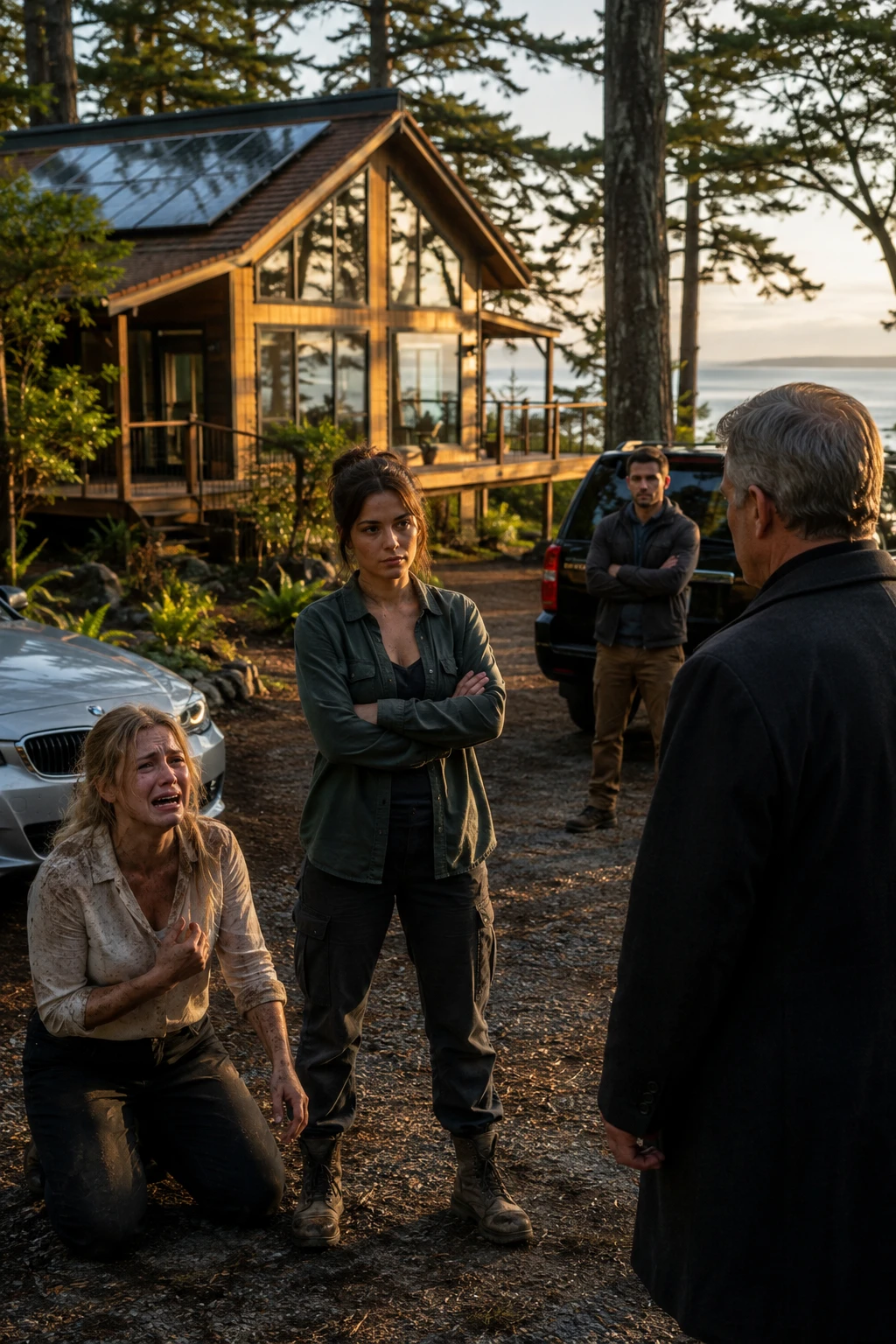
I was trimming lavender when tires shrieked across the gravel drive.
A silver BMW stopped beside the gate.
Olivia stumbled out.
Her blonde hair was tangled.
Her clothes looked slept in.
Mascara streaked both cheeks.
She was shouting into her phone.
“I don’t care what he told you! Dad, come here right now. I found her.”
Then she saw me.
Her gaze moved from my muddy boots to the cabin.
The solar panels.
The workshop.
The company trucks.
The ocean.
“You live here?”
“I built it.”
Her face went white.
“They said you disappeared.”
“Who?”
“Mom and Dad.”
I said nothing.
Olivia swallowed.
“Dad said you failed.”
“Apparently he was wrong.”
Her mouth trembled.
Then everything poured out.
Preston had left her.
The house had become a financial nightmare.
Her father’s investment portfolio had collapsed.
My parents had refinanced property, borrowed against retirement accounts, and poured money into investments they didn’t fully understand.
The money was gone.
“I did everything they wanted!” Olivia cried. “I married the right person. Bought the right house. Drove the right car. I was supposed to be the winner.”
She looked at the ground.
“Now I have nothing.”
Before I could answer, another engine rumbled through the forest.
A black SUV appeared.
Dad.
He stepped out and stared.
At the cabin.
At the workshop.
At me.
He walked toward us.
No greeting.
No apology.
“Maria,” he said, “we need to talk.”
I almost laughed.
“Our financial situation has changed.”
“That’s what Olivia said.”
He frowned.
“Don’t be childish. We’re still your family.”
Family.
The word felt almost obscene coming from him.
Dad drew closer.
“Your mother and I need somewhere to live.”
I stared at him.
“So that’s why you came?”
He hesitated.
Then Ethan emerged from the workshop.
He looked at Dad.
Then at Olivia.
Then at me.
His expression was strange.
“Maria,” he said quietly, “there’s something they haven’t told you.”
Dad’s face turned white.
“What are you talking about?” I asked.
Ethan held a thick envelope.
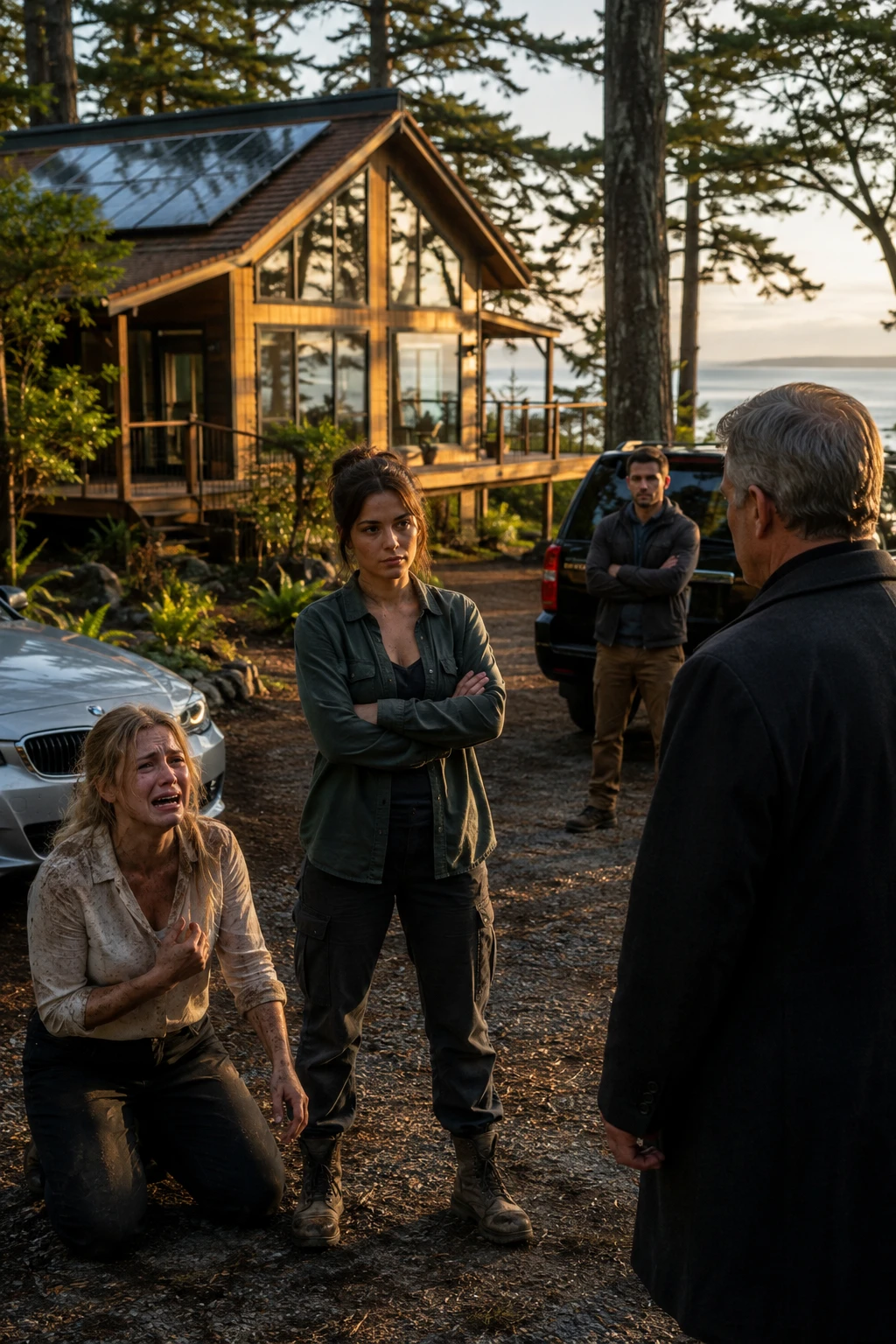
“I got this from our attorney this morning. I didn’t know how to tell you.”
Dad stepped forward.
“Give me that.”
Ethan moved it away.
My pulse accelerated.
“What is it?”
Ethan looked at me.
“Someone filed a claim against Evergreen.”
I felt the ground shift.
“What kind of claim?”
Dad closed his eyes.
Ethan continued.
“Ownership.”
I stared at my father.
“What did you do?”
“Maria—”
“What did you do?”
Olivia backed away.
Dad’s shoulders dropped.
Then he finally admitted it.
Years ago, after my grandfather died, he had inherited a small family trust.
A trust I had never known existed.
The trust had been created by my grandmother, specifically for me.
Not Olivia.
Me.
Grandmother had recognized my interest in engineering when I was a child. She had left money intended for my education and, eventually, “the construction of a home or business of Maria’s choosing.”
Dad had been named temporary trustee until I turned twenty-five.
He never told me.
Instead, he had moved the money.
First into his own investment accounts.
Then into Olivia’s expenses.
Her wedding deposits.
Her car.
And finally—
I looked at her.
“The house?”
Dad couldn’t meet my eyes.
The $150,000 check had come from money that legally belonged to me.
My stomach twisted.
“How much?”
Dad remained silent.
“HOW MUCH?”
Ethan answered.
“Originally? About four hundred and eighty thousand dollars.”
Olivia gasped.
I actually laughed.
Not because it was funny.
Because my brain refused to accept it.
My father had called me a failure while handing my sister money stolen from a trust meant to help me build my future.
But Ethan wasn’t finished.
“The claim against Evergreen is desperate,” he said. “Your father is arguing that because some of the original trust funds were improperly transferred through accounts connected to your early savings, they contributed indirectly to the purchase of this property.”
“That’s insane.”
“I know.”
Dad’s voice broke.
“I was trying to save us.”
“No,” I said. “You were trying to save yourself.”
Olivia suddenly turned on him.
“You told me that money was yours!”
“It was complicated.”
“You said Maria never earned anything!”
Dad snapped, “Enough!”
For the first time, Olivia didn’t shrink.
“No. You made me believe I was better than her.”
Her voice cracked.
“You built my entire life around competing with someone who wasn’t even competing with me.”
Dad stared at her.
Then headlights appeared again.
Another car.
This time a modest gray sedan.
Mom stepped out.
But she wasn’t alone.
An elderly woman emerged from the passenger seat.
I froze.
I knew that face.
Aunt Helen.
My grandmother’s younger sister.
I hadn’t seen her since I was seventeen.
Dad whispered, “Oh, God.”
Helen walked toward us carrying a leather folder.
“I’m guessing Richard finally told you about the trust.”
Nobody spoke.
She handed me the folder.
Inside was my grandmother’s original letter.
Written in blue ink.
My hands trembled as I read.
Maria sees buildings differently. Where others see walls, she sees what holds them together. Give her room to build something no one in this family has imagined yet.
My eyes blurred.
Then I reached the final paragraph.
And everything changed again.
Grandmother had anticipated the possibility that Dad might misuse the trust.
So she had added a condition.
If he concealed, diverted, or misappropriated the funds, control of every asset purchased substantially with that money would transfer to me upon discovery.
I slowly looked at Olivia.
Her house.
Dad’s investment property.
A rental condominium.
Even the BMW Olivia had arrived in.
Helen spoke calmly.
“Your father’s lawyer confirmed the tracing last week.”
Dad sank onto the porch step.
Olivia looked horrified.
“What does that mean?”
Helen looked at me.
“It means Richard didn’t come here because he needs a place to live.”
She paused.
“He came because you now legally control almost everything he has left.”
The forest went completely silent.
Dad stared at me.
For the first time in my life, the man who had always judged my worth was waiting for me to decide his.
I could have destroyed him.
Part of me wanted to.
Instead, I looked at Olivia.
“Do you want your house?”
She blinked.
“What?”
“I’m asking whether you want to keep living there.”
Tears filled her eyes.
“Yes.”
“Then you can. But you’ll refinance it into your own name, make the payments yourself, and never again let Mom or Dad define your value.”
She covered her mouth.
Then I turned to Mom.
She had been crying silently.
“I should have protected you,” she whispered.
“Yes,” I said. “You should have.”
I wasn’t ready to forgive her.
Maybe I never would be.
Finally, I faced Dad.
He looked older than he had thirty minutes earlier.
“What happens to me?” he asked.
Years of pain gathered in my chest.
Every ignored achievement.
Every comparison.
Every insult.
Every empty seat.
I could hear his voice again.
We put our money behind winners.
I crouched so we were eye to eye.
“You were wrong about one thing, Dad.”
He swallowed.
“I never needed you to invest in me.”
I gestured toward the cabin, the workshop, the land, Ethan standing beside me.
“I needed you not to steal from me.”
He closed his eyes.
I stood.
“You’ll return everything the court determines belongs to the trust. After that, what remains of your life is your responsibility.”
“Maria—”
“No.”
My voice was calm.
“You taught me something valuable.”
He looked up.
I repeated the words I had spoken at that dinner years earlier.
“I’ll build myself.”
Six months later, Dad pleaded guilty to financial misconduct connected to the trust and received probation, restitution requirements, and a permanent ban from serving as a trustee.
Mom moved into a small apartment and started therapy.
Olivia sold the oversized house.
Not because I forced her.
Because she wanted to.
She bought a modest townhouse and began working full-time for the first time in years.
We weren’t suddenly perfect sisters.
Real life doesn’t heal that neatly.
But we began having coffee.
Talking without competing.
Learning who we were without our parents narrating the conversation.
As for the recovered money?
I could have spent it on myself.
Instead, I created the Evelyn Carter Building Grant, named after my grandmother.
It funds scholarships and small construction projects for young women entering engineering and skilled trades.
The first recipient was a fourteen-year-old girl who had built a model bridge for her school science fair.
When she showed it to me, she looked embarrassed.
“My parents think this stuff is weird.”
I stared at the bridge.
Then at her.
And for a moment, I was twelve again, holding a gold medal nobody cared about.
I smiled.
“Your parents don’t have to understand it yet.”
She looked worried.
“What if they never do?”
I glanced through the workshop windows toward Evergreen.
Ethan was outside measuring timber for another cabin.
Olivia was helping unload supplies for the scholarship ceremony.
The Pacific flashed silver through the trees.
And I finally understood something my younger self had needed desperately to hear.
Being unseen does not make you insignificant.
Sometimes the people closest to you are simply standing too near your old story to recognize what you’re becoming.
“You keep building,” I told her.
She smiled.
That evening, after everyone left, I stood on the porch while the sky turned orange over the ocean.
Ethan wrapped an arm around my waist.
“You okay?”
I nodded.
For years, I had thought the greatest revenge would be making my father admit I was successful.
I was wrong.
The greatest victory was realizing his opinion had never been the measurement.
I looked at the cabin I had built after losing everything.
The company born from rejection.
The life created from all the pieces my family had once considered worthless.
Dad had spent years investing in appearances.
I had invested in foundations.
And foundations, I had learned, were funny things.
Nobody applauded them.
Nobody photographed them.
Most people never even saw them.
But when the storm came, they were the reason everything worth keeping remained standing.