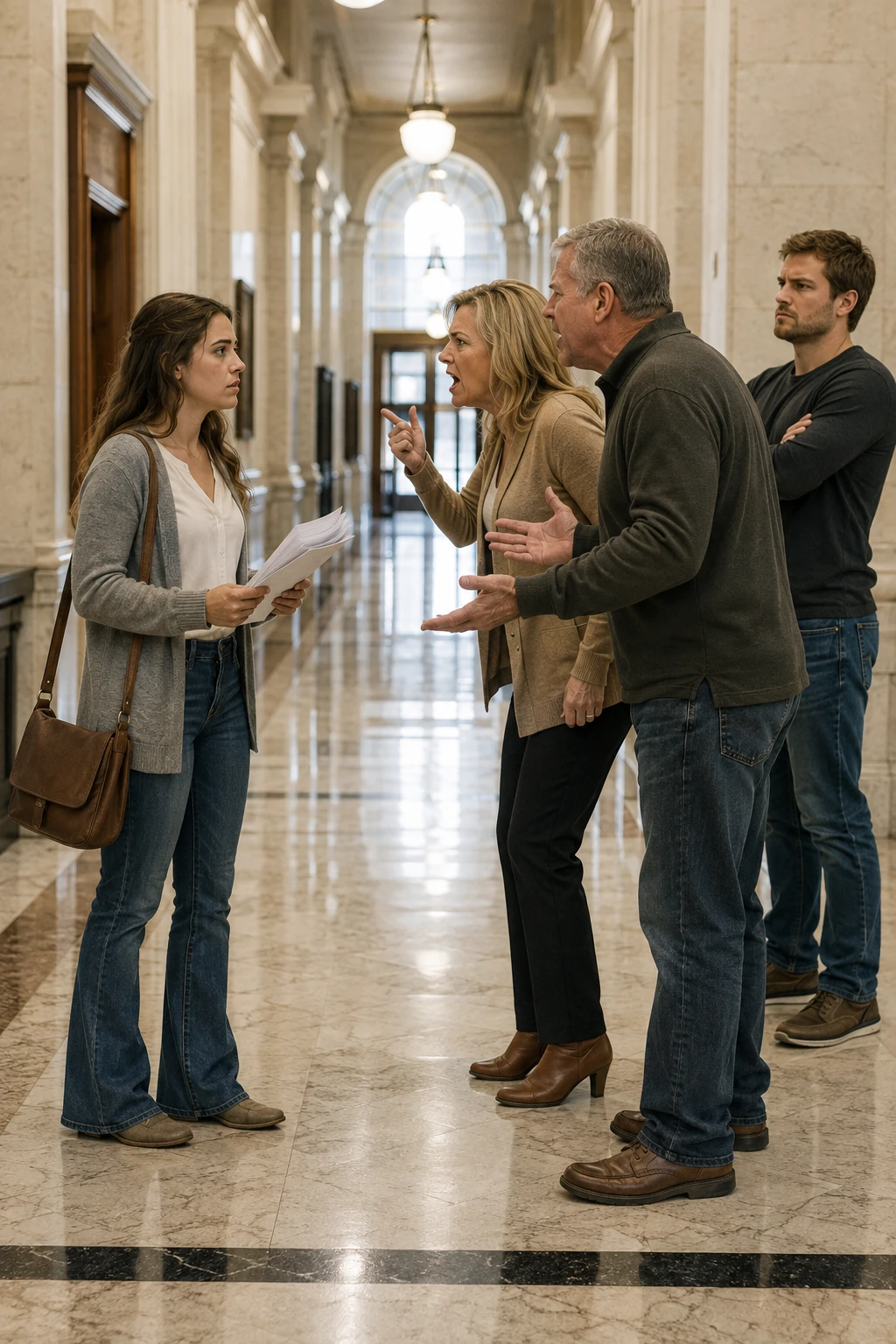
The first time my mother screamed, “You stole his future!”, we were standing in a courthouse hallway with strangers pretending not to stare.
But the moment my life truly split in two happened months earlier, on an ordinary Tuesday afternoon.
I was twenty-two years old, standing on the porch of the little two-bedroom fixer-upper I had bought outside Nashville, holding a bag of drywall anchors in one hand and a paint scraper in the other.
The house was nothing special.
The kitchen cabinets were outdated. The porch leaned slightly left. A long crack ran down the guest-room wall, and one bathroom faucet screamed every time I turned it on.
But it was mine.
Every chipped tile, crooked doorway, and ugly cabinet represented eight years of work.
I had been babysitting since I was fourteen.
Then came lawn mowing.
Tutoring.
Computer repair.
Freelance bookkeeping.
By college, I was working before class, after class, and most weekends.
I earned a full academic scholarship. I graduated without debt. I built a small online bookkeeping business and saved nearly every dollar I could.
At twenty-two, I bought my house.
No trust fund.
No secret inheritance.
No rescue.
That Tuesday afternoon, a man in a gray polo walked up my driveway.
“Evelyn Carter?”
“Yes?”
He handed me a thick envelope.
“You’ve been served.”
I laughed at first.
Then I opened it.
And stopped breathing.
Thomas and Linda Carter versus Evelyn Carter.
My parents.
Suing me.
The complaint accused me of fraud, unjust enrichment, interference with economic opportunity, and—most bizarrely—“breach of familial duty.”
They claimed I had benefited from family resources while deliberately refusing to help my older brother, Mason.
They demanded $250,000.
And my house.
The lawsuit called transferring my home to Mason “restitution for opportunities stolen.”
My phone rang before I finished reading.
Mom.
“What is this?” I asked.
“Don’t use that tone with me.”
“You’re suing me.”
“You know why.”
“No, actually, I don’t.”
Her voice hardened.
“You’ve been selfish toward Mason for years.”
Dad took the phone.
“Settle reasonably, Evelyn, or we’ll see you in court.”
“Settle for what? I worked for everything I have.”
“You sabotaged your brother.”
I nearly dropped the phone.
“How?”
“You never shared what you knew.”
“I offered to help Mason write a business plan.”
I heard movement in the background.
Then Mason shouted, “That house was supposed to be mine!”
I stared at my front door.
My house.
The walls I had painted myself.
The place I had sacrificed vacations, new clothes, dinners out, and sleep to afford.
“Mason, you’re twenty-six and you live in Mom and Dad’s basement.”
“You got secret money from Grandma!”
“What?”
“You heard me!”
“Grandma left both of us two thousand dollars.”
“You’re lying!”
Mom grabbed the phone.
“You stole his future. You knew he was the entrepreneur in this family.”
I laughed bitterly.
“He failed three businesses after you gave him a hundred thousand dollars.”
“He needed support!”
“And I didn’t?”
Silence.
Then Dad said something I would never forget.
“You never needed anything.”
That sentence explained my childhood better than he realized.
When I was fourteen, I asked Dad for forty dollars to join robotics club.
“Money doesn’t grow on trees,” he said. “Earn it.”
That same week, Mason received five hundred dollars for an entrepreneurship camp.
He quit after four days.
At sixteen, I got an eighty-dollar used bicycle for my birthday.
Mason got a new truck because he “needed transportation for opportunities.”
He wrecked it.
They bought him another.
When I earned my scholarship, Mom said, “That’s good, sweetie.”
When Mason got accepted to an expensive private business school, they threw him a catered party.
By graduation, I had fifteen thousand dollars saved.
Mason had more than two hundred thousand dollars in student loans my parents had co-signed.
And somehow, I was the thief.
That evening, I sat on my porch until sunset painted the boards orange.
Then I called my best friend, Naomi.
“My parents are suing me because I’m more successful than my brother.”
She went silent.
Then:
“Please tell me you’re fighting.”
I looked through my open doorway at the house.
“Yes.”
That night I found attorney Daniel Mercer.
He specialized in abusive civil litigation.
I left a message at 11:47 p.m.
“My family wants my house because my brother thinks my life should’ve been his. I want to fight.”
At eight the next morning, Daniel called.
I told him everything.
When I finished, he asked one question.
“Evelyn, do you want to simply win?”
I hesitated.
“Or do you want the court to understand exactly what your family did?”
Something inside me changed.
“I want them to understand.”
Daniel began digging.
And within two weeks, my parents’ story started collapsing.
Their records showed years of financial support for Mason.
Private tuition.
Cars.
Rent.
Business loans.
Credit-card payments.
Marketing expenses.
Equipment.
A failed food-delivery startup.
A failed clothing brand.
A cryptocurrency “consulting business” that lasted six weeks.
My parents had given Mason well over $100,000 in direct support, not counting his education.
Meanwhile, the financial support they had given me after age fourteen could practically fit on one page.
Birthday money.
Christmas money.
And Grandma’s $2,000 inheritance.
Exactly the same amount Mason received.
Then Daniel found the email.
It was from Dad to Mason.
Sent six months before the lawsuit.
Evelyn has done well for herself. Maybe we can convince her to help you get back on your feet.
Mason replied:
She owes me more than help. She has the life I was supposed to have.
When I read it, my stomach tightened.
“They knew,” I whispered.
Daniel nodded.
“They knew you didn’t steal anything.”
“So why sue me?”
“Pressure.”
“For money?”
“Maybe.”
He stared at the printed email.
“But I think there’s more.”
Three months later, we entered court.
Mom wouldn’t meet my eyes.
Dad sat stiffly beside her.
Mason looked relaxed.
Almost smug.
Their attorney argued first.
He described Mason as a “promising entrepreneur whose access to family support and business knowledge had been unfairly obstructed.”
Then he described me as someone who had “leveraged family advantages for exclusive personal gain.”
Daniel leaned toward me.
“Don’t react.”
I whispered, “He’s lying.”
“I know.”
Then their attorney said something that made my blood boil.
“Ms. Carter’s success cannot be viewed separately from the opportunities provided by the Carter family.”
Daniel stood.
“Your Honor, before we respond, we would like to introduce Exhibit 17.”
Dad looked at the document in Daniel’s hand.
His face turned white.
It wasn’t the email.
It was a bank statement.
Daniel approached the witness stand.
“Mr. Carter, do you recognize this account?”
Dad swallowed.
“Yes.”
“Whose account is it?”
“My mother’s.”
My grandmother.
Grandma June.
She had died two years earlier.
Daniel continued.
“Were you executor of her estate?”
“Yes.”
“And did her will leave two thousand dollars each to Evelyn and Mason?”
“Yes.”
Mason leaned back in his chair.
Daniel looked at the judge.
“Your Honor, that is what Mr. Carter told both children.”
My father’s lawyer suddenly stood.
“Objection.”
“Basis?”
“Relevance.”
Daniel smiled slightly.
“Extremely relevant.”
The judge allowed him to continue.
Daniel placed another document beside the first.
“This is a copy of June Carter’s actual will.”
My mother turned sharply toward Dad.
I froze.
I had never seen the will.
Daniel looked at me.
Then back at my father.
“Mr. Carter, please read paragraph twelve.”
Dad didn’t move.
The judge spoke.
“Mr. Carter?”
He lifted the paper.
His hands trembled.
Finally he read:
“‘I leave my residence and all proceeds from its future sale to my granddaughter, Evelyn Carter.’”
My heart stopped.
I stared at Daniel.
“What?”
Nobody answered me.
Daniel continued.
“And what was that residence worth when Mrs. Carter died?”
Dad said nothing.
“Mr. Carter?”
“Approximately…”
He swallowed.
“Three hundred and eighty thousand.”
The courtroom seemed to tilt.
Grandma had left me a house worth nearly $380,000.
Not two thousand dollars.
A house.
I looked at my parents.
Mom looked genuinely shocked.
“Mason?” she whispered.
He stared at the table.
Daniel placed another statement in front of Dad.
“After June Carter died, what happened to the house?”
Dad’s lawyer objected again.
Overruled.
Dad’s voice was barely audible.
“It was sold.”
“For how much?”
“Four hundred and twelve thousand.”
My chest tightened.
“And where did the money go?”
Silence.
Daniel asked again.
“Where did Evelyn Carter’s inheritance go?”
Dad finally looked toward Mason.
And in that instant, I knew.
No.
I whispered, “No.”
Daniel held up the account records.
Grandma’s house had been sold, and more than $300,000 of the proceeds had been transferred into accounts connected to Mason.
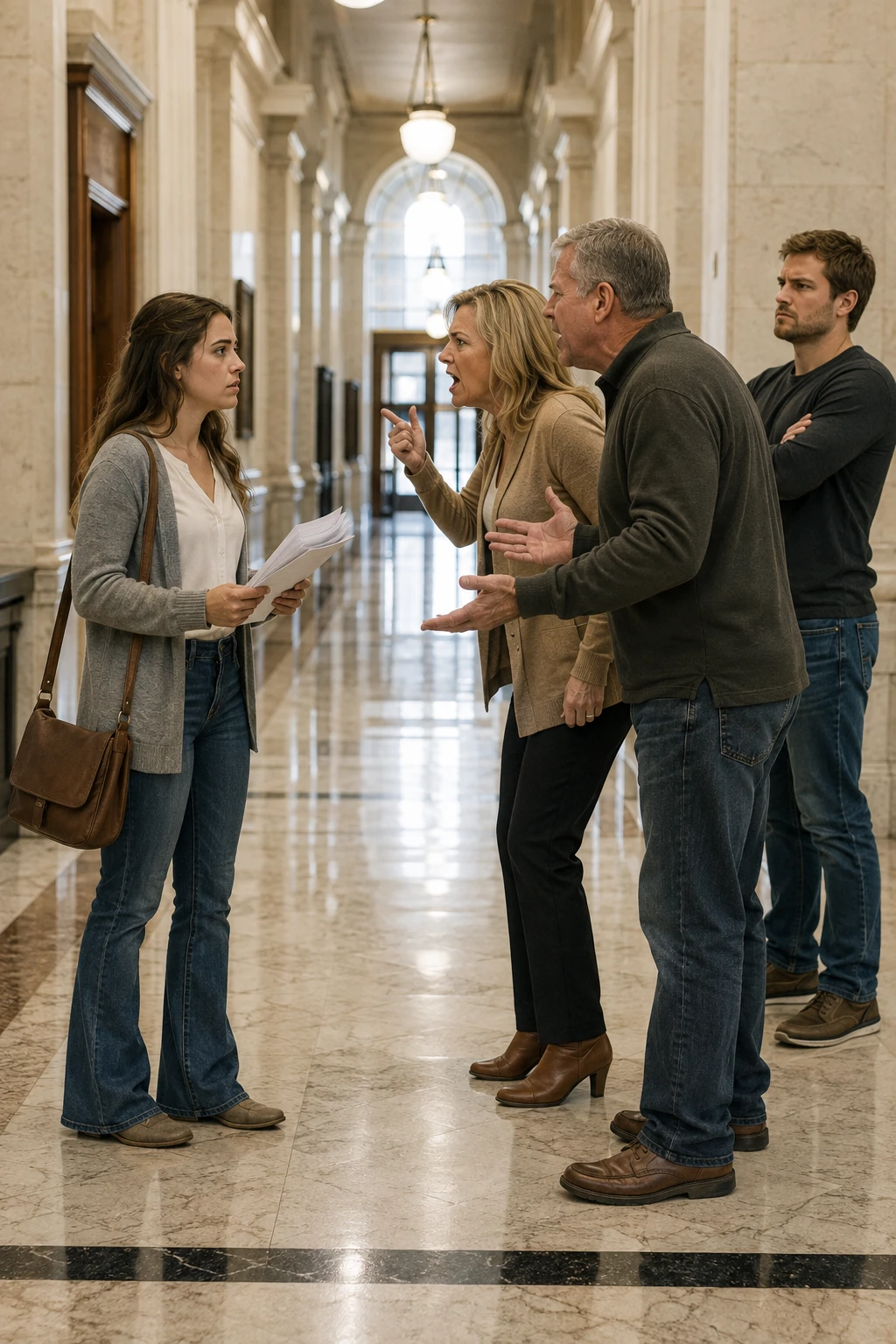
The courtroom erupted.
Mom stood up.
“Thomas!”
The judge ordered everyone seated.
I couldn’t hear anything clearly anymore.
My hands had gone cold.
Daniel leaned closer.
“Evelyn, stay with me.”
I stared at Dad.
“You stole my inheritance?”
He didn’t answer.
Mason suddenly spoke.
“It wasn’t stealing.”
The judge snapped, “Mr. Carter, you will remain silent unless called.”
But Mason couldn’t stop.
“She didn’t need it!”
Those words shattered something in me.
I looked at him.
“What did you say?”
“You always succeed! Everything works out for you!”
Daniel put a hand lightly on my arm.
Mason’s face twisted.
“I had ideas. I had plans. Grandma never believed in me.”
“So you took what she left me?”
“Dad said we’d balance it out later!”
Mom stared at Dad like she had never seen him before.
“You told me June’s estate barely had anything left after medical expenses.”
Dad closed his eyes.
And that was the second shock.
My mother hadn’t known.
At least not all of it.
Dad had lied to her too.
Daniel asked for a short recess.
Outside the courtroom, Mom ran toward me.
“Evelyn—”
I stepped back.
“Don’t.”
“I didn’t know about the house.”
“But you knew about this lawsuit.”
She froze.
“You stood there and demanded my home.”
Her face crumpled.
“I thought—”
“You thought what? That because I managed to build something without you, I should hand it to Mason?”
She had no answer.
Dad came out behind her.
For the first time in my life, he looked old.
“Evelyn.”
I turned away.
He said, “I was trying to keep the family together.”
Daniel actually laughed.
“By committing what appears to be estate fraud?”
Dad flinched.
“You don’t understand.”
“Then explain it.”
Dad looked at me.
“Mason was struggling.”
“And I wasn’t your child?”
“You were strong.”
There it was again.
The excuse they had used my entire life.
You were strong.
As if competence meant I deserved less.
As if being responsible meant I could be robbed.
As if surviving neglect gave them permission to neglect me more.
We returned to court.
Daniel called Mason.
Under oath, the story became worse.
Grandma had always worried about how my parents favored him.
She had secretly changed her will.
She left her house to me because she feared I would otherwise receive nothing.
Dad discovered the change after her death.
Instead of honoring it, he sold the property.
Most of the money financed Mason’s businesses.
When those businesses failed, Dad panicked.
Then I bought my own house.
Mason became furious.
He argued that if Grandma’s property had originally been “family wealth,” then my success meant I had benefited twice.
So they created the lawsuit.
It wasn’t really about my two-bedroom fixer-upper.
It was about making me surrender enough money and property to cover what they had already stolen.
Their plan was breathtaking.
If I settled, they could claim the dispute had been resolved privately.
If I signed over my house, Mason would receive another asset.
And if I accepted money instead, they hoped I would unknowingly sign a release broad enough to waive claims connected to Grandma’s estate.
Daniel had discovered the release language in an early settlement draft.
The judge stared at my father.
“Mr. Carter, are you telling this court that you initiated litigation against the beneficiary of an estate after diverting assets from that same beneficiary?”
Dad looked down.
No one spoke.
Then came the twist nobody expected.
Not even Daniel.
A woman stood at the back of the courtroom.
She was in her late sixties, wearing a navy suit.
“Your Honor?”
The judge frowned.
“Who are you?”
“My name is Margaret Hale.”
Dad’s head snapped up.
He looked terrified.
Margaret held a folder.
“I was June Carter’s attorney.”
Daniel stared at her.
“You drafted the will?”
“Yes.”
Dad whispered, “You said those records were destroyed.”
Margaret looked at him.
“No, Thomas. You hoped they were.”
The courtroom went silent again.
Margaret explained that Grandma had anticipated exactly this possibility.
She had known Dad might try to alter or hide the estate.
So she created a sealed trust document.
A document that would become effective if anyone interfered with my inheritance.
The judge reviewed it privately.
Then looked up.
Her expression had changed.
Under the trust, Grandma had not merely left me her house.
She had placed additional investment accounts worth nearly $900,000 into a protected trust.
But there was a condition.
If Dad administered the estate honestly, the trust would eventually be divided between me and Mason.
If Dad concealed assets, falsified the estate distribution, or attempted to deprive me of my inheritance…
Mason forfeited his entire share.
Everything passed to me.
Mason turned toward Dad.
“What?”
Dad looked sick.
Margaret continued.
“June knew Thomas would sacrifice Evelyn to protect Mason. So she wrote the trust to make that choice impossible without consequences.”
Mason stood.
“You lost me nine hundred thousand dollars?”
The judge ordered him seated.
He ignored her.
“You told me Evelyn stole my future!”
Dad shouted, “I did everything for you!”
Mason stared at him.
And then the final truth exploded into the room.
“I never asked you to steal Grandma’s house!”
Dad froze.
Daniel’s eyes sharpened.
I looked at Mason.
“What?”
Mason’s face drained of color.
“I thought Dad gave me his money. I didn’t know where it came from until last year.”
Dad shouted, “Stop talking!”
But Mason kept going.
“When I found out, I wanted him to fix it.”
I could barely breathe.
“So the lawsuit?”
Mason looked at me.
“He said if we scared you into signing the settlement, nobody would ever find out.”
Mom covered her mouth.
Dad had manipulated all of us.
He had convinced Mom that I was selfish.
He had convinced Mason that I owed him.
He had convinced me that Grandma barely left anything.
And when his lies began collapsing, he turned his children against each other to save himself.
The lawsuit was dismissed.
The judge referred the estate matter for investigation.
Within months, Dad faced civil judgments and criminal charges connected to fraud and misappropriation of estate assets.
Mom filed for divorce.
I recovered the proceeds from Grandma’s house, plus damages.
The trust became mine.
But the strangest part came six months later.
Mason showed up at my house.
No expensive clothes.
No smug expression.
Just jeans, a faded T-shirt, and an envelope.
“I’m not asking for money,” he said immediately.
I stayed in the doorway.
“What do you want?”
He handed me the envelope.
Inside was a cashier’s check.
Twenty-eight thousand dollars.
“What is this?”
“The only money I have left.”
I stared at him.
“Mason—”
“I don’t deserve forgiveness.”
His voice cracked.
“But I benefited from what Dad took from you.”
He looked toward the cracked porch railing.
“I spent my whole life thinking you were lucky.”
I almost laughed.
“Lucky?”
“I know.”
He wiped his face.
“I thought every time you succeeded, it proved I had failed.”
For the first time, he looked like my brother instead of my rival.
“I kept waiting for someone to build my life for me.”
He swallowed.
“And you were right.”
“About what?”
His eyes met mine.
“I never even tried to build one.”
I didn’t forgive him that day.
Maybe forgiveness doesn’t happen in one beautiful moment.
Maybe sometimes it begins with a door left slightly open.
A year later, I renovated the guest room.
I fixed the crack.
Replaced the floor.
Painted the walls.
And above the desk, I framed one piece of paper.
Not the lawsuit.
Not the settlement.
Not even Grandma’s trust.
It was a note Margaret had found inside Grandma’s estate file.
Five words in my grandmother’s handwriting.
“For Evelyn. She builds things.”
I cried when I read it.
Because after years of being told I needed less because I was strong, someone had understood the truth.
I had never been strong because I needed nothing.
I became strong because nobody gave me what I needed.
And for years, my family mistook that strength for permission.
Permission to overlook me.
Permission to take from me.
Permission to hand my victories to someone else.
They were wrong.
My house still wasn’t glamorous.
The porch still leaned a little.
The faucet still made a strange noise if I turned it too fast.
But every morning, I unlocked the front door and stepped into a life no one could claim I had stolen.
Because the truth was simple.
I hadn’t stolen anyone’s future.
I had built my own.
And in the end, the person who tried hardest to take it from me was the one who lost everything.