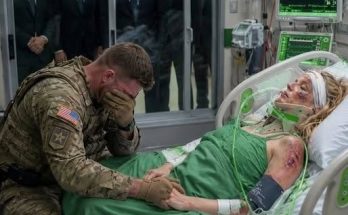
At 2:03 in the morning, I pushed through the emergency entrance of Mercy General still wearing my Army dress uniform, and the first thing I noticed was that nobody asked who I was. The second thing I noticed was worse. A nurse behind the reception desk looked at the silver oak leaves on my shoulders, glanced toward a side corridor, and immediately lowered her eyes. She knew why I had come. More importantly, she knew someone had already told the staff what not to say.
Forty-seven minutes earlier, I had been driving away from Fort Liberty when Chloe’s message reached my encrypted phone. There was no greeting. No explanation. I heard porcelain breaking, a sharp intake of breath, then my daughter fighting to get words past someone who seemed to be holding her down. “Mom… gatehouse… files… Richard knows.” Something struck the floor. The recording ended.
I called Chloe back three times. Nothing. I called the number assigned to her private security detail. Nothing. I considered the Charlotte police for perhaps two seconds, then rejected the idea. Chloe had married into the Sterling family four years earlier. The Sterlings donated ambulances, courthouse renovations, police equipment, campaign money, hospital wings, and enough charitable grants to ensure that powerful people remembered their generosity at convenient moments.
Richard Sterling’s family did not own Charlotte. They did not need to. Influence was cheaper than ownership.
I made one call before turning my car toward Mercy General. I did not call anyone whose salary could be affected by a Sterling donation.
Now, inside the hospital, disinfectant burned my nose. The lobby was nearly empty. A television mounted above a vending machine played a weather report without sound. Two security guards stood near the elevators, but neither one moved toward me. One looked at my uniform and deliberately studied the floor.
“Chloe Sterling,” I said to the nurse.
Her fingers stopped above the keyboard.
“Room?”
She swallowed. “Colonel, I’m not supposed to—”
“Where is my daughter?”
The nurse glanced toward the security guards. One of them gave the smallest shake of his head. She looked back at me. “Observation corridor. One-oh-four B.”
I did not thank her. I was already moving.
My shoes struck the polished floor with a rhythm I had heard thousands of times in headquarters buildings, hangars, command posts, and casualty wards. I knew what controlled fear looked like. The overnight staff had it. Doors closed as I passed. A man in a white coat stepped from a treatment room, saw me approaching, then quietly stepped back inside.
Near the end of the hall, a set of service doors stood open. Beyond them waited a freight elevator.
Two men in navy medical scrubs were pushing a steel transport gurney toward it.
Neither man looked like hospital staff.
The taller one had shoulders that pulled the fabric tight across his back. His hair was cut almost to the scalp, and there was old scar tissue along one ear. The other moved with his hands slightly away from his body, his weight balanced on the balls of his feet. I had spent most of my adult life around soldiers. Those two men were trained to hurt people.
Then I saw who was strapped between them.
For half a second, I stopped breathing.
Chloe’s wrists had been bound with wide canvas restraints. Another strap crossed her waist. Her ankles were secured separately. Her left eye was open; the right had swollen almost shut beneath bruising that spread toward her temple. Dried blood marked her lower lip. The ivory blouse she had worn earlier that evening was torn at the collar and darkened near one shoulder.
She saw me before either man did.
“Mom.”
It came out as a rasp.
I crossed the remaining distance.
The larger man stepped between us. “Authorized transport. You need to back away.”
“Who authorized it?”
He looked past me, as though expecting someone else to answer.
I moved my gaze to Chloe. Her breathing was too fast. Sweat dampened her hairline. A thick square of gauze had been taped across the skin above her left collarbone, and the center of it was turning red.
“Chloe, look at me.”
Her good eye found mine.
“Did you agree to be moved?”
The larger man answered for her. “She’s under psychiatric hold.”
I kept looking at my daughter.
“No,” Chloe whispered.
That single word changed the corridor.
The man reached for my upper arm. I caught his wrist before his fingers touched my sleeve, turned underneath it and forced his elbow into a position human joints were not designed to tolerate. He made a short, startled sound and dropped to one knee.
I released him before the joint broke.
“Do not touch me again.”
The second man shifted his right hand toward his waistband.
My hand went to the holster beneath my uniform jacket.
He stopped.
Nobody moved for several seconds.
“Mom,” Chloe said again.
I stepped around the kneeling man and reached the gurney. Up close, the damage was clearer. There were bruises on both forearms. One fingernail was split. Her cheek felt feverishly warm beneath my palm.
“Who did this?”
She shook her head once.
“Richard?”
Her mouth tightened.
That was enough.
I lowered my voice. “I made the call. You’re not alone now.”
Her expression changed. Not relief exactly. Chloe had gone beyond relief. She looked like someone trying to remain conscious long enough to complete a task.
“The coin,” she whispered.
“What coin?”
Her eyes moved toward the bloody dressing on her shoulder.
“Don’t let them take it.”
Before I could ask another question, a woman spoke behind me.
“I had hoped your arrival might calm her.”
I knew the voice.
I stood and turned.
Beatrice Sterling came down the corridor in a pale cashmere coat that probably cost more than the first car I had ever owned. Even at two in the morning, her silver-blond hair had been arranged perfectly. She carried a slim manila folder beneath one arm. Behind her walked her sons.
Carter Sterling stayed several steps back. His face was pale and damp, and he kept rubbing one thumb across his knuckles.
Richard stood closer to his mother.
My daughter’s husband had changed since I had seen him at Christmas. He looked heavier through the shoulders, harder around the mouth. His silk tie hung loose. There was a faint smear of blood on one cuff.
His knuckles were split.
I looked at his hands for a long time.
Richard tucked them into his pockets.
Beatrice noticed.
“Oh, Sarah,” she said softly. “Please don’t turn this into another military exercise.”
I looked at the restraints around Chloe’s wrists.
“What happened?”
“Your daughter became unstable.”
Chloe made a sound behind me.
Beatrice opened the folder. “Dr. Evans examined her. She is being held for seventy-two hours for evaluation. Richard tried to prevent her from hurting herself. She attacked him.”
I looked at Richard.
“Did she?”
He opened his mouth.
Nothing came out.
Beatrice answered again. “You’re tired. You’ve driven here in the middle of the night. I understand how shocking this looks.”
“How it looks?”
“She had an episode.”
My fingers curled at my side.
“What kind of episode leaves fingerprints on both arms?”
Richard finally spoke. “Sarah, you weren’t there.”
“No. But I’m here now.”
His eyes moved toward his mother.
That frightened me more than if he had shouted.
Beatrice stepped nearer the gurney. “Chloe has been under enormous stress. She developed delusions about Sterling Defense Logistics. She started stealing documents. Tonight she became violent when Richard confronted her.”
Chloe strained against the restraints. “Liar.”
“Sweetheart,” Beatrice said, without warmth, “this is exactly what I mean.”
I bent toward my daughter. “Tell me where you were before the hospital.”
“The estate.”
“The main house?”
She swallowed painfully. “Gatehouse first.”
Richard’s face tightened.
I saw it.
So did Chloe.
“They found out,” she whispered.
“Found out what?”
Beatrice snapped the folder shut. “Colonel Miller, this interrogation ends now.”
I stood.
The larger man in scrubs had regained his feet. He was holding his injured arm against his chest. The second remained near the elevator, watching me.
“Where are you taking her?” I asked.
“Oakridge Institute,” Beatrice replied.
I knew the name. Everyone in that part of North Carolina did. Oakridge was a private psychiatric facility in the mountains, famous for discretion, long-term treatment, and wealthy families who preferred difficult relatives to disappear beyond guarded gates.
Chloe’s fingers tightened against the restraints.
“No.”
Beatrice ignored her.
My daughter looked directly at me.
“Mom. Please.”
There are moments when twenty-six years of command experience disappear and you become only a parent standing beside your injured child. I wanted to tear every buckle from that gurney. I wanted to put Richard Sterling against the wall and ask questions until he gave me answers.
But anger is useful only when controlled.
So I counted exits.
Two service doors. One freight elevator. Four hospital cameras. Two hired men. Richard. Carter. Beatrice.
And whoever else was coming.
Beatrice moved beside Chloe, and for the first time her composure faltered. Her eyes had fallen on the dressing near Chloe’s collarbone.
The gauze was bulging.
Not swelling beneath the skin. Something harder.
Beatrice leaned closer.
“What have you done?”
Chloe turned her face away.
Beatrice’s voice sharpened. “What is under that bandage?”
I stepped between them.
She stopped.
For the first time that night, I saw fear inside Beatrice Sterling’s eyes.
Only for a second.
Then it vanished.
She looked past me toward Richard.
He was staring at Chloe’s shoulder too.
And suddenly I understood something none of them had intended to reveal.
Whatever had happened to my daughter was not only about an argument between husband and wife.
They were searching for something.
And Chloe had brought it into the hospital hidden beneath her own blood.