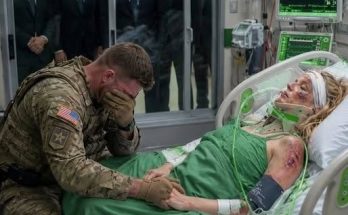
We did not return to my apartment.
By sunrise, Denise had arranged for Chloe to be transferred under military escort to a secure medical facility inside Fort Liberty. The official explanation was that evidence connected to an active federal defense-fraud investigation had created a security concern. The unofficial explanation was simpler: nobody trusted Mercy General anymore.
Chloe slept through most of the first day.
Military surgeons cleaned and closed the wound above her collarbone. Imaging confirmed a fractured cheekbone but no intracranial bleeding. Bruising covered her ribs and upper arms. Her wrists were raw from the restraints.
Every injury came with the same question.
Who did this?
For forty-eight hours, she barely answered.
When nurses entered unexpectedly, she startled. When a cart struck a doorframe in the hallway, she sat upright so fast that one of her monitors pulled loose. At night she woke from shallow sleep and checked the room before remembering where she was.
I sat beside her through most of it.
There are forms of helplessness no military school prepares you for. I had commanded soldiers under fire. I had made decisions knowing people might not come home. I had written letters to parents explaining how their sons and daughters died.
None of that taught me what to do when my own daughter stared at a closed door as though someone might come through it.
On the fourth day, she finally told me Richard had struck her.
She did not dramatize it.
“He saw my bag at the gatehouse,” she said.
We were alone. Morning light came through the narrow reinforced window.
“He asked where I was going. I told him I needed space.”
“And?”
“He already knew.”
“How?”
“Server access logs.”
I let the silence sit.
“He hit you because of the files?”
“The first time, yes.”
I looked at her.
“The first time?”
Chloe turned toward the window.
That was the moment I understood that the hospital had not shown me the beginning of Richard’s violence.
Only the end of whatever secrecy had protected it.
I wanted details. Names. Dates. Photographs. Everything an investigator would want.
Instead I asked, “Why didn’t you tell me?”
Her eyes filled, but the tears did not fall.
“Because you would have come.”
“Yes.”
“That’s why.”
I leaned back.
She knew me too well.
Richard’s family had spent years teaching Chloe that every response carried a price. If she challenged him, she embarrassed him. If she told me, she endangered me. If she left, she lost access to the evidence. If she stayed, she remained inside the house with the people committing the crimes.
She had not been passive.
She had been trapped between bad choices.
Two weeks later, the visible bruises began fading.
The investigation did not.
The data on the micro-SD card was larger than anyone expected. Federal forensic accountants built an isolated network inside a secure briefing suite. Files were duplicated, authenticated, decrypted, cross-referenced and printed until the room smelled permanently of hot toner and stale coffee.
I was allowed inside because some of the contracts involved Army procurement.
Chloe was there because she was the source.
The first afternoon she joined us, she wore a loose gray sweater that covered most of the healing wound on her shoulder. Her right cheek still carried faint yellow bruising.
Three forensic accountants sat across from her.
On the wall, account numbers spread across three monitors.
One analyst pointed toward a series of transfers.
“These payments originate in a rehabilitation procurement program.”
I recognized the project.
It funded advanced prosthetics for service members who had lost limbs.
The money moved from a federal account to a Sterling-controlled contractor, then through two consulting entities, then offshore.
I followed the figures.
Millions.
My stomach tightened.
“This was money for wounded soldiers.”
Chloe nodded.
“That was what made me keep looking.”
“Richard told you?”
“Not directly.”
She reached for a paper cup of coffee but did not drink.
“He complained one night that the margins on government rehabilitation programs were terrible. He said his grandfather had built the company around service, but Richard wasn’t interested in running a charity.”
One accountant frowned. “General Nathaniel Sterling founded the company?”
“Yes.”
I knew the name.
Everyone in uniform above a certain rank did.
General Nathaniel Sterling had been a celebrated battlefield commander decades earlier, then built Sterling Defense Logistics after retirement. He had rarely appeared in public during the last year. Corporate announcements attributed his absence to declining health.
“Does he know about the offshore structure?” I asked.
Chloe shook her head.
“I don’t know.”
“Does Beatrice?”
Her expression hardened.
“Yes.”
No hesitation.
The accountant changed screens.
Hundreds of coded transactions appeared.
Chloe pointed to several entries. “Those are why Richard started drinking more.”
“How do you know?”
“He talked when he drank.”
I studied her.
“What exactly did he say?”
“That his mother had finally convinced the board to move faster. That his grandfather was no longer capable of stopping them. That the family had wasted decades pretending government contracts were about patriotism.”
The room became quiet.
One analyst leaned forward.
“Chloe, there’s something I still don’t understand. Richard’s private terminal used biometric security. We found the authentication protocol in the system records. How did you access it?”
For the first time all afternoon, Chloe smiled.
It was not amusement.
It was the expression she had worn as a child when she solved a problem everyone else considered impossible.
“With packing tape.”
The analyst stared.
“Excuse me?”
“And a graphite pencil.”
I almost told her to start from the beginning.
Then I realized that was exactly what we all needed.
Chloe folded her hands on the table.
“It happened three months before the hospital.”
Her voice slowed.
“Richard had attended a polo-club gala. He came home after midnight. Very drunk.”
As she spoke, the sterile briefing room seemed to disappear from her eyes.
She was back inside Sterling Manor.
Back inside the house where she had learned to listen before opening doors.
“The study was downstairs,” she said. “His private server room was next to it. Richard usually locked the office whenever he left the house, but when he was home he relied on the biometric scanner.”
“How long had you been planning it?” I asked.
“About six weeks.”
My daughter had spent six weeks planning to break into her husband’s computer while sleeping beside him.
I said nothing.
She continued.
Richard had stumbled into the study after the gala, poured himself another scotch and sat in a leather chair without removing his shoes. Chloe waited in the hallway until his breathing became slow and heavy.
On the desk sat his glass.
She had noticed months earlier that Richard often lifted glasses with the same hand and pressed his thumb against the lower curve.
So she took one of her old sketching pencils from a desk drawer.
She had studied art before meeting Richard. There were still boxes of unused supplies in a guest room.
She ground graphite onto a sheet of paper.
Then she returned to the study.
Richard did not move.
Chloe dusted the side of the glass.
A thumbprint appeared.
She pressed transparent packing tape over it.
When she peeled the tape free, the dark spiral of Richard’s fingerprint remained on the adhesive.
One of the forensic accountants shook his head.
“That shouldn’t have worked on a modern scanner.”
“It almost didn’t.”
Chloe looked at him.
“I hadn’t reached the scanner yet.”
That was when Richard shifted in the chair.
The glass trembled in Chloe’s hand.
She froze.
Richard opened his eyes halfway.
For several seconds, husband and wife faced each other across the dark study.
“What are you doing?” he mumbled.
Chloe set the glass down.
“Getting water.”
He stared at her.
Her heart pounded hard enough that she could hear it.
Then Richard closed his eyes.
Within a minute, he was snoring again.
Chloe left the room.
She did not run.
Running would have made noise.
She walked upstairs, entered the guest bathroom and locked the door.
There she pressed the fingerprint tape against her own thumb, testing how the graphite pattern would sit against the skin.
“You improvised a biometric replica,” the analyst said.
“I improvised something that looked enough like one to try.”
“Why your thumb?”
“Heat and pressure.”
The accountant nodded slowly.
Smart.
Dangerously smart.
I looked at Chloe.
“What happened next?”
She rubbed the scar beneath her sweater.
“I waited.”
“For what?”
“For Richard to wake up.”
That answer surprised everyone.
Chloe explained that a sleeping Richard was unpredictable. He might remain in the study for twenty minutes or four hours.
A drunk Richard followed routines.
He eventually woke, cursed because he had fallen asleep in his clothes, and went upstairs.
Chloe heard the bedroom door close.
Then the shower started.
She had timed him before.
Drunk, irritated, wanting only to get into bed, Richard showered quickly.
Approximately three minutes.
“Three minutes?” I said.
“That was all I expected.”
“To access a private server?”
“To start the transfer.”
The lead accountant leaned back.
“You understand that if he had caught you—”
“Yes.”
Her tone ended the sentence.
We all knew what Richard had eventually done after discovering the breach.
Three months earlier, Chloe had known what he might do too.
That had not stopped her.
She waited outside the guest room until the plumbing began to roar through the walls.
Then she ran downstairs.
The private office door stood at the end of a narrow corridor.
Chloe entered.
Locked the door.
Crossed to the terminal.
The biometric scanner glowed beside the keyboard.
Red letters appeared on the monitor.
AUTHENTICATION REQUIRED.
She wrapped the tape around her thumb.
The shower continued upstairs.
She pressed the copied print against the scanner.
A line moved across the screen.
Once.
Twice.
Then red letters appeared.
ACCESS DENIED.
Chloe stopped speaking.
In the briefing room, nobody moved.
I realized my hands had closed into fists.
“How much time?” I asked.
She looked at me.
“Less than two minutes.”