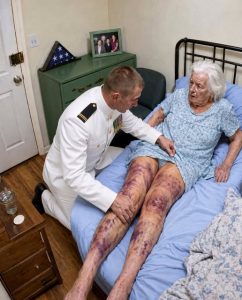
PART 2
Mom held my gaze for several seconds.
Then she smiled.
Not the frightened smile I remembered from childhood when she had tried to reassure me after thunderstorms.
Not the polite smile she gave strangers.
This one was thin.
Controlled.
Dangerous.
“How confused?” she asked.
I glanced toward the hallway.
“Enough to make Abigail confident.”
Mom’s expression hardened.
“And if the doctor believes her?”
“He won’t.”
“You don’t know that.”
“No,” I said. “But I know what he’s going to see.”
I pulled a folded sheet of paper from my pocket.
Mom took it.
Her eyes moved quickly across the page.
Security access logs.
Bank-transfer records.
A list of deleted camera files.
Dates.
Times.
Amounts.
Names.
She looked up.
“You found all this tonight?”
“I found enough.”
She gave the paper back.
“Samuel, there’s something you don’t understand.”
“We’ll talk after the appointment.”
Her fingers closed around my wrist.
Hard.
“No.”
I stopped.
Mom’s voice dropped to a whisper.
“This is bigger than Abigail.”
I stared at her.
From downstairs came the faint sound of a chair moving.
We both froze.
A second later, Abigail called my name.
“Samuel?”
I folded the paper and put it back into my pocket.
Mom released me.
“Go,” she whispered.
I hated leaving her there.
Every instinct told me to take her out of that house immediately, drive straight to a police station, and explain everything.
But instinct is not the same as strategy.
When you know someone has committed one crime, you act.
When you suspect they are connected to something larger, sometimes you wait long enough to see who comes looking.
I locked Mom’s door again.
Then I went downstairs.
Abigail stood in the kitchen wearing my old college sweatshirt.
She had opened a bottle of wine.
Two glasses sat on the table.
“You disappeared,” she said.
“Couldn’t sleep.”
“Jet lag?”
“Something like that.”
She poured me a glass.
I sat down.
The recorder was less than two feet from her knee.
For the next twenty minutes, Abigail performed.
She was exhausted.
She was worried.
She was afraid Mom might hurt herself.
She had sacrificed months caring for her while I was away.
She had missed work.
Canceled plans.
Lost sleep.
And through all of it, she kept glancing at me, measuring whether I believed her.
I nodded in the right places.
Asked gentle questions.
Let her become comfortable.
Then I said, “What happens if Mom refuses the evaluation tomorrow?”
Abigail swirled her wine.
“She won’t.”
“How do you know?”
“Because I’ve already spoken to the doctor.”
I let a second pass.
“What did you tell him?”
“That she’s paranoid. Aggressive. Delusional.”
“And the bruises?”
Abigail’s hand stopped.
Just for a fraction of a second.
Then she smiled.
“She grabs things when she falls.”
“Both wrists?”
Her eyes met mine.
I smiled first.
She relaxed.
“You know how old people are,” she said. “Their skin bruises if you look at them wrong.”
I took a sip of wine.
“And if she tells the doctor you locked her in the room?”
Abigail laughed.
Actually laughed.
Then she leaned back in her chair.
“Samuel, your mother has spent months accusing me of ridiculous things. She told Mrs. Smith I was poisoning her tea. She told the mailman I stole her pension. She told a nurse at the clinic I was keeping her prisoner.”
“Really?”
“She says anything when she’s upset.”
Abigail lifted her glass.
“That’s the advantage of having everything documented.”
I lowered my eyes.
“What do you mean?”
“Doctors’ notes. Neighbor statements. Incident reports.”
“You have incident reports?”
Her smile widened.
“I’ve been preparing.”
That word mattered.
Preparing.
Not coping.
Not reacting.
Preparing.
“For what?” I asked.
She stared into her glass.
Then she said it.
“For the day nobody believes her anymore.”
My pulse slowed.
I had learned during investigations that when someone believes they have won, silence becomes unbearable to them.
They start filling it.
So I said nothing.
Abigail kept talking.
“She could stand in the middle of the street screaming that I murdered someone and nobody would listen.”
She laughed again.
“Nobody is ever going to believe that old woman.”
Under the table, the recorder captured every word.
I smiled.
“You really thought of everything.”
She reached across the table and touched my hand.
“I had to.”
Her fingers were warm.
I wondered whether she could feel my heartbeat.
If she could, she would have noticed how calm it was.
At 7:30 the next morning, Abigail dressed Mom for the evaluation.
She chose a pale blue blouse.
Pearl earrings.
Gray slacks.
Respectable clothes.
Clothes designed to make the entire situation look compassionate.
Mom played her role perfectly.
She stared too long at the refrigerator.
Forgot where she had left her shoes.
Asked what day it was twice.
At breakfast, she called Abigail “Angela.”
Abigail shot me a triumphant look.
I nearly admired Mom’s performance.
Nearly.
Then Abigail grabbed her arm to guide her toward the car.
Mom flinched.
It was tiny.
Automatic.
But I saw it.
So did Abigail.
Their eyes met.
For one second, the performance vanished.
There was pure hatred between them.
Then Mom smiled vaguely.
“Where are we going?”
“The doctor,” Abigail said.
“Why?”
“To help you.”
Mom nodded.
“How nice.”
I drove.
Abigail sat beside me.
Mom sat in the back.
Halfway to the clinic, I noticed a black sedan behind us.
Nothing unusual about that.
Five minutes later, it was still there.
I changed lanes.
It changed lanes.
I took a side road.
It followed.
My hands tightened slightly around the wheel.
Abigail noticed.
“What is it?”
“Nothing.”
I turned into a gas station without signaling.
The black sedan continued past.
I caught only a glimpse of the driver.
Male.
Baseball cap.
Sunglasses.
No plate on the front.
When we reached the clinic, I parked near the entrance.
Mom looked at me in the mirror.
She had noticed the car too.
I could tell.
Abigail had not.
The psychiatric office occupied the third floor of a medical building.
Everything inside was beige.
Beige carpet.
Beige chairs.
Beige walls.
A fish tank bubbled quietly beside the receptionist.
A place designed to make difficult conversations feel harmless.
Dr. Ethan Mercer came out personally to greet us.
He was younger than I expected.
Maybe forty-five.
Silver-framed glasses.
Navy tie.
Calm voice.
He shook my hand.
“Captain Hale?”
“Major,” I corrected.
“My apologies.”
He smiled.
“Thank you for coming.”
Then he turned to Abigail.
His smile changed.
Only slightly.
But enough.
They knew each other better than she had told me.
“Mrs. Hale.”
“Doctor.”
He touched her elbow.
Casual.
Familiar.
Then he looked at Mom.
“And you must be Eleanor.”
Mom stared at him.
“Do I know you?”
Abigail sighed.
“There it is.”
Dr. Mercer gave her a reassuring look.
“We’ll take our time.”
He led us into his office.
I sat beside Mom.
Abigail sat directly across from Dr. Mercer.
That arrangement told me everything.
This was not an evaluation.
It was a presentation.
Abigail began speaking before the doctor even opened his file.
“She has good days and bad days. Lately more bad than good.”
Dr. Mercer nodded.
“Wandering?”
“Twice.”
“Aggression?”
“Some.”
“Paranoia?”
“Constantly.”
Mom stared at the bookshelf.
I said nothing.
Dr. Mercer made notes.
Then he turned to me.
“Major Hale, you’ve been deployed during most of this decline?”
“Yes.”
“So you haven’t witnessed the progression personally.”
“No.”
Abigail relaxed.
Dr. Mercer continued.
“Your wife has been managing an extremely difficult situation.”
“I can see that.”
He nodded sympathetically.
“In cases like this, family members often experience guilt when institutional care becomes necessary.”
I leaned forward slightly.
“Is institutional care necessary?”
“We’re assessing that.”
“But you already mentioned it.”
Dr. Mercer paused.
“Based on the history I’ve received.”
“From Abigail.”
“Yes.”
“Only Abigail?”
A longer pause.
“We have medical documentation.”
I smiled.
“Excellent.”
I reached into my bag.
Abigail looked at me.
“What are you doing?”
“Helping.”
I placed a thick folder on Dr. Mercer’s desk.
“This is Mom’s updated file.”
Abigail’s face changed.
Only for a moment.
Dr. Mercer looked down.
“I believe I already have—”
“That one is incomplete.”
He opened the folder.
The first document was a notarized cognitive evaluation Mom had completed eight weeks earlier.
Perfect score.
The second was a letter from her neurologist stating that she showed no clinical evidence of dementia.
The third was a pharmacy report.
No dementia medication.
No psychiatric medication.
No history of hallucinations.
The fourth was the emergency-room record from six weeks earlier.
Mom had been treated for bruising around both wrists.
The report listed the cause as:
“Fall in bathroom.”
But underneath that was the triage nurse’s note.
PATIENT STATES FAMILY MEMBER RESTRAINED HER.
Dr. Mercer’s eyes stopped.
Abigail leaned forward.
“What is that?”
I ignored her.
The fifth document was a printout of Abigail’s deleted security-camera access logs.
The sixth was the bank-transfer request.
The seventh was a transcript.
I had typed it at four that morning.
Dr. Mercer read one line.
Nobody is ever going to believe that old woman.
His face went pale.
Abigail stood up.
“Samuel, what the hell is this?”
I looked at her.
“The updated file.”
“You recorded me?”
“Sit down.”
Her mouth opened.
For the first time since I came home, she looked genuinely afraid.
Dr. Mercer removed his glasses.
“I think this appointment should stop.”
“No,” Mom said.
Her voice was clear.
Perfectly clear.
She turned toward him.
“No, Doctor. I think it should finally begin.”
Abigail stared at her.
Mom straightened in her chair.
The confused expression disappeared.
“You asked whether I knew you,” Mom said.
Dr. Mercer said nothing.
“I do.”
His face tightened.
Mom continued.
“You came to my house three months ago.”
Abigail went completely still.
I looked at Mom.
“What?”
She kept her eyes on Dr. Mercer.
“You came after Abigail told you Samuel’s deployment had been extended.”
“That’s not true,” Dr. Mercer said.
“You sat in my kitchen.”
“I have never been inside your home.”
“You drank coffee from the blue cup with the cracked handle.”
His eyes flickered.
Mom smiled.
“You hated the coffee.”
I turned to Abigail.
“What is she talking about?”
Abigail grabbed her purse.
“We’re leaving.”
I stood.
“No.”
“Samuel—”
“You’re not taking Mom anywhere.”
“I meant you and me.”
“There is no you and me right now.”
Her face changed.
The sweetness disappeared.
The careful wife vanished.
What remained was colder.
“You have no idea what you’re doing.”
“That’s probably true.”
I pointed toward the chair.
“Sit.”
She didn’t.
Dr. Mercer reached toward his phone.
I watched him.
“Who are you calling?”
“Security.”
“Good.”
I pulled out my own phone.
“I already called the police.”
That was a lie.
But it worked.
Dr. Mercer froze.
Abigail stared at me.
“You what?”
“I sent copies of everything to an investigator before we left the house.”
Another lie.
The best lies are built from things that could already be true.
Then Mom started laughing.
Quietly.
I looked at her.
She wasn’t looking at Abigail.
She was looking at Dr. Mercer.
“Tell him,” she said.
Dr. Mercer swallowed.
“Tell me what?” I asked.
Mom’s smile disappeared.
“The eighty thousand dollars wasn’t the beginning.”
My stomach tightened.
“What was?”
She looked at me.
“The house.”
I said nothing.
Mom continued.
“Your father bought that house before you were born.”
“I know.”
“No. You know he bought it. You don’t know how.”
Abigail sat down again.
Not because I told her to.
Because suddenly she wanted to hear this too.
Mom folded her hands.
“Your father had a business partner.”
I waited.
“His name was Richard Mercer.”
I looked at the doctor.
Dr. Ethan Mercer.
He stared back.
Mom nodded.
“His father.”
The room seemed smaller.
“What business?”
Mom looked toward the door.
For the first time, real fear returned to her face.
“Not here.”
I stepped closer.
“Mom.”
“Samuel, listen to me. Your father left records.”
“Records of what?”
Before she answered, someone knocked on the office door.
Three sharp knocks.
Dr. Mercer looked relieved.
Too relieved.
He moved toward the door.
“Security.”
I grabbed his arm.
“Don’t.”
He looked at my hand.
Then at me.
“Remove your hand.”
Another knock.
This time a man’s voice.
“Doctor?”
I recognized it.
Not the voice itself.
The accent.
The clipped tone.
I had heard it less than an hour earlier.
At the gas station.
The driver of the black sedan had rolled down his window to speak to someone at the next pump.
Same voice.
Mom whispered, “Samuel.”
Dr. Mercer pulled his arm free and opened the door.
The man in the baseball cap stood outside.
No sunglasses now.
Gray hair.
Heavy shoulders.
Scar near his left eyebrow.
He looked at me.
Then at Mom.
Then at Abigail.
“What happened?” he asked.
Nobody answered.
His attention settled on the folder.
His expression changed.
He stepped into the room and shut the door behind him.
“Who is he?” I asked.
Abigail whispered, “Samuel…”
The man smiled.
“I think your wife would rather I didn’t answer that.”
I took one step toward him.
He didn’t move.
Military posture.
Not active duty.
Former.
Maybe law enforcement.
Maybe private security.
Maybe something worse.
“Mom?”
She looked at the man.
“I told you they would find out eventually, Robert.”
Robert.
He sighed.
“You always were stubborn, Eleanor.”
My mother stood.
Her hands were shaking.
But her voice wasn’t.
“You locked me in that room because I found the ledger.”
Abigail snapped, “I did not lock you in there because of some stupid ledger.”
Silence.
Abigail realized what she had done.
Mom turned slowly toward her.
“Thank you.”
Abigail’s face drained of color.
My recorder was running in my shirt pocket.
Every word.
I looked at Robert.
“What ledger?”
He smiled at me.
“Your father’s.”
“What’s in it?”
“Names.”
“What names?”
“People who paid him.”
“For what?”
Mom answered.
“Silence.”
A cold pressure formed behind my ribs.
“My father was an accountant.”
“No,” Mom said.
“He was a fixer.”
I stared at her.
She continued.
“Businesses. Judges. Contractors. Police. Anyone who needed money moved without questions being asked.”
“That’s impossible.”
“I wish it were.”
“My father died twenty years ago.”
“And some of the people he protected are still alive.”
Robert looked at Mom.
“You should have burned it.”
“I tried.”
“But you didn’t.”
“No.”
“Where is it?”
Mom smiled.
“That’s why Abigail couldn’t get it out of me.”
I looked at my wife.
She had stopped pretending entirely.
Her eyes were flat.
“You hurt her for a book?”
Abigail whispered, “You don’t understand.”
“Then explain.”
She looked toward Robert.
Robert shook his head.
That was all.
One small movement.
But Abigail obeyed.
There it was.
The real power in the room.
Not Abigail.
Not Dr. Mercer.
Robert.
I moved closer to Mom.
“We’re leaving.”
Robert stepped between us and the door.
“No.”
I looked at him.
“You should move.”
He smiled.
“You’ve been home less than twenty-four hours, Major. Don’t make this worse.”
My pulse stayed steady.
“You followed us.”
“Yes.”
“You deleted the camera footage?”
“No.”
“Abigail did.”
“Yes.”
“The transfer?”
“She was supposed to move the money.”
“Where?”
Robert looked at me for several seconds.
Then he laughed softly.
“You really don’t know, do you?”
“Know what?”
He looked at Mom.
“Tell him.”
Mom said nothing.
“Tell me what?”
Abigail covered her face with both hands.
Dr. Mercer backed away from his desk.
Robert’s smile disappeared.
“The eighty thousand dollars belongs to you.”
I stared at him.
“What?”
“It came from an account in your name.”
“That’s impossible.”
“Is it?”
“I’ve never had eighty thousand dollars sitting anywhere.”
“You’ve had considerably more than that.”
My mouth went dry.
Mom closed her eyes.
I turned to her.
“Mom.”
She whispered, “Samuel…”
“How much?”
She didn’t answer.
“How much?”
“Your father left you money.”
“How much money?”
Robert answered.
“Four-point-two million.”
The words didn’t make sense.
They hung in the air like a foreign language.
I laughed once.
Not because it was funny.
Because my brain rejected it.
“My father left me nothing.”
“Officially,” Mom said.
I stared at her.
“You told me he died in debt.”
“I had to.”
“You lied to me for twenty years?”
“To keep you alive.”
The anger came fast.
“Don’t.”
“It’s true.”
“Don’t turn this into some protection story.”
“Samuel—”
“You let me enlist. You watched me struggle through college. You watched me work two jobs.”
“I know.”
“And there was four million dollars?”
“I couldn’t touch it.”
“Why?”
“Because the moment I did, they would know I had the ledger.”
Robert sighed.
“This is getting tedious.”
He reached inside his jacket.
I moved instinctively.
His hand came out holding a phone.
Not a weapon.
He placed it on Dr. Mercer’s desk.
On the screen was a photograph.
My father.
Much older than he had been when he died.
I stopped breathing.
The date stamp on the image was from eleven months ago.
My father had died twenty years ago.
At least, that was what I had believed every day of my adult life.
I picked up the phone.
“No.”
Mom whispered my name.
The picture showed a gray-haired man leaving a hotel.
Same crooked nose.
Same scar under the chin.
Same habit of wearing his watch too high on his wrist.
My father.
Alive.
I looked at Mom.
“You said you identified his body.”
She began to cry.
Quietly.
“I identified a body.”
The distinction hit me like a bullet.
I turned toward Robert.
“Where is he?”
Robert smiled.
“That depends.”
“On what?”
“On whether Eleanor gives us the ledger.”
I lunged at him.
Years of training moved faster than thought.
I caught his shirt.
Drove him backward.
His shoulder struck the wall.
Dr. Mercer shouted.
Abigail screamed.
Robert didn’t fight me.
That scared me more than if he had.
He simply looked into my eyes.
Calm.
Almost amused.
Then my phone rang.
I released him.
Unknown number.
I answered.
Silence.
Then a voice.
Older.
Rougher.
But unmistakable.
“Samuel.”
Every muscle in my body locked.
I had not heard that voice since I was seventeen.
I could still remember it calling from the garage.
Asking me to hold a flashlight.
Telling me not to tell Mom about the broken window.
Laughing when I burned hamburgers at my first barbecue.
My father.
“Dad?”
Mom covered her mouth.
Robert straightened his jacket.
The voice on the phone sighed.
“You weren’t supposed to come home yet.”
I stared at everyone in the room.
Abigail.
Mercer.
Robert.
Mom.
Every face contained a different secret.
“Where are you?”
“That doesn’t matter.”
“It matters to me.”
“Listen carefully.”
“No. You listen to me. Someone locked Mom in a room. Someone hurt her. Abigail tried to get control of her money, and now I find out you’re alive?”
Silence.
Then my father said something I did not expect.
“Abigail was following my instructions.”
I looked at my wife.
Her eyes filled with tears.
I almost dropped the phone.
“What?”
“She wasn’t supposed to hurt Eleanor.”
Abigail whispered, “I didn’t.”
Mom laughed bitterly.
“You held the door shut.”
“I was trying to keep you from calling Samuel.”
“You bruised my wrists.”
“That was Robert.”
Everyone looked at him.
Robert shrugged.
“She fought.”
My vision narrowed.
My father continued speaking.
“Samuel, I need you to stay calm.”
“You lost the right to tell me what to do twenty years ago.”
“I know.”
“No. You don’t.”
“The ledger can destroy people.”
“Then maybe they deserve to be destroyed.”
“You sound like me when I was your age.”
“I am nothing like you.”
“I hope not.”
For the first time, there was something in his voice that sounded like regret.
Then he said, “Your mother never had the ledger.”
I looked at Mom.
She froze.
“What?”
“She lied.”
Robert turned sharply toward her.
My father continued.
“Eleanor found the safe. She found the account. But the ledger was already gone.”
“Who took it?”
Another pause.
Then my father said, “You did.”
The room vanished.
For half a second, I was somewhere else.
Seventeen years old.
Rain outside.
My father shouting downstairs.
A metal box open on his desk.
Papers scattered across the floor.
Me grabbing something.
Running.
But the memory disappeared as quickly as it came.
I pressed the phone against my ear.
“I don’t know what you’re talking about.”
“Yes, you do.”
“No.”
“You just don’t remember.”
My mother stood.
“Stop.”
My father ignored her.
“You found me in the study the night before I disappeared.”
“Stop,” Mom said again.
“You saw what was in the safe.”
“No.”
“You took the ledger because you thought it was evidence.”
My head began to pound.
Images flashed.
A black cover.
Red stitching.
Names written in narrow columns.
My father grabbing my shoulder.
Mom screaming.
A car outside.
Blood on the kitchen floor.
I stumbled backward.
Abigail reached for me.
I slapped her hand away.
“Don’t touch me.”
My father said, “You hid it.”
“Where?”
“That’s what everyone has spent twenty years trying to discover.”
Mom stepped closer.
“Samuel, hang up.”
I looked at her.
“What happened that night?”
Her face broke.
“Please.”
“What happened?”
Robert answered.
“Your father was supposed to die.”
My father said, “Robert.”
But Robert kept talking.
“Your mother made a deal instead.”
“What deal?”
Mom’s lips trembled.
Robert pointed toward me.
“She gave them you.”
Silence.
I looked at Mom.
She shook her head.
“No.”
Robert smiled.
“She promised you would never remember what you saw.”
“That isn’t what happened.”
“She sent you away.”
“I sent him to his aunt.”
“She drugged you.”
“No.”
My breathing stopped.
Mom whispered, “Samuel…”
I touched the side of my head.
Suddenly, an old memory surfaced.
A hospital room.
A doctor asking me my name.
Mom sitting beside the bed.
Telling me I had been in a car accident.
But I had never remembered the accident itself.
I had only remembered waking afterward.
I looked at her.
“There was no car accident.”
She began crying harder.
I knew before she answered.
“No.”
The truth settled over the room.
Heavy.
Ugly.
My father alive.
My mother lying.
My wife conspiring.
A psychiatrist involved.
Millions hidden.
A ledger people had been searching for most of my life.
And somewhere beneath all of that—
a missing piece of my own memory.
My phone vibrated.
A text message.
Unknown number.
A photograph loaded.
I almost didn’t understand what I was seeing.
Then my blood turned cold.
It was a photograph of my childhood bedroom.
Taken recently.
The wallpaper had been removed.
A section of drywall had been cut open.
Inside the wall was a narrow metal compartment.
Empty.
Under the photograph was one sentence.
WE FOUND WHERE YOU HID IT.
Then another message arrived.
BUT SOMEONE GOT THERE FIRST.
I stared at Mom.
She was staring at her own phone now.
Her face went white.
“What?” I asked.
She slowly turned the screen toward me.
It was a security image from our house.
Timestamped six minutes earlier.
Someone had entered through the back door.
A woman.
Long gray coat.
Dark hair.
Carrying a leather case.
I didn’t recognize her.
Mom did.
Her knees nearly gave way.
“No,” she whispered.
“Who is she?”
Mom stared at the photograph.
Robert stepped behind me.
For the first time since I met him, he looked frightened.
Dr. Mercer whispered, “That can’t be possible.”
Abigail said nothing.
I looked from face to face.
“Who is she?”
Mom lifted her eyes to mine.
And said the one sentence that made every lie before it seem small.
“Samuel…”
Her voice broke.
“That woman is your sister.”
I laughed.
I couldn’t help it.
“I don’t have a sister.”
Mom shook her head.
“Yes, you do.”
The office door opened behind us.
A receptionist stood there, pale and confused.
“Dr. Mercer?”
Nobody answered.
She swallowed.
“There are police downstairs.”
Robert moved first.
He grabbed his phone.
Abigail stood.
Dr. Mercer backed toward a second door.
Mom caught my sleeve.
“Samuel, we have to go home.”
I stared at her.
“To meet the sister I apparently forgot?”
“She didn’t come to meet you.”
“How do you know?”
Mom looked at the photo again.
“Because if she has come back…”
Her voice dropped almost to nothing.
“…then she found the ledger.”
The fire alarm suddenly began screaming.
Red lights flashed in the ceiling.
People shouted in the hallway.
Robert swore.
Dr. Mercer opened the back door.
Abigail grabbed her purse.
Mom pulled me toward the hallway.
But I stood still.
Because underneath the fire alarm, my phone rang again.
Unknown number.
I answered.
A woman whispered,
“Sammy?”
Nobody had called me that since I was a child.
My hand tightened around the phone.
“Who is this?”
She laughed softly.
“You really don’t remember me.”
My mother shook her head violently.
“Hang up.”
The woman continued.
“I have Dad’s ledger.”
Robert rushed toward me.
I stepped away.
“And?”
“And everyone is lying to you.”
I looked at Mom.
At Abigail.
At Mercer.
At Robert.
“Who are you?”
There was a pause.
Then the woman said,
“My name is Rebecca.”
A childhood memory exploded behind my eyes.
A little girl sitting beside me beneath the stairs.
Her finger pressed to her lips.
A red ribbon in her hair.
A whisper.
Don’t tell Dad where I hid it.
I stopped breathing.
Rebecca said one final sentence.
“Come home alone, Sammy.”
Then the line went dead.
…If you want to know what happened next, please type “YES” and like for more.