There are pieces of the next forty minutes I remember with unbearable clarity and others that are simply missing. Trauma does that. It preserves a scrap of blue plastic caught against a drain while erasing whole stretches of time. It gives you the sound of rain striking a metal dumpster but takes away the moment you stopped believing someone would come through the door.
I remember shouting David’s name.
Not Eleanor’s.
Not Maya’s.
David’s.
I called for a dead man because he was the person who had always come when I needed him.
The alley gave me rain in reply.
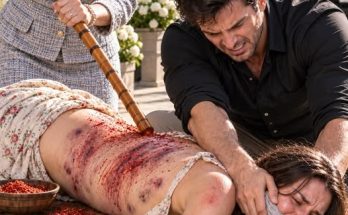
My back rested against cold brick. My dress had ridden above my knees. Water ran beneath my hips. I had lost both shoes by then, though I could not remember removing the second one. My phone lay several feet away, close enough to see and impossibly far to reach during a contraction.
I pushed because there was nothing else to do.
Pain narrowed the world until it contained only breath, pressure, and the desperate knowledge that my son was trying to enter a place that could kill him.
“Stay with me,” I kept saying.
He had never been anywhere else.
Still, I said it.
“Stay with me, baby. Stay with me.”
The words gave me a rhythm.
Between contractions, I crawled toward my purse.
My knees slipped twice on the pavement.
I found my phone beneath a packet of tissues. Rain had made the screen erratic. I wiped it on my dress and tried the emergency button again.
Nothing.
I pressed harder.
The screen flashed, went dark, then came back.
“Come on.”
My hands were so cold they felt disconnected from me.
I finally managed to open the call screen.
Before I could dial, another contraction struck.
The phone slid away.
I screamed through clenched teeth and pushed.
Something shifted.
Instinctively, I reached down.
I felt the shape of my baby’s head more clearly now.
Every childbirth class had warned us not to panic if things progressed quickly.
Those classes had taken place in a warm hospital conference room.
David had sat beside me stealing crackers from my packet.
This was not the situation they had described.
I heard the side door rattle once.
Hope shot through me.
“Maya!”
I shouted until my throat burned.
“Help me!”
The handle moved again.
Then stopped.
I later learned that Arthur had ordered a staff member to lock that entrance and had taken Maya toward the front of the building after she threatened to call the police. By the time she got outside and ran around the block, an ambulance had already arrived.
But at that moment I knew none of it.
All I knew was that the door remained shut.
Something inside me changed.
I wish I could describe it as courage.
It was not.
Courage suggests a person has choices and takes the difficult one.
I had no choice.
There was only survival.
I pulled off my coat, spread it beneath me as best I could, and tried to remember every instruction the childbirth nurse had given us.
Do not pull.
Support the head.
If the cord is around the neck, do not panic.
Keep the baby warm.
Warm.
The word nearly made me laugh.
My teeth were chattering.
Rainwater ran from my hair onto my lips.
Another contraction.
I screamed and pushed.
The pressure became enormous, then suddenly changed.
My son’s head slipped into my hands.
For a second the sight terrified me so completely that I forgot to breathe.
Dark wet hair.
A tiny face turned sideways.
Still attached to me.
Still coming.
“Oh God.”
My hands trembled beneath him.
“Okay. Okay.”
I did not feel okay.
I was speaking to both of us.
I checked his neck with numb fingers.
No cord.
Relief nearly made me collapse.
Then another contraction came.
I pushed once.
His shoulders turned.
His body slid into my hands so quickly I nearly lost him.
I caught him against my stomach.
For one impossible second there was no sound.
The rain vanished.
The funeral vanished.
Eleanor and Arthur vanished.
The whole world compressed into a small wet body lying motionless against mine.
“No.”
I rubbed his back.
“Come on.”
Nothing.
“No, no. Please.”
I cleared his mouth with my finger as we had been taught.
I rubbed harder.
“Baby, please.”
Then he drew a breath.
His face tightened.
A thin cry rose between us.
I began sobbing.
Not delicately.
Not quietly.
I bent over him, laughing and crying at once while his voice strengthened.
“That’s right,” I whispered. “Be angry.”
He screamed.
“Be as angry as you want.”
I pulled him beneath my soaked dress and coat, pressing his skin against mine.
His cord still connected us.
I did not touch it.
His body felt terrifyingly small.
I wrapped every dry piece of fabric I could find around him, which amounted to almost nothing. My own skin was the only real warmth available.
I looked toward the mouth of the alley.
“Help!”
My voice cracked.
“Somebody help me!”
No answer.
I shouted again.
My head began to feel light.
Blood mixed with rainwater beneath me, diluted into pale red streams that disappeared toward the drain.
I knew enough to be afraid.
I held my son tighter.
“Not yet,” I told myself.
I had buried one person that day.
I would not allow two more deaths to be added before sunset.
A truck engine rumbled somewhere nearby.
I screamed.
The engine continued.
“HELP!”
Brakes squealed.
Silence.
Then footsteps.
A man in a reflective municipal jacket appeared at the alley entrance carrying a black trash bag in one hand.
He saw me.
The bag fell.
For several seconds he simply stared.
I must have looked unreal: barefoot, drenched, bleeding, sitting on concrete in funeral clothes with a newborn against my chest.
“Call an ambulance,” I said.
That broke his paralysis.
He grabbed the radio clipped to his jacket, then seemed to think better of it and pulled out his phone.
“Jesus. Ma’am, don’t move.”
I laughed once.
“I wasn’t planning to.”
He came closer, then stopped when he saw the cord.
His face went pale.
“Is the baby breathing?”
As if offended by the question, my son cried again.
The man exhaled so sharply his shoulders dropped.
“Yes,” I said. “He’s breathing.”
He removed his waterproof work jacket and handed it to me.
I wrapped it around the baby.
“What’s your name?”
“Clara.”
“I’m Dennis.”
“Dennis, I’m cold.”
“I know. They’re coming.”
“Tell them newborn.”
“I did.”
“Tell them we’re both cold.”
“I told them.”
“Tell them I’m bleeding.”
His eyes dropped to the pavement.
“I told them that too.”
He crouched several feet away, helpless but unwilling to leave.
That mattered.
After being discarded by people who called themselves family, the first person who stayed with me was a stranger collecting municipal waste.
Sirens reached us minutes later.
I had heard ambulances hundreds of times in Boston.
I had never understood how beautiful that sound could be.
Two paramedics ran into the alley carrying equipment. A third followed with blankets.
They moved quickly without seeming rushed.
One knelt beside me.
“I’m Rosa. I’m going to take care of you and your baby. Can you tell me how long ago he was born?”
“I don’t know.”
“Five minutes?” Dennis offered. “Maybe seven.”
Rosa nodded.
“Good. Clara, keep looking at me.”
The second paramedic checked the baby.
“He’s got good color.”
Those four words nearly broke me.
They clamped and cut the cord, wrapped my son in warmed blankets, placed an oxygen cap near him, checked his pulse, and then turned their attention to me.
When they lifted me onto the stretcher, I panicked.
“My baby.”
“He stays with you.”
“Do not take him away.”
“We won’t unless we have to.”
“I mean it.”
Rosa rested one gloved hand on my shoulder.
“I hear you.”
The ambulance doors closed.
Heat blasted from the vents.
My whole body began shaking.
As we pulled away, I saw the funeral home through the rear window.
People had gathered beneath the front awning.
Black clothes.
Umbrellas.
Faces turned toward the sirens.
I thought I saw Maya running toward the ambulance.
Then the vehicle turned the corner.
At the hospital, everything became white lights and questions.
Name.
Age.
Due date.
Allergies.
Time of birth.
Prenatal complications.
Had I fallen?
Had anyone hurt me?
That question brought me fully awake.
The nurse looked at the marks beginning to darken around my upper arms.
“Those bruises,” she said gently. “How did they happen?”
I looked toward the bassinet where my son was being examined.
“My brother-in-law.”
The nurse stopped writing.
“Your brother-in-law grabbed you?”
“He threw me outside.”
Her expression changed.
“Were you outside when you delivered?”
“Yes.”
“Was anyone with you?”
“No.”
She set down the pen.
“Clara, do you want us to contact the police?”
I closed my eyes.
Not because I intended to protect Arthur.
Because I was exhausted beyond rage.
Because David’s body was still at the funeral home.
Because I had not even chosen my son’s name.
“Document everything,” I said.
The nurse studied me.
“Everything?”
“The bruises. The temperature when I arrived. Where I was found. What I told you.”
“Yes.”
“I’ll decide the rest later.”
She nodded once.
“I’ll make sure it’s recorded.”
The pediatrician examined my son for what felt like hours and was probably fifteen minutes. He had been chilled but responded quickly to warming. His breathing was strong. His heart sounded normal. There were no obvious signs that the fast delivery had harmed him.
“He’s a remarkably sturdy little guy,” the doctor said.
I stared at him.
“Sturdy.”
“It’s a compliment.”
A laugh escaped me.
The doctor smiled.
“You’re both lucky.”
I looked at the bruises around my arms.
Lucky was not the word I would have chosen.
When they finally placed my son against my chest again, the room had quieted.
Rain streaked the hospital window.
His eyes were closed.
His mouth made small searching movements against the blanket.
I touched his cheek with one finger.
“Leo,” I whispered.
The name had been on our list.
David liked it.
He said it sounded like someone who would know his own mind.
“Leo David,” I said.
My throat closed around the second name.
A nurse standing beside the bed pretended to adjust the IV tubing while I cried.
Later that night, Maya arrived.
Her hair was still damp.
She had changed clothes, but there was a dark bruise forming along one wrist.
The moment she saw Leo, she covered her mouth.
Then she came to my bedside and wrapped both arms around me.
“I am so sorry.”
I held her.
“Did they finish the funeral?”
She pulled away.
“Clara—”
“Did they?”
Her eyes filled.
“Yes.”
I looked toward the window.
I had not said goodbye.
That fact entered me slowly.
While my husband was being carried from the funeral home, I had been bleeding in an alley behind it.
Maya sat beside me.
“I tried to get outside. Arthur took my phone. The funeral director called from the front desk, but by the time they found you, the ambulance was there.”
“Eleanor?”
“She left after the burial.”
“Did she ask about us?”
Maya said nothing.
I looked at her.
“Did she ask whether the baby survived?”
The pause was answer enough.
Something went quiet inside me.
Not numb.
Precise.
I reached for my purse, which Dennis had apparently handed to one of the paramedics.
The contents had been dried and placed in a plastic hospital bag.
I searched the side pocket.
My fingers closed around a cream-colored card.
Robert Haines, Attorney at Law.
I turned it over.
On the back, in David’s handwriting, were five words I had never noticed before.
Clara — call him before anyone.
I read them twice.
Then I picked up my phone.
Click here to continue reading: PART 4: Two Days After Losing Everything, I Found the Paper Trail David Had Quietly Left Behind to Protect Our Son
The Day We Buried David, His Family Began Dividing His Life Before My Body Betrayed Its Last Fragile Calm
Part 3 of 12