Chapter 1: The Invisible Boy
It started on a Sunday—the kind of quiet, sun-drenched Sunday that feels like the whole world is moving a little slower before the crushing weight of Monday arrives. The air smelled of salt and distant rain, a deceptive calm before a storm I didn’t know was brewing.
My name is Luke. I’m thirty-eight, divorced, and navigating the beautifully complex challenge of raising my ten-year-old son, Caleb, entirely on my own.
Caleb is the quiet type. He is a boy who loves books, intricate charcoal drawings, astrophysics, and anything that allows him to slip seamlessly into the vast, vibrant corridors of his imagination. Back then, he still clung to the innocent belief that adults were fundamentally fair, and that family was a sacred word meaning people who would unconditionally make room for you at their table.
That belief began to fracture at a family lunch I hadn’t even planned to attend.
My younger brother, Gavin, had recently secured a promotion to senior partner at his corporate law firm, and he had decreed that we would celebrate at a notoriously overpriced, pretentious waterfront restaurant. Gavin had always worn his ambition like a heavy cologne. He was very proud of being an attorney. Very, very proud. He possessed the exhausting talent of weaving the phrases “my firm” or “one of my high-net-worth clients” into almost any conversation, whether we were discussing the weather or the price of gasoline.
His wife, Naomi, was a matching bookend. She had masterfully refined the dark art of delivering cruel, deeply personal insults with a dazzling, Crest-white smile, subsequently gaslighting anyone who took offense by sighing that they were simply “too sensitive.”
Caleb and I had originally blocked out that Sunday for the natural history museum. Then, my mother, Eleanor, called.
“Luke, your brother would really appreciate it if you came by, even if it’s only for an hour to toast him,” her voice crackled through the phone, layered with that familiar, maternal guilt-trip.
I hesitated, rubbing the bridge of my nose. “Mom, Caleb and I have tickets for the space exhibit…”
She didn’t miss a beat. “Luke, please. He’s still your brother.”
That single sentence had been weaponized against me so many times in my life that I already knew the choreography of this dance. So, against my better judgment, I surrendered. I pulled a crisp collared shirt from the closet, helped Caleb button up his favorite navy blue cardigan, and drove nearly forty-five minutes down the winding coastal highway toward the restaurant.
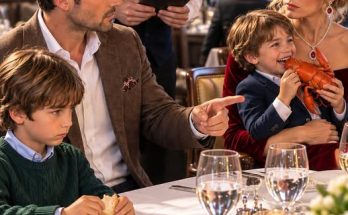
The establishment looked exactly like the sort of sterile, high-status place Gavin would select. Crisp white linen tablecloths. Floor-to-ceiling glass panes overlooking a marina filled with yachts. Servers moving with military precision in stark black uniforms. There was absolutely no children’s menu in sight.
By the time the hostess led us to the private dining alcove, the rest of the family had already entrenched themselves. The long mahogany table was littered with artisanal bread baskets, half-eaten oysters, and sweating bottles of sparkling water.
Gavin was holding court near the center, laughing loudly at his own joke. Naomi sat beside him, a pair of oversized designer sunglasses resting on her highlighted hair like a modern crown. Their eight-year-old twin boys, Grant and Carter, were viciously fencing with crab legs, ignoring the stains blooming on their polo shirts. My sister Jenna sat quietly near the opposite end, nursing a glass of Chardonnay, while our father aimlessly scrolled through his smartphone.
Mom waved us over, a tight, artificial smile plastered on her face.
I scanned the setup. There was only one empty chair left, tucked awkwardly near the corner of the table, almost overlapping with the serving station. I pulled it out, gesturing for Caleb to sit.
Then, the cold reality of the scene hit me.
There was no plate in front of that chair. No polished silver fork. No folded linen napkin. No crystal water goblet. Absolutely nothing had been set for my son.
Gavin finally stopped his monologue and noticed us standing there. “Oh, you actually made it.”
“Mom asked me to,” I replied, my voice steady, though a familiar tightness began to coil in my chest.
Naomi paused her conversation, barely glancing up from her manicured nails. “We didn’t know if you two were actually going to bother showing up, so we didn’t order anything for you.”
Caleb, sensing the shift in the atmosphere, instinctively stepped closer to my leg. He didn’t say a word, just glanced up at me with those wide, perceptive brown eyes.
The rest of the table seamlessly resumed eating, chewing on expensive appetizers as though nothing unusual had occurred. A waiter materialized at my elbow, a leather-bound menu tucked under his arm.
“Would you care for a menu, sir?” he asked politely.
Before I could open my mouth, Naomi’s voice sliced through the clatter of silverware. “One should be more than enough, thank you. Caleb probably already ate at home anyway.” She offered the waiter a dismissive, saccharine smile. “He’ll be fine. He’s used to going without.”
Silence descended on our corner of the table. A few extended relatives offered awkward, pitying smiles, but no one—not my mother, not my father, not my brother—said a word to correct her.
I looked down. My ten-year-old son had lowered his eyes to the floor. He didn’t argue. He didn’t whine. He didn’t look angry. He simply reached over to the table, picked up a tiny, stray breadcrumb, and began rolling it nervously between his thumb and forefinger.
Watching him try to make himself smaller, trying to absorb the humiliation without inconveniencing anyone, hurt me deeper than if he had burst into tears. It felt as if a fault line had cracked open right through my chest.
“I’d like two menus, please,” I said, my voice dangerously calm.
The waiter hesitated, his eyes darting between Naomi and me. “One for the young gentleman as well, sir?”
I locked eyes with Naomi, refusing to blink. “Yes. And bring him what I usually order when we dine at the Four Seasons.”
The ambient noise in the room evaporated. Gavin’s smug expression faltered, replaced by a flicker of genuine confusion. Naomi’s jaw tightened, her eyes finally snapping directly to mine.
I didn’t explain myself. I didn’t break the tension. I simply looked down at Caleb and gave him a small, conspiratorial wink.
There was a fundamental truth my family had never bothered to learn about me. Because I had struggled in my twenties while building my tech consulting firm, they had permanently cast me in the role of the “struggling, impractical older brother.” I drove a reliable, five-year-old sedan. I wore comfortable, unbranded clothes. I didn’t post flashy screenshots of closing deals or wire transfers on social media. I lived quietly. I invested aggressively. I built my empire in the shadows.
And because I didn’t aggressively display my wealth, my family arrogantly assumed I had none. I had let them believe it.
Until today.
But as the waiter walked away to fetch Caleb’s silver, Naomi leaned across the table, her eyes narrowing into venomous slits. “Well, Luke,” she purred, loud enough for the whole table to hear. “I hope your imaginary Four Seasons budget can stretch, because Gavin and I are taking the whole family to a luxury cabin in the mountains next month. But don’t worry… we won’t expect you to chip in for the expensive groceries.”
She thought she had won. She had no idea the war had just begun.
Chapter 2: The Cabin in the Pines
Over the following weeks, my senses were heightened. I began noticing the micro-aggressions I had previously trained myself to ignore for the sake of “peace.” The family group chat constantly exploded with celebratory emojis for everything Gavin’s twins accomplished. A soccer goal. A mediocre school diorama. A new haircut. Meanwhile, when Caleb brought home a flawless, straight-A report card and a commendation from his science teacher, my mother responded with a single, obligatory ‘thumbs-up’ emoji. Nothing from Gavin. Nothing from Naomi.
I could handle being the black sheep. But Caleb was beginning to internalize the silence.
Then came the mountain trip Naomi had threatened at the restaurant. Gavin had rented a sprawling, eight-bedroom architectural marvel of a cabin, nestled deep in a pristine pine forest. Naomi sent a sickeningly cheerful itinerary to the group chat: wine tastings by the massive stone fireplace, catered brunches, and a “wilderness scavenger hunt” for the children.
I debated making an excuse to stay home, but Caleb, in his infinite innocence, had seen photos of the forest and wanted to sketch the alpine trees.
To be safe, I messaged Naomi privately. “Anything you want us to bring? Specific food? Snacks for Caleb?”
Her reply came three minutes later. “We should have everything! Maybe bring some extra books for Caleb. He’s not really an outdoorsy, active kid anyway, right? He gets in the way of the twins’ sports.”
I swallowed my rage, packed our bags, and drove us up the mountain on a Friday evening.
The cabin was undeniably breathtaking. Vaulted ceilings, floor-to-ceiling windows framing the snow-capped peaks, and a kitchen that looked like a Williams-Sonoma showroom. We arrived just as everyone was settling in.
Caleb, tired from the drive, walked into the kitchen to grab a glass of water. He opened the massive, double-door stainless steel refrigerator.
I watched from the hallway as he stood frozen.
The top two shelves were overflowing with premium snacks. But slapped across the front of the shelves was a thick strip of neon green masking tape. Written in bold, black Sharpie marker were the words: GRANT AND CARTER — VIP KIDS’ SNACKS. DO NOT TOUCH.
Behind the tape were organic juices, artisan cheeses, fresh berries, and expensive protein bars.
Caleb quietly closed the refrigerator door and backed away.
I stepped into the kitchen just as Naomi walked in behind me, holding a glass of Merlot. I pointed at the fridge. “Should we have brought food specifically for Caleb? I asked you about this.”
“Oh, please, Luke, don’t make a scene,” she sighed, taking a sip of wine. “Those labels are just so the twins don’t fight over their favorite brands. Caleb can find something in the pantry. He’s not picky.”
I opened the pantry. On the bottom shelf, pushed into the dark corner, were a stale sleeve of plain rice cakes and two cans of unsalted lentils.
The real test came at dinner. Gavin had spent the afternoon grilling an enormous, decadent seafood feast on the back deck. Fresh Atlantic salmon, jumbo scallops, and bright red lobsters. The entire cabin smelled of garlic butter and woodsmoke.
We gathered around the massive rustic dining table. Caleb sat close beside me, his hands folded in his lap. As the massive serving platters were passed around the table, family members loaded their plates.
When the platter of lobster and scallops reached Naomi, who was sitting right next to Caleb, she abruptly set it down on the table, out of his reach.
“Oh, wait. I totally forgot,” she said loudly, tapping her chin. “Does Caleb even eat seafood? I know kids like him usually just want chicken nuggets or something plain.”
“He loves seafood,” I said, my voice dangerously flat. “Pass the platter.”
She looked down at the remaining lobster tails, then looked at the twins, who already had two tails each on their plates. “Well, Gavin precisely portioned everything out already for the people who RSVP’d on time. We’re a little short. Maybe Caleb can just share a piece of salmon with somebody.”
Gavin, carving a fish at the head of the table, didn’t even look up. “Yeah, just split something, Luke. It’s fine.”
Naomi smiled—that cold, reptilian smile. “He’ll survive. Like I said at the restaurant, he’s used to going without. It builds character.”
This time, a few people—my uncle, my father—actually let out soft, awkward chuckles.
A red haze descended over my vision. I looked at my son. His hands were gripping the edges of his empty chair, his knuckles white. He wasn’t crying, but his eyes were entirely hollow. He was getting used to being humiliated. He was accepting it as his default state.
I stood up so fast my chair screeched against the hardwood floor.
“I’ll be back,” I said.
Gavin looked up, suddenly confused. “Where are you going? We’re eating.”
“I’m getting dinner.”
I grabbed my keys, walked out the front door, and drove thirty-five minutes down the winding mountain road into the nearest resort town. I found the most exclusive, high-end steakhouse in the valley. I didn’t look at the prices. I ordered two massive prime filet mignons, truffle mashed potatoes, grilled asparagus, and two slices of imported cheesecake.
When I walked back into the cabin an hour and a half later carrying the heavy, aromatic takeout bags, the family was sitting in the living room playing a board game.
Naomi wrinkled her nose as the rich smell of truffle butter filled the room. “What on earth did you buy? The kitchen is closed.”
“Dinner,” I said, pulling out the cartons.
“For who?”
“For my son.”
I plated the gorgeous steaks at the dining table and sat right beside Caleb while he ate every bite. The living room went completely silent. But the damage had been done, and the atmosphere had permanently shifted. The hostility was no longer veiled; it was active.
And tomorrow, I would realize just how dangerous Naomi and her children truly were.
Chapter 3: Stolen Clouds
The following morning, the atmosphere in the cabin was suffocating. The remarks from the adults had become slightly more guarded, but the twins, Grant and Carter, had taken their mother’s cues perfectly. They recognized that Caleb was unprotected prey within this family dynamic.
They started tormenting him in the shadows. Whenever the adults were in the kitchen or out on the deck, I would catch glimpses of it. They mocked the way Caleb read. They mocked his slightly worn sneakers. They whispered and laughed every time he walked into a room.
Early in the afternoon, I was walking down the carpeted hallway toward our bedroom when I heard a distinct, tearing sound, followed by cruel laughter.
I quickened my pace. Through the open door of the game room, I saw Grant and Carter tossing Caleb’s beloved black sketchbook back and forth over his head. Caleb was jumping, his face flushed, desperately trying to snatch it back.
“Did you get this trash from a thrift shop?” Carter sneered, holding it high.
“Give it back. Please,” Caleb said, his voice trembling.
“What’s in here anyway? Stupid baby dragons?” Grant grabbed the book, opening it roughly. He found a page—Caleb’s masterpiece. It was an incredibly detailed, shaded drawing of a castle floating above the clouds, a kingdom he had been working on for weeks.
Before I could cross the threshold, Grant sneered, pinched the top of the heavy paper, and violently ripped the drawing out of the sketchbook. The sound of tearing paper echoed in the small room.
“Oops,” Grant mocked, dropping the torn page onto the floor.
I burst into the room. “What the hell are you doing?!” I roared.
The twins jumped, dropping the sketchbook and scurrying past me into the hallway like cockroaches fleeing the light. I knelt down, picking up the torn, crumpled drawing, and handed it to Caleb. His hands were shaking as he took it. He didn’t cry. He just looked at the ruined castle, his eyes totally dead.
Before I could march upstairs and demand Gavin discipline his children, Naomi’s voice drifted from the hallway. She had found the torn drawing on the floor where I had briefly dropped it to check on Caleb.
“Oh my gosh!” I heard her exclaim. I walked out to see her holding the crumpled page, smoothing it out. She was holding her phone in her other hand. “Grant? Carter? Did one of you draw this? This is incredible! My boys are absolute geniuses.”
Caleb stepped out behind me. “Aunt Naomi,” he said quietly. “That’s mine. I drew that.”
Naomi lowered her phone, her eyes narrowing. She looked at Caleb, then at the drawing, and then let out a sharp, condescending laugh. “Caleb, please. We all know you just scribble little stick figures. Don’t be jealous just because your cousins have real talent.”
“I spent three weeks on it,” Caleb insisted, his voice cracking.
Naomi crossed her arms, adopting a scolding, maternal tone. She looked right at him and delivered the fatal blow. “Listen to me, Caleb. You shouldn’t make a habit of stealing other people’s work and claiming it as your own. It’s a very ugly, deceitful trait. You need to stop lying.”
I felt the blood drain from my face. I stepped between her and my son. “Hand me the drawing, Naomi.”
“Excuse me?”
“I said, give me my son’s drawing. Before I lose what little remains of my temper.”
She thrust the paper at my chest, scoffing loudly. “Fine. Enable his lying. See how far he gets in life.” She turned on her heel and stormed off.
An hour later, the notification pinged on my phone. Naomi had snapped a picture of the drawing before I took it from her. She had posted it to her Facebook and Instagram accounts.
“So incredibly proud of my boys! Discovered this stunning sketch they’ve been hiding from me. True artists in the making! #ProudMom #GiftedKids #Art”
I showed it to Caleb. He looked at the screen, and I saw something fundamentally break behind his eyes. The last thread of his belief in this family snapped.
“Pack your bags, Caleb,” I said quietly. “We’re leaving.”
I didn’t say goodbye. I didn’t announce our departure. I carried our duffels to the car in grim silence. As I slammed the trunk, Gavin walked out onto the porch, holding a beer.
“You’re seriously leaving? You’re throwing a tantrum and storming out because the kids had a little spat?” he yelled down the steps.
I walked up to the base of the stairs, looking up at him. “I’m doing what I should’ve done years ago, Gavin.”
He smirked, leaning against the railing. “You’re overreacting, Luke. You’ve always been too soft.”
“No,” I replied, my voice dropping to a terrifying calm. “I’ve been underreacting. But I promise you this: I am going to make sure I never, ever forget what happened in this house.”
He laughed, taking a sip of his beer, thinking it was just dramatic brotherly bluster.
Halfway down the winding mountain road, the silence in the car was absolute. Then, from the backseat, a small voice broke the quiet.
“Dad?”
“Yes, buddy?”
“Did I do something wrong? Why don’t they want me?”
I pulled the car over to the gravel shoulder, threw it in park, and turned around. My vision was blurry with unshed tears of pure rage. “Listen to me, Caleb. Look at my eyes. You did nothing wrong. They are broken. They are arrogant, and they are wrong. You are brilliant.”
He nodded slowly, clutching his ruined sketchbook to his chest. But as I pulled back onto the road, I knew words weren’t enough. I needed to build a fortress for him. I needed to burn their kingdom to the ground.
Chapter 4: Building the Kingdom
The months following the cabin disaster were a period of intense, focused isolation. We ghosted the family. I ignored my mother’s passive-aggressive texts. I skipped my father’s birthday dinner.
Professionally, I was a ghost in the machine, and the machine was printing money. The previous year, my consulting firm had secured a multi-million-dollar infrastructure contract with a Fortune 100 logistics company. I was quietly amassing a fortune, hiding it behind LLCs and a professional pseudonym I had used for years in the tech sector: Y.L. Rowan. To the world, Y.L. Rowan was a visionary tech architect. To my family, I was still just “struggling Luke.”
Emotionally, however, Caleb was fading. The incident with Naomi and the stolen drawing had wounded him deeply. His grades dipped. He stopped raising his hand in class. He refused to draw.
I put him in therapy. We took a month-long trip to Japan, just the two of us. I bought him every art supply known to man. But what finally brought him back was a late-night conversation in my home office.
He came in holding a new, pristine sketchbook. He laid it on my desk. Inside was a comic he had titled The Boy Who Built His Own Kingdom. It was the story of a child who was banished from a cruel, vain village. Instead of crying, the boy climbed the highest mountain and built a magnificent, sprawling castle above the clouds, hidden from the world.
“What happens to the people in the village?” I asked softly, tracing the charcoal lines.
Caleb didn’t look up. “Eventually, it floods down there. They look up and see his castle. They beg him to let them in.”
“And does he?”
“No,” Caleb said, his voice flat. “He just builds the castle higher.”
I stared at my son, realizing the profound depth of his resilience. Make them remember, I thought.
That night, CloudKep was born.
I wanted to build Caleb’s castle in the real world. Using my resources, my team, and Caleb as my primary creative director, we built an elite, secure online platform designed exclusively for young artists, writers, and creators. It was a place for children who felt unseen, bullied, or marginalized to share their work, collaborate, and receive professional mentorship.
Caleb designed the user interface. He drew the logo—a floating castle. He named it CloudKep.
Within six months of our silent launch, the platform exploded. We hit fifty thousand active users. Educational boards endorsed us. Tech incubators threw grants at us, which I anonymously matched and donated to arts programs. The media started calling. I gave interviews exclusively via email under the name Y.L. Rowan.
On the platform’s ‘About Us’ page, I placed one single sentence, co-written by Caleb: “For every kid who was made to feel like they didn’t belong, we built a kingdom where they always will. — Caleb & Y.L. Rowan”
We were thriving in the shadows. And then, my mother decided to remind me why we were hiding.
My sister Jenna sent me a screenshot one Tuesday afternoon. “Did you see Mom’s Facebook post?”
I opened the image. It was a massive, professionally edited photo collage titled: OUR BEAUTIFUL, BRILLIANT GRANDCHILDREN.
It featured dozens of photos. Gavin’s twins playing soccer. Jenna’s new stepson. Even a third cousin’s toddler.
Caleb was entirely absent. Not a single photo.
In the comments, an old family friend had asked: “Eleanor, don’t you have another grandson? Luke’s boy?”
My mother’s public reply was burned into my retinas: “Oh, Luke’s boy is very quiet and awkward. He doesn’t come around much. He’s a little… different. But of course, we still love him!”
Of course we still love him. As if loving my son was a charitable act that required a public disclaimer.
I didn’t get angry. I felt ice water in my veins. I opened a secure folder on my desktop titled FOR THE RECORD. I dropped the screenshot in, right next to the photo of Naomi claiming Caleb’s stolen artwork.
I was ready to pull the trigger. And fate, as it turns out, has a wicked sense of irony, because the very next day, a desperate email landed in the Y.L. Rowan corporate inbox. It was from a struggling PR and Corporate Law firm begging for a lifeline. The sender’s name? Naomi.
Chapter 5: The Desperate Hypocrite
While CloudKep was soaring into the stratosphere, Gavin and Naomi’s carefully curated, Instagram-perfect life was secretly imploding.
Through my industry contacts, I had learned the truth. Gavin’s law firm had lost three major clients due to malpractice whispers. Naomi’s boutique PR agency was bleeding cash. They were drowning in debt, desperately trying to maintain the illusion of extreme wealth.
They needed a whale. They needed a massive, high-profile client to save them from bankruptcy.
And in the tech world, there was no hotter whale right now than CloudKep.
Sitting in my home office, sipping black coffee, I opened the Y.L. Rowan inbox. Over the past three weeks, there had been fourteen emails from Naomi. I read them all, savoring the pathetic desperation bleeding through the screen.
Dear Mr. Rowan, My firm represents the elite of the elite. We have been following CloudKep’s meteoric rise, and I personally believe your current representation is woefully inadequate for a visionary of your caliber…
Dear Mr. Rowan, I know you are busy, but I would fly anywhere in the country to meet with you. We can offer you a bespoke PR and legal shield that our competitors simply cannot match…
The most recent email, sent that very morning, was downright groveling, throwing her own colleagues under the bus to make herself look better. She begged for a five-minute phone call. She called me a “generational genius.”
I leaned back in my leather chair and laughed aloud in the empty room. Naomi was on her knees begging a man she thought was a stranger, while simultaneously treating the real me—and my son—like absolute garbage.
Thanksgiving arrived a week later. The family group chat buzzed with plans for a massive dinner at Gavin and Naomi’s house. Everyone was assigned a dish.
Caleb and I were not invited. No text, no call, no mention.
Jenna called me on Thanksgiving morning, sounding stressed. “Luke, where are you guys? Mom said you were bringing the pies.”
“We weren’t invited, Jenna.”
“What? No, Mom probably just assumed you knew to come! Just get in the car.”
“She didn’t assume, Jenna. They keep ‘forgetting’ us. There’s a difference.”
I hung up, turned off my phone, and looked at Caleb. We were standing on the deck of a rented cabin in Aspen, snow falling softly into a frozen lake. We spent the day cooking a massive turkey just for the two of us, drinking hot cocoa, and reading by the fire. Nobody mocked him. Nobody stole his food. Nobody told him he was an outcast.
I took a photo of Caleb, wrapped in a blanket, smiling genuinely, and posted it to my private social media. Caption: Turns out, family doesn’t have to be complicated. You just have to find the right kingdom.
Mom called four times that night. I let every single one go to voicemail.
A month later, the ultimate battlefield presented itself. Jenna formally announced her wedding to Tom, a kind, slightly awkward man who genuinely loved her. It was going to be the event of the year, spanning three days at the prestigious Ridge View Estate Winery.
When the heavy, gold-embossed invitation arrived in my mailbox, I opened it carefully. I scanned the schedule. Welcome dinner. Grand ceremony. Farewell brunch.
Then I looked at the wedding party list. Gavin’s twins were listed as junior groomsmen and ring bearers.
Caleb’s name was nowhere to be found.
I texted Jenna. “Was Caleb supposed to have a role in the ceremony? He bought a suit.”
It took her six hours to reply. “Luke, I am so sorry. I wanted him to do a reading. But Mom and Naomi took over the planning. They said adding Caleb would make the kids’ group look ‘uneven’ for the photos. Mom actually said he might look like a pity add-on. I fought them, but they control the budget.”
An “add-on.” My son was a photographic inconvenience.
I closed the phone. I opened my laptop. I didn’t get mad. I got to work. Because what Mom and Naomi didn’t know was that they didn’t control the budget. And they certainly didn’t control Ridge View Estate.
I did.
Chapter 6: The Architect of Shadows
Three years prior, I had made a massive angel investment into a struggling hospitality management fund. That fund had since aggressively expanded, acquiring several premier properties across the state. One of those properties was Ridge View Estate Winery.
I owned twenty-six percent of the holding company. I was a majority stakeholder. I had administrative override access to every single event, log, and vendor contract the property executed.
I poured myself a glass of bourbon and logged into the Ridge View executive portal. I pulled up the file for Jenna’s wedding.
Jenna had mentioned that she and Tom were paying for most of the wedding, taking out a loan. Gavin had apparently chipped in a few thousand dollars, but was parading around acting as if he were bankrolling the entire weekend.
I opened the seating chart for the reception.
Table 1: Gavin, Naomi, the twins, Mom, Dad. Table 2 through 11: Extended family, Naomi’s “networking” guests, Tom’s family. Table 12: Situated in the literal back corner of the grand hall, behind a massive floral pillar, right next to the swinging kitchen doors.
Assigned to Table 12: Luke and Caleb.
They had deliberately exiled us to the shadows. But the real treasure was in the communications log between the event planner and the clients. I found an email sent by Naomi directly to the venue manager.
I read it, my blood turning to liquid nitrogen.
To: Venue Management From: Naomi [Last Name] Subject: VIP Accommodations & Undesirables
As the primary financial sponsor of this event, I must insist on a seating change. Please move Luke and his son Caleb to Table 12, as far from the head table as possible. To be frank, they are the black sheep of the family. They are awkward, poorly dressed, and honestly, they simply do not fit the caliber of the VIP guests and investors I am bringing to this wedding for networking purposes. Keep them out of sight. – Naomi.
She had lied about being the sponsor to bully the staff into hiding my son.
I didn’t alter the seating chart. Let them think they had won. Let them set their own trap.
Instead, I picked up my phone and called Marcus, the best corporate AV and staging director in the state. I had made him a lot of money on a tech rollout a year ago.
“Marcus. I need a favor,” I said.
“Name it, Luke.”
“I need your top-tier crew at Ridge View Estate next Saturday. I need full control of the main hall’s soundboard, lighting, and projectors. And I need a hard override switch so no one in the venue can cut the mics except your guy.”
“Sounds like a hostile takeover,” Marcus chuckled.
“You have no idea.”
Next, I made an appointment at the most exclusive bespoke tailor in the city. I brought Caleb with me. I spent five thousand dollars having a custom, midnight-navy tuxedo tailored perfectly to his frame. Silk lapels. A subtle, silver embroidered ‘C’ on the inside cuff.
When Caleb looked at himself in the three-way mirror, he stood a little taller. The slumped shoulders vanished. He looked like a prince.
“Dad,” he whispered, tracing the silk lapel. “I’m not even in the wedding. Why are we doing this?”
I knelt down behind him, looking at our reflection in the mirror. I placed my hands on his shoulders.
“Because, Caleb, you don’t need their permission to be in the room. You don’t need a designated role to be the most important person there. This weekend, you walk with your head up. You are the boy who built the kingdom.”
He met my eyes in the mirror and nodded. The sadness was gone. Replaced by quiet, ironclad resolve.
The stage was set. The explosive charges were planted. All that was left was to strike the match.
Chapter 7: The VIP Treatment
The wedding weekend arrived in a flurry of fake smiles and passive-aggressive whispers. Friday’s welcome dinner was a masterclass in superficiality. Ridge View was bathed in golden fairy lights, the vineyards stretching out like a green ocean.
Gavin paraded his twins around in their matching blazers, soaking up the compliments. Naomi was operating like a shark in a feeding frenzy. She had invited three high-net-worth investors to the wedding under the guise of “family friends,” desperately trying to network and save her failing firm.
Caleb and I sat at our designated outcast table on the patio. Caleb looked incredibly sharp in a casual blazer, quietly sketching on a napkin. He was unbothered. He knew the secret.
Saturday morning dawned crisp and clear. The ceremony was beautiful. Jenna looked stunning, and despite the impending chaos I was about to unleash, I felt a surge of genuine love for my sister. She deserved a good man, and Tom was crying as she walked down the aisle.
But it was during the cocktail hour, right before the grand reception, that Naomi sealed her own coffin.
The guests were mingling on the terrace. I was standing near the bar, watching the crowd. Naomi was cornering an older, distinguished gentleman near the stone fountain. I recognized him instantly. It was Richard Sterling, the CEO of the hospitality investment fund. The fund that I controlled.
Naomi was leaning in, laughing too loudly, touching Richard’s arm, desperately pitching her PR firm’s crisis management skills. Richard looked politely uncomfortable.
At that exact moment, Caleb walked past them, holding a glass of sparkling cider, heading toward me. He accidentally brushed against the back of Naomi’s dress.
Naomi snapped. She spun around, her face twisting into an ugly mask of pure venom. She grabbed Caleb roughly by his upper arm, yanking him backward so hard his cider spilled onto the flagstones.
“Watch where you’re going, you clumsy little brat!” she hissed, her voice dripping with venom, though she kept it low. “Get out of here. Go sit in your corner and stop bothering important people!” She shoved him away.
Caleb stumbled, but caught his balance. He didn’t cry. He just adjusted his tuxedo jacket, looked her dead in the eye, and walked over to me.
Naomi immediately turned back to Richard Sterling, pasting her dazzling smile back on. “I am so sorry about that, Richard. My nephew. He’s a bit… troubled. No manners. Anyway, as I was saying about our retainer fees…”
Richard Sterling wasn’t looking at her. He was staring at Caleb in absolute horror. Then, his eyes tracked across the terrace and locked onto me.
Richard knew exactly who I was. He knew I was Y.L. Rowan. He knew I owned the board he reported to. And he knew Caleb was my son.
I gave Richard a slow, deliberate nod.
Richard physically recoiled from Naomi, his face draining of color. “Excuse me, Naomi,” he said, his voice completely devoid of warmth. “I need to go find my seat. Do not contact my office again.”
He walked away, leaving Naomi standing there, bewildered and panicked, the foundation of her financial rescue crumbling to dust in her hands.
The doors to the grand reception hall swung open. It was time.
As Caleb and I walked toward our assigned spot at Table 12, hidden behind the kitchen doors, my mother materialized beside us.
“Luke,” she hissed, grabbing my elbow. “I saw you glaring at Naomi outside. Don’t you dare ruin Jenna’s wedding because you feel excluded. Stay in your seat, keep quiet, and don’t make this about you.”
I looked down at the woman who had birthed me, feeling absolutely nothing but cold pity.
“I’m not going to ruin the wedding, Mom,” I said softly. “I’m just going to fix the lighting.”
I walked past her, leaving her frowning in confusion. I didn’t sit at Table 12. I walked directly to the sound booth at the back of the room, where Marcus and his AV team were waiting.
“Ready?” Marcus asked, his hand hovering over the master override switch.
“Cut the music,” I said. “Give me Mic One.”
Chapter 8: The Sky Belongs to Us
The soft jazz music echoing through the grand hall abruptly died. The sudden silence caused a ripple of confusion among the two hundred guests. Heads turned. Conversations halted.
I stepped out from the shadows of the sound booth, a wireless microphone in my hand. I walked slowly, deliberately, down the center aisle, straight toward the massive head table where Gavin, Naomi, and my parents sat.
Naomi’s eyes widened in panic. Gavin half-stood up, his face flushing red.
“Excuse me,” my voice boomed through the state-of-the-art speakers, crystal clear and commanding. “I promise to keep this brief. But there is a toast that needs to be made before dinner is served.”
My mother put her head in her hands. Naomi frantically waved at the catering manager, mouthing the words, Cut his mic! Cut the mic!
The manager rushed to a wall panel and flipped the audio switch. Nothing happened. Marcus had locked them out. The hall belonged to me now.
I stopped in the center of the dance floor. I turned to the sweetheart table.
“First, to Jenna and Tom,” I said, my tone softening into genuine warmth. “I love you both. Jenna, you look radiant. Tom, you are a good man. I wish you a lifetime of peace and profound happiness.”
Jenna smiled, tears in her eyes. Tom gave me a thumbs-up.
Then, I turned my body, facing Gavin and Naomi. The warmth vanished from my voice, replaced by the chilling precision of a surgeon holding a scalpel.
“Now. For the rest of my family,” I said. The temperature in the room seemed to drop ten degrees. “For years, I have watched my son, Caleb, be treated as an afterthought. An inconvenience. An ‘add-on.’ I have watched him be denied food at family tables. I have watched his artwork be mocked, torn up, and then falsely claimed by others for social media clout.”
Gasps rippled through the audience. Gavin looked like he was going to vomit.
“I have watched adults,” I stared dead into Naomi’s eyes, “physically yank a ten-year-old child and tell him he doesn’t belong among ‘important people.’”
“Luke, stop it!” my mother shrieked, standing up. “This is inappropriate!”
“Sit down, Eleanor,” I commanded. The sheer authority in my voice hit her like a physical blow. She sank back into her chair, trembling.
“You all thought we were weak,” I continued, pacing slowly. “Because we didn’t brag. Because we didn’t demand attention. But while you were busy excluding my son, he was busy building a kingdom.”
I looked at Marcus in the booth and nodded.
The massive white wall behind the head table suddenly illuminated. The AV projectors flared to life.
On the screen, magnified twenty feet high, was the Facebook post Naomi had made months ago—the torn drawing she had claimed her twins drew. Beside it, the article praising CloudKep, the platform she had been desperately trying to woo.
“A few months ago,” I said to the crowd, “Naomi praised a revolutionary new tech platform called CloudKep. She called the anonymous founders ‘inspiring’ and ‘visionaries.’ She said they gave her hope.”
I clicked a remote in my hand. The image on the screen transitioned. It showed the true ‘About Us’ page of CloudKep.
Founders: Caleb & Y.L. Rowan (Luke).
The collective intake of breath from the guests sucked the oxygen from the room.
Naomi’s jaw unhinged. She looked at the screen, then at me, then at Caleb, who was standing tall by Table 12 in his bespoke tuxedo, watching her world burn.
“That’s right, Naomi,” I said, my voice dripping with lethal calm. “The boy you told to get out of your way today is the architect of the company you’ve been begging to represent.”
I clicked the remote again.
Fourteen emails populated the giant screen. Naomi’s desperate, groveling, pathetic emails to Y.L. Rowan, begging for a contract, trashing her competitors, pleading for financial salvation.
“Thank you for the fourteen emails, Naomi,” I said, the microphone picking up every icy syllable. “But CloudKep declines your representation. We don’t do business with hypocrites.”
Gavin buried his face in his hands. The VIP investors Naomi had invited were whispering furiously to each other, looking at her with absolute disgust.
Naomi leaped to her feet, her face contorted in hysterical rage. “You arrogant bastard!” she screamed, her carefully crafted facade shattering completely. “You can’t do this! I am the sponsor of this event! I demanded you be put in the back corner because you are trash! Manager! Have him thrown out of my venue!”
She pointed a shaking finger at the venue manager, who was standing frozen against the wall.
I smiled. It wasn’t a happy smile. It was the smile of a wolf locking its jaws.
I clicked the remote one final time.
The screen displayed Naomi’s nasty email to the venue management, demanding we be hidden away. But right next to it, I projected a certified legal document. The corporate ownership registry for Ridge View Estate Winery.
Highlighted in bright yellow was my name, alongside a pie chart showing a 26% controlling majority stake.
“You don’t own this venue, Naomi,” I whispered into the mic, but it sounded like thunder in the silent room. “I do. I own twenty-six percent of the ground you are standing on. You didn’t hide us in the corner. You just showed us exactly who you are.”
I looked at my mother, who was silently weeping, realizing the magnitude of what she had lost. I looked at Gavin, whose career and social standing were currently evaporating before his eyes.
“We don’t need a seat at your table,” I said. “Because we own the building.”
I turned off the microphone and set it gently on a nearby table. I didn’t look back. I walked across the silent, stunned room, straight to Table 12.
Caleb stepped out from behind the table. He looked at me, a profound, undeniable strength radiating from him. He adjusted his silk lapel, took my hand, and together, we walked out the grand double doors into the cool evening air.
We didn’t run. We strolled.
The aftermath was absolute carnage. By Monday, the VIP investors, led by Richard Sterling, had severed all ties with Gavin’s firm. Word spread through the corporate ecosystem like wildfire. Naomi’s PR agency hemorrhaged clients, terrified of being associated with her toxic brand. The Ridge View board officially revoked her hosting privileges indefinitely.
My mother sends me long, apologetic emails now. I read them, archive them, and never reply. Jenna and Tom come to visit us often. They are the only family we kept.
Caleb still draws. But his castles aren’t hidden in the clouds anymore. They are built on solid ground, with massive iron gates, and he is the king holding the keys. They tried to make him feel small, but all they did was teach him how to conquer.
We never flew away because they rejected us. We flew because we finally understood that the sky had always belonged to us.
If you want more stories like this, or if you’d like to share your thoughts about what you would have done in my situation, I’d love to hear from you. Your perspective helps these stories reach more people, so don’t be shy about commenting or sharing.