“PART 2
The first thing I noticed was that nobody was speaking.
Not Daniels.
Not the medic.
Not even Staff Sergeant Cole Vega.
For six weeks, Vega had been able to turn anything into a weapon.
The way I held my rifle.
The length of my stride.
The extra second I took getting to my feet after field exercises.
He could make a joke out of breathing if he thought it would expose weakness.
But now his mouth was slightly open, and no words came out.
The medic recovered first.
“Jesus,” he whispered.
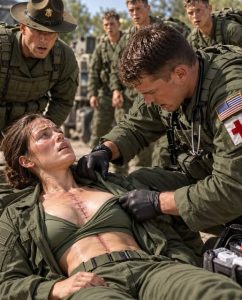
Across the left side of my chest, running from just beneath my collarbone to my ribs, was a wide, uneven sheet of scar tissue.
Some of it was pale and smooth.
Some of it was darker, twisted into ropes where skin grafts had healed badly.
A second scar disappeared beneath my undershirt toward my abdomen.
And near my shoulder, where the ruck strap had been grinding into me for almost twelve miles, the skin had split.
Blood had soaked through the thin fabric underneath my uniform.
The medic looked at me sharply.
“How long has this been open?”
I tried to answer.
My tongue felt too large for my mouth.
“Few days.”
“A few days?”
“I handled it.”
“No, Mercer.
You covered it.”
He reached for my shoulder.
I flinched so violently that Vega stepped backward.
The medic stopped.
“All right.
Nobody touches you unless I tell you first.”
His voice softened, but his eyes stayed hard.
“Did you have reconstructive surgery?”
I stared at the sky.
Georgia sunlight pressed down through a white haze.
“Three.”
“When?”
“Last one eighteen months ago.”
Daniels crouched several feet away.
He looked sick.
“You marched with that?”
I closed my eyes.
“It usually doesn’t hurt this bad.”
The medic gave a short, humorless laugh.
“Your pulse is over one-fifty, you’re showing signs of heat exhaustion, and you’ve reopened graft tissue under a seventy-pound load.”
He glanced at Vega.
“How was she cleared for this?”
Vega still said nothing.
That frightened me more than the shouting ever had.
The medic cut away more fabric.
Then he saw the smaller scar.
It sat beneath the larger graft, almost hidden in the distorted skin near my ribs.
A round depression.
Entry wound.
Another one, farther back.
Exit wound.
Vega saw those too.
His face drained of color.
“What happened to you?”
Daniels asked.
I opened my eyes.
Vega was staring down at me.
Not at my face.
At the scars.
And suddenly I understood something I had never expected.
He recognized them.
Not the exact scars.
The kind of scars.
His expression was too specific to be simple shock.
I had seen that look before, on men who woke up in hospital rooms after explosions.
On my father’s old friends when they heard fireworks too close to the Fourth of July.
On veterans who could identify the difference between a car backfiring and gunfire before anyone else turned their heads.
Recognition.
“Get the vehicle,” the medic ordered.
Daniels stood immediately.
Vega didn’t move.
“Sergeant?”
That snapped him out of it.
“Vehicle,” Vega barked.
But his voice cracked on the second syllable.
Daniels ran.
The medic started an IV while I lay on the road.
Vega walked a few paces away.
For once, he seemed to have no interest in watching me fail.
—
I woke up in the medical building several hours later.
The first thing I felt was cold.
Air conditioning.
Clean sheets.
Then came the pain.
My shoulder burned beneath fresh bandages.
My chest felt tight, and my head throbbed every time I moved.
A nurse noticed my eyes opening.
“Easy.”
I swallowed.
“My platoon?”
“Finished the march.”
“What time?”
She stared at me.
“You collapsed from heat exhaustion with an infected wound, and that’s your first question?”
“What time did they finish?”
“Mercer.”
I tried to sit up.
The room tilted.
She pushed me gently back.
“I don’t know.”
“My file—”
“Your selection status is not my concern right now.”
It was mine.
It was the only thing I could think about.
I had spent six weeks being told I didn’t belong.
Six weeks proving I could shoot, run, carry, crawl, climb, navigate and endure everything everyone else could.
Then, eleven and a half miles into one march, my body had betrayed me.
Again.
That word lived inside me.
Again.
The door opened.
I expected a doctor.
Instead, Vega walked in.
He had removed his campaign hat.
I had never seen him indoors without it.
Without the brim shadowing his face, he somehow looked older.
More tired.
There was a chair beside the wall.
He didn’t sit.
Neither of us spoke.
It became almost absurd.
The loudest man I had ever met stood five feet away from my bed, studying the floor like it contained classified instructions.
Finally I said, “You came to tell me I’m out?”
His eyes lifted.
“No.”
“Then why are you here?”
His jaw tightened.
“I wanted to ask you something.”
“That’s new.”
He accepted the hit without reacting.
“What happened to your chest?”
I looked toward the window.
“No.”
“No?”
“You don’t get to spend six weeks calling me weak and then ask for my medical history because you’re curious.”
His eyes narrowed automatically.
For half a second, the old Vega returned.
Then it disappeared.
“You’re right.”
That shut me up.
In six weeks, I had never heard him say those words.
He moved closer.
“I was wrong.”
I stared at him.
“Are you dying?”
“No.”
“Brain tumor?”
“Mercer.”
“Because this is concerning.”
The corner of his mouth almost moved.
Almost.
Then he looked at the bandages.
“I thought you were hiding a condition because you wanted to slip through selection.”
“I was.”
His gaze sharpened.
“So there is a condition.”
“There is pain.”
“That’s not what I asked.”
“It’s what I answered.”
He exhaled slowly.
“Your medical records mention reconstructive surgery after trauma.
They don’t explain the trauma.”
“That was intentional.”
“You had a bullet go through you.”
“Yes.”
“And burns.”
“Yes.”
“How old were you?”
I stared at him.
He waited.
Finally I said, “Seventeen.”
Something passed across his face.
“What happened?”
My throat tightened.
I hadn’t told anyone in the platoon.
I hadn’t wanted to become a story.
People treat scars differently once they know where they came from.
Some admire you.
Some pity you.
Some become afraid to demand anything from you.
I hated all three.
But Vega already knew enough to invent worse.
So I told him.
“My father was Army.”
Vega went very still.
“Name?”
“Master Sergeant Thomas Mercer.”
The change in Vega was immediate.
His shoulders locked.
His eyes snapped to mine.
“What did you say?”
I felt a chill that had nothing to do with the room.
“Thomas Mercer.”
He took one step backward.
“You’re Tommy Mercer’s daughter?”
Now it was my turn to stare.
“You knew him?”
Vega turned away.
His hand went to the back of his neck.
The nurse glanced through the doorway, saw us talking, and kept walking.
“Sergeant?”
Vega looked older again.
Much older.
“I served with him.”
The room seemed to narrow.
My father had been dead for seven years.
I knew the names of most of the soldiers he had served beside.
I knew the men who had attended his funeral.
I knew the ones who sent cards to my mother for three Christmases before life slowly pulled them away.
I had never heard the name Cole Vega.
“You’re lying.”
“No.”
“My father never mentioned you.”
“He wouldn’t have.”
“Why?”
Vega looked at me.
“Because the last time he saw me, he told me never to come near his family.”
The monitor beside my bed beeped faster.
I sat up despite the pain.
“What did you do?”
He didn’t answer.
“What did you do?”
“Mercer—”
“What did you do to my father?”
Vega’s face hardened.
Not with anger.
With preparation.
Like a man walking toward something he had avoided for years.
“Your father and I were on the same team during a deployment in Afghanistan.”
“I know where he deployed.”
“There was an operation outside Asadabad.”
I knew that too.
My father had been wounded there.
He had carried scars from it until the day he died.
Vega continued.
“Your father made a call I disagreed with.
We argued.
I went over his head.”
“What kind of call?”
His eyes shifted away.
“I can’t discuss all of it.”
“Then get out.”
“It involved civilians.”
My anger cooled by one degree.
Vega continued carefully.
“There was intelligence about a vehicle moving weapons through a village.
Your father believed the intelligence was bad.”
“And you?”
“I believed it.”
The room was silent.
“What happened?”
“The operation went wrong.”
“How wrong?”
Vega’s jaw flexed.
“People died.”
My stomach tightened.
“My father?”
“Not then.”
I knew enough about military language to understand what he wasn’t saying.
“How many civilians?”
“I’m not discussing numbers.”
“How many?”
He remained silent.
“Did my father blame you?”
“Yes.”
“Were you responsible?”
Vega stared at me for several seconds.
Then he said, “I believed I was.”
Believed.
Past tense.
Before I could ask what that meant, footsteps approached.
A captain entered the room with a folder tucked beneath one arm.
Captain Ellis.
Selection commander.
That ended the conversation.
“Sergeant Vega.”
“Sir.”
“Outside.”
Vega hesitated.
His eyes flicked toward me.
Ellis noticed.
“Now.”
Vega left.
Captain Ellis closed the door.
He placed the folder on the table beside my bed.
“Recruit Mercer, I’m going to ask you a direct question.”
“Yes, sir.”
“Did you intentionally conceal an active injury?”
My stomach sank.
“Yes, sir.”
“Were you experiencing pain before today’s march?”
“Yes, sir.”
“Did medical personnel instruct you to report reopening of the graft?”
I couldn’t answer immediately.
“That’s a yes,” Ellis said.
“Yes, sir.”
He opened the folder.
“Why?”
I looked at the blanket.
Because I knew what happened when people saw the scars.
Because I had spent years watching doctors, teachers, coaches and relatives use the same gentle voice when telling me I should reconsider difficult things.
Because I remembered waking at seventeen with half my torso wrapped in bandages and a surgeon telling me I might never regain full strength in my left arm.
Because three years later I had done my first unassisted pull-up and cried in an empty gym where nobody could see me.
“Because I wanted to finish.”
Ellis studied me.
“You nearly caused permanent damage trying to prove you weren’t damaged.”
I said nothing.
He closed the folder.
“You’re suspended from selection pending medical review.”
The sentence hit harder than Vega ever had.
“Sir—”
“That is not a dismissal.”
“I can continue.”
“Not today.”
“I can finish the march.”
“No.”
“I had half a mile left.”
“You had an IV in your arm forty minutes ago.”
“Sir—”
“Enough.”
His voice wasn’t cruel.
That made it worse.
I looked away before he could see my eyes burning.
Ellis picked up the folder.
Then he stopped.
“For what it’s worth, Mercer, nobody in your platoon thinks you quit.”
“That doesn’t change the record.”
“No.”
He studied me.
“But records can contain context.”
Then he left.
—
By evening, everybody knew.
Of course they did.
Military installations could move classified equipment across continents without anyone noticing, but one recruit collapsed on a road and the entire battalion knew before dinner.
Daniels came first.
He stood awkwardly in the doorway holding two protein bars.
“I brought these.”
“I’m on a liquid diet.”
“Oh.”
He looked at the bars.
“I can take them.”
“No.”
He put them on the table.
“They’re symbolic.”
“Of what?”
“I panicked at the vending machine.”
Despite myself, I laughed.
Pain stabbed beneath the bandages.
I stopped quickly.
Daniels grinned.
Then his expression changed.
“Why didn’t you tell us?”
“Because this is exactly what I didn’t want.”
“What?”
“That look.”
“What look?”
“The one you’re giving me right now.”
He frowned.
“I’m looking at you like you’re an idiot.”
I blinked.
“You marched eleven miles with an open wound.”
“Eleven and a half.”
“That correction is why you’re an idiot.”
I smiled.
He pulled the chair closer.
“Listen.
Nobody thinks less of you.”
“I didn’t ask what anybody thinks.”
“No, but you care.”
I stared at him.
He shrugged.
“We all care.
That’s why selection works.”
He stood.
At the door, he stopped.
“Oh.
One more thing.”
“What?”
“Vega destroyed somebody.”
“What do you mean?”
“After we finished.”
My pulse increased.
“Who?”
“Sergeant Pike.”
I knew Pike.
Assistant instructor.
Loud, smug, always standing near Vega.
“Why?”
Daniels leaned against the doorway.
“Apparently Pike made a joke about your scars.”
My stomach twisted.
“What did Vega do?”
“He put him against a wall.”
I stared.
“Vega?”
“Had to be pulled off him.”
That made no sense.
Vega had mocked me more than anybody.
Daniels seemed to read my face.
“Yeah.
We thought it was weird too.”
He left.
I remained awake for a long time after that.
—
At 2200, the lights in the hallway dimmed.
At 2217, Vega came back.
This time he closed the door behind him.
“You shouldn’t be here,” I said.
“No.”
“So leave.”
“I need to finish what I started.”
I watched him.
He reached into his pocket.
Then he placed something on the table beside my bed.
A photograph.
Old.
Dusty.
Creased down the middle.
Five soldiers stood in front of an armored vehicle.
My breath stopped.
My father was in the center.
Younger.
Lean.
Grinning.
His arm was wrapped around another soldier.
The other soldier was Vega.
I picked up the picture.
“You really knew him.”
“Yeah.”
I stared at my father’s face.
For a moment, I could almost hear his laugh.
“What happened between you?”
Vega remained standing.
“Your father discovered the intelligence behind that operation had been manipulated.”
“By who?”
“We never proved it.”
“You said you believed you were responsible.”
“I was the one who pushed the mission forward.”
“And Dad tried to stop it.”
“Yes.”
“So why did he tell you to stay away from us?”
Vega looked toward the door.
“Because what happened in Afghanistan didn’t stay there.”
Cold moved through my body.
“What does that mean?”
He stared at me.
“The attack that injured you at seventeen.”
Every muscle in my body went rigid.
My scars seemed to burn beneath the dressing.
That attack had happened in Virginia.
Not Afghanistan.
A truck had struck our vehicle on a rural road.
Then came gunfire.
Then fire.
My father had pulled me from the passenger seat.
He had died three days later.
The official investigation called it a robbery attempt that escalated.
Two suspects were killed fleeing police.
Case closed.
I looked at Vega.
“No.”
“Rowan—”
“Nobody here knows about that.”
“I do.”
“How?”
“Because your father called me two days before it happened.”
I couldn’t breathe.
“He said somebody had found him.”
“Found him?”
“He had evidence from the operation.
Evidence he had kept for years.”
My fingers tightened around the photograph.
“Evidence of what?”
Vega’s voice dropped.
“That the bad intelligence wasn’t a mistake.”
A buzzing filled my ears.
“The convoy?”
“Yes.”
“You think somebody deliberately sent your team after civilians?”
“I think somebody wanted a witness removed.”
“And my father knew?”
“Yes.”
“Why would that matter seven years later?”
“Because the person responsible wasn’t Taliban.”
The room felt suddenly too cold.
“Who was it?”
“I don’t know.”
“You’re lying.”
“I don’t know the name.”
“Then what do you know?”
Vega leaned closer.
“I know your father believed it came from inside our own command structure.”
I stared at him.
Everything I knew about my father’s death shifted sideways.
The truck.
The gunshots.
The official report.
My mother refusing to discuss it.
The investigators who stopped calling.
“You think the crash wasn’t random.”
“No.”
“You think they tried to kill us.”
“Yes.”
“And you never told anyone?”
“I did.”
“What happened?”
“My report disappeared.”
I almost laughed.
It came out broken.
“You expect me to believe this?”
“No.”
Vega pointed toward the photograph.
“Turn it over.”
I did.
There was writing on the back.
My father’s handwriting.
Cole—
If anything happens to me, check Mercer file 17-B.
Don’t trust the report.
—Tommy
I read it three times.
My hands started shaking.
“Where is file 17-B?”
“Gone.”
I looked up.
“Gone?”
“Your father mailed me a key before he died.
A storage box.
I got there two days after the attack.”
“Empty?”
Vega shook his head.
“Not empty.”
My heart hammered.
“What was inside?”
“One flash drive.”
“And?”
“A photograph.”
“Of what?”
“Not what.”
Vega’s expression changed.
“Who.”
He pulled out his phone.
For a moment, I thought he might show me.
Instead he stared at the screen.
Then his face went pale.
“What?”
He didn’t answer.
“Vega.”
He turned the phone toward me.
A message had appeared.
No name.
No number.
Just text.
YOU SHOULD HAVE LET THE GIRL QUIT.
Underneath it was a photograph.
Taken through the medical building window.
Taken minutes earlier.
It showed Vega standing beside my bed.
And me holding my father’s photograph.
My blood went cold.
“They’re here,” I whispered.
Vega crossed the room and killed the lights.
“Get down.”
“What?”
“Down, Rowan.”
The use of my first name frightened me more than anything else.
He moved beside the window.
For six weeks, I had thought Vega watched me because he wanted me gone.
Now another possibility formed.
A worse one.
“You knew who I was from the beginning,” I whispered.
Vega didn’t look at me.
“Yes.”
The answer struck like a physical blow.
“You recognized my name.”
“The day your orders arrived.”
“That’s why you targeted me.”
His silence told me enough.
Every insult.
Every punishment.
Every attempt to make me quit.
“You weren’t trying to prove I was weak.”
“No.”
“You were trying to make me leave.”
“Yes.”
Rage flooded through me.
“You humiliated me for six weeks because you thought that would protect me?”
“I thought if you washed out, you’d go home.”
“You had no right.”
“I know.”
“You could have told me.”
“No.”
“Why?”
“Because I didn’t know who was watching.”
A sound came from the hallway.
Footsteps.
Slow.
Vega froze.
So did I.
The footsteps stopped outside my door.
A shadow appeared beneath it.
Vega reached beneath his uniform blouse.
When his hand emerged, it held a compact pistol.
I stared.
Instructors did not walk around the medical wing armed like that.
Something inside me understood before my mind did.
“Vega,” I whispered.
He raised one finger.
Silence.
The handle began to turn.
Then stopped.
A white envelope slid beneath the door.
The footsteps moved away.
Vega waited.
Ten seconds.
Twenty.
Then he opened the door and checked the hallway.
Empty.
He picked up the envelope.
My name was written across the front.
ROWAN MERCER.
Inside was a single piece of paper.
And a brass key.
I unfolded the note.
Three lines.
Your father lied to Vega.
Vega lied to you.
Ask your mother what happened in Kabul.
I read it once.
Then again.
“My mother was never in Kabul.”
Vega stared at the message.
And for the second time that day, Staff Sergeant Cole Vega—the man who always had something to say—looked genuinely afraid.
“That,” he whispered, “is what your father told you.”
The door at the far end of the hallway slammed open.
Voices shouted.
Vega grabbed the key from my hand.
“Get dressed.”
“I’m suspended.”
“This isn’t about selection anymore.”
“What is that key?”
“I don’t know.”
“Where are we going?”
He looked at me.
“To find out why somebody just risked walking onto a secured Army installation to make sure you learned your mother has been lying to you for seven years.”
Then the building alarm began screaming.
Red emergency lights flashed across the walls.
A voice erupted through the intercom.
“SECURITY LOCKDOWN.
ALL PERSONNEL REMAIN IN PLACE.”
Vega swore under his breath.
Outside, boots thundered through the corridor.
I stared at the photograph of my father still lying on the bed.
Five soldiers.
One armored vehicle.
My father and Vega standing shoulder to shoulder.
Only now, under the flashing red light, I noticed something I had missed.
There was a sixth person in the background.
A woman half turned away from the camera, wearing civilian clothes.
I lifted the photograph closer.
My heart stopped.
Even twenty years younger, I knew that face.
“Vega.”
He followed my stare.
His expression collapsed.
The woman standing behind my father in Afghanistan was my mother.
And she was holding a rifle.
…If you want to know what happened next, please type “YES” and like for more.
”