Chapter 1: The Ash and the Oath
The chronicle of my own coup d’état began not with a grand, cinematic declaration of war, but with the acrid, choking scent of smoke and the desperate rescue of scorched wool.
It was a Tuesday evening, the kind of bleak, rain-slicked night that seemed to perfectly mirror the permanent, suffocating climate inside the Montgomery estate since my father’s unexpected death. The estate—a sprawling, gothic-revival stone house that my father had lovingly restored—no longer felt like a home. Under the dominion of my stepmother, Camilla, it had become a holding cell. And tonight, she was preparing to liquidate my prison.
I stood in the shadowed hallway of the second floor, my bare feet sinking into the plush, Persian runner. Downstairs, the muffled, clinking sounds of crystal and the low murmur of wealthy voices drifted upward. Camilla was hosting a private pre-sale gala. She was aggressively courting a conglomerate of real estate tycoons, aiming to sell the entire property and everything in it the moment I turned eighteen. That milestone, my legal emancipation, was exactly three days away. Prom night.
A sudden, sharp smell of accelerant and burning cloth snapped me out of my bitter reverie. It wasn’t coming from the kitchen. It was coming from the backyard.
I sprinted down the back staircase, my heart hammering a frantic rhythm against my ribs. I threw open the heavy oak door leading to the terrace. The rain had momentarily paused, leaving the night air thick with mist. In the center of the manicured lawn, the large wrought-iron incinerator barrel was roaring, its orange flames painting horrific, dancing shadows against the stone walls of the house.
Standing before the fire was Camilla. She wore a flawless emerald silk gown, a diamond tennis bracelet glittering on her wrist as she casually tossed pieces of my father’s life into the inferno. Old leather-bound journals. His favorite tobacco pipe. And, dangling from her impeccably manicured fingers like a piece of offensive trash, his heavy, olive-drab dress uniform.
No. The word didn’t even make it past my throat; it was just a raw, animal instinct.
I didn’t think. I just moved. I closed the distance across the wet grass in seconds, lunging past Camilla just as she released the heavy wool fabric. I plunged my bare hands toward the roaring heat, snatching the jacket before the fire could claim its core.
The hem was already caught. I beat the smoldering edges against the wet grass, gasping as the heat seared the tender flesh of my left forearm. The pain was immediate, a sharp, blinding white line that made my vision swim, but I didn’t let go. I pulled the heavy, singed fabric against my chest, breathing in the smell of ash, lost memories, and the faint, lingering ghost of his pine aftershave.
Camila let out a sound of pure, aristocratic disgust. Before I could stand, the sharp crack of her palm striking my cheek echoed like a gunshot in the damp night air. My head snapped to the side, the metallic tang of blood instantly pooling in the corner of my mouth.
“Have you completely lost your mind, Chelsea?” she hissed, her eyes reflecting the feral orange light of the fire. The mask of the grieving, noble widow she wore for the public was gone. This was the real Camilla. Cold. Calculating. Utterly ruthless.
“You can’t burn this,” I gasped, my voice trembling, clutching the jacket tighter. “It’s his. It’s all I have left.”
She laughed, a short, humorless sound. She stepped closer, the heat of the fire radiating behind her like a demonic halo. “It’s garbage. Just like the rest of the sentimental rot he left behind. The house goes on the market at midnight on Friday. The buyers are inside right now, writing the checks. You’d do well to forget him and pack your meager belongings, before I throw you out with the ashes.”
She turned on her heel, her silk gown swishing over the wet grass, and walked back toward the glowing warmth of the house.
I stayed on the cold ground for a long time, the burn on my arm throbbing with a sickening, steady pulse.
Later that night, locked inside my dimly lit bedroom, the real torture began. The first time I tried to stitch the ruined hem of the dress uniform, my hands wouldn’t stop shaking. I had decided, in a moment of sheer, desperate rebellion, that I wasn’t going to let Camilla destroy this. I was going to wear it. I was going to tailor this heavy, masculine armor into a gown for the Prom, a silent, undeniable protest on the very night she planned to celebrate selling our legacy.
But my left arm was wrapped in crude gauze, the burn weeping and stiff. The heavy military canvas fought the delicate needle at every turn. The needle slipped, plunging deep into the fleshy pad of my right thumb. I swallowed a sharp cry, tasting the lingering copper from Camilla’s slap, and wiped the fresh, bright blood on a grease-stained rag. I pressed on, my breathing ragged, terrified of letting a single crimson drop touch the olive fabric spread across my threadbare quilt.
I turned the jacket inside out, examining the extensive damage to the lining. The fire had eaten away a large section near the inner breast. I grabbed my sewing shears to trim the blackened threads. As I snipped away the ruined silk lining, the heavy shears struck something hard. Click.
I froze. My brow furrowed. I ran my uninjured fingers over the fabric. Sewn deeply into a secondary, hidden pocket—one designed to be completely invisible unless the jacket was effectively dismantled—was a small, rigid rectangle.
Holding my breath, I used a seam ripper to tear the pocket open. A small, black, encrypted USB drive fell into the palm of my hand. Attached to it was a tiny, tightly folded piece of waterproof paper.
My hands trembled as I unfolded it. It was my father’s handwriting, rushed and jagged.
Chelsea, if you find this, my suspicions were right. The heart medication was swapped. Do not trust Camilla. The offshore accounts and the falsified notary stamps are on the drive. Wait for Hayes.
My blood ran entirely cold. The room seemed to spin. The heart medication was swapped. My father hadn’t just died of a sudden, tragic heart attack. He had been murdered.
I scrambled across the room to my old, battered laptop. My hands were shaking so violently I dropped the USB twice before finally sliding it into the port. A password prompt appeared. I typed in my birthday. Incorrect. I typed in my mother’s maiden name. Incorrect.
I stared at the screen, tears of frustration pricking my eyes. Then, I remembered a phrase he used to whisper to me when I was little and afraid of the dark.
Olive and thread.
I typed it in. The progress bar flashed green. A massive directory of files exploded onto the screen. Bank transfers, Cayman Island account numbers, scanned copies of forged signatures, and a horrifyingly detailed, private email thread between Camilla and a private physician regarding the lethal dosage of digitalis.
I was staring at the undeniable proof of my father’s murder.
Suddenly, the floorboards outside my bedroom door creaked. A heavy shadow eclipsed the sliver of light under the doorframe. The doorknob began to turn, slowly, deliberately.
“Chelsea?” a voice whispered from the hallway. It wasn’t Camilla. It was something worse.
Chapter 2: Scissors and Sabotage
“Chelsea, open the door.”
It was Leah, my older stepsister. Her voice carried that sickeningly sweet, venomous lilt she only used when she was hunting for a weakness. I slammed the laptop shut, yanking the USB drive from the port and shoving it deep into the front pocket of my sweatpants. I threw a pile of laundry over the military jacket on the bed.
“I’m sleeping, Leah!” I called out, trying to keep the raw panic out of my voice.
“Funny,” she purred through the wood. “I can see the light under the door. And I know you don’t sleep when mother has guests. You just skulk.”
A key slid into the lock. She had a key. My heart dropped into my stomach. The door swung open, revealing Leah in a designer cocktail dress, a half-empty glass of champagne in her hand. Her sharp, predatory eyes instantly scanned the room, landing on the pile of laundry, then on my laptop, and finally, on the bloody rag wrapped around my hand.
“My, my,” she drawled, stepping into the room and closing the door behind her. “Playing Cinderella in the dirt again? Mother told me you threw a tantrum by the fire.”
“Get out of my room, Leah.”
She ignored me, sauntering over to my desk. “We are selling this dump on Friday. You’ll be out on the street. I just came to remind you to pack your pathetic little bags.” She paused, her gaze dropping to the floor.
My breath hitched. Peeking out from beneath the pile of laundry was the scorched gold braid of my father’s epaulette.
Leah’s eyes narrowed. In a flash, she lunged forward and yanked the laundry away, exposing the dissected military jacket and my antique sewing machine. She let out a sharp, cruel laugh.
“What is this? Are you making a costume for the freak show?” she mocked, picking up the heavy fabric.
“Don’t touch it!” I surged forward, pushing her arm away.
Leah stumbled back, her champagne splashing onto the floor. Her eyes flared with genuine malice. “You put your hands on me?”
Before I could react, she grabbed my grandmother’s antique sewing machine—the only mechanical tool I had to finish the dress—and shoved it violently off the desk. It hit the hardwood floor with a sickening crunch, the heavy cast-iron arm snapping, the needle mechanism shattering into a dozen useless pieces.
“Oops,” Leah whispered, a wide, malevolent smile stretching across her face. But she wasn’t done. She grabbed the heavy sewing shears off the desk, snatched the bodice of the uniform jacket, and drove the blades right through the side panel, ripping a jagged, fatal gash down the ribs.
“Wear that to Prom, you little rat,” she spat, tossing the shears onto the bed before turning and strutting out of the room.
I dropped to my knees, gathering the torn, ruined fabric into my arms. I didn’t cry. The time for tears had burned away in the incinerator. I looked at the shattered sewing machine, then at the massive tear in the side of the jacket.
I will not let them win.
I spent the next forty-eight hours operating in a state of hyper-focused delirium. My burnt arm throbbed relentlessly, fueled by adrenaline and a terrifying, cold rage. Without a machine, I was forced to use heavy-duty canvas needles, driving them through the thick wool by hand. Every stitch was a battle, ripping the skin on my fingertips, but I didn’t stop.
To fix the massive tear Leah had created, I couldn’t just sew it shut; the fabric was too frayed. Instead, I opened my father’s oak lockbox. I took his heavy, brass-and-enamel commendation medals—his Purple Heart, his Silver Star, his campaign ribbons—and I used them as literal armor. I pinned them in a cascading, overlapping pattern down the torn side of the bodice, transforming a fatal wound into a breathtaking display of military history and defiance.
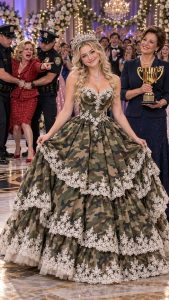
By the afternoon of the Prom, the dress was finished. It was a masterpiece of rebellion. The bodice was structured and authoritative, retaining the brass buttons, while the skirt flowed into a dramatic, sweeping silhouette. The burn marks and the medal-covered scar gave it a raw, fierce texture.
I was standing in front of my mirror, the USB drive safely tucked into a newly sewn secret pocket at my waist, when the doorknob rattled furiously.
“Chelsea!” It was Camilla. Her voice wasn’t cold; it was frantic. Panicked.
“I’m getting ready,” I said, my voice eerily calm.
“Open this door immediately!” she screamed, pounding her fists against the wood. “Where is it? Where is the drive?”
My blood ran cold. She had finally gone into my father’s lockbox. She knew the jacket was gone, and now, she realized what else was missing.
“I don’t know what you’re talking about,” I lied, stepping back toward the window.
“You lying little bitch!” Camilla shrieked. “I know you found it! Jenna saw you messing with the jacket!”
I heard the heavy, metallic scrape of the deadbolt sliding into place from the outside. She was locking me in.
“You are not leaving this room,” Camilla’s voice vibrated with a lethal threat through the heavy door. “The buyers are arriving in two hours to sign the final deeds. The mayor is coming. You will sit in that room until the ink is dry, and then I am going to have my security team come in there and tear that room, and you, apart until I find it.”
Silence fell over the hallway, thick and suffocating.
I looked at the dress. I looked at the heavy oak door. I was trapped on the second floor, a hostage in my own home, with the evidence of my father’s murder sitting against my ribs.
Then, the floorboards outside my door creaked again. But it wasn’t the light step of Camilla’s heels. It was the heavy, rhythmic thud of tactical boots. Two men. Stopping right outside my door.
“She’s in there,” Camilla’s muffled voice echoed. “Don’t let her out. If she tries to break the door, go in and restrain her.”
A deep, gruff voice replied, “Understood, ma’am.”
I backed away, my heart hammering against my ribs like a trapped bird. I looked at the window. Outside, a massive thunderstorm had finally broken, sheets of rain lashing against the glass, the wind howling through the old oak trees. It was a two-story drop to the stone patio below.
I had no choice. I was out of time.
Chapter 3: The Drop
The storm outside was a violent, thrashing beast, but it was nothing compared to the storm raging in my chest.
I stripped off my bloody, sweat-stained clothes and pulled the heavy olive fabric of the transformed uniform over my head. It fit like a second skin. It felt heavy. It felt like consequence. I took his black dress tie, cinching it tight around my waist as a sash, ensuring the hidden pocket holding the USB drive was secure against my hip.
I turned off the single lamp in my room, plunging myself into darkness. I crept to the window and unlatched the heavy brass lock. The wind immediately ripped the window open, blasting my face with freezing rain and the smell of ozone.
Directly outside my window was the massive, ancient oak tree my father and I used to climb. Its thickest branch hovered about four feet from the ledge, slick with rain and thrashing wildly in the gale. Below it was a sheer drop to the slate patio. One slip meant broken legs, or worse.
I could hear the security guards murmuring outside my bedroom door. I didn’t have time to second-guess.
I swung my legs over the windowsill, the rough stone scraping the back of my thighs. The heavy wool of the dress instantly soaked up the rain, weighing me down like lead. I took a deep breath, squeezed my eyes shut, and launched myself into the void.
My hands slammed into the wet bark of the oak branch. I slipped, my stomach dropping into my shoes, but my arms locked around the wood in a desperate embrace. The rough bark tore at the healing burn on my left arm, sending a blinding shock of agony through my nervous system. I clamped my mouth shut to stifle a scream.
Hanging suspended in the freezing rain, I slowly swung my legs up, hooking my knees over the branch. I shimmied backward, inch by agonizing inch, the heavy skirt of the dress catching on twigs and leaves. I reached the trunk and looked down. The roof of the wraparound porch was still ten feet below me.
I let go.
I hit the porch roof hard, the impact jarring my teeth, and immediately slid on the slick shingles. I scrambled frantically, my fingernails tearing on the roofing, before stopping myself just at the edge of the gutter. I dragged in a ragged breath, the rain plastering my hair to my face. From there, I dropped the remaining six feet into the dense, muddy rhododendron bushes flanking the front steps.
I lay in the mud for a moment, the breath knocked out of my lungs. I was bruised, bleeding, and covered in dirt. But I was out.
I stood up. I didn’t try to brush the mud off the dress. The dirt, the water, the fraying edges—it all belonged there. It was the uniform of a survivor.
I walked up the front steps to the massive double mahogany doors. Inside, the lights were blindingly bright. Through the glass panels, I could see the grand foyer. It was packed. Men in tuxedos, women in dripping diamonds. In the center of the room, standing at a massive antique table, was Camilla. She was holding a gold fountain pen, hovering over a thick stack of legal documents. Opposite her stood two men in sharp suits—the buyers.
This was it. The sale of my father’s legacy.
I didn’t knock. I placed both hands on the heavy brass handles and shoved the doors open with every ounce of strength I had left.
The doors slammed against the interior walls with a sound like a thunderclap.
The lively chatter of the room died instantly, sucked out of the space as if a vacuum had been turned on. The string quartet in the corner screeched to a halt. Fifty pairs of wealthy, influential eyes turned toward the entrance.
I stood in the doorway, framed by the raging storm behind me. Water dripped from the hem of my father’s jacket onto the pristine marble floor. The brass buttons gleamed under the chandeliers. The wall of medals pinned over my ribs caught the light, a jagged armor of honor and grief.
Camila froze, the gold pen slipping from her fingers and clattering onto the table. All the blood drained from her face. She looked as if she had seen a ghost. And in a way, she had.
“Chelsea,” she breathed, her voice barely audible over the sound of the rain.
Leah and Jenna, standing near the champagne fountain, gasped in synchronized horror.
“Don’t sign those papers,” I said. My voice wasn’t loud, but in the absolute silence of the room, it carried like a bell. I stepped fully into the light, leaving a trail of muddy water on the marble.
Camila recovered her composure with terrifying speed. Her eyes narrowed into slits of pure, venomous hatred. She turned to the two massive, suited men standing near the staircase—the private security guards she had hired.
“This girl is mentally unwell,” Camilla announced to the shocked crowd, her voice dripping with fake, maternal sorrow. “She has been having a severe manic episode since her father’s passing. Guards, please escort my stepdaughter upstairs. Gently. She needs her medication.”
The two large men moved toward me, their faces blank, their hands reaching out to grab my arms.
“Don’t touch me!” I shouted, backing up a step. I plunged my hand into the secret pocket at my waist and pulled out the black USB drive, holding it high in the air.
“I’m not crazy!” I yelled, my voice ringing off the vaulted ceilings. “I have the proof! I have the offshore accounts! I have the emails between Camilla and Dr. Evans! She swapped his medication! She murdered Major Thomas Montgomery for this estate!”
The room erupted into chaos. Gasps, shrieks, and furious whispers filled the air. The real estate tycoons stepped away from the table, looking alarmed.
Camila’s face twisted into a mask of absolute, unhinged fury. The façade was gone. “Get her!” she shrieked, pointing a trembling, diamond-clad finger at me. “Break her arms if you have to! Get that drive!”
The two massive guards lunged at me, their immense hands reaching for my throat.
Chapter 4: The Dead-Man’s Switch
The first guard grabbed my left shoulder, his thick fingers digging right into the fresh, weeping burn. I screamed, my knees buckling from the white-hot agony, but the heavy canvas of the military jacket absorbed the worst of his grip.
As he reached for the hand holding the USB drive, I spun, using the momentum of his pull to drive the sharp heel of my combat boot—the only shoes I could find to match the dress—directly into his kneecap. He grunted, his grip faltering just enough for me to tear away.
The second guard was faster. He tackled me around the waist, slamming me into an antique console table. A priceless Ming vase shattered onto the marble floor. I fought like a cornered animal, scratching, biting, kicking, but he was too heavy. He pinned my wrist against the floor, his massive knee pressing into my ribs, crushing the breath out of me. His free hand pried at my fingers, desperately trying to pry the USB drive loose.
“Give it to me, you little brat,” he grunted, twisting my wrist until I felt the ligaments pop.
“Help her!” a woman in the crowd screamed, but no one moved. They were frozen in the surreal horror of a high-society gala devolving into a violent brawl.
Camila stood over me, her chest heaving, a terrifying smile of triumph stretching across her face. “You stupid, stubborn girl,” she sneered, looking down at me as the guard peeled my fingers back one by one. “Did you really think you could outsmart me? You are nothing.”
My grip failed. The USB drive tumbled from my hand, skittering across the marble floor.
Camila lunged for it, her emerald gown pooling around her. Her manicured fingers brushed the black plastic casing.
Suddenly, the front windows of the grand foyer exploded in a blinding wash of oscillating red and blue light. The screech of heavy tires tearing through the wet gravel driveway drowned out the storm.
Before anyone could react, the remaining glass in the front double doors shattered inward. Armed men in full tactical gear poured into the room like a dark, synchronized wave. The letters MP—Military Police—were emblazoned in stark white across their Kevlar vests.
“Federal Agents! Nobody move! Hands where we can see them!” a voice boomed through a megaphone, vibrating the crystal in the chandeliers.
The guard pinning me instantly threw his hands in the air, scrambling off me. Camilla froze on the floor, her hand inches from the USB drive, staring in shock at the assault rifles leveled at her chest.
From the center of the tactical formation, two figures stepped forward into the brightly lit foyer. One was a tall, imposing man in a pristine Army dress uniform, his chest adorned with rows of ribbons. Beside him was a severe-looking woman in a charcoal pantsuit, clutching a thick leather briefcase.
“Major Thomas Montgomery did not raise a fool, Mrs. Montgomery,” the officer said, his deep baritone cutting through the panicked murmurs of the crowd. “And neither did I.”
He looked down at me, still lying on the floor, muddy, bleeding, and wrapped in his late friend’s armor. His hard eyes softened with an immense, paternal sorrow.
“Colonel Hayes,” I choked out, recognizing him from a dozen childhood photographs.
“At ease, Chelsea,” Colonel Hayes said softly. He stepped forward, picked up the USB drive from the floor, and slid it into his pocket. He then turned his full, terrifying attention to Camilla.
“Camilla Montgomery,” the woman in the suit—Ms. Sterling, the federal attorney—began, her voice like cracking ice. “You are under arrest by order of the Department of Defense and the FBI. The documents you were about to sign are fraudulent.”
“You have no jurisdiction here!” Camilla shrieked, scrambling to her feet, her perfect hair wild and unspooled. “This is a private estate! I am his widow! I have the will!”
“You have a forged piece of paper,” Ms. Sterling corrected smoothly, opening her briefcase. “Major Montgomery suspected your financial malfeasance and your attempts to poison him months before his death. He filed a classified, federal ‘Dead-man’s switch’ with military intelligence. His entire estate, his pension, and the deed to this house were placed into a blind federal trust, to be transferred solely to his biological daughter upon her eighteenth birthday.”
Ms. Sterling checked her watch. “It is currently midnight. Happy Birthday, Miss Montgomery.”
Camila let out a sound that was half-scream, half-sob. “No! I earned this! I tolerated that miserable man and this wretched brat! You can’t take it from me!”
Colonel Hayes nodded to two Military Police officers. “Take her. Wire fraud, forgery, grand larceny, and conspiracy to commit murder. Make sure the cuffs are tight.”
The officers grabbed Camilla, roughly wrenching her arms behind her back. The steel handcuffs clicked loudly in the silent room. Leah and Jenna began to wail, clinging to each other as their mother was dragged out into the rain, screaming obscenities until the doors of a military transport vehicle slammed shut, cutting her off.
The real estate tycoons quietly slipped out the side door, leaving the contracts unsigned and shredded on the table.
The guests, horrified and scandalized, were slowly ushered out by the remaining MPs. Within minutes, the grand foyer, once a site of my impending doom, was empty save for me, the attorney, and the Colonel.
I slowly pushed myself off the floor, my ribs aching, my arm burning, shivering uncontrollably as the adrenaline began to crash. I looked down at the dress. It was ruined. Covered in mud, blood, and torn beyond repair.
“I tried to save it,” I whispered, tears finally spilling over my cheeks. “I tried to fix it.”
Colonel Hayes stepped in front of me. His expression was unreadable. He reached into the inner breast pocket of his own immaculate uniform jacket. He pulled out a small, heavy velvet box.
“Your father didn’t want you to save it, Chelsea,” the Colonel said gently, his voice thick with emotion. “He wanted you to become it. He gave me strict instructions to give this to you tonight. If you survived the storm.”
He handed me the box.
Chapter 5: The Armor of Olive and Thread
My trembling fingers traced the gold trim of the velvet box before I pressed the latch. Inside, resting on a bed of dark satin, was a silver military identification tag—a dog tag. But it wasn’t my father’s. It had my name stamped into the metal. Chelsea Montgomery.
Beneath it lay a folded, crisp white envelope, sealed with a wax crest.
“He knew you would fight them,” Colonel Hayes said, taking off his own heavy, immaculate military overcoat. He stepped forward and draped it over my shivering shoulders. It enveloped me in warmth and the smell of clean wool, hiding the mud and the bloodstains of my battle. “He knew you were a soldier, Chelsea. Just like him.”
I clutched the coat around me, staring at the dog tag.
“Now,” the Colonel said, checking his watch again. “I believe your father’s instructions included one final detail for this evening. A vehicle is waiting outside to transport you to your high school gymnasium. You have a Prom to attend.”
I looked up at him, stunned. “Look at me, Colonel. I’m a mess. I’m covered in dirt and blood.”
He offered a slight, fiercely proud smile. “You look like a victor, Miss Montgomery. And victors do not hide in the dark.”
Twenty minutes later, the sleek black military town car pulled up to the brightly lit entrance of the high school. The bass from the DJ’s speakers thumped against the car windows. Girls in clouds of tulle and boys in rented tuxedos were milling around the entrance.
When the car doors opened, two Military Police officers stepped out first, standing at attention on either side of the vehicle. The chatter of the teenagers died down, replaced by a ripple of confused murmurs.
Then, I stepped out.
I kept the Colonel’s overcoat draped over my shoulders, but left it unbuttoned, revealing the jagged, mud-stained olive fabric of my father’s jacket, cinched tight with the black tie. The wall of brass and enamel medals gleamed fiercely under the streetlights. My hair was wild, damp, and tangled. I had a bruised jaw and a bloody lip.
I didn’t look like a princess. I looked like a warlord.
I walked up the concrete steps, the officers falling into step a respectful two paces behind me. As I entered the gymnasium, the music seemed to fade into white noise. Hundreds of heads turned. Whispers swept through the crowd like a shockwave. I braced myself for the laughter, for the familiar sting of being the weird, abused outcast of the Montgomery family.
Instead, absolute silence reigned.
They looked at the military escort. They looked at the medals pinned to my ribs. They saw the posture, the unyielding spine that had refused to break under Camilla’s heel.
Someone in the front row—the class president—slowly raised his hands and started to clap. Then, my old lab partner joined in. Then another. Soon, the entire gymnasium was filled with the deafening sound of applause. It wasn’t pity. It was sheer, undeniable respect. They didn’t know the whole story, but they saw the survival.
I didn’t dance with a boy that night. I didn’t need to. I walked to the center of the dance floor, took off the heavy overcoat, and danced alone. The heavy canvas of my father’s jacket spun around me, a shield that had finally, gloriously, become a pair of wings. I belonged, completely and unequivocally, to myself.
Later, long after midnight, the town car brought me back to the estate. The storm had passed, leaving the night air crisp and clean.
The house was completely silent. In the foyer, the shattered vase had been swept away. Camilla, Leah, and Jenna’s belongings were gone, confiscated as evidence or thrown out. The heavy, suffocating oppressive weight that had choked the house for years had vanished.
I walked slowly upstairs to my father’s old master bedroom—my room, now. I sat on the edge of the large, oak-frame bed, the house entirely mine, and broke the wax seal on the envelope the Colonel had given me.
The paper smelled faintly of his familiar pine aftershave.
Chels,
If you’re reading this, it means you made it to eighteen, and Hayes did his job. I am so deeply sorry I couldn’t be there to protect you from the storm I accidentally brought into our home. I realized too late what Camilla was, and it took time to build the legal walls to keep her from stealing your future.
I know the last few years must have been dark. I know she likely tried to break you. But I also know the girl I raised. You are forged from stronger steel than they could ever comprehend. The house is yours. The estate is yours. The future is yours. Do not let anyone take another second of your peace.
This uniform was never meant to be a relic, Chelsea. It was meant to be a reminder. Wear your scars proudly. You are braver than you think.
Welcome home, soldier.
Love, Dad.
I held the note against my chest, the rough, battle-torn wool of his uniform scratching against my skin, grounding me to the earth. I stood up and walked to the window, looking out over the sprawling lawns bathed in pale moonlight.
I stood in the middle of a house that finally, truly, felt like mine. Not because a federal attorney said so, and not because the walls were familiar. It was mine because, somewhere in the ashes, the blood, and the dark, I had fought the fire and taken my own story back.
If you want more stories like this, or if you’d like to share your thoughts about what you would have done in my situation, I’d love to hear from you. Your perspective helps these stories reach more people, so don’t be shy about commenting or sharing.