PART 2
Blake’s fist passed my cheek, close enough for me to feel the air move.
I let his momentum carry him one step beyond where he intended to land. Then I touched his shoulder—not struck it, not shoved it. Just redirected it.
He stumbled.
A murmur moved through the gym.
Blake caught himself and spun around, his expression no longer amused.
The old reflexes came back with frightening ease. They lived in the angle of my feet, the position of my hands, the way I read a person’s balance before he knew he’d lost it.
For one brief second, the gym disappeared.
There was only motion. Distance. Breath.
And the old, familiar certainty that if I moved first, someone else might not get back up.
I closed my fingers.
No.
That man was gone.
I had promised Evan.
Blake advanced again, more cautiously this time. The confidence had drained from his face, replaced by concentration. He was skilled—there was no denying that. His stance was clean, his timing disciplined, and his footwork better than most instructors I had encountered outside professional competition.
But he fought to win in front of people.
I had spent years learning how to survive when no one was watching.
He feinted toward my ribs, then followed with a quick jab. I stepped aside, letting it pass, and tapped his forearm as I moved.
Not hard.
Just enough to show him I could have done more.
His eyes narrowed.
“Stop running,” he said.
“I’m not running.”
“You’re afraid to engage.”
“No,” I replied. “I’m choosing not to hurt you.”
That answer landed harder than any punch.
A few parents shifted uncomfortably along the edge of the mat. Someone lowered a phone. Another person whispered Blake’s name, perhaps hoping to remind him that the entire room was watching.
He came forward again.
This time, I gave him what he wanted—or what he thought he wanted.
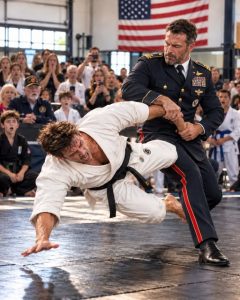
When he threw a wide right hand, I stepped inside the arc and caught his wrist. My other hand settled against his upper arm. I turned my hips, guided his momentum downward, and helped him to the mat without twisting or slamming.
He landed on his back, more surprised than injured.
The gym went still.
I released him immediately and stepped away.
Blake stared up at me.
“Get up,” I said.
He did, slower now.
The veteran in the bleachers remained standing. He was in his late sixties, perhaps early seventies, with a broad frame softened by age and a face marked by sun, wind, and years of refusing to complain. His gray Marine Corps cap was faded almost white along the brim.
He wasn’t looking at Blake.
He was looking at me.
Blake wiped his palm against his shorts.
“What kind of gym trick was that?”
“It wasn’t a trick.”
“You don’t fight like a plumber.”
“I’m not fighting.”
His jaw tightened.
For a moment, I thought he might ignore the warning signs and continue. Pride could make people remarkably careless. But something in my expression must have reached him, because he glanced toward the parents and lowered his hands.
“This is ridiculous,” he muttered. “You got lucky.”
“Maybe.”
I stepped off the mat.
The room exhaled around me.
The first person to move was a woman named Michelle, whose daughter had been in Evan’s class for nearly a year. She crossed the floor and picked up my flannel shirt.
“Here,” she said quietly.
“Thank you.”
Her eyes flicked toward Blake, then toward the hallway where Evan had gone.
“Is he all right?”
“He will be.”
“I’m sorry,” she said. “I should have said something when Blake chose him.”
I looked at her.
“You didn’t know what he was going to do.”
“I knew he liked making examples out of people.”
Her voice carried just enough for the parents nearest us to hear.
A few looked down.
That, more than anything, told me this wasn’t the first time Blake had crossed a line.
I put my shirt on but didn’t button it. My hands were steady. My breathing was steady.
Inside, however, something old had opened its eyes.
The veteran came down from the bleachers.
He moved carefully, one hand resting on the railing, but there was nothing frail about him. He stopped several feet away.
“Damon?” he asked.
I felt the room change.
Not dramatically. No one gasped. No music stopped. But attention gathered around us with the quiet pull of gravity.
I did not know him.
At least, I didn’t think I did.
“That’s right.”
He studied my face.
“Damon Vale?”
I nodded once.
His lips parted, but no sound came out.
Blake, still standing on the mat, looked between us.
“You know him?”
The old man didn’t answer.
He took another step.
“My name is Raymond Cole,” he said.
The name meant nothing to me.
Then he reached into the pocket of his jacket and pulled out a small, worn photograph.
It had been folded so many times that the edges were soft.
He held it out.
I didn’t take it.
“Where did you get that?”
Raymond’s eyes stayed on mine.
“From a man named Elias Mercer.”
The gym seemed to tilt.
I hadn’t heard that name spoken aloud in nine years.
Not since a humid morning in Virginia, when a government sedan had parked outside the small house I’d rented and a uniformed officer had told me that Elias was gone.
Not missing.
Not injured.
Gone.
The official language had been careful. Professional. Designed to leave no room for questions.
Elias Mercer had died overseas during an operation that would never appear in any newspaper. The rest of the details had been sealed, and the people who knew more had offered me the same sentence in different forms:
You did everything you could.
I had carried those words for years, though I had never believed them.
Raymond turned the photograph toward me.
It showed six men standing outside a weathered building beneath a pale sky. Their faces were younger, harder, almost unrecognizable beneath dust and exhaustion.
I was on the far left.
Elias stood in the center.
He was smiling.
I hadn’t seen that picture since the day it was taken.
“You were there,” Raymond said.
“So were you?”
“No.” His thumb moved over the photograph. “My son was.”
I looked at the man beside Elias.
At first, I barely recognized him. He had a narrow face, dark hair, and a crooked grin. He looked too young to be carrying the weight in his eyes.
“Daniel,” Raymond said. “Daniel Cole.”
I remembered him.
Not as a friend. Not exactly.
Daniel had been a communications specialist attached to our unit during one deployment. Quiet, observant, and always carrying a notebook he never allowed anyone else to touch.
He had died two months before Elias.
I remembered the radio going silent.
I remembered Elias standing in a doorway, listening to nothing.
I remembered the way he had stared at the floor afterward.
“What are you doing here?” I asked.
Raymond folded the photograph carefully.
“I moved to Cedar Falls three years ago.”
“Why?”
“Because Daniel’s daughter lives here.”
I didn’t know what to say.
Blake stepped off the mat.
“Mr. Cole, if this is some old military reunion, can we finish the class?”
Raymond turned toward him.
“No.”
The word was quiet.
Blake opened his mouth, but Raymond continued.
“Not until you apologize to the boy.”
Blake’s face reddened.
“I already told him it was an accident.”
“It wasn’t.”
“You saw what happened?”
“I saw enough.”
Raymond’s voice held no anger. That made it more effective.
Blake looked toward the parents. Some were watching him now. Others had put their phones away entirely.
His reputation was beginning to work against him.
He rubbed the back of his neck.
“Evan,” he called toward the hallway. “Come back in here.”
I moved between him and the hallway.
“You can apologize without making him stand in front of everyone.”
Blake looked at me.
For a second, neither of us spoke.
Then Michelle said, “He shouldn’t have to come back.”
Another parent nodded.
“He was hurt.”
“He was embarrassed,” someone else added.
Blake looked around the room and finally seemed to understand that winning the exchange with me would not restore what he had lost.
His shoulders lowered.
“I’m sorry,” he said.
The words were directed toward the hallway.
“I shouldn’t have used that kick during a demonstration. I shouldn’t have chosen you because you were smaller. It was wrong.”
Silence followed.
It wasn’t a perfect apology. He still sounded uncomfortable, and discomfort often made people defensive. But it was a beginning.
I waited.
After a moment, I said, “And the fees?”
Blake nodded.
“I’ll refund the month.”
“Evan won’t be returning.”
“I understand.”
I wasn’t sure he did. But for the first time that afternoon, he didn’t argue.
I walked toward the hallway.
Evan sat on a bench near the front entrance with his arms wrapped around his knees. He had changed into his sneakers but hadn’t put on his jacket. His face was pale, though his breathing had returned to normal.
When he saw me, he stood.
“Are we leaving?”
“Yes.”
He glanced past me.
“Did you win?”
I considered the question.
“No.”
His eyebrows drew together.
“Then why is everybody looking at you like that?”
“Because I didn’t let somebody else decide who I was.”
Evan seemed to think about this.
“Did you hurt him?”
“No.”
“Could you have?”
The question was soft.
I looked at my son. Thirteen years old. Still young enough to believe strength meant never being afraid, yet old enough to notice every hesitation adults tried to hide.
“Yes,” I said. “But that wouldn’t have made anything better.”
He nodded slowly.
Then he reached for his jacket.
As we walked toward the door, Raymond spoke behind us.
“Damon.”
I stopped.
Evan looked up.
Raymond stood several feet away, holding the old photograph.
“I need to talk to you.”
“I’m taking my son home.”
“I understand.”
“Another time.”
“I’ve been trying to find you for nine years.”
The words settled heavily between us.
Evan looked from him to me.
I kept my face still.
Raymond continued, “I didn’t know where you went. Elias gave me an address, but the house was empty. The neighbor said you’d left.”
“I changed my name.”
“I know.”
That stopped me.
My legal name had never changed. Damon Vale was still Damon Vale. But the name most people had known me by during my service had not been spoken outside official records.
Raymond’s gaze lowered briefly.
“I know what you were called.”
Evan’s hand tightened around his jacket.
“Dad?”
I forced my voice to remain calm.
“Go wait in the truck.”
He didn’t move.
“Evan.”
Something in my tone made him obey, but he paused at the entrance.
“Are you coming?”
“In a minute.”
He nodded and went outside.
Through the glass doors, I watched him cross the parking lot toward the Silverado. He looked back once before climbing into the passenger seat.
Only then did I face Raymond.
“What do you know?”
“Not enough,” he said. “That’s why I came.”
“About Elias?”
“About what happened before he died.”
I felt my stomach tighten.
“Elias died during an operation.”
“That’s what they told me.”
“It’s what happened.”
Raymond studied me.
“Is it?”
The question wasn’t accusatory. It was weary.
I glanced around the gym. Blake had disappeared into the office. Michelle was helping gather the younger students’ gear. The parents had begun leaving in small groups, speaking in low voices.
For nine years, I had built a life by refusing to look backward.
I had rented a modest house on Willow Street. I had repaired pipes, replaced water heaters, and answered emergency calls at two in the morning. I had attended parent-teacher conferences and learned how to cook three dinners Evan would actually eat.
I had gone to every school play, even when Evan had no lines.
I had kept photographs of him on the refrigerator and the past in a locked box beneath my bed.
It had worked.
Until now.
“Elias was my teammate,” I said. “He died doing his job.”
“He left something for me.”
“What?”
Raymond reached inside his jacket and removed a sealed envelope.
The paper was yellowed, the corners softened from handling. My name was written across the front in a blocky hand I recognized immediately.
Damon.
Nothing else.
My throat tightened.
“When did you receive this?”
“Three weeks ago.”
“Why wait?”
“Because I was afraid.”
I looked at him.
He gave a humorless smile.
“People think fear belongs only to young men in dangerous places. It doesn’t. At my age, you understand how much can be lost by asking one wrong question.”
“What changed?”
“My granddaughter found the envelope.”
“Where?”
“In a box of Daniel’s things. She was cleaning out her mother’s attic and found it inside an old radio case.”
“Your granddaughter?”
“Lena. She lives here in Cedar Falls. She teaches music at the middle school.”
I said nothing.
The name meant something.
Evan’s school had a music teacher named Lena Cole.
He had mentioned her once, in passing, after she helped him repair a broken clarinet mouthpiece. I remembered him saying she had a habit of humming while she talked.
Raymond watched recognition cross my face.
“You know her.”
“My son has met her.”
“Then perhaps that’s why I finally found you.”
“I don’t understand.”
“Elias addressed the envelope to Daniel. He must have expected it to reach my son. But Daniel was already dead. Somehow it ended up in his belongings.”
“Why would Elias write to Daniel if Daniel was dead?”
“Because he wrote it before Daniel died.”
I stared at the envelope.
The gym sounds faded around us.
“Then why didn’t you receive it earlier?”
Raymond’s eyes moved toward the doors.
“Because it wasn’t mailed.”
“What do you mean?”
“It was given to someone.”
“Who?”
“That is what I’ve been trying to determine.”
He held the envelope out again.
This time, I took it.
The paper felt lighter than it should have.
Elias’s handwriting had always been unmistakable—precise, compact, with the final letters of each word pressed harder than the beginning. He had once told me that his handwriting looked angry because he was impatient with paper.
I turned the envelope over.
The flap was still sealed.
“There’s something else,” Raymond said.
I looked at him.
“Daniel’s notebook is missing.”
A chill moved through me.
“Which one?”
“The black one. He carried it everywhere.”
“I remember.”
“His widow said it was with his personal effects when the military returned them. But it wasn’t in the box I received.”
“Maybe it was lost.”
“Maybe.”
His answer held the shape of a question.
I tucked the envelope into my shirt pocket.
“I’ll read this at home.”
“Damon—”
“I said I’ll read it.”
Raymond nodded, though disappointment crossed his face.
At the door, I paused.
“Don’t tell anyone about me.”
“I haven’t.”
“Not Blake. Not the parents. Not Lena.”
“You think I would?”
“I don’t know you.”
“You knew my son.”
“I knew Daniel.”
Raymond’s expression softened.
“Daniel talked about you often.”
I looked back.
“What did he say?”
“That you were the calmest man he’d ever met.”
I almost laughed.
Daniel had never thought I was calm. He had called me “quietly furious” whenever I refused to join an argument.
Raymond continued, “He said you carried too much responsibility for other people.”
That sounded more like Elias.
“Did he say anything else?”
“Yes.”
“What?”
“He said if anything happened to him, you would know what to do.”
The gym seemed colder.
I opened the door.
Raymond’s voice followed me.
“Do you?”
I stepped outside without answering.
Evan sat in the passenger seat, staring through the windshield. When I opened the driver’s door, he turned toward me.
“Who was that man?”
“His name is Raymond.”
“Was he in the military with you?”
I started the engine.
The question came naturally, without accusation. Perhaps that was what made it difficult.
“Why would you ask that?”
“Because he looked at you like he knew you.”
“He knew someone I used to work with.”
“Where?”
“Somewhere far away.”
“Doing what?”
I backed out of the parking space.
“Helping people.”
Evan watched me.
“That’s not an answer.”
“It’s the answer I’m ready to give.”
He faced forward again.
The silence between us wasn’t angry. It was simply unfamiliar.
For most of his life, Evan had accepted my silences because I had made them sound ordinary. If I didn’t discuss his mother, I told him some stories belonged to adults. If I didn’t talk about the years before Cedar Falls, I said I had moved on.
He had never pushed hard.
Until today.
“Did you used to fight people?” he asked.
“Sometimes.”
“Like in the gym?”
“No.”
“What kind of fight?”
“The kind where everyone is trying to get home.”
He absorbed that.
“Were you a soldier?”
I kept my eyes on the road.
“I served in the Navy.”
“Did you go on ships?”
“Sometimes.”
“But not always.”
“No.”
“Did you save people?”
“Sometimes.”
“Did people die?”
I tightened my grip on the steering wheel.
“Yes.”
He was quiet for several blocks.
Then he said, “Were you scared?”
“Yes.”
That answer surprised him.
“Really?”
“Being scared doesn’t mean you can’t do something difficult.”
“Blake said I wasn’t strong enough.”
“He was wrong.”
“I couldn’t breathe.”
“I know.”
“I thought everybody was laughing.”
“They weren’t.”
“Some were.”
“Some people laugh when they don’t know what else to do.”
“Did you?”
“Did I what?”
“Laugh when you were scared?”
I glanced at him.
“No.”
“What did you do?”
“I listened to my breathing.”
He considered this.
“Like you told me?”
“Exactly like I told you.”
The corner of his mouth moved, almost a smile.
At home, he went upstairs to shower. I stood in the kitchen, listening to the water begin behind the bathroom wall.
The house was quiet except for the refrigerator humming and the rain beginning against the windows.
I removed the envelope from my pocket.
For several minutes, I did not open it.
The name on the front seemed to belong to another life, another person. A younger man who had believed every problem could be solved if he was willing to work hard enough. A man who had trusted systems, orders, and people who said they knew more than he did.
I ran my thumb beneath the flap.
Then I stopped.
There was a faint mark near the seal.
Not damage. A small indentation, almost like the point of a pencil had pressed against the paper from inside.
I turned the envelope toward the light.
Something narrow was enclosed with the letter.
I opened it carefully.
Inside was a single sheet of paper folded twice.
No photograph. No official stamp. No military letterhead.
Just Elias’s handwriting.
Damon,
If you are reading this, then Daniel is gone, and I was unable to give you the truth myself.
I stopped.
The rain grew heavier.
I read the next line.
Do not trust the report.
My first instinct was to continue.
My second was to look toward the ceiling, as if someone might be listening through the plaster.
I walked to the back door and checked the lock. Then the windows. Then the front door.
It was an old habit I had never managed to bury completely.
When I returned to the table, I read on.
Daniel did not die because of an enemy action. The mission was compromised before we arrived. Someone knew our route, our timing, and the location of the extraction point.
I sat down.
The page trembled slightly in my hand.
There were only a few more lines.
I believe the leak came from inside our own command structure. I also believe they will blame Daniel if they need a convenient explanation. If I disappear, find the notebook.
The final sentence had been written darker than the rest.
And protect the boy.
I stopped breathing.
For several seconds, all I could hear was the rain and the water running upstairs.
The boy.
Elias had never met Evan.
Not in person.
Evan had been four years old when Elias died. I had sent one photograph of him to the team once, a picture taken at a county fair. Evan was sitting on my shoulders, gripping my hair with both hands while trying to reach a red balloon.
I had never told Elias his name.
He had known there was a child. He had known I was a father. But the wording in the letter was too specific.
Protect the boy.
I read the page again.
Then I turned it over.
Nothing.
No signature.
No date.
No explanation.
A floorboard creaked upstairs.
I folded the letter quickly and slipped it back into the envelope just as Evan came down the steps.
His hair was wet, and he had changed into an old sweatshirt with a faded baseball logo.
“Dad?”
I looked up.
“Yeah?”
“Can we talk?”
“Of course.”
He sat across from me.
His eyes moved to the envelope.
“What’s that?”
“A letter.”
“From the man at the gym?”
“Not exactly.”
“Is it about the military?”
I hesitated.
“Yes.”
He looked down at his hands.
“Are you in trouble?”
“No.”
“Did you do something bad?”
“No.”
“Then why do you look like that?”
I glanced toward the rain-streaked window.
“Like what?”
“Like somebody just told you something you didn’t want to hear.”
I smiled faintly.
“You notice too much.”
“You always say that when I’m right.”
I folded my hands on the table.
“Evan, there are things about my past I haven’t told you.”
“I know.”
“I wanted to protect you from them.”
“From what?”
“From thinking your father was someone he wasn’t.”
His brow furrowed.
“Are you someone else?”
“No. I’m still your dad.”
“That’s not what I mean.”
“I know.”
He waited.
I had faced armed men in narrow corridors. I had made decisions with incomplete information and consequences that lasted decades.
Nothing had prepared me for the look on my son’s face as he waited for the truth.
“I served in a special operations unit,” I said. “Some of the work was dangerous. Some of it was secret. I left because I wanted a different life.”
“Did you quit?”
“I completed my service.”
“Were you good at it?”
The honest answer was complicated.
“I was good at some parts.”
“Did you save people?”
“Sometimes.”
“Did you hurt people?”
I looked at him.
“Sometimes.”
He lowered his gaze.
“Do you still think about it?”
“More than I want to.”
“Is that why you don’t like fireworks?”
I almost smiled.
“You noticed that too?”
“You always leave the room.”
“I don’t like surprises.”
“Is that why you check the doors?”
I said nothing.
His face changed.
“You do check them.”
“I like knowing they’re locked.”
“Because of what happened before?”
“Because habits are hard to break.”
He studied me for a long time.
Then he asked, “Did you ever lie to me?”
The question was so direct that I answered before fear could interfere.
“Yes.”
His eyes lifted.
“About what?”
“About how much I remembered.”
He waited.
“I told you I didn’t remember much of my old life,” I said. “That wasn’t true. I remembered almost all of it.”
“Why didn’t you tell me?”
“Because I wanted you to know me as the person I became, not the person I had to be.”
He looked toward the living room, where a framed picture of the two of us stood on the mantel. We had taken it three summers earlier at a lakeside campground. Evan was missing one front tooth. I was squinting into the sun.
“You could have told me,” he said.
“I should have.”
The admission sat between us.
He didn’t forgive me immediately. Children were often more honest than adults about the weight of disappointment.
“Are you going back?” he asked.
“Back where?”
“To that life.”
“No.”
“How do you know?”
“Because I’m not that man anymore.”
“Then why did you fight Blake?”
“I didn’t fight him.”
“You know what I mean.”
I looked down at my hands.
“Because you needed me to stand up for you.”
“I needed you to stop him.”
“I did.”
“But you didn’t punch him.”
“No.”
“Why?”
“Because strength isn’t doing whatever you’re capable of doing.”
He nodded, though he didn’t look convinced.
After a moment, he said, “I don’t want to go back there.”
“You don’t have to.”
“I liked martial arts before.”
“Then we’ll find another instructor.”
“What if I’m not good at it?”
“Then we find something else.”
“Mom said I quit too easily.”
The mention of his mother entered the room like a draft.
I kept my voice even.
“Your mother wanted you to finish what you started.”
“She said if I keep leaving whenever things get hard, I’ll never know what I can become.”
“She wasn’t entirely wrong.”
His expression tightened.
“But Blake was wrong.”
“Yes.”
“So how do I know when to stay and when to leave?”
That was the real question.
I leaned back in my chair.
“You listen to how the place makes you feel.”
“That sounds stupid.”
“It isn’t. If something challenges you, you may feel tired, frustrated, or embarrassed. That doesn’t always mean you should leave. But if the person teaching you enjoys making you afraid, that’s different.”
“Then you leave?”
“Then you leave and tell someone you trust.”
“Like you?”
“Especially me.”
He looked at me.
“Even if you don’t know what to do?”
“Especially then.”
For the first time since we left the gym, his shoulders relaxed.
He stood and carried his cup to the sink.
“Are you going to tell me more later?”
“Yes.”
“When?”
“When I understand what I’m telling you.”
He gave me a skeptical look.
“That could take forever.”
“It might.”
“Then start with something small.”
I thought of Elias’s letter.
“Small?”
“Like what your old friends were called.”
I smiled.
“One was named Elias.”
“Was he your best friend?”
“No.”
“Did you trust him?”
The question caught me off guard.
“Yes.”
“Then he was your best friend.”
He went upstairs before I could answer.
I remained in the kitchen with the letter in front of me.
At nine-thirty, my phone rang.
The number was unfamiliar.
I let it ring once, then answered.
“Hello?”
No one spoke.
I glanced toward the stairs.
“Who is this?”
A woman’s voice came through, low and careful.
“Mr. Vale?”
“Yes.”
“My name is Lena Cole.”
I stood.
“Raymond’s granddaughter.”
“I know.”
“I’m sorry to call so late.”
“What do you need?”
There was a pause.
“Did my grandfather give you the envelope?”
“Yes.”
“Then you know about the notebook.”
“Your grandfather said it was missing.”
“It isn’t missing.”
The room seemed to narrow around me.
“Where is it?”
“I don’t know.”
“That’s not what I asked.”
Another pause.
Then she said, “It was in my classroom this morning.”
I looked toward the hallway.
“Why didn’t you take it?”
“Because I didn’t know it was there until after school.”
“Where exactly?”
“Inside the old upright piano.”
“Is it still there?”
“No.”
“Who found it?”
“I did.”
“Who moved it?”
“I don’t know.”
Her breathing changed.
“Mr. Vale, I think someone followed me home.”
I stepped away from the kitchen table.
“Are you safe?”
“I’m inside. The doors are locked.”
“Call the police.”
“I already did. They checked the house and found nothing.”
“Then why are you calling me?”
“Because when I opened the notebook, there was a name written on the first page.”
“What name?”
She didn’t answer immediately.
When she did, her voice had gone thin.
“Damon Vale.”
I closed my eyes.
Elias’s final words stared up at me from the table.
Protect the boy.
“Where is the notebook now?” I asked.
“I hid it.”
“Where?”
“I’m not telling you over the phone.”
“That’s wise.”
“Can you meet me tomorrow?”
“Where?”
“Somewhere public.”
“Your grandfather should be there.”
“He doesn’t know I found it.”
“Why not?”
“Because I’m afraid he’ll destroy it.”
I said nothing.
She continued, “There’s something else.”
“What?”
“The notebook isn’t just Daniel’s.”
A car passed outside, headlights sliding across the curtains.
Lena lowered her voice.
“It has pages in the back written by Elias Mercer.”
I gripped the edge of the counter.
“What do they say?”
“I only read one.”
“And?”
“Your name was there.”
“What else?”
She swallowed.
“So was your son’s.”
The rain tapped steadily against the glass.
“Lena,” I said, “listen carefully. Do not open the notebook again. Do not show it to anyone. Put it somewhere secure and stay with someone you trust tonight.”
“I’m at my grandfather’s house.”
“Good.”
“He’s asleep.”
“Wake him.”
“I can’t.”
“Why not?”
“Because he’s already gone.”
I frowned.
“What do you mean?”
“He left an hour ago.”
“Where?”
“I don’t know.”
“Did he take his phone?”
“No.”
“His car?”
“No.”
“Then how did he leave?”
Her silence answered before she did.
“He walked.”
I looked toward the front window.
Across the street, beneath the yellow glow of a streetlamp, a dark sedan sat with its engine running.
I had noticed it earlier but dismissed it as a neighbor’s visitor.
Now its headlights turned off.
“Lena,” I said, “lock the door to the room you’re in.”
“Why?”
“Just do it.”
I moved toward the window without touching the curtain.
“Are you alone in the house?”
“Yes.”
“Stay on the phone with me.”
The sedan remained motionless.
Then the driver’s door opened.
A man stepped out.
He wore a dark coat and held something in one hand—not a weapon, just a small rectangular object that caught the light.
My phone vibrated.
A message appeared on the screen.
Unknown number.
I opened it.
There was no text.
Only a photograph.
It showed Evan sitting in the passenger seat of my Silverado earlier that afternoon, looking through the gym window.
Beneath the image, a single sentence appeared:
Elias was right. Protect the boy.
I looked upstairs.
Evan’s footsteps moved across the floor above me.
Then Lena whispered through the phone, “Mr. Vale, I found another page.”
“What does it say?”
“It says the person who betrayed your unit never left the country.”
The man outside turned his face toward my house.
Lena’s voice trembled.
“He’s been living in Cedar Falls.”
I stared at the dark window, at the faint reflection of my own face, and understood that the life I had built for Evan had not been as hidden as I believed.
Then the front door handle began to turn.
END OF PART 2 — THE STORY CONTINUES IN PART 3. GO BACK TO THE COMMENTS AND TAP THE PART 3 LINK TO KEEP READING.