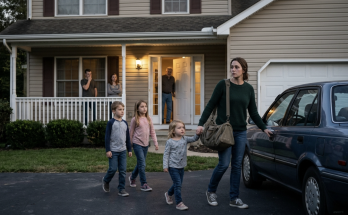
By the time Evelyn tapped her fork against her wineglass, I had been on my feet for almost nine hours. The turkey had rested exactly long enough. The sweet potatoes were still warm beneath their browned marshmallow crust. Two cousins were arguing about football near the fireplace, and someone had already spilled cranberry sauce on the linen runner I had ironed that morning. It looked like a family holiday because I had spent three days making sure it did.
I was carrying a bowl of green beans toward the dining table when the first clear tap rang through the room. Conversations thinned out. A second tap followed. Evelyn stood at the head of the table with one hand resting beside her plate, composed and perfectly comfortable in a house where she did not pay the mortgage.
“Before everybody sits,” she said, “there’s something we need to settle.”
Richard was three chairs away from me. He had been pouring wine for his uncle. His hand stopped above the glass, but he didn’t look at his mother. That small hesitation bothered me before I even knew why. It was the movement of a man who already knew what was coming.
Evelyn’s eyes found mine. “Claire, I think it would be better if you didn’t stay for dinner.”
For a moment I thought I had misunderstood her. The bowl was hot against my palms. Steam touched my chin. Somewhere near the kitchen, the refrigerator motor hummed into the sudden silence. Twenty relatives waited for someone to laugh and reveal that this was some ugly joke.
Nobody laughed.
I set the bowl down carefully. “Excuse me?”
Evelyn lifted her chin. “Thanksgiving should be for family. We’ve had enough tension lately, and I don’t want tonight becoming another argument.”
I looked around the table I had extended with two folding sections because her family was too large for the regular setting. I had bought the groceries. I had paid for the wine. I had ordered the extra chairs. I had gotten up before dawn to start the turkey because Evelyn had announced the week before that she was “too exhausted” to host this year.
“Whose house are we standing in?” I asked.
Several people lowered their eyes. Richard finally put down the bottle.
“Claire,” he said quietly.
That tone told me everything. Not outrage. Not confusion. Damage control.
I turned toward him. “Did you know she was going to say this?”
His jaw tightened. “Can we not do this in front of everyone?”
“Your mother just told your wife to leave her own Thanksgiving dinner in front of everyone.”
Evelyn exhaled as though I were being deliberately difficult. “This is exactly what I mean. You always turn everything into a confrontation.”
A cousin named Daniel stared at his phone. Richard’s aunt moved a dinner roll from one side of her plate to the other. His sister suddenly became fascinated by the candles. I knew most of these people’s birthdays. I had mailed gifts to their children. I had helped one cousin pay for a hotel after a plumbing disaster and had spent an entire weekend helping Richard’s sister move apartments.
Not one of them spoke.
“Richard,” I said, “am I leaving?”
His eyes met mine for barely a second.
Then he said, “Mom has made her decision.”
Something cold settled beneath my ribs.
“Her decision.”
He rubbed the back of his neck. “She thinks it’s best.”
“This is our house.”
“I know.”
“And I’m your wife.”
“I know that too.”
“Then why does she get to decide whether I can eat dinner at my own table?”
His voice dropped. “Because right now, my mother’s word is law. Please don’t make this worse.”
I could hear the oven fan behind me. That absurd domestic sound seemed sharper than everything else. Seventeen years of marriage narrowed into one sentence delivered beside a turkey I had seasoned before sunrise.
I looked at Evelyn.
She did not look triumphant. That would have been easier to understand. She looked certain. She had the confidence of someone who had tested the boundaries so many times that she no longer believed any existed.
“All right,” I said.
Richard blinked. “What?”
“I said all right.”
Evelyn’s shoulders loosened. Around the table, people shifted with visible relief. They thought the uncomfortable part was finished. They thought I would go upstairs, cry privately, return later, perhaps apologize for upsetting everyone. That was how these moments usually worked. Someone crossed a line. I absorbed it. Richard asked me to be reasonable. The family moved on.
I untied my apron and folded it once before placing it on the kitchen counter.
Richard followed me into the hallway. “Claire, where are you going?”
“You heard your mother.”
“I meant upstairs.”
I stopped.
“So when she said I shouldn’t stay for Thanksgiving, you interpreted that as me being confined to the bedroom while everyone else eats?”
“That isn’t what I meant.”
“What did you mean?”
He glanced toward the dining room, where everyone had resumed speaking in cautious murmurs.
“Just give her tonight,” he said. “We can talk tomorrow.”
I studied the man I had married. There were gray threads near his temples now. His tie was slightly crooked. Seventeen Thanksgivings ago, when we were still living in a cramped apartment, he had promised me that someday we would own a home big enough to fill with people we loved.
We had built that home.
Or I had believed we had.
“Who paid the property tax last month?” I asked.
His forehead creased. “What?”
“Who paid it?”
“Why are we talking about money?”
“Because apparently ownership and family are flexible concepts tonight.”
He lowered his voice. “Claire, stop.”
That word—stop—landed differently than he intended.
For years I had stopped. Stopped asking where certain transfers went because Richard said his business was complicated. Stopped questioning why Evelyn always seemed to have another emergency. Stopped objecting when family expenses appeared on our joint card. Stopped pointing out that my salary covered more and more while Richard talked about the next quarter being better.
I reached for my coat.
Richard stepped closer. “You’re seriously leaving?”
“Yes.”
“Over one dinner?”
“No.”
He waited.
I slipped my arms into my coat. “I’m leaving because when your mother told your wife she wasn’t family, you agreed with her.”
“I didn’t agree.”
“You enforced it.”
His mouth opened, then closed.
Evelyn appeared at the entrance to the hallway. “If you walk out dramatically, Claire, don’t blame anyone tomorrow when you regret it.”
I looked at her.
“No one is making a scene except you,” she continued. “You could simply give the family some space.”
“The family.”
“Yes.”
I picked up my purse.
Something inside it pressed against my hand: a thick folder I had brought home from my office two days earlier. Household documents. Insurance renewals. Copies of tax records. A few bank statements I had printed because I meant to spend the weekend organizing our finances before December.
For some reason, Evelyn’s eyes dropped to the folder when she saw its corner protruding from my bag.
Her expression changed.
Barely.
But I noticed.
“Why do you have that?” she asked.
I followed her gaze. “Have what?”
“That folder.”
Richard looked at my purse too.
The air in the hallway shifted so quickly that my anger was replaced by curiosity.
“Household paperwork,” I said.
“What kind of paperwork?” Richard asked.
I stared at him. “Why?”
“No reason.”
“Then you don’t need to know tonight.”
Evelyn stepped forward. “Claire, leave the documents here.”
It was the first thing she had said all evening that sounded less like an order and more like alarm.
I pulled my purse strap onto my shoulder. “They belong to me.”
“They belong to the household.”
“And ten minutes ago, according to you, I didn’t belong to the family.”
Her lips pressed together.
Richard said my name again, this time with a warning buried inside it.
I opened the front door.
Cold November air swept into the hallway. Behind me, silverware began moving against plates because someone had apparently decided the meal could continue. The smell of turkey and sage drifted toward the doorway.
“Claire,” Richard said.
I turned.
For one foolish second, I hoped he would come with me.
Instead he said, “Please don’t do anything impulsive.”
I looked from him to his mother.
Then I looked at the folder inside my purse.
“I think I’ve spent seventeen years doing exactly the opposite.”
I stepped outside and closed the door behind me.
I drove without choosing a destination. Holiday lights blurred along the roadside. My hands were steady on the wheel even though the rest of me felt strangely disconnected. I expected Richard to call before I reached the end of the street.
He didn’t.
I expected him to call when I crossed downtown.
Nothing.
I booked a room at a small hotel fifteen minutes from the house. The woman at reception wished me a happy Thanksgiving without looking up from her computer. I almost laughed at the normality of it.
Upstairs, I placed my purse on the desk, removed my shoes, and sat on the edge of the bed.
The room was quiet.
No Richard.
No Evelyn.
No relatives pretending not to listen.
For the first time all day, no one needed anything from me.
Then I remembered the way Evelyn had looked at my folder.
I pulled it from my purse.
The paperwork was ordinary at first: insurance documents, the mortgage statement, utility records, copies of joint credit-card statements.
Then I found three transfers I did not remember authorizing.
They were not enormous individually.
Together, they were large enough to make me sit straighter.
All three led to an account identified only by a partial number.
I searched earlier statements.
There it was again.
And again.
For almost three years.
My anger disappeared.
Something colder replaced it.
I turned another page and found a handwritten notation beside one transfer.
Richard’s handwriting.
One word.
Mom.
I stared at it until the letters blurred.
Then I looked at my silent phone on the hotel nightstand.
Nobody had called.
Not my husband.
Not Evelyn.
Not one of the twenty people who had watched me walk out.
For seventeen years, I had wondered whether I mattered to Richard’s family as much as they mattered to me.
That Thanksgiving night, sitting alone beneath the yellow light of a hotel lamp, I began to suspect I had been asking the wrong question.
The better question was what, exactly, I had mattered for.
Click here to continue reading: PART 2: By Morning I Had Fifty-Two Missed Calls, and the Financial Papers in My Bag Explained Why Everyone Suddenly Needed Me Back
Twenty People Watched My Mother-in-Law Erase My Place at Thanksgiving, but My Husband’s Silence Hurt More Than Her Words
Part 1 of 18