PART 2
The envelope trembled once in my hand.
Not because I was afraid of Bradley Vance.
Because Toby was watching from the second row, and I finally understood why he had stopped answering my calls.
My little brother sat beside a court-appointed advocate, shoulders hunched inside a sweater too large for him.
There was a yellow bruise beneath his jaw.
He saw me looking and pulled his collar higher.
“Your Honor,” I said, placing the envelope on the table, “this contains a sworn statement from Toby’s school counselor, photographs, financial records, and an emergency petition filed this morning.”
Vance reached for it.
Judge Henderson stopped him with a raised hand.
“Bailiff.
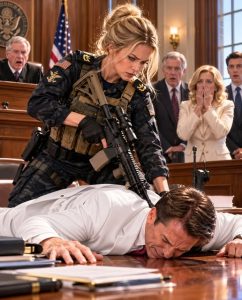
Take possession of Commander Sterling’s weapon.
Commander, remove your helmet and step away from counsel.”
I complied immediately.
The rifle went with the bailiff.
My helmet and vest went onto an empty chair.
Without them, I suddenly felt every hour of the flight home.
“And before we proceed,” the judge said, “you will explain why you assaulted an attorney in my courtroom.”
“He touched me.
I reacted.”
“That explains your conduct.
It does not excuse it.”
“No, Your Honor.”
Vance’s mouth twitched triumphantly.
I kept my eyes on the judge.
“I should have stepped back and asked the bailiff to intervene.
I apologize to the court.”
“And to Mr.
Vance?”
I turned toward him.
“I apologize for using unnecessary force.”
He looked disappointed.
He had expected an argument he could turn into a performance.
Judge Henderson opened the envelope.
The first page changed her expression.
The second made her glance toward Toby.
By the third, my father had stopped smiling.
“Mr.
Sterling,” she said, “what is Sterling Residential Services?”
My father adjusted his cuff.
“A property management company.”
“Owned by you?”
“Among other investors.”
“Your petition requests permission to use approximately eight hundred thousand dollars from your son’s trust to purchase a residence managed by that company.”
“A suitable home for a child has expenses.”
The judge placed a photograph beside the petition.
“Is this the proposed residence?”
Even from where I stood, I recognized the boarded windows.
My father’s voice hardened.
“The property is undergoing renovation.”
According to the independent valuation tucked beneath the photograph, it was worth ninety-three thousand dollars.
My grandfather had built his fortune restoring houses.
Apparently, my father had found a quicker method.
Vance rose.
“Your Honor, these materials have not been properly—”
“Sit down.
You will have an opportunity to respond.”
She read another page.
“What happened to this child last Thursday?”
My mother’s hands tightened around her purse.
“He fell.”
Toby went completely still.
It was such a small movement that nobody else seemed to notice: the way he stopped breathing, as if even air might get him in trouble.
I had seen men do that while waiting for another blow.
“Toby,” Judge Henderson said gently, “you don’t have to answer from your seat.”
My father turned toward him.
“Tobias, tell the judge what happened.”
“Mr.
Sterling,” she snapped.
“Face forward.”
For the first time since I had entered, Toby looked directly at me.
His lips moved.
*Don’t leave.*
I shook my head once.
*I won’t.*
***
Six hours earlier, I had been sitting aboard a military transport when a legal officer handed me a satellite phone.
A woman named Elena Ruiz was waiting on the line.
“I’m your brother’s school counselor,” she said.
“He gave me your number, but he made me promise not to call unless things got bad.”
“How bad?”
There was a pause.
“His father came to collect him yesterday.
Toby hid in a supply cupboard.”
The engines roared around me.
For several seconds, I heard nothing else.
Elena told me about the bruise.
The weight loss.
The essays Toby had stopped submitting because my father searched his backpack every evening.
Then she read something Toby had written during a counseling session.
*If I tell Maya, she’ll come home.
If she comes home, Dad will make sure she loses everything.
I can wait until I’m eighteen.*
Four years.
My brother had decided he could survive four more years if it protected me.
I called my commanding officer.
He arranged emergency leave.
Elena contacted Toby’s advocate, who filed the petition and told me to come directly to court.
The hearing had already begun when my aircraft landed.
The packet was waiting with the advocate downstairs.
My hurry explained the dust, the gear, the disastrous entrance.
It did not explain how I had missed what was happening for so long.
That was the question I carried upstairs.
***
Judge Henderson called a recess.
Toby’s advocate, Patricia Lowe, requested that he speak privately with the judge.
My parents were ordered to remain outside chambers.
My father caught my arm as I passed him.
This time, I looked down at his hand.
He let go.
“You have no idea what you’re doing,” he whispered.
“For once, I think I do.”
“He’s a difficult boy.”
“He’s fourteen.”
“You haven’t been here.”
That landed where he intended.
I had missed birthdays.
School concerts.
Ordinary Tuesdays when Toby might have needed someone to notice him.
My father leaned closer.
“You don’t get to disappear for years and come back playing mother.”
“No,” I said.
“I get to come back and listen.”
In chambers, Toby sat between Patricia and me.
A court reporter waited near the wall.
Judge Henderson took off her glasses.
“Toby, I understand you’re worried about what happens after you speak.”
He nodded.
“We’re going to discuss arrangements to keep you safe.
You can ask for a break whenever you need one.”
He stared at his shoes.
I wanted to take his hand, but I waited.
Finally, he reached for mine.
“Dad said I had to sign something.”
“What kind of document?” the judge asked.
“About the house.
He said it was what Grandpa wanted.”
“Did you sign?”
“No.”
His fingers tightened around mine.
“Grandpa told me never to sign anything I didn’t understand.”
The judge waited.
“He got mad,” Toby continued.
“Then Mom said I should stop making everything harder.”
My mother had always called silence peace.
I was beginning to understand what that peace had cost.
“Did your father hit you?” the judge asked.
Toby nodded.
“Has that happened before?”
Another nod.
“How often?”
“I don’t count.”
I felt my nails bite into my palm.
Beside me, Toby looked embarrassed.
As though he had admitted to bad grades.
“I’m sorry,” he whispered.
I turned toward him.
“For what?”
“Making you come home.”
That was when I broke.
Not loudly.
There was no speech, no dramatic collapse.
Tears simply ran down my face while I held his hand.
“You never have to apologize for that.”
For the first time all afternoon, he breathed deeply.
***
When we returned to the courtroom, two county investigators were waiting near the doors.
Vance saw them and began gathering his papers.
My father whispered furiously to him.
Judge Henderson resumed her seat.
“Pending further review, Toby will not return to either parent’s home.
Ms.
Lowe will coordinate a temporary placement.”
“With me,” I said.
The judge looked at me.
“Commander, your military obligations are a serious consideration.”
“I understand.”
“Do you have housing suitable for a minor?”
“Not in Chicago.”
My father gave a short laugh.
The judge continued.
“An available caregiver when you’re deployed?”
“Not yet.”
“Then I cannot place him with you simply because you love him.”
I swallowed.
Toby’s face emptied.
Across the aisle, my mother began crying.
For years, I had thought the hardest thing I could ever do was return from a mission carrying fewer people than I had taken out.
Then I stood in a courtroom and realized I could reach my brother, touch his hand, and still fail to bring him home.
Patricia rose.
“Your Honor, there is another family member available.
Mrs.
Evelyn Sterling.”
My grandmother.
My father turned sharply.
“She’s seventy-three.”
“And remarkably capable of answering for herself.”
The voice came from the doorway.
Grandma stood there in a navy coat, leaning on the walnut cane Grandpa had carved for her.
Elena Ruiz was beside her.
Grandma crossed the room slowly.
Her eyes passed over my discarded equipment, Vance’s scattered documents, and the bruise on Toby’s face.
Then they stopped on her son.
“Richard,” she said.
“What have you done?”
For a moment, he looked eight years old.
“Mother, this is a misunderstanding.”
She set a folder on Patricia’s table.
“I have a bedroom ready.
I also have copies of the trust documents, including the provision your attorney appears to have overlooked.”
Vance went pale.
The trust separated Toby’s care from control of his inheritance.
Neither parent could access the principal without an independent trustee’s approval.
Grandpa had trusted his son with birthday presents.
He had been less confident about several million dollars.
Judge Henderson reviewed the documents, then asked Grandma about her health, her home, and the support available to her.
I offered to stay there during my leave.
That was enough for an emergency arrangement, subject to a home assessment and another hearing.
Toby would go home with Grandma.
I would go with him.
My father stood before the judge finished.
“You’re turning my entire family against me.”
Grandma looked up.
“No, Richard.
We are finally looking at you.”
***
The investigators questioned my parents separately.
The financial inquiry had begun before I arrived.
An independent trustee had reported irregular invoices; Toby’s counselor had supplied the missing reason to act urgently.
No one was sentenced that afternoon.
No fortune changed hands with the strike of a gavel.
There were statements, signatures, telephone calls, and long stretches of waiting.
Vance left without looking at me.
My father left with the investigators.
My mother remained on a hallway bench, holding a tissue she had twisted into a rope.
“Maya.”
I stopped.
Toby stood beside Grandma a few feet away.
“Tell him I love him,” my mother said.
“He can hear you.”
Her eyes flicked toward him.
“Toby, sweetheart—”
He pressed closer to Grandma.
My mother looked back at me.
“I didn’t know it was this serious.”
“Elena called you three times.”
“Your father said—”
“You saw the bruise.”
She folded the tissue smaller.
“I thought keeping us together was the right thing.”
Behind me, Toby spoke.
“You let him lock my door.”
My mother closed her eyes.
“The key was on your necklace,” he said.
“I could hear it when you walked past.”
Nothing in that hallway moved.
Then Grandma put a hand on his shoulder.
“Come along, darling.”
My mother reached toward him.
He stepped away.
It was the smallest distance anyone had crossed that day.
It felt enormous.
***
That night, Toby stood in Grandma’s guest room and studied the bed.
Clean sheets.
A reading lamp.
A dresser with one drawer slightly crooked.
“You can change anything you like,” Grandma told him.
“Can I shut the door?”
“Of course.”
He hesitated.
“And open it again?”
Grandma’s face crumpled for half a second.
“Yes.”
After she left, I sat on the floor beside the bed.
Toby remained standing.
“You don’t have to stay up,” he said.
“I’m comfortable.”
“You’re wearing boots.”
I took them off.
He almost smiled.
At two in the morning, he finally climbed under the blanket.
At three, he woke shouting.
I stayed on the floor while he checked the door.
At four, he fell asleep again.
By sunrise, my back ached worse than it had after any operation I could remember.
I had never been more grateful for pain.
***
The following months were quieter than the courtroom.
They were also harder.
Toby startled when somebody dropped a pan.
He hid food in his dresser.
Once, Grandma asked him to put a towel in the laundry, and he apologized until she sat down and cried with him.
I learned to knock before entering his room.
I learned that asking “Are you okay?” could sound like a demand when the truthful answer had always been dangerous.
Instead, I asked whether he wanted company.
Sometimes he did.
Sometimes he wanted me outside the door.
I stayed there, too.
My command worked with me on a shore assignment.
Patricia helped me prepare a guardianship petition.
There were home visits, background checks, interviews, and a therapist who reminded me that vigilance was useful in combat and exhausting at a breakfast table.
“You cannot inspect every silence,” she told me.
“I can try.”
“Yes.
And then your brother will spend his life reassuring you.”
That stopped me.
I began learning how to be his sister again.
We burned pancakes.
We argued about music.
He discovered that I was terrible at the video game he loved and refused to let me blame the controller.
One evening, he laughed so hard that milk came out of his nose.
Grandma pretended to scold him.
Then she went into the kitchen and stayed there until her eyes were dry.
***
My father’s property scheme unraveled through bank records and invoices.
He eventually pleaded guilty to fraud and an assault charge connected to Toby.
The sentence felt too short to me, but Toby asked me not to spend our dinner discussing it.
So I stopped.
Vance became the subject of a professional disciplinary investigation.
The papers showed how much he had known about the proposed purchase.
My own conduct was reviewed as well.
I received a formal reprimand.
There were interviews, written statements, and a difficult conversation with my commanding officer.
Training was not permission to lose control.
I accepted that.
Toby needed to see someone admit wrongdoing without blaming the person they had hurt.
My mother attended supervised visits.
At the first one, she brought an expensive watch.
Toby left it on the table.
At the third, she brought no gift.
She said, “I should have opened your door.”
He looked at her for a long time.
“Yes,” he replied.
It was the first honest conversation I had ever heard between them.
It did not fix anything.
It gave them somewhere to begin.
***
Six months after I walked into court in combat gear, I returned in a plain blue suit.
Toby sat beside me.
His sweater fit.
The bruise was gone.
He still checked where the exits were, but he no longer watched every adult’s hands.
Judge Henderson reviewed the final reports.
Then she approved my guardianship.
Grandma squeezed my shoulder.
Toby stared at the order as though it might disappear.
Afterward, on the courthouse steps, he asked, “So where do I go now?”
“Home.”
“With you?”
“With me.”
“For how long?”
I crouched slightly so our eyes were level.
“You don’t have to earn your place there, Toby.”
He nodded, trying very hard to look fourteen.
Then he wrapped both arms around me.
I held him while traffic moved along the street and strangers passed without knowing that my whole world had finally become small enough to hold.
***
Grandma waited until that evening to give us the box.
It was a narrow cedar case with a brass lock.
“Your grandfather left instructions,” she said.
“I was to give this to you if Toby ever needed protection from Richard.”
I looked at her.
“Why didn’t you bring it to court?”
“Because there was nothing inside that would help the judge decide where he should sleep.”
She placed a small key beside it.
“But there is something you both need to know.”
Inside lay a birth certificate, a faded photograph, and an envelope addressed in Grandpa’s handwriting.
The photograph showed my uncle Daniel holding a baby beside a fishing boat.
Daniel had disappeared at sea when Toby was two.
We had buried an empty coffin.
I read the certificate.
Then I read it again.
Under *Father* was the name Daniel Sterling.
Under *Mother* was a name I had never heard.
Toby leaned against my shoulder.
“What does that mean?”
Grandma sat down.
“It means Richard and Caroline adopted you after your father disappeared.”
My brother stared at the photograph.
“Why didn’t they tell me?”
“I should have made certain they did.”
There was no excuse in her voice.
I opened Grandpa’s letter.
The first paragraph explained the trust.
The second explained why he had never allowed Richard to control it.
The third made my hands turn cold.
*Daniel did not die at sea.*
I looked up at Grandma.
She was crying.
“He contacted your grandfather three weeks before the funeral,” she said.
“He was frightened.
He said someone had followed him home.”
“Did Grandpa go to the police?”
“Yes.
Nothing came of it.”
Beneath the letter was a newer photograph.
Daniel, older and thinner, stood behind a chain-link fence.
On the back, Grandpa had written a date.
Nine months ago.
Toby touched the corner with one finger.
“Is my dad alive?”
Before I could answer, my phone vibrated.
An unknown number.
The message contained six words.
*Your grandfather was right.
Check outside.*
Through Grandma’s kitchen window, I saw a car idling across the street.
A man stood beside it beneath the streetlight.
His face was older than the one in the photograph.
But I knew him.
Uncle Daniel raised one hand.
Then my phone rang.
I answered without taking my eyes off him.
“Maya,” he said.
“Keep Toby away from the window.”
Across the street, the car’s rear door opened.
“And whatever happens next,” my uncle whispered, “do not let your mother into that house.”
…If you want to know what happened next, please type “YES” and like for more.