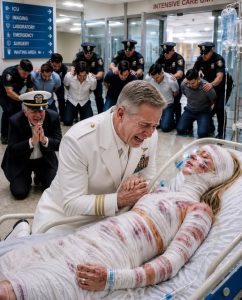
# PART 2 — THE MEN WHO LAUGHED OUTSIDE HER ICU
The first sound that disappeared from the hallway was laughter.
The second was confidence.
Nine men who had spent their entire lives believing fear belonged to other people suddenly found themselves standing beneath the fluorescent lights of St.
Matthew’s Hospital while uniformed police officers separated them one by one.
Clara’s father, Harold Mercer, was the last to move.
He kept staring at me.
Not at the officers.
Not at the investigators opening notebooks.
At me.
“General?” he whispered.
I said nothing.
For years, Harold had assumed my silence meant weakness.
He had mistaken restraint for fear.
That was his first mistake.
His second had been believing Clara would always remain too frightened to tell anyone what happened inside the Mercer family.
His third had happened tonight.
He had nearly killed my wife.
And our unborn child was already dead.
A detective approached me.
“General Cole?”
“Daniel Cole.”
He nodded.
“Detective Marcus Reed.
I need to ask you some questions.”
“You’ll have everything I know.”
Harold’s eldest son, Brent, laughed nervously from across the hallway.
“This is ridiculous.
It was a family argument.”
Detective Reed turned toward him.
“A family argument doesn’t usually fracture three ribs.”
Brent’s smile vanished.
Another brother spoke quickly.
“She fell.”
Reed looked at him.
“Into nine different fists?”
Nobody answered.
Hospital security had already begun isolating camera footage.
Two patrol officers were collecting clothing and photographing visible injuries on the men.
The walls were closing in.
Not because of me.
Because of evidence.
That distinction mattered.
I had spent most of my adult life commanding people with access to weapons, intelligence, and enormous authority.
The first lesson command teaches you is simple.
**Power becomes dangerous the moment you believe it exists for your personal anger.**
So I did not order soldiers to intimidate the Mercers.
I did not threaten anyone.
I did not raise my voice.
I sat beside Clara’s bed.
Her eyes were still closed.
Machines breathed and beeped around her.
I held her hand carefully because even her fingers were bruised.
“I’m here,” I whispered.
My voice broke on the second word.
Thirty years in uniform.
Three combat commands.
Two stars.
Thousands of soldiers.
And I had never felt as helpless as I did sitting beside my wife.
My gaze lowered toward the blanket covering her stomach.
Six months pregnant.
A daughter.
We had already chosen her name.
Emily.
Clara had wanted something simple.
Something warm.
She had bought a tiny pair of yellow socks three days earlier and placed them on my desk beside classified briefing folders.
I had pretended to be annoyed.
She had laughed.
“General Cole,” she had said, standing in my office doorway, “your daughter outranks you.”
I had looked at the socks.
“That’s unconstitutional.”
“She doesn’t care.”
Now Emily would never wear them.
I closed my eyes.
For several minutes, I let myself grieve.
Not as an officer.
Not as a commander.
As a father.
Then Clara’s fingers moved.
Barely.
I immediately leaned forward.
“Clara?”
Her eyelids fluttered.
Pain crossed her face before awareness did.
“Daniel?”
“I’m here.”
Her breathing changed.
Then panic entered her eyes.
“The baby.”
I wished there were another answer.
I wished rank could change reality.
I wished thirty years of experience had taught me how to say what came next.
It had not.
I squeezed her hand.
“Clara…”
She understood.
A sound escaped her that I will remember for the rest of my life.
Not a scream.
Something smaller.
Almost a gasp.
But it carried more pain than any scream could have.
“No.”
I lowered my forehead against her hand.
“I’m sorry.”
“No.”
Her chest began rising faster.
A nurse hurried in.
“Mrs.
Cole, please try not to move.”
“My baby.”
The nurse looked at me.
I shook my head once.
Clara began crying.
“I tried to protect her.”
“You did.”
“I covered my stomach.”
“I know.”
“They kept—”
Her voice broke.
“Clara.”
She looked at me.
I forced myself to remain steady.
“None of this is your fault.”
Tears rolled across the bruising around her eyes.
“My father said…”
“What?”
She swallowed painfully.
“He said if I chose you over the family again, he would make sure I regretted it.”
My jaw tightened.
Again.
That word mattered.
“Again?”
Clara closed her eyes.
And suddenly I knew.
This had not begun tonight.
“Clara, has he hurt you before?”
She did not answer.
That silence frightened me more than the hallway had.
I sat closer.
“Has Harold hurt you before?”
She whispered, “Not since I married you.”
My stomach turned.
“What happened before?”
Tears gathered again.
“My brothers used to hold me down.”
I went completely still.
“For what?”
“For leaving.”
“For going to college.”
“For dating someone Dad didn’t approve of.”
“For talking back.”
Each sentence was quieter than the last.
I felt rage rise.
Then I buried it.
Clara needed a husband.
Not a general.
“What happened tonight?”
She looked toward the door.
Fear entered her face instantly.
“Are they still here?”
“Police have them separated.”
“All of them?”
“Yes.”
She released a trembling breath.
I waited.
Finally she spoke.
“My father called yesterday.”
“I know you didn’t mention it.”
“I was embarrassed.”
“You never have to be embarrassed with me.”
“He said Mom had left something for me before she died.”
Clara’s mother had passed away twelve years earlier.
Clara rarely discussed her.
“What?”
“A box.”
“What was inside?”
“I don’t know.”
She glanced toward the door again.
“Dad said I had to come alone.”
I already hated where the story was going.
Clara continued.
“When I got there, there wasn’t any box.”
“What did he want?”
“Money.”
“How much?”
“Two hundred thousand dollars.”
I stared at her.
“Why?”
“He said Brent owes dangerous people.”
Brent.
The eldest brother.
The one who had laughed loudest in the hallway.
“I told Dad we didn’t have two hundred thousand dollars just sitting around.”
Clara gave a bitter, exhausted laugh.
“He said of course we did because you worked for the government.”
I almost smiled despite everything.
Harold’s understanding of federal employment had apparently never progressed beyond television.
“What happened after you refused?”
“They started insulting you.”
“That doesn’t matter.”
“It mattered to them.”
She closed her eyes.
“They said I had become arrogant because I married a man who wore nice suits and traveled.”
Then she whispered,
“I told them I was leaving.”
My hand tightened around hers.
“They blocked the door.”
The machine beside her began beeping faster.
A nurse stepped toward us.
I lowered my voice.
“You don’t have to tell me everything right now.”
“Yes, I do.”
She looked directly at me.
“For once, I do.”
So I listened.
Clara told me how her father grabbed her arm first.
How Brent shoved her against the dining-room wall.
How she warned them she was pregnant.
How one brother hesitated.
Only briefly.
Then Harold said something that froze the air in my lungs.
“He said, ‘Maybe losing Daniel’s baby will remind you who you belong to.’”
I closed my eyes.
For exactly two seconds.
When I opened them, Clara was studying me.
“Daniel.”
“Yes?”
“Promise me something.”
“Anything.”
“Don’t become like them.”
My throat tightened.
“I won’t.”
“Don’t use your position.”
“I won’t.”
“Don’t destroy your career for revenge.”
I leaned forward and kissed her forehead.
“I will use everything I know to protect the truth.”
She watched me carefully.
“And them?”
“The courts decide what happens to them.”
That seemed to give her something she desperately needed.
Safety.
Not vengeance.
Her eyes closed again.
Within minutes, medication pulled her back into sleep.
I stepped into the hallway.
Detective Reed was waiting.
“General.”
“She’s awake.”
“Can she talk?”
“Briefly.”
“Did she identify the attackers?”
“All nine.”
Reed’s expression hardened.
“Then we have a problem.”
“What problem?”
He glanced down the corridor.
“Three brothers are already claiming they weren’t present when the assault started.”
“They were.”
“We need proof.”
“You have hospital cameras.”
“Hospital cameras show arrival.
I mean cameras at the house.”
I thought for a moment.
“Harold has exterior security cameras.”
Reed nodded.
“We sent officers.”
“And?”
“They were removed.”
My eyes narrowed.
“When?”
“Looks recent.”
Of course.
Evidence tampering.
Then another officer approached quickly.
“Detective.”
Reed turned.
“What?”
“We have a witness.”
“Who?”
“A neighbor.”
My attention sharpened.
The officer lowered his voice.
“Woman named Ellen Voss.
She lives two houses down.
Says she saw Mrs.
Cole arrive around seven-thirty.”
“That helps establish location,” Reed said.
“There’s more.”
The officer looked at me.
“She heard screaming.”
Every muscle in my body tightened.
“She called 911?”
“No.”
“Why not?”
“She says she tried.”
Reed frowned.
“Tried?”
The officer handed him a tablet.
“She claims someone disconnected her landline from the exterior utility box.”
That changed everything.
Reed looked at me.
Premeditation.
Nobody said the word.
Nobody needed to.
Then my chief of staff appeared at the far end of the hallway.
Colonel Aaron Bishop had worked beside me for six years.
He walked toward me carrying my overnight bag.
“Sir.”
“Thank you for coming.”
He lowered his voice.
“Your protection team found something you need to know.”
I instantly corrected him.
“Anything related to the case goes to Detective Reed first.”
Bishop nodded.
“Already done.”
Reed gestured.
“Tell him.”
Bishop opened a folder.
“When the officers checked vehicles in the hospital parking structure, they identified a truck registered to Brent Mercer.”
“And?”
“In the truck was Mrs.
Cole’s purse.”
I stared at him.
Clara had arrived by ambulance.
Her purse should have remained at the house.
Reed continued.
“There was also a broken cell phone.”
Clara’s phone.
Someone had brought her belongings to the hospital.
Why?
Bishop answered that question.
“There was cash.”
“How much?”
“One hundred and eighty-seven thousand dollars.”
Silence.
Even Reed looked surprised.
“Cash?”
I asked.
“Yes.”
“Where did Brent get it?”
“We don’t know.”
I immediately understood the danger.
If this became connected to my position, even incorrectly, the investigation could become complicated.
“I want federal ethics counsel notified.”
Bishop nodded.
“Already happening.”
“And I want a complete financial audit of any account connected to me that investigators request.”
“Yes, sir.”
Reed studied me.
“You think they’ll claim it was your money?”
“I think people who nearly killed their pregnant sister may be capable of inventing explanations.”
I was right.
Twenty minutes later, Brent Mercer asked for an attorney.
Then Harold did.
Then all eight brothers.
By dawn, none of them were laughing.
But that was only the beginning.
At 6:14 a.m., Detective Reed entered Clara’s room with an expression I had learned to recognize during military briefings.
Something had changed.
“General.”
I stood.
“What happened?”
“We searched the Mercer residence after obtaining an emergency warrant.”
“And?”
“We found blood.”
My eyes moved toward Clara.
“She told you what happened.”
“Yes.”
“That confirms it.”
Reed hesitated.
“It confirms part of it.”
“What else?”
“Come with me.”
We stepped into a private consultation room.
He placed several evidence photographs on the table.
The first showed Clara’s blood near the dining-room wall.
The second showed a damaged chair.
The third showed the cable pulled from the exterior telephone connection.
Then Reed placed down another photo.
A locked metal cabinet.
“What is that?”
“We found it behind a false wall in Harold Mercer’s basement.”
He placed down the next photograph.
Inside were folders.
Dozens.
Names.
Dates.
Photocopies of identification documents.
Bank statements.
Loan agreements.
Some went back more than twenty years.
I looked at Reed.
“What are you telling me?”
“We don’t know yet.”
He pointed to another image.
A handwritten ledger.
Payments.
Debts.
Transfers.
Several entries had women’s names beside dollar amounts.
Including Clara’s.
My blood turned cold.
“How long has he been doing this?”
“We’re trying to determine that.”
Then Reed showed me the entry beside Clara’s name.
**CLARA — 200,000 — DUE BEFORE FRIDAY.**
Exactly what she had told me.
But underneath it was something else.
A second line.
**IF D.C.
REFUSES, USE E.M.
FILE.**
I stared at the initials.
“D.C. is probably me.”
Reed nodded.
“What is E.M.?”
“We were hoping you knew.”
I didn’t.
Then I remembered Clara’s mother.
Evelyn Mercer.
E.M.
My stomach tightened.
“Her mother.”
Reed went still.
“Clara’s mother?”
“Yes.”
“She died twelve years ago?”
“That’s what Clara told me.”
Reed gathered the photographs.
“We found another locked container labeled Evelyn.”
“What was inside?”
“That’s where this gets strange.”
He looked directly at me.
“The death certificate says Evelyn Mercer died in an automobile accident.”
“Yes.”
“But there was a hospital discharge record in the box.”
“From when?”
“Eleven years ago.”
I stared at him.
“That’s impossible.”
“One year after her official death.”
Neither of us spoke.
Then Reed placed the document in front of me.
The patient name was Evelyn Mercer.
Same birth date.
Same Social Security number.
Same emergency contact.
Harold Mercer.
And there was a handwritten notation.
**Patient fearful of returning home.
Requested confidentiality.**
The room suddenly felt smaller.
“Where was this hospital?”
“Colorado.”
Clara’s mother had supposedly died in Ohio.
Reed sat across from me.
“General Cole, I think tonight may have exposed something much larger than an assault.”
I looked through the glass wall toward Clara’s room.
She had spent twelve years grieving a mother who might not have been dead.
“Does Clara know?”
“No.”
“Don’t tell her yet.”
Reed raised an eyebrow.
“She nearly died twelve hours ago.
Let us verify it before we give her hope.”
He nodded.
“That’s reasonable.”
The door opened.
Colonel Bishop stepped inside.
“Sir, forgive me.”
“What?”
“You asked me to route anything relevant to law enforcement.”
“Yes.”
“We just received something.”
He handed his phone to Detective Reed first.
Reed read the message.
His expression changed.
Then he handed it to me.
The message had been sent through my official office inbox from an anonymous encrypted account.
Only one sentence.
**Ask Harold Mercer what happened at Red Creek in 1997.**
I looked up.
“What is Red Creek?”
Reed was already typing into his tablet.
Seconds later, he stopped.
“Red Creek, Kentucky.”
“And?”
“There was a fire there in 1997.”
“What kind of fire?”
“A residential fire.”
He scrolled.
“Seven people killed.”
I felt something dark settle in my chest.
“Mercers?”
Reed shook his head.
“No.”
He turned the tablet toward me.
The news clipping was old.
Grainy.
Seven members of one family had died when their farmhouse burned in the night.
Investigators originally blamed faulty electrical wiring.
Then another line caught my attention.
**Neighbor Harold Mercer told reporters he attempted to rescue the family but was driven back by smoke.**
I read it twice.
Harold.
Again.
Reed leaned back.
“This could be meaningless.”
“It could.”
Neither of us believed that.
The door opened again.
A young detective hurried inside.
“Reed.”
“What?”
“We found the missing house cameras.”
Reed stood.
“Where?”
“Not missing.
Hidden.”
The detective looked almost pale.
“There’s a second recording system.”
“Why would someone run two systems?”
“One is obvious.
The other is concealed.”
“Who installed it?”
“We don’t know.”
“Did it record last night?”
“Yes.”
My pulse hammered.
Reed asked the only question that mattered.
“What does it show?”
The detective hesitated.
“It shows all nine men assaulting Mrs.
Cole.”
My eyes closed.
Proof.
Undeniable proof.
“It also records audio.”
Every word Clara had described.
Every threat.
Every warning that she was pregnant.
Every response.
Reed exhaled slowly.
“That ends the argument over identification.”
“Not exactly.”
The young detective looked at me.
“There’s something else on the recording.”
“What?”
“About thirty minutes before Mrs.
Cole arrived, Harold Mercer received a visitor.”
“Who?”
“We don’t know.”
“Show me.”
The detective opened his tablet.
The footage was dark but clear enough.
A black sedan pulled into the driveway.
A tall man stepped out.
He wore a baseball cap low over his face.
Harold greeted him.
They entered the garage.
Ten minutes later, the man left.
I almost dismissed it.
Then he turned briefly toward the camera.
I stopped breathing.
“Pause.”
The detective paused the footage.
Reed looked at me.
“You recognize him?”
I stepped closer.
No.
It couldn’t be.
The face was older.
Thinner.
But I knew it.
I had known that man for nearly twenty-five years.
Colonel Bishop looked over my shoulder.
His expression changed instantly.
“Sir?”
Detective Reed looked between us.
“Who is he?”
I stared at the frozen image.
“His name is Samuel Vance.”
Reed waited.
I continued.
“He served under me.”
“What rank?”
“Colonel.”
“Served?”
“He disappeared eighteen years ago.”
Reed frowned.
“Deserted?”
“No.”
“Then what happened?”
“We were told he died.”
The room went silent.
Bishop whispered,
“Sir, Vance was killed overseas.”
“That’s what the casualty report said.”
The detective looked at the screen.
“Well, unless someone has his exact face…”
I finished the thought.
“He didn’t die.”
My mind began connecting pieces I did not want connected.
Evelyn Mercer.
Declared dead, then appearing at another hospital.
Samuel Vance.
Declared dead, now walking into Harold Mercer’s garage.
A hidden ledger.
Cash.
A concealed surveillance system.
A message about Red Creek.
This was no longer about one violent family.
Someone had built a system around people who officially no longer existed.
I looked at Detective Reed.
“This needs federal involvement.”
“I was about to say the same.”
Within two hours, federal investigators arrived.
Not because I called them.
Because Detective Reed did.
That mattered.
Everything had to remain clean.
Every warrant.
Every interview.
Every chain of custody.
Especially now.
At 9:40 a.m., Clara woke again.
I was sitting beside her.
She studied my face.
“You found something.”
Thirty years of command had apparently not taught me how to hide things from my wife.
“Yes.”
“About Dad?”
“Yes.”
She swallowed.
“How bad?”
“Potentially very bad.”
“Daniel.”
I took her hand.
“I need to ask you something about your mother.”
Her expression changed instantly.
“What?”
“Did you ever see her body after the accident?”
Clara stared at me.
“No.”
“Why?”
“Dad said it was too badly burned.”
My pulse quickened.
“Was there a funeral?”
“A closed casket.”
“Did you ever see an official report?”
“I was nineteen.”
“That’s not what I asked.”
She slowly shook her head.
“No.”
I looked toward the window.
Clara squeezed my hand.
“What did you find?”
Before I could answer, Detective Reed entered.
His face was pale.
“General.”
I stood.
“What?”
“We confirmed something.”
He looked at Clara.
Then back at me.
“We located Evelyn Mercer.”
Clara stopped breathing.
“What?”
Reed approached slowly.
“Mrs.
Cole, we believe your mother is alive.”
Clara stared at him.
For several seconds, nothing moved except the heart monitor.
Then she laughed once.
A broken, disbelieving sound.
“No.”
“I understand why that sounds impossible.”
“My mother is dead.”
“We have recent records.”
“No.”
“Clara,” I said softly.
She looked at me.
I nodded.
“We think it may be true.”
Her eyes filled immediately.
“Where is she?”
Reed hesitated.
“She’s in protective federal custody.”
“What?”
That answer stunned even me.
“Why?”
I asked.
Reed looked toward the door.
“Because Evelyn Mercer has apparently been cooperating with investigators for sixteen years.”
Clara’s face went white.
“Investigating what?”
Reed placed a thick sealed folder on the table.
“Your father.”
The room became silent.
Then he added,
“And several other people.”
“Who?”
Reed looked directly at me.
“One of them is Colonel Samuel Vance.”
I felt the air leave my lungs.
Clara looked between us.
“Who is that?”
Before I could answer, my phone rang.
An unfamiliar number.
I almost ignored it.
Then Detective Reed noticed.
“Answer it.”
I did.
“Daniel Cole.”
Silence.
Then a woman spoke.
Older.
Shaking.
“General Cole?”
“Yes.”
“My name is Evelyn.”
Clara sat upright despite the pain.
Every machine beside her protested.
The woman continued.
“I’m Clara’s mother.”
Clara covered her mouth.
I put the phone on speaker.
“Mom?”
Silence.
Then a sob.
“Clara?”
My wife began crying.
“Mom?”
“I’m here, baby.”
Clara’s entire body shook.
“You’re alive.”
“I’m so sorry.”
“Why?”
“I had to disappear.”
“Why?”
The woman’s voice broke.
“Because your father wasn’t the man you thought he was.”
Clara stared at the phone.
Then Evelyn said something neither of us expected.
“And Daniel…”
“Yes?”
“You need to listen carefully.”
Her tone changed.
Urgent now.
“There is one person you cannot trust.”
Detective Reed and I exchanged a glance.
“Who?”
Evelyn breathed shakily.
“The man standing closest to you.”
My eyes lifted.
Colonel Bishop stood just outside Clara’s room.
Our eyes met through the glass.
Then the hospital lights went out.
Darkness swallowed the entire floor.
Emergency alarms began screaming.
Someone shouted from the hallway.
I moved instantly toward Clara.
“Lock the door!”
Detective Reed drew his weapon.
Emergency lights flickered red.
Then my phone crackled.
Evelyn was still connected.
Her next words came through almost as a whisper.
“Daniel, Samuel Vance isn’t the only dead man who came back.”
I froze.
“What does that mean?”
But the call disconnected.
Outside the door, something crashed.
Then came three hard knocks against the glass.
Not from a police officer.
Not from my protection detail.
A figure stood in the darkened hallway wearing a hospital coat.
He slowly raised his face toward me.
And after thirty years of command, I finally understood why Harold Mercer had laughed so confidently outside Clara’s ICU.
**He had never believed he was facing me alone.**
He believed someone far more dangerous had already made sure I would never reach the truth.
And judging by the man now standing outside my wife’s locked hospital room—
**he might have been right.**
…If you want to know what happened next, please type “YES” and like for more.