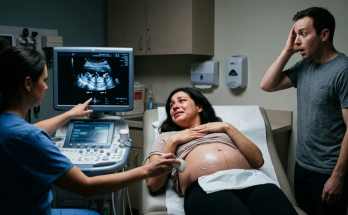
PART 1 TITLE: The Morning I Discovered I Was Pregnant, My Husband Turned a Medical Surprise Into an Accusation That Threatened Our Marriage
The second line appeared so faintly that I held the pregnancy test beneath the bathroom light to make sure I wasn’t imagining it. I turned the plastic stick sideways, then brought it closer to the window. Nothing changed. Two pink lines remained where there should have been one. Beyond the bathroom door, I could hear my husband moving through the kitchen, opening cabinets and setting his coffee cup on the counter. It was an ordinary Tuesday morning in our Texas home, and I was standing barefoot on the cold tiles with evidence of something that, according to Mark, could no longer happen.
My name is Emily Carter. Mark and I had been married for eight years, long enough to know which floorboards complained beneath his feet and how he liked his coffee when he was running late. We had made a comfortable life near Austin, with a modest house, dependable jobs, and savings accumulated slowly through years of postponed vacations and careful spending. Our marriage had once felt like the most certain thing in my life. But over the previous several months, something between us had shifted. Mark had become quieter at dinner, quicker to irritation, and increasingly protective of his phone. Whenever I asked whether something was bothering him, he blamed work. I wanted to believe him, partly because I loved him and partly because I had no idea what to do with the alternative.
Two months earlier, Mark had undergone a vasectomy. The decision hadn’t been an easy one between us. We had talked for years about the possibility of having another child, although those conversations had gradually become less frequent and more strained. I was still uncertain about closing that door permanently. Mark, however, had decided he didn’t want any more children. He spoke about money, responsibility, and how difficult parenting could become as we grew older. I understood those concerns. What troubled me was the way the discussion eventually stopped being a discussion. He arranged the appointment before I had fully accepted what it meant. I accompanied him to the clinic because he was my husband, and caring about him didn’t disappear simply because we disagreed.
I remembered the surgeon explaining that a vasectomy did not make a man sterile the moment the procedure ended. Another form of contraception was necessary until a follow-up semen analysis confirmed the absence of sperm. Mark had nodded while the doctor spoke. Later, when I reminded him about the test, he brushed the matter aside. He seemed to regard the surgery itself as the final step rather than the beginning of a process requiring confirmation. We argued once about it, briefly, while putting away groceries. Then everyday life took over. I never imagined that misunderstanding would become the reason my husband accused me of betraying him.
Standing in the bathroom, I considered whether the test might be defective. My period had been irregular before, and I had attributed the recent nausea to a stomach bug. The exhaustion made sense with my work schedule. Even the tenderness in my breasts had seemed like another ordinary hormonal change. I opened the cabinet, found a second test from the same box, and followed the instructions with hands that wouldn’t remain steady. When the second result was positive, I sat on the closed toilet lid. I pressed both tests between my palms, feeling the ridges of the plastic. A child. Whatever difficulties Mark and I had experienced recently, I couldn’t stop an unexpected warmth from spreading through my chest.
I waited until he finished his coffee. Mark was standing at the kitchen counter, looking at something on his phone, when I entered. He wore the pale blue shirt I had ironed the night before, and his car keys lay beside the fruit bowl. I asked him to sit down. He looked at the clock and said he had a meeting. I told him it was important. Something in my expression must have unsettled him, because he put the phone face down and pulled out a chair. I placed the two tests on the table between us. For several seconds, he stared at them without speaking. Then he looked at me, and the expression I had hoped would be astonishment hardened into suspicion.
“Whose child is it?” he asked.
I thought I had misunderstood. “Mark, what?”
He pushed his chair backward. “I had a vasectomy, Emily. You know that.”
“Yes. And you know the doctor said we needed to wait until the follow-up test.”
“Don’t try to explain this away with something technical.”
His voice was low, almost controlled, but his hands had tightened into fists. I told him again that he could still have sperm after the surgery and that he had never completed the recommended testing. He walked toward the window and shook his head. I watched him trying to turn a possibility he disliked into something impossible. I had expected confusion, perhaps even anger about the pregnancy itself. I had not expected him to question whether I had been faithful.
For the next hour, we repeated ourselves until the words seemed to lose their meanings. I insisted I had not been with anyone else. Mark demanded a confession I couldn’t give him. When I suggested calling the clinic, he refused. He claimed the doctor had told him the procedure was successful. I reminded him that the surgeon had explained the difference between performing the operation and confirming sterility. Mark said I was twisting a medical conversation to protect myself. Eventually, he grabbed his keys and left without another word. The tests remained on the kitchen table, one angled across the other, while I stood beside the sink listening to his car pull away.
I called him twice that afternoon. Both calls went unanswered. I sent him a message asking us to discuss the situation after we had both calmed down. He replied hours later with a single sentence telling me that I needed to admit the truth. I sat at my desk staring at the screen until a coworker asked whether I was feeling well. I said I had a headache. It was the easiest answer, and it allowed me to leave early without explaining why my hands shook every time my phone vibrated.
Mark didn’t come home for dinner. At nine o’clock, he sent a message saying he needed space. When I asked where he was staying, he didn’t answer. I spent the night in our bedroom, lying on the far edge of the mattress as though leaving room for him might somehow bring him back. The house smelled faintly of the laundry detergent I had used that morning. His watch was still on the dresser. Those small familiar things made his absence more difficult to understand. Nothing in the room had changed, yet the life they represented seemed suddenly unreliable.
By the following evening, Mark had begun telling people that our marriage was in trouble. His sister sent me a cautious message asking whether everything was all right. A neighbor called and offered an awkward suggestion about seeking counseling. Neither woman would explain exactly what Mark had said, but I recognized the careful language of people who believed they were approaching a scandal. Eventually, a mutual friend admitted that Mark had told several people I was pregnant by another man. Hearing the accusation repeated by someone who had known us for years was worse than hearing Mark say it himself. It meant the private cruelty had already escaped our house.
I called Mark again, this time furious. He answered after several rings. When I asked why he had discussed my pregnancy with other people, he said they deserved to know what had happened. I told him nothing had happened except that I was expecting a baby. He insisted he would not be made to look foolish. That sentence stayed with me. He was less concerned about whether I was frightened, less interested in what a doctor might say, than in how other people might judge him. I asked him to come home so we could arrange an appointment together. He said he would think about it, then ended the call.
During those first days, I kept trying to find a reasonable explanation for his behavior. Perhaps he was shocked. Perhaps he believed his procedure had eliminated every possibility of conception. Perhaps he needed time before he could accept what I was telling him. I had spent eight years learning how to understand Mark’s moods, and I instinctively searched for the familiar man somewhere beneath his anger. But the longer he stayed away, the harder it became to pretend that his behavior was simply confusion. He was making decisions. Each one exposed me to more humiliation, and none required him to hear my side.
Three days after the pregnancy test, I discovered where he had been staying. I learned it through a photograph that appeared on social media. Mark was sitting at a restaurant table beside a woman named Ashley, his arm resting behind her chair. She leaned toward him with an ease that didn’t suggest a chance encounter. The photograph had been posted without much explanation, but I recognized the restaurant and the shirt he was wearing. It was the same shirt he had worn on the morning I told him about the baby. I looked at the image until the screen dimmed, unable to reconcile the man smiling beside Ashley with the one who had accused me of destroying our marriage.
I knew Ashley only casually. She had appeared in conversations about Mark’s work and in photographs from occasional gatherings. He had described her as a friend. Nothing about those earlier mentions had encouraged me to imagine an affair. Now I examined every memory for something I might have missed. The evenings he worked late. The business calls he took outside. The weekends when his phone remained within reach even during meals. I knew that suspicious behavior did not automatically prove infidelity, and I hated the sensation of becoming someone who searched for hidden meanings in ordinary events. Still, the photograph disturbed me for reasons I couldn’t dismiss.
When I confronted Mark about Ashley, he didn’t deny spending time with her. Instead, he asked why I thought I had the right to question him. I reminded him that we were married. He answered that marriage meant something different after betrayal. For a moment, I couldn’t speak. Then I asked whether he had been involved with Ashley before my pregnancy. He said he wouldn’t discuss his personal life while I refused to tell the truth about mine. That was the first time I understood that he was using his accusation not merely to punish me but to excuse whatever he had already decided to do.
My nausea worsened during the following week. There were mornings when the smell of toasted bread sent me running to the bathroom. I developed a strange sensitivity to coffee, which had been part of my routine for years. I struggled to finish meals and often woke at three or four in the morning. Even so, I began arranging medical care. I called my gynecologist’s office, explained the positive tests and my uncertain dates, and scheduled an ultrasound. When the receptionist asked whether my husband would attend, I hesitated long enough for her to offer a more neutral question about bringing a support person. I said I wasn’t sure.
I wanted Mark at the appointment. That desire embarrassed me because he had done so little to deserve it. But beneath the anger was a quieter longing for the man who used to hold my hand during difficult conversations and notice when I hadn’t slept. I sent him the appointment details. I explained that the scan might establish how far along the pregnancy was and help clarify the timing. He answered that he would attend because he wanted proof. The word made my stomach tighten. I was trying to arrange medical care for our child. He was treating the visit as an investigation.
The day before the appointment, Mark came to the house to collect clothes. He walked through our bedroom opening drawers and filling a small suitcase while I stood in the doorway. There was nothing dramatic about his movements. He folded shirts and checked whether his charger was still plugged in. I asked whether he intended to come home after the scan. He didn’t answer immediately. Then he said that depended on what the doctor found. I asked him what he expected to find. He looked toward my stomach, still almost completely unchanged beneath my sweater, and said he expected the truth.
I told him I had already given him the truth. He closed the suitcase and headed for the door. I followed him into the hallway, suddenly unwilling to let another conversation end without an answer. I asked whether he was staying with Ashley. He stopped but kept his back toward me. For several seconds, the refrigerator motor was the only sound in the house. Then he said that Ashley had been there for him during a difficult period. I asked whether that meant they were together. He finally turned and said I had no right to demand loyalty from him. He left before I could reply.
That evening, I spread the clinic paperwork across the dining table. The forms asked about my medical history, previous pregnancies, medications, and the approximate date of my last menstrual period. I answered as accurately as I could. When I tried to calculate the weeks, the numbers confused me. I had been so distracted by Mark’s surgery and our deteriorating relationship that I had lost track of precisely when my last normal cycle occurred. I marked the uncertainty on the form. It seemed like a small detail, something the ultrasound would resolve, but I underlined the date twice without understanding why it felt important.
I also reviewed the information the vasectomy clinic had provided. The instructions were clear about the need for follow-up semen testing and continued contraception until clearance. Nothing suggested that surgery alone guaranteed immediate sterility. I photographed the relevant section and sent it to Mark. He read the message but did not respond. I almost sent another explanation, then stopped. The information was available to him. He had heard the surgeon. His refusal to consider it was no longer something I could repair by finding a better way to speak.
At the appointment the following morning, I arrived fifteen minutes early. The waiting room smelled of disinfectant and fresh coffee, an unpleasant combination in my condition. A television played quietly above the reception desk. Across from me, a couple examined a small pair of baby shoes while waiting for their name to be called. The man’s hand rested on the woman’s knee. I looked away. It wasn’t their happiness that hurt. It was how ordinary their tenderness seemed, how little effort it required. I folded my completed paperwork and tried not to think about the empty chair beside me.
Mark entered five minutes before the appointment, accompanied by Ashley. For an instant, I believed I was looking at them incorrectly, that she must have been passing through the waiting room for another reason. Then Mark walked directly toward me, and Ashley followed with her handbag tucked beneath one arm. He said she had come for support. I stared at him, waiting for some indication that he understood how cruel the arrangement was. He seemed almost satisfied with my reaction. Ashley stood beside him without apologizing. Her expression was carefully composed, although her fingers tightened around the strap of her bag.
I told Mark that Ashley had no place at my medical appointment. He replied that he wanted someone present who could help him recognize the truth. I looked toward the reception desk, aware that two people had turned to watch us. Instead of arguing in public, I approached the nurse and explained that I wanted to speak privately before the examination. She led me into a small room, closed the door, and asked what I needed. For the first time in days, someone appeared interested in my answer rather than in an accusation. I told her I was under considerable stress and that I did not want Ashley involved in my medical care.
The nurse assured me that the examination was mine and that I could decide who remained present. When she asked whether I wanted my husband admitted, I thought about the positive tests, the doctor’s instructions, and the possibility that Mark might finally accept a medical explanation. I said yes, provided the physician agreed and I remained comfortable. I also agreed to Ashley entering for a brief discussion because Mark insisted, a decision I would later question. I wasn’t trying to accommodate Ashley. I wanted the matter settled with witnesses, without another opportunity for Mark to distort what had been said.
Dr. Bennett entered the examination room carrying a tablet. She had a calm manner and the habit of looking directly at the person answering her questions. After reviewing my history, she asked about the uncertainty surrounding my dates. I explained that I had only recently discovered the pregnancy. Mark interrupted to mention his vasectomy. Dr. Bennett glanced at the date on the chart and asked whether he had completed his semen analysis. He said he had not. I saw a small change in her expression, not alarm exactly, but the focused attention of someone recognizing an important misunderstanding.
The examination began with the dimming of the lights. I lay back while Dr. Bennett adjusted the machine and explained what she was doing. Mark stood near the end of the examination table. Ashley remained by the wall with her arms folded. The monitor showed shifting patterns of gray and black that meant nothing to me at first. I watched the doctor’s face instead. She moved the probe, paused, and made several measurements. Then she looked at the information on her screen and returned to one particular area. Her concentration deepened. The room grew quiet enough that I could hear the machine’s low electrical hum.
Dr. Bennett asked Mark to confirm the date of his surgery. He gave it. She checked my chart again, then measured something on the screen. I asked whether the pregnancy looked normal. She said she wanted to explain a few findings carefully. Mark immediately asked whether the image proved that he couldn’t be the father. Dr. Bennett turned toward him with an expression that stopped him before he could continue. She said medical dating was not a paternity test, but the measurements already raised serious questions about his assumption. Then she rotated the monitor toward me. I could see a small shape surrounded by darkness, and beside it, something else that I couldn’t identify.
END PART 1
PART 2 TITLE: Inside the Ultrasound Room, One Unanswered Question About My Husband’s Surgery Became the Beginning of a Much Larger Revelation
Dr. Bennett studied the screen for several seconds before speaking. The silence was almost unbearable. I watched the movement of her eyes as she compared measurements, and I tried to determine whether her concentration meant something was wrong with the pregnancy. Mark shifted impatiently beside the examination table. He had arrived expecting the doctor to validate his accusation, and he seemed disturbed that she wasn’t providing an immediate answer. Ashley stood close to him, watching the monitor with an expression I couldn’t read. I gripped the edge of the paper sheet beneath me, painfully aware that the conversation concerned my body while everyone else waited to decide what my pregnancy meant.
“Before we discuss the images,” Dr. Bennett said, “I want to be certain I understand the timeline.” She addressed Mark directly. He confirmed that his vasectomy had taken place approximately two months earlier. She asked whether the surgeon had scheduled a follow-up semen analysis. He said yes but explained that he hadn’t attended. When she asked why, he gave a dismissive shrug and said he had assumed the surgery had accomplished what it was supposed to accomplish. Dr. Bennett didn’t challenge him emotionally. She simply explained that the operation and confirmation of sterility were separate steps. Without the required analysis, there was no documented evidence that his semen was free of sperm.
Mark reacted as though she had insulted his intelligence. He argued that the procedure had been performed successfully and that the doctor had told him everything went well. Dr. Bennett clarified that an uncomplicated operation did not mean immediate sterility. I listened with a mixture of relief and dread. Every sentence confirmed what I had been trying to explain, but I could already see how difficult it would be for Mark to accept that his certainty had never been justified. He had built weeks of anger upon an assumption, and the doctor was dismantling it in front of the woman he had brought to support him.
Ashley interrupted to ask whether a man could still father a child after undergoing the procedure. Dr. Bennett said pregnancy remained possible before the follow-up testing confirmed clearance. She added that the timing mattered in this case and returned her attention to the monitor. I noticed that Ashley’s face had lost some of its color. Until then, she had seemed interested in proving me dishonest. Now she appeared unusually concerned with the dates. I couldn’t understand why. Perhaps she feared the examination would expose Mark’s accusation as baseless. Perhaps she simply disliked losing the confidence she had displayed in the waiting room.
The doctor adjusted the image and enlarged a measurement. She explained that the pregnancy appeared farther along than we had believed. According to the structures visible on the scan, I was approximately eleven weeks pregnant, with several additional days indicated by the measurements. I stared at her, trying to place those weeks on a calendar. My mind moved backward through the missed period, the nausea, the weeks of exhaustion, and the day Mark had undergone his surgery. If the estimate was accurate, the pregnancy had already existed before he entered the operating room. The realization made the table beneath me feel strangely unstable.
Mark asked her to repeat the estimate. She did, explaining that ultrasound dating in early pregnancy was generally useful but still involved a margin of uncertainty. The important point was that the timing did not support his claim that the pregnancy had necessarily occurred after his vasectomy. I watched Mark calculate the dates in his head. His eyes narrowed, then widened slightly. He glanced toward Ashley, who had begun rubbing one thumb against the side of her handbag. I wanted to speak, but my throat had tightened. The answer was right there, no longer dependent on my ability to persuade him.
Dr. Bennett was careful about what the scan could and couldn’t establish. It could estimate gestational age, identify developing fetal structures, and help determine whether the pregnancy appeared to be progressing appropriately. It could not prove biological paternity. She told Mark that the date of his procedure was not, by itself, evidence of infidelity. If he had questions about paternity, those would require an appropriate test rather than speculation. Her measured explanation made his earlier certainty seem even more reckless. I had spent days defending my honesty against a conclusion he had reached without the basic medical information necessary to support it.
Mark looked at me then, and for the first time since the pregnancy test, he seemed unsure what to say. The anger that had been so immediate in our kitchen was no longer there in the same form. In its place was a wary expression, as though he had discovered a mistake in a calculation that had guided an important decision. He asked why I hadn’t recognized the pregnancy sooner. I explained that my cycle had been irregular, that I had mistaken the symptoms for illness and stress, and that I had not expected to become pregnant under the circumstances. Dr. Bennett confirmed that delayed recognition could happen, especially when early symptoms were difficult to distinguish from other changes.
I wanted to ask Mark whether he believed me now. The question rose to my lips, but I couldn’t bring myself to say it. Belief offered under pressure from a medical professional was not the same as trust. He had ignored my explanation when it came from me. He had repeated accusations to other people and treated me like a stranger whose words required independent verification. The scan might prove that his reasoning was unsound, but it would not erase the fact that he had preferred to condemn me rather than investigate the possibility that he was mistaken.
Dr. Bennett returned to the image. She told us there was another finding she wanted to examine more closely. Her tone was gentle, though focused, and that seriousness frightened me more than the discussion about dates. I immediately wondered whether there was an abnormality. I asked if something was wrong. She reassured me that she had not identified a reason to panic, but she wanted a clearer view before explaining what she was seeing. She moved the probe slightly, changed a setting, and waited for the picture to sharpen. On the screen, the shape I had noticed earlier became more distinct. So did the second shape beside it.
I had never learned how to interpret an ultrasound image. To my eyes, the screen contained shadows and blurred outlines, interrupted by bright edges that appeared and disappeared whenever the doctor adjusted the view. Yet I could see that she was examining two separate areas. Her gaze moved from one to the other, and she made an additional measurement. Mark leaned forward, suddenly interested in something beyond his accusation. Ashley stepped closer to the examination table, although no one had invited her. I heard myself ask whether the baby was all right. Dr. Bennett said she wanted us to look at the monitor together.
She indicated the first developing fetus and explained what we were seeing. I could make out a curved outline and a small flickering movement. My breath caught. Until that moment, pregnancy had existed primarily as two lines on plastic and a collection of frightening conversations. Now something living appeared before me. The doctor adjusted the image again and directed my attention to a second area. Another small figure came into view. For a moment, I couldn’t understand why the first image seemed to have been repeated. Then she explained that these were two distinct fetal structures.
“Two?” I whispered.
Dr. Bennett nodded. She showed us the first heartbeat and then the second, explaining that both were visible and that she wanted to document their measurements carefully. The rhythmic movement was almost impossible to comprehend. Two small hearts were beating inside me, each maintaining its own pace. I brought a hand to my mouth. For several seconds, the room and everyone in it seemed to recede. My husband, Ashley, the accusations, even the fear that had followed me into the clinic became distant. I was looking at two lives that had been developing quietly while the adults around them argued about betrayal.
The doctor told me I was carrying twins. I began to cry before I could answer. The tears surprised me because I had spent so much of the previous week struggling not to cry. These were different. I felt astonishment, tenderness, fear, and an unexpected sense of responsibility arriving together. I had entered the clinic hoping to confirm one pregnancy and perhaps settle the argument about its timing. Instead, I was learning that two babies were growing inside me. The future I had barely begun to imagine expanded so suddenly that I couldn’t see its boundaries.
Mark moved toward the monitor. His expression was difficult to interpret. He looked from the first fetus to the second, then back toward Dr. Bennett. He asked whether she was certain. She explained that two separate developing fetuses and their cardiac activity were visible. She would document the findings and arrange appropriate follow-up care. He asked again about the dates, this time without the force he had used earlier. Dr. Bennett repeated that the pregnancy was already underway before his surgery. I watched the information settle over him. His silence was no longer an attempt to intimidate me. He appeared to be confronting a reality he had refused to consider.
Ashley spoke next, asking whether the dating meant I couldn’t have been unfaithful. Dr. Bennett corrected the question. The ultrasound couldn’t establish the identity of the father, she explained, but it undermined the claim that a post-vasectomy pregnancy necessarily indicated an affair. Nothing in the scan supported Mark’s assumption that the procedure had made conception impossible. Ashley looked at him sharply. Their eyes met for an instant, and something passed between them that I didn’t understand. It was a brief exchange, almost invisible, but I would remember it later when I began examining the circumstances of Mark’s departure.
Mark finally addressed me. He spoke my name quietly, as though testing whether I would still respond to it. I looked at him without answering. He said he hadn’t known the pregnancy could have started before the procedure. I reminded him that I had tried to explain exactly that. He lowered his eyes. He said he had been certain. I asked whether certainty had justified humiliating me in front of our friends and neighbors. He opened his mouth but produced no answer. Dr. Bennett remained respectfully silent, allowing us a moment while she finished recording the measurements.
The doctor explained that a twin pregnancy required additional attention and that she wanted me to consult maternal-fetal medicine. She discussed scheduling further examinations and watching my health carefully. I listened, forcing myself to concentrate despite the emotional turmoil. I asked questions about the babies’ development, what the next appointment would involve, and whether the early findings were reassuring. She answered without offering promises beyond what the examination showed. For the first time that morning, I felt involved in a conversation about my health rather than forced to defend my character.
When the scan was finished, Dr. Bennett printed several photographs. She placed them in my hands, and I examined the small black-and-white images. Each seemed astonishingly fragile, a narrow rectangle containing information that had already changed my life. Mark watched me turn the pictures over. Then he asked whether he could have a copy. His request was quiet enough that I nearly missed it. I looked at him, remembering how he had spoken about the pregnancy in our kitchen and how easily he had announced his conclusions to people who knew us. I asked why he wanted the photographs.
He said the babies were his children. The words struck me with unexpected force. Only days earlier, he had treated the pregnancy as proof that I belonged to someone else. Now that the doctor had challenged his assumptions, he wanted to claim a place beside the lives on the screen. I asked whether he understood what had happened between those two moments. He said he knew he had been wrong. But he had said many things before, and I no longer trusted the emotional weight of a sentence merely because it was delivered softly. I told him that recognizing an error was not the same as repairing the harm caused by it.
Ashley shifted beside him. Until then, she had seemed uncomfortable but unwilling to leave. I turned toward her and asked whether she had anything to say. She replied that she had only come to support Mark. I asked whether she had encouraged him to accuse me. She looked away and said it wasn’t her place to interfere in our marriage. The answer was so absurd that I almost laughed. She had accompanied my husband to an intimate medical appointment while I was being accused of infidelity. She stood beside him publicly while my marriage collapsed. Yet she wanted to describe herself as uninvolved.
I rose carefully from the examination table and adjusted my clothes. My knees felt weak, but my thinking had become unexpectedly clear. I thanked Dr. Bennett for her patience and gathered the paperwork. Mark reached toward the photographs, and I pulled them closer to my chest. I wasn’t trying to deny him information about his possible children. I simply couldn’t accept his assumption that he could decide when to reject them and when to claim them without acknowledging the consequences. He followed me toward the door and asked whether we could talk somewhere private.
In the hallway, he said he wanted to reconsider everything. The phrase sounded almost reasonable until I remembered how far events had already progressed. I asked whether he had told our friends he was mistaken. He said he would. I asked whether he had corrected the accusations he made to his family. He said he needed time. Then I asked whether he intended to stop seeing Ashley. He glanced toward the examination room, where she remained standing. That hesitation answered more than any speech could have. He wanted relief from the consequences without yet deciding what he was prepared to surrender.
I told him I would not make decisions about our marriage in a hospital hallway. He asked whether I was angry. I said anger was only a small part of what I felt. There was grief for the trust I had lost, fear about raising twins, and an exhaustion so deep I could scarcely recognize myself. I said I needed to protect my health and the babies’ future. If he wished to be involved, he would have to approach the situation seriously, not through threats, gossip, or demands for forgiveness. Mark looked down at the photographs in my hands and asked whether there was any possibility we could recover what we had lost.
I had once believed that almost anything could be repaired if two people were willing to speak honestly. But honesty had been absent from our marriage in ways I was only beginning to understand. The photograph of Mark and Ashley at the restaurant returned to me. So did his refusal to answer when I asked where he had been staying. He had not merely misunderstood a medical procedure. He had moved toward another woman while refusing to hear his wife. I told him I couldn’t answer his question because I no longer knew the whole truth about our relationship.
We reached the waiting room together. Ashley collected her handbag and approached Mark, but he hardly looked at her. I could see the beginning of an argument in their restrained expressions. For the first time, I felt no obligation to settle it. I placed the ultrasound photographs inside my purse and stepped toward the exit. Mark followed, calling after me. When I turned, he said he wanted us to talk about the babies and our future. I asked whether he was prepared to do that without threatening me or accusing me of things he couldn’t prove. He said yes, but the answer came too quickly.
Outside, the sunlight was almost painfully bright. Cars moved through the parking lot, and someone nearby was laughing into a phone. I leaned against my vehicle for a moment and felt the hard edge of the keys against my palm. I was carrying two children, my marriage was collapsing, and the man who had helped create both problems now wanted me to reassure him. I realized I couldn’t keep waiting for Mark to become reasonable before protecting myself. I called the attorney whose name a friend had once given me and left a message requesting an appointment. When I finally drove away, I had made a decision I knew would change everything: I would not sign a single document or accept another promise until I understood exactly what Mark had been doing.
END PART 2
PART 3 TITLE: Two Heartbeats Changed What My Husband Believed, but the Divorce Papers and a Hidden Trail of Money Exposed His Real Intentions
At 5:17 the next morning, I sat on the edge of my bed with the ultrasound photographs spread across my knees. The house was quiet, and the sky beyond the curtains hadn’t begun to lighten. I had slept perhaps two hours. Each time I closed my eyes, I saw the small flickering movements on Dr. Bennett’s monitor, followed by Mark’s expression when she explained the pregnancy dates. I touched the outline of one fetus, then the other, careful not to crease the paper. I felt an unreasonable need to apologize to them for the fear and noise surrounding their earliest weeks. They were unaware of it, of course. But I wasn’t, and the responsibility of protecting them had become more immediate than anything else in my life.
My phone vibrated beside me. Mark wanted to talk. A second message followed, more insistent, and then another promising to explain himself. I read them without answering. His words had changed since the ultrasound, but the change seemed rooted in what he had learned rather than in any concern for what I had endured. He was frightened now. I knew him well enough to recognize the urgency that appeared whenever he felt he was losing control of an important situation. In the past, I would have called immediately to reassure him. This time, I put the phone face down and reached for the attorney’s number.
Rachel Morgan answered after I had left a message with her office. Her voice was composed, direct, and practical. I told her about Mark’s vasectomy, the pregnancy, and the accusations that followed. Then I explained how he had left our home and begun staying with Ashley. When I mentioned the ultrasound and the twins, Rachel asked several questions about dates and available medical records. She didn’t rush toward a conclusion about paternity, nor did she suggest that one scan resolved every legal issue. She wanted to understand what Mark had said, what he had done, and whether any documents had been placed before me for signature.
I told her about the divorce papers Mark had recently presented. They contained terms I hadn’t fully understood at first, including language addressing financial responsibility if he was determined not to be the father of my pregnancy. The implication had enraged me. He wanted me to accept financial penalties based upon an allegation he had never proved. Rachel asked whether I had signed anything. I said no. She told me to keep it that way until she had reviewed the documents. She also instructed me to preserve messages, statements, photographs, and records of the accusations Mark had made publicly. I found a notebook and began writing while we spoke.
By lunchtime, Mark had called repeatedly. He left a long voicemail in which he acknowledged being mistaken and apologized for the way he had treated me. His voice sounded strained, almost unfamiliar. He said he had panicked when he saw the pregnancy test and believed the surgery made fatherhood impossible. He asked me to remember the years we had spent together rather than the terrible things he had said recently. I listened to the recording once and sat very still afterward. Part of me wanted to reach through the phone toward the husband I remembered. Another part wondered why that husband had disappeared so completely when I needed him.
Rachel had advised me to preserve communications, so I saved the message with the others. Then I began collecting every written accusation Mark had sent. The folder grew quickly. There were messages questioning my fidelity, demands for an explanation, threats concerning the house, and references to the pregnancy as though it were proof of misconduct. I included the photograph of him with Ashley and notes about the conversations in which he had refused to discuss her involvement. Gathering everything was painful, but it changed how I experienced the situation. Instead of replaying arguments without resolution, I could see a sequence of decisions documented in black and white.
Three days later, Rachel called with information obtained during her review of the records and documents available to us. Mark’s vasectomy had been performed when he said it had. The operative report described an uncomplicated procedure, but the consent materials were explicit about the need for a later semen analysis. Mark had been instructed not to assume sterility before testing confirmed the result. No completed follow-up analysis appeared among the records he had provided. I wasn’t surprised. I had been present when the doctor explained the instructions. Still, seeing them documented gave the discussion a different weight. Mark had not lacked access to the information. He had simply treated his own assumption as more reliable.
Rachel said there was another detail she wanted me to consider. The divorce paperwork had been prepared earlier than I realized. Some of the drafting activity preceded the confrontation over my pregnancy, and the timeline suggested Mark had been thinking about leaving before he accused me of infidelity. I sat at the dining table with my notebook open, trying to understand what that meant. For days, I had believed the pregnancy had triggered his departure. If he had already been preparing to end our marriage, then the positive test might have done something different. It could have supplied an accusation convenient enough to justify a decision he was unwilling to explain honestly.
I asked Rachel whether she believed Mark had planned the entire confrontation. She refused to speculate beyond the documents. What mattered, she said, was that the dates warranted investigation and that I should consider the possibility of undisclosed financial activity. She recommended gathering records of our joint accounts and identifying any unusual transactions. I knew where we kept our statements, tax returns, and mortgage information. Mark had always handled more of the everyday financial administration, but both our names appeared on the major accounts. I thanked Rachel, ended the call, and went into the small study at the back of the house.
The room contained filing cabinets, an aging printer, and a desk Mark had bought when he began working remotely. I opened the lower drawer where we stored statements and insurance documents. The folders were arranged with the familiar neatness I had always appreciated. Nothing looked disturbed. I began with the joint savings account, comparing balances across several months. At first, the numbers appeared ordinary. Our mortgage payments and household expenses were consistent, and the account still held a substantial balance. Then I noticed several transfers I couldn’t identify. They were small enough that I might have overlooked them during a casual review.
The earliest transfers were a few hundred dollars. Later ones were considerably larger. I found payments for three hundred dollars, five hundred, and eight hundred, followed by transfers of two thousand and forty-five hundred. They went to accounts whose descriptions meant nothing to me. I searched our household records for explanations, wondering whether Mark had moved money into an investment account or paid an expense I had forgotten. Nothing matched. I wrote down the dates and reference numbers. With every page, the pattern became harder to dismiss as ordinary financial housekeeping. Money had been leaving our shared savings while Mark assured me our financial position was secure.
I moved on to the credit-card statements and found a hotel charge from six months earlier. It was associated with a resort outside Austin, covering three nights. I remembered that week because Mark had told me he would be attending a business conference. He had left with a small suitcase and called me once from his room, complaining that the sessions were tedious. I had wished him luck with a presentation he said he was giving the next morning. Now I searched the charge carefully. The hotel wasn’t where I remembered him saying he would stay. There were also restaurant bills, expensive enough to suggest something more elaborate than an ordinary work trip.
I searched his old travel confirmations, hoping to find an explanation before making another accusation. Several receipts appeared under his name. One listed two guests and a reservation for dinner. Another confirmed an accommodation arrangement that made no reference to any business event. I felt sick as I read the second guest’s details. Ashley Carter. I checked the date twice, then looked again at the hotel statement. The stay had occurred months before my positive pregnancy test, long before Mark claimed his relationship with Ashley had become relevant because I had supposedly betrayed him.
The discovery did not produce a dramatic outburst. I remained seated at the desk, staring at the screen while the ceiling fan rotated above me. I remembered the night Mark returned from that supposed conference. He had kissed my cheek, left his suitcase beside the washing machine, and told me the presentation had gone well. I had made him dinner and listened to his complaints about traffic. The intimacy of those ordinary details made the deception difficult to bear. He had not been a stranger suddenly doing something cruel. He had been my husband, sharing a home with me while concealing a relationship that threatened everything we had built.
I sent copies of the hotel records to Rachel and continued examining the statements. She called almost immediately and asked me not to confront Mark before we understood the financial picture. She also told me to preserve the original documents and avoid altering any records. I agreed. My impulse was to call him and demand answers, but I remembered how effectively he had turned our last confrontation into an accusation against me. This time, I wanted facts that couldn’t be dismissed through anger or evasive explanations. I created a separate folder for the transactions and began arranging them by date.
An hour later, I found correspondence concerning a mortgage preapproval. The application identified Ashley as the prospective buyer of a house in another neighborhood. At first, I couldn’t understand why documents relating to her purchase appeared among records connected to our accounts. Then I followed the financial references and saw the connection. Money that had originated in our joint savings had been moved through another account and used toward the proposed down payment. I reread the figures, trying to establish whether some other explanation existed. The evidence pointed toward something deliberate: while Mark was still living with me, money we had saved together was being directed toward a home for Ashley.
I leaned back in the chair and pressed my palms against my eyes. For years, we had discussed using some of our savings to renovate the kitchen and improve the backyard. We had also talked about preserving enough money for future children, even when those conversations became difficult. I had taken extra shifts and delayed purchases because I believed we were working toward shared goals. Now I understood why Mark had recently discouraged me from checking the balance too closely. He had reassured me that everything was under control. I had accepted those reassurances because the alternative would have meant admitting that I no longer trusted him.
Rachel instructed me to keep copies of the mortgage records and said we would need a more complete review of the accounts. She explained that financial questions in a divorce could become complicated, particularly when money had been transferred without both spouses understanding its purpose. She would examine which funds were involved, what authorizations existed, and whether the transfers should affect the eventual settlement. I listened carefully. My anger had not disappeared, but it was no longer directing my decisions. I needed to understand the legal consequences before making any move that could compromise my position.
During that conversation, I told Rachel something I had been reluctant to admit. I was frightened of raising twins without the stability I had expected from my marriage. The pregnancy itself remained astonishing, but I couldn’t ignore the practical questions pressing against me. Could I afford the house? Would Mark attempt to force a sale? What would happen to the savings that remained? How would I manage medical appointments, maternity leave, and the expenses of two newborn babies? Rachel didn’t pretend those questions were easy. She said we would address them systematically and that protecting my financial position was a reasonable priority.
I spent the rest of the afternoon photographing records and organizing them on my laptop. By evening, the dining table had disappeared beneath neat stacks of statements, printed emails, and handwritten notes. I had learned more about my husband’s financial activities in one day than I had known during several months of marriage. The discovery changed my understanding of Ashley’s place in our lives. She was no longer simply the woman Mark had turned to during a crisis. The records suggested she had been involved in plans requiring substantial financial commitments long before my pregnancy became public.
At six thirty, someone knocked on the front door. I saw Mark through the narrow glass panel. He stood on the porch without Ashley, wearing a dark jacket and carrying nothing. His shoulders sagged in a way I would once have found heartbreaking. I considered refusing to answer, but I wanted him to know that I understood more than he realized. I opened the door only partway and remained in the entrance. He asked if he could come inside. I said no. For a moment, he looked wounded by the boundary, as though he had forgotten how casually he had crossed my boundaries only days earlier.
Mark said he wanted to return home. He told me he had been confused, frightened, and overwhelmed by the pregnancy. He repeated that the ultrasound had changed his understanding of the situation. I asked whether he believed an apology could undo the accusations he had made. He said he would tell everyone he had been mistaken. I asked whether Ashley knew he was standing on my porch. He didn’t answer. I told him that returning home was not a matter of deciding he preferred his old life after discovering that his assumptions were wrong. He had made choices that I had not yet finished understanding.
He began to cry. I had seen Mark cry only a handful of times during our marriage, usually when something truly painful had happened. Seeing him that way stirred an old instinct to comfort him. But I looked at the photographs and statements on the table behind me and resisted. I asked why he had begun preparing divorce papers before the pregnancy. He looked startled. Then I asked how long he had been involved with Ashley. He rubbed his hands together and said things had been complicated. I told him complexity was not an answer. He looked away toward the driveway.
I reached behind the door and picked up the hotel confirmation I had placed there before answering his knock. When I held it out, Mark stopped speaking. His eyes moved across the page, and the color drained from his face. I asked whether his business conference had included three nights at a resort with Ashley. He said he could explain. I asked him to do so. He opened his mouth, paused, and then admitted they had been together. I waited for him to continue. Instead, he told me it had been a mistake and that he had wanted to protect me from unnecessary pain.
I showed him the mortgage preapproval next. He stared at Ashley’s name, then at the financial references. I asked whether money from our savings had helped fund her house. He said he hadn’t intended things to happen the way they had. I repeated the question, refusing to let him hide behind an explanation of his feelings. Finally, he acknowledged that some of the money had come from our joint accounts. His voice was barely audible. I looked at him and realized there was no version of the previous months in which he had simply become confused by my pregnancy. He had been planning another life while preserving the appearance of our marriage.
I told him to leave. Mark asked for another chance to explain and said he still loved me. I answered that love had not prevented him from lying, publicly humiliating me, or using our savings for another woman’s future. When he stepped closer, I told him firmly that the conversation was over. He retreated toward his car, then stopped beside the driveway. For a moment, he seemed to be struggling with a decision. He turned back, looking more frightened than he had when I showed him the bank records, and said there was another secret involving Ashley. I asked what he meant. He shook his head, promised to tell me later, and drove away before I could press him further.
END PART 3
PART 4 TITLE: After My Husband Admitted the Affair, a Midnight Message About Ashley’s Pregnancy Exposed the Secret Behind His Sudden Departure
The message arrived at 2:13 in the morning, just as I was beginning to drift into an uneasy sleep. My phone illuminated the bedside table, throwing a rectangle of light across the ultrasound photographs I had left beside the lamp. I expected another apology from Mark. Instead, he wrote that he needed to explain something about Ashley and couldn’t bear to keep concealing it. I sat up, pulling the blanket around my shoulders. The house was dark except for the light from the phone, and I could hear a distant vehicle passing through the neighborhood. I read his message again, unsettled by the urgency of his wording.
A second message appeared. Mark claimed Ashley had been deceiving him. Before I could respond, a third arrived, stating that she had told him she was carrying his child, but he no longer believed the baby was his. I stared at the screen. The words were simple enough to understand individually, yet together they seemed to describe an entirely different marriage from the one I thought I had been living. For several weeks, Mark had accused me of becoming pregnant by another man. All that time, he had apparently known that Ashley was expecting a baby too. He had hidden her pregnancy while treating mine as evidence of betrayal.
I typed a question asking whether Ashley was actually pregnant. Mark confirmed that she was, at least according to the information he had seen. He said she had told him about the pregnancy before I announced mine. He also claimed he had recently discovered reasons to doubt her account of its timing. I asked when he had first learned about it. Instead of answering directly, he pleaded with me to meet him the next morning. He said the situation was complicated and that explaining it by text would make matters worse. I nearly called him. Then I remembered the hotel, the mortgage paperwork, and how often his explanations had changed when confronted with evidence.
I took screenshots of the conversation and called Rachel. I hesitated when I saw the time, but she had told me to contact her if anything significant occurred. She answered after several rings, sounding sleepy until I explained what Mark had written. I read the messages aloud. She asked whether he had provided any documents or whether his claim was based entirely on what he said he had discovered. I told her he hadn’t sent proof. Rachel advised against meeting either Mark or Ashley alone and suggested that any discussion take place at her office, where we could record the relevant information accurately and keep the conversation focused.
After the call, I returned to the bedroom and sat beneath the blankets without lying down. I tried to arrange the events chronologically. Mark had been involved with Ashley for months. He had begun preparing divorce papers before my pregnancy test. Ashley had allegedly told him she was expecting a baby before he knew about mine. Then, when I announced my pregnancy, he accused me of infidelity, moved out, and openly attached himself to her. I didn’t yet know whether he had believed Ashley’s pregnancy was his from the beginning, but the possibility explained his behavior in a way the vasectomy argument never had.
I felt a deep, unpleasant recognition. If Mark believed Ashley was carrying his child, then his departure might have been driven by something more complicated than the shock of my pregnancy. He might have been trying to escape one family while preparing to establish another. The accusations against me would have made that transition easier to defend. Friends and relatives might sympathize with a husband who believed his wife had been unfaithful. They would be less sympathetic to a man who had concealed an affair, diverted marital savings, and abandoned his pregnant wife to join another woman. The difference mattered, and I suspected Mark understood it.
I looked at the twins’ photographs. Their small shapes were beginning to feel familiar. I knew which image Dr. Bennett had pointed to first and which contained the second heartbeat. The medical evidence had challenged Mark’s accusation, but it hadn’t revealed the full reason he wanted our marriage to end. That question now seemed more important than anything he had said about the vasectomy. I placed the photographs inside a folder to protect them and wrote the new information in the notebook Rachel had asked me to keep. I recorded the time of the messages, the wording of Mark’s claims, and the questions he had refused to answer.
By morning, I felt physically ill. I managed a little toast and water before leaving for Rachel’s office, but the nausea followed me into the car. At a traffic light, I caught my reflection in the rearview mirror and barely recognized the tired woman looking back. I was eleven weeks pregnant with twins, and the people who had spent weeks debating my honesty were now revealing an affair that had existed long before my pregnancy. The realization made me angry in a quiet, concentrated way. I no longer wanted an explanation that would make Mark seem less responsible. I wanted a truthful account of what he had done.
Rachel greeted me in the reception area and led me to a conference room. She had already reviewed the messages. Several legal pads lay on the table, along with copies of the financial documents I had provided. She explained that our immediate priorities remained unchanged: understanding the assets, preserving records, and addressing the divorce terms. Mark’s new claims might provide context, but they would not excuse the transfers or the accusations. I appreciated her insistence on separating emotional revelations from practical consequences. My personal life had become chaotic enough without allowing every new confession to redirect the entire process.
Mark arrived several minutes later. His shirt was wrinkled, and the skin beneath his eyes looked dark with fatigue. He carried a folder in one hand and a set of keys in the other. When he saw me, he stopped just inside the doorway. Rachel indicated a chair across the table. He sat without approaching me, and I noticed that he kept turning the keys between his fingers. I had seen him do that during difficult meetings and family disagreements. It was a small sign of anxiety that I knew well, and it reminded me of how much I had once understood about the person sitting opposite me.
Rachel began by asking him to explain the sequence of events clearly. Mark said Ashley had informed him that she was pregnant approximately three weeks before I told him about my own pregnancy. She had said the child was his. He admitted believing her without asking for independent confirmation. He also acknowledged that their relationship had begun months earlier, during the period when he was still living with me and describing Ashley as a friend. I sat with my hands folded, listening carefully. Hearing him acknowledge the affair in Rachel’s office did not lessen the pain. It made the deception more concrete.
I asked whether Ashley’s pregnancy had influenced his decision to leave. Mark nodded. He said he had felt responsible for her and believed they needed to build a life together. He described feeling trapped between two relationships, but I interrupted before he could turn his decisions into a story about unfortunate circumstances. I reminded him that I hadn’t known there were two relationships. I had been living inside a marriage that I believed still existed on the terms we had agreed upon. His feeling of being trapped came from commitments he had secretly created. It was not something that had happened to him without his participation.
Mark accepted the correction without arguing. Then he explained that when I presented the positive pregnancy tests, he had believed the vasectomy made it impossible for him to be the father. He admitted that Ashley’s pregnancy made his reaction even more complicated. He had already decided to leave and had begun arranging the separation. My pregnancy threatened to draw him back into responsibilities he was trying to abandon. I watched him struggle to explain that without sounding as cruel as the facts themselves. He said he had been angry and frightened. I told him neither feeling justified inventing an affair to condemn me publicly.
Rachel asked about the divorce paperwork. Mark admitted that he had discussed separation before the ultrasound and that the pregnancy accusations influenced the terms he later proposed. He said he had believed he needed to protect himself financially. Rachel pointed toward the clause that attempted to impose costs on me if paternity was disputed. She asked who had suggested it and what evidence supported it. Mark said he had taken advice and acted hastily. Rachel made a note, then told him those matters would be addressed through the legal process. I watched his expression change as he realized his admissions had consequences beyond the apology he had hoped to offer.
I returned to Ashley. I asked why he now believed she had lied about her baby. He hesitated, then explained that he had recently discovered she was communicating with another man. She had a second phone he hadn’t known about, and messages on it suggested an ongoing relationship. He claimed he didn’t know the man’s identity. I found that difficult to accept without further evidence, but I also knew I had no reason to become responsible for investigating Ashley’s romantic life. I asked what made him certain the child wasn’t his. Mark admitted he wasn’t certain. He had discovered information that raised serious doubts.
He opened the folder and placed several medical documents on the table. He explained that he had found them among Ashley’s belongings after she left a purse in the car. Rachel examined the papers without immediately commenting. I could see that they included information about pregnancy testing and dates. Mark pointed to the gestational estimates, which suggested the pregnancy had begun earlier than Ashley had led him to believe. He said the timing didn’t fit the account she had given him about their relationship. I thought of Dr. Bennett explaining the limits of ultrasound dating and waited for Rachel’s assessment.
Rachel studied the documents carefully. She said the recorded dates raised questions about Ashley’s explanation, but they were not proof of biological paternity or its absence. Pregnancy dating could help establish a likely timeframe, while identifying the father required a separate, appropriate procedure. She also noted that some of the documentation described the father as unconfirmed. Mark lowered his head. I saw how closely his situation resembled the one he had imposed on me. Once again, he had accepted a story about a pregnancy without verifying the facts. The difference was that he had given Ashley the benefit of trust he denied his wife.
I asked him whether Ashley knew he had found the documents. He said she knew they had argued about the pregnancy. According to Mark, she had become angry when he questioned the dates and refused to explain her relationship with the other man. He said he felt deceived. I looked at him for a long moment. Part of me wanted to ask whether he finally understood what it was like to be accused and dismissed. But our situations were not identical, and reducing everything to a cruel symmetry would have accomplished nothing. I asked instead whether he had told Ashley about the money he transferred from our accounts. He said she had encouraged several of the payments.
Rachel leaned forward. She asked him to explain precisely what Ashley had requested, when, and how the money had been used. Mark said Ashley had financial problems she claimed were temporary. He had helped with bills, loans, and expenses connected to the proposed house. He admitted that he hadn’t told me because he knew I would object. When Rachel asked whether he understood that the savings belonged to both of us, he nodded. I watched him struggle with that simple acknowledgment. He had treated our shared resources as available for a future I had never agreed to finance.
I asked whether Ashley had known about the equity in our home. Mark said she did. She had also asked questions about his employment benefits and life insurance. At first, he said, those conversations seemed like ordinary planning between people expecting a child. Now he was reconsidering them. I resisted the urge to supply motives we couldn’t establish. What mattered was that she appeared to have obtained detailed information about our finances while I remained unaware that she played any role in our marriage. Rachel wrote several notes and asked Mark to provide documentation for every transfer and financial commitment he had made.
Mark said Ashley had persuaded him that a rapid divorce would protect his future. She warned him that I might demand a large financial settlement and encouraged him to move forward quickly. He had accepted her advice because it suited what he wanted at the time. I asked whether he had ever considered discussing our finances with me directly. He said he had been afraid of confrontation. The answer felt inadequate even to him. We had managed eight years of mortgage payments, household expenses, and difficult decisions together. He could have spoken to me. Instead, he had chosen secrecy because it allowed him to keep making promises to both women.
Rachel asked him to clarify the connection between Ashley’s proposed house and the accounts receiving our money. He hesitated longer than he had during the discussion about the affair. Eventually, he admitted that Ashley had directed him toward a separate account for some payments and that he hadn’t fully understood the ownership arrangements. Rachel requested copies of the transfer instructions. Mark said he would provide them. I watched her write down the account details, then look at the documents already spread across the table. Her expression suggested she had noticed something important, although she didn’t explain it immediately.
I felt a sudden need to leave. The conversation had become a steady accumulation of betrayals, each one requiring me to revise what I believed about the previous eight years. I excused myself and walked to the restroom at the end of the hallway. There, I held the edge of the sink until the dizziness passed. I looked down at my abdomen, still barely rounded, and thought about the practical future waiting beyond this meeting. Medical appointments. A nursery. Two infants who would need care regardless of what Mark confessed. I realized I couldn’t allow his remorse or Ashley’s deception to consume all the energy I had left.
When I returned, Rachel was examining one of the transfer records. She asked Mark whether he recognized the recipient company. He said Ashley had described it as a business account connected to a family arrangement. Rachel asked whether he had ever verified who owned it. He admitted that he had not. She turned toward me and explained that the transaction needed further investigation because the recipient did not appear to be Ashley personally. The distinction mattered. If funds were being directed through a separate entity, we needed to establish who controlled that entity and what purpose the payments served.
Mark looked increasingly unsettled. He said he had believed the transfers were helping Ashley manage financial obligations and prepare for their future home. Rachel asked whether he had any written agreement confirming the intended use of the money. He shook his head. I thought about the evenings I spent reviewing our budget, postponing home improvements, and believing our savings remained available for our family. Mark had signed away or transferred substantial amounts while relying on another person’s explanations. His carelessness was not merely a private failing. It had exposed me and the children I was carrying to financial uncertainty.
The meeting ended with Rachel requesting additional records and telling Mark that future communication about the divorce should proceed through proper channels. She made no promises about the outcome and refused to let either of us treat the questions about Ashley as settled facts. I was grateful for that restraint. I had already lived through the harm caused by someone presenting suspicion as certainty. I would not repeat Mark’s mistake simply because I now had reasons to distrust another person. Evidence mattered, especially when important financial and legal decisions depended upon it.
Mark remained seated after Rachel gathered the documents. He looked at me and said he understood if I never forgave him. He wanted me to know, he added, that he intended to be involved with the twins. I didn’t answer immediately. I looked at his hands, the same hands that had once held mine during doctor’s appointments and signed the paperwork for our first home. I told him that becoming a father required more than declaring an intention after discovering the truth. He would have opportunities to act responsibly, but I would judge those actions over time. I wasn’t prepared to offer reconciliation, and I didn’t want him to confuse the children’s needs with his desire to return to our marriage.
Outside Rachel’s office, I stood beneath the shade of a small tree and took several slow breaths. The morning had become warm, and traffic moved steadily along the street. I felt tired enough to sleep in the car, yet my mind remained busy with questions. Why had Ashley directed money into a company account? How much had been transferred altogether? Was Mark telling the truth about the second phone and the pregnancy records? I had no answers, but for the first time I understood the shape of the problem. My marriage had not collapsed because of a positive pregnancy test. That test had exposed decisions already made in secret.
That afternoon, Rachel called after reviewing more of the transaction information. She said preliminary records connected the recipient company to Ashley’s brother. Several payments that appeared unrelated might therefore belong to the same financial arrangement. She cautioned that we still needed complete banking documentation before determining the amounts involved and the legal implications. I sat at the kitchen table, looking at the notes I had collected, and felt the significance of the discovery settle over me. This was no longer simply a question of whether Ashley had manipulated Mark emotionally. Our savings had passed through accounts tied to someone in her family, and the purpose of those transfers remained unclear.
I opened my notebook to a clean page and drew a line down the center. On one side, I wrote the facts we could document: Mark’s affair, the hotel reservation, the divorce preparations, the joint-account transfers, the mortgage application, and the pregnancy dates. On the other, I recorded what remained uncertain. I stared at the columns for several minutes. The facts were already damaging enough without inventing explanations. I called Rachel back and told her I wanted a complete accounting of the missing money and a settlement that protected the house and my children’s future. Whatever happened to Mark and Ashley, I would no longer allow their decisions to determine whether my babies had a secure home.
END PART 4
PART 5 TITLE: The Missing Savings Led to a Company I Had Never Heard Of, and One Signature Threatened Everything We Had Built
Rachel called before eight the following morning. I was standing in the kitchen, trying to swallow a piece of dry toast, when her name appeared on my phone. She asked whether I had access to the original monthly statements for our joint savings account, not merely the transaction summaries I had downloaded. I told her I did. Then she asked me to check whether any large transfers had been initiated from the account during the last ninety days. There was something unusually deliberate about the way she spoke. I set the toast aside and opened my laptop, suddenly aware that the amounts I had already discovered might represent only part of the problem.
The account balance appeared on the screen. For a moment, I thought the website had failed to load properly. The number was considerably lower than it should have been. I refreshed the page, waited, and checked again. Nothing changed. Overnight, another transfer had been processed. This one was for twelve thousand dollars. It had been initiated two days earlier, before Mark’s meeting with Rachel, but the funds had only just cleared. I stared at the transaction reference until the figures blurred. My husband had sat across from me and admitted mishandling our savings while another substantial payment was already moving out of the account.
I read the amount to Rachel. She asked me to download the confirmation and preserve the available details. She then instructed me to contact the bank’s fraud department and explain that I was disputing the purpose and authorization of transfers from a jointly held account. She was careful not to promise the bank would reverse them. Mark was an account holder, and his authority to move money complicated the matter. Still, we needed an immediate record of my objection and a clear understanding of what protective measures were available. I wrote down everything she said, then asked whether he could empty the account entirely before we resolved anything.
Rachel didn’t give me a comforting answer. She said the risk depended on the account’s terms, the bank’s procedures, and the legal orders we could obtain. She intended to seek appropriate temporary financial protections through the divorce proceedings. In the meantime, she told me to document the balance, preserve all statements, and avoid making retaliatory withdrawals that might create additional disputes. Her calmness helped me concentrate. I had spent too many days reacting emotionally to revelations that changed by the hour. This required careful, immediate action.
The bank representative listened while I explained the situation. I told her that my husband and I were separating and that substantial transfers had gone to accounts I did not recognize. She verified my identity, reviewed the recent activity, and explained the limits of what the bank could disclose about another institution’s account holder. She could confirm the transactions and initiate a review, but she could not simply classify an authorized account holder’s transfer as fraud because the other spouse objected. I understood the distinction, though it did little to ease my fear. By the time I ended the call, I had a case reference number and a list of documents Rachel would need.
I printed the updated statements and spread them across the dining table. The newest transfer appeared alongside several smaller ones I had already identified. Together, they formed a pattern that seemed increasingly deliberate. Money had left our account over months, sometimes in amounts modest enough to disappear among ordinary expenses, sometimes in sums large enough that Mark should have known I would eventually notice. I tried to calculate the total without making mistakes. My hands were unsteady, and I kept losing my place. Finally, I closed the calculator and waited for Rachel’s more thorough review.
My first impulse was to call Mark. I wanted to ask how he could sit in an attorney’s office and promise cooperation while concealing another transfer. But Rachel had warned me against confrontations that might produce more confusion than evidence. Instead, I sent him a short message asking that all further financial discussions take place through counsel. He responded almost immediately, asking whether I had discovered the transfer. I stared at those words. He didn’t ask what I meant. He already knew exactly which payment had prompted my message.
I forwarded the exchange to Rachel without replying. A few minutes later, Mark called. I let the phone ring. He called again, then left a voicemail explaining that he had been trying to resolve an obligation to Ashley and hadn’t realized the payment would clear after our meeting. He claimed the transfer had been difficult to stop. I listened once, saved the recording, and felt an exhausted disbelief settle over me. He was still describing deliberate financial decisions as though they were unfortunate weather events beyond his control.
By late morning, Rachel had arranged a conference call with a forensic accountant named Daniel Price. Daniel spoke plainly and asked for specific records: bank statements, credit-card activity, tax returns, account ownership information, and any documents connected to the proposed property purchase. He explained that our immediate task was to trace the funds rather than assume their final destination. A payment to a company associated with Ashley’s brother did not necessarily mean the brother retained the money. We needed to see where it went afterward, which would require formal requests for records.
I appreciated the distinction. I had begun imagining a coordinated scheme involving Ashley and her family, but imagination couldn’t establish financial facts. Daniel asked when I first noticed the transfers. I explained that Mark had handled much of the account administration and had repeatedly reassured me that our savings were secure. Daniel asked whether I had authorized any gifts or loans to Ashley. I said I hadn’t even known Mark was romantically involved with her. The silence that followed was brief but uncomfortable. Then Daniel told me to preserve every statement in its original form and avoid altering the files.
After the call, I sat alone at the table, surrounded by documents that had once represented our ordinary married life. We had opened the savings account shortly after buying the house. I remembered the afternoon we signed the paperwork, laughing because Mark had accidentally brought an expired driver’s license and we had to drive home for another form of identification. We had deposited a small amount each month at first. Later, when our salaries improved, we increased it. That account was supposed to make our future less frightening. Now it had become another reason I couldn’t sleep.
At noon, my sister Laura called. I had told her about the pregnancy but had avoided describing the full extent of Mark’s behavior. She lived two hours away and had always liked him, though she sometimes complained that he could be stubborn. When I finally explained the affair and the missing money, she fell quiet. Then she asked whether I was safe. The simplicity of the question nearly undid me. I told her Mark hadn’t threatened me physically, but I was frightened about finances and exhausted by the uncertainty. Laura said she could drive to Austin that evening.
I began to refuse. I told her she had work and responsibilities of her own. She interrupted gently, reminding me that I had helped her through a difficult period years earlier without treating it as an inconvenience. She wasn’t asking permission to care about me, she said. She wanted to know whether I would feel better with someone in the house. I looked at the empty chair where Mark usually sat and admitted that I would. Laura promised to arrive after dinner.
That afternoon, I attended a follow-up medical appointment arranged after the ultrasound. The physician reviewed the twin pregnancy and discussed the additional monitoring I would need. I answered questions about my symptoms, nutrition, and general health. When the doctor asked whether I had been experiencing unusual stress, I nearly laughed. Instead, I explained that my marriage was breaking down and that I was dealing with a difficult financial situation. She listened without judgment and reminded me that I didn’t have to manage the pregnancy alone. She encouraged me to keep my appointments and ask for support when I needed it.
I left with new instructions and another appointment scheduled. In the parking lot, I sat in my car for several minutes, staring at the papers. There was something reassuring about medical care that proceeded according to observable facts. The doctors measured, examined, documented, and explained. They did not decide what was true because it was emotionally convenient. I wished my marriage had been governed by the same ordinary discipline.
Laura arrived shortly after seven carrying an overnight bag and a container of homemade soup. She took one look at the papers covering the dining table and set the food down without comment. Then she hugged me. I had expected questions, perhaps advice. Instead, she held me until I stopped trying to appear composed. When we finally sat down, she asked me to begin wherever I wanted. I told her everything, starting with the pregnancy test and ending with the twelve-thousand-dollar transfer.
She listened carefully, occasionally asking for a date or clarification. When I described Mark bringing Ashley to the ultrasound, Laura set down her spoon. Her expression changed, but she didn’t interrupt. At the end, she asked whether Mark had apologized publicly for accusing me of infidelity. I said he had promised to correct the story but hadn’t done so. Laura looked at the phone beside my plate and said, “Then he hasn’t repaired the damage. He’s only acknowledged it to the person who already knew the truth.”
Her words stayed with me. Mark had spent the previous days presenting his remorse as though it should change my decisions immediately. Yet the people he had misled still believed parts of his accusations. Some had sent sympathetic messages to him. Others avoided me. He had created a public story in which I was the unfaithful wife, and correcting that story apparently remained less urgent than convincing me to forgive him.
After dinner, Laura helped me sort the records into labeled folders. She had a practical patience that made difficult tasks seem manageable. We separated medical documents from financial statements, messages from legal correspondence, and confirmed facts from unresolved questions. Then she noticed a name repeated across several payment references. It belonged to the company connected with Ashley’s brother. Laura wrote it on a sheet of paper and asked whether Daniel had investigated the business registration. I said he was beginning that process.
The company was called Westbridge Property Services. Its name sounded ordinary enough to belong to a legitimate real-estate business. The documents I had found, however, didn’t clearly explain what services it had provided to Mark or Ashley. Laura examined one of the invoices and pointed to the description. It referred vaguely to consulting and property preparation. The amount was thousands of dollars. I had never heard Mark mention consulting services connected to a house purchase.
I sent the invoice to Daniel. He responded later that evening, confirming that it was relevant and asking whether I possessed any additional invoices. I searched the study again. Behind a folder of insurance paperwork, I found an envelope containing several receipts and a printed agreement. The paper was folded twice, with Mark’s signature near the bottom. I recognized his handwriting immediately. The agreement described the transfer of funds for property-related expenses, but another line caught my attention. It referred to a reimbursement arrangement contingent upon the sale or refinancing of a residential property.
I read it three times. The property description did not match Ashley’s proposed house. It appeared to refer to ours.
Laura watched my face and asked what I had found. I handed her the page. She read the relevant paragraph, then looked up sharply. Neither of us understood exactly what legal authority the document might carry, but its implication was disturbing. Mark appeared to have represented that money connected to our marital residence could support an obligation involving Westbridge Property Services.
I called Rachel, who asked me to photograph every page and email the complete document. She explained that the wording needed careful examination before we could determine whether it created any enforceable claim. Mark could not necessarily bind my interest in the property merely by signing a private agreement, and the document might contain defects that limited its effect. Still, she wanted to review our title records immediately. The possibility that Mark had attempted to involve our home in his arrangement with Ashley made the situation more serious.
I walked into the living room and looked around. The couch had a small tear beneath one cushion. A bookshelf leaned slightly because Mark had assembled it without checking the floor. Photographs from our wedding and vacations hung above the fireplace. The house was imperfect and familiar, full of work we had done together and plans we hadn’t completed. I tried to imagine explaining to my children that the place I intended to raise them had been compromised because their father wanted to finance another woman’s future.
Laura came to stand beside me. She asked whether I wanted to stay with her until matters settled. I considered it. Her house would be peaceful, and I wouldn’t have to face memories of Mark in every room. But leaving felt premature. Rachel had advised me not to make major property decisions without understanding the consequences. More importantly, this was my home. I had contributed to the mortgage, repairs, taxes, and everyday expenses. I wasn’t ready to surrender the ordinary space of my life because Mark had behaved dishonestly.
The following morning, Rachel contacted me with preliminary results from the property records. No completed transfer of title appeared, and she had not identified a recorded lien arising from the Westbridge agreement. That relieved one immediate fear. However, she explained that the agreement still mattered because it showed Mark had been discussing our home as a source of future money without consulting me. She intended to demand a complete explanation and seek orders preventing further questionable transactions during the divorce.
I asked whether we could recover the savings. Rachel said we would pursue the issue, but she wouldn’t promise an outcome before examining all the evidence. Some funds might be traceable and subject to repayment or adjustment in the marital settlement. Others could be difficult to retrieve if they had moved through multiple accounts or been spent. Her honesty frightened me more than a confident reassurance would have, but it also helped me understand what needed to happen next.
By afternoon, Daniel had prepared a preliminary transaction chart. He explained that the payments linked to Westbridge were larger than the transfers I had initially recognized. Several amounts had been routed through accounts Mark described as personal investment or business expenses. The total was not yet final, but it represented a substantial portion of the savings we had accumulated during our marriage. Daniel emphasized that he was identifying movements of money, not yet establishing who ultimately benefited from each one.
I looked at the chart and remembered every postponed vacation, every weekend spent repairing the house ourselves, every conversation about whether an unnecessary purchase could wait. I had trusted that those sacrifices were building security for both of us. Now that security had been weakened by choices I hadn’t known existed.
Then Daniel pointed to one transaction that differed from the others. It was not merely a transfer from savings. It involved a payment connected to an application for credit using information associated with our home. The application had not been completed, but supporting paperwork had been submitted.
When he emailed the relevant page, I opened it beside the earlier Westbridge agreement. My name appeared among the applicant information. Below it was a signature that looked like mine.
I stared at the screen until Laura came over to see why I had stopped speaking.
I had never signed that document.
END PART 5
PART 6 TITLE: A Signature Bearing My Name Forced Me to Question How Far My Husband Had Gone to Finance the Life He Wanted Elsewhere
The signature resembled mine at first glance. The letters slanted slightly to the right, and the final stroke extended beneath the surname in a way I often used when signing quickly. But something about it felt wrong. I enlarged the image and studied the beginning of my first name. Whoever had produced it had copied the general shape without capturing the small hesitation I made before the final letter. It was the sort of difference that might escape a stranger. I had written that signature thousands of times.
Laura stood behind my chair while I examined the document. Neither of us spoke for several moments. The application referred to a proposed line of credit secured by residential property. Our address appeared beneath the applicant information, and Mark’s name was listed alongside mine. The document had apparently been submitted weeks before I discovered I was pregnant. I thought about the evenings Mark worked late in the study and the way he sometimes asked me to leave important papers on the desk so he could handle them. Had he used those opportunities to prepare documents in my name?
I called Rachel and told her plainly that the signature was not mine. She asked me to send the original file, including any accompanying email or transmission details, and warned me not to annotate or alter it. She would determine how the application had been submitted and whether it had progressed beyond an initial review. I asked whether I should call the lender immediately. Rachel said we needed to notify the institution that I disputed the signature and did not authorize the application, while preserving evidence of the submission.
My hands were cold by the time I ended the call. I had known Mark lied about Ashley. I had known he transferred money without discussing it with me. But seeing my name attached to a financial application changed the quality of the betrayal. It suggested someone had attempted to use my identity and ownership interest without my consent. Whether Mark had personally created the signature or permitted someone else to do so remained uncertain. The effect was the same: a document existed that represented my agreement to something I had never approved.
Laura pulled out the chair beside me. She asked whether Mark had access to examples of my signature. I almost laughed at the question. We had been married eight years. He had watched me sign mortgage papers, insurance forms, school records for relatives we helped, medical documents, and tax returns. He could have found dozens of examples in the filing cabinet. I looked toward the study door and felt an unfamiliar distrust of the house itself. Places that had once held ordinary domestic memories now seemed filled with opportunities for deception.
Rachel arranged for me to speak with a representative from the lender’s security department. The woman asked detailed questions about my identity, the property, and whether I had authorized anyone to submit an application on my behalf. I answered carefully. She confirmed that the application had been received but said she couldn’t discuss its full processing history until the review was complete. She documented my dispute and explained what additional identity-verification steps might be necessary. I asked whether funds had been released. She said the records available to her did not show an active loan or disbursement under that application.
The relief was immediate but incomplete. No money had apparently been borrowed through that particular application, yet someone had tried. I thanked her and recorded the reference number. When I told Rachel, she said the absence of a completed loan was important, but it didn’t eliminate the need to investigate the submitted documents. She intended to request the application history and identify who had communicated with the lender. I looked again at the signature on my screen. It appeared so confident, so ordinary, as though my consent had been a minor administrative detail.
Mark called while I was making lunch. His name appeared on the screen, and my stomach tightened. I hadn’t responded to his messages since the meeting at Rachel’s office. This time, I answered because I wanted to hear whether he would mention the application without prompting. He began by asking how I was feeling. I said I was managing. He asked whether the babies were all right. I told him my next appointment was scheduled and that he could request appropriate updates through the arrangements Rachel was helping establish.
He sounded disappointed. Then he said he had heard Rachel was asking questions about Westbridge. I asked how he knew. He replied that Ashley’s brother had contacted him, upset about inquiries concerning the company. I said the questions existed because marital funds had been transferred there. Mark insisted the situation was more complicated than I understood. I asked whether he had authorized an application for credit against our home. The silence lasted so long that I checked whether the call had disconnected.
Finally, he asked what application I meant.
I told him our address appeared on a credit document bearing both our names. I said one of those signatures wasn’t mine. His breathing changed. He asked whether I had spoken to the lender. I told him I had. Then he said he hadn’t intended for anything to proceed without discussing it with me. I asked whether he was admitting he knew about the document. He answered that Ashley had been helping organize financial arrangements and that he hadn’t examined everything carefully.
The explanation was infuriating. Mark had trusted Ashley to handle arrangements involving our savings and our house while treating my own account of our pregnancy as inherently dishonest. I asked whether he had given her permission to use my name. He said no. Then he qualified the answer, saying he might have forwarded old paperwork because Ashley claimed the lender needed basic financial information. I asked whether he understood what he was saying. He had handed private financial documents to the woman with whom he was having an affair, allowing her access to information about a house she did not own.
Mark began apologizing again. I interrupted and told him this was no longer a conversation about his intentions. Someone had submitted a document carrying a signature I didn’t write. I said the matter would be handled through the lender and our attorneys. He asked me not to make accusations until we knew what had happened. I nearly repeated the sentence back to him. Instead, I ended the call before anger could pull me into another argument.
Laura found me standing at the kitchen sink, holding a glass of water I hadn’t touched. She asked what Mark had said. I told her he claimed Ashley had helped with the paperwork. Laura shook her head and said, “He keeps describing her involvement as though it happened without his permission, but he gave her access in the first place.” I knew she was right. Even if Ashley had acted dishonestly, Mark had created the conditions that allowed it. He could not escape responsibility by claiming to have been careless.
That evening, Daniel called with more information about Westbridge Property Services. The company was registered under the name of Ashley’s brother, Nathan, and had existed for several years. Its public records showed a small business with a history of property-maintenance work. That alone was not suspicious. But Daniel had not found documentation showing that it provided services proportionate to the payments from our accounts. He emphasized that absence of records in our possession did not prove services were never performed. We needed invoices, contracts, and bank records to understand what the transactions represented.
I asked whether Nathan might have been holding money for Ashley. Daniel said it was possible but not yet established. He explained several ordinary reasons a company might receive payments connected to property transactions, then noted that the documents Mark had signed did not clearly identify any completed work. The uncertainty was frustrating. I wanted an answer that would make the pattern understandable. Instead, each new fact revealed another question that required formal investigation.
The next day, Rachel filed the necessary requests seeking temporary financial protections. She also prepared a formal demand for records concerning the disputed application and the transfers. She told me that while the legal process could be slow, creating a documented record now would protect my ability to challenge later claims. I signed the documents she had prepared after reading each page. For the first time in days, my own signature felt important. I wrote it carefully, fully aware of the difference between agreeing to something and having someone else pretend that I had.
I began checking my credit reports with guidance from the lender’s security representative. The process required verifying information about accounts and addresses. I found no evidence of a completed new loan secured by our home, but I did identify an inquiry associated with the disputed application. I documented it and began the process of disputing unauthorized activity. The administrative steps were tedious and strangely exhausting. Every form asked me to explain what had happened, and each explanation required me to describe the collapse of a trust I had once considered unquestionable.
Meanwhile, my pregnancy continued. I still woke nauseated, but there were moments when the symptoms eased enough for me to eat properly. Laura had begun leaving small containers of food in the refrigerator, labeled with dates. She accompanied me on short walks in the evening and stopped asking whether I wanted to talk whenever she noticed I needed silence. Her presence changed the atmosphere of the house. I no longer listened for Mark’s car each night. Instead, I listened to Laura moving in the kitchen or humming quietly while folding laundry.
One afternoon, while organizing the nursery closet, I found a small wooden box of keepsakes Mark and I had collected during our marriage. It contained ticket stubs, photographs, and a note he had written after our third anniversary. I sat on the floor and read it. He had promised to be honest with me even when honesty was uncomfortable. The words were simple, not particularly poetic, but I remembered how much they meant when he gave them to me. I wondered whether he had changed gradually or whether I had always been too willing to interpret his behavior generously.
I placed the note back in the box. I wasn’t ready to destroy the memories, but neither could I use them as evidence that the present was different from what I was seeing. Rachel had told me that emotional attachment and legal reality often moved at different speeds during a divorce. I was beginning to understand. Some mornings, I missed Mark so intensely that I wanted to call him just to hear his voice. Later that same day, I could look at the financial documents and feel certain I could never trust him again.
Several days passed before the lender provided additional information. The application had been submitted electronically from an account associated with Mark’s contact details. Supporting documents included copies of identification, financial statements, and signatures attributed to both of us. The lender had requested further verification before approving the loan, and the process had stalled. That requirement may have prevented a larger problem. Rachel asked for the complete communication history to determine who had responded to the verification requests.
When she called with the update, she said the disputed signature needed professional examination if the matter progressed. I agreed. I wanted to know who had created it, but I also recognized that the answer might not be simple. Mark could have signed my name. Ashley might have prepared the paperwork. Nathan might have been involved. Or someone else might have handled the submission. The documents placed responsibility somewhere among them, but speculation wouldn’t identify the person.
That night, Ashley contacted me directly for the first time since the ultrasound. Her message arrived from an unfamiliar number. She said Mark had told her I was accusing her of financial misconduct. She insisted she had done nothing wrong and demanded that I stop involving her family. The wording was aggressive, but beneath it I detected something else: concern about the investigation. I forwarded the message to Rachel. She advised me not to debate the allegations and said any relevant communication should be preserved.
Ashley sent another message several minutes later. She claimed Mark had given her money willingly and that I was trying to punish her because our marriage had failed. I read the words carefully. She did not deny receiving funds. She did not explain why payments went through her brother’s company. She focused instead on assigning motives to me. I had seen Mark do the same thing when he accused me of infidelity. The similarity was unsettling, though I reminded myself that resemblance in behavior was not proof of a shared plan.
I wrote a brief response stating that financial matters were being addressed through counsel and that I would not discuss them privately. Ashley replied almost immediately, telling me I would regret turning a personal disagreement into a legal dispute. I saved the message and stopped responding. Laura read it later and asked whether I felt threatened. I said I felt angry more than frightened. Still, Rachel recommended documenting the communication and taking reasonable precautions around the house.
Two mornings later, I received an email from a woman named Melissa Grant. She introduced herself as someone who had previously worked with Westbridge Property Services. She said she had learned that questions were being raised about certain transactions and believed she possessed information relevant to my situation. She did not explain how she had obtained my email address. At first, I suspected an attempt to manipulate me. The message was brief, and I had no way to verify her identity.
I forwarded it to Rachel, who contacted Melissa independently. Several hours later, Rachel called and said Melissa appeared to be a former administrative employee of Westbridge. She had agreed to speak with Rachel and Daniel and claimed to possess copies of invoices, internal correspondence, and account records. Rachel cautioned that the materials would need authentication and proper review before we could rely on them. Still, Melissa’s description matched several questions Daniel had been unable to answer.
I asked why Melissa had decided to come forward. Rachel said she claimed to have left the company after becoming uncomfortable with the way certain payments were documented. She had not yet provided a complete account, and Rachel didn’t want to draw conclusions prematurely. I understood. But I also felt an unfamiliar flicker of hope. Until then, the financial investigation had relied mostly on records I could obtain from our own accounts. Someone who had worked inside Westbridge might explain what happened after the money arrived.
Rachel arranged a meeting for the following afternoon. She told me I could attend, though she wanted Melissa’s initial account recorded without interruption. I agreed. I spent that evening preparing questions, then crossed most of them out. I didn’t want to enter the room determined to hear a particular explanation. I wanted facts, even if they were less dramatic or less satisfying than the story forming in my mind.
Before going to bed, I checked my phone. Mark had sent another apology, followed by a message asking whether I had spoken with Ashley. I answered neither. I placed the phone beside the ultrasound photographs and turned off the lamp. The room settled into darkness, but my thoughts remained fixed on the following day’s meeting. For the first time, someone outside our marriage might be able to explain where our savings had gone.
When I arrived at Rachel’s office the next afternoon, Melissa was already seated in the conference room. She looked younger than I expected, with tired eyes and a folder resting on her knees. She stood when I entered and introduced herself quietly. Rachel explained that we would begin with Melissa’s employment history and the records she had brought. Melissa nodded, then looked directly at me.
“I think you should know,” she said, “that the loan application wasn’t the first time they used your name.”
END PART 6
PART 7 TITLE: The Former Employee’s Records Revealed a Pattern of Deception, and My Husband Faced a Choice That Could Not Be Undone
Melissa placed the folder on the table and opened it with both hands. She had the careful movements of someone who had rehearsed a difficult explanation but still feared saying it aloud. Rachel asked her to begin with the period during which she worked for Westbridge Property Services. Melissa said she had handled scheduling, invoices, correspondence, and basic account administration for Nathan, Ashley’s brother. Her employment had lasted a little more than two years. She left several weeks earlier after disagreements about documentation and payments connected to projects she couldn’t verify.
Rachel asked what Melissa meant when she said my name had been used before. Melissa removed a series of printed emails from the folder. Some were addressed to financial institutions, others to vendors, and several appeared to involve proposed property arrangements. My name was included in communications describing me as a participating spouse or prospective guarantor. I examined the pages carefully. I had never seen them. One email suggested I had reviewed a proposal. Another referred to my supposed agreement to contribute marital funds. The statements were false, and seeing them written so casually made my skin prickle.
Melissa explained that she hadn’t initially recognized anything unusual. Nathan had told her that Mark and I were jointly pursuing a property investment with Ashley. In that version of events, Ashley was coordinating the practical arrangements because Mark and I were busy with work. Melissa had prepared correspondence using information Nathan supplied. She said she became suspicious when a lender requested direct confirmation from me and Nathan instructed her to redirect the request through Mark. Later, when additional questions arose, Nathan told her not to contact me under any circumstances.
I asked whether she had ever spoken to Mark. She nodded. She had heard him discussing the property arrangements with Nathan and Ashley during several meetings. According to Melissa, Mark appeared aware that marital money was being used, though she couldn’t say whether he understood every document being submitted. She recalled him asking whether I would need to sign anything. Nathan reportedly said the paperwork could be handled later. Melissa did not know whether Mark had objected. Her account was careful, limited to what she remembered hearing, and Rachel encouraged her to distinguish direct observations from assumptions.
Daniel examined the invoices while Melissa continued. Several listed services connected to Ashley’s proposed house, including maintenance planning, renovation estimates, and consulting. But the work descriptions were vague, and the amounts didn’t correspond neatly to any completed services Melissa knew about. She said Nathan sometimes instructed her to create invoices after money had already arrived, using general descriptions that would make the transactions appear connected to ordinary business activity. Rachel asked whether Melissa had retained original digital files or only printed copies. She said she possessed both.
The revelation unsettled me. I had imagined Westbridge as a possible destination for money that Ashley wanted to conceal, but Melissa’s account suggested the company might also have supplied documentation to justify the transfers after they occurred. Still, I forced myself to remain cautious. Melissa had left under difficult circumstances, and I knew her account would need verification. Daniel asked for the original files and explained how metadata and banking records could help establish whether the invoices had been created when they purported to be issued.
Melissa then produced a document I recognized immediately. It was the draft credit application bearing my disputed signature. She said Nathan had received it from Ashley, who described it as nearly complete. Melissa remembered noticing that the signature looked unusually flat in the scanned image, as though it had been inserted electronically rather than written on the page. She had asked whether the lender would require original signatures. Nathan told her not to worry about it. The application had later been submitted through an online account associated with Mark.
I felt an urge to ask whether Ashley had created the signature. Rachel asked first. Melissa said she had not witnessed anyone produce it and could not identify who had done so. She knew only that Ashley had supplied the document and that Nathan had directed its processing. The distinction mattered. It kept us from confusing a plausible explanation with a proven fact. I wrote down the information and tried to control my breathing. Whoever had produced the signature had treated my identity as something available for use whenever their plans required it.
Rachel asked why Melissa had retained the records. She explained that she kept copies of work she completed because Nathan often changed instructions and later blamed employees for errors. Over time, she became increasingly uncomfortable with requests to alter invoice dates or describe uncompleted services as finished. When she questioned those practices, Nathan told her she was making ordinary business matters unnecessarily complicated. Their disagreements escalated until she resigned. She said she had contacted us because she recognized my name when inquiries about the disputed transactions began and realized I might not know what had been represented in my name.
I listened without interrupting. There was no dramatic confession, no moment when every uncertainty disappeared. Instead, Melissa offered a collection of dates, documents, conversations, and observations. Their accumulation was more disturbing than a sensational allegation would have been. The evidence suggested that my supposed participation had been useful to people who never asked whether I wanted to participate. I thought about the care with which I had signed Rachel’s legal papers. Consent had meaning to me. In those documents, it seemed to have been reduced to a convenient assumption.
Daniel identified several payments from our accounts that corresponded to Melissa’s records. He asked whether Westbridge had maintained separate project files for the proposed home. Melissa said some files existed, but she believed the records were incomplete. She had brought copies of what she could lawfully provide from her own records and was willing to identify other documents that might be obtained through formal procedures. Rachel thanked her for distinguishing what she possessed from what she merely remembered. She said the next step would be to seek authenticated records through the appropriate legal process.
The meeting lasted nearly two hours. By the end, Melissa looked exhausted, and I felt as though I had spent the afternoon holding myself upright through sheer determination. Before leaving, she turned toward me and apologized for preparing correspondence that incorrectly represented my agreement. I told her I appreciated her willingness to explain what she knew. I wasn’t ready to assign all responsibility, and I understood that an employee following instructions might not recognize a deception immediately. What mattered now was ensuring the information could be examined fairly.
After Melissa left, Rachel closed the conference-room door and sat across from me. She said the new records strengthened our reason to investigate the financial arrangements and the disputed application. They did not automatically establish criminal wrongdoing by every person involved, and any allegation concerning forged signatures would require evidence identifying who had acted. She wanted me to understand that the legal process might separate these issues: recovering marital assets, resolving the divorce, disputing the loan application, and determining whether anyone had committed an offense.
I asked whether Mark could still claim he had been unaware of the way my name was used. Rachel said he could make that claim, but his own communications and the surrounding documents would be relevant. He had admitted forwarding private financial information, participating in transfers, and allowing Ashley to handle arrangements. Those facts mattered even if someone else had physically prepared the disputed signature. His responsibility toward our marital finances did not disappear merely because another person might have exploited his trust.
I drove home slowly, concentrating on the road whenever my thoughts began racing ahead. At a stoplight, I noticed a young father carrying a toddler across a parking lot. The child had one arm wrapped around his neck and the other extended toward a brightly colored balloon. The image stayed with me. I had wanted Mark to be a dependable father. I had imagined him holding our child, learning bedtime routines, and worrying about the ordinary details of parenthood. Now I wondered whether he understood responsibility only when it suited his desires.
Laura was waiting with dinner when I returned. She listened while I described Melissa’s account, then asked whether I felt any closer to understanding the missing money. I said I understood the path more clearly, but not the final destination. The transfers appeared connected to Westbridge and the proposed house, while the records suggested that my name had been used to support arrangements I never approved. Laura asked what Rachel intended to do next. I told her we would seek more records and continue protecting the remaining assets. It sounded slow and methodical, which was exactly what I needed.
That evening, Mark sent a message asking whether Rachel had spoken to Melissa. I wondered how he knew. Perhaps Nathan had told Ashley about the meeting. Perhaps legal inquiries were already reaching the company. I forwarded the message to Rachel. She responded that she would address the matter with Mark’s counsel and advised me not to discuss witnesses privately. I put the phone aside. It was becoming easier to resist the urge to explain myself to Mark. He had repeatedly used conversations to blur responsibility, and I no longer believed I could persuade him into honesty through emotional appeals.
The following morning, Mark appeared at the house without warning. Laura answered the door while I was upstairs. I heard his voice asking whether I was home. Laura told him he needed to arrange visits in advance. He said he had urgent information about Ashley. I came down the stairs slowly, holding the banister. Mark looked startled to see Laura, then relieved when I entered the hallway. He asked for five minutes alone. I said anything important could be discussed with Laura present or through our attorneys. His expression tightened, but he agreed.
He said Ashley and Nathan were blaming him for the investigation. According to Mark, they insisted he had authorized everything and that any disputed documents were his responsibility. He claimed Ashley had threatened to release private messages if he refused to defend her. I asked what messages she meant. He said some concerned their relationship and financial discussions. He appeared embarrassed, but I had little patience for his discomfort. I told him that private messages might be unpleasant, but their existence did not change what he owed me or our children.
Mark said he had begun questioning the payments himself. He had contacted a financial institution and requested records relating to the proposed house. He claimed he discovered that not all the money had been applied to property expenses. Some had moved into accounts he didn’t recognize. I asked whether he had documents supporting that claim. He said he would provide them to Rachel. I told him to do so. I wasn’t interested in another account that shifted blame toward Ashley without proving anything.
Then he said something that changed the conversation. He admitted he had known the original credit application included my name. He claimed Ashley had assured him it was only a preliminary form and that no binding document would proceed without my approval. He said he had not examined the scanned signature closely until Rachel questioned it. I looked at him, stunned by the ease with which he described using my identity in a process I knew nothing about. I asked why he hadn’t told me a lender was reviewing information connected to our home.
Mark looked toward the floor. He said he knew I would object. I told him that was precisely why he needed my consent. If a person knew someone would refuse, that did not create permission to proceed secretly. He nodded, but his understanding arrived far too late to undo what had happened. Laura stood beside the doorway, silent and watchful. I was grateful she was there. Her presence kept the conversation from becoming another exhausting exchange in which Mark’s distress displaced the harm he had caused.
I asked whether he had ever intended to tell me about Ashley before leaving. He said he had planned to explain once the divorce arrangements were underway. I asked whether he had intended to tell me about her pregnancy. He hesitated, then admitted he had hoped to avoid discussing it until the separation was settled. The cruelty of that plan was almost difficult to comprehend. He wanted to arrange the end of our marriage while withholding the very circumstances that had driven his decisions. My pregnancy had merely interrupted the sequence he preferred.
Mark’s eyes filled with tears. He said he had never expected the twins. He spoke about the ultrasound and how seeing their heartbeats had forced him to recognize the family he was risking. I believed that part of his reaction might be genuine. But sincerity in one moment did not erase months of deception. I told him the babies were not an argument he could use to regain access to our marriage. Their existence created responsibilities that would remain whether or not I forgave him.
He asked whether we could consider counseling. I said counseling might help us communicate as future co-parents, but I was not agreeing to marital reconciliation. He looked disappointed, then said he understood. For once, he didn’t immediately argue. Instead, he asked whether I would allow him to attend a future medical appointment. I told him we could discuss appropriate arrangements after he demonstrated that he could respect my boundaries and communicate without accusations. He nodded again.
Before leaving, Mark placed an envelope on the entryway table. He said it contained documents he had obtained concerning Westbridge. I didn’t touch it until he stepped outside. Laura watched through the window as he walked to his car. When the engine started, I opened the envelope. Inside were several bank records and copies of messages between Mark, Ashley, and Nathan. I began reading them at the table.
One message from Ashley caught my attention. It referred to a final payment that needed to be completed before the property arrangements could proceed. Another contained instructions to keep certain financial details away from me until the divorce was finalized. Mark had replied that he didn’t want complications. His words were not an outright confession of every allegation, but they showed how willingly he had participated in concealing information.
Then I reached a message from Nathan. It included an account number and a warning that funds needed to move before anyone asked questions. Mark had replied with a single word indicating agreement. I checked the date. The message had been sent shortly before one of the largest transfers from our savings.
I photographed the documents and sent them to Rachel. She called within minutes. Her voice remained controlled, but she said the correspondence was significant. It could help establish knowledge of the transfers and the effort to conceal them. She asked whether Mark had provided the original electronic messages. I said I would request them through counsel. She agreed and told me not to confront Ashley or Nathan.
That night, I sat with Laura in the living room. We had turned off the television, and the only light came from the lamp beside the couch. I told her I was beginning to fear that the financial damage might be greater than Mark understood. She asked whether I thought Ashley and Nathan had planned to take everything. I said I didn’t know. Their conduct raised questions, but the full records had not yet been obtained. I wanted to avoid the mistake Mark had made with my pregnancy: reaching a conclusion first and searching for confirmation afterward.
Several days later, Rachel informed me that the court had scheduled a hearing concerning temporary financial protections and the disputed marital assets. The hearing would not resolve the entire divorce, but it would allow us to seek measures limiting further harm while the investigation continued. I felt nervous about appearing in court, even though I had done nothing wrong. Legal proceedings had always seemed distant from my life. Now my children’s future seemed tied to documents, sworn statements, and decisions made by people who had never met us.
Rachel told me to prepare by reviewing the timeline and keeping my answers precise. She reminded me that I did not need to speculate about motives. I could describe what I observed, what I authorized, and what records showed. I spent the evening practicing those distinctions. Mark had accused me because he believed his suspicion was enough. I intended to make sure my own case rested on something stronger.
On the morning before the hearing, Daniel called with the results of another preliminary review. He had compared Westbridge’s invoices with records showing payments from our accounts. Several invoices had apparently been created after the transfers they purported to justify. He emphasized that the document dates required authentication, but the pattern supported Melissa’s account. More importantly, he had traced one large payment onward to an account associated with Ashley rather than to a construction or property vendor.
I asked whether that meant she still had the money. Daniel said he couldn’t yet determine the current balance or whether it had been spent. But the transfer established a possible route from our marital savings through Westbridge to an account connected with Ashley. He was preparing a report for Rachel.
I looked at the ultrasound photograph pinned beside my calendar. Two children were growing inside me while adults fought over money that should have helped provide their future. The thought sharpened my resolve. Whatever discomfort the hearing brought, I would not withdraw the challenge simply because Mark regretted the consequences.
When Rachel called that evening, she told me Mark had made a decision. Through counsel, he had agreed to provide sworn information about the transfers and the disputed application, even if doing so implicated Ashley and Nathan. Rachel cautioned that his cooperation would need to be tested against the records, but the decision mattered. He could no longer maintain the appearance that everyone else was responsible for his choices.
I set down the phone and looked toward the window. The hearing was approaching, and for the first time, Mark would have to choose between protecting the story he had created with Ashley and acknowledging the truth under circumstances where words carried consequences.
END PART 7
PART 8 TITLE: In Court, My Husband Finally Admitted What He Had Done, but the Evidence Forced Me to Protect My Children Without Him
The courthouse hallway smelled of polished floors and stale coffee. I arrived with Rachel nearly half an hour before the hearing, carrying a small folder of medical and financial records. Laura walked beside me, her hand resting briefly against my back whenever we passed a crowded doorway. I had dressed carefully that morning in a dark blue maternity-friendly dress that still hung loosely around my waist. My pregnancy was not yet obvious to strangers, but I felt its presence constantly. Two lives depended on the decisions I made, and I wanted to enter the courtroom as someone capable of making them.
Mark was already there. He stood near a window with his attorney, holding a stack of documents against his chest. When he saw me, his expression changed. He started forward, then stopped after Rachel looked toward him. We had agreed that communication about the proceedings would take place through counsel. I was grateful he respected that boundary, at least for the moment. I didn’t trust myself to hear another apology before giving testimony. I needed my thoughts clear.
Ashley arrived several minutes later with Nathan. I recognized her immediately, though she looked different from the composed woman who had accompanied Mark to my ultrasound. Her face was pale, and she kept glancing toward the courtroom doors. Nathan was broad-shouldered and neatly dressed, carrying a leather briefcase. He spoke quietly to Ashley while watching Mark from across the hallway. I wondered what they believed would happen that morning. Rachel had explained that the hearing concerned temporary financial protections in my divorce, not a final determination of every allegation. Still, the evidence might affect all of them.
We entered the courtroom when our case was called. The room was smaller than I expected, with wooden benches and a raised desk at the front. I sat beside Rachel while Mark took his place with his attorney. Ashley and Nathan remained in the seating area reserved for observers. I placed my hands in my lap and tried to slow my breathing. The judge reviewed the issues before the court: disputed transfers from marital accounts, concerns involving our residential property, and requests for temporary orders while the divorce proceeded.
Rachel began by presenting the financial timeline. She explained that substantial funds had moved from our joint accounts without my knowledge or agreement to support arrangements involving Ashley and Westbridge Property Services. She introduced the bank statements and documentation tracing selected transfers. Daniel’s preliminary analysis was presented with appropriate limitations. Rachel did not claim every dollar had been accounted for. She identified the transactions we could establish and explained why further disclosure was necessary.
I listened as the familiar numbers were read aloud. At home, the statements had felt like evidence of personal betrayal. In court, they became specific financial events that needed explanation. The distinction helped me remain composed. I watched the judge examine the records, ask questions about account ownership, and clarify the dates. There was no dramatic reaction from the bench. Each question was practical, directed toward understanding what had happened and what temporary protection was warranted.
When I was asked to speak, Rachel guided me through the basic facts. I confirmed the length of our marriage, our ownership of the home, and the purpose for which we had accumulated savings. I explained that I had not authorized payments to Ashley or Westbridge and had not been aware of the proposed financial arrangements. I described discovering the transfers after Mark left our home. When asked about the disputed credit application, I said plainly that the signature bearing my name was not mine.
Mark looked down at the table. I avoided interpreting his expression. My task was to answer accurately, not to decide whether he felt ashamed. I explained that I had contacted the lender, disputed the application, and learned that no completed loan or disbursement had been identified under it. I also confirmed that the application related to our home and had been submitted using information associated with our household. Rachel introduced the lender’s response and the available application records.
The judge asked whether I had ever agreed to use our home as security for Ashley’s property arrangements. I said no. I had never discussed such an arrangement with anyone before discovering the paperwork. I explained that Mark had handled many routine financial matters during our marriage, but that did not mean I had given him permission to sign documents in my name or commit my ownership interest to obligations involving another person.
For a moment, the courtroom was silent. I felt the weight of the question after answering it. My home had been central to nearly every decision we made as a married couple. We had repaired it, maintained it, and planned our future around it. Now I was explaining to a judge that someone had attempted to involve it in financial arrangements I didn’t know existed. The humiliation was different from the public accusations about my pregnancy, but no less painful.
Mark’s attorney questioned me about our ordinary financial practices. He asked whether Mark had previously moved funds between accounts without seeking my approval for every transaction. I acknowledged that he had. Routine transfers and bill payments were common in our household. Then I explained the difference between ordinary account management and using marital savings to benefit a person with whom he was having an undisclosed affair. I had not authorized the latter. I answered calmly, even when the questions made me feel as though my trust was being used against me.
Rachel then presented the correspondence Mark had provided. The messages showed discussions about keeping financial details away from me until the divorce was finalized. They also contained instructions concerning transfers to Westbridge. The judge asked questions about authenticity and whether original electronic records were available. Rachel explained the steps being taken to obtain them. I appreciated her caution. We had enough documented concerns without overstating what any single message proved.
When Mark was called to testify, he walked slowly toward the witness chair. I watched him raise his hand and take the oath. It was strange to see someone whose face I knew so intimately in such a formal setting. I remembered him standing in our kitchen with two pregnancy tests on the table, certain that he understood what had happened. Now he had to answer questions that couldn’t be dismissed through anger or accusation.
He admitted that he had been involved with Ashley while we were still married. He acknowledged transferring marital funds for expenses connected to her and the proposed property arrangement. He said he had believed some payments were temporary advances and that he expected eventual reimbursement. Rachel asked whether he had discussed those arrangements with me. He said no. When she asked why, he replied that he knew I would object and had hoped to settle the matter after the divorce.
The answer landed with a force that surprised me. I had heard him say similar things privately, but hearing them under oath removed the softness he sometimes used to disguise their meaning. He knew I would object. That was why he concealed the transactions. He had not misunderstood my wishes. He had anticipated them and arranged his behavior to avoid my consent.
Rachel asked about the credit application. Mark acknowledged that he knew my name appeared on the paperwork. He said he had not personally signed my name and had believed the form was preliminary. He admitted providing household financial information to Ashley, including documents that contained examples of my signature. He also conceded that he had not contacted me to verify whether I approved the application before it was submitted.
The judge questioned him directly about the submission process. Mark said Ashley had coordinated the paperwork and Nathan had assisted with property-related arrangements. He claimed he did not understand that the application had been sent for lender review with a signature attributed to me. The judge did not determine who had created the signature. Instead, the court focused on the need to preserve records and prevent further activity involving disputed marital assets.
Ashley shifted in her seat when Mark named her. Nathan leaned toward her and whispered something. I couldn’t hear the words. I reminded myself not to read too much into their gestures. People react to legal proceedings in unpredictable ways. What mattered was the testimony and documentation, not the appearance of fear or anger.
Rachel asked Mark about the timing of the divorce preparations. He acknowledged that he had consulted an attorney before I announced my pregnancy. He also admitted that Ashley’s claim to be carrying his child had influenced his decision to leave. When Rachel asked whether his later accusation of my infidelity was based on anything beyond his understanding of the vasectomy, he said no. He had not possessed evidence that I had been unfaithful.
I felt Laura’s hand touch my arm from the bench behind me. I had not expected the pregnancy accusation to arise so directly during a financial hearing, but Rachel had explained that Mark’s claims were part of the history surrounding the proposed divorce terms. Hearing him acknowledge the absence of evidence was painful in a way I had not anticipated. The words were simple, yet they confirmed that the humiliation he had imposed on me had rested on an assumption he refused to examine.
Mark’s voice faltered when he described the ultrasound. He said the dating information showed that his reasoning had been wrong and that seeing the twins had changed his understanding of the situation. Rachel asked whether he had corrected the accusations he made to friends and family. He admitted he had not yet done so comprehensively. The judge did not turn the hearing into a discussion about our marriage, but the admission remained in the record.
The proceedings returned to the disputed funds. Daniel’s findings showed that selected payments had moved from our accounts to Westbridge and then onward to accounts associated with Ashley. Mark said he hadn’t known the full route of the money. Rachel asked whether he had requested documentation before transferring it. He acknowledged that he had not. His testimony suggested a combination of deliberate concealment and extraordinary carelessness. Neither explanation restored the savings.
The judge asked whether Mark was prepared to cooperate with further disclosure and refrain from moving or encumbering disputed assets while the divorce continued. His attorney said he would comply with appropriate orders. Mark agreed. The court then addressed temporary measures designed to preserve the remaining marital property and require financial documentation. The details were narrower than I had imagined when the case began, but they mattered. They created enforceable boundaries where I had previously relied on promises.
The judge did not resolve the entire financial dispute. There was no immediate order returning every dollar, no final ruling about the disputed signature, and no declaration establishing Ashley’s or Nathan’s responsibility. Those questions required additional records and, potentially, separate proceedings. But the court imposed temporary restrictions intended to prevent further unauthorized financial activity and required disclosure of relevant accounts and transactions.
I listened carefully as Rachel explained the practical consequences afterward. The remaining assets would receive greater protection while the divorce proceeded. Mark would have to provide specified financial information. The records concerning Westbridge and the disputed application remained important, but the hearing had given us a stronger framework for obtaining them. It was progress, not completion.
Outside the courtroom, Ashley confronted Mark in the hallway. I was several feet away with Rachel when I heard her ask how he could have testified about their financial arrangements. Mark replied that he had answered the questions he was required to answer. Nathan stepped between them and said something too quietly for me to understand. Ashley looked toward me, her expression hardening. I turned away. I had no interest in becoming part of their argument.
Mark approached before we reached the elevators. He asked whether we could speak for a moment. Rachel remained beside me. I said he could speak briefly, provided the conversation concerned the children rather than our financial case. Mark nodded. He said he had contacted several relatives and corrected the accusation that I had been unfaithful. He also said he intended to speak to our mutual friends. I thanked him for correcting what he could, but I didn’t praise him for doing something he should have done immediately after the ultrasound.
He asked whether I believed he could become a good father. The question startled me. I had expected another plea for forgiveness or another explanation about Ashley. Instead, he stood before me looking frightened of a future he had helped create. I told him fatherhood would be determined by consistent behavior: honesty, financial responsibility, respect, and care for the children. He could not establish those things through one conversation. He would have time to demonstrate them, but I wouldn’t offer reassurance in advance.
Mark looked down at the floor. Then he said he still wanted to save our marriage. I felt a familiar ache, but it no longer confused me. I had loved him for years. Some part of that love remained in the memories attached to our home, the songs we used to play on long drives, and the ordinary routines we shared. But love did not require me to ignore what he had done. I told him I was continuing with the divorce.
He closed his eyes briefly. When he opened them, he asked whether the decision was final. I said yes. I had considered the matter carefully, and I could not rebuild a marriage on trust I no longer possessed. Counseling might help us communicate as parents, but reconciliation was not something I could promise or pursue honestly. He nodded, though the movement seemed to cost him effort.
Laura joined me as we walked toward the parking garage. She didn’t ask whether I felt victorious. There was no victory in watching eight years of marriage reduced to testimony and disputed statements. I felt relieved that the immediate financial risk had been addressed, but I also felt grief. The life I had expected was gone, and the one ahead would require decisions I hadn’t prepared to make.
At home, I changed into comfortable clothes and sat on the couch with the ultrasound photographs. Laura brought me water and a small plate of food. I ate slowly, thinking about the hearing. Mark had admitted the affair and the transfers. He had acknowledged that his accusations lacked evidence. The court had imposed protections, and Rachel was pursuing the remaining money. Those were meaningful developments. Yet the most important question had become personal rather than legal: how would I build a stable life for the twins without the marriage I had expected to rely upon?
I walked into the room we had once planned to turn into a nursery. It was still filled with storage boxes and an old desk. Sunlight fell across the bare wall where I imagined two cribs might eventually stand. I opened the window and let the afternoon air enter. For the first time, I allowed myself to picture the room as it could become. Two beds, a comfortable chair, shelves for books, and space enough for the ordinary chaos of childhood. I didn’t know exactly how I would afford everything, but I could begin with what remained under my control.
That evening, Rachel emailed a summary of the temporary orders and the next steps in the financial investigation. She also included a request for documents related to several transfers Daniel had not yet been able to trace. I reviewed the list and noticed one account reference I hadn’t seen before. It was associated with a payment made shortly before the disputed credit application. The amount was smaller than the largest transfers, but the description suggested it had financed professional services rather than property expenses.
I forwarded the reference to Daniel and asked whether he knew what it represented. He replied later that night. The payment appeared connected to document preparation and financial consulting services used by Westbridge. He had not yet identified who ordered the work or what documents were produced. However, the date aligned with the period when my name began appearing on applications and correspondence I had never authorized.
I sat at the dining table, looking at the message. The hearing had established temporary safeguards, but the full sequence of the financial arrangement remained unresolved. Someone had paid for professional assistance shortly before documents bearing my name entered circulation. That fact did not prove who created the disputed signature, but it provided another path for the investigation.
I wrote the reference number in my notebook and closed the laptop. Upstairs, Laura was preparing the guest room for another night. The house was quiet, and for once the silence didn’t feel entirely empty. I had made a decision in court that Mark could not undo through apologies. I would build my children’s future without returning to a marriage that had become unsafe for my trust.
But the questions about Westbridge were not finished. Somewhere among its records lay the explanation for how my name had been used, who had authorized the work, and how much of our savings could still be recovered. I knew the investigation might be difficult and slow. I also knew I would see it through.
END PART 8
PART 9 TITLE: The Payment Hidden Among Ordinary Business Expenses Revealed Who Had Prepared the Documents That Put Our Home at Risk
The first thing Daniel asked me was whether I recognized the name of the consulting firm listed beside the unexplained payment. I was standing in the nursery, holding a measuring tape against the wall where I hoped to place two cribs. Laura had been helping me work out whether there would be enough space for a changing table, but I set the tape down when Daniel explained why he was calling. The payment had been made shortly before the disputed credit application was submitted. It wasn’t proof of wrongdoing, he cautioned, but it might identify the person who assembled the paperwork bearing my name.
The consulting firm was called Red Oak Document Services. I had never heard of it. Daniel explained that it provided administrative assistance for property transactions, including preparing document packages for lenders and organizing financial records. Such work was ordinary when clients authorized it. What made this payment important was its timing and its connection to Westbridge Property Services. The invoice described an application package involving a residential property, but the service recipient wasn’t clearly identified. Daniel had requested supporting records through the appropriate channels.
I asked whether Red Oak might have created the signature that resembled mine. Daniel refused to speculate. He said document preparation companies sometimes inserted signature images supplied by clients, but they were not necessarily responsible for verifying every representation made by the person ordering the work. The important questions were who commissioned the package, what instructions were provided, and whether anyone represented that I had consented. I wrote those questions beneath the reference number in my notebook. They were simple questions. I wondered why so many people had worked so hard to prevent them from being answered.
Laura came into the doorway after I ended the call. She had heard enough to understand that another piece of the investigation was moving. She asked whether I wanted to continue measuring the room. I looked at the empty wall. For several weeks, every practical decision about the babies had been interrupted by discoveries concerning Mark. I wanted one afternoon in which choosing a crib mattered more than tracing a transfer. I told her we should finish. She smiled, retrieved the measuring tape, and stood beside the window while I marked a proposed layout on graph paper.
We measured carefully, accounting for the closet doors and the space needed to move between the furniture. Laura suggested placing the cribs along the longest wall so neither would stand directly beneath the window. I agreed. The discussion was ordinary, almost pleasantly boring. We argued gently about whether the old dresser would fit and laughed when Laura discovered that I had written one measurement in inches and another in centimeters. I had missed that kind of laughter. It didn’t solve the financial problems, but it reminded me that my life still contained things worth anticipating.
The following morning, Rachel called with an update concerning the records sought after the temporary hearing. Mark had begun providing additional account statements and communications. Some documents were incomplete, but the disclosures helped Daniel compare transfers from our savings with payments recorded by Westbridge. Rachel said the judge’s temporary orders had created a clearer obligation to preserve and produce information. She wanted me to understand that recovery of the money was still uncertain. Even when funds could be traced, legal remedies depended on facts that had not yet been established.
I asked how Mark was responding. Rachel said his attorney had indicated that he wished to cooperate, although several explanations required clarification. I didn’t ask whether he seemed remorseful. That question had lost much of its importance. Mark’s feelings might change from one day to the next, but documents would remain. If he truly intended to take responsibility, his cooperation would eventually be visible in the records and in his willingness to comply with the court.
Two days later, Red Oak’s records arrived. Rachel arranged a meeting with Daniel so we could review the relevant findings. Laura drove me to the office because I had been feeling lightheaded that morning, and I didn’t want to risk driving while distracted. We arrived just before noon. The conference room was familiar now, with its long table, pale walls, and narrow window overlooking the parking lot. I had begun associating the place with revelations that changed my understanding of my marriage.
Daniel opened a folder containing the invoice, an order form, and several emails. The order had been placed by Nathan on behalf of Westbridge. The initial request concerned preparation of a property-financing package using information about our marital home. Red Oak had received financial statements, identification documents, and a scanned signature image attributed to me. The firm had incorporated those materials into a draft application. Daniel explained that the correspondence did not show Red Oak independently verifying whether I had approved the transaction.
Rachel asked me to examine the signature image separately from the completed application. It was a small digital file, apparently cropped from another document. I recognized the general form of my handwriting, but the image looked incomplete around the edges. I remembered signing an insurance acknowledgment several years earlier with a particularly long final stroke. I asked whether the original could have come from that document. Daniel said we would need to compare examples before reaching any conclusion, but the possibility was reasonable.
He showed me the email through which Red Oak had received the file. The sender was Ashley.
I looked at her name and felt a sharp tightening in my chest. Until then, the available records had shown that she coordinated financial arrangements and supplied documents to Westbridge. Now we had a specific communication linking her to the signature image used in the application. It still did not establish who had copied or altered the image, but it placed the file in her possession before the disputed paperwork was prepared.
Rachel reminded me of that distinction before I could speak. She said the evidence supported further questions about Ashley’s role, not an immediate conclusion about every action taken. I nodded. Months of deception had taught me how dangerous certainty could become when someone used it to replace investigation. I wanted the truth even if it took longer than anger would prefer.
The next email concerned a request for confirmation that both property owners were aware of the proposed financing. Red Oak’s employee had asked Nathan whether the application should remain in draft status until both applicants could verify their participation. Nathan responded that the matter had already been discussed within the family and that Mark would handle any additional questions. Ashley followed with a brief message asking the company to prepare the package for submission.
Daniel pointed out that Red Oak’s correspondence contained no direct communication from me. There was no email, recorded call, or signed authorization in which I agreed to participate. The firm had apparently relied on assurances from people who did not have authority to speak for me. Rachel said that absence would be relevant to the dispute, although the full application history still needed examination.
I asked whether Mark had been copied on those messages. He had been included on one exchange, though not on the email attaching my signature image. In the message he received, the proposed financing was described as a way to meet short-term expenses connected with Ashley’s property. Mark had replied that he wanted to avoid involving me until the separation agreement was settled. The words were less ambiguous than his testimony about expecting to discuss everything later.
Rachel read the message twice. She said it would be important to obtain the original electronic record and compare it with Mark’s account of what he understood. His statement that he knew I would object was already part of the hearing record. This new correspondence suggested he had been aware that the application concerned our home and that he wanted to delay telling me. Whether he understood that a signature image was being used without authorization remained a separate question.
I leaned back in my chair and looked toward the window. The parking lot was crowded with cars, and a delivery driver was unloading boxes near the entrance. Ordinary work continued outside while I sat learning how my husband’s private decisions had threatened the roof over my head. I thought about the morning he accused me of infidelity and how confidently he had described himself as the injured person in our marriage. Even then, he had been participating in arrangements he knew I would reject.
Daniel continued through the records. Red Oak had prepared several drafts, each containing increasingly complete financial information. One version listed projected proceeds from the sale of our home. Another identified a proposed credit line as a temporary source of funding. The application eventually submitted to the lender used information from the later draft, including the disputed signature. A lender verification request appeared to have stopped the process before any loan was funded.
I asked whether the house had ever been in immediate danger of being transferred. Rachel explained that an application alone did not transfer ownership or establish a valid lien. The title search had found no completed conveyance or recorded lien arising from the disputed arrangement. Still, the attempt to obtain credit against the property without my consent required a formal response. The absence of a funded loan was fortunate; it did not make the underlying conduct harmless.
The meeting ended with Rachel identifying several next steps. She would seek additional communications from Ashley and Nathan, preserve the Red Oak materials, and determine whether a qualified document examiner should analyze the signature image. Daniel would continue tracing the money. I would provide original examples of my signature from documents in our household records. It felt almost absurd that the evidence of my own handwriting had become something I needed to assemble.
At home, Laura helped me search the filing cabinet for older documents. We found signed insurance forms, mortgage acknowledgments, and tax records. I selected several examples from different years and placed them in a folder. The signatures varied slightly depending on how hurried I had been, but they shared details absent from the application image. Laura asked whether examining my handwriting so closely made me feel strange. I told her it made me feel as though someone had borrowed a small part of my identity and expected nobody to notice.
That evening, Mark sent a message asking whether he could attend my next prenatal appointment. He said he understood my decision to divorce and did not intend to pressure me about reconciliation. He wanted an opportunity to be present for the babies without making the appointment about our marriage. I read the message twice. It was more respectful than his earlier demands, but I still hesitated. Medical appointments had become connected in my mind with the humiliation of seeing Ashley enter the examination room beside him.
I wrote back that I would discuss appropriate attendance after consulting my physician and considering what would make me comfortable. I asked him not to bring anyone else or contact the clinic directly to arrange access. He replied that he understood. I saved the exchange. The next day, I spoke with the medical office and confirmed that I could decide who attended. I appreciated the simple clarity of that rule. My body and medical care were not another subject for Mark to control.
At my next appointment, the doctor reviewed the twins’ development and explained what additional monitoring would be necessary as the pregnancy progressed. I brought Laura. We watched the images together, and she squeezed my hand when the doctor pointed out each heartbeat. The babies were still small, but their forms were becoming clearer. I felt a quiet astonishment that something so consequential was happening inside me while my days were consumed by documents and legal appointments.
On the drive home, Laura said she had never seen me look the way I did when I watched the monitor. I asked what she meant. She said I seemed frightened and peaceful at the same time. I considered that. The pregnancy was not uncomplicated, emotionally or practically, but the babies themselves had become a source of clarity. I could not control the circumstances in which they would be born. I could decide how carefully I prepared for them.
That afternoon, Rachel forwarded a message from Mark’s attorney. Mark had reviewed the Red Oak correspondence and acknowledged that his reply about delaying my involvement was authentic. He said he had intended to obtain my agreement later, after the divorce terms were settled. He continued to deny personally creating or authorizing the disputed signature. Rachel said the distinction remained important, but his acknowledgment helped establish the deliberate concealment of the proposed financing.
I sat with that information for a long time. Mark seemed to believe that intending to obtain permission later could excuse proceeding without it now. It was the same logic he had used when he hid Ashley. He would tell me after the divorce papers were prepared, after the house arrangements were underway, after the consequences became difficult to reverse. His plans always reserved honesty for a future moment when it would no longer interfere with what he wanted.
Several days later, Daniel completed another stage of his analysis. He identified additional payments that had moved from Westbridge to expenses associated with Ashley’s proposed property, including deposits and administrative costs. Other transfers remained unexplained. Some money appeared to have gone toward personal expenses unrelated to the house. Daniel emphasized that we needed complete records before deciding which amounts could be recovered directly and which might instead affect the divorce settlement.
I asked whether Ashley could be required to return money she had received. Rachel said several legal possibilities existed, depending on the ownership of the funds, the nature of the transfers, and the evidence concerning her knowledge. She would evaluate them carefully. In the meantime, we would pursue disclosure and preservation rather than making demands unsupported by a complete accounting. Her approach was methodical, and I found myself increasingly grateful for it.
One evening, Laura and I were assembling a small bookshelf for the nursery when my phone rang. It was Rachel. She said the requested account information had revealed a transaction Daniel wanted to discuss immediately. A substantial portion of the funds routed through Westbridge had not remained with Ashley or Nathan. Instead, it had been transferred to another account shortly after the disputed credit application was submitted.
I asked whose account it was.
Rachel paused, then explained that the available records identified Mark as one of the people associated with it.
I sat down on the floor beside the unfinished bookshelf. For weeks, Mark had described himself as a man deceived by Ashley and Nathan. He admitted carelessness, concealment, and the affair, but insisted he hadn’t understood where the money went. Now an account connected to him appeared near the end of the transaction trail.
Rachel warned me not to assume the transfer meant he had personally retained the money. The account structure and transaction purpose still required verification. Nevertheless, the discovery created a serious inconsistency with parts of his explanation. She intended to request a full account history and question him through counsel.
After the call, Laura sat beside me. Neither of us touched the bookshelf. I looked at the scattered screws and wooden panels, then at the ultrasound photograph resting on a nearby box. The financial investigation had begun with the belief that Mark had been manipulated by another woman. Every new record showed that the truth was more complicated.
I picked up my notebook and wrote down the account reference Rachel had provided. Underneath it, I added one question.
If Mark had been deceived, why had money returned to an account connected with him?
END PART 9
PART 10 TITLE: An Account My Husband Failed to Disclose Changed the Financial Investigation and Exposed a Decision He Had Made Before Leaving Me
The account was not one I recognized. Daniel explained that it had been opened at a financial institution Mark used for certain personal investments, but it did not appear among the accounts disclosed in the initial divorce paperwork. That omission concerned Rachel as much as the transfer itself. Mark had been required to provide information about his financial interests, and an undisclosed account receiving money associated with Westbridge needed explanation. I sat at the dining table listening to Daniel describe the available records, trying to distinguish what we knew from what I feared.
He had traced a transfer from Westbridge into the account, followed by several movements that appeared to redistribute the funds. The records did not yet show whether Mark controlled the entire account independently or whether someone else had access. Rachel said she would seek documentation of ownership, authorized users, and transaction instructions. She also intended to ask Mark why the account had not been disclosed. I looked at the date it was opened and felt a familiar tightening in my stomach. It was months before my pregnancy test and before Mark claimed our marriage had suddenly become impossible.
Laura was making tea when I ended the call. She brought me a cup and asked what had happened. I told her another account had surfaced, one connected to Mark. She looked toward the stacks of files on the table and asked whether there would ever be an end to the discoveries. I said I hoped so. But I was beginning to understand that an investigation did not unfold according to emotional need. It followed records, and records often led to questions nobody had anticipated.
Rachel contacted Mark’s attorney that afternoon. By the following day, she had received a response acknowledging the account’s existence. Mark described it as a temporary holding account used for proposed property expenses. He claimed that Ashley and Nathan had encouraged him to establish it so certain payments could be organized separately from our household finances. He said he had not included it in the initial disclosures because he considered the arrangements unfinished. Rachel told me that explanation would need to be tested against the legal requirements and the underlying statements.
I asked whether he could simply call something unfinished and leave it out. Rachel said financial disclosure obligations were not generally determined by whether a person regarded an arrangement as complete. Ownership, control, balances, and relevant transactions mattered. The precise requirements depended on the proceedings, but Mark’s explanation did not remove the need to provide records. I appreciated that she didn’t turn every troubling fact into a prediction of victory. She kept returning to what we could establish.
Mark’s account statements arrived several days later. Daniel reviewed them before speaking with me. He explained that the incoming Westbridge payment had been divided into several transfers. Some money moved toward expenses associated with Ashley’s proposed house. Another portion remained in the account for several weeks before being transferred elsewhere. A smaller amount had been used to pay fees and charges connected with the arrangement. The statements also showed deposits that were not directly linked to our savings, making it important to avoid treating the entire balance as disputed marital money.
The largest remaining transfer went to a brokerage account under Mark’s name. I recognized the institution but not the particular account. Mark had previously maintained retirement investments, and we had occasionally discussed their performance. This appeared to be a separate account opened during the months when he was planning to leave. Daniel said he was still verifying the source and ownership of the funds, but the transaction trail contradicted Mark’s earlier claim that all the transferred money had gone toward Ashley’s property.
I asked whether this meant he had been hiding money for himself. Daniel said the evidence raised that possibility, but we needed more than the transaction path to establish intent. A temporary investment account could have legitimate explanations, though its omission from disclosures and connection to concealed transfers were significant. Rachel would question Mark about why he opened it and why he failed to tell me. I wrote everything down, trying to resist the relief I felt at finally identifying money that might still exist.
That evening, Mark called from his attorney’s office. Rachel had arranged the conversation after I said I was willing to hear his explanation in a documented setting. His voice sounded tired. He began by acknowledging the brokerage account and saying he should have disclosed it earlier. I asked why he hadn’t. He said he had been trying to protect part of the money from Ashley and Nathan after becoming concerned about their demands. According to him, he had moved funds into the brokerage account because he no longer trusted the property arrangement.
I asked when those concerns began. He hesitated, then gave a date that preceded my pregnancy test. I looked at my notes. If his account was accurate, he had already questioned Ashley’s financial demands while continuing to plan a divorce and accusing me of infidelity. I asked why he had not simply stopped the transfers and spoken to me. He said he feared the money would disappear and believed he could recover it quietly before anyone noticed. The explanation sounded like another attempt to manage consequences without admitting what he had done.
Rachel asked whether the brokerage account still held the funds. Mark said most of the relevant amount remained, although market changes and fees had affected the balance. He agreed to provide a complete statement and refrain from further transfers without the necessary authorization. Rachel told him the temporary court orders already governed his conduct. I listened to the exchange and realized how much my relationship with Mark had changed. Once, I had trusted his assurances about our finances without asking for proof. Now even his cooperation required documents.
Mark asked whether recovering the money would change how I felt about him. I answered before Rachel could intervene. I said returning money that should never have been diverted would be important, but it would not erase the affair, the accusations, or the unauthorized use of my information. He was quiet for several seconds. Then he said he understood. I wasn’t certain he did, but I no longer needed to persuade him.
After the call, Rachel explained that the recovered or preserved funds could affect the eventual division of marital property. She would seek appropriate treatment of the money in the divorce, taking into account its source and the circumstances of the transfers. She cautioned that not every dollar would necessarily be returned directly to me. The court would consider applicable law and the overall financial circumstances. I accepted that. What mattered was preventing the money from disappearing and ensuring that the final settlement reflected what had happened.
Over the next week, I tried to make room for ordinary life. Laura and I finished assembling the bookshelf. We painted the nursery a soft, warm color and opened the windows to clear the smell. I ordered two simple cribs after comparing prices and safety features. Every purchase required me to think about the budget, but the court’s temporary protections had made planning less frightening. I was no longer watching the joint account balance fall without explanation.
My pregnancy was becoming more visible. Some mornings I stood before the mirror and rested my hands against the gentle curve of my abdomen, trying to imagine how much larger it would become. The babies remained a source of wonder, but I was also learning about the additional demands of a twin pregnancy. I followed the medical advice carefully, attended appointments, and tried to rest when fatigue made ordinary tasks difficult. Laura reminded me that I did not have to earn rest by completing every item on my list.
At one appointment, the physician explained that both babies appeared to be developing appropriately according to the measurements available at that stage. I felt a rush of relief. I had become frightened of good news, as though accepting it too quickly might invite disappointment. The doctor discussed upcoming monitoring and encouraged me to continue taking care of myself. I left with new images and a list of practical recommendations. For several hours, the financial investigation receded behind the simple fact that both heartbeats were still there.
I sent Mark a brief medical update through the communication arrangement we had established. He replied with thanks and asked whether there was anything the babies needed. I told him we were preparing the nursery and that financial support would be addressed through the appropriate agreements. He did not argue. His restraint was new enough that I noticed it, though I didn’t allow it to change my decision about the marriage.
Two days later, Rachel received additional correspondence from Mark’s attorney. Mark had agreed in principle to preserve the identified brokerage funds pending further order or agreement. He had also provided documents showing that the account contained money traceable to the Westbridge transfers. Rachel said this was useful progress. The question was no longer merely whether the money had disappeared. A portion could now be identified and protected while the remaining transactions were investigated.
But the same records revealed something else. Daniel noticed that the brokerage account had been opened shortly after Mark consulted an attorney about divorce. The timing suggested the account was part of a broader sequence of financial preparations rather than a spontaneous reaction to Ashley’s demands. Rachel wanted to know whether Mark had been advised to create the account, whether he had disclosed its purpose to his attorney, and whether he intended to exclude it from the marital estate.
I felt a renewed wave of anger. Mark had spent weeks portraying himself as confused and manipulated, but his financial preparations were increasingly difficult to reconcile with that description. He had consulted about divorce, moved money, opened accounts, and allowed my name to appear on documents while continuing to live with me. Those actions required time and planning. They were not the uncontrolled mistakes of a man reacting to one shocking pregnancy test.
Rachel asked whether I wanted to attend the next settlement conference. I said yes. She warned me that the discussion might be difficult and that we were unlikely to resolve every issue in one meeting. I told her I understood. I wanted to hear what Mark was prepared to acknowledge and what he intended to do about the remaining funds. More importantly, I wanted to make decisions about my future using accurate information rather than promises made in moments of remorse.
Before the conference, Daniel prepared an updated financial summary. He separated confirmed marital transfers, funds traced to Westbridge, amounts that appeared connected to Ashley’s property expenses, and money now identified in Mark’s brokerage account. The chart contained gaps where records remained incomplete. I appreciated that the gaps were visible. They reminded everyone that unanswered questions were not invitations to invent convenient conclusions.
At the meeting, Mark appeared quieter than before. His attorney presented a proposal involving disclosure, preservation of the brokerage funds, and adjustments to the eventual property settlement. Rachel reviewed the terms carefully. Some were reasonable starting points. Others left too much uncertainty about the remaining transfers and the disputed credit application. She asked for revisions and additional documentation. I watched Mark listen, occasionally nodding, without attempting to interrupt.
Then Rachel raised the question of the account’s original purpose. Mark said he had opened it because he anticipated a difficult separation and wanted access to funds while the divorce was pending. He admitted that Ashley had encouraged him to keep some financial arrangements separate. When Rachel asked whether he intended to disclose the account to me, he said he had planned to do so eventually. I felt an almost weary recognition. Eventually had become the word he used whenever he wanted to justify not telling me the truth.
I asked one question. Had he ever considered that the money represented years of work by both of us, not merely a resource available for whichever future he preferred? Mark looked at me for a long moment. He said he had convinced himself he would settle everything fairly once the divorce was complete. I asked how he could have done that while concealing accounts and allowing transfers I didn’t authorize. He did not answer.
The conference ended without a final agreement. Rachel believed further progress was possible, but several important questions remained. Mark had agreed to additional disclosures and to preserve identified funds. The disputed signature required continued investigation. We also needed a clearer accounting of the money that had remained with Ashley or passed through Westbridge. I left disappointed that the matter was not finished, though I knew a rushed settlement could create problems that lasted much longer.
That evening, Laura found me sitting in the nursery, surrounded by unopened packages. She asked whether the conference had gone badly. I said it had gone slowly. She laughed softly and told me that slow progress was still progress. Then she helped me unpack a set of tiny cotton blankets. We folded them into the dresser drawer, one after another, until the drawer was full. The physical simplicity of the task calmed me.
Later, Rachel called with an update that changed the next stage of the investigation. Mark’s attorney had provided correspondence showing that Ashley had requested a substantial payment shortly before Mark opened the brokerage account. She had claimed the money was necessary to secure the proposed property and cover expenses related to her pregnancy. Mark had initially agreed, but then delayed transferring the full amount.
Rachel said the messages suggested a dispute between Mark and Ashley over money had begun before I discovered my pregnancy. The conflict might explain why Mark moved some funds into an account he controlled. It also raised questions about whether Ashley’s claimed pregnancy had been used to pressure him financially.
I looked at the ultrasound photograph on the dresser. Mark had accused me of dishonesty because he believed my pregnancy was impossible. Yet he had accepted Ashley’s account of her pregnancy while making large financial commitments. Now those commitments were being examined alongside evidence that he had begun doubting her demands before our marriage collapsed.
Rachel said the next step would be to obtain the communications surrounding the disputed payment and determine whether any representations about Ashley’s pregnancy could be verified. She reminded me that paternity remained a separate question and that neither woman’s pregnancy could be understood through assumption alone.
I thanked her and ended the call. Then I stood in the nursery, surrounded by furniture waiting to be assembled, and felt the shape of the remaining conflict change. We were no longer searching only for money. We were beginning to understand the pressure that had driven Mark’s decisions, and the truth might implicate him more deeply than any confession he had yet made.
END PART 10
PART 11 TITLE: Ashley’s Demands Began to Unravel, but the Records Showed My Husband Had Helped Create the Trap He Now Feared
Rachel’s next call came while Laura and I were sorting baby clothes by size. The dining table was covered with tiny sleepers, socks, and cotton shirts that seemed impossibly small. I had begun accepting practical gifts from relatives who knew about the twins, though I was still uncomfortable discussing the pregnancy with people who had heard Mark’s accusations. Rachel asked whether I could come to her office the following afternoon. Daniel had completed a review of the correspondence surrounding Ashley’s financial demands, and several messages required discussion.
I placed a folded sleeper in the drawer and asked whether the records showed what Ashley had done with the money. Rachel said they clarified some transactions but also revealed that Mark had knowingly assisted with arrangements he later described as entirely Ashley’s idea. She wanted me to hear the details in context. I agreed to attend. After the call, I stood beside the table for several minutes, holding a tiny blue shirt between my fingers. Each new discovery seemed to require another adjustment to the image of my husband I had carried for eight years.
At the meeting, Daniel began with a timeline. Ashley had informed Mark that she was pregnant before I discovered my own pregnancy. According to the messages, she claimed that the baby was his and that they needed to establish financial stability before the birth. She repeatedly raised the proposed house, emphasizing that a child required a secure place to live. Mark responded with assurances that he would help. The exchanges were intimate in a way I had not expected to encounter in financial records.
I read one message in which Mark promised Ashley they would have a future together. Another referred to ending his marriage quickly. I felt a familiar sting, but I forced myself to continue. The words were not merely evidence of an affair. They explained why he had begun arranging money and property before I told him about the twins. He had already committed himself emotionally and financially to another household.
Daniel then showed me messages in which Ashley requested specific payments. She described expenses connected to the proposed home, medical appointments, and obligations she said needed immediate attention. Some requests corresponded to documented costs. Others lacked supporting invoices or receipts. Daniel cautioned that the absence of records did not prove the expenses were invented. It meant only that we had not yet verified them.
What troubled me most was Mark’s response. In several messages, he expressed concern about transferring large sums from our joint accounts. He wrote that I would notice and that he didn’t want to create questions before the divorce. Ashley urged him to proceed, reminding him of the future they planned. Mark eventually agreed to move smaller amounts over time. The pattern matched the transactions Daniel had traced.
Rachel asked me to look at one particular exchange. It occurred shortly before Mark opened the brokerage account. Ashley had demanded an additional payment, saying the property arrangement would fail without it. Mark replied that he couldn’t continue moving money without a clearer accounting. Ashley responded angrily, accusing him of abandoning her and the baby. She also threatened to tell me about their relationship if he refused.
I read the message twice. For months, Mark had concealed Ashley from me. Now I saw that she had threatened to expose the affair while demanding money. The threat did not excuse his actions, but it explained why he might have felt increasingly desperate. He had created a secret that another person could use against him. Instead of ending the deception, he had tried to control it through financial arrangements.
Daniel said the messages helped explain why Mark diverted some funds into the brokerage account. He appeared to have been trying to preserve money he had already removed from our household finances while negotiating Ashley’s demands. That did not make the transfer innocent. He had still concealed assets and acted without my consent. But the records suggested the brokerage account served more than one purpose: preparation for divorce and an attempt to retain control over funds Ashley wanted.
I asked whether Ashley had known about the brokerage account. Daniel said several messages suggested she suspected Mark was withholding money, but he had not found proof that she knew the account’s details. She continued demanding payments after it was opened. Nathan also sent messages urging Mark to resolve outstanding obligations. The tone became increasingly hostile as the dates approached my pregnancy test.
Rachel pointed out that Mark had been under pressure before I told him I was expecting. He had already begun planning divorce, moving assets, and arguing with Ashley. When my pregnancy emerged, he had responded by accusing me instead of confronting the problems he had created. The vasectomy gave him a reason he believed others would accept. I listened, recognizing how neatly his accusation had served his immediate interests.
I asked whether he had deliberately used the pregnancy to justify leaving. Rachel said the timeline supported asking that question, but motive remained something we would need to establish through testimony and evidence. Mark had admitted that Ashley’s pregnancy influenced his decision to leave. He had also acknowledged preparing divorce papers before my positive test. Those facts were sufficient to challenge his original story without claiming to know every thought he had.
After the meeting, I walked to the parking lot with Laura. The afternoon heat rose from the pavement, and I paused beneath a tree before getting into the car. Laura asked whether I was all right. I said I felt strangely calm. The messages were painful, but they had removed some of the uncertainty. Mark had not simply become cruel because he misunderstood his surgery. He had been managing a secret relationship, financial pressure, and plans for another household. His accusation against me fit into that larger sequence.
At home, I found a message from Mark asking whether I would consider mediation to resolve the property issues. Rachel had already mentioned that possibility, and I was willing to explore it if the necessary disclosures were complete. I replied that my attorney would discuss scheduling and terms. Mark thanked me, then asked whether I had reviewed Ashley’s messages. I didn’t answer. He had provided the records through counsel; there was no reason to turn them into another private conversation.
The following morning, I received an unexpected call from Mark’s sister, Susan. We had been friendly for years, although her initial message after the pregnancy announcement had been cautious and uncomfortable. She asked whether she could apologize. I listened while she explained that Mark had recently told the family he had been mistaken about my fidelity. He had also acknowledged the affair and his responsibility for the separation. Susan said she was ashamed that she had accepted his account without speaking to me directly.
I thanked her for calling. She asked about the twins, and I told her they were doing well according to the latest examination. Her voice softened. She said she hoped she might be part of their lives someday, regardless of what happened between Mark and me. I appreciated the distinction. I told her I wanted the children to have loving relatives, but boundaries and trust would matter. She understood. When we ended the call, I felt that one small piece of the public damage had finally been addressed.
More apologies followed over the next several days. A mutual friend sent a message acknowledging that she had believed Mark’s accusation. Another admitted she had avoided contacting me because she didn’t know what to say. I appreciated the honesty, though the apologies did not erase the loneliness of those earlier weeks. Some relationships would recover. Others might remain distant. I no longer felt responsible for making everyone comfortable with what had happened.
Meanwhile, Rachel continued pursuing the remaining financial records. The temporary orders had limited further transfers, and Mark’s brokerage account remained subject to the agreed restrictions. Daniel identified additional money associated with Ashley’s personal expenses, but the amounts still required verification. Rachel discussed possible claims concerning the diversion of marital funds and the disputed credit application. She reminded me that legal recovery could involve settlement adjustments rather than physically retrieving every payment from the original recipient.
I began working with a financial planner recommended by Rachel. We reviewed my income, expected maternity leave, housing costs, and the likely expenses of caring for twins. The planner asked practical questions about insurance, childcare, and emergency savings. I found the discussion both frightening and empowering. For the first time, I was making financial plans based on my own decisions rather than assuming Mark would manage the details.
The planner helped me create several scenarios. One assumed I remained in the house with a property settlement that preserved enough savings for a reasonable emergency fund. Another considered the possibility that I might eventually sell and move to a smaller home. We discussed the limits of predicting childcare costs and the importance of avoiding commitments before the divorce was finalized. Nothing was certain, but I began to see options where I had previously seen only loss.
At my next prenatal appointment, the doctor reviewed the twins’ growth and explained what changes I might experience over the coming weeks. I asked about fatigue and occasional discomfort. She provided guidance on what was typical and what symptoms should prompt immediate medical attention. Laura attended with me, taking notes while I listened. We left with another appointment scheduled and a growing stack of ultrasound images.
Mark had asked to attend, but I had decided this appointment would remain private. I sent him a medical update afterward. He thanked me and did not object. I was beginning to recognize a difference between his earlier attempts to control the situation and his more recent willingness to accept limits. I hoped that change would continue, not because I wanted our marriage back, but because the twins deserved a father capable of respecting other people.
Several days later, Rachel contacted me with news about Ashley’s pregnancy. Mark’s attorney had informed her that Ashley and Mark were discussing a legally appropriate paternity test when it became possible. No result existed yet. Mark continued to question whether he was the biological father, but his doubts remained unconfirmed. I was relieved that someone had finally insisted upon evidence rather than assumptions.
I asked Rachel whether the outcome of Ashley’s paternity question would affect our financial case. She said it might provide context for Mark’s decisions, but the transfers and disputed documents would be evaluated according to their own facts. Even if Ashley’s child was not Mark’s, that would not automatically establish fraud or excuse his conduct. Conversely, if he was the father, his obligations to that child would not erase his responsibilities toward our twins or the marital property.
The distinction mattered deeply to me. I didn’t want another child, still unborn, to become an object of punishment because adults had behaved badly. Whatever the truth about Ashley’s pregnancy, the baby had no responsibility for the deception surrounding it. I hoped Mark would eventually understand that paternity was a matter requiring evidence and that the child’s welfare deserved consideration independent of his anger.
That evening, Laura and I sat on the porch as the sun went down. The air smelled faintly of rain, and the neighborhood was quiet except for a dog barking several houses away. I told her I was tired of thinking about Ashley. Laura said that was understandable. Then she asked what I wanted to think about instead. I considered the question. For months, my days had been organized around responding to Mark’s actions. I wanted to begin making plans that belonged to me.
I told her I wanted to finish the nursery, return to reading before bed, and choose names for the babies. I wanted to stop checking my phone every few minutes. I wanted to feel capable of raising my children without constantly imagining the worst. Laura listened, then suggested we spend the following weekend doing something ordinary. We could shop for curtains, have lunch somewhere pleasant, and leave the legal papers at home for a day.
We followed through. The weekend wasn’t perfect; I still felt nauseated after lunch, and I had to sit down twice while browsing stores. But we found curtains that matched the nursery walls and a small rug that made the room feel warmer. I bought two identical stuffed rabbits, then laughed at myself for choosing toys the babies wouldn’t use for months. Laura said there was no harm in being ready to welcome them.
On Monday, Rachel called about mediation. Mark had offered a more substantial proposal concerning the preserved brokerage funds and the division of the remaining marital assets. The proposal acknowledged that money had been diverted for Ashley’s benefit and suggested compensating adjustments. Rachel said the offer was not yet adequate, but it represented a change from Mark’s earlier position. She intended to negotiate further after obtaining complete account information.
I asked whether he was finally being honest. Rachel said honesty was not something she could determine from one proposal. Compliance, accurate disclosures, and consistent cooperation would provide a better measure. I smiled despite myself. She had become very good at reminding me not to confuse relief with resolution.
That afternoon, Mark sent a message asking whether we could discuss the babies’ names. I had not yet chosen them, and I wasn’t ready for a conversation that might make us feel like the married couple we used to be. I told him I would consider his suggestions but would make decisions at an appropriate time. He replied with two names he liked and a short explanation of why. I read them, then placed the phone aside.
For the first time, I felt able to imagine a future in which Mark participated in the children’s lives without occupying the same place in mine. It would require patience and firm boundaries, but the possibility no longer seemed entirely unrealistic.
Then Rachel called again, this time about a newly obtained set of Westbridge records. The documents included an internal ledger showing how several large payments had been categorized. Most entries matched expenses Daniel had already identified. One did not. It was labeled as a consulting fee, but the supporting correspondence suggested the payment had been made for something unrelated to property services.
Rachel said the recipient had provided information that could clarify the disputed signature and the preparation of the credit application. The evidence was not yet complete, but it pointed toward a person who had been involved in assembling the documents after Red Oak prepared the drafts.
I asked whether that person was Mark.
Rachel said the available records did not establish that. But they did identify someone who had received direct instructions from Ashley and Nathan.
The investigation was approaching the question I had carried since seeing my name on the application: who had decided that my consent could be replaced with a copied signature?
END PART 11
PART 12 TITLE: The Person Behind the Disputed Signature Finally Came Forward, and the Financial Settlement Became Impossible to Separate From the Truth
Rachel arranged the interview for Thursday morning. The person identified in Westbridge’s records was a freelance administrative contractor named Kevin Moore, who had performed document-processing work for Nathan. I knew almost nothing about him beyond his name and the payments Daniel had traced. Rachel explained that Kevin had agreed to provide records and answer questions through the appropriate legal process. His account would need verification, and she cautioned me not to expect a single interview to resolve every issue. I agreed, though I could scarcely stop thinking about the signature.
I arrived at Rachel’s office with Laura shortly before the meeting. The morning was cool after overnight rain, and water still clung to the leaves outside the building. I had slept badly, imagining possible explanations and trying to prepare myself for disappointment. When Kevin entered the conference room, he looked ordinary in a way that surprised me. He was middle-aged, wearing a gray shirt and carrying a laptop bag. He greeted everyone politely and sat at the far end of the table, clearly uncomfortable with the attention.
Rachel began by asking Kevin to describe his work for Westbridge. He said he had handled document conversion, formatting, electronic submissions, and administrative tasks on a freelance basis. Nathan usually contacted him with specific assignments. Kevin explained that he was not an attorney, lender, or financial adviser. He prepared files according to instructions and sometimes uploaded completed packages to portals designated by clients. Rachel asked whether he had worked on documents connected to my home. He said he had.
My chest tightened. Kevin opened his laptop and displayed a folder containing several versions of the credit application. The earliest version resembled the draft prepared by Red Oak. Later versions contained additional information, including identification documents, financial statements, and the signature image attributed to me. Kevin explained that Nathan had asked him to assemble the materials into a single submission package. He had been told that the applicants had already reviewed the documents and that the remaining work was administrative.
Rachel asked whether Kevin had spoken directly with me. He said no. He had communicated with Nathan and, on several occasions, Ashley. Mark’s contact information appeared in the application, but Kevin did not recall speaking with him personally. I watched Kevin’s hands as he scrolled through the files. They were steady now, though he still seemed reluctant to meet my eyes.
Then Rachel asked the question I had been waiting for. Who inserted the image of my signature?
Kevin paused. He said Ashley had emailed him a file containing the signature and asked him to place it in the appropriate field. He had complied, believing the image represented a signature already authorized for the application. He admitted that he did not independently verify that belief. Rachel asked whether he created or altered the signature itself. Kevin said he had cropped the supplied image to fit the form but had not drawn the signature or copied it from another document. He offered the original email and file as evidence of what he had received.
I felt anger rise, but it was different from the fury I had experienced when Mark first accused me of infidelity. This time, the facts were becoming clearer. Ashley had supplied the signature image to Red Oak and then to Kevin, while Nathan coordinated the package. Kevin acknowledged inserting the image into the application. The remaining question was where Ashley had obtained it and whether Mark had knowingly permitted its use.
Rachel asked Kevin whether anyone had told him that I had personally approved the transaction. He said Nathan had assured him that both property owners were participating. Ashley had also written that the signature was already on file. Kevin admitted he had accepted those statements without seeking independent confirmation. Rachel asked whether he understood now that I disputed the signature. He looked toward me and said he did. His expression was troubled.
I asked whether he had ever wondered why nobody contacted me directly. Kevin answered carefully. He said he had assumed the clients and document-preparation firm had handled authorization before the materials reached him. In retrospect, he understood that assumption had been inadequate. I appreciated his willingness to acknowledge the problem, but I also felt the cost of his carelessness. My identity had traveled through several people’s hands, each relying on someone else’s assurance that I had agreed.
Daniel examined the electronic files and asked about their creation dates. Kevin explained how he saved versions and tracked revisions. He provided the original email attachments and the completed submission package. The records appeared consistent with the timeline already established: Red Oak prepared the drafts, Ashley supplied the signature image, Nathan coordinated the final package, and Kevin assembled and submitted it. Rachel said the materials would need proper authentication and might be reviewed by a document examiner, but they substantially clarified the preparation process.
I asked whether Kevin knew anything about the financial transfers. He said his work had been limited to document processing and that he did not control the accounts. He had received payment from Westbridge for his services. Rachel showed him the invoice Daniel had identified, and he confirmed it related to the application package. That explained one of the previously unexplained payments. The amount was far smaller than the major transfers, but its significance came from what it connected.
Kevin left after agreeing to preserve the original records and cooperate with any lawful requests. When the door closed, I remained seated. I had imagined this moment for weeks. I thought I would feel triumphant when we learned who had handled the signature. Instead, I felt tired. The process had been so ordinary: an email attachment, a cropping instruction, a document assembled for submission. People had treated a decision involving my home as a series of administrative tasks that didn’t require my participation.
Rachel reviewed the implications. The evidence supported my position that I had not personally authorized the application. It established that Ashley supplied the signature image and that Kevin inserted it into the document. It did not conclusively establish who originally extracted the image or whether Mark knew it would be used in that way. Rachel said those questions might require further evidence and could be relevant to separate proceedings. She also reminded me that the application had not resulted in a funded loan or recorded lien against the house.
I nodded. The absence of a completed loan was an important relief. We were dealing with an attempted financial arrangement, not a debt already secured against my property. Still, I wanted the record corrected and any unauthorized application activity addressed. Rachel said the lender’s investigation would continue using the newly obtained documents. We would provide the evidence necessary to support my dispute and preserve my rights.
The meeting shifted to the divorce settlement. Rachel explained that Mark had submitted an updated proposal after reviewing the latest financial analysis. The proposal recognized substantial diversion of marital funds and offered a compensating adjustment in the division of assets. It also addressed the preserved brokerage money and the remaining savings. Rachel believed the revised terms were closer to a reasonable resolution, though several issues required negotiation.
I asked whether Ashley or Nathan had agreed to return any funds. Rachel said no final agreement existed. Some money remained traceable, but the legal route to recovery was still being evaluated. She was careful to distinguish the divorce settlement from possible claims involving third parties. I understood that we might resolve the division of marital property before every question about Westbridge reached a conclusion. The uncertainty frustrated me, but I no longer believed that all parts of the story needed to end at the same moment.
Later that day, Mark requested a conversation through counsel. Rachel agreed to arrange one after discussing the purpose with me. He wanted to address the signature evidence and the remaining settlement terms. I considered refusing. I had heard enough explanations from him to fill a book, and most had arrived only after documents contradicted his earlier account. But I also knew that resolving the financial issues would require some cooperation. I agreed to a structured meeting at Rachel’s office.
Mark arrived the following afternoon looking exhausted. He carried no folder this time. His attorney sat beside him and opened the discussion by acknowledging the new document-processing records. Mark said he had reviewed the emails showing Ashley supplied the signature image. He insisted he had not instructed anyone to reproduce my signature. He admitted, however, that he had provided Ashley with copies of our financial and insurance documents, including records bearing my handwriting.
I asked why. Mark said Ashley had told him the lender needed information about the property and its owners. He had believed the paperwork would remain preliminary until the divorce was further along. I reminded him that he knew I would refuse the arrangement if asked. He lowered his head and said he had convinced himself he could explain everything later. I looked at him without speaking. Eventually had become the foundation of nearly every betrayal he committed.
Rachel asked Mark whether he had ever directly authorized Ashley to use my signature image. He said no. His attorney confirmed that this was his position. Rachel then asked whether he had reviewed the final application before submission. Mark said he had seen portions of it but not the completed package containing the signature. The available records would determine whether that account was consistent with the evidence. No one in the room attempted to treat his denial as conclusive.
I asked Mark one question that had troubled me since the investigation began. If he had already decided to leave, why had he continued using our shared savings and property as resources for Ashley’s future? He looked at me for a long moment. Then he said he had believed he could divide the money fairly afterward. He had treated the accounts as though they belonged to him because he was the one managing them. He admitted that he had stopped thinking about how his decisions affected me.
His answer was painful because it was so ordinary. There was no elaborate explanation, no sudden revelation that transformed him into someone entirely different. He had allowed entitlement, secrecy, and fear of confrontation to guide his behavior. Ashley’s demands might have intensified the situation, but he had participated willingly. He had chosen not to tell me because honesty would have interfered with what he wanted.
I told him that his actions had threatened more than my bank balance. They had taken away my ability to plan for the twins without fear. They had forced me to question documents bearing my own name. They had made me wonder whether the house we had built together could remain a safe place for our children. Mark listened without interrupting. When I finished, he said he understood that apologies could not repair all of it.
The settlement discussion lasted another hour. Rachel reviewed proposed adjustments to account for the diverted funds, the preserved brokerage assets, and our respective interests in the house. Mark agreed in principle that the financial consequences of his decisions should not fall entirely on me. His attorney requested clarification on several valuation issues. Rachel said those could be addressed through updated statements and agreed calculations.
I didn’t feel the satisfaction I expected. Negotiating assets while carrying Mark’s children was not the future I had imagined. But I was relieved that the conversation had become practical. For months, Mark had tried to manage conflict through denial and emotional pressure. Now we were discussing records, obligations, and terms that could be evaluated. That was progress, even if it came too late to save our marriage.
After the meeting, Mark asked whether he could speak to me briefly about the twins. Rachel remained nearby. He said he had been researching what twin pregnancies involved and wanted to understand how he could help. I told him the most useful thing he could do was cooperate with the financial settlement, respect medical boundaries, and prepare for responsible co-parenting. He nodded and said he would.
I asked whether he had received any new information about Ashley’s pregnancy. Mark said the question of paternity remained unresolved. He had consulted counsel about arranging appropriate testing, but no result was available. He looked ashamed as he admitted how quickly he had believed Ashley while accusing me. I told him the central lesson should not depend on whether her child was his. He had no right to treat suspicion as proof, regardless of which woman he was questioning.
Mark said he had begun to understand that. I hoped he meant it. Then I ended the conversation and left with Rachel.
Over the following week, the financial settlement moved closer to completion. Daniel finalized another stage of his analysis, separating verified transfers from amounts still under investigation. Rachel negotiated language addressing the preserved brokerage funds and proposed protections for the marital home. She cautioned me that any settlement would require careful review and, where applicable, court approval. I read each draft closely, asking questions whenever a clause seemed unclear.
Laura and I continued preparing the nursery. We installed the curtains, arranged the cribs, and placed the small stuffed rabbits on a shelf out of reach. The room was beginning to look like a place where children might actually live. I stood in the doorway one evening and imagined two babies sleeping beneath the soft light of the lamp. The image brought tears to my eyes, but they were different from the tears I had cried after discovering Mark’s affair.
At my next medical appointment, the twins’ heartbeats were reassuring, and the physician reviewed their growth. I asked questions about delivery planning and the possibility of needing additional support after birth. The doctor explained that twin pregnancies could require closer monitoring and that plans might change depending on how the babies developed. I appreciated the honesty. I had learned not to rely on certainty where it didn’t exist.
I began making a practical list of people who could help after the birth. Laura immediately volunteered. Susan offered to bring meals and assist with errands, subject to whatever boundaries I established. A close friend from work promised to help organize supplies. I was surprised by the number of people willing to offer something concrete. My marriage had become unstable, but my life was not empty.
One evening, Rachel called with news about the lender’s investigation. The institution had reviewed the new records and confirmed that the disputed application would not proceed. It was preserving the relevant materials and continuing its internal review. Rachel said the information supported my position that I had not authorized the application. Any final determination concerning responsibility for the signature would depend on the evidence and any further proceedings.
I felt a wave of relief. The house was not burdened by a loan arising from that application, and the lender had acknowledged my dispute. It did not undo the fear I had experienced, but it removed an immediate threat.
Then Rachel told me Ashley had contacted Mark’s attorney with a proposal concerning the remaining disputed funds. She claimed she could arrange repayment of part of the money connected to Westbridge if certain claims were resolved. The offer was preliminary and required careful verification. Rachel had not accepted anything.
I asked why Ashley was suddenly willing to discuss repayment.
Rachel said she could not know her motive. The investigation had produced a clearer record of the transfers, the document preparation, and the parties involved. That might have influenced Ashley’s willingness to negotiate. But the terms would matter more than her reasons.
I stood beside the nursery window, looking into the dark yard. For months, Ashley had appeared confident that the financial arrangements would remain beyond my reach. Now she was proposing to return money. The change did not erase what happened, but it suggested that the evidence had altered the balance of the dispute.
Rachel told me she would review the proposal and compare it with Daniel’s accounting. She warned that an offer of partial repayment did not necessarily mean an admission of wrongdoing. I understood. I no longer needed anyone to confess in order to protect myself. I needed enforceable agreements, accurate records, and a stable future for my children.
After the call, I placed the phone on the windowsill and rested both hands against my abdomen. The twins were still too small for the kind of movement I would eventually recognize clearly, but I imagined them growing quietly while the adults around them struggled to account for their choices.
I had entered the investigation wanting to know who had used my signature. Now I knew much more about how the application had been prepared and who had supplied the image. The financial settlement was approaching a resolution, though several questions remained. Mark’s responsibility was no longer something he could explain away through confusion, and Ashley’s willingness to negotiate suggested the records had become impossible to ignore.
I turned off the nursery light and closed the door gently. Whatever happened next, I would not allow the final stages of the divorce to be driven by fear or revenge. I wanted the truth preserved, the money accounted for as fairly as possible, and the house protected.
For the first time since the pregnancy test, those goals seemed achievable.
END PART 12
PART 13 TITLE: Ashley Offered to Return the Missing Money, but Her Conditions Threatened to Conceal the Truth We Had Spent Months Uncovering
The proposal arrived on a Wednesday morning, folded into a thick packet of documents that Rachel asked me to read before our next meeting. I was sitting at the dining table with a bowl of oatmeal growing cold beside my laptop. The twins had begun making their presence known in a more physical way. My abdomen was noticeably rounded, and the exhaustion that had accompanied the early pregnancy now arrived in waves rather than remaining constant. I had planned to spend the morning organizing baby clothes. Instead, I found myself staring at a settlement offer from the woman whose involvement with my husband had nearly cost me my home.
Ashley proposed returning a portion of the funds traced from our marital accounts through Westbridge Property Services. The payment would be arranged through a combination of money she claimed to have available and proceeds from assets connected to the proposed house purchase. At first, the offer appeared to be the kind of progress Rachel had been working toward. Then I reached the conditions. Ashley wanted a broad release of potential claims involving her and Nathan, restrictions on discussing the underlying transactions, and language stating that the payment did not constitute an acknowledgment of misconduct.
I read the conditions twice before calling Rachel. She answered immediately and asked which part concerned me most. I told her it wasn’t the denial of wrongdoing. I understood that settlements often included language allowing people to resolve disputes without admitting liability. What disturbed me was the breadth of the proposed confidentiality provision. It seemed designed to prevent me from discussing the financial arrangements even when doing so might be necessary to correct false statements or respond to legitimate inquiries. After months of being accused of dishonesty, I had no desire to sign another document that made the truth difficult to establish.
Rachel agreed that the language was too broad. She said some confidentiality terms could be reasonable, particularly when protecting private financial information, but this draft attempted to reach beyond the immediate dispute. It might interfere with disclosures required by law or with communications necessary for the divorce proceedings. She had no intention of accepting it in that form. I felt relief hearing her say so. I didn’t want revenge against Ashley. I wanted money that belonged to our marital estate properly accounted for, documents bearing my name corrected, and legal questions resolved without surrendering my right to speak truthfully.
The amount offered also required scrutiny. Daniel’s analysis had identified several categories of transfers, and Ashley’s proposed repayment covered only some of them. She appeared to acknowledge receiving money associated with Westbridge while leaving unanswered questions about other payments. Rachel explained that accepting partial payment could be useful if the agreement preserved our ability to address unresolved amounts. But the proposed release would extinguish more claims than the payment justified. She wanted a complete explanation of which transactions Ashley believed the offer covered and whether Nathan would contribute.
I looked at the spreadsheet Daniel had prepared. Numbers that once represented savings for emergencies, home repairs, and future children now appeared under headings describing transfers, account movements, and disputed expenditures. I remembered the evenings Mark and I had spent discussing whether we could afford a vacation or whether we should put the extra money toward the mortgage. We had been careful because we believed those choices mattered. Ashley’s proposal asked me to accept a fraction of those savings while promising not to discuss how the money had left our household. The imbalance was difficult to overlook.
Laura entered the kitchen carrying a laundry basket and noticed the papers spread across the table. She asked whether the offer was reasonable. I said it was a beginning, not an agreement. She placed the basket beside the stairs and sat across from me. When I explained the confidentiality condition, she frowned and asked why Ashley needed silence if the transactions were legitimate. I reminded her that people sometimes negotiated confidentiality for ordinary reasons, but this provision reached far beyond protecting financial privacy. Laura nodded, then asked the question I had been avoiding: whether I was prepared for the dispute to continue if Ashley refused to change the terms.
I considered that carefully. Pregnancy had changed the way I measured time. Court dates and financial negotiations could be postponed; the babies’ development could not. I was approaching the stage when medical appointments would become more frequent, and I knew that complications could alter my plans without warning. I wanted the investigation resolved before the birth. Yet accepting a settlement that left me financially exposed could create problems lasting years. I told Laura I was willing to negotiate firmly, but not indefinitely. Rachel and I would have to determine which issues were essential and which could be resolved through a practical compromise.
That afternoon, Rachel arranged a call with Daniel. He walked us through the proposed repayment against the verified transaction history. Some amounts could be traced directly from our joint accounts to Westbridge and onward to Ashley. Others had been transferred into the brokerage account Mark had opened and were already subject to preservation arrangements. A third category remained partly unresolved because the records did not establish the ultimate recipient or purpose. Daniel cautioned us not to count the same money twice when calculating potential recovery. His explanation was patient and precise, and I appreciated the care with which he separated documented facts from estimates.
Rachel said she intended to counter with a proposal that identified specific transfers, required verifiable repayment arrangements, and preserved necessary legal disclosures. Any release would be limited to the claims actually being resolved. She also wanted Ashley and Nathan to provide complete documentation showing that the promised funds existed and could be paid. An agreement based on an unsupported promise would offer little protection. I agreed. I had spent too many months accepting assurances from people who considered honesty optional.
Before the call ended, I asked whether the disputed signature could be addressed separately. Rachel said yes. The lender had already confirmed that the application would not proceed, and the institution retained the documents for its review. The evidence from Red Oak and Kevin Moore could be preserved independently of a financial settlement. Depending on future findings, additional remedies or proceedings might remain available. She emphasized that we should not allow an agreement concerning repayment to misrepresent what had happened to the application or prevent lawful cooperation with investigators.
Afterward, I closed the laptop and walked into the nursery. The curtains Laura and I had chosen softened the afternoon light. Two cribs stood against the longest wall, their mattresses still covered in protective wrapping. The dresser held folded clothes arranged by size, and a small shelf contained children’s books that friends had begun sending. I rested my hand on the back of one crib. For a moment, the room felt detached from everything happening in Rachel’s office. Then I remembered that the financial dispute was one reason I could not yet relax completely. The house surrounding this room had been placed at risk by people who treated my consent as an inconvenience.
Mark called that evening through the communication arrangement we had established. He asked whether I had reviewed Ashley’s proposal. I said Rachel was handling the negotiations and that I would not discuss the terms privately. He accepted that, then asked how I was feeling. I told him the pregnancy was progressing and that I had another monitoring appointment scheduled. He asked whether he could attend. His request was respectful, but I still felt the familiar hesitation. I had begun allowing him to receive appropriate medical updates, yet the memory of Ashley standing in the examination room remained difficult to separate from the idea of having him present.
I told him I would consider attendance at a future appointment if he continued respecting the boundaries we had established. He thanked me. Then he said he wanted to apologize for something he had not previously addressed. He admitted that after the ultrasound, he had initially focused on how the pregnancy affected his own life rather than on how frightened I must have been. He said he had treated the twins as proof that his accusation was wrong before thinking about them as children who needed care. I listened without interrupting. The admission was more specific than his earlier apologies, but I still didn’t know what to do with it.
I told him that understanding the harm was important, but I wasn’t asking him to analyze our marriage for my benefit. I needed him to act responsibly from that point forward. He said he knew. I reminded him that the financial settlement remained essential because the twins would need stability. He said he would cooperate. We ended the call without an argument. I sat with the phone in my hand afterward, surprised by how little I wanted to revisit the conversation. His remorse had become something he needed to manage, not something I needed to carry.
Two days later, Rachel informed me that Mark had supplied additional brokerage statements and agreed to an independent valuation of the relevant accounts. The revised divorce proposal included a larger adjustment recognizing the funds he had diverted for Ashley’s benefit. It also contemplated an arrangement under which I could retain the marital home, subject to final financial calculations and approval of the settlement. I read the summary several times. Keeping the house had become more than a preference. It represented continuity for the babies and a way to avoid another upheaval while preparing for their arrival.
Rachel cautioned that the proposal still required work. The mortgage, remaining savings, brokerage assets, and any repayment obtained from Ashley would need to be considered together. We had to avoid an agreement that appeared favorable on paper but left me unable to maintain the house after maternity leave. She encouraged me to review the numbers with the financial planner before making a commitment. I agreed. The relief of imagining the nursery remaining mine could not substitute for a realistic budget.
The financial planner met with me the following week. We examined my expected income, insurance coverage, property taxes, utilities, and projected expenses for twins. She built scenarios reflecting different levels of financial support and several possible outcomes of the settlement. The numbers were sometimes intimidating, but they gave me a clearer sense of what was manageable. I learned that keeping the house might be possible if the property division preserved sufficient liquid savings and Mark met his future obligations. It would require careful planning, not wishful thinking.
During that meeting, the babies shifted beneath my ribs in a way that made me pause. I had begun noticing small movements over the previous days, uncertain at first whether I was recognizing them correctly. This time, the sensation was distinct enough that I placed a hand against my abdomen. The planner stopped speaking and asked whether I was all right. I smiled and told her I thought one of the babies had moved. For several seconds, we both forgot the spreadsheets. The interruption felt like a reminder of why the work mattered.
That evening, I sat in the nursery with Laura and described the movement. She placed her hand against my stomach but felt nothing. We laughed at the babies’ apparent unwillingness to perform on demand. Then she asked whether I had decided on names. I told her I had a short list but wanted more time. Mark had suggested two names earlier, and although I wasn’t prepared to discuss final choices with him, I had not dismissed them simply because they came from him. The twins would have their own lives beyond the failures of our marriage. I wanted their names chosen with care rather than resentment.
The next development came from Ashley’s attorney. Rachel received revised terms that reduced the scope of the confidentiality provision and proposed a schedule for repayment. Ashley would provide an initial payment followed by additional sums tied to documented assets. Nathan would supply records concerning Westbridge’s involvement, though he continued to deny that the company had knowingly participated in improper transactions. Rachel said the revision was closer to something worth considering, but the payment guarantees remained inadequate.
I asked whether Ashley had explained why the money moved through Westbridge instead of going directly to her. Rachel said her attorney characterized the company as an intermediary for legitimate property-related services and expenses. That explanation might account for some transactions, but not all of them. Daniel’s review had identified invoices created after payments and transfers that did not appear connected to documented services. Those discrepancies remained unresolved. We would not accept a general description in place of an accounting.
Meanwhile, the question of Ashley’s pregnancy continued to affect Mark. He sent a message stating that arrangements for an appropriate paternity determination were being discussed through counsel. He did not ask me to become involved. I appreciated that. Whatever the result, the child was not responsible for the adults’ behavior. I had decided that Ashley’s paternity dispute would not influence my choices about our divorce. Mark’s obligations to our twins existed independently of any other child he might have fathered.
A few days later, Susan called to ask whether she could bring baby supplies. She had begun knitting two blankets and wanted to make sure I would be comfortable accepting them. I told her I would. During the conversation, she said Mark had been quieter with the family and had stopped blaming me for the marriage’s collapse. She didn’t ask me to forgive him. Instead, she said she hoped he would continue taking responsibility. I appreciated that Susan understood the difference between supporting her brother and defending his actions.
The family had become a complicated subject. Mark’s accusations had damaged relationships that once felt secure, and his corrections could not restore them instantly. But Susan’s willingness to acknowledge what happened made it possible to imagine a different relationship with her. I wanted the twins to know their relatives, provided those relationships were safe and respectful. I told Susan that the babies’ welfare would guide my decisions. She agreed without hesitation.
Rachel called again near the end of the week. Ashley’s attorney had supplied partial documentation supporting the proposed repayment. Some funds were available, but the later installments depended on events that had not yet occurred. Rachel wanted stronger security for those payments. She also intended to preserve claims concerning any transfers not covered by the agreement. I told her I supported that approach. The fact that Ashley was negotiating no longer impressed me. What mattered was whether the terms could be enforced.
That afternoon, Mark requested another settlement conference. His attorney indicated that he was prepared to make additional concessions concerning the preserved brokerage funds if doing so would allow the divorce to proceed without prolonged litigation. Rachel advised me that an offer made for practical reasons could still be valuable, but we needed to consider the complete financial picture. I understood. I no longer cared whether Mark’s cooperation came from guilt, fear, or a genuine desire to do better. The outcome needed to be fair and sustainable.
The conference was scheduled for the following Tuesday. I spent the weekend reviewing the financial summaries and preparing questions. Laura offered to help, but I told her I wanted to understand the figures myself. For eight years, I had allowed Mark to handle too much of our financial life because I believed trust made constant oversight unnecessary. I didn’t intend to become suspicious of everyone, but I wanted to be capable of examining the obligations that shaped my future.
On Monday evening, I received a message from Ashley. It was shorter than her earlier demands. She said she wanted the dispute finished and hoped I would accept the proposed repayment. She claimed that continued proceedings would hurt everyone involved, including the children. I read the message carefully. The reference to children angered me because she had helped create circumstances that threatened their security. Still, I did not respond emotionally. I forwarded the message to Rachel and wrote back only that negotiations should proceed through counsel.
Ashley replied once more. She said I didn’t understand what Mark had promised her. I stared at the screen. For a moment, I considered asking what she meant. Then I remembered how often private conversations had produced accusations and incomplete explanations. I saved the message without answering. Whatever promises Mark had made, they did not authorize the use of our marital savings or my identity.
The next morning, I arrived at Rachel’s office with my notebook and a copy of the revised settlement proposal. Mark was already seated with his attorney. He looked tired but composed. Rachel began by reviewing the outstanding financial issues. The discussion was practical, focused on property values, preserved funds, and the terms necessary to secure repayment. For the first hour, we made steady progress.
Then Rachel raised a provision concerning Ashley’s repayment. She explained that the money would be treated in a manner consistent with the final marital-property accounting and that I would not release claims unrelated to the specified transfers. Mark’s attorney agreed in principle. Mark remained silent until Rachel asked whether he had disclosed every account and financial commitment connected to Ashley.
He looked at his attorney, then at me. His hesitation was unmistakable.
Rachel repeated the question.
Mark said there was one additional agreement he had not previously provided.
The room fell quiet. I placed my pen on the table and waited.
He reached into his folder and removed a document bearing Ashley’s name and his own. It was dated before my pregnancy test. He explained that he had promised financial assistance tied to Ashley’s proposed house and her expected child, and that the agreement might affect the remaining settlement negotiations.
I looked at the date and felt the familiar shock of discovering another decision made behind my back.
The document did not merely concern money already transferred. It contained a promise involving future funds Mark had expected to receive after our divorce.
For the first time, I understood why Ashley had been so determined to finish the settlement on her terms.
END PART 13
PART 14 TITLE: A Secret Agreement With Ashley Threatened the Final Settlement, Until My Husband Chose Between Concealing His Promises and Accepting Their Cost
Mark’s attorney asked for a brief recess before anyone discussed the document further. Rachel agreed, but she requested a complete copy before the meeting resumed. I watched Mark slide the pages across the table. His expression was drawn, and he avoided looking directly at me. I had begun recognizing that posture. It appeared whenever he knew a fact would damage his explanation but hoped someone else might soften its consequences. I gathered my notebook and followed Rachel into the smaller conference room beside her office.
The agreement was dated several weeks before I discovered my pregnancy. It described financial assistance Mark had promised Ashley in connection with her proposed home and the child she believed he had fathered. Some obligations were tied to money he expected to receive from the eventual division of our marital property. Others referred to future contributions that would come from his personal resources. The language was poorly drafted, but its intention was clear enough. Mark had made promises based on an assumption that our divorce would leave him with funds he could redirect toward another household.
Rachel read the document slowly. She explained that a private promise between Mark and Ashley did not automatically give Ashley rights to my property or alter the court’s authority over the marital estate. Any enforceability questions would depend on the agreement’s terms and applicable law. But the document mattered because it helped explain Mark’s financial behavior. He had been trying to satisfy obligations he created while concealing the affair and preparing to end our marriage.
I asked whether the agreement could interfere with my ability to keep the house. Rachel said it should not determine my property rights simply because Mark had promised Ashley money. Nevertheless, it could complicate negotiations if Mark believed he needed to preserve assets to meet those commitments. She intended to make clear that obligations he undertook without my knowledge would not be allowed to reduce my rightful share of marital property. I nodded, though my hands had begun trembling.
What hurt most was not the possibility of another financial dispute. It was the date. Mark had signed the agreement while still eating dinner with me, discussing household repairs, and pretending our marriage had a future. He had been planning how to divide resources that belonged to both of us before I even knew another woman existed in his life. I had spent those same weeks worrying about his increasing distance and wondering whether he was unhappy at work. The contrast felt crueler than any accusation he had made after the pregnancy test.
Rachel placed the agreement beside the other records. She said the document also raised questions about whether Ashley’s financial demands had been based on promises Mark voluntarily made or on obligations she later exaggerated. The evidence suggested elements of both, but the legal significance would require careful analysis. She reminded me that Mark’s responsibility did not disappear because Ashley might have pressured him. He had chosen to sign.
I told Rachel I wanted the settlement to proceed only if every remaining financial obligation was disclosed. I couldn’t tolerate another surprise after signing a final agreement. She agreed. She would require Mark to affirm that he had provided complete information about accounts, debts, guarantees, and relevant commitments. If necessary, we would postpone finalizing the terms. I had hoped the conference would bring closure, but accuracy mattered more than speed.
When we returned to the main room, Mark looked toward me as though expecting anger. I felt anger, but it had settled beneath a layer of exhaustion. Rachel asked him to explain why the agreement had not been disclosed earlier. He said he believed it concerned only his future personal obligations to Ashley and therefore wasn’t relevant to our marital property division. Rachel pointed out that it expressly referred to funds he anticipated receiving through the divorce. Mark acknowledged that he had been wrong to withhold it.
I asked whether Ashley had threatened to enforce the agreement. Mark nodded. He said she had referred to it repeatedly after their relationship deteriorated. She argued that he had promised to provide a home for her child and could not withdraw simply because he questioned paternity. Mark said he now understood that the agreement might create obligations regardless of whether he was the biological father, depending on its terms and enforceability. His attorney confirmed that those questions were being reviewed separately.
For a moment, I felt a complicated sadness. Mark had tried to build another life through secrecy, and now the promises he made in that life were becoming obligations he could not easily escape. I did not enjoy watching him struggle. I had loved him once, and some part of that history remained. But pity was no reason to accept financial terms that endangered my children.
Rachel asked whether Mark had any additional undisclosed agreements. He said no. His attorney added that they would provide a formal certification after completing another review. Rachel said she would require supporting disclosures, not merely an assertion. The discussion resumed with a stricter focus on what could be verified. Mark agreed that Ashley’s agreement would be treated as his separate issue unless the applicable law and evidence required otherwise. He also agreed to preserve the identified brokerage funds while the final property terms were negotiated.
I watched him sign an acknowledgment concerning the additional disclosure. The gesture was ordinary, a pen moving across paper. Yet I couldn’t stop thinking about my own signature, copied into a credit application without permission. The contrast remained sharp. Mark could sign documents on his own behalf, accept obligations, and make promises. What he could not do was convert those decisions into my consent.
By the end of the conference, Rachel believed we had reached the framework for a final divorce settlement. The proposed terms would allow me to retain the marital home, subject to the agreed financial adjustments and necessary formalities. A portion of the preserved funds would be allocated in a way that recognized the diversion of marital savings. Mark would retain responsibility for obligations connected to Ashley that were properly his, and the remaining disputed transfers would be addressed through carefully defined provisions. Future support for the twins would be determined according to the applicable legal requirements and our financial circumstances.
I didn’t sign the final agreement that day. Rachel insisted on reviewing updated account balances, property information, and the new disclosure before recommending approval. I was grateful. A few months earlier, I might have accepted almost any proposal that promised to end the uncertainty. Now I understood that patience could be a form of protection. I could tolerate another week of negotiation if it prevented years of avoidable difficulty.
Mark approached me after the conference while Rachel remained nearby. He asked whether I was relieved. I said I would be relieved when the documents were complete and the obligations enforceable. He nodded. Then he apologized for hiding the agreement. I told him the apology was unnecessary unless it led to complete honesty. He seemed to accept that without argument.
He asked about the babies. I told him they were growing and that the doctor remained attentive to the additional risks of a twin pregnancy. He said he wanted to help with expenses and practical preparations. I explained that we were working toward formal arrangements for support and communication. He said he would cooperate. His tone was quieter than it had been during the first weeks after the pregnancy test. I hoped the change would endure.
On the drive home, Laura asked whether I believed Mark had finally disclosed everything. I looked through the passenger window at the passing houses and businesses. I wanted to say yes, but I had learned how unreliable that certainty could be. I told her the records would have to confirm it. She nodded and changed the subject to dinner. We stopped for takeout because I was too tired to cook, and for once I allowed myself to enjoy the simple convenience without calculating whether we should save the money.
The following week brought several practical developments. Rachel received updated brokerage statements and confirmation that the preserved funds remained intact. Daniel completed a revised analysis incorporating the additional agreement and the latest Westbridge records. The lender provided further documentation confirming that the disputed credit application had not resulted in a loan or lien against our home. My challenge to the signature remained part of the institution’s records, and the materials supplied by Kevin Moore were preserved.
Rachel explained that the available evidence supported resolving the immediate financial issues without waiting for every possible dispute involving Ashley, Nathan, or Westbridge to reach a final outcome. Any agreement would need to define exactly which claims were settled and which rights remained available. I appreciated her insistence on clarity. It meant the divorce could move toward completion without pretending that every unanswered question had disappeared.
Ashley submitted another revised repayment proposal. This time, the terms identified specific transfers and offered stronger assurances concerning the initial payment. Nathan agreed to provide supporting business records and participate in the repayment arrangement to the extent specified. Neither admitted intentional misconduct, and Rachel made clear that the agreement should not be interpreted as a final determination of disputed allegations. Still, the proposal represented a significant improvement over the original demand for broad silence and release.
I read the revised language carefully. The confidentiality provisions were narrower, with exceptions for lawful disclosures, professional advisers, tax and legal obligations, and other necessary communications. The release was limited to defined financial matters addressed by the payment. Rachel said the terms were now within a range she considered negotiable. We discussed the remaining risks, particularly the possibility that later installments might not be paid as promised. She required additional protections before advising acceptance.
Daniel’s updated accounting helped determine how the repayment should be credited in the overall marital-property division. He explained that funds recovered from Ashley and Nathan could not simply be added on top of amounts already compensated through Mark’s settlement without considering the source and ownership of the money. We needed to avoid double recovery while ensuring that the diversion did not leave me unfairly disadvantaged. The calculations were complicated, but Rachel and Daniel walked me through them until I understood.
During those days, my pregnancy continued to progress. I had begun moving more slowly, especially in the evenings. The twins seemed increasingly active, and I sometimes paused during conversations when a movement surprised me. My medical team reviewed the monitoring schedule and discussed signs that would require urgent attention. I followed the recommendations carefully, aware that no amount of planning could guarantee an uncomplicated delivery. The uncertainty was different from the financial dispute. It was part of pregnancy itself, something to approach with preparation rather than blame.
Laura helped me pack a preliminary hospital bag. She insisted it was early enough that we could change everything later, but having the essentials organized made me feel calmer. We placed comfortable clothes, documents, toiletries, and a small notebook inside. I added the ultrasound photographs in a protective sleeve, then hesitated. Laura asked why. I told her I wanted to remember the first time I saw the two heartbeats, but I didn’t want the images to bring back the humiliation of that appointment. She said the photographs belonged to the babies’ story, not to Mark’s accusations. I placed them in the bag.
Susan visited one afternoon with the two knitted blankets she had promised. One was pale green, the other cream-colored, each with a simple pattern along the edges. She had also brought a few practical supplies and a handwritten card. I welcomed her into the nursery. She stood in the doorway for a moment, taking in the cribs and the neatly arranged shelves. Then she began to cry quietly. I asked whether she was all right. She said she was thinking about how differently the pregnancy should have been celebrated.
I understood what she meant. The early months had been consumed by suspicion and humiliation rather than ordinary anticipation. But I didn’t want the babies’ arrival defined entirely by that loss. I told Susan we still had time to make good memories. She smiled and helped me place the blankets in the dresser. We spent the afternoon discussing family stories and practical plans for after the birth. For a few hours, the divorce remained outside the nursery door.
Mark continued receiving medical updates and occasionally sending respectful questions. He had begun attending a counseling program focused on communication and co-parenting, according to what he told me. I did not ask for details, and I did not treat the information as proof that he had changed. But his recent behavior was more consistent. He accepted boundaries, responded to requests through appropriate channels, and stopped turning conversations about the babies into appeals for reconciliation.
One evening, he asked whether he could contribute to purchasing the car seats. I told him the models I had selected and explained that we needed to confirm their compatibility with my vehicle. He offered to pay for both. I agreed, provided the purchase was documented as part of the financial arrangements we were establishing. He accepted without complaint. It was a small, practical action, but I valued it more than his earlier declarations of love. The babies needed reliable care, not dramatic promises.
Rachel called several days later with news that Ashley’s repayment arrangement had reached terms the parties were prepared to formalize. The initial payment was to be made through a verified process, with additional installments secured according to the negotiated agreement. Rachel explained that the arrangement would not recover every disputed dollar directly from Ashley or Nathan, but combined with the proposed divorce settlement, it would substantially address the financial loss identified in Daniel’s accounting. I felt relief, though I waited for confirmation that the first payment had actually been completed.
The confirmation arrived the following week. Rachel forwarded the documentation showing that the initial funds had been received through the agreed mechanism. She reminded me that future installments remained obligations to monitor and enforce if necessary. I understood. Still, seeing money move back toward resolution was different from hearing another promise. For months, the investigation had followed funds away from our home. Now at least part of that movement had begun to reverse.
The divorce settlement was finalized in principle soon afterward, pending the remaining formal steps. Rachel reviewed the terms one final time with me. I would retain the house, with the agreed allocation of assets and liabilities designed to make that outcome sustainable. Mark’s undisclosed accounts and diverted transfers had been addressed through financial adjustments. The disputed credit application remained documented as unauthorized by me, and no resulting loan burdened the property. The arrangements concerning the twins would provide a framework for future support and parental responsibilities, subject to the appropriate legal process.
I signed the settlement documents after reading every page. Rachel watched quietly while I wrote my name. The gesture felt different from the signatures I had placed on earlier papers. I understood what I was agreeing to. I had asked questions, examined the consequences, and made the decision myself. When I finished, Rachel said we had taken an important step toward closure. I thanked her and felt tears gather unexpectedly in my eyes.
Outside the office, I stood beside my car for several minutes. The day was bright and warm. Traffic moved steadily along the road, and a woman nearby struggled to fold a stroller into the trunk of her vehicle. I watched her for a moment, imagining how soon I would be learning the same practical skills. The future no longer appeared as an empty space beyond the collapse of my marriage. It contained specific responsibilities, familiar rooms, and people who had chosen to help me.
That evening, I received a message from Mark. He said his attorney had informed him that the settlement terms were moving toward final approval. He thanked me for approaching the financial discussions carefully and said he regretted the harm he had caused. I read the message without feeling compelled to answer immediately. Then I wrote that I hoped we could continue communicating responsibly for the children’s sake. He replied that he would try.
I placed the phone beside me and rested against the nursery chair. For the first time in months, I allowed myself to imagine the divorce reaching its conclusion without another financial surprise. The house would remain my home. The most serious threat from the disputed application had been removed. The missing money had been traced far enough to support substantial financial remedies, and the remaining obligations were documented.
But one important question still surrounded Mark’s other relationship. Ashley’s pregnancy continued, and the uncertainty about the baby’s father had influenced nearly every decision that brought us here. Mark had finally agreed to seek a proper determination rather than rely on suspicion. I did not need the result to decide my future, but I knew it would affect his.
Several days later, Rachel informed me that Mark’s attorney had received confirmation that an appropriate paternity test had been arranged under circumstances agreed upon by the relevant parties. The result would not be available immediately. I asked no further questions. Whatever it showed, it would not change the truth of what Mark had done to me.
I looked around the nursery, now nearly complete, and felt the twins move beneath my hands. The next chapter of my life would not depend on Ashley’s secrets or Mark’s regrets. It would begin with two children who had never asked to be part of any of this.
END PART 14
PART 15 TITLE: When the Final Truth About Ashley’s Baby Emerged, I Finally Understood What My Children Needed More Than the Marriage I Had Lost
The call came on a quiet afternoon while I was folding the last of the newborn clothes. I had arranged tiny socks in pairs across the nursery chair, though I already suspected they would become hopelessly mixed after the babies arrived. The window was open, and the room smelled faintly of clean cotton and the lavender soap Laura had placed in the adjoining bathroom. For several minutes, I had been thinking about nothing more complicated than whether the dresser contained enough space for blankets. Then my phone rang, and I saw Mark’s name.
I answered because our recent conversations had become more measured and because I knew he was waiting for information concerning Ashley’s pregnancy. His voice was unusually flat. He asked whether I had a moment to talk. I sat down carefully, resting one hand against my abdomen. He said the paternity results had arrived through the arrangements made by the relevant parties. After a long pause, he told me the test had excluded him as the biological father of Ashley’s baby.
I closed my eyes. The result was significant, but it did not produce the satisfaction I might once have imagined. For months, Mark had accused me of infidelity while trusting Ashley’s account of her pregnancy. He had dismantled our marriage, diverted savings, and attempted to build a future with her. Now he had learned that the child he expected to raise with Ashley was not biologically his. The reversal was undeniable. But another unborn child existed at the center of it, and I could not feel triumphant about uncertainty or pain surrounding a baby who had done nothing wrong.
Mark said he had reviewed the result with his attorney and understood its meaning. He sounded stunned, as though the possibility had remained abstract until someone placed a document in his hands. I asked whether Ashley had been informed. He said she had. They were addressing the remaining legal and financial questions through counsel. He did not ask me to help him decide what to do, and I was grateful for that. His relationship with Ashley was no longer a problem I intended to manage.
Then he began to apologize. He said he had believed Ashley because he wanted their relationship to justify the life he was planning. He had believed my pregnancy was impossible because accepting it would have forced him to confront the responsibilities he was trying to leave behind. The words were more painful than his earlier admissions because they were finally specific. He was no longer describing confusion as something that happened to him. He was acknowledging that his beliefs had been shaped by what he wanted to be true.
I listened until he finished. Then I told him the paternity result did not change our divorce or the obligations he had accepted. He said he knew. I reminded him that he had accused me publicly without evidence and that no result involving Ashley could undo the damage. He acknowledged that too. For the first time, I felt no need to make him understand anything further. The facts were available. What he did with them belonged to him.
After the call, I remained in the nursery chair for several minutes. The twins shifted beneath my ribs, and I placed both hands against my abdomen. Their movements were no longer faint suggestions. They had become part of the rhythm of my days, sometimes startling me awake at night, sometimes arriving when I was speaking and forcing me to pause. I thought about how completely the pregnancy had changed my life before the babies were even born. It had exposed a marriage that was already breaking, but it had also given me a reason to stop accepting uncertainty as the price of keeping peace.
Laura found me there a little later. She had been downstairs preparing dinner and came up when she noticed how quiet the house had become. I told her about the paternity result. She sat on the edge of the second crib and looked at me for a long moment. Then she said she hoped Mark would finally stop treating other people’s honesty as something he could determine according to his own needs. I nodded. There was nothing else to add.
I called Rachel the following morning, not because the result changed my legal position but because I wanted to understand whether it affected any outstanding agreements. She explained that Mark’s obligations to Ashley would depend on the terms of their arrangements and applicable law, not solely on biological paternity. The financial settlement involving our marital assets had already accounted for the known transfers and commitments. Any further dispute between Mark and Ashley would be handled separately. I felt relieved that my future no longer depended on the outcome of their relationship.
Rachel also confirmed that the final divorce documents were moving through the remaining approval process. The property settlement had been structured to preserve my interest in the house and allocate the identified assets and liabilities according to the negotiated terms. The initial repayment under Ashley and Nathan’s agreement had been completed, and the remaining installments were documented and subject to the agreed enforcement provisions. Not every dollar had been physically returned, but the combination of repayment and adjustments addressed the substantial losses Daniel had identified.
I asked whether the disputed credit application was fully resolved. Rachel said the lender had closed the application without funding a loan and retained the records supporting my dispute. No lien from that application had been recorded against the house. The available evidence showed that Ashley supplied the signature image, Kevin Moore inserted it into the application package, and Nathan coordinated the submission process. The investigation had not conclusively established who originally extracted the image or whether Mark knew precisely how it would be used. I accepted that limitation. The important legal and financial danger had been addressed, and the unanswered questions were preserved rather than disguised as certainty.
That afternoon, Daniel sent his final accounting summary. I read it slowly, comparing the figures with the notes I had kept since discovering the first suspicious transfer. The document traced money from our joint accounts through Westbridge, identified funds preserved in Mark’s brokerage account, and separated verified expenditures from amounts resolved through negotiated adjustments. It was not a simple story of one person taking money and another recovering it. It was a complicated record of concealment, poor judgment, disputed transactions, and eventual disclosure. Yet it gave the financial chaos a shape I could understand.
I thought about the woman I had been when I first opened our statements after Mark left. I had sat at the study desk wondering whether a few unfamiliar transfers were ordinary expenses I had forgotten. I had been frightened to ask questions because every confrontation seemed to produce another accusation. Now I could read the complete accounting and understand what had happened to a substantial portion of our savings. The knowledge did not restore the marriage, but it restored something important in me: confidence that I could examine a difficult situation and make decisions without surrendering to someone else’s certainty.
The final divorce hearing took place several weeks later. By then, my pregnancy was far enough along that walking through the courthouse required more patience than before. Laura accompanied me, carrying the folder of documents while I concentrated on moving comfortably. Mark arrived with his attorney and greeted me quietly. He asked how the babies were doing. I told him the most recent examination had been reassuring and that the doctors continued monitoring the pregnancy carefully. He thanked me for the update and did not attempt to discuss reconciliation.
The hearing was brief compared with the earlier financial proceedings. The judge reviewed the submitted agreement, asked the necessary questions, and addressed the remaining formal requirements. Rachel guided me through my responses. I confirmed that I had reviewed the settlement, understood its major provisions, and entered into it voluntarily. I was not pressured into accepting terms I did not understand. I had spent months ensuring that would be true.
When the judge approved the divorce under the applicable procedures, I felt a quiet pressure release inside my chest. There was no dramatic declaration and no moment of public vindication. The marriage that had once defined so much of my adult life was legally ending. I looked toward Mark. He remained seated, his hands folded before him. I could not tell what he was thinking, and for once I did not try.
Outside the courtroom, Rachel hugged me briefly and reminded me that several administrative steps would follow, including implementing the property and financial arrangements. She said her office would help ensure the required transfers and documents were completed. I thanked her. She had never promised an effortless outcome, and that honesty had allowed me to trust her through every difficult stage.
Mark approached as Laura and I prepared to leave. He said he wanted to acknowledge something before we parted. He told me he had spent years assuming that providing money and managing accounts meant he was acting responsibly. He had used that belief to excuse decisions he made without consulting me. He said he understood now that responsibility required honesty, consent, and respect, not merely confidence in his own judgment. I listened without interrupting.
Then he said he still loved me. The words hurt, but not in the way they once would have. I believed he might feel love for the life we had shared. I also believed that love had not prevented him from making choices that destroyed my trust. I told him I hoped he would build a better understanding of commitment before the twins were old enough to notice the consequences of his behavior. He nodded, looking close to tears.
I did not offer forgiveness as a reward for his apology. I told him that we would need to cooperate as parents and that I wanted our children to have a healthy relationship with him if he could provide one. Our marriage was over, but the twins deserved adults who could communicate without using them to settle old grievances. Mark agreed. We parted in the hallway without embracing.
The following weeks brought a welcome shift in attention. My medical appointments became more frequent, and the nursery was ready. Susan continued helping with practical preparations, bringing meals and supplies without asking for anything in return. Laura stayed close, adjusting her work schedule so she could accompany me when necessary. Friends organized a small gathering to celebrate the babies. I had initially resisted the idea, uncomfortable with being the center of attention after months of gossip. But the gathering was gentle and ordinary, filled with laughter, food, and people who wanted to welcome two children.
Someone brought a pair of knitted hats. Another friend gave me a stack of picture books she had saved from her own children’s early years. Laura placed the two stuffed rabbits on the nursery shelf, and Susan cried when she saw the blankets she had made folded inside the cribs. I looked around the room and realized how much support had gathered around me while I was preoccupied with losing my marriage. The discovery was humbling. I had not been abandoned by everyone simply because Mark had left.
Mark continued communicating through the arrangements we established. He contributed to agreed expenses, attended a co-parenting counseling session with me, and began preparing for the babies’ arrival. The counseling was not an attempt to repair our marriage. It focused on boundaries, communication, and how we would handle decisions involving the children. At first, the conversations felt awkward. We had spent years speaking as husband and wife; now we were learning to discuss practical matters as separate parents. But the structure helped.
I told Mark that I would not allow our children to become messengers between us or witnesses to arguments about the divorce. He agreed. We discussed how to share medical information, how to arrange visits after the birth, and how to handle decisions that required cooperation. Some details would depend on the babies’ needs and any medical complications, so we left room for adjustments. I appreciated that we were finally discussing uncertainty without treating it as a threat.
As the expected delivery period approached, my doctors increased their monitoring. They explained that twin pregnancies sometimes required earlier delivery or changes to the original birth plan. I tried to remain flexible. I had prepared a hospital bag, arranged transportation, and made sure Laura knew where to find important documents. The nursery stood ready, but I had learned not to confuse preparation with control. I could make thoughtful decisions and still accept that events might unfold differently from what I imagined.
The night before one of my later appointments, I sat alone in the nursery chair and looked at the two cribs. I thought about the first ultrasound, when Dr. Bennett turned the monitor toward me and showed me two heartbeats. That moment had occurred inside a room crowded with suspicion, humiliation, and people who seemed more interested in assigning blame than understanding the pregnancy. Yet the heartbeats themselves had remained clear. They had been the one thing everyone could see without argument.
I rested my hands against my abdomen and spoke softly to the babies. I told them I was doing my best to prepare a safe place for them. I told them they would be loved. I didn’t make promises about a perfect family or an easy life. I had learned how fragile those promises could be. Instead, I promised to listen, to be honest when things were difficult, and to protect them without teaching them to fear the world.
A few weeks later, the pregnancy reached a point when my medical team recommended delivery. The decision followed careful monitoring and discussion of the twins’ development and my health. I was frightened, but the doctors explained the plan clearly and answered my questions. Laura drove me to the hospital, carrying the bag we had packed months earlier. Mark had been informed according to our arrangements and arrived separately. For once, his presence did not feel like an attempt to control the situation. He waited where the staff directed him and followed the boundaries I had set.
The hospital was bright and busy. Nurses moved with practiced efficiency, checking information and explaining each step. I remember the cool sensation of the sheets beneath my hands and Laura’s voice reminding me that I was not alone. The birth did not unfold exactly as I had imagined during those quiet evenings in the nursery, but the medical team remained attentive, and I felt cared for. My thoughts narrowed to the immediate task of bringing the babies safely into the world.
When the first cry reached me, I began to weep. It was a small, sharp sound, nothing like the voices I had heard through the hospital walls during previous visits. A few moments later, another cry followed. Two distinct voices. Two children who had existed as blurred shapes on a monitor and movements beneath my ribs were suddenly present in the room. I couldn’t stop looking toward them, astonished that the long months of waiting had led to something so immediate and real.
The medical team completed the necessary examinations and care. Both babies required the ordinary attention given to newborns, and the staff continued monitoring them closely. When I was finally able to hold them, I felt an exhaustion deeper than anything I had known. Yet beneath it was a stillness I had not experienced for months. I looked at their tiny faces and tried to recognize the features that belonged to each of them. They seemed impossibly delicate and entirely themselves.
I named them Lily and Noah.
The names had emerged gradually during the pregnancy, chosen because I loved their sound and the quiet associations they carried for me. I had discussed them with Mark during our co-parenting conversations, and we had reached an agreement without allowing the decision to become another argument. Now, holding Lily and looking toward Noah beside me, I felt that the names finally belonged to the children rather than to an idea of them.
Laura came to my bedside and kissed my forehead. She looked at the babies, then covered her mouth with one hand as tears filled her eyes. She had spent months helping me through financial records, medical appointments, and sleepless nights. Seeing her expression reminded me that their arrival was not mine alone to celebrate. Many people had helped create the safety surrounding them.
Mark was allowed to meet the twins according to the arrangements we had made. He entered quietly and stopped near the bed, looking from Lily to Noah with an expression I had never seen before. He asked whether he could hold one of them. I nodded when the nurse confirmed it was appropriate. He sat carefully and took Noah into his arms. For several seconds, he said nothing. Then tears began running down his face.
I watched him without trying to interpret every emotion. Perhaps he was thinking about the ultrasound, the accusations, or the future he had nearly abandoned. Perhaps he was simply overwhelmed by holding his son. I didn’t need to know. What mattered was what he would do after leaving the hospital, when fatherhood became ordinary work rather than a dramatic moment.
Mark looked toward me and thanked me for allowing him to be there. I told him the twins deserved a father who showed up consistently. He nodded. There was no promise of reconciliation between us, no suggestion that the babies’ arrival could restore the marriage. We were two people who had once loved each other and now shared responsibility for two children. That was enough to begin.
During the following days, I learned how demanding life with newborn twins could be. Sleep came in fragments. Feeding schedules overlapped, and the simplest tasks required planning. Laura stayed with me, and Susan helped with meals and errands. Mark fulfilled the responsibilities we had arranged, though we continued adjusting the practical details as the babies’ needs became clearer. There were difficult moments, but the structure we had established prevented many old arguments from returning.
The house felt different once Lily and Noah came home. The nursery that had stood silent for months filled with small sounds: blankets shifting, soft breathing, and the impatient cries of babies who had no interest in the careful schedules adults created. The living room acquired baskets of supplies, and the kitchen counter became crowded with bottles and notes. I had worried that the house would always remind me of Mark’s betrayal. Instead, the children began filling it with memories that belonged to a new chapter.
One afternoon, after both babies had finally fallen asleep, I sat at the dining table where I had once placed the two positive pregnancy tests. Sunlight crossed the wood, illuminating the faint marks left by years of meals and ordinary household life. I remembered Mark standing there, demanding to know whose child I was carrying. I remembered the loneliness that followed, the accusations, and the fear that I might lose everything. Then I looked toward the nursery, where Lily and Noah slept, and felt how far I had traveled from that morning.
The divorce was complete. The house remained mine under the settlement we had negotiated. The disputed financial arrangements had been addressed through documented repayment and property adjustments, with remaining obligations subject to enforcement if necessary. The credit application bearing my unauthorized signature had not produced a loan against the property. The truth about Ashley’s baby had been established through proper testing rather than assumption. Not every emotional wound had healed, and not every unanswered question had received a perfect explanation. But the central threats that had governed my life for months had been confronted.
I no longer needed Mark to admit every mistake in exactly the words I wanted to hear. His conduct had consequences, and he would have opportunities to demonstrate whether he had learned from them. I would judge those opportunities by his actions, especially where our children were concerned. Forgiveness, if it came, would not mean returning to the marriage. It would mean reaching a point where his choices no longer controlled my peace.
That evening, Laura found me holding Lily while Noah slept in the bassinet beside us. She asked what I was thinking about. I looked at my daughter’s face, at the delicate curve of her cheek and the way her fingers curled against my shirt. I told Laura I had once believed losing my marriage meant losing the future I had planned. Now I understood that the future had changed, but it had not disappeared.
Laura smiled and sat beside me. We listened to the quiet sounds of the house for several minutes. Outside, the evening light faded across the yard. Somewhere nearby, a dog barked, and a car passed slowly along the street. Nothing about the moment was extraordinary to anyone who might have seen us through the window. A woman holding a baby. Another child sleeping nearby. A sister sitting close enough to help.
But I knew what it had taken to reach that room.
I had entered the ultrasound clinic hoping to prove that I had not betrayed my husband. The doctor had shown me two heartbeats and explained that the pregnancy had begun before his vasectomy. Those findings had challenged the accusation, but the deeper truth emerged only through everything that followed. Trust required more than certainty. Love required more than promises. And family was not simply the arrangement people claimed to want when life suited them.
I looked down at Lily, then toward Noah, and felt the answer settle quietly inside me.
My children did not need the marriage I had struggled to save.
They needed a home where honesty mattered, where their safety came before appearances, and where love was demonstrated through the ordinary work of showing up.
That was the family I intended to give them.
END PART 15