“No one came back for us,” the girl whispered.
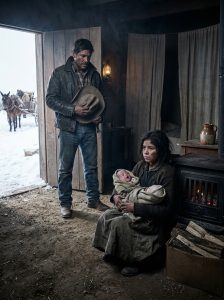
The fire had dwindled to a circle of reddish embers, and Lucía Peralta was afraid to move away from the babies long enough to fetch more firewood. She was 11 years old and 4 months, though she had stopped counting the days since the storm covered the roads of the Sierra de Chihuahua with snow. She sat on the dirt floor of a one-room cabin, her back leaning against the iron stove. In her lap she held two newborns who seemed to weigh no more than a handful of blankets.
The boy, the stronger one, slept with his mouth slightly open. The little girl breathed with difficulty, letting out a weak sound like the whistle of the wind under the door.
Lucía had already given them names in secret.
The boy would be called Mateo, like his grandfather.
The girl would be Milagros, because Lucía needed to believe that a miracle could still happen.
Her mother had been dead for 6 days.
Her father had been gone for 6 days.
Don Julián Peralta had ridden out on horseback in search of a doctor and a wet nurse. Before leaving, he had knelt in front of Lucía and promised he would return before nightfall.
“Keep the stove lit and don’t open the door to any strangers.”
Lucía had nodded.
Night fell, but her father did not return.
He didn’t return the next day either.
Nor the day after that.
The town of San Jacinto was less than 15 kilometers away. Even with snow, an experienced rider could make the round trip in a single day.
Lucía looked at the wood box.
Four logs remained.
There was also a little cow’s milk left in a jug, but it had begun to turn sour. Lucía would soak a piece of clean cloth and let small drops fall into the babies’ mouths. Mateo still swallowed. Milagros was already starting to turn her face away.
Lucía understood that this was bad, even if she couldn’t explain why.
Behind a curtain, on the bed, lay her mother, covered with a sheet.
Dolores had gone into labor prematurely. The babies were born too quickly. There had been blood — much more than a girl should ever see. Lucía had heated water, brought blankets, and held her mother’s hand while Don Julián rode out desperately for help.
Before dying, Dolores looked at her eldest daughter.
“Don’t leave your siblings alone.”
Lucía had kept her promise.
For 6 days she had slept no more than a few minutes at a time. She fed the little ones, changed the rags they used as diapers, and kept the fire going until the firewood was almost gone.
She didn’t cry. Crying wasted strength, and she had none to spare.
“No one came back for us,” she repeated.
She said it the way someone acknowledges that a river has frozen or that a harvest has been lost.
Not as a complaint.
As a fact.
The smoke was what made Tomás Barragán stop.
The cowboy was traveling in a cart loaded with flour, salt, coffee, and tools. He was 43 years old and knew every path in the sierra. For more than 15 winters he had carried goods between isolated towns and mining haciendas.
He knew which cabins remained inhabited during storms and which stayed empty until spring.
He also knew that the Peralta family lived there.
He had seen Julián a few times at the market. He remembered Dolores pregnant, smiling as she chose fabric to prepare baby clothes.
The smoke coming from the chimney was too weak.
Tomás stopped the mules.
For a few seconds he looked at the cabin, almost buried under the snow. Then he climbed down from the cart, adjusted his hat, and walked toward the door.
He knocked twice.
“Julián! It’s Tomás Barragán. I saw the smoke from the road.”
No answer.
He knocked again.
Then he heard a small voice.
“My dad isn’t here.”
Tomás rested his hand on the wood.
“Who’s inside?”
“Just me and the babies.”
The man closed his eyes.
Eleven years earlier he had buried his wife and daughter during an epidemic. Since then he had traveled alone, convinced that pain could no longer surprise him.
He was wrong.
“Listen to me, child. I’m going to open the door, but I won’t come in until you give me permission. I just need to know if you’re all right.”
There was a long pause.
“You can open it.”
Tomás lifted the latch.
The inside was almost as cold as the outside. The smell of smoke, sour milk, and illness filled the room.
Lucía remained seated beside the stove, holding the two babies tightly against her chest. Her hair was tangled, there was soot on her cheek, and her dark eyes were far too serious for her age.
Tomás removed his hat.
“Where is your mother?”
Lucía looked toward the curtain.
“She didn’t survive.”
“And your father?”
“He left for help 6 days ago.”
Tomás understood that something terrible had happened….