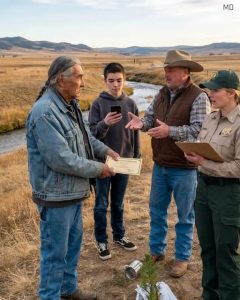
The man in the pressed shirt pushed a fifteen-page document across my kitchen table and tapped a penciled X beside the signature line. His name was Sturgis, and his cattle operation bordered my ranch on the eastern side, where it had already absorbed three smaller properties in less than a decade. County official Harold Pruett sat beside him, insisting the papers were only part of a routine update to the valley’s water records. Sturgis watched my face instead of the document, waiting to see whether I would question what they had placed before me. When I said I intended to read every page, Pruett sighed and reminded me that calving season had already begun. Sturgis leaned back in my father’s chair and calmly said a 66-year-old man running a ranch alone should be grateful anyone was helping him remain legal. I opened the front door and told both men they knew the way out. By nightfall, I had discovered exactly why they had been so eager to obtain my signature.
My name is Wallace Red Hawk, and my Lakota family has depended on that creek since my grandfather filed our original water claim in 1912. He carved the first irrigation channel through frozen ground with a shovel and a mule, establishing one of the oldest priority dates within forty miles. My father, Joseph, protected the ranch through droughts, floods, and years when the bank sent mortgage warnings almost every month. By the time the property passed to me, the ranch supported a cattle herd valued at nearly $240,000 and required roughly $186,000 a year to operate, but without dependable water, both the livestock and land would lose most of their value. Sturgis understood that our senior claim allowed us to draw water before newer operations during a dry season. He did not need my house, barn, or pasture; he wanted the date attached to my grandfather’s claim. To him, four generations of work were simply numbers on a county ledger that could be transferred with one tired man’s signature.
The language on the first two pages sounded harmless, but the third page told a different story. Under a section labeled “administrative consolidation,” the form reassigned my family’s water rights to an organization called Valley Water Holdings, which turned out to be controlled by Sturgis. Signing would have voluntarily surrendered my 1912 priority, allowing his operation to drain the creek before my cattle received a drop. I went to the cedar trunk at the foot of my bed and removed an oilcloth bundle my grandfather had ordered our family never to discard. Inside was the original territorial water certificate, complete with his name, the government seal, and the date of his claim. The next morning, county clerk Corinne Davis compared it with the official water ledger and found that our priority date had recently been changed from 1912 to 1936. The alteration would have placed Sturgis ahead of us even if I refused to sign his agreement. Then Corinne examined the authorization at the bottom of the amended record—and the signature belonged to Harold Pruett.
My attorney filed an emergency challenge with the state water court while Corinne prepared certified copies of the certificate, altered ledger, and transfer agreement. The state office authenticated the territorial seal and restored our 1912 priority, confirming that no later claim could legally move ahead of ours. Investigators also traced Valley Water Holdings directly to Sturgis and began reviewing how his operation had acquired the rights connected to the other three ranches. Pruett was suspended after records showed that he had approved amendments without proper notice or supporting evidence. I notified my mortgage lender and insurance provider because losing the creek would have damaged the property’s collateral value and threatened coverage for the ranching operation. My attorney documented the water claim as a protected investment and updated my estate plan so my grandson Trevor could inherit the ranch without anyone quietly separating the land from its water. The proposed transfer was declared invalid, and the court prohibited any further changes to our record without state approval. Sturgis had arrived expecting an old rancher to surrender his birthright, but he left facing questions about every piece of property his company had absorbed.
The creek continued running across my north pasture during the driest summer we had seen in years, and our grass remained green while newer claims were temporarily restricted. Months later, Sturgis appeared at my door without Pruett, his documents, or the polished smile he had worn during his first visit. He apologized and said he had underestimated how fiercely I would defend the ranch. I told him four generations had already defended it; I was simply the person standing there when he tried to take it. The original certificate now hangs beside my grandfather’s photograph instead of resting unseen in the cedar trunk. Someday, Trevor will sit at the head of this table, and I will hand him the oilcloth that protected our family’s future for more than a century. I kept the water because my grandfather saved the proof—and because I took the time to read the third page. This story is a dramatization; its names, characters, and details are fictional.