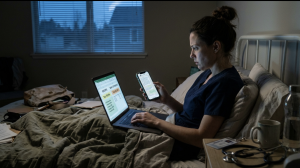
PART 1 TITLE: I Thought My Family Needed My Help Until One Private Conversation Made Me Question Every Dollar I Had Ever Sent Them
I used to believe my family would never deliberately hurt me.
That was probably the most expensive belief I ever had.
I wasn’t wealthy.
I wasn’t living in some beautiful house with money left over at the end of every month.
I was a hospital worker who earned her paycheck by taking care of people who were often having the worst days of their lives.
My name was Lily.
And for three years, almost every extra dollar I earned seemed to find its way back to my family.
I told myself that was what families did.
They helped.
They sacrificed.
They made sure nobody was left struggling alone.
I believed those things so completely that I rarely stopped to question what I was being told.
When my mother needed money, I sent it.
When my father called about an unexpected expense, I found a way to cover it.
When David had another financial problem, I worked more hours.
When Sarah needed help, I adjusted my own budget.
When Chloe needed something for school, I made sure she had it.
I never called any of them a burden.
I never sent a bill.
And I never expected anyone to repay me for loving them.
What I didn’t understand was that they had developed a very different understanding of our relationship.
I discovered that while looking at a conversation I was never supposed to read.
It was a private family group chat.
They had called it Family Reality Check.
I remember staring at that name before scrolling farther down.
There was something almost ordinary about it.
A family discussing things among themselves.
Nothing that should have frightened me.
Except I wasn’t included.
And the messages I found weren’t ordinary.
They were discussing me.
My money.
My willingness to help.
Even the way I responded when someone told me there was a problem.
At first, I tried to convince myself that I had misunderstood the conversation.
I was exhausted.
I had been working at the hospital.
My scrubs still smelled faintly of disinfectant.
The apartment was quiet, and I could hear the refrigerator running from the kitchen.
I wanted an innocent explanation.
I wanted one more message to appear that would make everything sound less terrible.
Instead, I kept reading.
There were jokes about my apartment.
Remarks about my clothes.
Comments about how much I worked.
And references to the money I had been sending them for years.
I recognized the people making those comments.
My mother.
David.
Sarah.
Chloe.
People whose birthdays I remembered without checking a calendar.
People I had worried about while lying awake after long hospital shifts.
People I had trusted with things I barely told anyone else.
Seeing their names beside those remarks made my hands feel numb.
I kept thinking about the apartment where I was sitting.
The furniture wasn’t expensive.
My couch had belonged to someone else before I bought it.
The coffee maker was basic.
The laptop sitting on my table had been purchased during a sale.
I had never felt ashamed of those things before.
I thought they meant I was being sensible.
I thought I was putting money where it mattered.
Apparently, my family had found them funny.
The worst part wasn’t even that they laughed about my possessions.
It was realizing they knew exactly why I didn’t have nicer ones.
They had been receiving the money I could have spent on myself.
I scrolled through more messages.
There were discussions about getting me to cover Christmas.
There were remarks about the way I always agreed when someone needed financial help.
They spoke about my generosity as though it were something predictable.
Something they could count on.
I remembered conversations that had once made me feel needed.
My father telling me he hated asking for money.
My mother explaining how worried she was about the family’s expenses.
David describing another setback.
Chloe saying she couldn’t afford something important for university.
I had responded to those calls without hesitation.
Sometimes I had been at work when they came.
Sometimes I had been eating dinner.
Sometimes I had just fallen asleep after a twelve-hour shift.
It never mattered.
If the family needed me, I answered.
That was how I had been raised to think.
And looking back, I could see how easily they had used that belief.
I had mistaken being useful for being loved.
I didn’t want to admit it.
Not yet.
I continued scrolling until I found a discussion that made me sit completely still.
Sarah had asked my mother about some papers.
She wanted to know whether I would put my signature on them without examining the details.
My mother seemed certain that I would.
She planned to explain the documents as something needed to improve my father’s financial position.
David wondered what would happen if I looked closely.
My mother’s answer was that I trusted her too much to raise questions.
I read that exchange again.
Then a third time.
I had never imagined that my own mother would discuss my trust as something she could use against me.
There was no uncertainty in her words.
She wasn’t wondering whether I might agree.
She was planning around the assumption that I wouldn’t refuse.
The realization made me put my phone on the table.
I stared at the wall across from me.
There was nothing unusual about it.
The same plain wall I had looked at every evening.
The same little apartment I had returned to after working long shifts.
But suddenly, it didn’t feel like the place I had been living for years.
It felt like the place where I had been hiding the cost of everyone else’s comfort.
I thought about the times I had worried over grocery prices.
The clothes I had decided not to buy.
The trips I had postponed.
The evenings when I convinced myself that staying home was better anyway.
I thought I was making responsible choices.
And maybe I was.
But those choices had been shaped by information my family had given me.
Information I now had good reason to doubt.
I picked up my phone again.
I didn’t contact anyone.
I didn’t write an angry message.
I didn’t call my mother and demand an explanation.
I opened our private conversation instead.
Her most recent message was from three days before.
She had been talking about Christmas.
She wanted everyone together.
She said she and Dad missed me.
She asked whether I could help make the holiday memorable.
I had answered without taking time to consider my budget.
I told her I would handle the meal and the presents.
I told her there was nothing for her to worry about.
She sent back a heart.
One red heart.
I remembered how good that small response had made me feel.
I had been tired when I received it.
I had looked at it and imagined my parents happy around the Christmas table.
I had imagined Chloe opening gifts.
David laughing.
Sarah enjoying dinner without worrying about the cost.
That was what I believed I was purchasing.
A little happiness.
A little breathing room.
A Christmas where nobody had to worry.
Now I looked at the same heart and felt embarrassed.
Not because helping them had been wrong.
But because I had accepted so little in return that a single symbol of affection felt like enough.
I set the conversation aside and opened my banking records.
There was something I needed to know.
I wanted to see what my generosity had actually cost.
I started with the transfers I remembered most clearly.
My mother had received $2,500 for what I believed were medical expenses.
My father had needed $1,800 for urgent car repairs.
I had contributed $3,200 toward a family vacation.
Sarah had received $950 when she said she couldn’t cover rent.
David had needed $1,400 for electricity and other household costs.
Chloe’s university expenses had required another $4,700.
Those were only the payments I could remember without searching.
There were dozens more.
I went through them slowly.
Every time I found another transfer, I remembered the conversation that had come before it.
A worried voice.
A request delivered carefully.
A promise that things would improve.
Sometimes there had been an apology.
Sometimes there had been tears.
Sometimes somebody had reminded me that I was the only person who could help.
I had taken those statements seriously.
I had believed every one of them.
I opened my laptop.
The screen lit up the kitchen table.
I created a new spreadsheet and gave it a name that would be easy to recognize.
Family Financial Support, 2023–2026.
It wasn’t supposed to be evidence.
Not when I first opened it.
I simply wanted to see the facts in one place.
I entered the payments one by one.
Dates.
Amounts.
Reasons.
I checked bank transfers against receipts.
Then I looked through credit card charges.
Digital payment confirmations.
Invoices.
Travel bookings.
There were Thanksgiving groceries.
Christmas dinners.
Birthday expenses.
Hotel rooms.
Flights.
Furniture purchases.
Insurance payments.
And shopping money.
Things I had covered because somebody said the family needed them.
Some expenses were small enough that I had forgotten them entirely.
Others made me stop typing.
I remembered choosing between paying for something I needed and sending money home.
I remembered deciding that I could wait.
I was always the one who could wait.
My coat could survive another winter.
My vacation could happen another year.
My apartment didn’t need anything new.
My family came first.
That was the rule I had followed.
Nobody had written it down.
Nobody had formally asked me to live that way.
But I had learned it so thoroughly that I enforced it against myself.
When the total crossed $40,000, I stopped and checked my entries.
I thought I had made a mistake.
I compared the amounts again.
They were correct.
I kept going.
More birthdays.
More bills.
More emergencies.
More holidays.
The final amount was over $60,000.
I stared at the screen.
Sixty thousand dollars.
I knew what that money could have meant in my own life.
Savings.
A better financial cushion.
A chance to rest without calculating the income I was losing.
A home with furniture I had chosen because I liked it, rather than because I could afford it.
I remembered a shift that had lasted sixteen hours.
I had been so tired afterward that I could barely concentrate while shopping for groceries.
I wanted to order dinner and go straight home.
Instead, I walked through the store comparing prices.
I had sent money to my family that week.
I needed to make the rest of my paycheck last.
I didn’t resent them that night.
That was what hurt when I remembered it.
I had been proud of myself.
Proud that I could help.
Proud that the people I loved were comfortable because I had worked harder.
I thought my sacrifices meant something to them.
The spreadsheet told me how much I had given.
The private messages told me what they thought of it.
And I didn’t know which one hurt more.
I leaned back in my chair and closed my eyes.
I didn’t need another calculation.
I didn’t need to go through the same receipts again.
For years, I had been arranging my life around the belief that my family needed rescuing.
Now I had evidence that at least some of those emergencies had been used to get money from me.
I looked at the spreadsheet.
Then at the conversation on my phone.
Neither one could explain the other away.
And for the first time, I wondered whether I had ever really known what my family needed.
Or whether I had only known what they wanted me to believe.
END PART 1
PART 2 TITLE: At Four in the Morning, I Found My Name on a Financial Agreement My Mother Believed I Would Sign Without Questions
I thought the spreadsheet would be the worst thing I found that night.
I was wrong.
I had already seen more than enough to understand that my family had been dishonest with me.
I had seen the private jokes.
I had seen the money requests discussed as though they were carefully planned transactions.
I had counted what I could prove I had spent.
I should have closed everything and gone to bed.
But I couldn’t stop thinking about the paperwork my mother had mentioned.
Why would she need me to sign something?
Why was David worried about whether I would read it?
And why was my mother so certain that I wouldn’t?
I returned to the private conversation.
I moved through the messages more slowly this time.
I wasn’t looking at their jokes anymore.
I was searching for anything connected to financial documents.
Something about that discussion had frightened me in a different way.
Money I had already given was gone.
I could accept that, even if it hurt.
But signing an agreement I didn’t understand could put me in a position I couldn’t easily escape.
At 4:06 in the morning, I found a photograph.
It was a picture of a document.
I opened it and enlarged the image.
My name was at the top.
Lily.
I stared at it for a while before reading the messages around it.
My mother had shared the image.
She described it as an agreement that would allow my income to strengthen the family’s financial position.
She wanted to use that additional support to refinance the house.
Sarah wanted to know whether I understood what the paperwork would mean.
My mother planned to describe the arrangement as temporary.
David asked what they would do if I refused.
The answer was familiar.
She would remind me of everything my parents had done for me while I was growing up.
I felt sick.
I had heard those reminders all my life.
Not always during arguments.
Sometimes during ordinary conversations.
My mother would talk about raising children.
My father would mention the years he had worked to provide for us.
Someone would say that adult children should remember what their parents sacrificed.
I had never thought those comments were leading toward something like this.
I believed gratitude was something you felt.
Something you demonstrated by showing up when people needed you.
I didn’t believe it was supposed to become a debt someone could collect forever.
But looking at the document, I realized my mother might see it differently.
She had my name on paperwork I hadn’t requested.
She was discussing how to persuade me to sign it.
And she seemed more interested in my obedience than my understanding.
I didn’t know exactly what was written in that agreement.
The photograph didn’t tell me everything.
I couldn’t tell whether the document was complete or whether anyone had submitted anything.
I wasn’t qualified to determine the legal consequences from a screenshot.
But I understood enough to be careful.
I wasn’t going to sign anything simply because my mother handed it to me.
Not anymore.
I saved the photograph.
Then I returned to the beginning of the conversation and started preserving what I could.
I took screenshots.
I saved the relevant sections of the chat.
I made sure I had the messages about the money requests.
I included the discussions about Christmas.
I saved the remarks about my trust.
And I kept the exchange about the agreement with my name on it.
I wanted the exact words available later.
Not my memory of them.
Not an interpretation I might struggle to explain.
The messages themselves.
I downloaded the bank statements I had used for the spreadsheet.
I gathered my payment confirmations.
I put the invoices into a separate folder.
Then I made a backup.
I also sent the records to myself by email so I wouldn’t be relying on one device.
It felt strange to take those precautions against my own family.
I hated how strange it felt.
If somebody at the hospital had described the same situation to me, I would have understood why they wanted documentation.
I wouldn’t have questioned their caution.
But this was my mother.
My father.
People whose names had always meant something safe to me.
I kept having to remind myself that their relationship to me didn’t make the messages disappear.
I couldn’t pretend I hadn’t read them.
I couldn’t return to the version of Christmas that existed before I opened that chat.
And I couldn’t keep sending money while they were planning how to involve me in something larger.
I sat at the kitchen table with my phone beside the laptop.
The hospital scrubs I wore were creased from my shift.
My shoulders ached.
I was exhausted, but I felt too alert to sleep.
I could have called my mother.
I knew she would probably answer eventually.
I could have asked her what the agreement was.
I could have demanded an explanation for every ugly remark.
But I knew how those conversations usually went.
I would begin with a question.
She would sound hurt.
She would ask why I didn’t trust her.
Then she would tell me how much she loved me.
Before long, I would be the one apologizing for making her feel bad.
That had happened enough times for me to recognize it.
I wasn’t ready to repeat it.
I wanted time to think without being interrupted by guilt.
I wanted one decision that belonged entirely to me.
So I stayed quiet.
I finished organizing the records.
Then I sat there until the time on my phone changed again.
At 5:15 a.m., I made coffee.
It was awful.
I had made it too strong, and it tasted bitter.
Normally, I would have poured it out and started again.
That morning, I drank it anyway.
I was sitting at the same kitchen table when I checked the private chat again.
There were fresh messages.
Chloe wanted to know whether I had gotten up yet.
Sarah assumed I was probably asleep after my shift at the hospital.
David thought someone needed to remind me about the Christmas expenses.
Then my mother said she would speak to me later.
She sounded confident that she knew how to handle me.
I held my cup with both hands.
There was something terrible about seeing that conversation happen in real time.
They weren’t discussing something from months earlier.
They were planning what to say to me that very day.
I knew exactly how the call would begin.
My mother would sound warm.
She might ask whether I had eaten.
She would probably tell me she missed me.
Then she would mention Christmas.
She would explain that things were difficult.
She would make it sound as though the holiday depended on me.
If I hesitated, she would remind me how important family was.
If I still hesitated, I expected she would become upset.
And I would feel responsible for fixing it.
I could almost hear her voice.
For years, I had believed those conversations were spontaneous.
Now I knew they could be planned.
I looked at my coffee.
Then at the phone.
I had spent so much time trying to prevent other people’s disappointment that I barely knew what I wanted anymore.
I wanted to stop feeling afraid every time my family called.
I wanted to look at my paycheck without immediately calculating how much somebody else might need.
I wanted Christmas to be something I could enjoy instead of another obligation I had to finance.
More than anything, I wanted to know that the people I loved weren’t laughing at me when I wasn’t there.
But I couldn’t make that last wish come true.
I had already seen what they said.
I opened a blank message.
My hands hovered over the keyboard.
I started writing about the money.
Then I deleted it.
I wrote that I couldn’t believe what they had done.
I deleted that too.
I wanted to explain the nights I had cried from exhaustion.
I wanted to tell my mother about the meals I hadn’t bought.
I wanted David to understand what I had given up to help him.
I wanted Chloe to remember that I had been there when she needed someone.
I wanted Sarah to think about all the times I had taken her problems seriously.
But the more I wrote, the more I understood something.
They already knew I helped them.
They knew how hard I worked.
They knew what they asked me to do.
The private conversation wasn’t evidence that they lacked information.
It was evidence that they didn’t respect what I had done with it.
I didn’t need to prove that I was hurt.
I needed to make a decision.
I erased the long paragraph.
I started again.
This time, I kept my message simple.
I told them I had discovered Family Reality Check.
I explained that I had seen their comments about my work, my home, my clothes, and the financial help I provided.
I said I had read their discussions about creating emergencies and trying to get me to agree to financial paperwork without properly explaining it.
I told them I had helped because I cared about them.
I hadn’t been keeping a private account of what they owed me.
I hadn’t expected anyone to celebrate my generosity.
But I had believed they respected me.
I explained that I could no longer continue supporting them financially.
There would be no more payments for the holiday meal.
No presents purchased on everybody’s behalf.
No money for travel.
No household bills.
No rent.
No shopping expenses.
No more automatic rescue whenever someone called with a problem.
I also stated that I wouldn’t sign any financial agreement.
Not for my parents.
Not for my siblings.
Not for anyone.
I asked them not to approach me with dishonest emergencies or attempts to make me feel guilty.
I told them I had preserved the messages and the relevant financial records.
Then I explained that I needed some distance.
I wished them a good Christmas.
I said I would be spending mine looking after myself.
And I signed my name.
Lily.
I read the message carefully.
I wanted to make sure it didn’t contain anything I might regret.
I hadn’t insulted anyone.
I hadn’t threatened to expose them publicly.
I hadn’t demanded the return of the money.
I had simply told them what I knew and what I would no longer do.
Still, I hesitated before sending it.
I thought about the Christmas mornings from when I was little.
My mother making cinnamon rolls.
My father bringing boxes into the living room.
Chloe coming downstairs in her pajamas.
The sound of people moving around before breakfast.
I remembered believing that Christmas meant everyone belonged somewhere.
That if you had a family, you had a place you could always return to.
For a moment, I wanted that feeling back badly enough to close the message.
I wanted my mother to be the woman I remembered.
I wanted my father to be someone who would protect me from this.
I wanted all those ugly comments to be a misunderstanding.
Then I remembered the name they had given me.
Holiday parasite.
I was the person buying the meals.
Paying the bills.
Helping with the gifts.
Working extra shifts.
And somehow, in their private conversations, I was the one they had chosen to ridicule.
At 5:42 a.m., I sent the message.
It appeared in the group.
I watched the screen.
For a little while, there was no response.
I felt strangely calm.
Then the typing notifications began.
Sarah was preparing a reply.
David started typing.
Chloe appeared.
My mother joined them.
The notifications kept changing.
Somebody would begin a message and stop.
Then somebody else would start.
I waited.
Sarah responded first.
She wanted to know what I thought I was doing.
I didn’t answer.
David followed by accusing me of making a serious issue out of what he considered harmless teasing.
I kept looking at the screen.
Then Chloe replied.
She didn’t apologize.
She didn’t ask whether I was all right.
She seemed upset that I had gained access to something they had intended to keep hidden.
That was when I understood how little any of them had thought about my feelings.
Their first concern wasn’t the harm.
It was the discovery.
I placed the phone face down.
A moment later, it rang.
Mom.
I watched her name appear.
The call ended.
She tried again.
Then once more.
I didn’t pick up.
Soon a message arrived.
She called me sweetheart.
She said I had been working too hard and shouldn’t make important choices while exhausted.
She wanted me to call her.
I read it slowly.
There was no mention of the document.
No explanation for the financial requests.
No apology for the group conversation.
She was treating my reaction as the problem.
I sent one short answer.
I told her I understood perfectly well what I had read.
Then I silenced the group notifications.
I sat there with my bad coffee and the spreadsheet still open.
Nothing had been repaired.
Nobody had admitted anything.
My family was angry.
But the message had gone through.
And for once, I had made a decision without asking how it would affect everybody else’s comfort.
END PART 2
PART 3 TITLE: My Father’s Email Revealed They Had Already Counted on My Income, and My Sister’s Call Showed Me How Little They Understood
I thought sending that message would bring an argument.
I didn’t expect my father to confirm so much of what I was afraid of.
By the time I had showered, it was already morning.
I put on clean clothes and left my hospital scrubs aside.
My phone had been making noise for hours.
I had stopped looking at every notification.
I knew my family wanted answers.
What I didn’t know was whether any of them wanted to understand why I had finally said no.
At 7:18 a.m., an email arrived from my father.
The subject was about the house.
I opened it while sitting in my apartment.
He said my mother had told him about my message.
He didn’t understand why I was acting differently.
He reminded me that our family had responsibilities.
Then he wrote something that made me read the email again.
They had already arranged financial plans expecting my continued help.
There was an appointment the following week.
He expected me to cooperate.
He didn’t want me to create an embarrassing situation for the family.
My mother would explain things when I returned home for Christmas.
I put the phone on the table.
I couldn’t believe how ordinary his message sounded.
It was as though he were reminding me about a scheduled dinner.
As though I had forgotten to bring something I had promised.
But the thing he was discussing wasn’t a plate of food or a Christmas gift.
It was my income.
My future.
Possibly my name on a financial obligation.
He wrote as though those things already belonged in the family budget.
I read the message again.
There was no attempt to address what I had discovered.
He didn’t ask what the private conversation had contained.
He didn’t ask why I was upset.
He didn’t acknowledge that I had already contributed an enormous amount of money.
He simply expected me to return to my usual place.
The person who helped.
The person who agreed.
The person who didn’t make anyone uncomfortable.
I closed the email.
Then I remembered something that had happened a few months earlier.
My father had asked me to send him recent pay stubs.
He said they were needed for an insurance matter.
I hadn’t questioned him.
I had copies available.
I sent them.
It had taken only a few minutes.
At the time, I barely considered it important.
Now I could picture those documents with my name, employer, and earnings on them.
And I could hear my mother discussing a refinancing arrangement in the private chat.
I felt my stomach tighten.
I had also shared copies of identification in the past for what I understood to be insurance paperwork.
I didn’t know whether any of those documents had been used for something else.
I wasn’t going to assume that they had.
But I couldn’t ignore the possibility anymore.
I contacted my bank.
I explained that I was concerned about the potential misuse of my financial information.
I wanted to know whether there were any applications or obligations connected to my details that needed attention.
I also took steps to review my credit reports and protect my accounts.
Every question I asked made me uncomfortable.
I kept thinking that I shouldn’t have to do this because of my own parents.
But the feeling didn’t change what I needed to do.
I had trusted them with information I wouldn’t casually give to a stranger.
Now I needed to make sure that trust hadn’t created a bigger problem.
At 8:03 a.m., my phone rang.
It was Chloe.
I stared at her name.
Of everyone in the family, she was one of the people I most wanted to believe had simply been careless.
I remembered helping her with schoolwork.
I remembered buying the textbooks she needed.
I remembered sending grocery money when she said she was short.
I had helped her settle into college.
Those memories weren’t false.
I had been there.
I had done those things.
And I wanted to know whether any of them had mattered to her.
I answered.
She said my name quietly.
I asked what she wanted.
She wondered whether we could have a conversation.
I asked what we needed to discuss.
There was a pause.
Then she told me that Mom was very upset.
I looked down at the floor.
Of course.
My mother was upset.
That was the first thing Chloe wanted me to know.
Not that my feelings mattered.
Not that she regretted participating in the conversation.
Only that our mother was suffering because I had stopped cooperating.
I asked whether she had read my message.
She admitted she had.
I told her that should have explained the situation.
Chloe tried to make the group chat sound less serious.
She said the comments had been jokes.
Things people said without thinking.
I asked what part was supposed to be funny.
She didn’t answer immediately.
I reminded her about the Christmas presents I had paid for.
I asked whether she thought it was amusing that I had worked during my birthday so David could have money for a gaming computer.
She tried to interrupt.
I kept my voice level.
I brought up the money my mother had claimed was needed for medical care.
The same money that had been connected to a trip to Cabo.
Chloe became quiet.
I waited for her to say something.
Anything that showed she understood.
Instead, she pointed out that I always seemed to have money available.
I looked around my apartment.
The secondhand couch.
The cheap coffee maker.
My hospital bag beside the door.
The laptop I had bought on sale.
I asked her whether she thought I was wealthy.
She said I earned good money.
I told her the difference between receiving a paycheck and having unlimited money.
I worked long shifts.
I cared for patients who were seriously ill.
Some days were so busy that I barely had time to eat.
My income came from hours spent on my feet, making decisions, doing work, and carrying responsibility.
It wasn’t money that appeared without effort.
Chloe protested that she hadn’t meant it that way.
But I wanted her to understand what she had said.
She believed I always had money because I usually agreed to help when somebody asked.
That was all.
My willingness had become proof that helping didn’t cost me anything.
I had never thought about how it looked from their side.
If I said yes every time, perhaps they had decided I had nothing to sacrifice.
I had been careful not to make anybody feel guilty about taking my money.
They had mistaken that silence for abundance.
Chloe’s voice changed.
She reminded me that Christmas was only a few weeks away.
The family had already placed orders.
Plans were moving forward.
I told her those expenses belonged to the people who had made them.
She said Mom had promised I would cover everything.
I reminded her that our mother couldn’t make financial commitments on my behalf.
She sighed.
I knew she wanted the conversation to return to something familiar.
A little pressure.
A little guilt.
Then my agreement.
But I couldn’t do that anymore.
She asked whether I was really prepared to refuse.
I looked at my hands.
I thought about helping her move into college.
I could almost feel the weight of the boxes again.
I remembered buying her supplies.
Checking that she had everything.
Making sure she wouldn’t have to worry about things other students could afford.
I had wanted her to have opportunities.
I still wanted that.
But I no longer wanted to be treated as though I existed to provide them.
I told Chloe that my decision hadn’t changed.
Then I ended the call.
For several minutes, I sat without moving.
I hadn’t shouted at her.
She hadn’t shouted at me.
There had been no dramatic ending.
And somehow, that made it more painful.
She hadn’t sounded like someone who was losing a sister.
She had sounded like someone whose expected payment had disappeared.
I wanted to cry.
But the tears didn’t come right away.
I placed my phone beside the laptop.
The spreadsheet was still there.
I thought about how many conversations had ended with me agreeing to send money.
I had always felt relieved afterward.
The problem had been solved.
Someone I loved would be comfortable.
I could return to work knowing I had helped.
That relief had been part of the reason I kept doing it.
I didn’t have to think about the disappointment that might follow a refusal.
Now I had refused.
And their disappointment was everywhere.
At 9:26 a.m., I received another message.
The number wasn’t saved in my phone.
But the sender identified herself.
Sarah.
She had found another way to reach me.
Her message was direct.
She didn’t want me blaming everyone else for whatever disagreement I had with our mother.
She said Christmas plans were already in place.
People were depending on me.
She believed it was unfair to withdraw my support so close to the holiday.
I stared at her words.
For a moment, I almost started writing a detailed explanation.
I wanted to tell her that Christmas wasn’t a financial contract.
I wanted to ask why nobody had checked whether I could afford what they expected.
I wanted to know why they were so concerned about their plans and so unconcerned about what I had learned.
Then I remembered the spreadsheet.
I opened it again.
I scrolled to the Christmas expenses.
The previous year had cost me $6,840.
The year before that, I had spent $7,215.
The year before that, $5,930.
I checked the figures.
They were the amounts I had recorded from my financial documents.
Three Christmas seasons.
Nearly twenty thousand dollars between them.
I thought about how easily those years had passed.
The planning.
The shopping.
The calls asking whether I had ordered something.
The messages about gifts.
The requests for another payment.
I remembered being told how wonderful everything had been.
And how proud I had felt to make it happen.
Then I remembered Sarah’s message.
She believed people were counting on me.
She was correct.
They had been counting on me for years.
That was exactly what I needed to change.
I sent her a short reply.
I told her that everyone expecting me to pay was the reason I had to stop.
Then I blocked the number.
I didn’t feel victorious.
I felt tired.
I had spent the morning defending a boundary that shouldn’t have required so much explanation.
I wasn’t asking anyone to give me money.
I wasn’t demanding that they change their holiday.
I was simply refusing to finance it.
Yet every response treated that decision as a betrayal.
I wondered how long it would take before they stopped calling.
Whether they would apologize.
Whether Christmas would pass without anyone understanding.
I didn’t have those answers.
I knew only that I couldn’t go back to pretending everything was fine.
At 10:11 a.m., another email appeared.
This time, I recognized a name I hadn’t seen in my inbox for years.
Aunt Renee.
My mother’s relative.
She wasn’t somebody who regularly became involved in my financial decisions.
That made the message unusual.
The subject was a request for me to call her.
I opened it.
She said my mother had been telling relatives that I had already committed to helping with the house.
More specifically, she believed I had agreed to accept financial responsibility connected to it.
Aunt Renee was concerned that I didn’t know what my parents intended to put in front of me.
I stopped reading for a moment.
My father’s email had mentioned plans.
My mother’s chat had mentioned an agreement.
Now my aunt was telling me that the rest of the family had been given a story about my consent.
Consent I had never provided.
I read the next part.
Aunt Renee said there was information about my father’s mortgage that my parents hadn’t shared with me.
She believed I needed to learn it before Christmas.
I held the phone tightly.
The anger I had felt earlier was still there.
But it was no longer the only thing I felt.
I was afraid.
Not of another insult.
Not of another request for Christmas money.
I was afraid because my family seemed to have been making decisions about my financial future without including me.
And I was beginning to understand why my mother had been so confident that I would sign whatever she presented.
END PART 3
PART 4 TITLE: Aunt Renee Finally Told Me Why My Parents Needed My Signature, and the Debt Behind Their House Changed Everything I Believed
I called Aunt Renee at 10:17 that morning.
She answered quickly.
I could hear from her voice that she had been expecting me.
I didn’t spend time on greetings.
I asked what was happening with my parents’ house.
She was quiet for a moment.
Then she told me she had hoped my mother would explain it herself.
I felt my chest tighten.
I asked her to tell me.
She said my parents were dealing with serious debt.
Not the medical expenses I had been told about.
Not the retirement problems my father had mentioned.
Something else.
I sat down at the kitchen table.
I asked what had caused it.
Aunt Renee told me my father had refinanced the house approximately two years earlier.
He had borrowed against its equity.
My mother wanted the money to help David establish a business.
I closed my eyes.
David’s business.
The equipment rental company.
I remembered his phone call.
He had sounded hopeful when he talked about the venture.
He said he needed startup capital.
I had sent him $4,000.
He told me he would return the money.
He never did.
I hadn’t pursued him over it.
He was family.
I had assumed he would pay me when things improved.
Now Aunt Renee was telling me that my parents had been funding the same business with money borrowed against their home.
I asked how large the loan had been.
She told me it was approximately $180,000.
I repeated the number because I thought I might have heard her incorrectly.
One hundred and eighty thousand dollars.
It was almost impossible for me to imagine.
I had worked so hard to send my family relatively small amounts.
A few hundred here.
A few thousand there.
I had worried about spending too much on groceries.
And all that time, my parents had been carrying a debt that dwarfed the money I had sent them.
Aunt Renee said David’s business had failed.
My father was still responsible for the money borrowed against the property.
I looked at the spreadsheet on my laptop.
I had been trying to understand what happened to $60,000.
Now there was another figure.
$180,000.
The numbers were connected through the same people, but I didn’t know the full financial picture.
I needed to be careful not to confuse suspicion with proof.
Still, I couldn’t ignore what my aunt was telling me.
I asked why my parents had never discussed the refinancing with me.
Aunt Renee said my mother hadn’t wanted me asking difficult questions.
That answer hurt more than I expected.
I had spent years being told I was an important part of the family.
Someone they could rely on.
Someone whose help made everything easier.
Yet when they made a major decision involving the house, I hadn’t been trusted with the truth.
I had only been expected to help with the consequences.
I asked how they planned to involve me.
Aunt Renee explained that my parents were considering another refinancing arrangement.
My mother had told several relatives that my earnings could help them qualify.
She had presented it as though I had already agreed to guarantee the loan.
I gripped the phone.
I had never made that promise.
Not once.
I had never agreed to become responsible for the mortgage.
I hadn’t even known the size of the debt.
Aunt Renee said she understood.
She didn’t claim to know whether anything had already been submitted in my name.
But she had heard my mother say she possessed documents showing my income.
I thought about the pay stubs.
The papers my father had requested.
The explanation about insurance.
I had sent those documents because I believed I was helping with an ordinary administrative matter.
Now I didn’t know what had happened to them.
I remembered the photograph in the private chat.
My name at the top.
My mother explaining that the agreement would allow the family to use my income to support the refinancing.
I remembered her confidence that I wouldn’t examine it closely.
The pieces were beginning to fit together.
But I still didn’t know exactly what the agreement said.
I didn’t know whether the lender had seen any of my information.
I didn’t know whether anyone had taken a formal step involving my finances.
I refused to invent answers simply because I was frightened.
I wanted documentation.
I wanted facts.
I told Aunt Renee I appreciated her warning.
Then she said there was more.
My mother had also told people that I intended to help with the mortgage payments.
According to that story, I had offered because I wanted to keep the family together.
I stared at the wall.
I couldn’t believe it.
My mother had taken the love I felt for my family and turned it into a promise I hadn’t made.
She had described me as willing.
Almost eager.
As though I had volunteered to carry another financial obligation.
I asked Aunt Renee whether she was certain that was what my mother had been saying.
She confirmed it.
I let out a short laugh.
There was nothing funny about it.
I just couldn’t think of another response.
I had spent years making real sacrifices.
I had paid real bills.
I had worked real hours.
And now I was discovering that my mother had been describing sacrifices I hadn’t even agreed to make.
I asked my aunt to send whatever information she had.
She agreed.
Before we ended the call, she said something that stayed with me.
She reminded me that having parents didn’t mean I was required to repair every financial mistake they made.
I thanked her.
When the call ended, I remained seated.
I could see the spreadsheet.
The folder of receipts.
The screenshots from the private conversation.
Everything was still open.
I had created those records because I wanted to understand the last three years.
Now they felt like the beginning of something I needed to take much more seriously.
I contacted my bank again.
This time, I explained the circumstances more clearly.
I told them I had reason to believe my personal financial information might be used in connection with borrowing I had not authorized.
I wanted to protect my accounts.
I wanted to know what steps I should take to identify any improper activity.
I also contacted the credit reporting agencies and arranged fraud alerts where available.
I made plans to review my reports.
I didn’t want to discover a problem months later because I had been too embarrassed to take precautions.
Then I contacted an attorney.
That was a difficult decision.
I knew how my family would react if they learned I had sought legal advice.
My mother would say I had humiliated her.
My father would accuse me of overreacting.
David would probably make another joke.
Sarah might say I was treating my own parents like criminals.
Chloe would remind me that Mom was upset.
I could already hear them.
But none of those imagined reactions changed the risk.
I needed someone who understood financial agreements.
Someone who could read the actual documents without being influenced by family history.
Someone who wouldn’t tell me to sign simply because my mother asked.
I gathered the records I had preserved.
The relevant messages.
The screenshot of the agreement.
The financial documents.
The information about the proposed refinancing.
I sent what I could to the attorney for review.
Then I waited for his response.
My phone continued receiving messages from home.
My mother left six voicemails that day.
My father sent four emails.
David accused me of tearing the family apart.
Sarah suggested that earning more money had made me forget where I came from.
Chloe sent a message telling me our mother was crying because of my behavior.
I read it.
I thought about replying.
I wanted to explain that I hadn’t caused the refinancing.
I hadn’t borrowed against the house.
I hadn’t funded David’s failed business with my parents’ equity.
I hadn’t created a secret conversation to ridicule someone who was helping me.
I hadn’t told relatives that somebody had agreed to take on a debt without asking them.
Those choices hadn’t been mine.
I hadn’t made them.
And I wasn’t going to accept responsibility for them simply because my mother was upset.
I put the phone away.
The rest of the day continued.
That surprised me.
I had been so accustomed to responding whenever somebody in my family needed something that ignoring their messages felt almost dangerous.
I expected a new emergency.
A call demanding that I fix the problem.
A reason I would have to abandon everything and start making arrangements.
But life went on.
I still had responsibilities at the hospital.
Patients needed care.
My coworkers spoke to me during breaks.
There were ordinary conversations.
Small moments of laughter.
Work that had nothing to do with my family’s financial situation.
For once, I wasn’t constantly checking whether someone had asked for another transfer.
I wasn’t calculating how much of my paycheck I could spare.
I wasn’t trying to solve a problem I hadn’t created.
I noticed the difference.
It wasn’t happiness exactly.
I was still hurt.
Still worried.
Still trying to understand the betrayal.
But there was a little room in my head that hadn’t been there before.
Room to think about myself.
Room to make a decision without immediately wondering who would be disappointed.
Later, the attorney responded.
He had reviewed the material I provided.
He was careful about what the available information did and didn’t establish.
He didn’t tell me that my family had already committed fraud.
He didn’t pretend a screenshot could answer every legal question.
He told me to protect myself.
I shouldn’t sign documents I hadn’t independently reviewed.
I shouldn’t send additional money while the situation remained unclear.
And I shouldn’t agree to become responsible for somebody else’s debt without understanding the consequences and receiving independent legal advice.
He also advised me to preserve the messages and other communications.
I followed that advice.
I kept the records organized.
I didn’t delete the unpleasant messages.
I didn’t remove the emails simply because reading them hurt.
I knew I might need them.
While reviewing my inbox again, I found another email from my mother.
It had arrived at 2:43 a.m.
She began affectionately, as she often did.
She said she understood that I was upset.
Then she reminded me that my parents had raised me.
She described the sacrifices they had made.
She pointed to the life I had built.
And she suggested that now I should repay that care by helping them.
There was a family meeting planned for Saturday.
She expected me to come home.
The house needed to be discussed.
I sat quietly after reading it.
Part of me still wanted to believe that my mother loved me in the way I had always imagined.
I didn’t think every memory from my childhood was a lie.
I remembered the cinnamon rolls.
The Christmas mornings.
My father carrying presents.
The ordinary moments when I had felt wanted.
Those things had happened.
But so had the conversation I found.
My mother had told the others that I would trust her without questions.
She had discussed how to persuade me with guilt.
She had treated my willingness to help as something she could control.
I couldn’t erase those messages because I missed the mother I remembered.
I opened a reply.
I told her clearly that I wasn’t agreeing to sign financial paperwork.
I wouldn’t accept responsibility for another person’s borrowing.
If she wanted to discuss the refinancing, she needed to send the documents ahead of time.
I would have them examined independently.
That was all.
No insult.
No argument.
No apology for protecting myself.
Her response came quickly.
She wanted to know how I could address my own mother that way.
I read the question.
Then I closed the email.
I didn’t answer.
I had spent years measuring my words so carefully that nobody at home would feel offended.
I couldn’t continue doing that while my financial future was being discussed without my consent.
Saturday was approaching.
And I had no intention of walking into a family meeting where the decision had already been made for me.
END PART 4
PART 5 TITLE: I Refused to Attend My Parents’ Financial Meeting Until Aunt Renee Called and Offered to Stand Beside Me When They Asked for My Signature
I had already decided not to go home that Saturday.
For the first time in years, I felt that saying no was the safest decision I could make.
My mother wanted a family meeting.
My father expected cooperation.
David had accused me of ruining the family.
Sarah believed I had become selfish.
Chloe was still worried about how upset our mother felt.
Nobody had asked whether I was all right.
Nobody had asked what I needed.
And nobody had offered to explain the financial agreement before expecting me to sign it.
I kept returning to that detail.
The agreement.
A document with my name on it.
A document my mother had discussed with the others before I even knew it existed.
I had seen the messages.
I had heard what Aunt Renee knew.
I had spoken with an attorney.
Still, part of me wanted the whole thing to be a misunderstanding.
I hated admitting that.
I wanted to believe my mother had simply handled a difficult situation badly.
I wanted to believe my father hadn’t understood what she was planning.
I wanted someone to tell me there was an innocent reason for everything.
But wanting an explanation wasn’t the same as having one.
I sat at my kitchen table and looked at the folder of records on my laptop.
The spreadsheet was still there.
More than $60,000.
I remembered how shocked I had been when the total appeared.
Now that number was competing with another.
$180,000.
The amount Aunt Renee said my parents had borrowed against their house to help David start his business.
I couldn’t stop thinking about the difference.
I had been working extra shifts to send a few thousand dollars at a time.
Meanwhile, my parents had taken on a debt I hadn’t even known existed.
I remembered David explaining that his equipment rental company needed startup money.
He had sounded confident.
I had believed him.
When he asked for $4,000, I thought I was helping my brother build something.
I imagined he would eventually earn enough to support himself.
He had promised to repay me.
I hadn’t insisted on a written agreement.
That was another thing I regretted.
Not because I wanted to punish him.
Because I had treated every request from my family as something that shouldn’t require questions.
I thought questions suggested distrust.
And I thought distrust was something a good daughter or sister should avoid.
Looking back, I had confused love with the absence of boundaries.
I wasn’t proud of that.
But I was beginning to understand it.
I opened my mother’s last email again.
She had challenged the way I spoke to her.
That was all.
She hadn’t explained the refinancing.
She hadn’t sent the documents I requested.
She hadn’t addressed the private messages.
She had focused on my tone.
I read the email twice.
Then I closed it.
I wondered whether she understood why I was frightened.
She knew I had seen the conversation.
She knew I had discovered the plan involving my income.
And still, she seemed to believe she could make me feel ashamed enough to cooperate.
That was the part I couldn’t forgive easily.
I had always responded when she sounded hurt.
I had always tried to make things right.
Even when I wasn’t certain I had done anything wrong.
Especially then.
I remembered the little red heart she had sent when I promised to pay for Christmas.
It had seemed affectionate.
Now I wondered whether she had smiled because she loved me.
Or because she had gotten the answer she wanted.
I didn’t know.
And I couldn’t prove what she had felt.
But I knew what she had written in the private conversation.
That was enough to change how I approached her.
The attorney’s advice stayed with me.
I wouldn’t sign anything without independent review.
I wouldn’t agree to pay another person’s debt.
And I wouldn’t allow a family meeting to replace proper financial information.
Those weren’t unreasonable conditions.
They were ordinary precautions.
I kept reminding myself of that because part of me still felt guilty.
I could hear my father’s voice when I imagined refusing.
He would say the family had responsibilities.
He would remind me of the sacrifices my parents had made.
He would tell me that time was running out.
I had heard those kinds of arguments before.
Usually, they ended with me agreeing.
This time, I needed a different ending.
I considered what might happen if I stayed away on Saturday.
My mother would be angry.
My father would probably send another email.
David would have something unpleasant to say.
Sarah might accuse me of abandoning everyone.
Chloe would remind me that Christmas was approaching.
I knew all of that.
And for once, knowing they might be upset didn’t automatically change my decision.
I thought about how long it had taken me to reach that point.
Three years of transfers.
Three years of canceled plans.
Three years of looking after other people’s needs.
I had started to measure my value by how quickly I could help.
If I responded immediately, I was a good daughter.
If I paid a bill, I was a dependable sister.
If I covered Christmas, I was generous.
I had rarely stopped to ask whether those people treated me kindly when I couldn’t provide something.
Now I knew what they said when they thought I wasn’t listening.
I had read enough.
I didn’t need another insult to make the situation clear.
Friday evening arrived.
I had no intention of changing my plans.
Then Aunt Renee called.
I looked at her name before answering.
She was the one person who had warned me about the mortgage without asking for anything in return.
I had been grateful for that.
Her email had frightened me.
Her explanation had frightened me even more.
But she had given me information I needed.
I answered.
She asked how I was doing.
I didn’t know how to respond.
I had been working.
I had been answering necessary messages.
I had been checking financial records.
I had been doing ordinary things.
But I was still trying to accept what my family had done.
I told her I was managing.
She didn’t press me.
Then she brought up the family meeting.
She said my mother had been speaking to relatives.
According to the version she was telling them, I had refused to help because I had become selfish.
I closed my eyes.
There it was again.
Selfish.
I wondered how many times my family had used that word without my knowing.
I thought about the $2,500 I had sent for what I believed were medical expenses.
The $1,800 for my father’s car.
The $4,700 for Chloe’s university costs.
The money for Sarah’s rent.
The money for David’s household bills.
The Christmas expenses.
And all the smaller payments in between.
More than $60,000.
Yet when I finally said I couldn’t continue, the explanation was that I cared only about myself.
I told Aunt Renee I wasn’t surprised.
She was quiet for a moment.
Then she asked whether I would reconsider attending Saturday’s meeting.
I looked at my kitchen table.
The laptop was closed.
My phone rested beside it.
I hadn’t expected her to make that suggestion.
I told her I didn’t want to walk into a room where everyone had already agreed I was wrong.
She understood.
Then she said she would be there.
I hadn’t known that when I first decided to stay away.
I asked whether she was certain.
She told me she intended to attend.
I sat with that information.
I thought about what it would mean to walk into my parents’ house without being completely alone.
Aunt Renee knew about the refinancing.
She knew I hadn’t agreed to guarantee the loan.
She knew my mother had been telling people a different story.
Most importantly, she hadn’t asked me to sign anything.
I trusted her more than I trusted the people who had been demanding my cooperation.
That was difficult to admit.
But it was true.
I considered the attorney’s advice again.
He hadn’t told me that I could never speak to my parents.
He had told me not to make financial commitments without understanding them.
I could attend a conversation.
I could listen.
I could ask questions.
None of those things required a signature.
I realized I didn’t have to choose between blindly obeying my family and refusing to hear what they had to say.
There was another option.
I could go there on my own terms.
I told Aunt Renee I would consider attending if certain things were understood.
I wasn’t bringing money.
I wasn’t signing documents.
And if anyone became threatening or aggressive, I would leave.
I repeated those conditions because I needed to hear myself say them.
Aunt Renee understood.
I agreed to come.
After we ended the call, I remained seated for a long time.
I wasn’t relieved.
Not exactly.
I knew the meeting would be uncomfortable.
I knew my parents wouldn’t appreciate having their assumptions questioned.
But I also knew that avoiding the room wouldn’t make the proposed agreement disappear.
I wanted to see the documents.
I wanted to hear my parents explain what they were asking.
And I wanted to know whether they would finally tell me the truth.
I opened my laptop again.
I looked at the screenshot of the financial agreement.
My name was visible.
The surrounding conversation was still there.
I remembered my mother’s confidence that I would sign without reading.
I looked at those words and felt something settle inside me.
I wasn’t the same person who had sent those pay stubs months earlier.
Back then, I had believed a family request needed no explanation.
Now I knew better.
I hadn’t become wealthy.
I hadn’t become cruel.
I hadn’t stopped caring about people.
I had simply learned that caring about someone didn’t require me to surrender my judgment.
I thought about what I wanted to say at the meeting.
I didn’t prepare a speech.
I knew a speech would only give everyone more words to argue with.
I needed answers.
What was the document?
What was the refinancing for?
How much money was involved?
What responsibility were they expecting me to accept?
Those were simple questions.
They should have had simple answers.
If my parents genuinely needed help, there should have been no reason to hide the details.
And if they couldn’t explain the agreement honestly, I had no reason to sign it.
I reviewed the records one more time.
The private messages.
The emails.
The screenshot.
The spreadsheet.
I made sure I still had the copies I had saved.
Then I closed the folder.
I didn’t need to carry every painful detail into the meeting in my head.
The documents could speak for themselves if necessary.
I thought about Christmas.
My mother had wanted everyone together.
She had told me the family missed me.
She had asked me to make the holiday special.
I had promised dinner and gifts.
That promise had been made before I discovered what they were saying about me.
Before I learned about the financial agreement.
Before Aunt Renee explained the mortgage.
I had already withdrawn the promise.
And I intended to keep that decision.
I wasn’t going to let Saturday’s meeting become another discussion about presents or holiday shopping.
The house was the issue.
The debt was the issue.
My consent was the issue.
I wanted to remember that when everyone started talking.
Because I knew how easily family conversations could move away from the actual problem.
Someone would mention my mother’s feelings.
Someone would accuse me of forgetting my upbringing.
Someone would bring up Christmas.
Before long, I would be defending my character instead of asking about the agreement.
I didn’t want to do that again.
The money I had already spent was gone.
I had accepted that I might never see it returned.
But the money I hadn’t earned yet was still mine.
My future paychecks were mine.
My credit was mine.
My signature was mine.
I repeated those facts to myself.
Not because they were complicated.
Because I had spent so long acting as though my family had a claim on all of them.
By the time Friday evening ended, my decision was made.
I would go to my parents’ house on Saturday.
I would listen.
I would ask questions.
I would not bring money.
I would not sign anything.
And I would leave if the conversation became aggressive.
It was the first time I had agreed to a family request without agreeing to the outcome they wanted.
That distinction mattered.
I didn’t know what my parents would say when I arrived.
I didn’t know whether they would tell me the truth about David’s business.
I didn’t know whether the agreement was as serious as it appeared.
But I knew what I could control.
I could read before signing.
I could refuse to accept an obligation I didn’t understand.
And I could walk away.
For once, I wasn’t going home to rescue everyone.
I was going home to find out what they had been planning to make me responsible for.
END PART 5
PART 6 TITLE: I Drove Back to the House Where I Grew Up and Realized Christmas Decorations Could No Longer Make It Feel Safe
Saturday came.
I had agreed to attend the meeting, but that didn’t mean I wanted to be there.
I thought about canceling.
More than once.
I knew my mother would be waiting.
My father would expect an answer.
David would probably be irritated that I had questioned anything.
Sarah would have her own opinion.
Chloe would be caught up in whatever our mother had told her.
I could imagine all of them in one room.
I could imagine how small I would feel.
That thought bothered me.
I was an adult.
I worked in a hospital.
I made difficult decisions while caring for patients.
I understood responsibility.
Yet the idea of sitting at my parents’ dining table still made me feel like a child who was about to be scolded.
I knew why.
In that house, I had spent years trying to be the daughter who didn’t cause trouble.
The one who helped.
The one who listened.
The one who didn’t complain.
When somebody needed something, I was supposed to find a way.
And if I couldn’t, I felt ashamed.
Even now, after everything I had discovered, that old feeling hadn’t disappeared.
I looked at the records on my phone before leaving.
I still had the family messages.
I still had the financial information.
I had the emails.
I had the attorney’s advice.
I reminded myself that none of those facts would change simply because my father raised his voice or my mother became upset.
I wasn’t going to argue about whether I was a good daughter.
I wasn’t going to discuss what I owed my parents for raising me.
I wanted to know what they were asking me to sign.
That was the purpose of the meeting.
I repeated it while preparing to leave.
My mind kept returning to the same image.
My name on that document.
I still remembered how it felt to see it in the private chat.
My mother had treated the agreement as something almost finished.
She was confident she could persuade me.
I wondered whether she had already imagined the moment.
Perhaps she thought she would put the folder in front of me.
Perhaps she expected me to smile and ask where to sign.
That was what I had done with smaller requests for years.
I never demanded detailed explanations.
I assumed my parents were telling me the truth.
But this wasn’t a grocery bill.
It wasn’t a Christmas dinner.
It wasn’t even the $4,000 I had sent to David.
It was a proposed financial commitment connected to the house.
And I had no intention of agreeing without understanding it.
I drove to my parents’ home that afternoon.
The closer I got, the more uncomfortable I felt.
I had made that trip many times before.
Usually, I looked forward to seeing everyone.
I would think about what I had brought.
A birthday present.
Groceries.
Something my mother needed.
A gift for Chloe.
I often arrived already prepared to give somebody something.
That afternoon was different.
I wasn’t carrying a solution.
I wasn’t going to pay a bill.
I wasn’t bringing a financial promise.
I was bringing questions.
I wondered how everyone would respond to that.
I kept thinking about Aunt Renee.
She had promised to be there.
I didn’t know whether her presence would change the discussion.
But it mattered that someone else knew my side.
Someone understood that I hadn’t offered to guarantee the mortgage.
Someone understood that my mother had been telling people I had agreed.
I held on to that thought.
When I reached the house, I recognized everything.
The curtains were white.
They looked the way they always had.
There were small Christmas decorations near the entrance.
A wreath hung on the front door.
I knew that wreath.
My mother had bought it the previous year.
She had used my credit card.
I remembered approving the expense without giving it much thought.
It had seemed like a small way to make her happy.
Now I sat in my car looking at it.
I wondered how many things in that house had been paid for with money I sent.
I couldn’t know for certain.
I didn’t want to turn every object into an accusation.
But it was difficult not to notice the decorations.
The wreath.
The welcoming entrance.
The appearance of a family preparing for a happy Christmas.
I had helped pay for that appearance.
And I had believed I was helping create something real behind it.
I stayed in the car for a moment.
Christmas music was coming from inside.
I could hear it faintly.
That familiar sound brought back memories I hadn’t expected.
I remembered being little.
I remembered running through the front door.
I remembered how safe I felt when the house was full of people.
My mother would be busy.
My father would be moving things around.
Chloe would be excited about the presents.
There were mornings when I believed nothing bad could happen as long as we were together.
I missed that feeling.
I missed it so much that sitting there hurt.
For a moment, I wanted to put the car in reverse and leave.
Not because I was afraid of the documents.
Because I didn’t want another memory of that house to become painful.
I had already lost so much of what I believed.
I didn’t want to lose the comfort of coming home too.
But I knew avoiding the meeting wouldn’t change what I had learned.
My mother had discussed using my income.
My father had told me the family had already made plans around my support.
Aunt Renee had explained the mortgage.
Those things were real whether I entered the house or not.
I looked at the wreath one more time.
Then I got out.
Walking toward the door felt strangely difficult.
I knew the path.
I knew the entrance.
I knew the house.
But I didn’t know what kind of reception I would receive.
I hadn’t spoken to my parents normally since sending the Christmas message.
My mother had tried to call.
My father had written emails.
I had refused to return to our old conversations.
Now everyone would be in the same room.
There would be no screen between us.
No opportunity to silence the group chat.
No way to avoid seeing their faces when I asked about the agreement.
I reminded myself of the conditions I had made with Aunt Renee.
No signature.
No money.
No staying if anyone became aggressive.
I had to mean those conditions.
They couldn’t be words I repeated privately and abandoned the moment somebody became disappointed.
I entered the house.
Christmas music was playing.
The sound was ordinary.
The decorations were ordinary.
And the room looked like a place where a family might gather to enjoy the holidays.
But the people waiting inside weren’t gathered around a Christmas meal.
They were there for a financial meeting.
I saw my mother.
My father.
David.
Sarah.
Chloe.
Aunt Renee.
And my cousin Olivia.
Everyone was there.
I hadn’t expected the room to feel so formal.
The dining table had been prepared.
Printed documents were spread across it.
Not plates.
Not gifts.
Papers.
I looked at them before looking around the room again.
The sight made my chest tighten.
I had hoped the meeting might begin with an explanation.
Instead, the documents were already arranged.
Ready for discussion.
Ready for whatever my parents expected me to do.
I noticed my father near the fireplace.
I remembered him standing in that part of the room during other family gatherings.
He had always seemed comfortable there.
It was his house.
His place.
The place where he expected to be listened to.
I had admired him growing up.
I thought about that while watching him.
For years, if my father said he had a problem, I believed him.
I never asked for proof of an unexpected expense.
I never demanded receipts before helping.
When he said he was embarrassed to ask for money, I usually sent it before the conversation became more uncomfortable.
I had wanted to protect his pride.
Now I wondered whether he understood how much that had cost me.
My mother came toward me.
She didn’t begin by asking about my hospital shifts.
She didn’t ask whether I had been sleeping.
She didn’t ask whether I was still upset.
Instead, she seemed pleased that I had finally come.
She treated my arrival as an opportunity to discuss everything as a family.
I nodded.
I greeted everyone.
My voice sounded calmer than I felt.
I looked around the room.
There were no hugs.
Nobody reached for me.
Nobody asked how I had been.
I wasn’t sure why that hurt so much.
I hadn’t expected warmth after the messages I had sent.
Still, seeing my family sitting together without any sign that they cared about what I had gone through was painful.
They knew I had discovered their private remarks.
They knew I had seen the jokes.
They knew I had read what my mother planned.
And yet the only visible concern seemed to be the meeting.
I wondered whether they had discussed my arrival before I came.
I wouldn’t have been surprised.
But I had no evidence of another conversation, and I didn’t want to spend the afternoon imagining things I couldn’t know.
The facts in front of me were enough.
The table.
The documents.
The people waiting.
My father’s expression.
My mother’s insistence that we talk.
I stood there for another moment.
Then my father directed me toward an empty chair.
He made it clear there was a lot to discuss.
I looked at the chair.
I had sat at that dining table many times.
Family dinners.
Holidays.
Ordinary afternoons.
I had listened to everyone talk about their lives.
I had celebrated their successes.
I had worried about their problems.
And I had made promises around that same table that eventually became financial obligations.
Now I was being asked to sit there again.
Only this time, there was a folder waiting.
I thought about the person I had been before discovering Family Reality Check.
She would have walked in carrying gifts.
She would have apologized for arriving late, even if she wasn’t late.
She would have asked what everybody needed.
She would have listened while her parents explained the problem.
Then she would have done her best to solve it.
I didn’t hate that version of myself.
She had been trying to love people.
But she had trusted too easily.
She had accepted guilt as proof of responsibility.
And she had believed that being needed meant being valued.
I wasn’t going to punish myself for that anymore.
I walked to the chair.
I sat down.
I kept my attention on the documents in front of me.
I didn’t reach for my wallet.
I didn’t offer to help before hearing the details.
I didn’t apologize for the message I had sent.
The room was familiar.
The people were familiar.
Even the Christmas music was familiar.
But the purpose of my visit had changed.
I wasn’t there to make everybody comfortable.
I was there to understand what my family had been planning.
For the first time in my life, I had come home prepared to ask questions before offering anything.
END PART 6
PART 7 TITLE: The Family Meeting Began Without a Single Apology, and the Folder Waiting on the Table Was Exactly What I Had Feared
I had barely settled into the chair when my mother brought the folder toward me.
It was thick.
I noticed that immediately.
There were several printed pages inside.
I could see enough to understand that this wasn’t a casual conversation about household expenses.
These were financial documents.
The kind of papers that deserved careful attention.
The kind I had specifically told my mother I wouldn’t sign without independent review.
She placed the folder in front of me.
I looked at it.
Then I looked at her.
I had imagined this moment during the drive.
I wondered whether she would acknowledge the private group chat.
Whether she would explain why my name had appeared on a document I hadn’t requested.
Whether she would apologize for discussing my consent as though it were guaranteed.
But she didn’t begin with any of that.
She simply presented the paperwork.
I felt a familiar pressure to cooperate.
It was the same feeling I used to get when my family asked for money.
The problem had already been decided.
Someone needed something from me.
My role was to make it happen.
The difference was that I could recognize the feeling now.
I didn’t have to obey it.
I asked what the papers were for.
My mother gave a general answer.
She described them as financial paperwork.
Nothing I needed to worry about.
Nothing particularly complicated.
I looked at the folder again.
I remembered the private messages.
Sarah asking whether I would sign without examining the agreement.
David wondering what might happen if I actually read it.
My mother saying that I trusted her.
I had read those comments more than once.
Now I was sitting in front of the very kind of paperwork they had discussed.
And my mother was treating it as something ordinary.
I felt my stomach tighten.
I asked to examine the documents.
My father responded with impatience.
He said there wasn’t enough time to go through everything.
I looked toward him.
He was still near the fireplace.
I wondered whether he had any idea how his words sounded to me.
He wanted me to make a financial decision.
He wanted it done quickly.
And he didn’t believe I needed time to understand the papers.
That was exactly what had frightened me about the private chat.
I reminded him that we could meet again if there wasn’t enough time.
I meant it.
I wasn’t trying to delay anyone out of spite.
I simply wasn’t going to make a commitment without knowing what I was agreeing to.
David leaned back in his chair.
I noticed the movement.
He looked comfortable making fun of the situation.
He made a sarcastic remark about me suddenly behaving like a legal expert.
I looked at him.
For a moment, I remembered the $4,000 I had sent to help his equipment rental business.
I remembered believing in him.
I remembered thinking he was trying to build something worthwhile.
I had wanted him to succeed.
Now I knew my parents had borrowed against the house to support that business.
I knew the venture hadn’t worked out.
And he was sitting there mocking me for wanting to read financial paperwork.
I didn’t need to raise my voice.
I told him I wasn’t pretending to be a lawyer.
I had simply learned that agreeing to something without reading it first was dangerous.
Aunt Renee lowered her eyes.
I noticed a small smile she tried to hide.
It was the first moment since I entered the house when I felt that someone understood what I was doing.
I wasn’t trying to insult my parents.
I wasn’t accusing them of anything new.
I was asking for the same basic consideration I would expect in any financial decision.
I wanted to understand the documents.
Nothing more.
Nothing less.
My mother pulled the folder slightly closer.
She seemed ready to explain.
I watched her hands.
I remembered those hands from my childhood.
Making food.
Wrapping gifts.
Straightening decorations.
Holding mine when I was little.
It was difficult to connect those memories with what I had read in the private conversation.
I wondered how many things could be true about the same person.
Could my mother have loved me when I was young and still be willing to manipulate me now?
Could she have made real sacrifices raising me and still be wrong to demand that I take responsibility for the house?
I had spent days thinking about those questions.
I didn’t have simple answers.
But I knew that whatever she had done for me before didn’t automatically make this agreement safe.
I waited for her explanation.
The Christmas music continued playing.
I could hear it beneath the conversation.
It made the room feel almost absurd.
There were decorations outside.
A wreath I had helped pay for.
A family gathered around the dining table.
And instead of discussing Christmas dinner, we were talking about a financial agreement that could affect my future.
I wondered whether anyone else noticed the contrast.
Nobody mentioned it.
My mother continued treating the meeting as though it were a normal family obligation.
I thought about how easily that phrase could hide something serious.
Family obligation.
It sounded respectable.
It sounded warm.
It made refusing seem cruel.
But an obligation involving another person’s debt was not the same as helping with groceries.
It wasn’t the same as buying presents.
It wasn’t even the same as sending money to cover a temporary bill.
I understood that now.
The attorney had made that distinction clear.
I remembered his advice while looking at the folder.
I had a right to know what was being requested.
I had a right to have the agreement reviewed.
I had a right to refuse.
I didn’t need to earn those rights by proving I was a good daughter.
I already had them.
My father seemed to think the urgency should settle the matter.
He wanted the discussion to move forward.
I could see that.
The appointment he had mentioned in his email was approaching.
He had already told me the family’s plans depended on my support.
I wondered how far those plans had progressed.
Had my parents told the lender I would cooperate?
Had they discussed specific numbers?
Had they shown anyone my pay stubs?
I didn’t know.
And I wasn’t going to pretend I knew.
Those were questions that needed proper answers.
I looked at the printed pages.
I had requested the documents in advance.
My mother hadn’t sent them.
Instead, she had waited until I was sitting at the dining table with everyone watching.
That detail mattered to me.
It meant I was being asked to consider the agreement in the most emotionally difficult setting possible.
In front of my parents.
In front of David.
In front of Sarah and Chloe.
In front of relatives who had heard different versions of what I supposedly promised.
I didn’t know whether my mother had chosen the setting for that reason.
I couldn’t prove her intention.
But I knew how the situation affected me.
I felt watched.
I felt pressured.
And I felt the old temptation to agree simply to make the discomfort stop.
I thought about all the times I had done exactly that.
A phone call would begin with bad news.
I would feel anxious.
Someone would explain why money was urgently needed.
I would send it.
The conversation would become pleasant again.
Sometimes my mother would thank me.
Sometimes my father would sound relieved.
Sometimes David would promise things would improve.
I would put the phone down feeling useful.
And the pressure would disappear until the next request.
I had come to associate giving money with peace.
It was difficult to break that pattern.
Even now, sitting in front of the folder, part of me wanted to ask how much they needed and make everything easier.
Then I remembered the spreadsheet.
The small apartment.
The coat I had worn for four years.
The extra shifts.
The meals I had skipped.
The private jokes.
The word parasite.
I looked down at my hands.
They were the same hands that had worked those shifts.
The same hands that had entered those transfers.
The same hands that had helped Chloe move into college.
They didn’t owe anyone another signature.
I wanted my family to understand that.
But I was beginning to accept that understanding wasn’t something I could force.
They might never agree with my decision.
They might continue calling me selfish.
They might tell other relatives that I had abandoned them.
None of those possibilities made the financial agreement less serious.
I looked toward Aunt Renee.
She was still sitting with us.
Her presence reminded me why I had agreed to attend.
I had come to listen.
I had come to ask questions.
I hadn’t come to accept whatever was placed in front of me.
I returned my attention to my mother.
I waited.
She began to explain the situation more directly.
My parents needed help with refinancing the house.
The bank wanted stronger financial backing.
My employment made me attractive as someone who could provide that support.
That was what they wanted from me.
My income.
My financial standing.
My signature.
I felt the meaning of those words settle over me.
The house wasn’t simply the place where I had grown up.
It was also the property my parents had borrowed against.
The place tied to the debt from David’s failed business.
The place they now wanted to refinance again.
I remembered Aunt Renee telling me how much money had been borrowed.
Approximately $180,000.
I remembered my father warning that financial plans were already in motion.
I remembered my mother telling relatives I had agreed to help.
All those pieces had led to this table.
I didn’t touch the folder.
I wanted the details before I touched anything that could be mistaken for agreement.
The other people in the room remained quiet for the moment.
I could feel the expectation.
They wanted the conversation to move toward a solution.
A solution they believed I could provide.
But I had spent too long being the solution to problems I didn’t create.
I looked at my mother.
For the first time, she was speaking openly about refinancing.
It wasn’t enough.
Not yet.
But at least the subject was finally being named.
I waited for the rest.
I needed to know whether she was asking for ordinary help or something that could place a major financial obligation on me.
And I wasn’t going to let anyone rush me past that question.
END PART 7
PART 8 TITLE: My Mother Finally Admitted They Wanted Me to Guarantee the House Loan, but My Father Still Would Not Tell Me the Amount
My mother finally said what the agreement was meant to accomplish.
My parents wanted to refinance their home.
The bank required additional financial support.
Because I had stable employment, they wanted me to guarantee the loan.
I heard the words clearly.
I didn’t interrupt.
I didn’t pretend I was confused.
I looked at the folder in front of me.
It was the same kind of arrangement I had feared after reading the private conversation.
My income would be used to support a financial obligation connected to the house.
And my parents had been discussing that possibility long before they told me the truth.
I felt a strange mixture of anger and relief.
Anger because my suspicions had been justified.
Relief because I was no longer trying to understand hints and evasions.
The request had finally been spoken aloud.
They wanted me to become a guarantor.
That was not a small favor.
It wasn’t paying for Christmas dinner.
It wasn’t buying a few gifts.
It wasn’t covering one month of rent or electricity.
It was a financial commitment that could have consequences far beyond the holiday season.
I remembered the attorney’s warning.
I remembered the screenshot.
I remembered my father’s email.
The same request had appeared in different forms.
First as a document I wasn’t supposed to question.
Then as financial plans my parents claimed were already arranged.
Now as a request for my agreement.
I wondered whether anyone at the table understood how different those things sounded from my side.
They had been planning.
I had been discovering.
They had been discussing my income.
I had been working to earn it.
They had been telling people I would help.
I had never been asked.
That difference was the entire problem.
I looked at my mother.
She appeared to regard the refinancing as a reasonable family matter.
Maybe to her it was.
Maybe she believed I should be willing because the house had once been my home.
Maybe she thought the sacrifices of raising children entitled parents to financial support later.
I couldn’t know everything she believed.
But I knew what she had said in the private chat.
She expected me to trust her enough not to read the agreement carefully.
That was the part I couldn’t forget.
I thought about how the meeting had begun.
She had placed the folder in front of me.
She had described it vaguely.
My father had complained that there wasn’t time to read everything.
David had mocked me for asking questions.
Only after I continued insisting did my mother explain the purpose.
I wondered what would have happened if I had behaved the way I usually did.
If I had smiled.
If I had said I trusted her.
If I had asked where to put my signature.
I didn’t let myself imagine every possible consequence.
There was no way to know what would have happened.
But I was grateful I had read the private messages before this meeting.
Without them, I might have been far less cautious.
I looked at the document again.
I still hadn’t touched it.
I wasn’t ready.
I needed more information.
My mother had told me what she wanted.
She hadn’t yet explained the full financial situation.
She hadn’t told me what obligations the agreement would create.
And she hadn’t addressed the debt Aunt Renee had described.
I remembered that conversation.
My aunt’s voice had been quiet.
She had told me my father borrowed approximately $180,000 against the house.
The money had been used to support David’s equipment rental company.
The business hadn’t succeeded.
My father had been left with the debt.
Now my parents wanted to refinance again.
I wasn’t qualified to determine every financial consequence of that history.
I didn’t know the current loan balance.
I didn’t know whether other debts were involved.
I didn’t know the exact terms of the new arrangement.
But I knew enough to ask questions.
And I knew the answers mattered.
I looked toward my father.
He was the person whose name was associated with the mortgage.
He had been the one who borrowed against the house.
He had also been the one who emailed me after I announced that my financial support was ending.
I remembered his words.
He said the family had made plans expecting my continued help.
He warned me against refusing to cooperate.
He told me the meeting was important.
At the time, those statements had made me frightened.
Now I could see exactly why he had written them.
My participation was part of the plan.
Not a possibility.
Not something they had approached me to discuss freely.
Something they had already counted on.
I thought about what it meant to be counted on in that way.
There were good kinds of trust.
A patient trusted me to do my work carefully.
A coworker trusted me to complete my responsibilities.
Those expectations came with clear roles.
Everyone understood what was being asked.
But my family had been counting on me without telling me the truth.
They had treated my willingness as something automatic.
They had mistaken my past generosity for permanent consent.
I didn’t want to be that person anymore.
I looked at the dining table.
It was covered with printed papers.
There were enough pages to remind me that this wasn’t a casual request.
I thought about my own apartment.
The small kitchen.
The secondhand couch.
The inexpensive coffee maker.
The place where I had spent hours entering transfers into a spreadsheet.
Those things suddenly felt more important than ever.
They represented a life I had built through work.
Not a luxurious life.
Not an impressive one.
But mine.
I had paid for it.
I had maintained it.
I had made sacrifices to keep it going while helping everyone else.
Now my parents wanted to use my financial position to strengthen theirs.
They might have believed that was practical.
But I needed to understand what I would be risking.
I thought about how my family had described my money in the private chat.
As though I always had more available.
As though my job gave me an endless supply.
As though the things I went without were personal choices unrelated to them.
Chloe had said something similar on the phone.
She thought I always had money because I never refused when people asked.
I remembered trying to explain that earning money wasn’t the same as having unlimited funds.
I worked twelve-hour shifts.
Sometimes longer.
I cared for seriously ill people.
I had responsibilities that didn’t disappear because my family needed another payment.
I knew exactly how difficult it could be to earn one dollar.
And I knew what it felt like to send thousands away.
The people at the table seemed to see only the income.
Not the work behind it.
Not the exhaustion.
Not the things I had postponed.
I wondered whether any of them had considered what would happen to me if the refinancing arrangement became a problem.
Would they help?
Would they make sacrifices?
Would they work extra hours because I couldn’t manage my obligations?
I didn’t know.
I wasn’t going to claim they would refuse.
But the private conversation had given me little reason to trust their concern for my financial security.
I thought about David.
The equipment rental business had been his idea.
I had sent him $4,000.
My parents had borrowed far more.
Now the business had failed, and everyone seemed to be looking at me.
I wondered whether he understood the position his failed venture had put the family in.
I didn’t ask him that question.
Not yet.
The central issue wasn’t whether I approved of his past decisions.
It was whether I would accept responsibility for the debt connected to those decisions.
That was what the papers were about.
I kept my attention on the agreement.
I had no reason to make the discussion larger than it already was.
I didn’t need to revisit every insult in the private chat.
I didn’t need to demand an explanation for the word parasite.
I didn’t need to defend the amount of money I had spent.
Those things mattered.
They had changed my relationship with my family.
But at that moment, the financial documents mattered most.
I thought about Aunt Renee’s warning.
She had told me that being somebody’s daughter didn’t make me responsible for repairing every mistake they made.
I hadn’t understood how deeply I needed to hear that until I sat at the table.
Because I still felt guilty.
Even after everything.
My parents were in financial trouble.
The house was involved.
David’s business had failed.
Christmas was approaching.
Everyone was upset.
And part of me wanted to solve it.
That was the habit I had built over years.
If the family had a problem, I felt responsible.
If my mother cried, I wanted to make it stop.
If my father sounded ashamed, I wanted to send money before he had to ask twice.
I had become so accustomed to that role that refusing felt unnatural.
But I was learning something difficult.
Feeling responsible didn’t mean I actually was responsible.
I could love my parents without guaranteeing their debt.
I could care about David without paying for the failure of his company.
I could want Chloe to succeed without funding every expense she encountered.
I could wish Sarah well without covering her rent.
And I could want my family to enjoy Christmas without paying for it myself.
Those were different things.
I was finally beginning to separate them.
My mother’s explanation stayed in my head.
She wanted my stable employment to make the refinancing possible.
I wondered what she had told the bank.
I wondered what she had told my father.
I wondered whether everyone sitting there knew that I had never agreed.
I remembered Aunt Renee saying my mother had told relatives I volunteered.
That was false.
I hadn’t volunteered.
I hadn’t even been informed.
The first time I learned about the proposed agreement was through a private conversation I wasn’t supposed to see.
That fact made the meeting feel very different.
If my parents had approached me honestly, perhaps we could have discussed their situation without all this pain.
They could have explained the refinancing.
They could have told me about David’s failed business.
They could have shown me the financial statements.
They could have asked whether I was willing to consider helping.
I might still have refused.
But at least I would have been treated as someone whose consent mattered.
Instead, they had assumed I would comply.
They had prepared the paperwork.
They had made plans.
They had expected my signature.
And they had become angry when I learned enough to question them.
I looked at my father’s face.
I remembered him teaching me, through ordinary childhood conversations, that family members should look after one another.
I had believed that lesson.
I still believed people should help loved ones when they reasonably could.
But I no longer believed that help should be obtained through pressure or concealment.
I wanted him to understand the distinction.
I wanted him to see that I wasn’t refusing to listen.
I had come to the meeting.
I was sitting at the table.
I was asking about the documents.
I hadn’t walked out.
I hadn’t shouted.
I hadn’t insulted him.
I was giving him an opportunity to explain.
And the first thing I needed was the amount involved.
It seemed like the most basic question in the world.
How much debt were they asking me to guarantee?
I knew what Aunt Renee had told me about the earlier borrowing.
Approximately $180,000.
But I didn’t know whether that was the amount being refinanced.
I didn’t know whether the balance had changed.
I didn’t know the details of the proposed loan.
I needed to hear the actual figure from my parents.
I looked from the folder to my father.
He had been impatient earlier.
He had made it clear that he wanted the meeting to move quickly.
But this wasn’t something I could decide quickly.
I thought about the attorney’s advice one more time.
No signature without independent review.
No financial obligation without understanding the terms.
No further money simply because somebody was demanding it.
I had followed that advice so far.
I wasn’t going to abandon it now.
I wanted to keep my voice calm.
I knew that if I sounded angry, somebody might focus on my tone instead of answering.
My mother had already done that by email.
I didn’t want another discussion about whether I was being disrespectful.
I wanted a number.
A real number.
Something that could be checked against the paperwork.
Something that would tell me the size of the obligation my family had been preparing to place in front of me.
I looked directly at my father.
Then I asked him how much money was involved.
For the first time since I had entered the house, he didn’t respond immediately.
He hesitated.
I stayed quiet.
I didn’t rescue him from the silence.
I didn’t suggest a number.
I didn’t answer my own question to make the moment easier.
I had done that kind of thing too often.
I had filled uncomfortable silences with reassurance.
I had offered money before anyone finished explaining.
I had treated another person’s embarrassment as something I was responsible for removing.
Not this time.
The folder remained on the table.
My mother was beside it.
My father was in front of me.
Aunt Renee was there.
So were David, Sarah, Chloe, and Olivia.
Everyone had come to discuss the house.
Everyone had been waiting for my cooperation.
Now I was waiting for an answer.
And I wasn’t going to agree to anything until I received one.
END PART 8