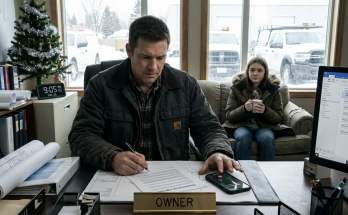
The divorce had been final for several weeks when Martin Collins wrote to me.
I wasn't expecting a letter.
I certainly wasn't expecting one from him.
By October, my life had begun settling into something I could recognize again.
I went to work.
I came home.
I spent time with Sophie.
And for the first time in years, I didn't have to think about whether Martin would approve of how I lived.
That alone made my days easier.
I still drove my old F-250.
I still carried tools when I visited job sites.
And I still walked through the warehouse to speak with employees whose names I had known for years.
Nothing about that had changed.
What changed was the feeling I carried home.
I no longer dreaded the next family gathering.
I no longer waited for another joke about my work.
I didn't have to listen to Clare explain why her father hadn't meant to offend me.
There was no longer a reason to pretend.
One morning, Lisa brought a stack of correspondence into my office.
There were ordinary business letters.
A few documents requiring signatures.
And one envelope that looked different.
It was addressed to me by hand.
No company letterhead.
No attorney's name.
No official markings.
Just my name.
Daniel Whitaker.
I recognized the handwriting before I opened it.
Martin Collins.
I sat there looking at the envelope.
For a moment, I considered throwing it away.
The man had spent years making me feel unwelcome in his family.
He had humiliated my daughter on Christmas Eve.
And his name had appeared on an attempted ownership transfer involving a signature I had never written.
I didn't owe him another conversation.
I didn't owe him an explanation.
And I certainly didn't owe him the comfort of knowing I had read whatever he wanted to say.
But I opened it anyway.
Inside was a short handwritten letter.
I unfolded the paper.
Martin began by admitting that he had misjudged me.
I read that sentence twice.
For eight years, I had heard the opposite.
He had called me a repairman as though it were something shameful.
He had laughed whenever I arrived in my old truck.
He had spoken about wealthy friends and successful businessmen while looking directly at me.
Now he was admitting that his judgment had been wrong.
I leaned back in my chair.
He wrote that he had always measured men by what they owned.
The houses they lived in.
The vehicles they drove.
The business relationships they maintained.
Those were the things he had respected.
I looked toward the office window.
My truck was parked outside.
Nothing about it had changed.
It was still the same F-250.
Still dependable.
Still the vehicle I had driven through difficult years while building Whitaker Home Solutions.
Martin had finally learned that it didn't tell him what was in my bank accounts.
But I wondered whether he had learned anything more important.
I continued reading.
He wrote that the financial investigation had affected his entire family.
David was having difficulty finding another job.
Marcus had moved away.
Relationships among their relatives had become strained.
And Clare was no longer speaking with him regularly.
I stopped there.
I knew some of those things already.
David and Marcus had been dismissed after the company substantiated serious policy violations.
The investigation had identified questionable expenses and transactions.
Recovery efforts had continued through the proper channels.
Martin had retained an attorney.
And the attempted ownership transfer had been rejected after the supporting documents failed verification.
Those were facts.
I had never wanted to destroy anyone's family.
But I wasn't going to pretend their decisions had been harmless.
I looked down at the letter again.
Martin seemed to be describing the damage that had reached his own life.
The missing relationships.
The employment consequences.
The family arguments.
I understood that those things were painful.
But I couldn't ignore what had happened before the consequences arrived.
I remembered Sophie standing outside in twenty-two-degree weather.
I remembered Clare watching from inside.
I remembered driving to get my daughter while she was frightened and freezing.
I remembered her asking whether her mother had called to check on her.
And I remembered how difficult it had been to tell her the truth.
Those memories didn't disappear because Martin was unhappy with the results of his decisions.
Near the bottom of the page, he finally mentioned Christmas Eve.
He wrote that he hoped I could eventually forgive him for what had happened.
I stared at those words.
It was the part I had been looking for.
Not a discussion of the company.
Not an explanation about David's employment.
Not another lecture about how business worked.
An acknowledgment of the night he had put his granddaughter outside.
I wished he had written more.
I wished he had explained why he believed humiliating a sixteen-year-old girl was acceptable.
I wished he had acknowledged how frightened she had been.
I wished he had understood that she had spent months trying to make sense of why her own family hadn't protected her.
But the letter didn't answer those questions.
It only asked for forgiveness.
I folded the paper.
Then I unfolded it again.
For a moment, I thought about responding.
I could have written about the freezing night.
About the way Sophie had pulled her sweatshirt sleeves over her hands for days afterward.
About the breakfast she barely ate.
About the meeting with Clare in the café.
I could have told Martin that apologies weren't supposed to erase consequences.
But I knew something.
He didn't need another explanation from me to understand what he had done.
Sophie had been sixteen.
She had been cold.
He had known.
That should have been enough.
I folded the letter carefully.
Then I placed it in my desk drawer.
I didn't write back.
I didn't call him.
I didn't ask Robert to contact his attorney.
The letter wasn't a legal document requiring action.
It was simply an apology from a man who had finally experienced consequences.
And I wasn't ready to give him the answer he wanted.
For years, I had believed that forgiveness was something I needed to offer whenever somebody apologized.
I had grown used to accepting explanations.
Martin hadn't meant it.
Martin was just difficult.
Martin came from a different generation.
Those were the things I had heard.
Sometimes I had repeated them myself.
Looking back, that embarrassed me.
Because every excuse had made it easier for him to continue.
He insulted me.
I stayed quiet.
He laughed at my work.
I changed the subject.
He embarrassed me at family gatherings.
I told myself it wasn't worth arguing.
Eventually, he treated my daughter with the same cruelty.
And that was something I couldn't excuse.
The letter remained in my drawer.
I didn't hide it because I was frightened of reading it.
I simply didn't want it sitting on my desk.
That space belonged to my work.
Not to Martin Collins.
Later that afternoon, Nathan came into my office with several operational reports.
We reviewed them together.
There were staffing questions.
Project schedules.
Ordinary decisions that had nothing to do with my former in-laws.
I appreciated that.
For months, it had seemed impossible to discuss company finances without thinking about the investigation.
Now we were talking about business again.
Nathan noticed the drawer was still slightly open.
He didn't ask about it.
I closed it.
Then we continued working.
When the meeting ended, he mentioned that several employees had appreciated the way the compliance review had been handled.
I looked at him.
"What do you mean?"
"They were worried everyone connected to the Collins family would be treated the same."
I nodded.
"I remember."
"Some of them expected the worst."
I thought about Tyler Collins.
The warehouse coordinator with six years of good performance reviews.
His records had been clean.
There had been no evidence connecting him with the questionable transactions.
HR had recommended that he remain employed.
I had agreed.
That decision had never been difficult.
"What happened with the investigation wasn't about their names," I said.
Nathan nodded.
"I know."
I looked through the glass wall at the people working outside.
Some had been with me for years.
Others were newer.
They had families.
Bills.
Plans for the future.
They deserved a workplace where decisions were based on evidence.
Not on who their relatives were.
That was the business I had wanted to build.
And it was the business I still intended to run.
After Nathan left, I sat quietly for a moment.
Martin's letter was in the drawer.
The company reports were on the desk.
The difference between them seemed important.
One represented years of trying to earn the approval of somebody who didn't respect me.
The other represented years of work I had actually been proud of.
I knew which one deserved my attention.
That evening, I drove home.
The truck heater hummed softly.
I had heard that sound thousands of times.
I remembered driving the same vehicle to job sites before we could afford better equipment.
I remembered keeping spare tools behind the seat.
I remembered checking my account balance before buying supplies.
Back then, eighteen thousand dollars had seemed like an enormous responsibility.
Now the company was worth sixteen point nine million.
But the truck still felt familiar.
I had never wanted a different vehicle just to impress Martin.
And I wasn't going to buy one now to prove that he had been wrong.
When I arrived home, Sophie was there.
She looked up when I came inside.
"Hey, Dad."
"Hey, sweetheart."
She smiled.
"Long day?"
"Not too bad."
I put my keys down.
For a moment, I considered mentioning the letter.
Then I looked at her.
She was seventeen now.
School and ordinary life were beginning to take up more space in her thoughts again.
She had spent enough time worrying about Martin.
I decided not to bring him into the evening.
We talked about her day.
Nothing dramatic.
Nothing involving lawyers.
Nothing about the company.
It felt good.
Later, when she went to bed, I sat in the quiet living room.
I thought about what Martin had written.
He had finally admitted that his judgment of me was wrong.
But my worth hadn't changed.
I had been the same man when he called me a poor handyman.
The same man when he laughed at my truck.
The same man when he discovered I owned the company.
His opinion hadn't created my success.
And his apology couldn't repair what he had done to Sophie.
I could acknowledge that he regretted his actions without pretending they had never happened.
I could recognize that his family was struggling without taking responsibility for their decisions.
And I could choose not to answer his letter.
That was something I hadn't understood before.
Silence could mean different things.
For years, my silence had been surrender.
I had kept quiet because I wanted Clare to be happy.
Because I wanted family gatherings to remain peaceful.
Because I didn't want another argument.
Now my silence meant something else.
I wasn't avoiding Martin.
I was simply refusing to return to the same relationship.
He had asked for forgiveness.
Maybe one day I would feel differently.
But I wasn't going to offer it just because the consequences had finally become uncomfortable for him.
I turned off the living room light.
Before going upstairs, I looked at the front door.
I remembered another door.
The one Martin had refused to open on Christmas Eve.
I remembered Sophie standing on the other side.
Waiting.
Cold.
Frightened.
I couldn't change that memory.
But I could make certain our home would never become a place where she had to beg somebody to let her in.
That mattered more than answering any letter.
Click here to continue reading: PART 10: My Daughter Wanted to See Her Mother Again, and I Had to Accept That Rebuilding Their Relationship Was No Longer My Decision
My Father-in-Law Called Demanding Answers About His Family’s Jobs, But He Had No Idea Who Was Sitting Behind the Desk
Part 9 of 12