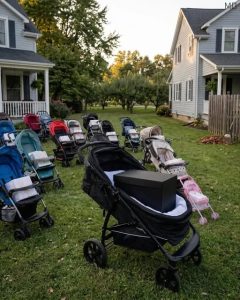
The doorbell rang just after dawn, pulling me from the first full night of sleep I had managed since losing my newborn son. When I opened the front door, no one was standing on the porch. Instead, dozens of baby strollers covered my lawn, their canopies shining with morning dew. Each one held a sealed box, and the largest black stroller had an envelope bearing my name. My hands began shaking as I stepped onto the wet grass. Three weeks earlier, I had buried Noah, and one week later, my husband Thomas had packed a suitcase and left because he could no longer face the empty nursery. Now strangers had somehow surrounded my home with the very objects I had spent weeks trying not to see.
Before Noah was born, Thomas and I had spent nearly $4,200 preparing his room. We bought a white crib, a $650 stroller, unopened boxes of diapers, tiny outfits, and a rocking chair where I imagined feeding him during quiet nights. After he passed at the hospital, everything remained untouched. Thomas wanted to sell the house and erase every reminder, but I could not bring myself to close the door on our son. Then I saw a young mother named Elena sitting outside a Virginia grocery store with her baby, Mateo, pressed against her chest in a worn carrier. I drove home, packed Noah’s stroller, blankets, diapers, and clothes, and gave them to her. Elena cried as she promised that Mateo would grow up hearing about the little boy whose gifts had helped him.
That night, something inside me finally loosened, and I slept on the couch until the mysterious doorbell woke me. I opened the first box and found a folded blanket, tiny socks, and a letter from parents whose daughter Emma had lived only nineteen hours. Another box honored Owen, who had never come home from the hospital, while others carried the names of twins, daughters, sons, and grandchildren. Soon cars began pulling up, and grieving families gathered along the sidewalk. An older woman named Linda explained that Elena had visited their community resource center and described what I had done. Every member of their support group had gone home, opened a closet they had avoided for years, and brought one stroller to my lawn—but the black stroller still held the answer none of them had shared.
Inside it was a wooden plaque reading “Noah’s Strollers,” along with plans to donate every item to struggling families. Linda explained that the group had already contacted an attorney to establish a charity, arranged insurance for donated equipment, and found storage space in a building whose mortgage was being covered by a local business owner. A small investment account would fund repairs, while an estate planner had offered to help families leave future gifts to the project. Nothing required a court battle or complicated paperwork from grieving parents; they could donate whenever they felt ready. Thomas arrived carrying documents to list our house, but stopped when he saw the crowd. I told him the nursery was no longer an empty room—it had become the first home of something larger than either of us.
Within a year, Noah’s Strollers had helped more than 180 families. I kept the house, turned the nursery into an office for the project, and learned that healing did not mean forgetting my son. Thomas and I never repaired our marriage, though he eventually donated money and quietly attended one fundraiser. Elena became a volunteer, often arriving with Mateo riding proudly in Noah’s stroller. Some parents brought boxes through tears; others left them anonymously on the porch. Each gift carried a name, a memory, and love that still needed somewhere to go. Noah never came home in my arms, but because of him, many other babies went home with something their families desperately needed.