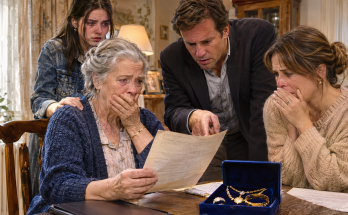
The conversation about money began before I had finished my first cup of tea.
I remember being surprised by that.
Thomas had supposedly died only days earlier.
We had just buried him.
And my children were already prepared to discuss who would control what he had left behind.
After the funeral, we returned home.
People came and went.
There were quiet conversations in the hallway.
Flowers appeared on tables that had already been crowded with flowers.
Someone brought food I had no appetite for.
I sat through everything because I didn't know what else to do.
Celeste stayed close.
Adrian handled calls.
They moved around the house with the confidence of people who knew exactly what would happen next.
I began noticing how often they made decisions without asking me.
Which visitors could stay.
Which conversations were too tiring.
Which matters should be postponed.
They called it helping.
I had called it helping, too.
Until that morning.
As the house finally grew quieter, Adrian asked me to join him in the library.
I followed him without protest.
The library had always been Thomas's favorite room.
There were shelves filled with books he had bought over the years.
A familiar chair stood near the window.
His desk remained exactly as he had left it.
That detail almost broke me.
For a moment, I forgot the message.
I imagined him walking through the doorway, complaining that someone had moved his papers.
Then I remembered where I had been that morning.
And what I had read.
Adrian pulled out a chair for me.
"Sit down, Mom."
I sat.
A cup of tea waited beside my place.
It was still warm.
I wondered who had prepared it.
I didn't drink.
Celeste entered carrying a folder.
She set it in front of Adrian.
Neither of them seemed uncertain.
That should have told me something.
Adrian opened the folder and turned it toward me.
"There are a few matters we need to settle."
I looked at the documents.
"Already?"
He nodded.
"We shouldn't let things become complicated."
"Your father's funeral was this morning."
"I know."
"Then perhaps you could explain why this can't wait."
He gave Celeste a look.
She pulled her chair closer.
"Mother, the company needs stability."
I looked at her.
"Does it?"
"Of course."
"Who told you it was unstable?"
She hesitated.
"That's not what I meant."
"Then what did you mean?"
Adrian raised one hand.
"We don't need an argument."
"I haven't started one."
He took a breath.
I recognized the expression on his face.
He used it when he wanted a business discussion to end.
Thomas had the same expression sometimes.
The difference was that Thomas usually knew what he was talking about.
Adrian pointed to the first document.
"This gives us temporary authority to manage the voting interests."
I read the heading.
Then the next page.
And the next.
The language was familiar.
Not because Adrian had explained it.
Because I understood exactly what those words meant.
I kept my expression blank.
The documents were much more than temporary arrangements.
They would place control of significant company decisions in my children's hands.
They would give them access to Thomas's private financial accounts.
They also attempted to transfer authority over the Vale Family Trust.
That last part was the most important.
I looked at the yellow tab marking the signature line.
It was positioned neatly.
As though someone expected me to sign without reading.
Celeste folded her hands.
"Dad would never want you dealing with all this."
I looked up.
"Did he tell you that?"
She blinked.
"What?"
"Did your father say he didn't want me involved?"
"Not in those words."
"Then whose words are they?"
Her smile tightened.
Adrian leaned forward.
"Mom, he trusted us."
I watched him for a moment.
"Your father trusted what was written and properly authorized."
Adrian's eyes changed.
Just slightly.
But enough.
He hadn't expected that answer.
I looked down again.
There was a time when I would have challenged every questionable sentence immediately.
I would have asked who drafted the documents.
I would have checked the legal authority behind each proposed transfer.
I would have demanded the names of the trustees and examined the supporting records.
Fifteen years investigating financial fraud had taught me never to accept a document because the person presenting it sounded confident.
But I didn't do any of that.
Not yet.
I kept reading.
I remembered the conversations Thomas and I had shared when the family trust was created.
He had wanted protection.
For the business.
For the family.
For any time when one person's death or incapacity might create confusion.
I had insisted on specific safeguards.
Thomas sometimes teased me about treating every financial arrangement as a potential crime scene.
I told him that financial crimes usually began with someone assuming a trusted person would never cross a line.
He stopped teasing me after that.
We had designed the trust so that control could not simply pass into new hands after a reported death.
Two independent trustees had to approve certain changes.
One of those trustees was me.
That requirement had not disappeared because my husband was presumed dead.
It had not disappeared because my son wore an expensive suit.
And it had not disappeared because my daughter kept smiling at me.
I turned another page.
I knew what was missing.
The necessary authorization wasn't there.
The safeguards had not been satisfied.
Yet my children were asking me to sign.
I looked at Adrian.
"Who prepared these?"
He answered without hesitation.
"The appropriate people."
"Which people?"
"Our advisers."
"Names, Adrian."
His expression hardened.
"Mom, this isn't the time."
I lowered my eyes.
"Perhaps you're right."
The words came out quietly.
I saw Celeste relax.
That told me something important.
They were not interested in whether I understood the documents.
They were interested in whether I would stop asking questions.
For a few moments, nobody spoke.
I looked at the papers as though I was struggling with them.
Adrian moved the folder closer.
"We can explain everything later."
I touched the edge of a page.
"All right."
Celeste leaned toward me.
"Really?"
"Really."
I watched the relief appear on her face.
It was almost immediate.
I felt sick.
Not because I was frightened of signing.
Because I had just seen how badly my daughter wanted me to stop thinking.
Adrian produced a pen.
He placed it beside the yellow tab.
I picked it up.
My hand trembled.
That part wasn't an act.
I had watched strangers lower my husband's coffin.
I had received a message that might have come from him.
And now I was sitting across from my children, wondering whether they were trying to take everything we had built.
My body knew what was happening even while my mind resisted it.
I looked at the signature line.
I knew my legal signature as well as I knew my own face.
I had used it on contracts, bank records, trust documents, and professional reports.
There was a particular way I formed the letters.
A small movement at the beginning.
A consistent ending.
Tiny details that would matter to anyone examining authenticity.
I didn't use that signature.
Instead, I wrote an old version of my name.
One I had used casually decades earlier.
It belonged on shopping notes and ordinary household lists.
Not on financial documents.
I had no intention of giving my children a valid authorization.
But I wanted them to believe they had one.
That distinction mattered.
At the time, it was the only safe move I could see.
I put down the pen.
Adrian lifted the paper.
His eyes moved directly to the signature.
Then he smiled.
Not the tired smile he had worn at church.
A different one.
A satisfied one.
Celeste leaned over to look.
She exhaled.
I heard it.
They thought the problem had been solved.
I was the problem.
Or at least, that was how they were treating me.
Adrian gathered the documents.
"Thank you, Mom."
I looked at him.
"For what?"
"For trusting us."
Trust.
There was that word again.
I wanted to ask whether he even understood it.
Instead, I folded my hands in my lap.
"I suppose your father would want us to be careful."
"Exactly," he answered.
I nearly laughed.
Thomas would have examined those papers until he understood every consequence.
Then he would have asked why our children were in such a hurry.
But I said nothing.
Adrian closed the folder.
Celeste stood.
She touched my shoulder again.
"You should rest."
"I will."
"Don't worry about the accounts."
I looked up at her.
"Should I?"
She paused.
"No. That's what I'm saying."
"Then I won't."
My voice sounded so mild that she seemed pleased.
I hated how convincing I had become.
There had been years when I deliberately kept quiet during family business conversations.
Thomas and I had an understanding.
He ran the company.
I remained available when he needed someone to examine an unusual arrangement or question.
Sometimes he asked for my help.
Sometimes he didn't.
I respected that.
But the children had apparently mistaken my absence from daily operations for ignorance.
They believed that because I no longer worked as a forensic accountant, I had forgotten how to recognize fraud.
They believed that a funeral made me incapable of understanding a legal document.
Most of all, they believed that being my children entitled them to my cooperation.
I rose from the table.
Adrian offered to walk me upstairs.
I declined.
I wanted to be alone.
I also wanted to be somewhere I could read my phone without anyone looking over my shoulder.
As I reached the library door, Celeste called after me.
"Mother?"
I stopped.
"Yes?"
"We're doing this because we love you."
I turned.
She was standing beside Adrian.
Two grown children.
My children.
For a brief moment, I saw them as they had been years earlier.
Adrian with scraped knees.
Celeste with a ribbon coming loose from her hair.
I remembered all the ordinary things a mother remembers.
Breakfasts.
Birthday cakes.
A child's hand reaching for mine.
And I wondered when those memories had stopped telling me who they were.
"I hope that's true," I said.
Then I left the room.
Upstairs, I closed my bedroom door.
I stood there without moving.
My handbag rested against my hip.
Inside it was the message.
I took out my phone.
I read the words again.
Thomas claimed he was alive.
He had warned me about Adrian and Celeste.
Downstairs, those same children believed they had secured control of his affairs.
I looked at the wedding ring on my hand.
Then at the ring that had supposedly been recovered after the crash.
I could no longer treat the message as a cruel mistake.
I didn't know exactly what had happened.
But I knew the documents were wrong.
And I knew my children had been relieved when I signed them.
I sat on the edge of the bed.
For the first time that day, I stopped trying to behave like the widow everyone expected.
I began thinking like the accountant I had once been.
Click here to continue reading: PART 3: That Night I Locked My Bedroom Door and Read the Second Message That Led Me Away From My Children
I Was Standing Beside My Husband’s Coffin When a Message Arrived That Made Me Question Everything About His Death
Part 2 of 15