PART 3
Then I looked down at my wedding ring.
Ernest had given it to me forty years earlier, on a rainy afternoon when we had promised to spend the rest of our lives together.
I remembered how he had smiled that day.
“Theresa, never let anyone make you feel like you are worth less than you are.”
I had laughed at him.
“Who would ever make me feel that way?”
He hadn’t answered.
Now, standing at the port with the ocean stretching endlessly before me, I finally understood what he had meant.
Sometimes the people who make you feel the smallest are the very people you spent your entire life trying to make happy.
My phone vibrated again.
AUSTIN: MOM, PLEASE ANSWER ME. WHAT IS IN THIS FOLDER?
I didn’t reply.
Instead, I opened my handbag and checked the documents my attorney, Daniel, had prepared.
Everything was there.
The property transfer documents.
The updated trust agreement.
The financial statements.
And the final letter Ernest had asked me to keep until I was ready to begin a new chapter of my life.
I had promised him I would never open it until I was certain I could stand on my own.
That morning, I finally felt ready.
But before I tell you what was inside that folder, you need to understand something about my house.
Because the truth was, Austin had never owned it.
Not even for one day.
And that was only the beginning.
Three months before Ernest died, he called me into his study.
He had been getting weaker for weeks. His hands trembled whenever he tried to hold his coffee cup, and sometimes he struggled to finish a sentence without stopping to catch his breath.
I had spent most of those months sleeping in the chair beside his hospital bed.
I knew every medication schedule, every doctor’s appointment, and every warning sign.
But that afternoon, he asked me to close the bedroom door.
“Theresa, I need to talk to you about Austin.”
I sat beside him.
“What happened, Ernest?”
He looked toward the window.
“Have you noticed how often he asks about the house?”
I sighed.
“He’s probably worried about what will happen to us when we’re gone.”
Ernest slowly turned his head toward me.
“That’s what you think?”
I didn’t understand his question.
“He is our only son.”
“I know.”
“He has children to think about.”
“I know that too.”
Ernest closed his eyes.
For a few seconds, the only sound in the room was the ticking of the old clock on his bedside table.
Then he spoke.
“Theresa, being someone’s child doesn’t give them the right to everything you have worked for.”
I frowned.
“Why are you saying this?”
He reached for my hand.
“Because I’ve seen things you haven’t.”
He explained that several months earlier, Austin had visited him while I was at the pharmacy.
According to Ernest, our son had asked whether the house could be transferred into his name before Ernest passed away.
At first, Ernest thought he was simply discussing future arrangements.
But Austin had become increasingly insistent.
He had even brought documents for Ernest to sign.
Ernest refused.
“What documents?” I asked.
“Something about a family property arrangement. I didn’t like the wording, so I told him I wanted Daniel to review everything first.”
I felt a strange coldness spread through my chest.
“Why didn’t you tell me?”
“Because I wanted to be certain before upsetting you.”
He squeezed my hand.
“Theresa, our son has changed.”
I wanted to defend Austin.
I wanted to say that he was under pressure, that he had a family to support, that perhaps Ernest had misunderstood something.
But deep down, I remembered all the little things I had ignored.
The money he borrowed and never returned.
The way Chloe spoke to me.
The way they had begun treating our home as though it were already theirs.
And the way Austin had started asking about our savings whenever Ernest’s medical condition became worse.
“What do you want me to do?” I whispered.
Ernest looked directly into my eyes.
“Protect yourself.”
That evening, he called Daniel.
And for the next several weeks, while I believed we were simply preparing for the worst, Ernest and our attorney quietly reviewed everything we owned.
Our house.
Our savings.
Our investments.
Our life insurance.
Even the money Ernest had inherited from his parents.
We discovered something that made my husband deeply uncomfortable.
Austin had been telling relatives that his father intended to leave him the house.
He had even discussed renovating the property and moving his family into it.
But Ernest had never promised him anything.
Not once.
The house was purchased by Ernest and me after years of working long hours and saving every dollar we could.
We had paid the mortgage together.
We had renovated the kitchen ourselves.
We had planted the roses in the garden with our own hands.
It was our home.
Not an inheritance Austin could claim before we were even gone.
Daniel advised us to update the estate arrangements and make our intentions legally clear.
We did.
And Ernest made one more decision.
He wanted me to have complete control over the property and our remaining assets.
He didn’t want me to spend the rest of my life asking our son for permission to live in the home I had helped build.
I remembered crying when Ernest signed the final documents.
“You’re still going to be here,” I told him.
He smiled weakly.
“I hope so, sweetheart.”
But he knew.
I think he knew much more than I wanted to accept.
Back on the cruise ship, I finally opened the envelope Ernest had left for me.
My hands trembled as I unfolded the paper.
His handwriting was shaky, but I recognized every letter.
It began:
“My dearest Theresa,
If you are reading this, it means I’ve left you alone in this world.
I wish I could have stayed longer.
I wish I could have taken you to all the places we talked about visiting.
I wish we had grown old together without worrying about doctors, bills, or family problems.
But there is one thing I want you to remember.
You are not required to sacrifice the rest of your life just because you spent the first part taking care of everyone else.
You have spent forty years being a good wife and mother.
Now, please spend some time being yourself.
Don’t allow guilt to bring you back to a life that makes you unhappy.
I love you.
Ernest.”
I pressed the letter against my chest.
For the first time since the funeral, I cried.
But these tears felt different.
They weren’t tears of helplessness.
They were tears of love.
I sat by the window for several minutes before wiping my face.
Then I looked at my phone.
There were seventeen missed calls.
Eight from Austin.
Six from Chloe.
Two from Daniel.
And one from a number I didn’t recognize.
I called Daniel first.
“Theresa,” he answered immediately. “Are you aboard?”
“Yes. I’m on the ship.”
“Good. I was beginning to worry.”
“Daniel, Austin found the folder.”
There was a short pause.
“Then he has finally read the documents.”
“What is he going to do?”
“That depends on whether he understands what they mean.”
I looked out at the harbor.
“Tell me something, Daniel. Why was he so frightened?”
My attorney exhaled.
“Because the folder contains more than the property documents.”
I sat up.
“What do you mean?”
“Theresa, do you remember the $85,000 you and Ernest lent Austin two years ago?”
I immediately remembered.
Austin had told us his business was struggling.
He said he needed money to pay suppliers and employees.
Ernest and I had withdrawn part of our retirement savings to help him.
Of course, I had never expected the money back.
“He was going to repay us when things improved,” I said.
“That’s what he told you.”
Something about Daniel’s tone made my stomach tighten.
“What aren’t you telling me?”
“Before Ernest died, we reviewed the bank transfers and the paperwork associated with that money. Some of the transactions were not what Austin had described.”
I stood up.
“What transactions?”
“Your son used part of the money to settle personal debts. Another portion went toward a luxury vehicle registered in Chloe’s name.”
I couldn’t speak.
Daniel continued carefully.
“Your husband was particularly upset because Austin had told you the money was being used to keep his employees paid.”
I lowered myself onto the chair.
I remembered that conversation.
I remembered Austin standing in our kitchen, looking exhausted.
I remembered giving him the money and telling him that family should always help each other.
And I remembered Ernest quietly watching us.
“Why didn’t Ernest tell me?”
“He didn’t want you spending his final weeks fighting with your son. He asked me to organize the evidence and make sure you understood your legal options when you were ready.”
I closed my eyes.
“Does Austin know?”
“Now he does. The second folder contains copies of the financial records, the signed loan agreement, and a letter explaining what happens if he continues making false claims about your property.”
I took a deep breath.
“Thank you, Daniel.”
“One more thing, Theresa.”
“Yes?”
“Don’t let anyone pressure you into signing anything while you’re away. If Austin calls, you don’t have to discuss the legal matters with him directly. Let me handle it.”
“I understand.”
After we ended the call, I turned my phone off.
For the first time in years, I didn’t feel obligated to answer every person who wanted something from me.
Meanwhile, back at my house, Austin was beginning to lose control of the situation.
I didn’t know everything happening there at the time.
But Daniel later told me what happened after Austin opened the second folder.
He had been standing in the living room with Chloe when he finally unfolded the first document.
At the top was a copy of the property deed.
His eyes moved across the page.
Then he stopped.
“What?” Chloe asked.
Austin didn’t answer.
She walked closer.
“What’s wrong?”
He turned the paper toward her.
“Mom transferred the house.”
“To who?”
“To herself. It’s already protected under the estate arrangements.”
Chloe stared at him.
“That doesn’t make sense. Your father wanted you to have that house.”
“He didn’t!”
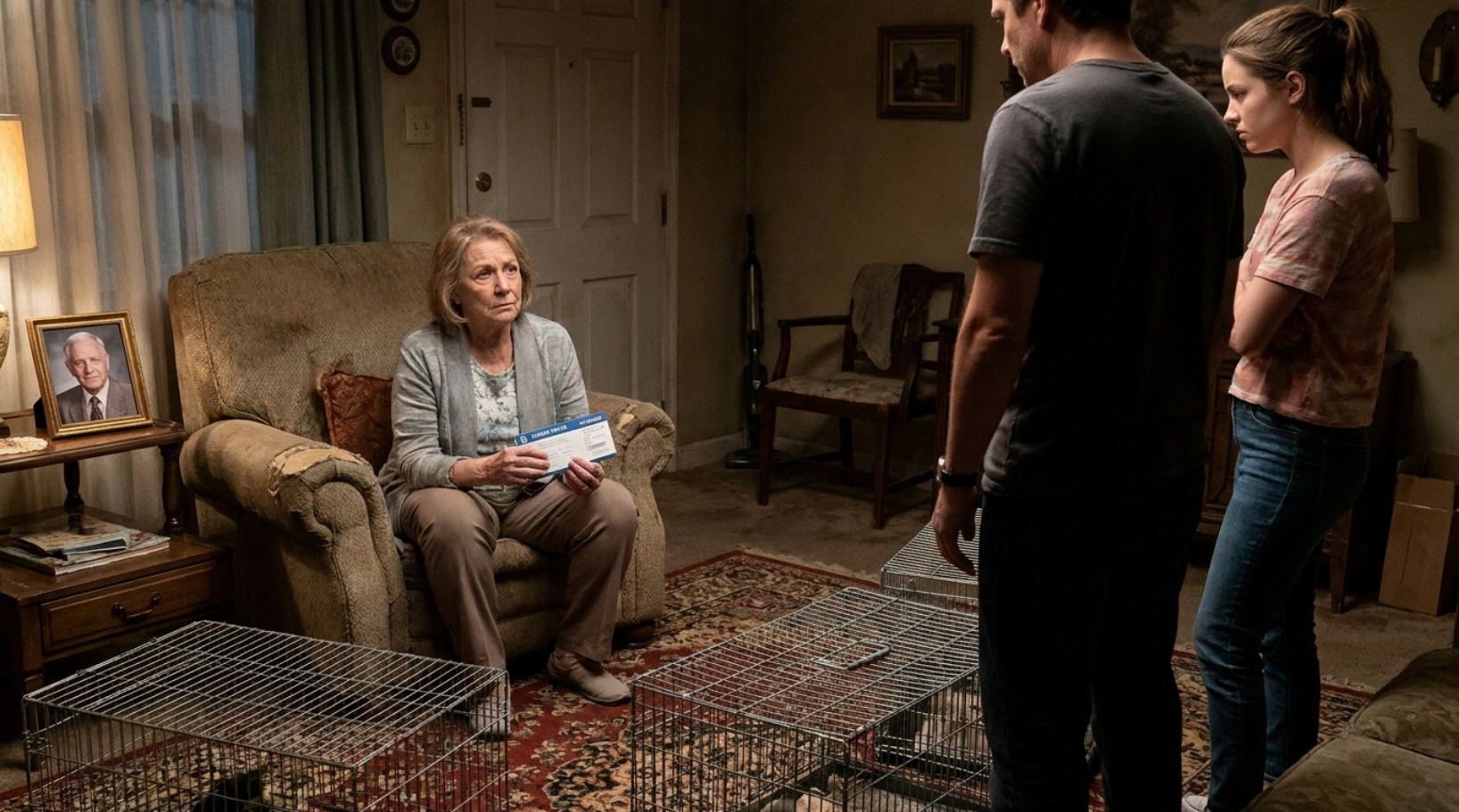
Austin’s voice was so loud that the cat carrier still sitting near the doorway seemed to rattle.
Chloe stepped back.
“Don’t shout at me.”
He continued flipping through the documents.
There were copies of the estate agreement, the updated trust provisions, and a letter from Daniel explaining that any attempt to enter, sell, transfer, or claim ownership of the property without Theresa’s permission would be challenged through the appropriate legal process.
Then he found the financial records.
He recognized the bank statements immediately.
The dates.
The amounts.
The transfers.
His face became increasingly pale.
Chloe grabbed the papers.
“What’s this?”
Austin snatched them back.
“Nothing.”
“Then why are you shaking?”
He finally looked at her.
“Because Mom knows.”
“Knows what?”
“Everything.”
For several seconds, Chloe said nothing.
Then she slowly sat down.
“How much does she know?”
Austin stared at the documents.
“Enough.”
By ten o’clock that morning, my phone was switched back on.
I had just finished breakfast when a message appeared from Austin.
AUSTIN: Mom, we need to talk. This has gone too far.
I stared at the screen.
Another message arrived.
AUSTIN: I understand you’re upset, but you can’t just disappear and leave us with all these legal problems.
I almost laughed.
Legal problems?
I hadn’t created any legal problems.
I had simply stopped allowing other people to make decisions about my life.
Then Chloe sent a message.
CHLOE: Mrs. Theresa, I think there has been a misunderstanding. We were only trying to help you. Please don’t make this situation worse.
I read it twice.
Help me?
I remembered the cages being dropped onto my carpet.
I remembered her telling me that everybody had their own problems.
I remembered the way she had spoken about cleaning up after the animals.
I also remembered how she had looked at my house during the funeral reception, commenting that the living room would look better with different furniture.
I put the phone down.
I wasn’t ready to speak to either of them.
But just as I was about to leave my cabin, another message appeared.
This one was from Daniel.
DANIEL: Theresa, I need to inform you about something. Austin just contacted my office. He says he wants to challenge the property arrangements. There is also another issue involving a document he claims Ernest signed shortly before his death.
I froze.
A document Ernest had signed?
I immediately called Daniel.
“What document?”
His answer made my heart begin racing.
“Austin says he has a copy of a handwritten agreement in which Ernest supposedly promised him the house.”
I gripped the edge of the table.
“That’s impossible.”
“That’s what I told him. But he insists he has evidence.”
“Did Ernest ever sign anything like that?”
“Not according to our records.”
I looked toward the framed photograph of Ernest that I had placed inside my suitcase.
“Daniel, I need to know what he’s talking about.”
“I’ve asked Austin to send us a copy. We need to examine it carefully.”
I was silent.
Then I remembered something.
About two weeks before Ernest died, Austin had visited the house while I was at the hospital pharmacy.
He had stayed with his father for almost an hour.
When I returned, Ernest seemed unusually quiet.
I had asked whether something was wrong.
He simply told me that he was tired.
I had never questioned it again.
Now, suddenly, that memory returned with uncomfortable clarity.
“Daniel,” I whispered, “I think there is something you should know.”
“What is it?”
“Austin visited Ernest alone shortly before he died. I wasn’t there. And afterward, Ernest seemed frightened.”
Daniel didn’t answer immediately.
Then he said something that made my entire body go still.
“Theresa, I think we need to investigate exactly what happened during that visit.”
I walked toward the balcony.
Below me, the ocean stretched endlessly beneath the morning sunlight.
I had imagined this cruise as a year of peace.
I had imagined reading books, meeting people, visiting beautiful cities, and finally learning how to live without being responsible for everyone else.
But it seemed my family’s secrets had decided to follow me across the ocean.
Then Daniel sent another message.
It contained a photograph.
The image showed a handwritten document with Ernest’s name at the bottom.
I zoomed in.
The signature looked familiar.
But something was wrong.
I knew Ernest’s handwriting better than anyone.
I had watched him sign birthday cards, Christmas letters, mortgage documents, and thousands of little notes over forty years.
And the signature in that photograph didn’t look quite right.
I called Daniel again.
“Don’t let Austin do anything with that document.”
“Why?”
I swallowed hard.
“Because Ernest never wrote his capital E like that.”
There was a long silence.
Then Daniel spoke very quietly.
“Theresa, I think your son may have made a serious mistake.”
I stared at the photograph.
And just as I was about to ask what he meant, another message appeared from an unknown number.
It contained only one sentence.
“Mrs. Theresa, there is something you don’t know about your husband’s final days. I was there when your son visited him.”
I read the message three times.
Then another message followed.
“Please don’t tell Austin I contacted you. I have the original document.”
My hands began trembling.
Because suddenly, I understood something.
The folder I had left on my living room table might not have been the only secret Ernest had prepared for me.
And whoever had just contacted me knew exactly what happened during the final days of my husband’s life.
For the first time since boarding the cruise ship, I wondered whether the truth about my son was even worse than I had imagined.
PART 4: THE SECRET MY HUSBAND TOOK TO HIS GRAVE
I stared at the message on my phone until the screen went dark.
For several seconds, I couldn’t move.
The ship was sailing farther away from Miami, carrying me toward a year of freedom I had dreamed about for so long. Yet the past was suddenly reaching across the ocean, demanding that I look at something I had spent weeks trying not to think about.
Someone had been there when Ernest was visited by our son.
Someone had seen something.
And that person claimed to have the original document.
I immediately typed a reply.
ME: Who are you? And what do you know about my husband?
The answer arrived less than a minute later.
UNKNOWN NUMBER: My name is Patricia. I was one of your husband’s nurses during his final weeks at home. I didn’t know whether I should contact you, but after hearing what your son is claiming, I cannot stay silent anymore.
My heart began beating faster.
Patricia.
I remembered her.
She was a middle-aged woman with short brown hair who had helped care for Ernest during the final weeks of his illness. She was gentle, patient, and always spoke to him as though he were an old friend.
I typed again.
ME: What happened?
This time, her response took longer.
Then a photograph appeared.
It showed Ernest sitting in his favorite chair, wearing his blue cardigan.
Beside him stood Austin.
The date on the photograph was two weeks before Ernest died.
I zoomed in.
Austin was holding a folder.
Ernest was looking directly at him, but there was something about his expression that made my stomach turn.
He didn’t look happy.
He looked frightened.
Patricia sent another message.
PATRICIA: Your husband asked me to keep a copy of something for him. He said that if anything happened to him, I should give it to his attorney. I was afraid because your son told me it was a private family matter. But I think you deserve to know the truth.
I immediately called her.
She answered after the second ring.
“Mrs. Theresa?”
“Patricia, please tell me what happened.”
She took a deep breath.
“Your son visited your husband that afternoon. I was in the hallway when I heard them arguing.”
I closed my eyes.
“What were they arguing about?”
“The house.”
I gripped my phone.
Patricia continued.
“Your husband told Austin he would never sign the documents. He said everything had already been arranged legally and that you would be protected.”
I swallowed.
“And Austin?”
“He became angry. He told your husband that he had spent his entire life waiting for his inheritance and that it wasn’t fair for you to control everything.”
I felt tears gathering in my eyes.
“Those were his exact words?”
“Yes.”
Patricia paused.
“Then your husband told him something I will never forget.”
“What?”
“He said, ‘Austin, your mother gave you everything she had. The least you could do is let her keep what belongs to her.’”
I covered my mouth.
For a moment, I could almost hear Ernest’s voice.
Patricia continued.
“Your son left the room very upset. But before he went, he placed some papers on the bedside table and told your husband he would return for them.”
“What papers?”
“I don’t know. But your husband asked me to take photographs after Austin left.”
My voice became barely audible.
“Did you?”
“Yes.”
“Do you still have them?”
“Yes, Mrs. Theresa. I also have a small envelope your husband asked me to keep.”
I sat down.
“What is inside it?”
“I haven’t opened it. Your husband told me it was for you.”
I couldn’t speak.
After forty years of marriage, Ernest had somehow managed to leave one final message waiting for me.
And now I was beginning to understand why he had been so determined to protect me.
That afternoon, I arranged a video call with Daniel.
Patricia joined us.
She showed him the photographs and explained everything she had witnessed.
Daniel listened without interrupting.
When she finished, he asked her whether she would be willing to provide a written statement and preserve the original photographs.
“Of course,” she replied. “I don’t want anyone to use Mr. Ernest’s illness to take advantage of his wife.”
Daniel thanked her.
Then he turned toward me.
“Theresa, I want you to understand something. We shouldn’t assume the document Austin produced is fraudulent until it has been properly examined. But there are serious inconsistencies that need investigation.”
“I understand.”
“We’ll arrange for the original document to be reviewed by a handwriting expert. We’ll also examine the date, the circumstances in which it was supposedly signed, and the witnesses.”
I nodded.
Then I asked the question that had been sitting in my heart.
“Daniel, did Ernest know Austin was trying to take the house?”
“Yes.”
“How long had he known?”
“Longer than he told you.”
I looked down.
Daniel opened another file.
“Theresa, your husband also instructed me to prepare a separate document concerning the money you gave Austin.”
I remembered the $85,000.
“What about it?”
“He wanted the loan agreement enforced if Austin continued denying the debt or making false claims about your property.”
I stared at the screen.
“But I don’t want to take my son’s money.”
Daniel nodded.
“I know. Ernest anticipated that you would say that.”
He opened another document.
“There is a provision allowing you to decide whether to pursue repayment. Your husband wanted you to have the choice, not the obligation.”
I began crying.
Even after death, Ernest had thought about the things I might be afraid to do.
He had spent his final weeks making sure nobody could force me into another sacrifice.
Three days later, the first official news arrived.
Daniel called me early in the morning.
“Theresa, we have examined the document Austin submitted.”
I sat up in bed.
“And?”
“The handwriting expert has identified several inconsistencies. The signature requires further examination, but there are indications that the document may have been altered.”
I closed my eyes.
“Can he prove it?”
“We are gathering the original records and witness statements. Patricia’s testimony is important. We also have Ernest’s medical records and the documents he signed with me.”
“What happens now?”
“We will respond through the proper legal channels. Austin has no automatic right to take possession of your house.”
I felt a strange mixture of relief and sadness.
I had never imagined spending my later years discussing legal documents involving my own child.
But I also knew I could no longer pretend everything was normal.
That afternoon, I finally answered Austin’s call.
He picked up immediately.
“Mom!”
His voice sounded exhausted.
“Hello, Austin.”
“Where are you? Why aren’t you coming home?”
“I’m on the cruise.”
“I know that! But what are you doing? You left us with a legal disaster.”
I looked through my cabin window.
The ocean was calm.
“Austin, I left you with a letter.”
“You know what I mean!”
He took a breath.
“Mom, Chloe and I have been discussing everything. We think we should meet when you return. We can sort this out as a family.”
I remained silent.
Then he said something that surprised me.
“Mom, I miss you.”
For a moment, my heart softened.
Because no matter how old a child becomes, a mother never completely stops hoping that her child will love her without conditions.
But then I remembered the day he left those cages in my living room.
I remembered the cemetery.
I remembered him asking about my house while the dirt from his father’s grave was still on my shoes.
“Austin,” I said quietly, “do you miss me, or do you miss having someone who takes care of everything for you?”
He didn’t answer.
“That’s not fair, Mom.”
“Neither was the way you treated me.”
He sighed.
“Look, I know Chloe was a little rude, but she didn’t mean anything by it.”
I closed my eyes.
“You brought three animals into my home without asking whether I was emotionally or physically able to care for them. You told me I would be bored if I didn’t have something to do. Your wife told me that everybody had problems.”
“Mom, we were going through a lot too.”
“And I was burying your father.”
Silence.
I continued.
“I don’t expect you to understand everything I have been through. But I will no longer allow you to decide what my life should look like.”
Then I heard Chloe speaking in the background.
“Ask her about the house!”
Austin covered the phone poorly.
I could hear everything.
“Mom, Chloe wants to know when you’re coming back.”
I almost smiled.
“Tell Chloe that my house is not available for her to manage.”
He became angry.
“So you’re choosing a cruise ship over your own family?”
I looked at Ernest’s photograph on my bedside table.
“No, Austin. I’m choosing myself for the first time in forty years.”
Then I ended the call.
The following weeks were unlike anything I had experienced before.
I visited beautiful places along the Caribbean coast.
I walked through colorful streets, tasted unfamiliar food, and watched sunsets from the deck.
I met a retired teacher named Margaret who had lost her husband two years earlier.
We became friends almost immediately.
One evening, while we were sitting beside the swimming pool, she asked me why I had decided to take such a long cruise.
I told her everything.
She listened quietly.
When I finished, she reached across the table and held my hand.
“Theresa, you know what the saddest thing is?”
“What?”
“Sometimes we spend so much time teaching our children how to live that we forget to teach them how to respect us.”
I looked at her.
She smiled gently.
“And sometimes the best lesson we can give them is to stop rescuing them.”
Those words stayed with me.
For the first time, I began to understand that loving my son didn’t mean giving him unlimited access to my life.
I could love him and still say no.
I could forgive him without allowing him to hurt me again.
I could be his mother without becoming his servant.
And perhaps most importantly, I could enjoy my remaining years without apologizing for it.
Three months into my cruise, Daniel called with an important update.
The document Austin had submitted had been challenged.
An independent handwriting examination found that the signature was inconsistent with Ernest’s verified signatures. Other irregularities in the document’s preparation also raised serious questions.
Patricia had provided a signed statement confirming what she witnessed during Austin’s visit.
The attorney had also obtained copies of relevant communications and financial records.
Daniel explained that the matter would proceed through the appropriate legal channels.
Meanwhile, Austin’s attempts to claim the house had been unsuccessful.
The property remained legally protected under the arrangements Ernest and I had made.
But there was another development.
Chloe had contacted Daniel.
She wanted to speak with me.
I hesitated.
Then I agreed to a short video call.
When her face appeared on the screen, she looked different.
Her hair was tied back, and she wasn’t wearing the expensive makeup I was used to seeing.
“Hello, Mrs. Theresa.”
“Hello, Chloe.”
She looked down.
“I wanted to apologize.”
I didn’t respond immediately.
She continued.
“I know you probably don’t want to hear from me, but I’ve been thinking about what happened.”
I waited.
“I shouldn’t have brought the animals to your house like that. I shouldn’t have spoken to you the way I did.”
“Why are you apologizing now?”
She swallowed.
“Because I realize we treated you terribly.”
I looked at her carefully.
She continued.
“When you were helping us, I started thinking of it as something normal. I thought you would always be available. I never considered that you might be tired or lonely.”
Her eyes became wet.
“And when your husband died, I was so focused on our vacation that I didn’t even think about what you were going through.”
For the first time, I saw something resembling genuine regret in her face.
But I wasn’t ready to pretend everything was fine.
“Chloe, I appreciate your apology. But an apology doesn’t erase what happened.”
“I know.”
“And I need you to understand that things will be different when I return.”
She nodded.
“We understand.”
I wasn’t certain she did.
But I ended the call without arguing.
Sometimes a quiet boundary is more powerful than a thousand angry words.
The biggest surprise came five months later.
Austin called me directly.
Not through Chloe.
Not through Daniel.
Just my son.
“Mom, can we talk?”
I was sitting on my balcony, reading a book.
“Yes.”
He was silent for a few seconds.
Then he said, “I lost my job.”
I felt sorry for him.
“What happened?”
“The company has been having financial problems. They let several people go.”
“I’m sorry to hear that.”
He cleared his throat.
“Chloe and I have also been having problems. We argued a lot about the house and the money.”
I didn’t interrupt.
Then he said something I had never expected to hear.
“I think I became someone Dad wouldn’t have recognized.”
My eyes filled with tears.
“Why do you say that?”
“Because he always told me to take care of you. And somehow, I started thinking that taking care of you meant controlling everything you owned.”
He paused.
“I was angry that you had the house protected. I was angry that you wouldn’t give us money. I was angry that you left without asking our permission.”
I looked at the ocean.
“And now?”
“Now I realize you never needed our permission to live your life.”
I remained silent.
He continued.
“Mom, I know I can’t fix everything with one phone call. But I want you to know that I’m sorry.”
For the first time, I believed he understood at least part of what he had done.
But I also knew that forgiveness would take time.
“Austin, I love you.”
His breathing changed.
“But loving you doesn’t mean I will return to the way things were.”
“I understand.”
“If you want to rebuild our relationship, you must start by respecting my decisions. You must never treat my home, my savings, or my time as things you are automatically entitled to.”
“I promise.”
“And you need to become responsible for your own life.”
“I know, Mom.”
We spoke for another twenty minutes.
There was no dramatic reconciliation.
No promises that everything would immediately become perfect.
Just a mother and son having an honest conversation for the first time in years.
When we hung up, I sat quietly for a long time.
I missed Ernest.
I wished he could have heard that conversation.
But I also knew he would have told me not to rush.
Trust is not rebuilt with words.
It is rebuilt through consistent actions.
By the time my cruise reached its final months, I had changed in ways I couldn’t have imagined.
I had made friends from different countries.
I had learned to dance again.
I had taken hundreds of photographs.
I had visited places Ernest and I had once dreamed of seeing together.
And I had started writing letters to him.
Every Sunday, I sat at my desk and wrote about the places I had visited.
I told him about the food I had tasted, the people I had met, and the beautiful things I had seen.
Sometimes I wrote about Austin.
Sometimes I wrote about how much I missed him.
And sometimes I simply wrote about the weather.
It became my way of keeping Ernest close without allowing grief to keep me trapped in the past.
Then, one evening, while the ship was sailing toward its final destination, I received a message from Daniel.
DANIEL: Theresa, I have an update regarding the house and your son’s financial situation. Everything has been resolved legally. I’d like to discuss the remaining arrangements when you return.
I called him immediately.
He explained that the property dispute had been resolved in my favor.
Austin had no ownership claim to the house.
The questionable document had not been accepted as proof of ownership, and the legal concerns surrounding it had been referred for appropriate review.
The financial records relating to the $85,000 loan had also been addressed.
Daniel reminded me that I could still decide whether to pursue repayment.
I thought about it for a long time.
Finally, I told him I wanted the agreement honored, but I was willing to accept a realistic repayment schedule if Austin cooperated.
I didn’t want revenge.
I wanted accountability.
There was a difference.
One year after leaving Miami, my cruise ship returned to the same port.
I stood on the deck holding my suitcase.
The same harbor lights shone in the distance.
But I was no longer the woman who had boarded that ship twelve months earlier.
That woman had been exhausted.
She had been grieving.
She had spent so many years putting everyone else first that she had almost forgotten what she wanted from life.
The woman standing there now was still a mother.
Still a widow.
Still someone who missed her husband every day.
But she was also someone who understood her own worth.
When I stepped into the terminal, I noticed a familiar face waiting near the entrance.
Austin.
He was holding a bouquet of white roses.
For a moment, neither of us moved.
Then he walked toward me.
“Mom.”
I looked at him.
He seemed older.
His expensive-looking clothes had been replaced by a simple shirt and trousers.
He looked nervous.
“Welcome home.”
I glanced at the flowers.
“Thank you.”
He handed them to me.
Then he asked quietly, “Can I hug you?”
My eyes filled with tears.
“Of course.”
He wrapped his arms around me.
And for the first time in a very long time, the hug felt genuine.
He held me for several seconds before stepping back.
“I missed you, Mom.”
“I missed you too.”
He took my suitcase.
“Would you like me to drive you home?”
I smiled.
“Yes, sweetheart.”
During the drive, we spoke about ordinary things.
The weather.
The cruise.
The places I had visited.
He asked whether I had enjoyed the trip.
I told him about the elderly couple who had celebrated their fiftieth wedding anniversary aboard the ship and the woman who had taught me to dance.
He laughed.
For a little while, everything felt almost normal.
Then we reached my neighborhood.
As the car turned onto my street, I saw the familiar garden.
The roses were blooming.
The front lawn had been trimmed.
And the white curtains I had left behind were still hanging in the windows.
I felt my throat tighten.
Ernest wasn’t there to welcome me.
But our home was.
When I entered the living room, I stopped.
The photograph of Ernest was still on the table.
Someone had cleaned the frame.
Beside it was a small vase of fresh white flowers.
Austin stood behind me.
“I kept everything the way it was.”
I slowly walked toward the photograph.
“Thank you.”
He placed my suitcase beside the stairs.
Then he reached into his jacket pocket and removed an envelope.
“I brought something for you.”
I turned.
“What is it?”
He handed it to me.
Inside was a letter.
It was handwritten.
At the top were the words:
FOR MOM.
I unfolded it.
“Mom,
I don’t know where to begin.
I spent most of my life thinking that because you loved me, you would always say yes.
I thought your help was something I could depend on without ever asking whether you had anything left to give.
I was wrong.
When Dad became ill, I should have been there more.
When he died, I should have held your hand.
Instead, I asked about the house.
I will regret that for the rest of my life.
I also know that what happened with the documents was wrong. I allowed fear and selfishness to influence my decisions, and I hurt the two people who had sacrificed the most for me.
I cannot ask you to forget that.
I only hope that one day I can become someone you are proud to call your son.
I am not asking for money.
I am not asking for the house.
I am asking for the chance to earn your trust again.
I love you.
Austin.”
I lowered the letter.
My eyes were filled with tears.
Austin looked at the floor.
“I know it’s not enough.”
“No,” I whispered. “It isn’t.”
He nodded.
“But it’s a beginning.”
He looked up.
I walked toward him and placed my hand against his cheek.
“Your father loved you very much.”
“I know.”
“He wanted you to become a good man. Not a wealthy man. Not a man who owned a big house. Just a good man.”
Austin began crying.
“I wish I had listened to him.”
“So do I.”
We stood together in the living room for a long moment.
Then I said something I had wanted to say for years.
“Austin, I want you to know that you are always welcome to visit me. But this house is my home. I will decide who enters it, when they enter it, and what happens inside it.”
He nodded.
“I understand.”
“And Chloe?”
He hesitated.
“She’s working on things too.”
“She is welcome to apologize in person when she is ready. But I won’t accept being treated badly again.”
“I’ll tell her.”
I smiled gently.
“Good.”
Several months later, my life had settled into a peaceful routine.
I had hired a gardener to help with the yard.
I joined a local community group for retired women.
Every Wednesday, Margaret, my cruise friend, and I met for lunch.
Sometimes we talked about our husbands.
Sometimes we talked about travel.
And sometimes we laughed about the silly things we had done when we were younger.
Austin began visiting once every two weeks.
He didn’t ask for money.
He didn’t discuss the property.
He simply came to have coffee and talk.
His relationship with Chloe remained complicated, but they were beginning to address their problems without involving me.
He also began making payments toward the $85,000 loan, as agreed through the legal arrangement.
It wasn’t a fortune.
But it was a sign that he was finally taking responsibility.
One afternoon, he arrived with a small box.
“Mom, I brought you something.”
I opened it.
Inside was a beautiful pair of pearl earrings.
I looked at him.
“Austin, these are lovely. But you didn’t need to buy me anything.”
He smiled sadly.
“I know. I just remembered the earrings you sold to help Dad pay for his medication.”
I touched the pearls.
“I never regretted selling those.”
“I know.”
He paused.
“But I wanted you to have something beautiful again.”
I hugged him.
And that afternoon, we sat together in the garden, drinking coffee beneath the old oak tree.
For the first time in years, I didn’t feel as though I was being visited because someone needed something.
I felt as though my son simply wanted to spend time with his mother.
One year and six months after Ernest’s death, I returned to the cemetery.
I carried white roses.
The same flowers I had placed beside his photograph when I first returned home.
I knelt beside his grave and brushed away a few fallen leaves.
“Hello, my love,” I whispered.
The wind moved gently through the trees.
I told him about the cruise.
I told him about the friends I had made, the places I had visited, and the things I had learned.
I told him that Austin had started changing.
I told him that I still missed him.
And finally, I said something I had never been able to say during those first terrible weeks after his death.
“Ernest, I am happy again.”
I placed the roses beside his name.
Then I took out the letter he had written before he died.
I had carried it with me for so long that the edges were beginning to soften.
I read the final lines once more.
You are not required to sacrifice the rest of your life just because you spent the first part taking care of everyone else.
I smiled through my tears.
“You were right, sweetheart.”
I stood up slowly.
For forty years, I had believed that being a good mother meant never saying no.
I had believed that being a good wife meant putting my husband’s needs before my own.
I had believed that love was measured by how much I could sacrifice.
But Ernest had taught me something different.
Love should never require you to disappear.
And family should never make you feel like a burden in your own home.
As I walked back toward my car, my phone rang.
It was Austin.
“Mom, are you coming home for dinner tonight?”
I smiled.
“What’s for dinner?”
He laughed.
“I made your favorite chicken soup.”
“Did you make enough?”
“Of course.”
“Then I’ll be there.”
I ended the call and looked up at the sky.
For the first time in a very long time, I was looking forward to tomorrow.
I still had my house.
I still had my memories.
I still had the love of a husband who had protected me until his final days.
And I had finally discovered that my life did not end when I became a widow.
It was simply beginning again.
I was Theresa. I was a wife, a mother, and a grandmother. But above all, I was still a woman with dreams of her own.
And I had no intention of giving those dreams away again.