The first thing I heard was the computer hitting the fireplace.
Not my daughter screaming.
Not somebody shouting a warning.
Just a hard crack against brick, followed by the smaller sounds of plastic and metal landing on tile.
I turned toward the fireplace.
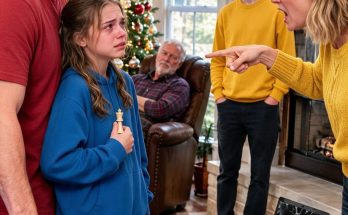
My eleven-year-old daughter, Sage, was standing beside her chair.
Her hands were empty.
A moment earlier, she had been holding her laptop, explaining a chess position to her cousin.
Now the computer was lying in pieces on the hearth.
The screen had bent backward.
The casing had split near one corner.
Several black keys were scattered across the floor.
I recognized one of them near the edge of the rug.
It had come from a laptop I had purchased only three months earlier.
Three thousand four hundred dollars.
I knew that number because I had spent months working extra shifts to afford it.
My name is Nolan Greer.
I live in Houston, Texas, with my daughter, and for twelve years I have worked as an air traffic controller at Hobby Airport.
People sometimes ask whether that kind of work makes me nervous.
It does.
But I have learned to control what I do with that feeling.
When several things demand attention at once, I cannot afford to react to the loudest one.
I have to look at what actually happened.
That habit followed me home.
It followed me into family dinners.
And on Christmas Day, it followed me into my father's living room.
I wish I could say I handled what happened perfectly.
I didn't.
I stayed controlled, but that was not the same as protecting my daughter from every cruel word she heard.
I understood the difference later.
At the time, I was staring at a broken computer and trying to understand why a thirteen-year-old boy had thrown it across the room.
The boy was my nephew, Tai.
He was my sister Tessa's son.
Sage had been showing him a chess puzzle.
That was all.
No argument had started.
Nobody had been fighting over the computer.
She had been sitting near the fireplace with the laptop open, explaining something she had learned during chess practice.
I had seen her do it many times.
When Sage discovered an interesting position, she wanted to share it.
She could spend an entire afternoon thinking about why one move worked and another failed.
Most children her age would have moved on to something else.
Sage would still be studying the board.
Sometimes she explained a position to me while I was preparing dinner.
Sometimes she turned the screen toward me and asked whether I could find the winning move.
Usually, I couldn't.
She never made me feel foolish about it.
She simply showed me what I had missed.
That afternoon, she had been explaining how a rook could restrict the other king's movement.
She tilted the laptop so Tai could see the board.
He looked at it.
Then he glanced toward his own tablet.
His iPad was older than Sage's computer.
I noticed that comparison only because of what happened afterward.
Tai reached for the laptop.
He took hold of it with both hands.
Then he threw it toward the fireplace.
There was no time for Sage to catch it.
The computer struck the brick before falling onto the tiled hearth.
For a few seconds, nobody said anything.
I looked at Tai.
He was standing beside the fireplace.
He did not seem frightened by what he had done.
He did not hurry to pick anything up.
He did not apologize.
Sage remained beside her chair.
I watched her look at the damaged screen.
Then her hand disappeared into the front pocket of her hoodie.
I knew exactly what she was holding.
A small ivory chess queen.
It had belonged to her grandfather, who had taught her to play when she was six.
Before he died, he gave her that piece from his favorite chess set.
She had kept it ever since.
It was not something she displayed on a shelf.
She carried it with her.
When she felt nervous, she slipped her fingers around it inside her pocket.
Sometimes she did that before chess matches.
Sometimes she did it when something upset her.
I had never asked her to stop.
That little queen meant more to her than most of the trophies she had earned.
Seeing her reach for it beside the broken laptop hurt more than I expected.
She was trying to steady herself.
And the adults in that room were about to make things worse.
My sister got up from her chair.
For one brief moment, I believed she was going to correct her son.
I thought she would tell Tai to explain himself.
Maybe she would make him acknowledge what he had destroyed.
I was wrong.
Tessa looked directly at me.
"Nolan, you need to make Sage say she's sorry."
I stared at her.
I honestly thought I had misunderstood.
"Sorry for what?"
Tessa gestured toward Sage.
"For making Tai feel bad."
I looked at the pieces of the laptop again.
Then I looked at my nephew.
"Tai just threw her computer into the fireplace."
Tessa did not deny it.
That was the strange part.
She had seen enough to know what happened.
She simply believed the explanation should begin with my daughter's behavior.
"She was showing off," Tessa said.
I felt my jaw tighten.
"She was explaining a chess puzzle."
"She knows he doesn't have a computer like that."
There it was.
The comparison.
The laptop Sage used for schoolwork and chess had somehow become an insult to another child.
Tessa continued talking about Tai's feelings.
She said Sage had made him uncomfortable.
She acted as though a child's embarrassment explained the destruction of somebody else's property.
I waited for her to hear herself.
She didn't.
I looked at Sage.
She was still holding the ivory queen inside her pocket.
Her face had changed.
She no longer seemed focused on the broken laptop.
She was listening to her aunt explain why she deserved what had happened.
That was when my father became involved.
His name is Hugh.
He had been watching television during the gathering.
Until that moment, he had said nothing.
He lowered the volume and turned toward us.
I expected him to settle the matter.
He was the oldest person in the room.
It was his house.
He had watched his grandchildren grow up.
Surely he could see the difference between explaining a chess position and deliberately destroying a laptop.
Instead, he supported Tessa.
"Maybe she brought it on herself," he said.
I looked at him.
He continued in the same casual voice.
"She needs to understand that you can't keep irritating people."
I remember the television still being on.
I remember the keys on the tile.
I remember thinking that my father sounded as though we were discussing a minor disagreement between children.
Not a destroyed computer.
Not a little girl who had been blamed for somebody else's anger.
Just another family inconvenience he wanted settled quickly.
I glanced toward Craig, Tessa's husband.
He remained on the couch.
He had not moved to help.
He had not spoken to Tai.
He seemed determined to stay outside the argument.
I had seen that kind of silence before.
People could convince themselves they were keeping the peace when they were really allowing someone else to be hurt.
Tai still stood near the fireplace.
Nobody had demanded an explanation from him.
Nobody had asked whether he understood what the laptop cost.
Nobody had told him he was wrong.
Instead, all the attention had shifted toward Sage.
My daughter.
The child who had been trying to share something she loved.
I could feel myself getting angry.
Not because I could not afford another computer.
Three thousand four hundred dollars was a serious expense for me, but the price was only part of what made that moment painful.
Sage had watched me save for that laptop.
She knew I had worked overtime.
She understood that buying it had required planning.
She had never treated it carelessly.
I had wanted to give her something that would support the work she was already doing.
Now it was broken.
And my family was asking her to apologize.
I looked at Tessa.
Then at my father.
I understood something I had avoided admitting for years.
They were not confused about the facts.
They simply preferred the version of events that allowed Tai to avoid responsibility.
Arguing about it would not change what they had already decided.
I could have raised my voice.
I could have demanded that Tessa pay for the computer.
I could have reminded my father how much I had done for the family.
There were plenty of things I wanted to say.
But Sage was standing right there.
Every minute I spent fighting with them was another minute she had to remain in that room, listening.
I made my decision.
"All right. I understand."
Tessa looked at me.
I did not explain what I meant.
I went to the fireplace and carefully gathered the laptop.
The broken screen moved when I lifted it.
I noticed how badly the hinge had been damaged.
Several keys remained on the floor.
I collected what I could.
Then I placed the computer in a shopping bag.
The bag was not meant for something heavy and broken.
I held it carefully as I stood.
Sage looked up at me.
"Come on," I told her.
I guided her toward the front door.
Nobody stopped us.
Nobody offered to pay for the damage.
Nobody asked Sage whether she was all right.
That silence stayed with me.
I was used to being the quiet person in my family.
The one who did not argue.
The one who made arrangements.
The one who helped when something went wrong.
I had convinced myself that keeping family relationships peaceful was part of being responsible.
But I had never intended for my daughter to pay the price for that peace.
We left my father's house.
The Christmas gathering continued without us.
I carried the shopping bag to the car.
Sage sat down and placed it across her knees.
I could see the damaged laptop through the open top.
She held the bag carefully during the drive.
Neither of us spoke for a while.
Houston traffic moved around us.
I kept my eyes on the road.
My daughter stared at the computer.
I wanted to ask her what she was thinking.
I wanted to tell her that none of it had been her fault.
But I also knew she had heard every word in that living room.
A few comforting sentences would not erase what her aunt and grandfather had said.
So I drove.
After a while, Sage turned toward me.
"Dad?"
"Yeah, sweetheart?"
"I think the Escape key is still under Grandpa's couch."
I looked at her.
She was trying to smile.
For one second, I almost laughed.
Then I realized what she was doing.
She was trying to make me feel better.
Her laptop had been destroyed.
Her relatives had blamed her.
And she was worried about how upset I looked.
That made me feel ashamed.
Not of her.
Of myself.
I should have recognized earlier how often my family expected us to absorb their behavior without complaint.
I should have understood what that was teaching Sage.
Instead, I had kept telling myself that family was complicated.
That people sometimes said things they did not mean.
That maintaining relationships required patience.
I had used those explanations for years.
Sage had just been given a painful lesson about what happened when patience had no boundaries.
I kept driving.
The shopping bag shifted slightly when we turned.
Sage steadied it with both hands.
I glanced at her again.
She was eleven years old.
She loved chess.
She worked hard at school.
She had been proud of a computer she used to learn.
Nothing she had done justified what happened.
And for the first time that Christmas, I stopped thinking about how to make my relatives understand.
I started thinking about what my daughter needed from me.
We were going home.
That was the only decision that mattered at that moment.
Click here to continue reading: PART 2: After Bringing My Daughter Home, I Finally Admitted How Often My Family Had Expected Me to Pay for Their Problems
I Thought Christmas With My Family Would Be Safe Until My Nephew Destroyed Something My Daughter Had Worked So Hard to Earn
Part 1 of 12