PART 2 — THE MOMENT MY SON STOPPED CALLING THEM FAMILY
Eli slipped his hand out of mine.
It was such a small movement that nobody else noticed.
But I did.
For five years, whenever my sister Danielle opened her mouth at Thanksgiving, my son had reached for my hand.
This time, he let go.
He pushed back his chair, carefully placed his napkin beside his plate, and looked directly at my father.
“Grandpa, do you think I’m a mistake too?”
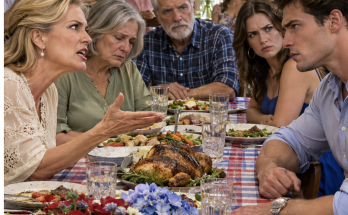
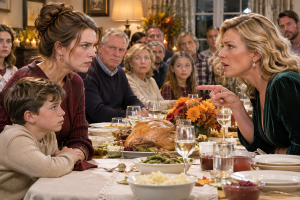
The entire dining room went silent.
My father, Richard Carver, had spent thirty years managing people at a manufacturing company. He could settle arguments between grown men without raising his voice.
But he couldn’t answer an eight-year-old boy.
“Of course not, buddy,” he finally said.
Eli nodded slowly.
“Then why do you let Aunt Danielle say it?”
Nobody moved.
My mother stared at her plate.
Danielle gave a sharp little laugh.
“Oh, for heaven’s sake. Jenna, you’ve made him so sensitive.”
I stood up.
“Danielle, don’t say another word to my son.”
She crossed her arms.
“I’m not the one making a scene.”
“No,” I said quietly. “You’ve been making one for five years. The rest of us have just been pretending not to hear it.”
I turned toward Eli.
“Get your coat, sweetheart. We’re leaving.”
He didn’t argue.
That frightened me more than anything.
Usually, leaving Grandma and Grandpa’s house meant negotiating for another ten minutes with Lucy.
But Eli simply walked toward the hallway.
Lucy started crying.
“Mom, why are they leaving?”
Danielle rolled her eyes.
“Because your aunt can’t take a joke.”
And then something happened that I would remember for the rest of my life.
Lucy stood up.
She looked at her mother with tears rolling down her cheeks.
“It’s not a joke if Eli cries afterward.”
Danielle’s expression changed.
“Lucy. Sit down.”
But Lucy shook her head.
“You told Aunt Jenna that Eli doesn’t have a real family. But he’s my family.”
My sister’s face went bright red.
“Enough.”
I walked into the hallway before the argument could become another spectacle my son had to witness.
Eli was already wearing his coat.
His little sneakers were untied.
I knelt to fix them, and he watched me silently.
Then he asked a question that nearly broke me.
“Mom, did Grandma Rose know I was a mistake?”
My hands stopped moving.
I looked up at him.
“Eli, listen to me very carefully. You are not a mistake. You never were. You are the best thing that has ever happened to me.”
His lower lip trembled.
“Then why does Aunt Danielle hate me?”
I wanted to tell him she didn’t.
I wanted to offer some comforting explanation about unhappy adults and cruel words.
But I had spent five years explaining away behavior that never should have been excused.
So I told him the truth.
“I don’t know why she says those things. But I know she is wrong. And I should have stopped bringing you here a long time ago.”
He wrapped both arms around my neck.
I held him until he was ready to move.
We were halfway to the front door when my mother appeared.
“Jenna, please. Don’t leave like this.”
I stood up.
“Like what, Mom?”
She glanced toward the dining room.
“Everyone’s upset. Can’t we talk about this after dinner?”
I stared at her.
“After dinner?”
She looked embarrassed.
“You know what I mean.”
“Yes,” I said. “I finally do.”
For years, my parents had treated Danielle’s cruelty like an unfortunate family habit.
Something inconvenient.
Something everyone else was expected to tolerate.
But the moment I refused to tolerate it, suddenly I was the problem.
My father came into the hallway carrying my casserole dish.
“Take this,” he said stiffly. “And let’s not make things worse.”
I looked at the dish.
Then at him.
“Dad, Eli just asked whether you think he’s a mistake.”
He shifted his weight.
“I told him no.”
“And when Danielle called him one, what did you say?”
He didn’t answer.
“Exactly.”
I took Eli’s hand and opened the front door.
Behind us, I heard Danielle call from the dining room.
“She’s always been jealous because I gave our parents a proper family.”
I stopped.
For one terrible second, I wanted to go back.
I wanted to tell everyone what I knew about Danielle’s marriage, her debts, and the carefully polished life she displayed at family gatherings.
But Eli squeezed my fingers.
“Mom, can we just go home?”
So we did.
We drove through the cold Virginia evening without speaking for almost fifteen minutes.
Then Eli asked whether we could stop for pancakes.
“On Thanksgiving?” I said.
He gave me the smallest smile.
“Pancakes don’t say mean things.”
We found a diner with yellow booths and Christmas decorations already hanging in the windows.
Eli ordered chocolate-chip pancakes.
I ordered coffee I barely touched.
And for the first time all day, my son laughed.
That should have been the end of it.
I should have taken him home, turned off my phone, and let the rest of my family deal with the consequences of their own behavior.
But at 8:43 that evening, my phone started ringing.
It was my mother.
I let it go to voicemail.
Then my father called.
Then Danielle.
By nine o’clock, I had eleven missed calls and a family group chat filled with messages about how I’d ruined Thanksgiving.
I was reading them when one message appeared from a number I barely recognized.
It belonged to my cousin Rebecca, who had been sitting near the end of the dinner table.
Her message contained six words.
“Jenna, there’s something you need to see.”
Underneath was a video.
I pressed play.
At first, it showed the Thanksgiving table, the serving dishes, and my sister repeating those awful words about Eli.
Then the camera shifted.
And I saw something I had completely missed.
While everyone was watching me, my mother had reached across the table and grabbed Danielle’s wrist.
She was whispering something.
Rebecca’s phone had been close enough to capture it.
I turned up the volume.
My mother’s voice was low, but unmistakable.
“Danielle, stop. If Jenna finds out why you’ve really been doing this, she’ll never forgive us.”
I watched that moment three times.
Then a fourth.
Because suddenly I understood something terrifying.
My sister’s cruelty might not have been the entire story.
And whatever my mother was hiding, she had known about it long before that Thanksgiving dinner.
Before I could call Rebecca, another message appeared.
This one was from my father.
“Jenna, don’t speak to Rebecca until we’ve had a chance to explain.”
I stared at the screen.
How did he know Rebecca had contacted me?
Then came a second message.
“There’s something about Grandma Rose’s estate you were never told.”
And for the first time that night, I realized my family wasn’t calling because I’d walked out.
They were calling because someone had finally threatened to tell me the truth.
PART 3 — THE SECRET GRANDMA TOOK TO HER GRAVE
I stared at my father’s message until the words began to blur.
“There’s something about Grandma Rose’s estate you were never told.”
For almost three years, I had believed my grandmother’s affairs were settled.
She had died peacefully at eighty-two, leaving behind a modest house, some savings, and a collection of jewelry that my mother said had been divided according to her wishes.
I hadn’t questioned any of it.
I was grieving.
And Grandma Rose had always told me that money was the least important thing a family could leave behind.
But now, sitting on my couch with Eli asleep in the next room, I wondered whether those words had meant something different to her.
My phone rang again.
Rebecca.
I answered immediately.
“Tell me what you know.”
She didn’t waste time.
“Jenna, are you alone?”
“Yes.”
“Good. Because I don’t want Eli hearing this.”
My stomach tightened.
“Rebecca, you’re scaring me.”
She sighed.
“I didn’t send you that video just because of what Danielle said.”
“Then why?”
“Because I heard your mother talking to Danielle before dinner.”
I sat up straighter.
“What did she say?”
Rebecca hesitated.
“She told Danielle to stop bringing up Eli’s father because someone might start asking questions about Grandma Rose’s will.”
For several seconds, I couldn’t speak.
“What does Eli’s father have to do with Grandma’s will?”
“I don’t know everything,” Rebecca admitted. “But I know your grandmother changed her estate documents about six months before she died.”
I gripped my phone.
“Changed them how?”
“She created a trust.”
“For whom?”
Rebecca’s voice dropped.
“For Eli.”
The room seemed to tilt.
I looked toward the hallway where my son’s bedroom door stood slightly open.
“That’s impossible,” I whispered.
“Why?”
“Because nobody ever told me.”
“That,” Rebecca said, “is exactly what I’m trying to explain.”
I stood up and began pacing.
“How do you know this?”
“Grandma asked me to drive her to an attorney’s office after she stopped driving. She didn’t tell me the details that day. But afterward, she said she’d made sure Eli would have something that nobody could take away from him.”
My eyes filled.
That sounded exactly like Grandma Rose.
Even when everyone else treated my son as an inconvenience, she had treated him like a blessing.
But a terrible question followed.
“If Grandma left Eli something, where is it?”
Rebecca went quiet.
Then she said, “I think that’s what your parents are afraid you’ll ask.”
I ended the call twenty minutes later with more questions than answers.
The next morning, I found an old photograph of Grandma Rose holding Eli on his fourth birthday.
She was sitting in her garden, smiling as he showed her a plastic dinosaur.
On the back, in her familiar handwriting, she’d written:
For my favorite little explorer. Never let anyone tell you that you don’t belong.
I sat on the kitchen floor and cried.
Not because of the money.
Because even after her death, my grandmother seemed to be the only person in that family who had planned to protect my son.
At 9:17 a.m., someone knocked on my apartment door.
I looked through the peephole.
My father.
He stood alone, wearing the same brown jacket he’d worn to Thanksgiving dinner.
I opened the door but kept the security chain fastened.
“Where’s Mom?”
“At home.”
“Where’s Danielle?”
He looked irritated.
“Can we please not start with your sister?”
“Then why are you here?”
He glanced toward the apartment hallway.
“Jenna, this isn’t something we should discuss through a door.”
I considered refusing.
But I wanted answers.
I removed the chain.
He stepped inside and immediately noticed the photograph on my kitchen table.
His expression changed.
“You’ve been talking to Rebecca.”
“Yes.”
He rubbed his forehead.
“She’s making things sound worse than they are.”
“Then tell me what they are.”
He sat down without being invited.
For a moment, he looked much older than he had the day before.
“Your grandmother established a trust for Eli,” he finally admitted.
My heart hammered.
“How much?”
He swallowed.
“Approximately one hundred and eighty thousand dollars when it was created.”
I stared at him.
That was more money than I had ever seen in one place.
Enough to cover years of college tuition.
Enough to give Eli opportunities I had spent countless nights worrying I couldn’t afford.
“Why wasn’t I told?”
Dad looked away.
“Your grandmother made your mother responsible for administering it.”
I folded my arms.
“And?”
“And there were disagreements about how the money should be handled.”
“What disagreements?”
He didn’t answer.
I leaned forward.
“Dad, where is my son’s money?”
His face tightened.
“Jenna, you need to understand that Danielle and Michael went through a very difficult financial period.”
I felt cold.
“Don’t.”
“Her husband’s business was struggling. They were facing foreclosure.”
“Dad.”
“Your mother thought she could help temporarily.”
I stepped backward.
“No.”
He looked at me helplessly.
“Everyone believed the money would be replaced before Eli was old enough to need it.”
For a moment, all I could hear was the refrigerator humming.
Then I asked the question that would change everything.
“How much did they take?”
He lowered his eyes.
“Most of it.”
I pressed one hand against the kitchen counter.
My mother.
The woman who had watched Danielle humiliate my child year after year.
The woman who had asked me to keep the peace.
She had been entrusted with money meant for my son.
And she’d apparently used it to rescue the daughter who called him a mistake.
“Get out,” I whispered.
“Jenna, please—”
“Get out of my apartment.”
He stood.
“You don’t understand the whole situation.”
I laughed.
It was an ugly, disbelieving sound.
“Then explain it. Explain how you could sit at Thanksgiving dinner and let Danielle call Eli a child your family feeds when she may have been living on money Grandma left him.”
Dad flinched.
“That isn’t fair.”
“Fair?”
My voice rose.
“Do you have any idea how many extra hours I worked last year so Eli could join his school’s science program? Do you know how many times I told him we couldn’t afford something because I was trying to keep our bills paid?”
Dad stared at the floor.
“And all that time,” I continued, “my own family was hiding money that belonged to him?”
He finally looked up.
“Your mother intended to fix it.”
“When?”
He had no answer.
I opened the front door.
“Leave.”
He walked into the hallway, then turned.
“Jenna, please don’t involve lawyers. We can settle this privately.”
I looked at him for a long moment.
“That’s what you’ve been doing for five years, Dad. Settling everything privately. Protecting Danielle privately. Letting my son suffer privately.”
I shut the door.
Then I locked it.
For the next hour, I sat at my kitchen table trying to process what I’d heard.
Eventually, I opened my laptop.
I searched for the name of the attorney who had handled Grandma Rose’s estate.
I found his office number on an old letter tucked inside a folder of family documents.
His name was Samuel Whitaker.
I called.
When his receptionist answered, I explained who I was.
There was a pause.
Then she said something unexpected.
“Ms. Carver, Mr. Whitaker has been hoping you would contact him.”
My breath caught.
“Why?”
“I’ll let him explain.”
A minute later, an older man’s voice came through the phone.
“Jenna? This is Samuel Whitaker.”
“Yes.”
He exhaled slowly.
“I’m sorry it’s taken this long.”
I closed my eyes.
“Do you know what happened to Eli’s trust?”
“I have concerns about how it has been administered,” he said carefully. “And there are documents you need to review.”
“Can you tell me whether my mother took the money?”
“I’d rather go through the records with you before drawing conclusions.”
I appreciated his caution.
But my patience was almost gone.
“Mr. Whitaker, my family has lied to me for years.”
His voice softened.
“Then I think it’s time you heard what your grandmother wanted.”
We arranged to meet that afternoon.
Before hanging up, he asked one more question.
“Jenna, did your father tell you why Rose created the trust?”
“For Eli’s future, I assume.”
There was a long silence.
“That was part of it,” he said.
“What was the other part?”
He hesitated.
“Your grandmother believed someone in your family was deliberately trying to make you and your son feel unwelcome.”
My throat tightened.
“She knew about Danielle?”
“She knew more than you realize.”
Then he added words I wasn’t prepared to hear.
“Rose left a sealed letter for you. She instructed me to give it to you if the family ever began fighting over Eli’s place in it.”
I stared at the phone.
“What does the letter say?”
“I haven’t opened it.”
“Why not?”
“Because she addressed it to you alone.”
I looked again at the photograph of Grandma Rose.
For years, I’d believed her death had taken away the only person who truly understood what Eli and I were going through.
Now I wasn’t so sure.
At 2:30 that afternoon, I walked into Samuel Whitaker’s office.
He placed a thick folder on the desk.
Then he handed me a cream-colored envelope.
Across the front, written in my grandmother’s unmistakable handwriting, were seven words:
Jenna, when they finally show you who they are.
My hands trembled as I opened it.
Inside were three handwritten pages.
I began reading.
And halfway down the first page, I discovered that Grandma Rose had known about a secret involving Danielle long before Eli was born.
A secret my sister had spent years trying to bury.
And the trust fund wasn’t the only reason she wanted my son treated like he didn’t belong.
PART 4 — GRANDMA’S LETTER EXPOSED THE LIE MY SISTER HAD HIDDEN FOR YEARS
I sat across from Samuel Whitaker with my grandmother’s letter trembling between my fingers.
The first few sentences were exactly what I expected from Grandma Rose.
My dearest Jenna,
If you’re reading this, it means the people who should have protected you have finally forced you to see the truth.
I wish I could be sitting beside you when you discover it.
But since I cannot, I need you to be brave enough to do what I should have done years ago.
I swallowed hard.
Samuel remained silent.
I continued reading.
Your sister has spent most of her life convincing people that she is better than you.
I watched it happen when you were children.
I watched your parents excuse her behavior because she was older, louder, and more difficult to confront.
And when Eli was born, I watched her turn that same cruelty toward an innocent little boy.
Tears blurred the handwriting.
I wiped my face and kept reading.
But there is something you must know.
Danielle has been lying about the life she built.
And the reason she resents you is not what she has allowed you to believe.
I stopped.
“What does that mean?” I whispered.
Samuel leaned forward.
“Keep reading, Jenna.”
The next paragraph made my stomach tighten.
Three years before Eli was born, Danielle came to me asking for money.
She said Michael had made a terrible business decision.
She said they would lose their house unless I helped.
I agreed to meet with them, but I asked to see their financial records first.
What I discovered was not a struggling business.
It was a pattern of dishonesty.
My eyes moved faster.
Michael had accumulated debts Danielle knew nothing about.
But Danielle had a secret of her own.
She had been taking money from an account your grandfather created for both of you when you were children.
I looked up.
“What account?”
Samuel opened the folder in front of him.
“Your grandfather established an education and family assistance fund years before he passed away.”
I shook my head.
“Nobody ever told me.”
“I understand.”
“Was I supposed to receive money from it?”
Samuel nodded.
“Both you and Danielle were named beneficiaries under the original arrangement. But the records suggest your sister received distributions far beyond her intended share.”
My mouth went dry.
“How much?”
“We’re still reconstructing the transactions.”
I looked back at Grandma’s letter.
When I confronted Danielle, she cried.
She promised to replace everything.
Then she told me something I will never forget.
She said you didn’t deserve the same opportunities because you had always been the favorite.
I stared at those words.
The favorite?
Me?
I thought about all the birthday parties Danielle had insisted on controlling.
All the Christmas mornings when she complained if my gifts seemed better than hers.
All the times our parents told me to apologize simply because she refused to stop arguing.
I had never felt like the favorite.
But apparently, Danielle had spent her entire life believing I was stealing something from her.
I made a mistake, Jenna.
I believed I could protect both of you by keeping her secret while requiring her to repay the money.
Instead, she learned that I was willing to protect her from consequences.
My hands tightened around the paper.
When Eli was born, I realized I could not leave his future dependent on the same people who had failed to protect yours.
That is why I created his trust.
It was my way of giving him something no one could call charity.
I pressed the letter against my chest.
Grandma had understood.
She knew exactly how Danielle made us feel.
And she had wanted Eli to grow up knowing he belonged.
But the final paragraph was the one that changed everything.
There is one last thing you should understand.
Your sister believes that if she can convince everyone your son is less deserving, nobody will question why she has received so much more than you.
Do not let her turn Eli into the explanation for her choices.
He has nothing to prove.
Neither do you.
Love always,
Grandma Rose.
I lowered the letter.
For a long time, neither Samuel nor I spoke.
Finally, I asked, “Did my grandmother know my mother might use the trust money for Danielle?”
Samuel shook his head.
“I don’t believe she anticipated that. Your mother was appointed trustee because Rose believed she would respect the legal responsibilities of the position.”
“Then why didn’t anyone check?”
“That’s one of the questions we need to investigate.”
He opened another document.
“Your grandmother’s instructions required the trust to be maintained for Eli’s benefit. Your mother was supposed to preserve the assets, provide proper accounting, and make distributions only as permitted by the trust.”
I stared at the papers.
“And she gave the money to Danielle?”
“Your father has apparently acknowledged that money was used to assist Danielle’s family. We need the account statements to determine precisely what happened.”
I nodded slowly.
“Can I get those?”
“As Eli’s parent, you can seek an accounting on his behalf. Given the potential conflict, I would recommend independent legal representation.”
I looked down at Grandma’s letter.
For years, I’d believed protecting Eli meant finding ways to keep him away from my sister’s worst remarks.
Now I understood that I had to do more.
I needed to make sure his future wasn’t being taken from him while the adults around him pretended everything was fine.
“I want every document,” I said.
Samuel nodded.
“Then we should begin with a formal written request.”
We spent another hour reviewing what he had.
There were copies of the trust documents.
A record of the original funding.
Several incomplete annual summaries.
And one bank statement showing a large transfer made eighteen months after Grandma’s death.
The amount was $72,000.
The destination account belonged to a company called D&M Property Holdings.
I stared at the name.
“D&M?”
Samuel nodded.
“Do you recognize it?”
I did.
Danielle and Michael.
They had created that company when they purchased a rental property outside Richmond.
I remembered Danielle bragging about it at Christmas.
She had worn a new diamond bracelet and told everyone that smart people made their money work for them.
At the time, I was saving twenty dollars a week for Eli’s summer camp.
I pointed at the statement.
“That’s my sister’s company.”
Samuel’s face grew serious.
“Are you certain?”
“Yes.”
He wrote something on a legal pad.
“That’s important information.”
I looked at the date again.
The transfer had happened just weeks before Danielle began making particularly cruel comments about Eli at family gatherings.
I had always thought her behavior was simply getting worse.
Now I wondered whether guilt had something to do with it.
At 4:15 p.m., I left Samuel’s office carrying copies of the documents and Grandma’s original letter.
I sat in my car and called Rebecca.
She answered immediately.
“Did you find out?”
“Yes.”
“How bad?”
I stared through the windshield.
“Worse than I imagined.”
I explained what Samuel had shown me.
Rebecca listened without interrupting.
When I mentioned D&M Property Holdings, she made a strange sound.
“What?” I asked.
“Jenna, Danielle told everyone Michael’s parents helped them buy that property.”
“Apparently not.”
Rebecca was quiet for a moment.
Then she said, “There’s something else.”
My heart sank.
“What now?”
“After you left Thanksgiving yesterday, Danielle started yelling at your mother.”
“About what?”
“I couldn’t hear everything. But I heard her say that your mother had promised the paperwork would never become a problem.”
I closed my eyes.
“Of course she did.”
“And Jenna?”
“Yes?”
“Danielle said something about documents that had been signed after Grandma died.”
I went still.
“What documents?”
“I don’t know. But your mother looked terrified.”
I thanked her and ended the call.
Then I drove straight home.
Eli was with my neighbor, Mrs. Patterson, who had agreed to watch him while I met with the attorney.
When I picked him up, he was sitting at her kitchen table building a cardboard rocket.
He looked up and smiled.
“Mom, look. It has three engines.”
I smiled back.
“That’s amazing, sweetheart.”
He held up the rocket.
“Grandma Rose would have liked it.”
I knelt beside him.
“She would have loved it.”
He studied my face.
“Have you been crying?”
“A little.”
“Because of Aunt Danielle?”
I hesitated.
“Because I found something Grandma Rose left for us.”
His eyes widened.
“Like treasure?”
I thought about the letter in my bag.
“Yes,” I whispered. “Something like that.”
That evening, after Eli fell asleep, I spread the documents across my kitchen table.
I read every page.
Then I noticed something strange.
One of the annual trust summaries contained my signature.
At least, it was supposed to be my signature.
The document stated that I had reviewed and acknowledged the trust’s financial activity.
It was dated eleven months earlier.
I remembered that month clearly.
I had been working overtime, taking Eli to medical appointments for a stubborn ear infection, and worrying about whether I could afford new tires.
Nobody had asked me to review a trust.
Nobody had even told me it existed.
I leaned closer.
The signature looked almost perfect.
But there was one detail whoever had written it had gotten wrong.
I had stopped using my middle initial on legal documents after my divorce.
The signature on that page included it.
I took a photograph and sent it to Samuel.
Then I wrote:
I did not sign this.
He called less than ten minutes later.
“Jenna, don’t contact your mother about this yet.”
“Why?”
“Because we need to preserve the original document and establish who prepared it.”
I looked at the signature again.
“Do you think someone forged my name?”
“I think we have enough reason to ask serious questions.”
I swallowed.
“Could this involve criminal charges?”
“Potentially. But we need evidence before reaching that conclusion.”
We agreed to speak again the following morning.
I thought I might finally get some sleep.
Then, at 10:38 p.m., my doorbell rang.
I checked the peephole.
Danielle.
She stood outside holding a large white envelope.
Her face looked pale.
I didn’t open the door.
“What do you want?”
She leaned toward the peephole.
“Jenna, I know you went to Whitaker’s office.”
I said nothing.
“Mom told me.”
Of course she had.
Danielle lowered her voice.
“You need to stop digging.”
I felt anger rise through my chest.
“Go home, Danielle.”
“I’m serious. You have no idea what you’re getting into.”
I rested one hand against the door.
“Did you take Eli’s money?”
She went silent.
“Answer me.”
Her voice changed.
“Mom said it was a loan.”
I closed my eyes.
There it was.
Not a denial.
Not an explanation.
Just another excuse.
“Did you know it belonged to my son?”
She hesitated.
“Jenna, Michael and I were going to lose everything.”
“And you thought Eli should lose his future instead?”
“That’s not fair!”
I almost laughed.
That phrase seemed to be the family motto.
Danielle pressed the envelope against the door.
“There’s something you need to see before you destroy everyone.”
I didn’t move.
“Leave it on the floor.”
She hesitated.
Then I heard the envelope slide beneath the door.
Danielle walked away.
I waited until her car disappeared before unlocking it.
Inside the envelope were copies of several documents.
A handwritten note from Danielle was clipped to the front.
You think Mom did this because she loves me more.
You’re wrong.
She did it because Dad told her to.
My pulse quickened.
Underneath was a photocopy of an agreement dated two months before Grandma Rose died.
The document appeared to authorize a change in how Eli’s trust would be managed.
At the bottom were three signatures.
My mother’s.
My father’s.
And Grandma Rose’s.
I stared at the third signature.
Then I looked at the date.
Because on that exact day, Grandma Rose had been in the hospital after a serious stroke.
She had been unable to hold a pen.
I knew because I had been sitting beside her bed.
And suddenly, the question was no longer whether my sister had stolen money from my son.
It was whether my parents had used my dying grandmother’s name to make it possible.
Then I turned to the final page.
Someone had written a short sentence beneath the signatures.
Jenna Carver was informed of these changes and gave her verbal consent.
And beside that sentence was the name of the person who supposedly witnessed my consent.
Rebecca.
My cousin.
The same woman who had sent me the Thanksgiving video.
The same woman who had encouraged me to uncover the truth.
I picked up my phone.
Before I could call her, a message arrived from Rebecca herself.
Jenna, whatever Danielle just gave you, please don’t believe everything in it.
I stared at the screen.
Then another message appeared.
There’s something I haven’t told you about the day Grandma Rose died.
END OF PART 4
PART 5 — THE WITNESS WHO KNEW WHAT REALLY HAPPENED
I stared at Rebecca’s message, feeling the blood drain from my face.
There’s something I haven’t told you about the day Grandma Rose died.
For nearly three years, I had believed I knew everything about that terrible afternoon.
Grandma Rose had suffered a second stroke.
The hospital had called my parents.
By the time I arrived, she was already gone.
That was the story everyone told me.
Now I wasn’t sure I believed any of it.
I called Rebecca immediately.
She answered on the first ring.
“Jenna, please don’t hang up.”
“Then tell me the truth.”
“I will.”
“Did you sign that document?”
There was a long silence.
“Yes.”
My stomach dropped.
“You told me you were helping me.”
“I am trying to help you.”
“Rebecca, your name is on a document claiming I agreed to changes in my son’s trust. Changes I never even knew existed.”
“I know.”
“Then explain yourself.”
Her voice cracked.
“Because your father threatened to destroy my career if I didn’t.”
I stopped pacing.
“What?”
“Three years ago, I was working as an administrative assistant at his company. I was twenty-seven, barely paying my rent, and trying to finish my accounting certification.”
I remembered.
Rebecca had worked for Dad briefly before taking a position at a small accounting firm.
“Your father called me into his office the morning Grandma Rose died,” she continued.
“He had a stack of documents on his desk. He said they were routine family estate papers and needed a witness.”
“Did you read them?”
“Not carefully enough.”
I closed my eyes.
“Rebecca.”
“I know. I know what you’re thinking.”
“No, you don’t. Because I’m trying to understand how someone could sign away my son’s future and then sit across from me at Thanksgiving dinner.”
She began crying.
“Jenna, I didn’t know the money was Eli’s until later.”
I pressed my fingers against my forehead.
“Then why didn’t you tell me when you found out?”
“Because I was afraid.”
“Of my father?”
“Yes.”
I almost laughed.
My father.
The same man who had spent decades lecturing me about responsibility.
The same man who had insisted that family loyalty mattered more than money.
Apparently, he had been using both as weapons.
“What did he threaten you with?”
Rebecca took a shaky breath.
“He said he’d report me for falsifying company expense records.”
“Did you?”
“No. But he had access to everything, Jenna. He said he could make it look like I had.”
I sat down.
“Do you have proof?”
“Yes.”
My heart started pounding.
“What kind of proof?”
“Emails. Messages. And something else.”
“What else?”
She hesitated.
“A recording.”
I stood up again.
“Of what?”
“Your father telling me exactly what he wanted me to say if anyone questioned those signatures.”
For several seconds, I couldn’t speak.
Then I asked, “Why are you telling me now?”
Rebecca’s voice became steadier.
“Because I watched Eli’s face yesterday.”
I looked toward his bedroom.
“He was sitting at that table like he’d done something wrong just by existing,” she whispered. “And I realized I was helping the people who made him feel that way.”
My throat tightened.
“Rebecca, I need everything you have.”
“I know.”
“Not tomorrow. Not next week. Now.”
“I’ll send copies tonight.”
I ended the call and sat motionless.
Then I looked again at the agreement Danielle had slipped beneath my door.
Three signatures.
One supposedly belonging to a woman who could barely move her right hand.
One belonging to a witness who had just admitted she had been pressured.
And one belonging to my father.
I suddenly remembered something Grandma Rose had told me shortly before her first stroke.
We had been sitting on her back porch while Eli chased fireflies.
She had looked toward the house and said, “Jenna, your father has always confused being in charge with being right.”
At the time, I thought she was talking about his stubbornness.
Now those words felt like a warning.
The following morning, I called Samuel Whitaker before taking Eli to school.
I explained everything.
He listened carefully.
Then he asked, “Do you still have the envelope Danielle delivered?”
“Yes.”
“Keep it. Don’t write on the documents or alter anything.”
“Rebecca says she has a recording.”
“That could be important, but we’ll need to establish its authenticity and the circumstances in which it was made.”
I nodded, even though he couldn’t see me.
“What about Grandma’s signature?”
“We should compare it with verified examples and obtain her medical records through the appropriate legal process.”
I looked at the agreement again.
“Samuel, I was with Grandma in the hospital on that date. She couldn’t even hold her water cup without assistance.”
His voice grew serious.
“Then we need to investigate whether this document was validly executed.”
I swallowed.
“And if it wasn’t?”
“Then someone may have attempted to use an invalid or fraudulent document to justify transactions involving Eli’s trust.”
I closed my eyes.
“Could my parents go to prison?”
“That’s not something I can predict. Our immediate priority is to protect Eli’s interests and preserve the evidence.”
For the first time, I appreciated that Samuel refused to make promises.
He didn’t tell me everything would be fine.
He told me what needed to be done.
And after years of listening to my family explain away wrongdoing, that felt like something I could trust.
At breakfast, Eli was unusually quiet.
He pushed cereal around his bowl before looking at me.
“Mom?”
“Yes, sweetheart?”
“Are we going to Grandma’s house for Christmas?”
The question caught me off guard.
“I don’t think so.”
He nodded.
Then he asked, “Will Lucy still be my cousin?”
I sat beside him.
“Of course she will.”
“Even if Aunt Danielle doesn’t want us there?”
I wrapped an arm around his shoulders.
“Being cousins isn’t something your aunt gets to decide.”
He thought about that.
“Can Lucy come to our apartment instead?”
“I hope so.”
He smiled faintly.
“We could make the cardboard rocket bigger.”
I kissed the top of his head.
“That sounds like a wonderful idea.”
But after I dropped him at school, my phone began ringing.
Danielle.
I ignored it.
She called again.
Then she sent a message.
Mom says you’re trying to get Dad arrested.
I stared at the screen.
A second message appeared.
Do you understand what this will do to our family?
I typed a response.
Do you understand what taking Eli’s money has already done to him?
Her answer came almost immediately.
It wasn’t supposed to happen this way.
I stared at those words.
Then I wrote:
What wasn’t?
She didn’t answer.
Twenty minutes later, another message arrived.
Meet me alone. There are things Dad hasn’t told either of us.
I almost deleted it.
But then I remembered the envelope.
Danielle had brought me documents that potentially implicated our parents.
Why would she do that if she was completely loyal to them?
I called Samuel.
He advised me not to meet privately and suggested that Danielle could provide information through counsel or in a documented setting.
So I sent her one final message.
If you have evidence, give it to my attorney. I’m not meeting you alone.
She responded with a single sentence.
Then ask Dad what happened to the other $60,000.
I froze.
The other sixty thousand?
Grandma’s trust had started with approximately $180,000.
Samuel had shown me the $72,000 transfer to Danielle’s company.
My father had admitted that most of the fund was gone.
But where had the rest gone?
I drove straight to Samuel’s office.
He had already received the email I forwarded.
When I arrived, he was studying a series of account statements.
“Jenna,” he said, “I was about to call you.”
My pulse quickened.
“Did you find something?”
He nodded.
“There’s a second transfer we need to investigate.”
“How much?”
“Sixty thousand dollars.”
My mouth went dry.
“Where did it go?”
He turned his computer monitor toward me.
The receiving account was listed under a business name I didn’t recognize.
Carver Consulting Services.
I frowned.
“My father retired from manufacturing two years ago.”
“Does he own a consulting company?”
“Not that I know of.”
Samuel pointed to the account information.
“Your father’s name appears in the business registration.”
I stared at the screen.
The transfer had been made just four months after Grandma Rose died.
“What was the money used for?”
“We don’t know yet.”
I thought about my father’s lifestyle.
His retirement.
The expensive fishing boat he’d purchased.
The trips he and my mother had taken.
And suddenly, I wondered how much of the comfortable life I’d watched them enjoy had been financed with money my grandmother intended for Eli.
Samuel continued.
“I also want you to understand something important. Those two transfers alone don’t establish the full current balance of the trust. We need complete statements, records of any investments, and documentation of expenses.”
I nodded.
“But they establish that I have serious reasons to be concerned.”
“Yes,” he said. “They do.”
We spent another hour preparing formal requests for records.
By the time I left, my hands were shaking with exhaustion.
I had expected to feel relieved after finding answers.
Instead, every answer seemed to uncover another betrayal.
At 5:12 that evening, Rebecca sent me three files.
Two contained emails from my father.
The third was an audio recording.
I put on headphones before listening.
At first, I heard papers rustling.
Then Rebecca’s younger voice.
“Mr. Carver, I don’t understand why Jenna’s name is on this.”
My father’s voice followed.
“Because she doesn’t need to know the details.”
“But this says she gave consent.”
“She would have if we’d explained it.”
Rebecca sounded uncomfortable.
“Then shouldn’t we ask her?”
There was a pause.
Then my father said something that made my skin crawl.
“Jenna has always been emotional about that boy. She’ll turn this into a family crisis.”
I gripped the edge of the table.
Rebecca spoke again.
“What if the attorney asks questions?”
My father answered without hesitation.
“Then you tell him what I’ve instructed you to tell him.”
Another pause.
“And if I refuse?”
His response was cold.
“Then perhaps your next employer should know about the accounting irregularities we found.”
The recording ended.
I sat staring at my laptop.
My father hadn’t just hidden things from me.
He had apparently pressured someone else to help maintain the deception.
I forwarded the file to Samuel.
Then I closed my computer.
For several minutes, I simply breathed.
I thought about every Thanksgiving dinner.
Every family photograph.
Every time my father had put his arm around Eli and called him his little buddy.
How could someone pretend to love a child while helping deprive him of something meant for his future?
At 7:30 p.m., my mother arrived.
I saw her through the peephole.
She looked exhausted.
Her hair was untidy, and she wasn’t wearing the pearl earrings she normally wore everywhere.
“Jenna,” she called softly. “Please open the door.”
I didn’t.
“What do you want?”
“I need to talk to you.”
“Then talk.”
She looked down the hallway.
“Not through a door.”
I folded my arms.
“You had five years to talk to me when Danielle was hurting my son.”
My mother began crying.
“I know.”
I hadn’t expected that.
She pressed a hand against her mouth.
“I know I failed you.”
I remained silent.
Then she said something that made me reach for the lock.
“Jenna, your father doesn’t know I’m here.”
I opened the door but stayed in the doorway.
My mother looked frightened.
Truly frightened.
“What happened?” I asked.
She stepped inside.
Then she whispered, “Richard found out Danielle gave you those documents.”
I waited.
“He’s furious. He says she’s trying to put all the blame on us.”
“Isn’t she involved?”
My mother nodded.
“Yes.”
“Then why are you here?”
She looked directly at me.
“Because I need to tell you something before your father finds a way to explain it away.”
My heart pounded.
“Tell me.”
She took a trembling breath.
“When your grandmother first created Eli’s trust, Richard wanted control of it.”
I stared at her.
“Why?”
“Because he already owed money.”
“To whom?”
My mother swallowed.
“To your grandmother.”
I felt my stomach drop.
“How much?”
She shook her head.
“More than you think.”
Then she reached into her handbag and pulled out a folded sheet of paper.
It was old and yellowed around the edges.
Across the top were the words:
Personal Loan Agreement.
Underneath was my father’s signature.
And beside it was an amount that made me grip the doorframe.
$240,000.
I looked at my mother.
“Dad borrowed almost a quarter of a million dollars from Grandma?”
She nodded.
“And he never paid her back.”
I stared at the paper.
“Why didn’t she tell me?”
My mother’s eyes filled again.
“Because he promised her something.”
“What?”
She started crying harder.
“He promised that if she kept quiet, he’d make sure you and Eli were taken care of.”
I felt sick.
“And instead he took Eli’s money?”
My mother covered her face.
“Yes.”
I stepped away from her.
For the first time, I understood that my father’s betrayal had begun long before Thanksgiving.
Long before Grandma died.
Possibly even before Eli was born.
But my mother wasn’t finished.
She lowered her hands and looked at me with an expression I had never seen before.
“Jenna, there’s something else.”
I said nothing.
“Your grandmother discovered what Richard was doing before her final stroke.”
My heart began racing.
“She knew?”
My mother nodded.
“And she was planning to confront him.”
I swallowed.
“When?”
My mother’s voice broke.
“The morning she was taken to the hospital.”
I stared at her.
“Mom, what are you saying?”
She looked toward Eli’s closed bedroom door.
Then she whispered five words that made everything go still.
“Your father was there first.”
Before I could ask what she meant, headlights swept across my living room window.
My mother’s face went white.
She looked outside.
“Oh, God,” she whispered.
“What?”
She grabbed my arm.
“Jenna, don’t let him inside.”
I looked toward the parking lot.
My father’s car had just pulled into the space beside mine.
And he wasn’t alone.
Danielle was sitting in the passenger seat.
PART 6 — MY FATHER CAME TO SILENCE US, BUT MY MOTHER HAD ONE LAST SECRET
My mother grabbed my arm so tightly that her fingernails pressed into my skin.
“Jenna, please. Don’t open that door.”
I stared at her.
“Mom, what did Dad do to Grandma?”
She shook her head.
“I don’t know everything.”
“Then tell me what you do know.”
Before she could answer, someone knocked.
Three sharp knocks.
Then my father’s voice came through the door.
“Jenna, I know your mother is in there.”
My mother closed her eyes.
For the first time in my thirty-four years, I saw something in her face that I had never associated with my father.
Fear.
Not embarrassment.
Not frustration.
Fear.
“Mom,” I whispered, “has he hurt you?”
She looked away.
That was answer enough to make my stomach turn.
Another knock.
“Open the door. We need to settle this.”
I pulled my phone from my pocket and checked that it was recording.
Then I spoke through the door.
“There’s nothing to settle tonight, Dad.”
“Don’t be ridiculous.”
“Go home.”
Danielle’s voice followed.
“Jenna, stop acting like we’re criminals!”
I nearly laughed.
After everything I’d discovered, that was the word she was worried about.
Criminals.
My mother stepped toward the door.
“Richard, leave us alone.”
Silence.
Then my father spoke again.
“Margaret, come outside.”
“No.”
His voice hardened.
“Don’t make this worse.”
I glanced toward Eli’s bedroom.
His door was still closed.
But I knew how easily he woke when adults raised their voices.
I wouldn’t let him become another audience for this family’s cruelty.
“Dad,” I said, “if you don’t leave, I’m calling the police.”
For several seconds, nobody spoke.
Then Danielle shouted, “You’d call the police on your own father?”
I looked at my mother.
She was trembling.
“Yes,” I answered.
And I meant it.
My father gave a bitter laugh.
“You have no idea what you’re doing, Jenna.”
“Then you can explain it to my attorney.”
Another silence.
Then I heard footsteps moving away.
A car door slammed.
A second door followed.
I watched through the window until their car disappeared.
Only then did my mother breathe normally again.
She sank onto the couch.
I sat across from her.
“Now,” I said quietly, “tell me about Grandma.”
My mother stared at her hands.
“Your grandmother called your father the morning she had her final stroke.”
“Why?”
“She’d received information about money missing from an account connected to her estate planning.”
My heart pounded.
“Eli’s trust?”
“Not exactly. She was investigating Richard’s old loan and some transactions she couldn’t explain.”
“Did she confront him?”
My mother nodded.
“She asked him to come to the house.”
I leaned forward.
“And?”
“He went.”
“What happened?”
“I wasn’t there.”
I waited.
She wiped her cheeks.
“Richard told me they argued. Rose accused him of taking money and hiding documents. He said she became agitated.”
My stomach tightened.
“And then?”
“He told me she collapsed.”
I couldn’t speak.
My grandmother had been eighty-two.
She’d already suffered a stroke.
Another one was medically possible.
But hearing that she’d collapsed during an argument with my father changed how I understood that morning.
“Did Dad call an ambulance?”
“Yes,” my mother said quickly. “The emergency services records will confirm that.”
“Then why did you tell me not to let him inside?”
She looked toward the door.
“Because I know what happens when Richard thinks he’s losing control.”
I stared at her.
“What does that mean?”
She twisted her wedding ring.
“After Rose died, he told me certain estate documents needed to be signed. He said the family couldn’t afford delays.”
“Did you sign them?”
“Yes.”
“Did you know they weren’t legitimate?”
“I knew something was wrong.”
The admission landed between us like a stone.
I waited for her to continue.
“He said Rose had agreed to everything before she became ill. He told me the paperwork was only catching up with her wishes.”
“And you believed him?”
My mother started crying.
“At first.”
I felt anger rise.
“At first?”
She nodded.
“When I saw money moving into Danielle’s business, I asked questions. Richard said he’d arranged temporary loans and everything would be repaid.”
“But you were the trustee.”
“I know.”
“You were responsible for protecting Eli’s money.”
“I know, Jenna.”
“Then why didn’t you stop him?”
She looked at me through her tears.
“Because I was afraid of what would happen if I challenged him.”
I stood up.
“Mom, I’ve spent five years watching you choose silence over my son’s dignity.”
She lowered her head.
“And now you’re telling me you stayed silent while his inheritance disappeared.”
“I am.”
I looked away.
Part of me wanted to comfort her.
She looked so small sitting on my couch.
But another part of me remembered Eli asking whether his great-grandmother had thought he was a mistake.
And that part refused to let her tears erase what she’d done.
“If you want to help,” I said, “tell the truth to my attorney. All of it.”
She nodded.
“I will.”
“Even if it means you face consequences?”
Her face crumpled.
“Yes.”
I studied her for a long moment.
Then she reached into her handbag again.
“I brought something else.”
She removed a small silver flash drive.
My heart began pounding.
“What is that?”
“Copies of financial records Richard kept on his home computer.”
I stared at it.
“Why do you have them?”
“Because six months ago, I finally realized he wasn’t going to replace the money.”
She held it toward me.
“I copied what I could access.”
I didn’t take it immediately.
“Mom, how were these obtained?”
“They were in a shared household folder. I had access to it.”
I looked at the drive.
There was no way to know what it contained without examining it.
And I wasn’t going to make another careless decision.
“I’m giving this to Samuel,” I said.
“Please do.”
“I’m not going to promise it protects you.”
“I understand.”
I took the drive.
Then my mother said something unexpected.
“Jenna, there’s an account under your name.”
I went still.
“What?”
“Richard opened it years ago.”
“I’ve never opened an account with him.”
“He told me you had authorized him to manage some of your savings.”
My chest tightened.
“I never did.”
“I know that now.”
I stared at her.
“Are you telling me Dad used my identity?”
“I think he may have.”
For several seconds, I couldn’t move.
The trust.
The documents.
The suspicious signatures.
And now an account bearing my name.
I felt as though the entire history of my family was being rewritten in front of me.
“Why are you telling me all this tonight?”
My mother looked toward the window.
“Because Danielle called me after she gave you those papers.”
I waited.
“She said Richard had told her he’d never taken a dollar for himself.”
“But he did.”
“Yes.”
“And she found out?”
My mother nodded.
“She confronted him. He blamed me.”
I sat down slowly.
“Of course he did.”
“Then he told Danielle that if you went to the police, everyone would go down together.”
I looked at her.
“And that frightened her?”
“It made her angry.”
I thought about my sister.
For five years, she’d treated Eli as someone beneath her.
Now the money she’d accepted might expose her family’s financial troubles.
But she had also discovered that our father had used her as part of his deception.
I didn’t know whether Danielle felt guilt, fear, or simply resentment.
I no longer wanted to guess.
I wanted evidence.
At 11:20 p.m., my mother left after agreeing to speak with Samuel the next morning.
I watched her drive away.
Then I checked on Eli.
He was sleeping beneath his blue dinosaur blanket, one hand resting on the cardboard rocket he’d made with Mrs. Patterson.
I sat beside him.
For years, I’d tried to give him a peaceful childhood by keeping family arguments away from him.
Now I understood that peace wasn’t the same as pretending nothing was wrong.
Sometimes protecting a child meant refusing to let the adults around him continue lying.
I kissed his forehead.
Then I walked back into the kitchen and sent Samuel a message explaining what my mother had brought me.
He replied early the following morning.
Please bring the drive and all original materials to our appointment. Do not alter or circulate the contents.
At 9:00 a.m., I arrived at his office.
My mother was already there.
So was another attorney, a woman named Patricia Hale.
Samuel introduced her as someone experienced in trust disputes and financial misconduct.
For almost two hours, they questioned my mother.
She described the documents she’d signed.
The money transferred into Danielle’s company.
The pressure my father had placed on her.
And the account bearing my name.
Patricia took careful notes.
Then she asked, “Mrs. Carver, why did your husband believe he could move trust funds without scrutiny?”
My mother hesitated.
“Because he controlled the paperwork.”
“What paperwork?”
“The statements. The correspondence. The records he gave me to sign.”
Patricia looked at Samuel.
Then she asked one more question.
“Did he ever ask you to sign a document for Jenna?”
My mother went pale.
“Yes.”
I felt the room go cold.
“What document?” Patricia asked.
My mother covered her mouth.
“A consent form.”
“Did Jenna sign it?”
“No.”
“Then who did?”
My mother began crying again.
“Richard told me he’d take care of it.”
I stared at her.
She wouldn’t meet my eyes.
Patricia waited patiently.
“Mrs. Carver, do you know whether he signed Jenna’s name himself?”
My mother whispered, “I saw him practicing it.”
Everything inside me went still.
My own father had apparently practiced my signature.
Not because he was signing a birthday card.
Not because he was filling out a harmless family form.
But because he wanted documents to appear as though I’d approved decisions I’d never been told about.
Samuel closed his folder.
“Jenna,” he said, “we need to take steps to protect you and Eli immediately.”
I nodded.
My voice sounded distant.
“What happens now?”
Patricia explained that we could pursue an accounting, seek appropriate court relief to protect the trust, and consider making a report to law enforcement based on the evidence.
She also recommended that I check for accounts opened in my name and take precautions against possible identity misuse.
For the first time, I felt that the problem was being treated with the seriousness it deserved.
Not as family drama.
Not as a misunderstanding.
As a matter involving real financial obligations and potentially fraudulent documents.
When the meeting ended, my mother approached me.
“Jenna, can you forgive me?”
I looked at her.
I remembered every Thanksgiving.
Every excuse.
Every time she’d pulled me into the kitchen instead of confronting Danielle.
“I don’t know,” I answered.
Her eyes filled.
“But I hope Eli can someday.”
I shook my head.
“You don’t get to ask him for that. He’s a child. He shouldn’t have to carry the weight of making adults feel better about what they’ve done.”
My mother lowered her head.
I picked up my bag.
“What you can do is tell the truth and help restore what belongs to him.”
She nodded.
I left without hugging her.
That afternoon, I received a call from Danielle.
I almost ignored it.
But something made me answer.
“What?”
Her voice sounded different.
No anger.
No sarcasm.
Just exhaustion.
“Jenna, Michael moved out.”
I stayed silent.
“He says I’m going to ruin his life if I cooperate with your attorney.”
“Are you going to?”
She hesitated.
“I don’t know.”
“Then why are you calling me?”
There was a long pause.
“Because I found something.”
My stomach tightened.
“What?”
“Records from D&M Property Holdings.”
“And?”
“The money from Eli’s trust didn’t stay in our company.”
I gripped the phone.
“Where did it go?”
“Michael transferred part of it to another business.”
“Whose business?”
She took a shaky breath.
“Dad’s.”
I closed my eyes.
Of course.
But Danielle wasn’t finished.
“And Jenna, there’s something worse.”
I leaned against the kitchen counter.
“What could possibly be worse?”
She whispered, “Dad made it look like you were receiving payments.”
For a moment, I couldn’t breathe.
“What?”
“He created records showing regular distributions to an account with your name on it.”
I thought about what Mom had told me.
The account I never opened.
The account my father allegedly controlled.
“Why would he do that?”
Danielle began crying.
“Because if anyone ever questioned the missing money, the paperwork would make it look like you knew about the trust.”
My chest tightened.
“And that I benefited from it.”
“Yes.”
I stared at the wall.
My father hadn’t merely hidden money from me.
He had apparently constructed a trail that could make me appear involved.
I forced myself to speak calmly.
“Danielle, send those records to Samuel.”
“I will.”
“And don’t contact me again unless it’s about evidence or the children.”
She made a wounded sound.
“Jenna, I’m your sister.”
I closed my eyes.
For five years, she’d used that relationship to demand forgiveness she had never earned.
“You were also Eli’s aunt,” I answered.
Then I ended the call.
Three days later, Samuel called with an update.
The legal team had begun tracing the accounts.
They had also obtained information suggesting that some documents were inconsistent with the dates and circumstances under which they were supposedly signed.
Nothing had been proven in court.
But the evidence was serious enough that they were preparing formal action.
Then Samuel said something that changed the direction of the investigation.
“Jenna, we found a record of a meeting your grandmother attended shortly before her final hospitalization.”
I sat up.
“With whom?”
“A financial adviser.”
“What was the meeting about?”
“She was asking questions about funds missing from the family account.”
I swallowed.
“Did she find out Dad took the money?”
“We don’t know everything she learned. But the adviser kept notes.”
Samuel paused.
“One note is particularly important.”
“What does it say?”
He read slowly.
Client reports concern that family member may attempt to interfere with estate documents. Client intends to provide additional records to attorney.
My heart hammered.
“Did Grandma ever give you those records?”
“Not that I can find.”
I closed my eyes.
“Then where are they?”
“That’s what we’re trying to determine.”
After the call, I took Grandma’s letter from my desk.
I read it again.
And again.
Then I remembered a detail I hadn’t thought about in years.
When Grandma Rose was alive, she kept a small wooden box in her bedroom closet.
It had belonged to her mother.
She called it her memory box.
After the funeral, I’d asked Mom whether I could have it.
She told me the box had been thrown away because the wood was damaged.
I’d believed her.
But now I wondered.
At 6:40 that evening, I called Rebecca.
“Do you remember Grandma’s wooden box?”
Rebecca went quiet.
“Yes.”
“Did you see it after the funeral?”
Another pause.
Then she said, “Jenna, I thought you knew.”
My heart started racing.
“Knew what?”
“Grandma didn’t leave that box at your parents’ house.”
I sat up.
“What?”
“She gave it to someone before she died.”
“Who?”
Rebecca hesitated.
“Mrs. Patterson.”
I froze.
My neighbor.
The woman who had watched Eli while I met with Samuel.
The woman who had known Grandma Rose for years through their church.
The woman whose kitchen Eli had been sitting in just days earlier.
“Rebecca, are you sure?”
“Yes.”
I ended the call.
Then I walked across the hallway and knocked on Mrs. Patterson’s door.
She opened it wearing a blue cardigan.
“Jenna, sweetheart. Is everything all right?”
I took a trembling breath.
“Did my grandmother give you a wooden box?”
Her expression changed immediately.
For several seconds, she simply stared at me.
Then she stepped aside.
“Come in, Jenna.”
I followed her into the living room.
She walked to a cabinet, unlocked the bottom drawer, and removed a familiar wooden box.
My grandmother’s box.
I pressed a hand against my mouth.
“Why didn’t you tell me?”
Mrs. Patterson looked at me with tears in her eyes.
“Because Rose gave me very specific instructions.”
“What instructions?”
“She said I was to keep it until you stopped trying to make your family accept what they were doing to you.”
My eyes filled.
“How would you know when that happened?”
Mrs. Patterson smiled sadly.
“She said you’d come asking for the truth.”
She placed the box on the table.
Beside it was a small envelope.
My name was written across the front.
I opened it.
Inside was a single note.
Jenna, if you’ve found this box, you’ve finally chosen to protect yourself and Eli. I’m proud of you.
But before you open it, understand something.
Your father is not the only person who betrayed you.
I stared at those words.
Then I lifted the lid.
Inside were old photographs, bank records, several handwritten letters, and a small sealed envelope marked:
For Jenna — The Truth About Danielle.
I looked up at Mrs. Patterson.
She was crying.
“Your grandmother wanted you to know,” she whispered.
“Know what?”
Mrs. Patterson took my hand.
“That the reason Danielle has hated you all these years began with something your parents did when you were both children.”
And as I reached for the sealed envelope, I realized that the story of my son’s stolen inheritance was only one part of a much older family secret.
END OF PART 6
PART 7 — THE LETTER THAT REVEALED WHY MY SISTER HAD HATED ME SINCE CHILDHOOD
I stared at the envelope marked For Jenna — The Truth About Danielle.
For thirty-four years, I had believed my sister simply disliked me.
She resented my accomplishments, criticized my decisions, and turned every family gathering into a competition I never wanted to enter.
But sitting in Mrs. Patterson’s living room, holding a letter my grandmother had hidden before her death, I began wondering whether Danielle’s cruelty had started with something neither of us understood.
“Are you ready?” Mrs. Patterson asked gently.
I shook my head.
“No.”
She squeezed my hand.
“Then take your time.”
But I couldn’t wait anymore.
I opened the envelope.
Inside were four handwritten pages.
The first sentence made my breath catch.
My dearest Jenna, there is something about your childhood that your parents should have told you many years ago.
I swallowed and continued.
When Danielle was eleven and you were six, your father made a decision that changed the way your sister saw you.
I remembered being six.
I remembered our small yellow house.
I remembered Danielle refusing to let me play with her dolls and locking her bedroom door whenever I approached.
I had always assumed that was normal sibling behavior.
Grandma’s next words made me question everything.
Your grandfather had established a savings arrangement intended to help both girls with their education.
But when your father began experiencing financial trouble, he persuaded your mother to use money intended for Danielle to cover household debts.
They told Danielle the money had been spent because you were sick.
My hands went cold.
Sick?
I had been hospitalized with pneumonia when I was six.
I remembered the oxygen mask, the nurses, and my mother sitting beside my bed.
What I didn’t remember was anyone telling me that my illness had cost my sister her future.
I kept reading.
The explanation was not true.
Your medical expenses were covered by insurance and other family resources.
Your father had already used the savings to cover losses from a failed investment.
I stared at the words.
For nearly three decades, Danielle had believed I was the reason she lost money meant for her.
And my father had allowed her to believe it.
Danielle was devastated.
She began saying that everything good in the family was taken from her and given to you.
Your parents never corrected her.
I tried repeatedly to persuade them to tell her the truth, but Richard insisted that revealing his financial problems would destroy the family.
Tears rolled down my cheeks.
I finally understood something.
Danielle’s resentment hadn’t appeared out of nowhere.
Someone had planted it.
Someone had watered it with lies.
And for years, my parents had watched it grow.
I turned the page.
But Jenna, understanding how your sister became cruel does not excuse what she has done.
She has been an adult for many years.
She has made her own choices.
And whatever she believes about your childhood, she has no right to punish Eli for it.
I pressed the letter against my chest.
Grandma Rose had known exactly what I needed to hear.
Compassion wasn’t the same as permission.
Understanding Danielle’s pain didn’t mean I had to sacrifice my son’s happiness to soothe it.
Mrs. Patterson handed me a tissue.
“Rose worried about both of you,” she said.
I looked at her.
“Did Danielle know the truth before Grandma died?”
Mrs. Patterson hesitated.
“Rose tried to tell her.”
“When?”
“About a year before her final stroke.”
My heart began pounding.
“What happened?”
“She refused to listen.”
I frowned.
“Why?”
“Because Richard convinced her that Rose was confused.”
I closed my eyes.
Of course he had.
My father had spent decades controlling the family’s version of events.
Whenever someone challenged him, he made them seem unreasonable.
He had done it to me.
He had done it to Rebecca.
And apparently, he had done it to Grandma Rose.
I unfolded the final page.
There is another reason I am leaving you these records.
I discovered that Richard was not merely hiding what happened to the girls’ savings.
He had continued using family accounts to cover debts, moving money between them whenever questions arose.
I began collecting copies because I feared he would destroy the originals.
I looked toward the wooden box.
There were dozens of papers inside.
Bank statements.
Old letters.
Handwritten notes.
Dates and account numbers.
My grandmother had been building a record.
Not because she wanted revenge.
Because she knew the truth might disappear if nobody preserved it.
I looked at Mrs. Patterson.
“Did Grandma ask you to hide all of this?”
She nodded.
“She told me Richard had started asking what documents she kept in her bedroom.”
My chest tightened.
“Was she afraid of him?”
Mrs. Patterson considered the question.
“She was afraid of what he might do to protect himself.”
I sat very still.
Then I asked the question I’d been avoiding.
“Do you think my father caused her final stroke?”
Mrs. Patterson’s expression became serious.
“Jenna, I don’t know. And I don’t want you to accuse anyone without evidence.”
I nodded slowly.
“She had serious medical problems,” Mrs. Patterson continued. “What happened that morning deserves an honest examination, but an argument alone doesn’t tell us what caused her collapse.”
I looked at Grandma’s handwriting.
For once, someone was refusing to turn uncertainty into a convenient story.
I appreciated that.
“Can I take the box?”
Mrs. Patterson nodded.
“Rose wanted you to have it.”
I carefully gathered everything.
Then she touched my arm.
“There’s one more thing.”
I looked up.
“Your grandmother asked me to tell you something when you finally collected the box.”
“What?”
Mrs. Patterson’s voice softened.
“She said you spent too much of your life believing you had to earn your place in your own family.”
My throat tightened.
“She wanted you to know you never had to.”
I couldn’t answer.
I simply hugged her.
And for the first time since Thanksgiving, I cried without trying to stop myself.
The following morning, I brought the entire box to Samuel Whitaker’s office.
Patricia Hale joined us.
We spent nearly three hours reviewing Grandma’s records.
The documents appeared to show a long pattern of money moving between accounts controlled or influenced by my father.
Some transactions were decades old.
Others were surprisingly recent.
Patricia carefully separated the papers into categories.
“Jenna,” she said, “your grandmother kept remarkably detailed records.”
I nodded.
“She never threw anything away.”
Samuel examined a handwritten ledger.
“This could help us identify transactions that need further investigation.”
I looked at him.
“Does it prove Dad stole the money?”
“Not by itself,” he answered. “But it gives us leads, dates, and records we can compare with bank statements.”
Then Patricia found something that made her stop.
A letter dated eight months before Grandma Rose died.
It was addressed to my father.
She read it silently.
Then she looked up.
“Jenna, I think you should see this.”
I took the paper.
It was written by Grandma.
Richard,
I have reviewed the financial records you provided.
The discrepancies are too substantial to ignore.
I am asking you one final time to produce a complete accounting of the money you borrowed and the accounts you have controlled.
If you do not cooperate, I will ask my attorney to take appropriate action.
You have until the end of the month.
Rose.
I stared at the date.
Grandma had been trying to confront him months before her final stroke.
Her concern had not come from one heated argument.
She had been pursuing the matter for some time.
Samuel examined the letter.
“Was this sent?”
I shook my head.
“I don’t know.”
Patricia turned over the page.
There was a handwritten note on the back.
Delivered personally. Richard refused to discuss it.
Underneath was another sentence.
He said Margaret would lose everything if I continued.
I looked at my mother in my imagination.
Sitting at Thanksgiving dinner.
Telling me to ignore Danielle.
Begging me not to involve lawyers.
Perhaps she had known for years that speaking up could expose a much larger financial disaster.
That didn’t excuse her silence.
But it helped explain why she had seemed so desperate to maintain it.
At noon, Samuel called me back into his office after Patricia stepped out.
“There is something we need to discuss,” he said.
My stomach tightened.
“What?”
“Your grandmother’s records suggest your father may have used the same financial arrangement more than once.”
I stared at him.
“What arrangement?”
“He appears to have transferred money between accounts to cover obligations as they came due.”
I thought about Danielle’s business.
Eli’s trust.
The account opened in my name.
“Like borrowing from one person to repay another?”
“In some instances, that may be what happened. We need a qualified financial examination to establish the full pattern.”
I leaned back.
“How far does it go?”
Samuel looked at the papers.
“Possibly more than twenty years.”
I felt exhausted.
For years, my father had lectured me about living within my means.
He criticized my rented apartment.
He questioned my grocery budget.
He once told me that if I’d made better choices, Eli wouldn’t have to grow up without financial security.
And all that time, he may have been covering financial problems of his own.
I looked at Samuel.
“I don’t want to spend the rest of my life fighting my family.”
He nodded.
“I understand.”
“But I won’t let them take anything else from Eli.”
“Then we’ll focus on protecting his legal interests and establishing what happened.”
That afternoon, I received an unexpected message from Danielle.
Can we talk about when we were kids?
I stared at it.
Then I replied.
What about it?
Her response came several minutes later.
Grandma tried to tell me something about our savings account before she died.
My heart raced.
I know.
Three dots appeared.
Disappeared.
Then appeared again.
Finally, she wrote:
Did Dad lie to me?
I looked at Grandma’s letter beside my laptop.
This was the first time Danielle had asked me a question without accusing me of something.
I typed carefully.
Yes. According to Grandma’s records, he did.
My phone rang almost immediately.
I answered.
For a moment, Danielle said nothing.
Then she whispered, “He told me you took everything from me.”
I closed my eyes.
“I was six, Danielle.”
“I know.”
“You knew I was six.”
Her breathing became uneven.
“He said Mom and Dad spent my education money because you were sick.”
“That wasn’t true.”
She began crying.
“I believed him.”
I sat quietly.
Then she said something I hadn’t expected.
“I was angry at you for so long that I stopped questioning whether I had a reason.”
I looked toward Eli’s room.
My son was at school.
His little dinosaur drawings covered the refrigerator.
“And you took that anger out on Eli,” I said.
Danielle made a broken sound.
“I know.”
For years, I had wanted to hear her acknowledge what she’d done.
Now that she finally had, it didn’t feel like victory.
It felt sad.
Because an apology couldn’t give Eli back the Thanksgivings he’d spent waiting for his aunt to humiliate him.
“Danielle,” I said, “whatever Dad told you, you made your own choices.”
“I know.”
“You looked at an eight-year-old child and called him a mistake.”
She started crying harder.
“I don’t know how to fix that.”
“You can’t fix it with one conversation.”
“I know.”
I took a breath.
“If you want to do something meaningful, cooperate with the investigation. Tell the truth. Return whatever money you legally owe.”
She was quiet.
Then she whispered, “I will.”
I didn’t promise forgiveness.
I didn’t tell her everything would be okay.
I simply ended the call.
That evening, I made spaghetti for Eli.
We sat at our little kitchen table while he explained a science project about the solar system.
He wanted to build Saturn out of cardboard.
“With real rings, Mom. Not just painted ones.”
I smiled.
“We can figure that out.”
Then he looked at me seriously.
“Mom, are you sad because Grandma and Grandpa are mad at us?”
I set down my fork.
“No, sweetheart.”
“Then why?”
I thought carefully before answering.
“Sometimes grown-ups make choices that hurt other people. And sometimes fixing those choices takes time.”
He considered that.
“Like when I broke Mrs. Patterson’s flowerpot?”
I smiled faintly.
“A little.”
“But I told her I did it.”
“Yes.”
“And I helped clean it up.”
“You did.”
He nodded.
“Then grown-ups should do that too.”
My eyes filled.
“Yes, Eli. They should.”
He returned to his spaghetti.
And I sat there realizing my eight-year-old understood accountability better than the adults who had spent decades demanding respect.
Two days later, Patricia called.
Her voice was unusually serious.
“Jenna, we received a response to the request for trust records.”
I sat up.
“From my mother?”
“From an attorney representing both of your parents.”
My heart sank.
“What did they say?”
“They are disputing some of the allegations and requesting additional time to produce documents.”
I exhaled slowly.
“Of course.”
“But there’s something else.”
“What?”
“They included a document that purports to release your parents from liability for certain trust transactions.”
I felt cold.
“Signed by whom?”
Patricia paused.
“By you.”
I closed my eyes.
“Another fake signature?”
“We haven’t established that yet. But the document needs careful examination.”
“When was it supposedly signed?”
She gave me the date.
I froze.
Because I remembered that day perfectly.
It was Eli’s seventh birthday.
I’d taken him to a children’s museum.
We spent the entire afternoon together.
There were photographs.
Receipts.
And a parking payment recorded on my bank statement.
I had never been anywhere near my parents’ attorney.
“Patricia,” I said, “I can prove where I was.”
“Good. Preserve everything you have.”
Then she added, “There’s another unusual detail.”
My pulse quickened.
“What?”
“The document was notarized.”
I stared at the wall.
“By whom?”
She read the name.
And I felt my stomach drop.
Because the notary wasn’t Rebecca.
It wasn’t my mother.
It wasn’t anyone from my father’s company.
It was Michael.
Danielle’s husband.
The man who had accepted money from Eli’s trust.
The man who had just moved out of my sister’s house.
And suddenly I understood why he had been so desperate to stop Danielle from cooperating.
He wasn’t just protecting a business.
He might have been protecting his own role in the documents that made the missing money appear legitimate.
Then Patricia said one final thing.
“Jenna, Michael has contacted our office.”
I sat forward.
“What does he want?”
“He says he has information your father doesn’t know he possesses.”
My heart began pounding.
“What information?”
Patricia took a slow breath.
“He claims he has the original financial records from the week your grandmother died.”
I gripped the phone.
“And?”
“He says those records reveal who actually received the money.”
I swallowed.
“Will he give them to us?”
“He says he will.”
“What’s stopping him?”
Patricia paused.
“He wants to negotiate his own legal position first.”
I closed my eyes.
Of course he did.
Even now, someone was trying to turn the truth into a bargaining chip.
But Patricia wasn’t finished.
“Jenna, there’s one more thing he told us.”
“What?”
“He claims your father has been hiding an additional account.”
I felt my stomach tighten.
“Another account?”
“Yes.”
“Whose name is on it?”
Patricia hesitated.
Then she said, “Eli’s.”
I went completely still.
My eight-year-old son’s name.
An account I had never opened.
An account nobody had told me existed.
And according to Michael, money had been moving through it for years.
END OF PART 7
PART 8 — THE BANK ACCOUNT IN MY SON’S NAME EXPOSED MY FATHER’S BIGGEST LIE
I sat frozen with my phone pressed against my ear.
“Patricia, are you telling me my father opened a bank account using Eli’s identity?”
“That’s what Michael claims,” she answered carefully. “We haven’t verified it yet.”
I looked toward the refrigerator, where Eli had taped a drawing of Saturn with bright yellow rings.
My son was eight years old.
He still needed help tying his shoelaces when he was tired.
He still believed his cardboard rockets could someday reach the moon.
And apparently, the adults who were supposed to protect him might have been using his name to move money.
“What do we do?” I whispered.
“We’re going to verify the account, establish who controlled it, and determine whether any transactions were unauthorized.”
“And Michael?”
“He has retained an attorney. We’re arranging for the relevant documents to be produced through appropriate channels.”
I closed my eyes.
“Can I trust anything he says?”
“Not without independent evidence.”
That answer was exactly what I needed.
For weeks, everyone in my family had offered explanations.
My father blamed my mother.
My mother blamed my father.
Danielle blamed their childhood.
Michael apparently wanted to bargain.
I was finished accepting explanations without proof.
“Patricia,” I said, “I want every account connected to Eli examined.”
“We’re working on it.”
“And if someone used his identity?”
“We’ll pursue the appropriate remedies and help you protect his information.”
After we hung up, I sat at the kitchen table until the sun began setting.
Then Eli came home from school.
He ran through the door carrying a folded piece of construction paper.
“Mom! Look!”
I forced myself to smile.
“What is it?”
He unfolded the paper.
It was a certificate.
Excellent Citizenship Award.
His teacher had written a note underneath.
Eli always makes sure nobody is left out.
I stared at those words.
Nobody is left out.
My child, who had spent five Thanksgivings being treated like he didn’t belong, was the one making sure other children felt included.
I hugged him so tightly that he laughed.
“Mom, you’re squishing my certificate!”
“Sorry, sweetheart.”
He looked at me.
“Are those happy tears?”
I nodded.
“The happiest.”
That night, after Eli fell asleep, I made myself a promise.
Whatever happened with the trust, the money, or my family, I would never allow this investigation to swallow his childhood.
He deserved birthday parties, school projects, and pancakes on Saturday mornings.
He deserved to be a child.
The adults could face the consequences without making him carry them.
The next morning, Samuel called.
“Jenna, Michael’s attorney has provided preliminary records.”
I sat up.
“What did they show?”
“There appears to be an account opened under Eli’s name approximately two years ago.”
My stomach tightened.
“Who opened it?”
“The documents identify your father as the adult associated with the account.”
I gripped the phone.
“And me?”
“Your name appears on an authorization form.”
I closed my eyes.
“Of course it does.”
“We’ll need to obtain the bank’s original records and determine how the form was submitted.”
I took a slow breath.
“How much money went through the account?”
Samuel hesitated.
“The records Michael provided suggest transactions totaling more than ninety thousand dollars.”
For a moment, I couldn’t speak.
“Ninety thousand?”
“That’s the total movement reflected in these records, not necessarily ninety thousand dollars of additional missing money. Some funds may have moved between the same accounts more than once.”
I appreciated the distinction.
But it didn’t make the situation less frightening.
“Where did the money go?”
“Several transfers appear connected to Carver Consulting Services. Others require further investigation.”
My father’s company.
Again.
I pressed my fingers against my forehead.
“Was there anything left?”
“The most recent statement Michael provided shows a balance of approximately eleven hundred dollars.”
I stared at the wall.
One thousand one hundred dollars.
That was all the statement showed.
I thought about Grandma Rose carefully saving money for my son’s future.
I thought about her sitting in the garden with Eli, telling him he could become anything he wanted.
And I thought about my father treating that future like another account he could use whenever he pleased.
“Samuel,” I whispered, “I want this stopped.”
“We’re pursuing protective measures.”
After the call, I opened my laptop and began collecting everything I could find.
Photos from Eli’s seventh birthday.
Bank statements.
Old emails.
Messages from my parents.
I organized them by date.
For the first time in my life, I wasn’t trying to convince my family to treat me fairly.
I was preparing to establish the truth without their cooperation.
At noon, Danielle called.
I almost declined.
Then I answered.
“What do you want?”
Her voice sounded tired.
“Michael says you’re going after his business.”
“I’m trying to recover money belonging to my son.”
“He says Dad handled most of the accounts.”
“Then Michael can explain his involvement to the attorneys.”
She went silent.
Finally, she asked, “Did you read Grandma’s letter?”
“Yes.”
“About when we were little?”
“Yes.”
I heard her breathing change.
“Jenna, I called Mom.”
I waited.
“I asked her whether Dad really lied about your hospital bills.”
“What did she say?”
“She admitted it.”
I closed my eyes.
Danielle began crying.
“She said they used the money for his investment losses. She said they let me blame you because Dad thought it would be easier than explaining what happened.”
I said nothing.
“I hated you for something you didn’t do.”
“Yes,” I answered quietly.
“Every time you got something nice, I thought it had been bought with money that should have been mine.”
I leaned against the counter.
“And every time I tried to be close to you, you pushed me away.”
She cried harder.
“I know.”
I looked toward the hallway.
“But Danielle, that was thirty years ago. Eli wasn’t even born.”
Her voice broke.
“I don’t know why I said those things to him.”
I took a slow breath.
“Because you knew they hurt me. And eventually you stopped caring that they hurt him too.”
She didn’t argue.
For once, my sister had nothing to say.
Then she whispered, “Lucy won’t speak to me.”
I frowned.
“What?”
“She heard what I said at Thanksgiving. She told me she doesn’t want to grow up treating people the way I do.”
My chest tightened.
“She’s a good kid.”
“I know.”
“Then listen to her.”
Danielle was silent for several seconds.
“Do you think Eli will ever forgive me?”
I closed my eyes.
“That’s not something you get to ask him for right now.”
“I understand.”
“Show him you’ve changed by changing. Don’t make him responsible for making you feel forgiven.”
She began crying again.
Then she said something I hadn’t expected.
“I’m going to give Patricia everything.”
I stood straighter.
“Everything?”
“The company records. My emails with Dad. The messages Michael sent after he moved out.”
“Why?”
She took a shaky breath.
“Because Lucy asked me what Grandma Rose would think of me.”
I closed my eyes.
“And what did you tell her?”
Danielle whispered, “I couldn’t answer.”
When the call ended, I sat quietly for a long time.
For the first time, I wondered whether Danielle might actually change.
Not because she’d apologized.
Not because she’d cried.
But because she had finally stopped demanding that everyone else pretend her behavior was harmless.
Still, I wasn’t ready to trust her.
Trust would require time.
And consequences.
Three days later, Patricia invited me to her office.
Samuel was there.
So was a forensic accountant named Daniel Mercer.
He was a calm man in his early fifties who spoke slowly and checked every number twice.
On the conference table lay several folders.
Daniel opened the first.
“We’ve been mapping the transfers between the trust, the accounts associated with your son, and the businesses involved.”
I nodded.
“What have you found?”
He turned a page toward me.
“We have identified transactions that appear inconsistent with the stated purpose of the trust.”
My stomach tightened.
“Can you tell where the money went?”
“Some of it. We still need additional records.”
He showed me a diagram.
Money had moved from the trust into Danielle and Michael’s company.
Some of that money had then moved into my father’s consulting company.
Other funds had passed through the account under Eli’s name.
I stared at the arrows.
It looked like a maze.
“Why move it so many times?”
Daniel answered carefully.
“There could be various explanations for transfers between related accounts. But the pattern warrants examination, particularly because the trust was supposed to benefit Eli.”
Patricia leaned forward.
“Jenna, there is something else.”
My heart sank.
“What now?”
“Your father recently contacted the institution holding the remaining trust funds.”
I sat up.
“Why?”
“He requested another distribution.”
For a moment, I couldn’t speak.
“After everything that’s happened?”
“Yes.”
“How much?”
“Twenty-five thousand dollars.”
I stared at her.
“Was it approved?”
“No. The institution declined to process it pending clarification of the authority and documentation.”
I exhaled.
For the first time, something had been stopped before the money disappeared.
“What reason did Dad give?”
Patricia looked at Samuel.
Then she answered.
“He claimed the funds were needed for Eli’s educational expenses.”
I felt my face grow hot.
“Educational expenses?”
“Yes.”
“My son’s school doesn’t cost twenty-five thousand dollars.”
“I understand.”
I stood up.
“Dad doesn’t even know what grade Eli is in without asking me.”
Patricia waited until I sat down again.
Then she handed me a copy of the request.
Attached was a letter.
It appeared to be from me.
The letter stated that I had approved the withdrawal to support Eli’s enrollment in a private educational program.
I read it twice.
Then I started laughing.
Not because anything was funny.
Because the lie was so careless.
“What’s wrong?” Samuel asked.
I pointed at the letter.
“It says Eli is being transferred to a school in Charlottesville.”
Patricia nodded.
“Do you recognize it?”
“No.”
I looked up.
“And the school’s name is wrong.”
The room went quiet.
“What do you mean?” Daniel asked.
“This isn’t a school.”
I turned my phone toward them.
A search of the business name showed a private consulting organization.
And beneath the listing was a familiar name.
Richard Carver.
My father.
He had apparently attempted to direct another twenty-five thousand dollars toward an organization connected to himself.
Using my son’s education as the explanation.
Patricia examined the screen.
“We need to verify the entity and its ownership.”
I nodded.
But my hands were shaking.
For years, Dad had told me that I needed to become more financially responsible.
Now I was sitting in an attorney’s office looking at a request that appeared to use my child’s name to justify another transfer.
Something inside me finally settled.
I wasn’t going to beg my father to explain.
I wasn’t going to argue about whether he meant well.
I was going to let the evidence speak.
That evening, I received a message from him.
Jenna, I know you’ve been speaking with lawyers. You’re making a terrible mistake.
I read it.
Then another message arrived.
Families don’t survive when children turn against their parents.
I stared at the screen.
For a moment, I thought about answering.
I could have told him that families didn’t survive when parents betrayed their children.
I could have described every Thanksgiving.
Every lie.
Every dollar.
Instead, I took screenshots and forwarded them to Patricia.
Then I put my phone away.
Because my son was in the living room waiting for me to help build Saturn.
And I refused to let my father take another evening from him.
We spent two hours cutting cardboard rings and painting them gold.
Eli got paint on his nose.
I got glue on my sweater.
And when we finished, he held up the model proudly.
“Mom, it’s perfect!”
I laughed.
“It’s a little crooked.”
He studied it.
Then he shrugged.
“That’s okay. It still works.”
I smiled.
Sometimes children said things that made the world feel simple again.
The next morning, my phone rang at 7:12.
Patricia.
I answered immediately.
“Is everything okay?”
Her voice was serious.
“Jenna, I need you to come to my office.”
My stomach tightened.
“What happened?”
“We received a response from your father’s attorney.”
“And?”
“They’ve provided additional financial records.”
I waited.
“There’s something in them that may significantly change how we understand this situation.”
My heart began pounding.
“What?”
Patricia hesitated.
“Your father claims that some of the money transferred from Eli’s trust was repayment for an earlier loan.”
I frowned.
“A loan to whom?”
“To your grandmother.”
I stared at the wall.
“That makes no sense. Dad owed Grandma money.”
“That’s what the records you’ve provided suggest.”
“Then why is he claiming she owed him?”
“Because he’s produced a promissory note that appears to reverse the obligation.”
I felt cold.
“Signed by Grandma?”
“Yes.”
I closed my eyes.
Another signature.
Another document.
Another version of history that benefited my father.
“Is it real?”
“We don’t know. It needs examination.”
Then Patricia added something unexpected.
“But that’s not the main reason I’m calling.”
My pulse quickened.
“What is?”
“Your father’s attorney also sent us correspondence that appears to have been written by Grandma Rose shortly before her death.”
I sat forward.
“What does it say?”
Patricia took a slow breath.
“It says she intended to remove your mother as trustee.”
My heart hammered.
“And appoint whom?”
There was a long silence.
Then Patricia answered.
“You.”
I couldn’t breathe.
“Me?”
“Yes.”
I stared at Eli’s Saturn model on the kitchen table.
For years, I had believed Grandma trusted my mother to protect his inheritance.
Now there was evidence she may have changed her mind.
“Why wasn’t that done?”
“That’s what we need to establish.”
Patricia paused.
“Jenna, there’s one more document.”
I closed my eyes.
“What?”
“A letter from your grandmother to your father. It demands that he return money and stop interfering with Eli’s trust.”
My throat tightened.
“Did Dad ever answer?”
“Yes.”
I gripped the phone.
“What did he say?”
Patricia’s voice grew quiet.
“He wrote that if Rose continued interfering, he would make sure Jenna never saw another dollar from this family.”
I sat perfectly still.
My grandmother had been fighting for us.
Not only with letters and warnings.
She had been trying to change who controlled Eli’s future.
And my father had apparently threatened to cut us off rather than surrender that control.
But then Patricia said something that made my heart nearly stop.
“Jenna, there’s a handwritten note at the bottom of your grandmother’s letter.”
I whispered, “What does it say?”
She read it slowly.
If Richard refuses, contact Jenna directly. She must know what happened to her father’s first family.
I froze.
“His what?”
Patricia didn’t answer immediately.
Then she said, “Jenna, were you aware that your father may have been married before he married your mother?”
I stared at the wall.
“No.”
“And were you aware that he may have another child?”
My mouth went dry.
“No.”
Patricia took a breath.
“Then we need to discuss what we’ve found.”
Because suddenly, the missing inheritance wasn’t the only family secret waiting to be uncovered.
There was someone else.
Someone who had apparently been connected to my father’s financial history for decades.
And according to Grandma Rose’s note, that person might know exactly how everything began.
PART 9 — THE WOMAN MY FATHER ERASED FROM OUR FAMILY HISTORY
I sat at my kitchen table, gripping the phone so tightly that my fingers began to ache.
“Patricia, are you telling me I have another sibling?”
“Possibly,” she answered. “We have records indicating your father was married before he married your mother, and there may have been a child from that marriage.”
I stared at the wall.
Thirty-four years.
Thirty-four years of family dinners, birthdays, Christmas mornings, and conversations about how important honesty was.
And my father had never mentioned another wife.
Another child.
Another family.
“Does Mom know?” I whispered.
“We haven’t established that.”
I closed my eyes.
“Who is this person?”
“Her name is Caroline Bennett. She’s forty-three and lives in North Carolina.”
Her.
My possible older sister.
I suddenly remembered Grandma Rose’s handwritten warning.
She must know what happened to her father’s first family.
“What does Caroline have to do with Eli’s trust?” I asked.
Patricia hesitated.
“We don’t know yet. But your grandmother’s financial records include several payments associated with Caroline’s mother.”
My stomach tightened.
“Payments for what?”
“Some appear to be related to an older financial settlement. Others are harder to explain.”
I took a slow breath.
“Is Caroline involved in taking Eli’s money?”
“We have no evidence of that.”
That mattered.
I didn’t want to make the same mistake my family had made with Eli.
I wasn’t going to decide someone was guilty simply because their name appeared in a story I didn’t understand.
“Can we contact her?”
“Through an appropriate process, yes. But first, we should verify the records and determine what information she may be willing to share.”
I nodded.
Then I asked the question that had been growing inside me.
“Patricia, how many more secrets do you think my father has?”
She was quiet.
“I can’t answer that, Jenna.”
Neither could I.
The following morning, I met Samuel and Patricia at their office.
On the conference table lay a thin folder.
Compared with the thick stacks of financial records we’d been reviewing, it looked almost harmless.
But I had learned that the smallest documents sometimes carried the largest betrayals.
Patricia opened it.
“This is a copy of a marriage record from twenty-nine years before your parents married.”
I stared at the name.
Richard Allen Carver.
Beside it was another name.
Evelyn Bennett.
My father’s first wife.
I felt strangely disconnected from my own body.
“He never told us,” I said.
Samuel nodded.
“We understand.”
“Did Grandma know?”
“According to her correspondence, yes.”
I looked down.
Of course she had.
Grandma Rose had spent the final years of her life trying to untangle secrets my father had buried for decades.
Patricia turned the page.
There was a copy of a birth record.
Caroline Marie Bennett.
Father listed: Richard Allen Carver.
I touched the edge of the paper.
“So she’s really my sister.”
“The records identify the same man. We’ll continue verifying the documentation, but they provide substantial support for that relationship.”
I leaned back.
All those years, Danielle had insisted she was the older, more responsible daughter.
She had built her identity around being first.
First child.
First wedding.
First granddaughter to give our parents a grandchild.
But apparently, neither of us had been our father’s first daughter.
I thought about how Danielle would react.
Then I realized something more important.
Caroline had grown up without the father we’d spent our lives trying to please.
And I wondered whether that had been a blessing or another kind of heartbreak.
Patricia slid another document toward me.
“This is a letter Evelyn Bennett sent your grandmother many years ago.”
I began reading.
Rose,
I am not writing to cause trouble for Richard’s new family.
I am writing because Caroline deserves to know why her father disappeared from her life.
He promised to support her.
He promised to keep in contact.
Instead, he stopped answering our letters and told people I had prevented him from seeing her.
My throat tightened.
I kept reading.
I have tried to protect Caroline from the worst of it.
But she is growing older, and she has begun asking why other children have fathers who attend their school events while hers sends promises that never become visits.
I pressed a hand against my mouth.
The words reminded me of Eli.
Of the questions he asked about his own father.
Of the careful way I’d tried to answer without making him feel unwanted.
I continued.
Please tell Richard that Caroline has done nothing wrong.
Whatever happened between us, she is still his daughter.
I lowered the letter.
For several seconds, nobody spoke.
Then I whispered, “He did it to her too.”
Samuel looked at me.
“What do you mean?”
“He made a child feel responsible for an adult’s choices.”
I stared at the paper.
“He let Danielle blame me for money Dad lost. He let Eli believe he didn’t belong. And he apparently let Caroline grow up wondering why her father abandoned her.”
My voice broke.
“How many children did he hurt just to avoid taking responsibility?”
Nobody answered.
Because there wasn’t an answer that could make any of it acceptable.
That afternoon, Patricia helped arrange a careful initial contact with Caroline.
I didn’t expect an immediate response.
But at 6:18 p.m., my phone rang.
An unfamiliar North Carolina number.
I answered.
“Hello?”
A woman spoke.
“Is this Jenna Carver?”
“Yes.”
There was a pause.
“My name is Caroline Bennett.”
My heart began pounding.
“I know.”
She gave a nervous laugh.
“I’ve been staring at your number for almost an hour.”
“Me too,” I admitted.
For a moment, neither of us spoke.
Then Caroline said something that made tears fill my eyes.
“I’ve wondered about you for years.”
I closed my eyes.
“You knew about me?”
“Yes.”
“How?”
“Grandma Rose.”
I sat up.
“You knew Grandma?”
Caroline’s voice softened.
“She found me when I was twenty-six.”
My eyes filled.
“She came to see you?”
“Yes. She apologized for the way my father had treated my mother and me. She said she couldn’t change the past, but she didn’t want me believing his choices meant I wasn’t worth loving.”
I covered my mouth.
That sounded exactly like Grandma Rose.
“She kept in touch?” I asked.
“Every Christmas. Every birthday. Sometimes she’d send a little note just to ask whether I was happy.”
I started crying.
Grandma had been quietly loving a granddaughter the rest of us never knew existed.
Caroline waited.
Then she whispered, “Jenna, I’m so sorry about your son.”
I froze.
“You know about Eli?”
“Your attorney explained a little. And Grandma told me about him when he was small.”
I wiped my face.
“She loved him so much.”
“I know.”
Caroline paused.
“She sent me a photograph of him once. He was wearing a dinosaur shirt and holding a toy truck.”
I laughed through my tears.
“He wore that shirt until it barely fit.”
We both fell silent.
Then Caroline said, “I think there are things you should know about our father.”
My chest tightened.
“I’m listening.”
“He didn’t just stop supporting my mother.”
“What do you mean?”
“He convinced her that if she challenged him about the money he owed, he’d fight for custody.”
I stared at the wall.
“She was frightened.”
“Yes.”
Caroline’s voice became steady.
“But she kept records. Every letter. Every payment he missed. Every promise he made.”
I sat forward.
“Do you still have them?”
“Yes.”
“Caroline, would you be willing to share them with my attorney?”
“I already told her I would.”
I closed my eyes.
“Thank you.”
She hesitated.
“Jenna, I don’t want anything from you.”
I felt my throat tighten.
“I know.”
“I don’t want to take your place in the family.”
That sentence nearly broke me.
“Caroline, you don’t have to earn a place.”
She went quiet.
Then she began crying.
We spoke for almost an hour.
She told me about her mother, who had passed away six years earlier.
About her husband, Peter.
About her two teenage daughters.
About the small bakery she owned outside Raleigh.
And I told her about Eli.
About his love of space.
About his cardboard rockets.
About his school award for making sure nobody felt left out.
When I finished, Caroline whispered, “I think I’d really like to meet him someday.”
I smiled through my tears.
“I think he’d like that too.”
But before we ended the call, her voice became serious.
“Jenna, there’s something Grandma Rose asked me to keep.”
My heart began pounding.
“What?”
“A letter from your father.”
I sat straighter.
“When was it written?”
“About four years ago.”
“What does it say?”
Caroline hesitated.
“He offered me money.”
I frowned.
“For what?”
“To sign an agreement stating that I would never pursue any claim involving his estate.”
My stomach tightened.
“Did you sign it?”
“No.”
“Why not?”
“Because the agreement also required me to say I had no knowledge of other financial obligations he owed.”
I stared at the wall.
“What obligations?”
“She didn’t explain them to me at first. But Grandma believed he was trying to make certain records disappear.”
I closed my eyes.
“Do you still have the agreement?”
“Yes.”
“Please send it to Patricia.”
“I will.”
Then Caroline added something that made my heart nearly stop.
“Jenna, the amount he offered me wasn’t small.”
“How much?”
“Two hundred thousand dollars.”
I froze.
Two hundred thousand.
Almost the same amount as Grandma’s original loan to my father.
“Did he have that kind of money?”
Caroline gave a sad laugh.
“I don’t know. But he said he could arrange it through a family account.”
A family account.
Those words suddenly sounded poisonous.
The following morning, I forwarded everything Caroline sent me to Patricia.
Within two hours, she called.
“Jenna, these documents are important.”
I sat down.
“Why?”
“Because the draft agreement identifies a source of funds your father proposed using.”
My pulse quickened.
“What source?”
“A trust associated with your grandmother’s estate.”
I felt cold.
“Eli’s trust?”
“We need to verify whether it’s the same trust and whether any money was actually transferred. The draft alone doesn’t establish that.”
I nodded.
“But Dad was trying to use family money to make Caroline give up her rights?”
“That appears to be one possible interpretation. We need more evidence.”
I rubbed my forehead.
“Is there anything in this family that Dad didn’t try to control?”
Patricia didn’t answer.
Then she said, “There’s another issue.”
My stomach tightened.
“What?”
“Caroline’s documents include correspondence suggesting your father had financial problems before he married your mother.”
I closed my eyes.
“Of course he did.”
“And your grandmother may have been paying certain obligations to protect Caroline and her mother.”
I thought about the loan agreement Grandma had kept.
The $240,000 my father owed her.
The money he’d apparently never repaid.
“Patricia, is it possible Dad was using Grandma’s money for decades?”
“That’s one of the possibilities we’re examining.”
For the first time, I understood why Grandma Rose had kept so many records.
She hadn’t been tracking one missing payment.
She had been watching a pattern repeat itself.
The same excuses.
The same promises.
The same frightened people.
And now that pattern had reached Eli.
That evening, Danielle arrived at my apartment.
I wasn’t expecting her.
But this time, she stood quietly outside the door.
No shouting.
No accusations.
Just a tired woman holding a small envelope.
I opened the door only after making sure Eli was watching a movie with Mrs. Patterson.
“What do you want?”
Danielle swallowed.
“Mom told me about Caroline.”
I said nothing.
“She said Dad was married before.”
“Yes.”
Danielle stared at me.
“Did you know?”
“I found out yesterday.”
She looked down.
For a moment, she seemed completely lost.
Then she whispered, “I spent my whole life thinking being his oldest daughter made me special.”
I watched her carefully.
“And now?”
She let out a shaky breath.
“Now I think being his daughter just made me useful.”
I didn’t know what to say.
She handed me the envelope.
“Michael gave me these before he left.”
“What are they?”
“Copies of records Dad told him to destroy.”
My heart pounded.
I took the envelope.
Inside were several pages showing transfers between Carver Consulting Services and another company.
The company name was unfamiliar.
Bennett Family Holdings.
I looked up sharply.
“Bennett?”
Danielle nodded.
“I thought the same thing.”
Caroline Bennett.
My newly discovered sister.
I stared at the documents.
“Does Caroline own this company?”
“I don’t know.”
I immediately called Patricia.
She asked me to send copies through a secure channel and preserve the originals.
Then she told me not to draw conclusions until the business records could be verified.
I agreed.
But something about the dates bothered me.
The transfers had begun shortly after Grandma Rose’s death.
And the largest payment was listed as $48,500.
I studied the page.
Then I noticed a handwritten note in the margin.
Final settlement — C.B.
Caroline Bennett.
My stomach tightened.
Had my father been sending money to Caroline?
Had she known?
I didn’t want to believe it.
Not after our conversation.
Not after hearing how much she had suffered.
But I had learned that wanting to trust someone wasn’t the same as knowing the truth.
I called Caroline.
She answered warmly.
“Jenna?”
“Caroline, I need to ask you something.”
Her voice changed.
“Okay.”
“Do you own a company called Bennett Family Holdings?”
Silence.
Then she said, “No.”
“Have you ever received forty-eight thousand five hundred dollars from our father?”
Another silence.
“No.”
I closed my eyes.
“Are you sure?”
“Jenna, what is happening?”
I explained the documents.
When I finished, Caroline sounded genuinely shocked.
“My mother had a small business registered under a similar name years ago,” she said. “But it closed after she became ill.”
I sat straighter.
“Could someone have reopened it?”
“I don’t know.”
“Did Dad ever have access to its records?”
Caroline hesitated.
“He helped my mother register it when they were still married.”
I felt my chest tighten.
Another company.
Another account.
Another possible connection my father had kept hidden.
I promised Caroline we would let the attorneys investigate.
After the call, I sat on the couch beside Danielle.
For several minutes, neither of us spoke.
Then she whispered, “Jenna, do you think Dad ever really loved us?”
I looked at her.
It was the first honest question she’d asked me in years.
“I don’t know what he felt,” I answered.
Danielle wiped her eyes.
“But I know love isn’t supposed to require us to lie for him.”
She nodded slowly.
Then she did something I never expected.
She took out her phone.
And she called our father.
I reached for her arm.
“Danielle, don’t—”
But he had already answered.
“Danielle?”
She put the call on speaker.
“Dad, I know about Caroline.”
Silence.
Then his voice hardened.
“Who told you?”
“That doesn’t matter.”
“It matters to me.”
She took a shaky breath.
“I also know about Bennett Family Holdings.”
Another silence.
A longer one.
Then my father asked, “Where are you?”
Danielle looked at me.
“With Jenna.”
His voice changed instantly.
“Put your sister on the phone.”
I shook my head.
Danielle swallowed.
“Dad, we want the truth.”
He gave a short, bitter laugh.
“You girls have absolutely no idea what you’re doing.”
I leaned toward the phone.
“Then explain it.”
For several seconds, all I heard was his breathing.
Then he said something I hadn’t expected.
“Jenna, Caroline Bennett is not the person you think she is.”
My stomach tightened.
“What does that mean?”
My father paused.
Then he spoke slowly.
“Ask her why she came to Richmond the week your grandmother died.”
I froze.
Caroline had never mentioned being in Richmond.
Not once.
My father continued.
“Ask her why she met with Rose privately.”
My heart began pounding.
Then he delivered one final sentence.
“And ask her what Rose gave her before she went into the hospital.”
The call ended.
Danielle and I stared at the phone.
For the first time since meeting Caroline, I felt genuine uncertainty.
Not because I believed my father.
But because he’d mentioned something specific.
Something that could be checked.
I opened my messages and found Caroline’s number.
Before I could call, a new message appeared.
It was from Caroline.
Jenna, there’s something I should have told you yesterday.
My hands began trembling.
Another message followed.
I was with Grandma Rose the day before her final stroke.
Then a third.
And she gave me something your father has been trying to find ever since.
I stared at the screen.
Because suddenly, I understood that my newly discovered sister might be holding the one piece of evidence that could explain everything.
END OF PART 9
PART 10 — THE EVIDENCE MY GRANDMOTHER HID BEFORE SHE DIED
I stared at Caroline’s message until the words stopped looking real.
She gave me something your father has been trying to find ever since.
My sister Danielle was sitting beside me, watching my face.
“What did she say?” she whispered.
I turned the phone toward her.
She read the messages.
Then she looked up.
“Jenna, call her.”
I pressed Caroline’s number.
She answered immediately.
“Jenna, I need you to hear me out.”
“Then tell me everything.”
Caroline took a shaky breath.
“I came to Richmond the day before Grandma Rose had her final stroke.”
“Why didn’t you tell me?”
“Because I was afraid you’d think I was involved in what happened afterward.”
My stomach tightened.
“What happened afterward?”
“Your father started accusing me of stealing from her.”
I glanced at Danielle.
She looked equally shocked.
“Caroline, what did Grandma give you?”
There was a long pause.
“A sealed package.”
“What was inside?”
“I didn’t open it until after she died.”
My heart began pounding.
“And?”
“Financial documents. A handwritten statement. And a recording.”
I stood up.
“A recording of what?”
Caroline’s voice trembled.
“Your father admitting what he’d done.”
For several seconds, I couldn’t breathe.
Danielle grabbed my wrist.
“Put it on speaker,” she whispered.
I did.
“Caroline,” I said carefully, “what exactly did Dad admit?”
“That he’d taken money from several family accounts over the years. That he’d lied about why Danielle’s education money disappeared. And that he’d used Grandma’s money to cover debts he couldn’t repay.”
Danielle covered her mouth.
I closed my eyes.
It was everything Grandma’s letters had suggested.
But this time, there might be a recording of my father saying it himself.
“Why didn’t Grandma give it to Samuel?” I asked.
“She told me she was afraid Richard would find out before she could make arrangements to protect everything.”
I looked toward Grandma’s wooden box on my kitchen table.
“Why give it to you?”
Caroline’s answer made my eyes fill.
“Because I was the one daughter he couldn’t pressure by threatening to take away my place in his family.”
I swallowed hard.
She continued.
“Grandma said you’d spent your whole life hoping your father would finally be proud of you. She was afraid that if he found out you had the evidence, he’d convince you to give it back.”
I sat down slowly.
She was right.
Before Thanksgiving, my father could have called me selfish, ungrateful, or disloyal, and I probably would have spent days wondering whether he had a point.
But not anymore.
“Caroline, do you still have the original recording?”
“Yes.”
“Then I want you to give it to Patricia.”
“I already contacted her office.”
Danielle leaned forward.
“Caroline, this is Danielle.”
Silence.
Then Caroline answered cautiously.
“Hello.”
Danielle’s voice cracked.
“I don’t know what Dad told you about me.”
Caroline waited.
“But whatever he said, it probably wasn’t good.”
There was a pause.
“He told me his younger daughters didn’t know about his first marriage.”
Danielle wiped her cheeks.
“That part was true.”
For a moment, none of us spoke.
Then Danielle whispered, “I’m sorry you had to grow up without him.”
Caroline answered so quietly I almost missed it.
“I’m beginning to think growing up without him protected me from some things.”
Danielle started crying.
I stared at the floor.
Because the saddest part was that I understood exactly what Caroline meant.
The following morning, I met Patricia and Samuel at their office.
Caroline joined us by video call.
She had a small wooden desk behind her and a framed photograph of two smiling teenage girls on the wall.
Her daughters.
My nieces.
The thought still felt strange.
Patricia placed a document in front of her.
“Caroline, before we review the recording, I need to establish how you received it.”
Caroline explained the visit.
Grandma Rose had called her and asked whether she could come to Richmond.
She said she had important family information to preserve.
When Caroline arrived, Grandma was sitting in her living room with a folder and a small digital recorder.
“She looked exhausted,” Caroline said. “But she was completely clear about what she wanted.”
“What did she say?” Patricia asked.
“She told me Richard had been taking money for years and that she’d finally confronted him.”
My heart tightened.
“Was Dad there?”
“No. He’d left earlier.”
Caroline continued.
“She said she had recorded part of their conversation because she was tired of being told she’d misunderstood what he said.”
Patricia nodded.
“Did you listen to it while she was alive?”
“No. She asked me to keep the original safe and give it to her attorney if she became unable to do so.”
“Why didn’t you give it to Samuel immediately after she died?”
Caroline lowered her eyes.
“Because Richard contacted me after the funeral. He accused me of taking documents from Rose and threatened to involve the police.”
I felt anger rise.
“He threatened you too?”
“Yes.”
“Why didn’t you tell anyone?”
Caroline looked directly into the camera.
“Because I had two young daughters, a small business, and no desire to fight a man who’d already made my mother’s life miserable.”
I couldn’t blame her for being afraid.
But I was grateful she’d kept the evidence.
Patricia then asked her to provide the original device and all related materials for proper examination.
Caroline agreed.
We listened to a copy of the recording.
At first, there was only the sound of a chair moving.
Then Grandma Rose’s voice.
Weak, but unmistakable.
“Richard, I want you to explain why money from the family accounts ended up in your business.”
My father’s voice followed.
“Mother, we’ve been through this.”
“No. You’ve talked around it. Today, I want an answer.”
I gripped my hands beneath the table.
There was a long silence.
Then Dad spoke.
“I had obligations.”
“What obligations?”
“Business debts. Loans. Things I was trying to keep under control.”
“And you used money that wasn’t yours?”
Another silence.
Then he answered.
“I intended to replace it.”
My chest tightened.
Grandma spoke again.
“You said that twenty years ago.”
“I did replace some of it.”
“Some,” she repeated.
My father sounded irritated.
“You don’t understand what it takes to keep this family comfortable.”
Grandma’s answer came immediately.
“I understand that Jenna rents an apartment and works hard to care for her son while you tell everyone how irresponsible she is.”
I covered my mouth.
My grandmother had defended me when I wasn’t even in the room.
Then she continued.
“And I understand that Danielle believes lies you told her when she was a child.”
Dad exhaled sharply.
“Don’t start that.”
“She blamed Jenna for money you lost. You let her carry that resentment for nearly thirty years.”
“It kept the peace.”
I felt sick.
It kept the peace.
The same excuse.
Again.
Grandma’s voice became stronger.
“No, Richard. It kept you from being held responsible.”
The recording went quiet.
Then Dad spoke in a tone I knew too well.
“You’re going to tear this family apart over old mistakes.”
Grandma answered.
“You’ve been tearing it apart for years. I’m trying to stop you.”
I began crying.
Samuel handed me a tissue.
The recording continued.
Grandma demanded a full accounting of the money borrowed from her.
She asked about the accounts my father controlled.
And then she mentioned something that made everyone in the conference room sit straighter.
“Eli’s trust is not available to you, Richard.”
My father’s response was immediate.
“I never said it was.”
“You asked Margaret about using it.”
“That was a misunderstanding.”
“No,” Grandma answered. “It was a request. And I’m telling you now that the money belongs to Eli.”
I closed my eyes.
She had known.
Even before her death, she had been trying to keep my father away from my son’s inheritance.
Then Grandma said something that made my heart break.
“That little boy has spent enough time being treated like he should apologize for being born. I will not allow you to take his future too.”
There was silence.
Then my father said, “You’re being dramatic.”
Grandma answered with six words.
“You sound just like you did before.”
The recording ended shortly afterward.
Nobody spoke.
I stared at the table.
For years, I’d believed Grandma Rose was simply the kindest person in our family.
Now I understood that she’d also been the bravest.
She had confronted my father when everyone else was too frightened to challenge him.
She had kept records.
She had prepared evidence.
And she’d trusted someone outside his control to preserve it.
Patricia broke the silence.
“This recording is potentially significant. We’ll need to verify its authenticity and assess how it can be used.”
I nodded.
“Does it prove he took Eli’s money?”
“Not by itself. It predates some of the transactions we’re investigating. But it supports important parts of your grandmother’s account and may help establish his knowledge and intentions.”
I took a shaky breath.
“Then what happens next?”
Samuel leaned forward.
“We’re preparing to seek court intervention to protect the trust and require a full accounting.”
I looked at him.
“And the forged documents?”
“Those concerns will be addressed as part of the broader investigation, along with any appropriate referrals.”
For the first time, I felt something stronger than anger.
Relief.
Not because everything was resolved.
But because the truth was finally becoming something more substantial than my word against my father’s.
That afternoon, Danielle came to my apartment.
She had asked first.
I agreed to speak with her while Eli was at Mrs. Patterson’s.
When she entered, she looked around our small living room.
For years, she’d made comments about its size.
This time, she said nothing.
I sat across from her.
“Did Patricia tell you about the recording?”
Danielle nodded.
“She let my attorney know that Grandma had preserved evidence relevant to the investigation.”
I studied her face.
“What are you going to do?”
She folded her hands.
“I’m cooperating.”
“And Michael?”
“He’s still trying to protect himself.”
I nodded.
Danielle looked down.
“Jenna, I found out something else.”
My stomach tightened.
“What?”
“Dad told Michael that if anyone questioned the transfers, you would be blamed.”
I stared at her.
“Why me?”
“Because some of the documents have your signature.”
“My forged signature.”
She nodded.
“Dad said the paperwork would make it look like you’d approved the distributions.”
I felt cold.
That was what I’d feared all along.
My father hadn’t merely used Eli’s money.
He had apparently tried to arrange things so I could be held responsible if the truth emerged.
Danielle began crying.
“I didn’t know he was doing that.”
I watched her.
“But you knew you received money from the trust.”
She lowered her head.
“Yes.”
“And you kept insulting Eli.”
Her shoulders shook.
“Yes.”
I waited.
For once, she didn’t offer an excuse.
Then she whispered, “I don’t deserve to ask you to forgive me.”
I answered quietly.
“No. Not right now.”
She nodded.
“I know.”
I looked at my sister.
The same woman who had spent five Thanksgivings humiliating my son.
Now she was sitting in my apartment, finally admitting what she’d done.
But I wasn’t going to confuse regret with repair.
“If you want to help Eli,” I said, “work with the attorneys to establish what money your company received and how it can be repaid.”
Danielle wiped her face.
“I’m trying.”
“Then keep trying.”
She looked toward the kitchen.
“Can I ask you something?”
“What?”
“Does Eli hate me?”
I thought about my son’s face at Thanksgiving.
His little hand slipping out of mine.
His question to Grandpa.
Then I answered.
“He’s hurt. And he shouldn’t have to manage your feelings about that.”
Danielle nodded slowly.
“I understand.”
I wasn’t certain she did.
But for the first time, she seemed willing to learn.
Two weeks later, Patricia called with news.
The court had scheduled an initial hearing concerning the trust.
The legal team was seeking an accounting and protective orders while the financial records were examined.
I listened carefully.
“So Dad will have to answer questions?”
“The court can require parties to respond through the legal process,” she said. “We still have work to do, but the matter is moving forward.”
I closed my eyes.
“Thank you.”
Then she added something unexpected.
“Jenna, we’ve also received additional records concerning Bennett Family Holdings.”
My heart tightened.
“Caroline’s mother’s old company?”
“Yes.”
“Was Caroline involved?”
“The records we’ve reviewed so far don’t establish that. But they indicate the company name may have been used in transactions long after its original operations ended.”
I swallowed.
“By Dad?”
“We’re investigating who authorized those transfers.”
I thought about Caroline.
She’d spent decades trying to understand why our father abandoned her.
Now even her mother’s old business name appeared in his financial records.
It seemed there was no part of the family history he hadn’t touched.
That evening, Eli and I made homemade pizza.
He insisted on arranging the pepperoni into the shape of a rocket.
It looked more like a crooked tree.
But he was delighted.
While we ate, he asked, “Mom, are we going to have Thanksgiving at Grandma’s house next year?”
I set down my plate.
“No, sweetheart.”
He nodded.
“Good.”
The word surprised me.
“Good?”
He looked at his pizza.
“I don’t like feeling scared when Aunt Danielle talks.”
My heart tightened.
I moved my chair closer.
“You never have to go somewhere just because other people think you should.”
He looked up.
“Even if they’re family?”
“Even then.”
He thought about it.
Then he smiled.
“Can we have pancakes again next Thanksgiving?”
I laughed.
“We can have pancakes every Thanksgiving if you want.”
“With chocolate chips?”
“Especially with chocolate chips.”
He grinned.
And for the first time, I realized that maybe our family traditions didn’t need to be rescued.
Maybe we could build new ones.
Ones that didn’t require my son to endure humiliation in exchange for belonging.
But the peace didn’t last.
Three days before the court hearing, I received a letter.
It had been delivered by certified mail.
The return address belonged to my father’s attorney.
I opened it at the kitchen table.
Inside was a formal notice and a statement signed by my father.
I read the first page.
Then the second.
By the third, my hands were shaking.
My father was claiming that I’d known about Eli’s trust all along.
That I’d approved certain transactions.
And that I’d received financial benefits through an account opened in my name.
He was denying responsibility for the alleged misuse of funds.
And he was attempting to shift much of the blame toward me.
I stared at the papers.
Then I called Patricia.
She answered immediately.
“Jenna?”
“He’s blaming me.”
“I know. We received a copy.”
I felt tears rising.
“He’s actually trying to make it look like I took my own son’s money.”
Patricia’s voice remained calm.
“An allegation isn’t proof. We will examine the documents and respond through the proper process.”
I took a shaky breath.
“Do we have enough evidence?”
“We have substantial evidence to investigate and present. But I won’t promise a particular outcome.”
I closed my eyes.
Then she added, “There’s something you need to know before the hearing.”
My stomach tightened.
“What?”
“Your father has listed a witness.”
I frowned.
“Who?”
“Someone he says can confirm you knew about the financial arrangements.”
My heart began pounding.
“Rebecca?”
“No.”
“Danielle?”
“No.”
I gripped the phone.
“Then who?”
Patricia hesitated.
“Your mother.”
I froze.
“Mom?”
“Yes.”
“But she admitted everything in your office.”
“She did. And we’ve preserved her earlier statements.”
I stared at the wall.
“Why would she testify for Dad now?”
“We don’t know what testimony she intends to give.”
I felt sick.
My mother had come to my apartment crying.
She’d handed over financial records.
She’d admitted signing suspicious documents.
And now my father was naming her as a witness against me.
Before I could speak, another call appeared on my screen.
Mom.
I told Patricia I’d call her back.
Then I answered.
“Mom?”
She was crying.
“Jenna, please don’t believe what Richard’s lawyer sent you.”
I closed my eyes.
“Then why is your name on it?”
“Because Richard told them I would testify.”
“Will you?”
She hesitated.
And that hesitation hurt more than any answer.
“Mom.”
Her voice broke.
“He says if I don’t support him, he’ll make sure I lose the house and everything I have.”
I stared at the wall.
“Then you need to speak to your own attorney.”
“I know.”
“Are you going to tell the truth?”
She started sobbing.
“I want to.”
I felt something inside me harden.
“Wanting to isn’t enough anymore.”
There was silence.
Then my mother whispered, “Jenna, there’s something I haven’t told Patricia.”
My chest tightened.
“What?”
“After your grandmother died, Richard made me sign a second set of documents.”
I closed my eyes.
“More documents?”
“Yes.”
“What did they say?”
My mother’s breathing became uneven.
“That you had agreed to take responsibility for managing part of Eli’s money.”
I stared at the papers in front of me.
“Mom, I never agreed to that.”
“I know.”
“Then why did you sign?”
“Because Richard told me it was the only way to keep the family out of trouble.”
I pressed a hand against my forehead.
“And you believed him?”
“For too long.”
I felt exhausted.
“Mom, you need to tell Patricia everything.”
“I will.”
Then her voice dropped.
“But Jenna, you need to know something before the hearing.”
“What?”
“Richard doesn’t know that I kept the original documents.”
I sat straighter.
“The originals?”
“Yes.”
“Where are they?”
She hesitated.
“Somewhere he can’t reach them.”
My heart began pounding.
“Then bring them to Patricia.”
“I will.”
“And Mom?”
“Yes?”
“No more secrets.”
She began crying again.
“No more secrets.”
The call ended.
I sat motionless.
For the first time, my mother was being forced to choose between protecting my father and telling the truth about what had happened to Eli.
I wanted to believe she’d finally make the right choice.
But I had believed her promises before.
And those promises had cost my son years of peace.
The morning of the hearing, I dressed Eli for school.
He was excited about presenting his Saturn project.
I helped him straighten his collar.
Then he looked up.
“Mom, are you going somewhere important today?”
I smiled faintly.
“Yes.”
“Like a meeting?”
“Something like that.”
He thought for a moment.
Then he reached into his pocket.
He pulled out a tiny cardboard star.
It was painted silver.
He placed it in my hand.
“For luck,” he said.
I stared at it.
Then I hugged him.
“Thank you, sweetheart.”
He smiled.
“You always tell me to be brave.”
I kissed his forehead.
“And you always remind me why.”
Two hours later, I walked into the courthouse with Samuel and Patricia.
My father was already there.
He wore an expensive gray suit.
His hair was neatly combed.
He looked exactly like the respectable man everyone in Richmond believed him to be.
Danielle sat several rows behind him.
Caroline had traveled from North Carolina.
Rebecca was there too.
Then my mother entered.
She carried a large brown envelope.
My father turned toward her.
For one brief moment, I saw something flicker across his face.
Not relief.
Not affection.
Alarm.
My mother looked at him.
Then she looked at me.
And instead of sitting beside her husband, she walked toward Patricia.
She placed the envelope on the table.
My father stood abruptly.
“Margaret, what are you doing?”
My mother didn’t answer him.
She looked directly at Patricia.
“These are the original documents Richard told me to destroy.”
The room went quiet.
My father’s face drained of color.
Then my mother added something none of us expected.
“And there’s one more thing.”
She reached into the envelope.
She removed a small notebook.
I recognized it immediately.
Grandma Rose’s handwriting covered the first page.
My mother placed it on the table.
“Rose gave me this before she died,” she whispered.
My heart began pounding.
“What is it?” I asked.
Mom looked at me with tears in her eyes.
“It’s a record of every time Richard borrowed money from the family.”
I stared at the notebook.
Then she turned to the final page.
“And here,” she said, “is the last entry she ever made.”
Patricia leaned forward.
My mother read the words aloud.
Richard has promised to return everything before Jenna discovers the truth.
I no longer believe him.
Then Mom turned the page.
There was one more sentence, written in shaky handwriting.
If anything happens to me, make sure Jenna sees the bank letter dated October 14.
I froze.
October 14.
The day before Grandma’s final stroke.
Patricia looked at my mother.
“Where is that letter?”
Mom reached into the envelope again.
Then she pulled out a document bearing the bank’s official letterhead.
She handed it to Patricia.
I watched as Patricia read the first paragraph.
Her expression changed.
She read it again.
Then she looked at Samuel.
“We need to verify this immediately.”
I leaned forward.
“What does it say?”
Patricia took a slow breath.
“Jenna, this letter suggests that your grandmother had discovered an account opened using her identity without her authorization.”
My heart nearly stopped.
“Another account?”
“Yes.”
“Who controlled it?”
Patricia turned the page.
Then she looked directly at me.
“According to the records attached to this letter, your father was listed as the authorized representative.”
I stared at her.
The missing money.
The false signatures.
The businesses.
The accounts.
And now evidence suggesting Grandma Rose herself may have been a victim.
But there was something even more shocking.
Patricia pointed to the date of the largest withdrawal.
My stomach dropped.
Because it wasn’t made before Grandma went into the hospital.
It wasn’t made while she was recovering.
It was made three days after she died.
And the withdrawal was for $125,000.
PART 11 — THE DAY MY FATHER’S PERFECT LIFE BEGAN TO FALL APART
One hundred and twenty-five thousand dollars.
Withdrawn from an account opened in my grandmother’s name.
Three days after she died.
I stared at the bank letter in Patricia’s hands, struggling to understand what I was seeing.
My grandmother had spent her final years trying to protect Eli’s inheritance.
And according to the records, someone had continued moving money under her name even after she was gone.
Across the courtroom, my father stood perfectly still.
For the first time in my life, Richard Carver looked frightened.
“That’s not what it looks like,” he said.
Patricia turned toward him.
“Mr. Carver, your attorney can address the document through the proper process.”
My father looked at my mother.
“Margaret, what have you done?”
She didn’t lower her eyes.
Something about that small act nearly brought me to tears.
For thirty-four years, my mother had looked away whenever my father became angry.
This time, she looked directly at him.
“I brought the records, Richard.”
“You don’t understand what you’re doing.”
“I understand exactly what I’ve been helping you hide.”
The judge called for order.
The hearing wasn’t a criminal trial, and nobody was going to be convicted that morning.
But Patricia asked that the newly produced documents be preserved and that further transactions involving the trust be restricted while the financial records were examined.
My father’s attorney objected to several statements and requested time to review the materials.
The judge listened.
Then came the words I’d been hoping to hear.
The court granted temporary protective relief over the trust assets and ordered an accounting under a schedule set by the court.
My father could no longer simply treat Eli’s inheritance as another family account available for his use.
I felt my shoulders drop.
It wasn’t over.
Not even close.
But for the first time, someone with authority had told my father that he couldn’t control the outcome by being the loudest person in the room.
When the hearing ended, I stayed seated.
Patricia leaned toward me.
“Jenna, this is an important first step.”
I nodded.
“Does that mean we’ll get Eli’s money back?”
“We’ll pursue recovery. But we need to establish what assets remain, who received the funds, and what legal remedies are available.”
I looked toward the other side of the room.
My father was speaking sharply to his attorney.
Danielle stood near the exit, crying silently.
Caroline watched from the back row.
Rebecca sat beside her.
And my mother stood alone.
The family I’d spent my life trying to hold together had finally stopped pretending everything was fine.
Strangely, the truth looked less ugly than the pretending.
At least now everyone could see the damage.
As I gathered my belongings, my father approached.
“Jenna.”
I turned.
He looked at the small silver cardboard star in my hand.
The one Eli had given me that morning.
For a moment, his expression softened.
Then he said, “You didn’t have to do this.”
I looked at him.
“Do what?”
“Drag our family through court.”
I felt a familiar ache in my chest.
Even now, he wanted to make me responsible for the consequences of his choices.
“Dad, you had years to tell the truth.”
He shook his head.
“I was trying to keep everyone afloat.”
“By taking money from Eli?”
His jaw tightened.
“It’s more complicated than that.”
“No,” I said quietly. “The accounting may be complicated. What belongs to my son isn’t.”
He glanced toward the attorneys.
“You think these people care about your family?”
I thought about Grandma Rose.
Her letters.
Her little wooden box.
Her shaking handwriting.
Then I answered.
“Grandma cared. And you didn’t listen to her either.”
For once, he had nothing to say.
I walked away.
Outside the courthouse, Caroline was waiting.
She held two paper cups of coffee.
“I wasn’t sure what you drank,” she said.
I smiled weakly.
“Anything with caffeine.”
She handed me one.
We stood together on the courthouse steps.
My older sister.
A woman I hadn’t known existed a month earlier.
She looked at me.
“Are you okay?”
I thought about lying.
Then I shook my head.
“Not really.”
She nodded.
“Me neither.”
We both laughed softly.
Then she reached for my hand.
“You know, when Grandma Rose first contacted me, I thought she was trying to make up for Richard abandoning us.”
I looked at her.
“But she wasn’t,” Caroline continued. “She wasn’t trying to buy forgiveness. She just wanted me to know I mattered.”
I felt tears rise.
“She did that for Eli too.”
Caroline smiled.
“Then maybe that’s what we should carry forward.”
I squeezed her hand.
Not the money.
Not the secrets.
Not the anger.
The love Grandma had given us when the rest of the family made it feel conditional.
Over the following months, the investigation moved slowly.
Much more slowly than I’d expected.
There were document requests, account statements, interviews, and meetings with attorneys.
Some records contradicted others.
Some money had been transferred more than once, making the totals difficult to understand.
Daniel Mercer, the forensic accountant, spent weeks tracing the transactions.
He separated genuine trust expenditures from transfers that had no apparent connection to Eli’s needs.
He examined my father’s consulting business.
He reviewed the records from Danielle and Michael’s company.
And he identified a series of transactions involving accounts opened under other family members’ names.
Then he found something important.
The $125,000 withdrawal after Grandma’s death had been deposited into an account controlled by my father.
From there, the money had been divided among several destinations.
Some went toward business debts.
Some went toward personal expenses.
And some appeared to have been used to cover earlier obligations.
The records did not prove every allegation immediately.
But they made one thing increasingly difficult for my father to deny.
He had exercised control over substantial amounts of money that were not simply his personal savings.
Patricia and Samuel coordinated the appropriate legal proceedings and referrals.
My mother obtained her own attorney and provided sworn testimony about the documents she’d signed.
Rebecca supplied the original emails and recording she had preserved.
Caroline provided Grandma’s recording and the documents from Evelyn Bennett’s old business.
And Danielle did something I hadn’t expected.
She acknowledged that her company had received money from Eli’s trust and agreed to cooperate with efforts to trace and repay the funds.
Michael resisted.
He continued claiming that he’d relied on my father’s representations.
But the documents he had notarized became a serious issue.
By the time the relevant records were examined, the evidence raised substantial questions about whether the signatures and acknowledgments were genuine.
My father continued denying intentional wrongdoing.
He claimed the transactions were loans.
He claimed Grandma had approved them.
He claimed I’d misunderstood the family arrangements.
Then an independent examination of several disputed signatures produced findings that supported my account that I hadn’t signed the documents.
I remember the moment Patricia told me.
I was standing outside Eli’s school, waiting for dismissal.
For years, my family had made me feel as though my own memories weren’t reliable.
They told me Danielle was joking.
They told me Grandma had agreed.
They told me I’d been informed.
They told me I was being dramatic.
Now someone who had never met my family had examined the evidence and found reasons to question the documents I’d always said were false.
I leaned against my car and cried.
Not because it fixed everything.
Because I no longer had to convince my father to believe me.
My word was finally being taken seriously.
But the most difficult moment came three months later.
Danielle asked to meet me at a coffee shop.
I agreed.
Not because I trusted her completely.
But because she had been cooperating, and I wanted to understand what she intended to do next.
She arrived without makeup.
Her hair was tied back.
She looked older than I remembered.
“Thank you for coming,” she said.
I nodded.
We ordered coffee.
Then she placed a folder on the table.
“What is that?” I asked.
“Documents from the sale of our rental property.”
I stared at her.
“You sold it?”
“Yes.”
“Why?”
She took a shaky breath.
“Because some of the money used to purchase it came from Eli’s trust.”
My chest tightened.
“Danielle—”
“Please let me finish.”
I waited.
“Michael and I are separating. The property’s sale won’t cover everything we owe, and the financial issues still have to be resolved. But I’ve instructed my attorney to work on returning the portion that can be recovered.”
I looked at the folder.
For years, Danielle had bragged about that property.
She’d called it proof that she’d made better choices than I had.
Now she was selling it because the foundation of that success had been built, at least in part, on money that belonged to my child.
“Why are you telling me this?” I asked.
Her eyes filled.
“Because I owe Eli more than an apology.”
I said nothing.
She continued.
“I used to think that if I could prove my life was better than yours, Dad would finally stop comparing us.”
I looked down at my coffee.
“Danielle, I wasn’t competing with you.”
“I know that now.”
She wiped her eyes.
“You were just trying to raise your son.”
I nodded.
“And I made that harder.”
“Yes.”
Her voice broke.
“I hate who I became.”
I studied her face.
Then I said something she’d probably never expected.
“Hating yourself won’t help Eli.”
She looked up.
“Changing your behavior will.”
She nodded slowly.
“I understand.”
I leaned forward.
“And Danielle, I need you to hear something.”
“What?”
“Lucy is watching you. Just like Eli watched me.”
She began crying.
“If you want your daughter to learn something better, show her.”
Danielle covered her face.
For once, I didn’t rush to comfort her.
Some feelings belonged to the person who had caused the harm.
I had spent too many years carrying other people’s guilt.
I wasn’t doing that anymore.
When we left the coffee shop, Danielle stopped beside my car.
“Jenna?”
I turned.
“Do you think we can ever be sisters again?”
I looked at her for a long moment.
“We’ve always been sisters.”
Her eyes filled.
“But being sisters doesn’t mean I have to give you access to Eli.”
She nodded.
“I know.”
“If you keep making different choices, maybe we can build something healthier someday.”
She smiled sadly.
“I’d like that.”
I got into my car.
And for the first time, leaving Danielle behind didn’t feel like losing something.
It felt like choosing something better.
That evening, Eli came home with exciting news.
His science project had won first place in his class.
He ran through the apartment holding his certificate.
“Mom! Saturn won!”
I laughed.
“Of course Saturn won!”
He climbed onto the couch beside me.
“Mrs. Patterson says Grandma Rose would be proud.”
I wrapped my arm around him.
“She would be.”
He leaned against my shoulder.
Then he asked quietly, “Mom, are people still fighting about Grandma’s money?”
I froze.
I hadn’t told him the details.
But children noticed more than adults realized.
I answered carefully.
“Some grown-ups are working through problems that happened with money Grandma wanted to save for you.”
He frowned.
“Did I do something wrong?”
My heart broke all over again.
“No, sweetheart.”
“Then why is everybody upset?”
“Because some adults made choices they shouldn’t have made. And now they’re responsible for fixing them.”
He looked at me.
“Like Aunt Danielle?”
I swallowed.
“Yes.”
He was quiet for a moment.
Then he asked, “Does she still think I’m a mistake?”
I turned toward him.
“Eli, what Aunt Danielle said was cruel and wrong. It was never true.”
He looked down.
“I know.”
I waited.
Then he whispered, “But sometimes I still hear it in my head.”
I pulled him into my arms.
And that was the moment I understood something no amount of money could repair by itself.
Even if we recovered every dollar Grandma left him, even if my father faced every consequence, even if Danielle spent the rest of her life apologizing, my son would still need time to heal.
So I made another decision.
I arranged for Eli to speak with a child counselor who could help him process what he’d experienced.
I didn’t want him growing up believing he had to pretend hurtful words didn’t matter.
And I wanted him to understand that asking for help was a kind of strength.
Over time, his laughter came more easily.
He stopped asking whether Grandpa was angry with him.
He began talking about Lucy again without looking worried.
And when his school announced a family science night, he invited Mrs. Patterson, Caroline, and me.
Not my parents.
Not Danielle.
Not because I told him whom to invite.
Because those were the people he felt safe celebrating with.
I respected that.
Six months after Thanksgiving, Patricia called with a major update.
The court had reviewed substantial financial evidence, and the parties were discussing recovery and restitution arrangements.
Certain assets had been identified that might be available to satisfy the financial obligations.
The trust’s administration was being transferred away from my mother under court supervision.
And my father’s conduct was now the subject of a separate official investigation.
I listened carefully.
“So Eli’s future is going to be protected?”
“The court has taken meaningful steps toward that,” Patricia said. “But the full financial recovery still depends on further proceedings.”
I nodded.
I had learned not to confuse progress with completion.
Then she added something unexpected.
“Jenna, your father has requested a meeting with you.”
My stomach tightened.
“Why?”
“He says he wants to discuss a resolution.”
I looked toward Eli, who was building another cardboard rocket on the living room floor.
“Does he need to speak to me directly?”
“No. Any financial resolution can be handled through counsel.”
I took a breath.
“Then I don’t want a private meeting.”
Patricia paused.
“Are you certain?”
“Yes.”
My voice was steady.
“For my entire life, Dad has used private conversations to make everyone doubt what they know. If he has something to say about the money, he can say it through the legal process.”
“I understand.”
I ended the call.
And for the first time, I didn’t feel guilty about refusing my father.
But two days later, a handwritten letter arrived.
It wasn’t from his attorney.
It was from Dad himself.
I considered sending it directly to Patricia without opening it.
Instead, I photographed the envelope and contacted her before reading it.
After we discussed how to preserve it, I opened the letter.
There were only three paragraphs.
The first blamed financial pressure.
The second blamed the decisions he’d made to protect the family.
But the third was different.
Jenna, I know you think I never cared about you or Eli.
That isn’t true.
I made decisions I can’t undo, and I know I’ve lost your trust.
But before this ends, I want you to understand why your grandmother was so determined to protect your son.
I stared at the words.
Then I read the final sentence.
There’s something Rose knew about Eli that I never had the courage to tell you.
My heart began pounding.
I read it again.
Something about Eli?
I immediately forwarded the letter to Patricia.
Then I called Samuel.
He listened as I explained.
“Jenna,” he said, “your father may be trying to draw you into another private conversation.”
“I know.”
“Don’t assume this claim is true simply because he wrote it.”
“I won’t.”
But I couldn’t stop wondering.
What could Grandma have known about Eli that my father had kept from me?
That night, after Eli fell asleep, I opened Grandma Rose’s wooden box again.
I examined every photograph.
Every letter.
Every handwritten note.
Then I found something tucked beneath the cloth lining.
A small envelope.
I was certain I hadn’t seen it before.
Across the front, Grandma had written:
For Eli, when he is old enough to understand.
My hands began trembling.
Inside was a letter.
And a photograph.
The photograph showed Grandma Rose standing beside a younger man outside a hospital.
He looked familiar.
Terribly familiar.
I turned it over.
On the back were three words.
Eli’s father, Daniel.
I stared at the photograph.
Daniel.
My son’s father.
The man who had disappeared from our lives.
The man who had never become a dependable part of Eli’s childhood.
I hadn’t seen him in years.
Why did Grandma Rose have a photograph of him?
And why had she hidden it inside a letter meant for my son?
I opened the folded page.
The first sentence made my breath catch.
My sweet Eli, if you’re reading this someday, I want you to know that the circumstances of your birth never made you less worthy of love.
Tears filled my eyes.
Then I reached the second paragraph.
There are things your mother was never told about the pressure placed on your father when you were born.
I froze.
Pressure?
From whom?
I kept reading.
And suddenly, the final secret Grandma Rose had tried to protect began to reveal itself.
My father hadn’t simply allowed Daniel to disappear.
According to Grandma’s letter, Richard Carver had helped make sure he stayed away.
And tucked behind the photograph was a copy of a payment record.
Twenty thousand dollars.
Sent from an account controlled by my father.
To Daniel.
Dated just weeks after Eli was born.
I stared at the page.
For eight years, I had believed Daniel simply chose to abandon us.
Now I had to consider something I never imagined.
My father might have paid him to leave.
And if that was true, then the same man who let Danielle call my son a mistake had helped create the absence she used to shame him.
I pressed Grandma’s letter against my chest.
Then I whispered into the quiet apartment.
“Dad, what have you done?”
END OF PART 11
PART 12 — FINAL PART: THE DAY MY SON LEARNED HE WAS NEVER A MISTAKE
I stared at the payment record until my eyes burned.
Twenty thousand dollars.
Sent to Daniel shortly after Eli was born.
From an account controlled by my father.
For eight years, I’d believed Daniel had simply walked away because he wasn’t ready to become a parent.
Now I was holding evidence that someone else might have helped him make that choice.
I looked toward Eli’s bedroom.
My little boy was asleep beneath his dinosaur blanket.
He had no idea that the adults in his life had been making decisions about him since before he could speak.
I sat at the kitchen table and opened the rest of Grandma Rose’s letter.
My dearest Eli,
I hope that by the time you read this, you understand something your mother has always known.
You were wanted.
You were loved.
And you were never responsible for the choices adults made around you.
I wiped my cheeks.
Then I kept reading.
When you were a baby, I discovered that your grandfather had spoken privately with your father.
I do not know everything they discussed.
But I found a payment that troubled me, and when I asked Richard about it, he refused to explain.
He told me Daniel had agreed to stay away because it would make life easier for everyone.
My hands began trembling.
I challenged him.
I told him that no one had the right to decide your future without considering what was best for you.
But Richard insisted he was protecting the family’s reputation.
I closed my eyes.
Reputation.
That word had controlled my entire childhood.
Don’t embarrass your father.
Don’t upset your sister.
Don’t make a scene.
Don’t tell outsiders family business.
And apparently, even my son’s earliest relationships had been judged according to what my father considered respectable.
I turned to the final page.
Eli, I cannot promise that everyone who should love you will behave as they should.
But I can promise this.
Their failures are not your identity.
Your mother’s courage is not measured by how long she tolerates cruelty.
And your worth has never depended on a last name, a marriage certificate, or anyone else’s approval.
You are our family because you are loved.
Never forget that.
Grandma Rose.
I pressed the letter against my heart.
Then I cried.
Not the quiet tears I’d shed so many times before.
I cried for the little girl who’d spent her childhood trying to please her father.
For the young mother who’d believed she had to keep attending Thanksgiving dinners to prove her son belonged.
And for the little boy who had listened to his aunt call him a mistake.
But when the tears stopped, I knew exactly what I needed to do.
The following morning, I called Patricia.
I told her about the payment.
The photograph.
Grandma’s letter.
She listened carefully.
“Jenna, the record may be important, but we need to establish what the payment was for.”
“I know.”
“Do you have current contact information for Daniel?”
“No.”
“Then let’s proceed carefully. We can investigate whether he is willing to provide an account of what happened.”
I took a slow breath.
“I don’t want Eli hurt by another adult making promises he can’t keep.”
“That’s a reasonable concern.”
I looked toward the kitchen, where Eli was eating cereal.
“Whatever we discover, I want to handle it in a way that protects him.”
Patricia agreed.
Over the next several weeks, Daniel was located.
He was living in Tennessee.
He had remarried.
And when he learned that the payment record had been discovered, he agreed to speak with my attorney.
I expected another complicated explanation.
Another man blaming everyone except himself.
But what he admitted surprised me.
My father had offered him money to leave Richmond and stop contacting me.
He had told Daniel that I wanted no further involvement and that any attempt to remain in Eli’s life would cause legal trouble.
Daniel said he believed some of what my father told him.
But he also admitted something important.
He could have contacted me directly.
He could have sought independent legal advice.
He could have made an effort to be a father.
He hadn’t.
And no amount of money changed that responsibility.
When Patricia told me, I sat quietly for a long time.
Then I asked, “Does Daniel want to meet Eli?”
“He’s expressed an interest in discussing that possibility.”
I closed my eyes.
Eight years of missed birthdays.
Eight years of school pictures.
Eight years of scraped knees and bedtime stories.
One conversation couldn’t repair those years.
I decided that any future contact would have to be carefully considered, consistent, and guided by what was healthy for Eli.
I wasn’t going to let another adult enter his life simply to feel better about the past.
My son deserved more than someone’s sudden guilt.
He deserved reliability.
Meanwhile, the financial case continued.
After months of reviewing records and pursuing the legal proceedings, the evidence established that substantial funds had been improperly diverted from Eli’s trust.
My father ultimately entered into a settlement resolving the civil claims against him and agreed to financial recovery measures.
Separate legal consequences followed from the investigation into the disputed documents and transactions.
He could no longer describe everything as a family misunderstanding.
My mother accepted responsibility for failing to carry out her duties as trustee and cooperated with the recovery process.
Danielle and Michael’s company returned funds through the sale of assets and negotiated repayment arrangements.
Not every dollar appeared immediately.
Some repayment obligations would take time.
But the trust was placed under independent professional administration, and a financial plan was established to protect what could be recovered for Eli.
For the first time, his inheritance was no longer controlled by people who treated it like family money they could borrow whenever they pleased.
I remember sitting in Patricia’s office when she showed me the updated trust accounting.
There were still outstanding amounts.
There were still legal expenses and recovery matters to complete.
But the money that had already been restored was being managed for Eli’s benefit.
I stared at the paperwork.
Then I began crying.
Patricia waited.
Finally, she asked, “Are you all right?”
I nodded.
“It’s not really about the money.”
She smiled gently.
“I know.”
I looked down at the documents.
“Grandma wanted him to have a future that belonged to him.”
Patricia nodded.
“And now there are protections in place to help make that happen.”
I wiped my cheeks.
For years, I’d been told that accepting what my family did was the price of keeping the peace.
Now I finally understood.
Peace built on silence wasn’t peace.
It was permission for the same harm to continue.
And I wasn’t granting that permission anymore.
One year after that terrible Thanksgiving, November arrived again.
The stores filled with holiday decorations.
Schools sent home paper turkeys.
And grocery stores stacked pumpkin pies beside the checkout lanes.
My mother called two weeks before Thanksgiving.
I answered.
“Hello, Mom.”
Her voice sounded nervous.
“Jenna, I wanted to ask whether you and Eli might come for dinner.”
I closed my eyes.
For a moment, I remembered the old house.
The crowded dining room.
The casserole dish in my hands.
Seventeen relatives watching my sister humiliate my son.
Then I looked at Eli, sitting on the floor building a model spaceship.
“No, Mom.”
She was quiet.
“I understand.”
I appreciated that she didn’t argue.
She had been working to rebuild some kind of relationship with me.
But rebuilding trust didn’t mean returning to the place where my son had been hurt.
“Maybe we can meet for lunch another day,” I said.
Her voice softened.
“I’d like that.”
“We’ll decide what works for Eli.”
“Of course.”
Then she whispered, “Jenna, I’m sorry I didn’t protect him.”
I took a slow breath.
“I know you’re sorry.”
There was a pause.
“But the most important thing now is that you respect what he needs.”
“I will.”
We ended the call.
And for the first time, I didn’t spend the afternoon wondering whether I’d been cruel.
I’d been clear.
There was a difference.
Danielle called the next day.
She asked whether Lucy could visit Eli during the holiday weekend.
I asked Eli how he felt.
He smiled immediately.
“Can she bring her board games?”
I laughed.
“I’m sure she can.”
So we arranged for Lucy to visit.
Danielle brought her to the apartment but didn’t assume she was invited inside.
She stood in the hallway holding a small bag of snacks.
“Thank you for letting Lucy come,” she said.
I nodded.
“Eli’s excited.”
Danielle looked toward the living room.
He was sitting on the carpet, arranging game pieces.
For a moment, her eyes filled.
Then she looked at me.
“Jenna, I know I can’t undo what I said.”
I waited.
“And I know an apology doesn’t mean Eli has to forgive me.”
I nodded.
She took a shaky breath.
“But I want you to know I’m trying to become someone Lucy can be proud of.”
I studied her face.
For years, Danielle had talked about how respectable her life looked.
Now she was finally talking about the kind of person she wanted to be.
That mattered more.
“I hope you keep trying,” I said.
She nodded.
Then she did something simple.
She left without demanding a hug.
Without asking for forgiveness.
Without making the afternoon about herself.
For the first time, my sister respected a boundary without treating it like an insult.
I closed the door and watched Lucy run toward Eli.
“Did you save the red pieces?” she asked.
Eli grinned.
“Always.”
And something in my chest loosened.
The children had never been the problem.
They had been waiting for the adults to stop making everything harder.
Thanksgiving morning arrived cold and bright.
For the first time in years, I wasn’t rushing to prepare a casserole for my parents’ crowded table.
I wasn’t worrying about what Danielle might say.
I wasn’t rehearsing responses to insults before they happened.
I was standing in my own kitchen wearing pajamas and making pancake batter.
Eli sat at the counter.
“Extra chocolate chips, Mom.”
I smiled.
“You’re going to turn into a chocolate chip.”
He laughed.
“Then I’ll be the world’s first astronaut chocolate chip.”
Mrs. Patterson arrived at ten.
She brought strawberries and whipped cream.
Caroline arrived shortly afterward with her husband Peter and their two daughters.
My nieces.
Eli had spent weeks looking forward to meeting them again.
He ran to the door carrying his newest cardboard rocket.
“Look! This one has landing legs!”
Caroline laughed.
“That’s incredible!”
Her daughters immediately asked whether they could help him build another.
Within minutes, the living room floor was covered with cardboard, tape, markers, and little silver stars.
I stood in the doorway watching them.
A year earlier, Eli had been sitting at a Thanksgiving table where his own aunt called him a mistake.
Now he was surrounded by people who were genuinely excited to be in his company.
Nobody needed him to prove he belonged.
Nobody questioned his place.
Nobody treated him like an obligation.
He was simply Eli.
And that was enough.
We ate pancakes at eleven.
We had roasted chicken and mashed potatoes later in the afternoon.
There were no expensive decorations.
No matching tableware.
No seventeen relatives watching one person decide who deserved respect.
Just laughter.
Stories.
And a little boy who spent most of the afternoon explaining how rockets worked.
After dinner, Caroline approached me in the kitchen.
She was holding Grandma Rose’s old photograph.
The one of her sitting in the garden with Eli.
“Jenna,” she said softly, “Grandma would have loved this.”
I looked toward the living room.
Mrs. Patterson was helping Eli attach another cardboard fin to his rocket.
Caroline’s daughters were laughing.
Peter was washing dishes without anyone asking.
I smiled through tears.
“Yes,” I whispered. “She would have.”
Caroline squeezed my hand.
Then she said, “You did it.”
I shook my head.
“Did what?”
“You made the kind of family Grandma always wanted for you.”
I looked around.
And for the first time, I believed it.
But the most important moment came that evening.
After everyone left, Eli and I sat together on the couch.
He was tired from laughing.
His hair was messy.
There was a tiny streak of whipped cream on his sleeve.
He leaned against me.
“Mom?”
“Yes, sweetheart?”
“Was this a real Thanksgiving?”
I looked down at him.
“Of course it was.”
He thought about that.
“But we didn’t go to Grandma and Grandpa’s house.”
“No.”
“And Aunt Danielle wasn’t here.”
“No.”
He looked around our little apartment.
Then he asked, “Can it still be Thanksgiving if everybody isn’t together?”
I felt my throat tighten.
I brushed his hair away from his forehead.
“Yes, Eli.”
“How?”
“Because Thanksgiving isn’t about getting every relative into the same room.”
He looked up.
“Then what’s it about?”
I smiled.
“Being grateful for the people who love us and treat us with kindness.”
He considered that.
Then he nodded.
“I like this Thanksgiving better.”
I kissed the top of his head.
“Me too.”
He was quiet for a moment.
Then he asked a question I knew I’d been waiting to answer since the previous year.
“Mom, am I really part of our family?”
I turned toward him.
“Eli, you are the heart of this family.”
He smiled a little.
“Even without Dad?”
“Even without Dad.”
“Even if Aunt Danielle used to say those things?”
“Especially then. Nobody else’s cruel words can change who you are.”
He rested his head on my shoulder.
“I don’t think I’m a mistake anymore.”
My eyes filled.
I held him closer.
“You never were, sweetheart.”
He looked up.
“Do you know what I think?”
“What?”
“I think Grandma Rose knew that.”
I laughed through my tears.
“She absolutely did.”
He smiled.
Then he reached into his pocket.
He pulled out a tiny silver cardboard star.
Another one.
Just like the star he’d given me before the court hearing.
He placed it in my hand.
“This one’s for Grandma Rose.”
I stared at it.
“Why?”
“Because she helped us find our real family.”
I couldn’t speak.
I simply hugged him.
And in that moment, every argument, every sleepless night, every painful discovery seemed to lead back to one truth.
My son had never been the problem.
His birth had never been a disgrace.
And his existence had never required an apology.
The shame belonged to the adults who had treated him cruelly.
Not to the child who’d loved them anyway.
Later that night, after Eli went to bed, I placed his little silver star beside Grandma Rose’s photograph.
Then I took out the first letter she’d written to me.
The one she’d left for the day my family finally showed me who they were.
I read the final words again.
He has nothing to prove.
Neither do you.
For years, I’d believed being a good daughter meant tolerating whatever my family demanded.
I’d believed being a good sister meant forgiving Danielle before she even apologized.
And I’d believed being a good mother meant keeping Eli connected to relatives who repeatedly hurt him.
I was wrong.
Being a good mother meant teaching my son that love didn’t require humiliation.
That family wasn’t a license to be cruel.
And that walking away from people who refused to respect him wasn’t weakness.
It was protection.
I folded Grandma’s letter and placed it back in the wooden box.
Then I looked around my little apartment.
The furniture was ordinary.
The kitchen was small.
The curtains didn’t match perfectly.
There were cardboard rockets scattered across the living room.
And for the first time in my adult life, I didn’t wish any of it were different.
Because this home had something my parents’ beautiful house never gave my son.
Safety.
Belonging.
Peace.
The following morning, Eli climbed into my bed with his dinosaur blanket.
“Mom?”
I opened one eye.
“Yes?”
“Can we make pancakes again next year?”
I laughed.
“Absolutely.”
He grinned.
“And invite everybody who was nice?”
I pulled him close.
“Everybody who treats us with love and respect.”
He nodded thoughtfully.
Then he whispered, “That’s a good family.”
I kissed his forehead.
“Yes, sweetheart.”
I looked toward the window, where the morning sunlight filled our little bedroom.
And I finally understood what Grandma Rose had been trying to teach me all along.
You don’t protect a family by hiding the truth.
You protect it by refusing to let cruelty become its tradition.
You don’t honor the people you love by sacrificing the people who depend on you.
And you don’t have to keep a seat at someone else’s table when your own home is filled with love.
My sister had spent five Thanksgivings calling my son a mistake.
My parents had spent those same five years asking me to stay quiet.
But the year I finally stood up and walked away, I didn’t destroy our family.
I ended the tradition of allowing it to hurt my child.
And I discovered that the most powerful thing I could ever give Eli wasn’t an inheritance, a famous last name, or a perfect family photograph.
It was the certainty that his mother would never again ask him to accept cruelty just to belong.
Because my son was never a mistake.
The mistake was believing that people had the right to hurt him simply because we called them family.
And the day I stopped accepting that was the day our real family finally began.
THE END.