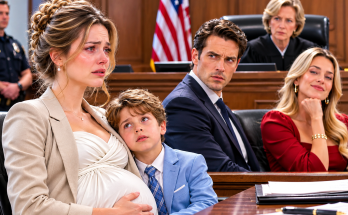
I thought I had already heard the most painful evidence.
Then Caroline told me there was a recording.
My father had preserved it before his death.
It involved a conversation with Julian and Thomas Whitaker.
I stared at her.
"A recording?"
She nodded.
"It has been reviewed and authenticated."
I felt my chest tighten.
I hadn't heard Dad's voice in a long time.
Not in a room.
Not over the phone.
Not speaking to me.
Sometimes I tried to remember exactly how he sounded.
I remembered his laugh.
I remembered the way he said my name when he wanted me to pay attention.
But memories change.
They soften.
Certain details become difficult to hold.
Now I was being told that a recording of him existed.
And that it might help explain the financial questions surrounding Julian.
I didn't know whether I wanted to hear it.
Part of me did.
Desperately.
Another part was frightened.
Because if Dad had spoken to Julian about the trust, I might discover how much he understood before I did.
I had already been ashamed of ignoring his warnings.
I wasn't sure I could bear hearing them in his own voice.
Caroline explained that the relevant portion had been admitted after the proper review.
The recording would be considered with the other evidence.
I listened.
Then I asked whether Dad had known Julian was planning something.
Caroline didn't answer that directly.
She said the conversation would speak for itself.
I nodded.
I didn't press her.
I wanted to hear it.
Even if it hurt.
The courtroom became quiet as the recording was prepared.
I folded my hands together.
My stomach felt heavy.
My daughter moved once.
I rested my palm against her.
Then the recording began.
There was a moment of ordinary background sound.
Then I heard him.
Dad.
His voice was unmistakable.
For a second, I couldn't breathe.
I had imagined hearing him again so many times.
But not like this.
Not in court.
Not while trying to understand whether my husband had attempted to take control of the inheritance Dad had left behind.
I looked down.
Tears blurred the papers in front of me.
Caroline placed a hand near mine.
She didn't speak.
I was grateful.
I needed to hear every word.
Dad was asking Julian about the business finances.
He wanted to know whether Julian intended to rely on my inheritance to support business obligations.
I lifted my head.
There it was.
The question Peter's memorandum had hinted at.
The concern Dad had apparently carried years earlier.
Julian answered.
He denied planning to use my trust.
His voice sounded familiar.
Confident.
A little impatient.
The same tone he used at home when I asked him something he considered unnecessary.
I felt sick hearing it.
I remembered being married to that voice.
Believing it.
Defending it.
Then Thomas spoke.
He explained that the trust contained restrictions.
There were limits on how the assets could be handled.
Dad insisted those protections were clear.
He wanted Julian to understand that the money wasn't available for whatever business plan he might propose.
I sat very still.
This was what Dad had been trying to tell me.
He hadn't simply disliked my husband.
He had been worried about something specific.
Julian had been discussing financial resources he didn't control.
Dad had confronted him.
Thomas had been present.
The restrictions had been explained.
Then Julian said something that made the room feel colder.
He suggested there might be another way to obtain authority if I refused.
I stared at the table.
The words were not shouted.
They were spoken as though he were discussing a practical option.
That made them worse.
Dad asked him what he meant.
Julian began talking about a husband's role when his wife could no longer manage her affairs.
I felt my daughter move.
My hand tightened against my stomach.
I thought about the hospital visit.
The complications.
The medication.
The clipboard.
The document that appeared to give Julian financial decision-making powers if I became unable to handle my affairs.
The connection was impossible to ignore.
Years earlier, Julian had already been thinking about how a husband might obtain authority when his wife couldn't make decisions.
Now there were questionable documents dated to a hospital visit when I had been frightened and exhausted.
I covered my mouth.
I didn't want to make a sound.
Dad challenged him immediately.
He made it clear that being married to me didn't give Julian the right to take away my independence.
His voice was firm.
Not angry in the way Julian became angry.
Firm.
The way Dad sounded when he had decided something mattered and wouldn't be negotiated.
Then he said something I would carry with me for the rest of my life.
He told Julian that I was a person, not a financial resource to be used.
He made it clear that my children weren't financial resources either.
I began crying.
I couldn't stop.
Because Dad had understood something I hadn't.
He had seen the danger in treating family relationships as a way to gain control of money.
He had known Julian wanted access to the trust.
And he had insisted that neither I nor my children existed to support Julian's ambitions.
I remembered the day Dad refused the business loan.
I remembered defending Julian.
I remembered accusing my father of being unfair.
Now I heard Dad's voice protecting me when I wasn't even in the room.
I felt ashamed.
Then grateful.
Then terribly sad.
I wanted to tell him I understood.
I wanted to apologize.
I wanted one more ordinary conversation at his kitchen table.
Instead, I was sitting in court.
Listening to a recording he had left behind.
The recording continued.
There were more words about the trust's restrictions.
About authority.
About the limits that had been established.
I listened as carefully as I could.
But the sentence about me and the children kept repeating in my mind.
Dad had not wanted us turned into financial instruments.
He had wanted us to be safe.
I looked toward Julian.
His expression was tight.
He wasn't smiling.
He wasn't trying to meet my eyes.
I wondered what he remembered about that conversation.
Had he been angry afterward?
Had he complained that Dad didn't respect him?
Had he told me only the parts that made himself look wronged?
I remembered how often he said my family didn't trust him.
Now I understood why.
It wasn't because Dad wanted to control our marriage.
It was because Julian had spoken about gaining financial authority without my agreement.
And Dad had challenged him.
Thomas had been present.
That detail hurt almost as much as Julian's words.
Thomas had heard the conversation.
He knew what Dad wanted.
He knew the trust's restrictions.
He knew Julian had raised the possibility of obtaining authority if I refused.
And yet years later, his name appeared in disputed paperwork connected to exactly that kind of authority.
I looked at Thomas.
He sat quietly.
I couldn't tell what he was thinking.
But I wanted him to remember the promise he had made to my father.
I wanted him to remember why Dad had trusted him.
I wanted him to understand what it meant to fail someone who had placed his family's future in your hands.
The recording ended.
For a moment, I heard nothing.
Then ordinary courtroom sounds returned.
A chair moved.
Someone handled papers.
I looked down at my hands.
They were trembling.
Caroline gave me time.
I wiped my face.
I tried to breathe.
I was surprised by how much hearing Dad had hurt.
I had expected anger toward Julian.
And I felt it.
But what overwhelmed me was grief.
Dad had been gone for years.
I had learned to live without seeing him.
I had accepted that certain conversations would never happen again.
Then suddenly, his voice had filled the room.
And he was still protecting me.
Even after his death.
I thought about the trust administrator.
The safeguards.
The letter.
The memorandum.
The recording.
Dad had left more than money.
He had left evidence of his concerns.
He had left instructions.
He had made sure the people responsible for the trust knew that authority should never be granted casually.
I had once thought he was too cautious.
Now I understood that caution had helped prevent a much larger loss.
When Caroline spoke again, her voice was steady.
She addressed the relevance of the recording.
It showed that Julian had been told about the restrictions.
It showed that my father had challenged the idea of using my inheritance for business purposes.
And it showed that Thomas had been aware of the trust's protections.
I listened.
The legal significance mattered.
But emotionally, I was still sitting with Dad's voice.
I kept remembering the last ordinary conversations we had.
The things we talked about.
Leo.
Family.
Work.
The future.
I wondered whether Dad had wanted to tell me more about Julian.
Maybe he had tried.
Maybe I hadn't listened.
I knew he had warned me about protecting the inheritance.
I knew he had refused to finance Julian's business.
But I had interpreted those actions as a lack of faith in my husband.
I had been wrong.
I wanted to apologize.
I couldn't.
So I decided I would do something else.
I would honor what Dad had tried to protect.
I would stop treating his caution as an inconvenience.
I would make sure Leo and my daughter benefited from the safeguards he created.
And I would teach them that love shouldn't require surrendering control of their own lives.
I looked toward Julian again.
For years, I had tried to understand why he became angry when I said no.
Why he treated ordinary financial boundaries as insults.
Why he believed being my husband should give him access to everything connected to me.
The recording gave me an answer.
He had seen authority as something he should be able to obtain even if I refused.
That was the difference between us.
I had believed marriage meant making decisions together.
He had treated my refusal as a problem to solve.
The hospital documents made more sense now.
So did the signature samples.
So did the attempted changes to the trust.
I felt cold realizing how long the idea might have existed.
But I also felt stronger.
Because the recording showed that my father had not imagined the danger.
And I hadn't imagined it either.
There were records.
There were documents.
There were statements.
There was evidence that could be examined independently of Julian's explanations.
When the hearing paused, Caroline asked if I wanted a moment.
I nodded.
We sat quietly.
I looked at the notebook I had carried into court.
Near the top, I had written that I wanted my children protected.
I thought about changing the sentence.
Making it longer.
Adding something about my father.
But I didn't.
The words already said enough.
I took a slow breath.
Then I looked toward the judge's bench.
I knew the proceedings weren't finished.
There were still questions about Thomas.
Still questions about the consulting payments.
Still questions about how the disputed documents had been prepared.
But I had heard something I needed to hear.
My father had never viewed me as an obstacle to Julian's success.
He had viewed me as his daughter.
A person with rights.
A mother whose children deserved protection.
I closed my notebook.
For the first time, I no longer felt foolish for trusting my father.
I felt grateful that he had trusted me enough to leave the inheritance in my name, protected by rules that didn't depend on Julian's approval.
Click here to continue reading: PART 12: Thomas Admitted He Had Helped Julian Despite My Father’s Warnings, and I Finally Saw the Difference Between a Mistake and a Betrayal
I Was Ready to Leave My Marriage With Almost Nothing, but the Judge Saw Something in My Husband That I Had Missed
Part 11 of 15