The Purple Map to Nowhere
Chapter 1: The Midnight Toll
My name is Rachel Bennett. I am thirty-four years old. Up until the precise moment my father branded me the mother of a liar, I firmly believed that the most devastating injury a parent could inflict was a refusal to listen. At four minutes past midnight, the universe saw fit to correct my ignorance. There were far, far worse things.
The glowing digits on the microwave blurred as I stood barefoot on the chilling linoleum of my kitchen in Macon, Georgia. The house was suffocatingly quiet, save for the low, rhythmic hum of the refrigerator. I was waiting. My eight-year-old daughter, Sophie, had embarked on a road trip with my parents earlier that afternoon. Their destination was Orlando, a vacation she had been counting down to with the fervent, breathless anticipation only a child possesses. I was merely waiting for that final, customary text message confirming they had safely checked into their hotel.
Instead, my phone vibrated in the dark. The screen illuminated, displaying a number I didn’t recognize, hailing from a northern Florida area code.
Logic, desperately trying to shield my rising panic, whispered that perhaps my father’s battery had died. Perhaps he was borrowing the hotel concierge’s phone. I swiped the screen to answer.
“Is this Rachel Bennett?” a male voice asked. It wasn’t the polished tone of a front desk clerk. Behind his baritone voice, the violent, rhythmic rushing of heavy traffic roared, punctuated by the deep, guttural rumble of a massive engine idling.
“Yes,” I stammered, my hand instantly flying to my throat. “Who is this?”
“My name is Isaac Bale. I drive a commercial freight truck. Ma’am, I am currently sitting on the shoulder of the interstate with your little girl. I need you to focus and listen to me very carefully.”
There is a distinct biological phenomenon that occurs when a mother hears words that threaten her child. The vocabulary reaches your eardrums, but your brain flatly refuses to parse them into a coherent reality. I stared blankly at the empty wooden chair tucked under the kitchen table—the exact spot where Sophie usually abandoned her glittering pink school backpack.
“What on earth do you mean you’re with my daughter?” I breathed, my voice barely a wisp. “She is in a car with her grandparents.”
“I found her abandoned beside the access road just outside Lake City. She is injured. She’s bleeding from a fall, and she can’t put weight on her leg. I’ve already dispatched 911, and my hazard lights are blinding the whole highway. I am not leaving her side until the paramedics arrive.”
The world tilted on its axis. For a suspended, agonizing second, the silence in my kitchen was absolute. And then, cutting through the static and the roar of the Florida highway, a fragile, terrified frequency pierced the line.
“Mommy!”
It was Sophie. I had kissed away her fevers, rocked her through night terrors, and bandaged a hundred scraped knees. A mother knows the exact octave of her child’s suffering. But in all my eight years of raising her, I had never heard her voice sound so incredibly small, so hollowed out by pure terror.
“Baby, I’m right here!” I cried out, my fingernails digging into the granite countertop so hard the tips went white. “Can you hear me? I am right here.”
“Please come get me,” she sobbed, the sound hitching in her chest.
“I am coming. I swear to you, I am coming right now.” I pressed the phone closer, desperate to bridge the physical miles. “Mr. Bale, please, whatever you do, do not leave her alone out there in the dark.”
“I told you, I’m planted right here,” Isaac’s voice returned, a steady anchor in a churning sea. “She is sitting safely in my cab’s headlights where the emergency responders can spot us. She’s talking to me.”
My hands shook so violently I dropped a pen twice before grabbing an unopened envelope to scribble down the mile marker he rattled off. I frantically asked if she had been struck by a passing car. Isaac calmly stated he hadn’t witnessed an impact. Then, I asked the question that made my blood run cold: Where are my parents?
The line went dead silent, save for the sweeping whoosh of a semi-truck flying past his microphone.
“Ma’am,” Isaac finally said, dropping his voice to a hushed, grave register. “I know Sophie. My own kid goes to her elementary school in Macon. I’ve seen the two of you at the pickup line. And I saw exactly who did this to her.”
The question of who was forming on my tongue, tasting like ash, when my phone vibrated against my cheek. Another call was overriding Isaac’s. I pulled the device away to look.
Dad.
I stared at the caller ID as if it were a venomous snake. My father, Robert Hale. I begged Isaac to stay on the line with Sophie, placed him on hold, and clicked over to my father.
There was no greeting. There was no frantic questioning of where his granddaughter was, or if she was breathing, or if the paramedics had arrived. He didn’t even say hello.
“Rachel,” my father’s voice boomed, chillingly composed and dripping with authoritative absolute. “Whatever that truck driver just told you, your daughter is weaving a tale. She is lying.”
I stopped breathing. An absolute stranger had discovered my battered, weeping child on the gravel shoulder of a highway in the dead of night. Yet, her grandfather’s immediate, overriding priority was establishing his narrative, ensuring I didn’t believe the victim.
He knew a truck driver was there. He knew Isaac was talking to me. Which meant my father knew Sophie had been left behind. And he was trying to silence her before the truth could even take a breath.
Chapter 2: The Departure
To fully comprehend the sheer psychological gravity of my father’s midnight declaration, you have to rewind to the sunlit afternoon prior. You have to picture Sophie standing in the center of my kitchen, a brand-new notebook clutched protectively against her chest.
She had spent hours utilizing a dull purple colored pencil to draw an intricate, winding route from Georgia down to Florida. The line bypassed cities she couldn’t pronounce and culminated next to a hastily sketched, crooked palm tree. Across the top, she had scrawled ORLANDO in letters so massive they spilled off the margins. For an eight-year-old, the vast, intimidating world becomes manageable only when you can name it and map it out.
“Do you think Grandma will let me keep a seashell if I find a really pretty one?” she had asked, her eyes wide with innocent calculation.
“Orlando is inland, sweetheart. It’s not right on the beach,” I gently corrected, smoothing her hair.
“I know that. But maybe we’ll stop for gas somewhere that sells shells.”
I had smiled, kneeling to help her zip up her neon duffel bag. This excursion was supposed to be a brief, magical school-break getaway. My parents had dangled the promise of it for weeks. My mother, Elaine Hale, had meticulously reviewed the packing list. My father had called at 7:00 AM sharp to dictate that we must be standing on the curb, luggage in hand, the moment his tires touched my driveway. That was his default mode of communication—treating even joyful family vacations like military deployments.
I harbored reservations, of course. They were the standard, low-humming anxieties of a single, working mother releasing her child into the wild without her. Would Sophie hydrate enough? Would she succumb to homesickness when the sun went down? But I ruthlessly swatted those worries away.
Sophie adored baking sugar cookies with my mother. She had once spent a grueling Saturday afternoon helping her grandfather scrub and wax his sedan, beaming with pride when he bestowed upon her the title of “Chief Assistant.” Those fragments of joy were genuine.
Yet, equally genuine was my father’s terrifying ability to extinguish all oxygen in a room with a single, hardened glare. I had spent thirty-four years internalizing the lesson that if Robert Hale was displeased, the world was an unsafe place. I pushed the dark thoughts away. The good memories outshone the bad, I repeated like a mantra.
When his immaculate SUV pulled up, my father didn’t bother cutting the engine or stepping out to embrace his granddaughter. He sat behind the wheel, his wrist flicking to check his luxury watch. My mother hopped out, enveloping Sophie in a cloud of floral perfume, presenting a tote bag overflowing with juice boxes and travel blankets.
When Sophie proudly displayed her purple map, Elaine cooed appropriately, promising they would track their progress marker by marker.
“Let’s get the show on the road, Elaine,” Robert snapped through the cracked window. “We are already behind schedule.”
They weren’t late because of us. My parents had unilaterally changed the departure time twice that morning. Yet, I watched my tiny daughter scramble, hoisting her bag with frantic urgency, as if sheer speed could purchase her grandfather’s fleeting approval. A cold, sour knot twisted in my stomach. I ignored it. I ignored it because he was glaring, because Sophie plastered on a brave smile, and because my entire existence had been a masterclass in ignoring my intuition to appease his temper.
“Send me a picture when you get to the hotel!” I yelled as she climbed into the leather backseat.
She twisted around, mashing her hands against the tinted glass, waving fiercely until the vehicle vanished around the bend of our suburban street.
The house immediately felt cavernous. Her crayons were scattered across the dining table. Her morning cereal bowl sat in the sink. I was meant to relish this rare, serene quiet, but instead, I found myself tethered to my phone, refreshing my messages obsessively.
Around 3:00 PM, my mother texted a blurry photo from a roadside diner. Sophie was in a booth, her purple notebook open, smiling around a mouthful of fries. I exhaled, tension leaving my shoulders. But zooming in, I noticed my father sitting across from her. His jaw was clenched tight; his eyes were dark and unsmiling. You’re projecting, I scolded myself.
Hours later, I called. Elaine answered, her voice tight, complaining about gridlock traffic. I could hear Sophie in the background, asking an innocent question about a billboard. Then came my father’s booming voice, commanding absolute silence so he could concentrate on the road. Elaine hastily promised to call back when they parked and hung up.
I accepted the dial tone. I had been accepting versions of that dial tone since I was a little girl in pigtails.
My father’s ultimate gospel was “consistency.” In his translation, consistency meant that when he issued a decree, no human being drew breath to question it. If he raised his voice and I wept as a child, he accused me of theatrical manipulation. My mother would inevitably slink into my bedroom hours later, smelling of dish soap, gently stroking my hair and whispering that he loved me, he just “had a lot on his plate.” Her softness was the velvet glove covering his iron fist. It made the illusion so much easier to swallow.
But by 9:00 PM, the digital updates ceased entirely. I texted my mother. An hour later, two words materialized: Still driving.
I asked if Sophie could FaceTime for two minutes to say goodnight. Nothing. The bubble didn’t even appear to show she was typing.
By 11:30 PM, I was pacing the floorboards, convincing myself that the interstate was a dead zone, that my parents were capable adults. But the silence stretched, heavy and malignant, wrapping around the house until a few minutes past midnight.
And then, Isaac Bale called.
Which brings us back to the moment I held my breath, listening to my father’s chilling dismissal on the other line. Your daughter is lying.
“What, exactly, happened to Sophie?” I asked, my voice dropping to a dangerous, vibrating low.
“She got herself entirely worked up,” Robert huffed, his tone bordering on absolute boredom. “She threw a tantrum. She absolutely refused to do as she was told.”
“That is not what I asked you,” I countered, gripping the phone.
“Rachel, do not start this. Do not take the hysterical word of some blue-collar stranger over your own flesh and blood.”
I could hear Elaine whimpering something indiscernible in the background.
“Where are you right now?” I demanded.
“We pulled off the interstate to find a quiet place,” he deflected.
“Why is Sophie not in the car with you?”
He launched into a convoluted soliloquy about how she had caused a public scene, how she needed to be taught a lesson about respecting authority, how she needed to “cool off.” He danced around the truth with the grace of a seasoned politician.
“She is eight years old, Dad!” I screamed, shattering the silence of my kitchen. “She is bleeding by the side of an interstate! A trucker had to call me!”
“You always coddle her. You let her exaggerate every little scratch,” he spat back. “You need to reign your child in.”
For a fraction of a second, thirty years of deep-rooted conditioning flared. The phantom urge to apologize, to soften my tone, to stroke his ego so he wouldn’t hang up on me, nearly overtook my vocal cords. But then the image of Sophie, shivering in the headlights of a freight truck, begging for her mother, eclipsed everything else.
“Tell me exactly where you left her,” I commanded, stripping every ounce of deference from my voice.
He fell dead silent. He didn’t answer, but the silence was profound. It was the first time in my entire existence that I had successfully forced Robert Hale to stop correcting me. I pulled the phone away and ended the call. I didn’t care about his narrative anymore.
I switched back to Isaac. “I’m here,” I gasped.
“The ambulance is pulling up right now,” Isaac confirmed, the flashing red and blue lights audible in the reflection of his voice.
I threw open my front door and sprinted to my car, leaving the kitchen lights blazing behind me.
Chapter 3: The Long Drive South
The first brutal lesson I learned on the agonizing highway journey to Florida was how utterly impotent an adult becomes when staring through a windshield, trying to will time and space to collapse.
I gripped the steering wheel, my knuckles white, forcing the speedometer to hover just above the legal limit. Every fiber of my being screamed to press the accelerator to the floorboard, to fly blindly through the pitch-black Georgia pines. But I brutally reminded myself that creating a fiery wreck on Interstate 75 would not save my daughter.
The second revelation was that sheer terror did not paralyze me; rather, it weaponized my focus. I utilized my car’s Bluetooth to call the regional dispatch center. I needed the specific hospital name. I needed the charge nurse. I needed to know if Sophie was conscious, if her pupils were reactive, if the blood Isaac had described was arterial or superficial.
The female dispatcher was incredibly composed. She couldn’t answer every medical inquiry, but she verified that Sophie was secured in the ambulance and stable. In a lifetime dictated by my father’s arrogant, unverified certainties, I found immense comfort in a stranger who honestly admitted the boundaries of her knowledge.
My mother called my cell phone twice during the drive. I let it ring out into the darkness both times.
Her voicemails populated minutes later. The first was brisk, almost annoyed. She claimed Sophie had become “unmanageable,” that Robert had simply pulled over to give her a “time out,” and that the entire situation was being blown wildly out of proportion. The second voicemail, left twenty minutes later, was a drastic pivot. Her voice trembled with syrupy affection, begging me not to terrorize myself over a “minor family misunderstanding.”
Misunderstanding. I let the word bounce around the interior of my car. My parents could violently overturn a dining room table in a fit of rage and Elaine would classify it as a “spirited debate.” But they could no longer control the script. An outsider had witnessed the curtain fall. An ambulance had driven away with the evidence.
I crossed the Florida state line as the first gray hints of dawn threatened the horizon. I pulled into the emergency bay of the Lake City hospital, threw my car in park, and sprinted through the sliding glass doors.
The sterile scent of iodine and bleach hit me like a physical wall. The night staff, anticipating my arrival, swiftly guided me past the chaotic triage area and down a quiet corridor. I had spent three hours rehearsing a script. I would be a pillar of stoic strength. I would not shed a single tear. I would assure Sophie that the nightmare was banished.
But the second I pushed open the heavy wooden door to her treatment room, the script incinerated.
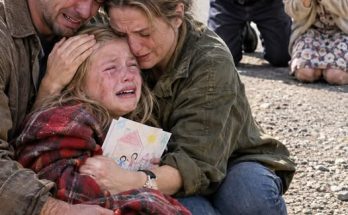
She was propped up against a mountain of stiff, white hospital pillows. She looked so agonizingly small, swallowed by the institutional sheets, her face bruised and puffy from hours of hyperventilation. Thick, white gauze wrapped her left forearm, and a massive bandage covered the entirety of her right shin.
She saw me. Her good arm reached out before I had even crossed the threshold.
I collapsed over the bed rail, carefully maneuvering around the IV lines to bury my face in her tangled, sweat-dampened hair. “I’m here,” I choked out, a ragged sob betraying my stoicism. “Mommy’s right here.”
She let out a shuddering, violent exhale, as if she had been holding her breath since she was pulled from the car. She clung to the fabric of my shirt with a desperate, white-knuckled grip.
Dr. Nadia Patel stepped into the room softly, allowing us a long, unbroken minute before introducing herself. She was a masterclass in clinical empathy. She detailed the abrasions, the deep laceration on the leg that required extensive cleaning to remove embedded gravel, and the severe bruising blooming across Sophie’s bicep.
“The injuries are consistent with being forcefully dragged and making high-velocity contact with a rough asphalt surface,” Dr. Patel stated, her eyes locking with mine. “Medical science can document what happened to the tissue, Ms. Bennett. But healing the psychological trauma of being abandoned near live traffic is a much longer road.”
“Can I stay?” Sophie suddenly whispered, her voice gravelly. She shrank back into the pillows, her eyes darting toward the door as if expecting a monster to step through.
“I will never leave this room,” I promised, kissing her forehead.
“Even… even if Grandpa gets mad?”
The question hung in the sterilized air, heavy and toxic. Dr. Patel paused, her pen hovering over the chart, but she mercifully refrained from probing.
I took a deep breath, looking directly into my daughter’s terrified eyes. “Grandpa does not have the power to decide if I stay with you ever again. He is not in charge. I am.”
Sophie searched my face, analyzing the micro-expressions, testing the structural integrity of my promise. Slowly, she uncurled her fingers and slipped them into my palm.
Once the medical team stepped out, a hospital social worker entered, gently explaining that given the nature of the injuries and the location of the abandonment, law enforcement and child protective services had been formally activated.
A decade ago, the mere threat of authorities examining my family would have triggered a severe panic attack. What will the neighbors say? How will my father survive the embarrassment? But as I stared at the dark purple bruises in the shape of my father’s fingers on my daughter’s delicate arm, the old, conditioned loyalties evaporated into mist. The priority wasn’t protecting Robert Hale’s sterling country-club reputation. The priority was ensuring no one ever made my child feel ashamed of begging for her life.
I poured a small paper cup of ice water and held it to Sophie’s lips. The room was quiet, save for the rhythmic beeping of the vitals monitor.
“Where is your purple notebook, sweetheart?” I asked softly, noticing the empty bedside table.
She looked down at the stark white blanket. “It’s still in Grandma’s backseat. He… he probably threw it in the garbage.”
I wanted to instinctively assure her that they would never do such a cruel thing. But I bit my tongue. I could no longer offer her false platitudes based on a fictionalized version of her grandparents.
“I don’t know what he did with it,” I admitted honestly. “But if we don’t get it back, I will buy you a hundred new ones, and we will draw a brand new map.”
She shook her head, tears spilling over her eyelashes. “But that was the one I drew the palm tree in.”
I nodded, my heart fracturing. Some losses cannot be remedied with a trip to the store. She deserved a mother who validated her grief, not one who tried to paint over it.
“I tried so hard to be good, Mommy,” she suddenly confessed, her voice fracturing. “I kept my face perfectly still.”
“Sophie, listen to me,” I said, gripping her hand tightly. “You never, ever have to prove that you were ‘good’ to earn my help. You are allowed to cry. You are allowed to be scared.”
“I asked Grandma to use her phone to call you,” she whispered, her eyes squeezed shut. “Grandpa said I was being a disrespectful brat.”
I didn’t press her for a chronological police report. I let the horrific narrative bleed out at her own pace. She described the sudden, violent swerve onto the gravel shoulder. The slamming of the vehicle in park. Her grandfather’s explosive rage. The terrifying sensation of his large hands clamping around her bicep, ripping her from the safety of the leather seat.
She remembered stumbling, her knees and hands tearing against the jagged gravel. She remembered screaming for her grandmother, who sat frozen in the passenger seat, staring straight ahead.
“Did anyone try to open the door for you?” I asked, my voice dangerously calm.
She shook her head, a pathetic, small motion. “I saw the red taillights driving away in the dark. I thought… I thought they were just turning around to scare me. But they kept going.”
I felt hot, stinging tears cascade down my cheeks. I didn’t wipe them away. I let her see my fury and my sorrow.
“Don’t be sad, Mommy,” she sniffled, trying to reach up to wipe my face.
“I am incredibly sad that you were hurt, Sophie,” I told her, making sure my voice carried the weight of absolute truth. “But I am not sad that you told me. You did the bravest thing in the world tonight. You survived.”
I sat in the uncomfortable vinyl hospital chair as she finally succumbed to exhaustion, drifting into a restless, twitching sleep. I pulled my phone from my pocket. My screen was littered with notifications. My father demanded I call him before speaking to the “incompetent” police. My mother begged for a private family meeting to “get our stories straight.”
I screenshotted every single message, archived them into a hidden folder, and powered the device down.
For the first time in thirty-four years, I did not waste mental energy constructing a diplomatic response to de-escalate Robert Hale’s impending wrath. I had far more critical work to do. My daughter had not simply thrown a tantrum on a road trip. She had been assaulted, abandoned in a high-traffic hazard zone, and left for dead by the very people tasked with her protection.
Families can argue about tone and curfews and hurt feelings. But there is no universe where a “harmless family disagreement” ends with a bleeding child praying for salvation in the headlights of an eighteen-wheeler.
Chapter 4: The Truth Unfolds
By mid-morning, the adrenaline had burned off, leaving a cold, hyper-vigilant clarity in its wake.
Detective Marisol Vega introduced herself in a sterile consultation room down the hall from Sophie’s room. She possessed a quiet, grounded authority that immediately put me at ease. She didn’t offer grandiose promises of swift justice, nor did she minimize the trauma.
“We are currently establishing the timeline,” Detective Vega explained, her notebook open on the steel table. “Mr. Bale, the truck driver, provided a comprehensive initial statement. We are actively attempting to procure dashcam footage, as his rig is equipped with a forward-facing camera system.”
“Do you…” I hesitated, feeling the ghost of my father’s gaslighting creeping up my spine. “Do you think she is telling the truth?”
Detective Vega stopped writing. She looked up, her dark eyes pinning me with a look of absolute professional certainty. “Ms. Bennett, your daughter was found battered on the shoulder of an interstate. Medical evidence corroborates a high-impact fall on asphalt. We don’t deal in ‘belief.’ We deal in evidence. And the evidence currently indicates a severe case of reckless endangerment and child abandonment.”
I exhaled a breath I felt like I had been holding since childhood. I realized I wasn’t asking if she believed Sophie; I was asking if the system would allow Robert Hale to manipulate his way out of it. Vega’s methodical, evidence-based approach gave me a new armor. My father’s booming confidence meant nothing in the face of hard data.
I provided the detective with the screenshots of the text messages and recounted the chilling midnight phone call word for word. When I reached the part where my father claimed Sophie was lying before I had even accused him, Vega’s pen moved swiftly.
After the interview, I walked out into the hospital courtyard to call Isaac Bale. He answered on the second ring, his voice thick with exhaustion.
“I just wanted to tell you she’s stable,” I said, the wind whipping my hair. “They’re treating the lacerations. And I… I don’t possess the vocabulary to adequately thank you for what you did.”
“You don’t owe me a damn thing, Rachel,” Isaac said softly. “I was gearing down for the exit when I saw the SUV idling on the shoulder. At first, I thought they blew a tire. Then I saw a grown man violently dragging a little shadow out of the backseat. By the time I laid on the airhorn, he had dropped her and floored it.”
The visceral image made my stomach pitch. “You stayed,” I whispered. “She told me you stayed.”
“I have a daughter the same age,” he replied, his voice tightening with suppressed emotion. “It was the easiest decision I’ve ever made in my life. I’ve already handed my company’s dashcam hard drive over to the highway patrol. The camera angle isn’t perfect, but it caught enough of the altercation.”
Before I could process the magnitude of the dashcam revelation, my phone beeped with an incoming call from my mother. I thanked Isaac profusely and switched lines, deciding it was time to face the enabler.
“Rachel, thank god,” Elaine breathed, her voice a pitchy, nervous flutter. “You are making a catastrophic mistake by freezing us out. You are letting people who aren’t blood dictate our family business.”
“Isaac Bale saw what happened, Mom,” I said, my voice shockingly level.
“He saw a five-second, out-of-context snippet of a very long, very difficult day!” she deflected rapidly. “Your father has an old-school way of handling discipline, you know this. It doesn’t mean he intentionally wanted her skin ripped open!”
“What did you do when she hit the pavement, Elaine?” I asked. The use of her first name acted like a physical blow. She gasped.
“I… I told everyone to just settle down,” she stammered.
“Did you open your door? Did you unbuckle your seatbelt and go to her?”
“You simply do not understand how defiant she was being!” she shrieked, the mask slipping. “She was pushing his buttons on purpose!”
The script was so incredibly predictable. First, minimize the abuse. Second, blame the victim for inciting the abuse. Third, demand I act as the emotional buffer to preserve the family aesthetic. It was a sick, cyclical waltz, and the music had finally stopped.
“She is an eight-year-old child,” I said, my voice dropping to a deadly, icy whisper. “You left her on the side of a highway where trucks do eighty miles an hour. This is not about whether she was using her manners. You abandoned her.”
“It was only supposed to be for a minute to scare her straight!” she blurted out, a desperate, damning admission.
The silence that followed was suffocating. She had finally admitted the intent. They had weaponized abandonment.
“Do not ever contact me or my daughter again,” I said.
I hung up the phone. The bridge was officially, gloriously burned to ash.
Chapter 5: Drawing the Battle Lines
The discharge process was a labyrinth of paperwork, wound care tutorials, and establishing safety protocols. Because my parents did not possess legal custody, the hospital staff helped me draft temporary administrative barriers. If they attempted to access Sophie, security would intervene.
We drove back to Macon a day later. The return journey was a painstaking exercise in rebuilding trust. Every time we stopped for fuel, I narrated my exact movements. I am walking to the pump. I am standing right here. You can see me through the glass. Sophie sat rigidly in the backseat, her eyes tracking my every twitch, learning in real-time that a promise to return wasn’t an empty threat.
Pulling into our driveway, the sheer normalcy of our house felt like a violent culture shock. The neighbor’s sprinklers were running. The mail was stacked in the box. Nothing on the exterior indicated that the family unit inside had been fundamentally obliterated.
Sophie limped into the kitchen, her eyes immediately finding the scattered crayons on the dining table. She reached out, her bandaged fingers lightly grazing a cerulean blue stick, before looking at the empty space where her purple map used to reside.
“Are we home for good now?” she asked, her voice hovering.
“Yes, baby. We are home.”
“Can Grandpa come here?”
“No,” I said firmly, pulling out a chair and sitting eye-level with her. “He is not allowed here.”
She swallowed hard, her eyes darting to the front window. “What if he commands you to let him in?”
I thought of the thousands of times I had capitulated to Robert Hale simply to avoid the exhausting, soul-crushing warfare of his displeasure. I thought of the little girl bleeding on the gravel.
“He can command the wind to stop blowing, but it won’t matter,” I told her, my voice resolute. “I am your mother. I am the absolute authority on who enters this house. And he is banished.”
She didn’t smile, but her rigid shoulders dropped an inch. She leaned her weight against my chest, and I wrapped my arms around her, realizing that the true battle for her psychological recovery was only just beginning.
That evening, the phantom siege began. Sophie woke up in a cold sweat at 8:00 PM, panic radiating from her pores, asking if the deadbolts were thrown. I didn’t dismiss her fear. I walked her to the front door, let her touch the heavy brass lock, and then we marched from window to window, securing every latch together. We were fortifying our castle.
Three days later, the phantom siege became a physical one.
I was at the kitchen sink when I saw a familiar luxury sedan idle by the curb. My mother, Elaine, marched up the concrete walkway, clutching a glass Tupperware container of baked ziti. It was her ultimate weapon of mass rug-sweeping. If she delivered a casserole, the abuse was officially erased from the ledger.
Sophie walked into the hallway, freezing in terror as she spotted the silhouette through the frosted glass. “Is that Grandma?” she whimpered, backing away.
“Go upstairs, Sophie. Lock my bedroom door. Do not come down until I say so,” I commanded softly. She scrambled up the carpeted stairs like a frightened rabbit.
I didn’t open the door wide. I stepped out onto the porch, pulling the heavy door shut behind me until the latch clicked. I stood on the welcome mat, blocking her path.
Elaine looked deeply offended before I even opened my mouth. She thrust the heavy glass container toward my chest. “You look exhausted, Rachel. I brought dinner. You need to stop this childish silent treatment and let me take care of you.”
“Why are you standing on my property when I explicitly told you we require absolute distance?” I asked, my arms crossed over my chest, ignoring the pasta.
She huffed, a delicate, martyr’s sigh. “Because I am Sophie’s grandmother. I have a right to see her.”
“Your biological title makes your actions infinitely more depraved, Elaine,” I countered, my voice echoing slightly in the quiet suburban air. “Not less.”
Her knuckles turned white around the glass container. “Your father made a miscalculation! A terrible, split-second error in judgment, if that’s the dramatic terminology you require! But you are allowing government bureaucrats and strangers to tear our legacy apart over a temper tantrum!”
“I didn’t tear anything apart. Robert dragged an eight-year-old out of a car and left her in the dark. You sat in the passenger seat and watched. That is the legacy.”
She glared at me, her eyes darting to the locked door behind me. “Move aside, Rachel. Let me see my granddaughter.”
“No.”
The syllable hung in the humid Georgia air. I had never wielded that word against her with such devastating finality. She stared at me, her mouth slightly ajar, waiting for the inevitable apology, the softening, the capitulation. It never came.
“You are punishing me for loving my family!” she spat, tears of genuine frustration welling in her eyes.
“Leave the property, Elaine. If you come back, I will have the police trespass you.”
She stood paralyzed for five agonizing seconds before spinning on her heel, marching back to the sedan, the baked ziti still clutched to her chest. I watched her taillights disappear, my heart hammering against my ribs, high on the intoxicating adrenaline of successfully defending my perimeter.
Ten minutes later, my phone vibrated. A text from Robert.
You humiliate your mother on your doorstep like a common vagrant. You have severely forgotten who put the roof over your head and the food in your mouth. You belong to this family, Rachel. Act like it.
I didn’t reply. I didn’t need to. He believed raising a child was a transactional debt that demanded lifelong, blind obedience. I realized then that I didn’t owe him my daughter’s safety to pay off the tab of my childhood.
The next morning, Detective Vega called.
“Ms. Bennett,” she began, her tone carrying a new, heavy significance. “We have finished processing the dashcam footage from Mr. Bale’s logistics company, alongside the security cameras from a nearby gas station on the access road.”
“And?” I asked, my pulse roaring in my ears.
“It corroborates everything your daughter said. It shows the extraction. It shows the fall. And it shows the vehicle remaining stationary for forty-five seconds before accelerating away. It was not a ‘split-second error.’ It was a calculated abandonment.”
Chapter 6: The Weight of Evidence
The revelation of the video footage fundamentally altered the atmospheric pressure of our reality. I was no longer a hysterical daughter battling her father’s gaslighting; I was the guardian of a federally documented victim.
I took copious, meticulous notes in a spiral-bound ledger. I documented every phone call with Detective Vega, the dates of Sophie’s trauma counseling sessions, and the exact times my parents attempted to breach our digital boundaries. In my family, reality had always been fluid, subject to revision based on Robert’s mood. Writing down objective, verifiable facts became my anchor. It stopped me from arguing with my own memory.
The emotional toll on Sophie was a pendulum swing of progress and regression. Returning to school required strategic planning. We established a silent signal with her homeroom teacher—if the hallway crowds triggered her panic, she could place a specific blue index card on her desk to excuse herself to the quiet of the nurse’s office.
One evening, while I was carefully removing the surgical tape from her healing leg, she looked up at the ceiling. “Did Grandpa hate me that night?”
I stopped peeling the tape. I looked at the jagged pink scar knitting itself together. “I cannot speak to what is inside his heart, Sophie. But I can tell you with absolute certainty that nothing you did, nothing you said, justified how he treated you.”
“When he gets mad, his eyes look like he doesn’t even know my name,” she whispered, a tear slipping down her cheek. “I wish I had just stayed quiet in the car. If I didn’t ask to call you, maybe he wouldn’t have grabbed me.”
“No,” I said fiercely, grabbing her small face in my hands. “Do not ever accept the blame for an adult’s lack of control. Asking for your mother is your right. His violence was his choice. Do you understand me?”
She nodded slowly, the guilt momentarily abating. But it was a conversation we would have to repeat. Abuse leaves a residual poison that convinces the victim they poured the drink.
Meanwhile, the Hale family PR machine was imploding. As the reality of a formal criminal investigation loomed, my parents’ narratives began to wildly fracture.
Robert shifted from outright denial to intellectualizing the event. He sent me a sprawling, manifesto-like email claiming Isaac Bale lacked the “context of familial discipline.” He argued that he was teaching Sophie a vital lesson about respect and that he would never have allowed lasting harm to befall her. He completely failed to grasp that instilling the fear of death in a child on an interstate was the lasting harm.
Elaine, desperate to salvage her own skin, attempted a separate maneuver. She sent a message claiming she had begged Robert not to do it, that she was a victim of his terrifying temper as well, and that she would gladly testify to the authorities—if I allowed her visitation rights with Sophie.
I read the message in my kitchen, a cold disgust washing over me. She was attempting to barter her cooperation in a criminal investigation for access to the victim.
Truthful cooperation is a legal and moral obligation, Elaine, I replied through the designated portal set up by my attorney. It is not a currency to purchase access to my child.
She accused me of treating her like a criminal. I realized then that my mother was a prisoner of her own making, trapped in a lifelong role of appeasing a tyrant, completely incapable of protecting the innocent if it meant standing in the line of fire.
As the weeks dragged into months, the investigation transitioned into the hands of the state prosecutor. Because of the undeniable corroboration—Isaac’s testimony, the dashcam footage, the ER medical reports, and the forensic interview conducted by child advocates—Robert’s defense attorney realized a trial would be a public massacre of his client’s precious reputation.
I didn’t want a cinematic courtroom drama. I didn’t want to drag Sophie to a witness stand to perform her trauma for a jury of strangers while my father glared at her from the defense table. I wanted legally binding boundaries. I wanted it written in ink, backed by the threat of a jail cell, that Robert Hale was a danger.
And that is precisely what the plea agreement delivered.
Chapter 7: Rebuilding the Map
The legal resolution arrived on a damp Tuesday afternoon. It wasn’t accompanied by a grand parade or a sweeping orchestral score.
Robert accepted a negotiated plea for reckless endangerment and child neglect. The consequences involved heavily monitored probation, mandatory anger management, and, most crucially, a strict, legally enforceable protective order barring him from coming within five hundred yards of Sophie or me. Elaine, due to her documented complicity, was issued a concurrent restraining order regarding contact.
When the prosecutor called to confirm the judge had signed the paperwork, I sat in my car in the grocery store parking lot and waited for the triumphant euphoria to hit.
It never came.
Instead, I gripped the steering wheel, my hands trembling, and wept for the father I never truly had. I grieved the illusion of the protective grandfather. I mourned the Sunday dinners we would never attend again, the holidays that would be eerily quiet. Cutting off a cancerous limb saves your life, but it doesn’t mean you don’t miss the phantom weight of it.
When I explained the legal outcome to Sophie that evening, I kept the language age-appropriate. I told her that a judge had reviewed the rules, decided Grandpa broke a very serious one, and ordered that he could no longer come near us to ensure she remained perfectly safe.
She processed this while chewing on a slice of apple. “Is it because I told the police what he did?” she asked, her eyes wide with apprehension.
“No, sweetheart. It is entirely because of what he did,” I corrected gently. “Telling the truth just turned the lights on so everyone could see the mess he made.”
She thought about this for a long, quiet moment. “Can we make popcorn and watch a movie?”
“Absolutely.”
It was an ordinary request, but it felt monumental. She wasn’t carrying the weight of the verdict. She was allowed to just be an eight-year-old on a Tuesday night.
Our healing was not linear, but the trajectory was upward. We practiced saying “no” to small things. I allowed her to change her mind about weekend plans without demanding a logical thesis to justify it. I learned to apologize to her when I lost my patience, demonstrating that adults can be flawed without being dangerous.
A year after the nightmare on the highway, Sophie came home from school and bypassed the TV. She walked straight to the kitchen table, unzipped her backpack, and pulled out a brand-new, oversized sketchpad.
She opened to a crisp, blank white page. From her pencil box, she extracted a vibrant, unsharpened purple colored pencil.
I held my breath, watching from the sink as she pressed the lead to the paper. She didn’t attempt to redraw the lost route to Orlando. She didn’t draw a crooked palm tree or a hotel.
Instead, she drew a sprawling, winding road that looped in joyous, chaotic circles. At the end of the line, she sketched a small, sturdy house with a bright yellow roof. She drew the front door wide open.
“Where does this road go?” I asked softly, stepping closer to admire the architecture.
“It goes here,” she said, tapping the little yellow roof. “It’s a house where people are allowed to say when they feel scared, and nobody yells at them for it.”
Tears pricked my eyes, but I smiled widely. “Is there room for me in that house?”
She looked up at me, handing me the purple pencil. “Only if you draw yourself in. But you have to stand right next to me.”
I took the pencil, my hand steady, and drew two stick figures, equal in height, holding hands on the front porch. The picture was uneven, chaotic, and entirely unfinished. It was the most beautiful map I had ever seen.
I had spent my entire life believing that love meant absorbing another person’s cruelty to keep the peace. The highway had taught me the brutal truth: real love is building a fortress to protect the innocent, even if it means locking your own family outside the gates. The road ahead was blank, but for the first time in thirty-four years, I was the one holding the pen.
If this story resonated with you, or if you believe in the power of breaking generational cycles to protect our children, please like and share this post if you find it interesting.