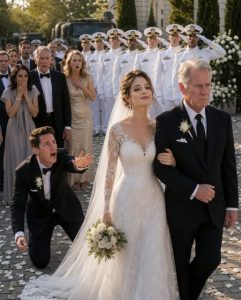
Part 2
The word General seemed to fall from the officer’s mouth and strike the stone courtyard like thunder.
No one laughed now.
Not Charles Whitmore, who stood frozen with his phone still pressed against his ear.
Not Ethan, whose mouth hung slightly open as he stared at the military identification in my hand.
Not the two hundred guests who, only moments ago, had applauded while my father was drenched with a garden hose in front of the entire wedding party.
The silence was so complete that I could hear water dripping from the hem of my ruined dress onto the polished stone beneath my feet.
My father sat inside the SUV, wrapped in my jacket, his shoulders still trembling. Through the window, his eyes searched mine—not with fear, not with shame, but with a quiet confusion that hurt me more than the water, more than the laughter, more than Ethan’s betrayal.
He had never known.
For three years, I had hidden pieces of my life from him. For his safety. For operational security. For all the reasons that had sounded reasonable when spoken in secure rooms under fluorescent lights.
But standing there now, with the Whitmore estate crumbling around us, those reasons felt terribly small.
“General Morrison,” Colonel Hayes said, still standing at attention. “All initial actions have been executed. Federal procurement suspension is active. Joint review teams are on-site at Whitmore Dynamics headquarters. Treasury has frozen flagged accounts pending investigation.”
A low murmur rippled through the guests.
Whitmore Dynamics.
Charles’s company.
The crown jewel of his family empire.
The name stamped on missiles, surveillance systems, armored vehicle components, and half a dozen classified defense technologies that had made him obscenely wealthy.
Charles finally lowered his phone.
His face had turned the color of ash.
“This is impossible,” he said.
I looked at him. “No. What’s impossible is that you believed cruelty had no consequences.”
His eyes narrowed, desperate to find weakness. “You can’t do this. You don’t have the authority.”
Colonel Hayes stepped forward. “The orders were approved through proper legal channels.”
Charles pointed a shaking finger at me. “Because of a wedding? Because of a joke?”
At that, my father opened the SUV door.
I turned immediately. “Dad, stay inside.”
But he stepped out anyway, slowly, carefully, still wrapped in my jacket. His shoes squelched against the stone. His hair was plastered to his forehead. His suit clung to his thin frame.
He looked smaller than I had ever seen him.
But when he spoke, his voice was steady.
“It wasn’t a joke,” he said.
Charles looked at him as if a chair had started speaking.
My father took one step forward. “A joke makes everyone laugh. What you did was meant to make one person feel worthless.”
For a moment, Charles had no answer.
Then his pride returned, wounded and ugly.
“You people always do this,” he snapped. “Pretend to be noble while reaching for what belongs to your betters.”
Ethan flinched. Even he knew his father had gone too far.
But Charles was unraveling now, and men like him always mistook rage for strength.
“You think a title changes who you are?” he barked at me. “You think a uniform makes you superior? You are still the daughter of a schoolteacher who couldn’t afford a decent suit for his own daughter’s wedding.”
Something inside me went very still.
I had commanded troops through ambushes. I had stood in war rooms while casualty reports were read aloud. I had buried friends. I had negotiated with men who smiled while planning massacres.
But nothing had ever tested my restraint like that sentence.
Ethan finally stepped between us.
“Dad, stop.”
Charles spun on him. “Don’t you dare tell me to stop. This woman just destroyed our family.”
“No,” I said. “Your family was already destroying itself. I just stopped pretending not to see it.”
Ethan turned toward me, his expression shifting from shock to pleading.
“Emily,” he said softly. “We can fix this.”
I almost laughed.
Instead, I studied his face—the clean jaw, the expensive haircut, the eyes I once mistook for kindness.
For three years, he had brought flowers when I worked late. He had held my hand at hospital visits. He had told me he admired my discipline, my calm, my refusal to flaunt money or status.
And yet, when his father humiliated mine, Ethan had not hesitated.
He had smiled.
He had tightened his grip on the hose.
“No,” I said. “We can’t.”
His voice dropped lower. “I didn’t know who you were.”
“That’s the problem, Ethan. You should have known who I was without the stars.”
The words landed between us with more force than anger ever could.
Behind him, several guests began leaving quietly, slipping toward the valet line as if distance could erase what they had witnessed. Others stood frozen, phones in hand, recording.
One of Charles’s executives pushed through the crowd, pale and sweating.
“Charles,” he whispered harshly. “The board is calling an emergency session. The news is already picking this up. Someone leaked footage from the drone.”
Charles’s head snapped toward the hovering camera above the lawn.
The drone.
The same drone he had paid to film his son’s glorious wedding.
The same drone that had captured him laughing while my father was soaked in front of two hundred witnesses.
Poetic justice had a strange sense of timing.
Charles lunged toward the drone operator. “Shut it down!”
The young man backed away. “Sir, it’s already live-streamed to the production server. I can’t pull it back.”
Charles looked like he might strike him.
The military police moved one step forward.
He stopped.
For the first time that day, Charles Whitmore understood there were doors money could not open and uniforms money could not intimidate.
Colonel Hayes turned to me. “General, federal agents have requested permission to enter the estate office. There may be relevant corporate records on-site.”
Charles stiffened. “This is private property.”
“Not anymore,” said a woman’s voice from behind the SUVs.
A woman in a navy suit stepped forward, holding a leather folder. Her dark hair was pulled tightly back, and her expression carried the sharp calm of someone accustomed to ending conversations.
“Marissa Vale,” she said. “Office of the Inspector General.”
Charles stared at her. “You need a warrant.”
She opened the folder. “We have one.”
The paper trembled slightly in Charles’s hand when she gave it to him.
His eyes scanned the document. With each line, his face changed. Confusion became disbelief. Disbelief became fear.
“What is this?” he whispered.
Marissa did not blink. “An investigation into procurement fraud, bribery, falsified compliance certifications, unlawful subcontracting, and misappropriation of classified research funds.”
A gasp moved through the crowd.
Ethan turned slowly toward his father.
“Dad?”
Charles did not answer.
That silence told me more than any confession could.
I had suspected Whitmore Dynamics for months. Irregular bids. Inflated invoices. Components that passed inspection too neatly, too quickly. Subcontractors with no real facilities. Anonymous tips that vanished before investigators could trace them.
But suspicion was not action.
Not until that morning, when my office received enough evidence to justify immediate suspension.
Operation Blackstone had not been created because of my father.
It had been waiting.
Charles’s cruelty had simply given me the final reason to stop delaying the inevitable.
Ethan looked at me, horror dawning in his eyes. “You planned this?”
“I planned to marry you today,” I said. “The investigation was separate.”
“Then why execute it now?”
I looked past him to my father, standing wet and humiliated beneath a sky that had been decorated with white roses and silk ribbons.
“Because your family mistook patience for permission.”
Charles suddenly laughed, but it was thin now. Broken.
“You think this ends me?” he said. “I know senators. Cabinet members. Generals older and more powerful than you.”
Marissa Vale closed the folder. “Several of them are already cooperating.”
That was when Charles truly lost color.
Not anger.
Not embarrassment.
Fear.
Pure, private, unmistakable fear.
Ethan saw it too.
The world he had inherited began cracking in front of him. Not in dramatic explosions, but in tiny fractures. A glance from one executive to another. A lawyer stepping away before taking a call. A board member removing his Whitmore family pin and sliding it into his pocket.
Empire was not stone.
It was agreement.
And everyone was beginning to disagree.
My father moved closer to me. “Emily,” he said quietly. “I want to go home.”
The simplicity of the request nearly undid me.
Home.
Not revenge. Not victory. Not spectacle.
Just home.
I nodded. “We’re leaving.”
Ethan reached for my arm.
Colonel Hayes moved immediately, but I lifted a hand to stop him.
Ethan’s fingers never touched me. He let them fall.
“Emily, please,” he whispered. “Don’t leave like this.”
I looked at him.
The man in front of me was not the man I had loved. Perhaps that man had never existed. Perhaps he had only appeared in rooms where kindness was convenient and disappeared when cruelty earned applause.
“You had three seconds,” I said.
His brow tightened. “What?”
“When your father turned that hose on my dad, you had three seconds to show me who you were.” My voice stayed calm, though every word cost me something. “You showed me.”
His eyes filled with tears.
Once, that would have moved me.
Not anymore.
I helped my father into the SUV again. Before I climbed behind the wheel, Charles shouted my name.
“Emily!”
I turned.
He stood in front of his mansion with federal agents behind him, wedding guests scattering around him, and his empire collapsing through the glowing screen of his phone.
But somehow, he still managed to look arrogant.
“You will regret this,” he said. “People like you always do. You climb high, but you forget who owns the ladders.”
I smiled faintly.
“No, Charles. I never forgot. I just built my own.”
Then I got into the SUV and drove away from the Whitmore estate.
For the first ten minutes, neither of us spoke.
The road curved through miles of private land, past white fences and sculpted hedges, past security gates and bronze family crests mounted on stone pillars. The farther we drove, the more the estate disappeared in the rearview mirror.
My father sat beside me with my jacket pulled tightly around him.
I turned the heat up.
“I’m sorry,” I said.
He kept looking out the window.
“I should have stopped it sooner.”
He shook his head. “No.”
“Dad—”
“No, Emily.” His voice was soft but firm. “You don’t apologize for what cruel people choose to do.”
My throat tightened.
He finally turned to me. “But you do owe me one answer.”
I gripped the wheel. “I know.”
“How long?”
The question was simple.
The answer was not.
“I was promoted six months ago,” I said. “Before that, I was serving in classified command roles. I wanted to tell you. Many times.”
He stared at me.
“Four stars,” he said slowly.
I nodded.
“My little girl?”
Despite everything, I almost smiled. “Your little girl.”
He leaned back, absorbing it.
Then, unexpectedly, he laughed.
It was quiet at first, then fuller, warmer. Not cruel laughter. Not like theirs. This laughter came from somewhere tired and astonished and alive.
“What?” I asked.
He wiped his eyes. “Your mother would have said, ‘That explains why she was always bossy.’”
The laugh broke something open in me.
I pulled into a quiet overlook near the lake, stopped the car, and covered my face with both hands.
For the first time that day, I cried.
Not loudly. Not dramatically.
Just enough for the strength to leak out.
My father reached over and placed his hand on my shoulder, the same way he had when I was seven and came home crying because another girl had mocked my secondhand shoes.
Back then, he had knelt in front of me and said, “Never let someone else’s emptiness convince you that you are small.”
I had remembered those words on battlefields, in hearings, in rooms full of men who underestimated me.
Somehow, I had forgotten them in love.
“I should have known,” I whispered.
“No,” he said. “You loved him. Love makes us generous with explanations.”
I lowered my hands. “And foolish.”
“Sometimes.”
We sat there for a long moment, watching the lake ripple under the pale afternoon sun.
Then my secure phone rang.
I wiped my face and answered.
“Morrison.”
Colonel Hayes’s voice came through. “General, there’s been a development.”
My body shifted instantly back into command. “Go ahead.”
“Federal agents found a secure room beneath the east wing of the Whitmore estate. Hidden servers. Hard-copy ledgers. Foreign transfer records.”
My eyes narrowed. “Foreign?”
“Yes, ma’am. Preliminary review indicates possible unauthorized technology transfers.”
The air inside the SUV seemed to sharpen.
Unauthorized transfers were not just fraud.
They were treason.
My father saw my expression change. “What is it?”
I held up one hand gently.
Hayes continued. “There is something else. Your name appears in several files.”
“My name?”
“Yes, ma’am. Along with surveillance photos. Personal schedule estimates. References to your father.”
The lake beyond the windshield blurred for half a second.
My father.
“What references?”
A pause.
“Ma’am, I think you need to return to a secure location.”
I looked at my father, still damp, still unaware that the humiliation at the wedding may not have been random cruelty at all.
“What did the files say?” I asked.
Hayes hesitated.
That hesitation told me enough to make my blood run cold.
“Colonel.”
His voice lowered. “They were assessing leverage points.”
I closed my eyes.
Leverage.
My father had not simply been mocked because Charles thought he was poor.
He had been targeted because someone had identified him as my weakness.
I ended the call and started the SUV.
My father straightened. “Emily?”
“We’re not going home.”
He looked at me carefully. “Where are we going?”
“A safe location.”
The warmth from moments ago vanished.
Behind us, in the distance, the Whitmore estate was no longer visible. But suddenly it felt closer than ever.
My father said nothing for a while.
Then he looked down at the ruined gray suit sticking to his knees.
“You know,” he said quietly, “I never liked that boy.”
Despite the fear tightening my chest, I glanced at him.
“You told me he seemed polite.”
“He was polite to people he thought mattered.” My father’s jaw tightened. “That is not the same thing as being kind.”
I had no answer.
The secure phone rang again.
This time, the caller ID made my hands still.
UNKNOWN SECURE ROUTE.
Only a handful of people in the country could reach that line through a masked channel.
I answered.
No one spoke at first.
Then a distorted voice said, “General Morrison.”
“Identify yourself.”
A soft chuckle.
“Congratulations on ruining your wedding. Very theatrical.”
My father looked at me sharply.
I kept my voice even. “Who is this?”
“Someone who tried to warn Whitmore not to underestimate you.”
My grip tightened on the wheel.
The voice continued. “Unfortunately, Charles was always too proud to listen. Ethan too weak. But you already knew that.”
“What do you want?”
“Want?” Another quiet laugh. “General, this is not about what I want. This is about what your father knows.”
The road seemed to tilt beneath me.
“My father is a retired schoolteacher.”
“Is that what he told you?”
I glanced at Dad.
His face had changed.
Not confused.
Not afraid.
Recognizing.
My breath caught.
The voice on the phone softened.
“Ask him about November 17th, 1989.”
My father closed his eyes.
For the first time in my life, I saw guilt on his face.
Not embarrassment.
Not sadness.
Guilt.
“Dad?” I whispered.
The voice said, “The Whitmores were never the beginning of this story, General. They were just the first wall to fall.”
Then the line went dead.
I pulled the SUV to the side of the road so abruptly the tires spat gravel.
For several seconds, the only sound was the engine humming and my own heartbeat pounding in my ears.
My father looked older than he had that morning.
Much older.
“What happened on November 17th, 1989?” I asked.
He stared through the windshield.
The afternoon light touched the water still clinging to his silver hair, and suddenly the quiet schoolteacher I had known all my life seemed like a stranger wearing my father’s face.
When he finally spoke, his voice was barely above a whisper.
“That was the day I stopped being a schoolteacher.”
A chill moved through me.
“You told me you taught for forty years.”
“I did.” His hands folded tightly in his lap. “After.”
“After what?”
He turned to me then, and there was a grief in his eyes I had no training to defend against.
“After I betrayed a man who should have died.”
Before I could ask another question, headlights appeared in the rearview mirror.
Three black vehicles.
No plates.
Fast.
Too fast.
My father looked back and exhaled slowly.
“They found us,” he said.
“Who?”
He reached under the soaked cuff of his sleeve and pulled at a seam I had never noticed before. Something small and metallic slipped into his palm.
A drive.
Old. Scratched. Hidden inside his suit.
The suit Charles had mocked.
The suit Ethan had soaked.
My father pressed the drive into my hand.
“Emily,” he said, his voice suddenly steady again, “whatever happens next, do not give this to anyone in uniform.”
My blood went cold.
“Dad, I am someone in uniform.”
He looked at me with unbearable tenderness.
“I know.”
The first vehicle behind us accelerated.
My father fastened his seat belt.
And for the second time that day, the man I thought I knew shattered into someone else entirely.
…If you want to know what happened next, please type “YES” and like for more.
PART 3: THE DRIVE HIDDEN IN MY FATHER’S SUIT
The black vehicles came up behind us like shadows with engines.
For one impossible second, I could not breathe. The road was empty, the lake glimmered coldly beside us, and in my palm lay the scratched metal drive my father had hidden inside the seam of the very suit Ethan and Charles had mocked.
**The suit they thought proved he was poor had been carrying a secret powerful enough to make men hunt us.**
“Dad,” I said, my voice low, “tell me the truth. Now.”
My father stared at the rearview mirror. The three vehicles were closing fast.
“Drive first,” he said. “Truth later.”
That tone was not the voice of the gentle schoolteacher who had packed my lunches and helped children with fractions for forty years. It was calm, precise, sharpened by danger.
I slammed my foot on the gas.
The SUV roared forward.
Behind us, the lead vehicle accelerated. My secure phone buzzed on the dashboard, but I ignored it. I took the first turn hard enough to make the tires scream. My father braced one hand against the door, not panicking, not shouting, just watching the road with eyes that seemed to recognize every threat before it happened.
“Two miles ahead,” he said. “Old service road on the right. Take it.”
“How do you know that?”
“I used to run this route.”
The answer struck me like a slap.
“Run from who?”
He looked at me. “From people who smiled in government buildings.”
The first black vehicle rammed us from behind.
The SUV jolted violently. My father hit the dashboard with his shoulder, and rage tore through me so fast my hands tightened around the wheel.
“Seat belt tight?” I asked.
“Yes.”
“Good.”
I swerved left, then snapped the wheel right into the service road. Gravel exploded beneath us. Branches scraped the windows. The pursuing vehicles overshot the turn for half a second, giving us distance.
Not enough.
Never enough.
My father reached into the glove compartment and pulled out the emergency beacon I kept there.
“Don’t activate that,” he said.
“That beacon calls military support.”
“Exactly.”
I stared at him. “You told me not to give the drive to anyone in uniform. Now you don’t want me calling my own people?”
His face collapsed with pain.
“Emily, I spent my life teaching you to trust honor, duty, and service. I never taught you that uniforms can be stolen by cowards.”
The words went straight into my chest.
Ahead, the service road split.
“Left,” he said.
I turned.
The lake disappeared behind thick trees. My phone rang again. This time the caller was Colonel Hayes.
I answered on speaker. “Hayes.”
“General, where are you? Your vehicle signal vanished.”
I looked at my father.
He shook his head slowly.
Hayes continued, “Ma’am, return to base immediately. We have reason to believe your father may be a target.”
My father leaned toward the phone and said quietly, “Colonel Hayes, who gave you the phrase November 17th?”
There was silence.
Too much silence.
Then Hayes answered, “Sir, I don’t know what you mean.”
My father closed his eyes.
“Emily,” he whispered. “End the call.”
I did.
For a moment, I could only hear the engine and the hammering of my heart.
“Hayes is loyal,” I said, though even to myself it sounded less certain than before.
“Maybe,” Dad replied. “Or maybe loyalty is being used against him.”
We burst out of the trees onto a narrow bridge. Beneath it, dark water rushed over rocks.
“Stop halfway,” Dad said.
“What?”
“Trust me once more.”
I stopped.
My father opened the door.
“Dad!”
He stepped out, limping slightly, still soaked, still wrapped in my jacket. He moved to the rear of the SUV, snapped open a panel near the bumper, and pulled a small black tracker from beneath the frame.
I had not placed it there.
He held it up.
“They found us because of this.”
The lead vehicle appeared at the edge of the road.
My father threw the tracker over the bridge.
The black vehicle swerved toward the signal, overshooting the bridge entrance and crashing into a muddy ditch near the riverbank.
I stared at him.
“Who are you?”
He got back inside, breathing hard.
“My name is Thomas Morrison,” he said. “I was a schoolteacher. I was also, for eleven months in 1989, an analyst for a classified program called Sparrow Gate.”
The second and third vehicles appeared behind us.
I hit the gas again.
“What was Sparrow Gate?”
My father looked at the drive in my hand.
“A program designed to identify corruption inside military procurement before it became treason.”
My blood went cold.
“Whitmore Dynamics.”
He nodded. “They were not the first. They were the children of the first.”
The road widened ahead. I could see a small maintenance station near a dam, abandoned except for a rusted gate and a line of dead lights.
“We need shelter,” he said. “And a computer not connected to military networks.”
I almost laughed from the madness of it.
“Dad, I command armies.”
“And right now,” he said gently, “you need a library computer.”
That was when I understood the shape of his fear.
The enemy was not chasing us because we were helpless.
They were chasing us because we were connected.
Every official line could be watched. Every secure channel could be poisoned. Every familiar ally could become a doorway.
**My entire power structure had turned into a cage.**
And the only man outside that cage was the one everyone thought was too small to matter.
## PART 4: **THE SCHOOLTEACHER WHO ONCE SAVED A NATION**
We reached the town library twenty minutes later.
It sat between a shuttered bakery and a hardware store, glowing with warm yellow light as evening gathered around the windows. Inside, a teenage volunteer looked up from the desk and blinked at the sight of a four-star general in a ruined wedding dress walking beside a soaked old man in a gray suit.
“Long day?” she asked.
My father smiled gently. “You have no idea.”
We used a public terminal in the back corner. My father refused Wi-Fi. He asked for an old desktop with a wired connection and no automatic cloud backup. The teenager shrugged and pointed us to a machine near the genealogy section.
Of course, my father knew what to do.
With trembling fingers, he inserted the drive.
The screen went black.
Then a single line appeared:
**SPARROW GATE ARCHIVE — AUTHENTICATION REQUIRED**
My father inhaled slowly and typed a phrase.
Not a password.
A sentence.
**Never mistake silence for surrender.**
The system opened.
Folders filled the screen. Dates. Names. Contracts. Transfer routes. Secret memoranda. Bank records. Photographs.
I saw Charles Whitmore’s father.
Then his grandfather.
Then names I recognized from defense committees, intelligence boards, procurement offices, private military firms, and diplomatic circles.
A hidden network had grown through decades like mold behind polished walls.
At the center of it was not Charles.
It was something called **The Meridian Circle**.
“What is this?” I whispered.
Dad sat back, exhausted.
“In 1989, I was assigned to help audit military suppliers. I was young. Idealistic. Good with numbers. I found a pattern—tiny thefts hidden in massive budgets. Then I found shipments that did not match destinations. Technology listed as destroyed appeared in foreign testing sites months later.”
“You reported it?”
“To my superior.” His mouth tightened. “He told me to forget what I had seen.”
“But you didn’t.”
“No.”
I scrolled through the files, dread gathering in my stomach.
Dad continued, “A man named Adrian Vale helped me. He was an investigator. Brilliant. Fearless. He had a wife, a daughter, a life he loved. We built the archive together.”
“Vale?” I said. “Marissa Vale?”
His face darkened with grief. “Adrian was her father.”
The library suddenly felt colder.
“What happened?”
My father’s voice cracked.
“On November 17th, 1989, Adrian was supposed to deliver the evidence to a congressional committee. I was supposed to meet him at the station. But someone reached me first.”
He stared down at his hands.
“They showed me a photograph of your mother. Pregnant with you.”
Everything inside me went still.
“They said if I delivered the files, she would die before sunrise.”
“Dad…”
“I was twenty-nine,” he whispered. “Terrified. I thought I could delay one day. Just one day. I called Adrian and told him the meeting was compromised. I told him to change locations.”
His eyes filled.
“They were waiting at the new location.”
I did not speak.
“He survived the attack,” Dad said. “Barely. But his wife was killed. The evidence vanished. Adrian disappeared. Everyone believed the case died with him.”
“And you?”
“I ran. I married your mother. I became a teacher. I told myself I had chosen my family. But every year, I added what I could to the archive. Every article. Every contract. Every name. I kept watching them.”
I looked at the soaked gray suit.
“You carried this today because of the wedding.”
He nodded.
“When you told me you were marrying a Whitmore, I recognized the name. I prayed I was wrong. Then I saw Charles at the rehearsal dinner. The arrogance. The old phrases. The same family crest on his cufflinks that appeared in Sparrow Gate documents.”
“Why didn’t you tell me?”
“Because I thought I could protect you one more time.”
The sentence broke my heart.
Outside the library window, headlights slowed near the curb.
A black sedan.
Then another.
My body went rigid.
“They’re here,” I said.
Dad quickly copied three folders into an encrypted upload window.
“Where are you sending it?”
“To the only person who hated the Meridian Circle longer than I feared it.”
The upload completed.
A minute later, the library doors opened.
Marissa Vale walked in.
Her navy suit was gone. She wore a black coat, her hair loose around her face. Two agents entered behind her, but they did not move like federal investigators.
They moved like hunters.
My hand shifted toward the sidearm hidden beneath my ruined bridal jacket.
Marissa stopped.
“General Morrison,” she said. “Step away from him.”
My father stood slowly.
“Hello, Marissa.”
Her eyes locked on him with such fury that I understood the truth before she spoke.
“You,” she said, voice shaking. “You are the reason my mother died.”
Dad bowed his head.
“Yes.”
The word cracked the room open.
I stepped between them. “He was threatened.”
“We were all threatened,” she snapped. “My father still walked into fire.”
“He was protecting my mother,” I said.
“And mine was buried because of it.”
No one moved.
The two agents behind Marissa reached inside their coats.
“Don’t,” I said.
They froze.
Marissa looked from them to me, and something sharp passed over her face.
Then one of the agents raised his weapon—not at my father.
At Marissa.
I moved before thought.
I grabbed her by the shoulder and pulled her down as the first shot shattered the computer monitor behind us.
The library erupted in screams.
My father slammed his hand against the fire alarm.
Red lights flashed. Sirens shrieked.
Marissa hit the floor beside me, stunned.
“They’re yours?” I shouted.
“No,” she said, eyes wide. “They were assigned by my office.”
The two fake agents advanced through smoke and panic.
My father crawled behind a shelf and shouted, “Emily, west exit!”
I fired once into the overhead lights.
Darkness swallowed the room.
In that instant, enemies became silhouettes.
I dragged Marissa toward the back hallway while my father led the terrified volunteer and two elderly patrons toward the emergency door.
For all his secrets, for all his guilt, my father’s first instinct was still to save people.
**That was when I knew he had never truly betrayed who he was.**
He had only been punished for surviving.
## PART 5: **THE WOMAN WHO HATED MY FATHER SAVED HIS LIFE**
We escaped through the alley behind the library as rain began to fall.
Marissa clutched her bleeding arm where broken glass had cut her. My father moved beside her, one hand pressed against his ribs, his face pale with pain. I scanned the street, counting exits, shadows, reflections.
“Your car?” I asked Marissa.
“Compromised.”
“Phone?”
“Compromised.”
She looked at my father with burning eyes.
“And apparently my entire office may be compromised too.”
Dad leaned against the brick wall.
“I’m sorry,” he said.
Marissa laughed bitterly. “Do you have any idea how many times I imagined hearing that?”
“I deserve worse than your anger.”
“Yes,” she said. “You do.”
But when he swayed, she caught his arm.
The gesture surprised all three of us.
She released him quickly, as if offended by her own reflex.
“Don’t die yet,” she muttered. “I haven’t decided what justice looks like.”
We found refuge in the basement of the old hardware store. The owner was a former sergeant named Miller who had once served under me in Afghanistan. He did not ask why I was in a wedding dress or why my father looked like he had been dragged through a river.
He simply locked the door, gave us dry blankets, and said, “Trouble follows rank, ma’am.”
“Tonight it followed family,” I said.
In the basement, beneath shelves of paint cans and seed bags, Marissa opened a backup tablet from a sealed evidence pouch. My father’s upload had reached her private dead-drop.
She decrypted the files.
For nearly an hour, the three of us watched the Meridian Circle unfold.
It was bigger than Whitmore Dynamics. Bigger than procurement fraud.
They had been placing defective components into military systems while billing for premium-grade equipment. They used shell companies to move stolen technology overseas. They bribed officials to bury accident reports. They arranged careers, marriages, appointments, and scandals like chess pieces.
And then we found the folder marked:
**MORRISON, EMILY — ACCESS PATHWAY**
My pulse slowed.
Inside were surveillance photographs of me from the last three years.
At a coffee shop with Ethan.
At my home.
At my promotion ceremony.
With my father on his porch.
The engagement had not been coincidence.
Ethan Whitmore had been introduced to me deliberately.
Marissa read the file aloud, her voice tightening.
“Subject displays high operational restraint, limited social attachments, primary emotional vulnerability: father. Romantic access through Ethan Whitmore assessed viable.”
I felt the world tilt.
Ethan had not simply disappointed me.
He had been positioned.
Every dinner. Every apology. Every late-night conversation. Every gentle smile.
A strategy.
My father whispered, “Emily…”
I could not look at him.
Not because I blamed him.
Because if I looked at anyone with kindness in that moment, I might break.
Then Marissa opened an audio file.
Charles Whitmore’s voice filled the basement.
“Ethan doesn’t need to know the whole purpose. Let the boy think he’s charming her. If she ever becomes inconvenient, we use the father.”
Then another voice answered.
Distorted.
The same voice from the secure call.
“Humiliation breaks disciplined people faster than violence. Do it publicly. Make her choose emotion over protocol.”
My hands curled into fists.
They had wanted me to react recklessly.
They had wanted me to abuse my authority out of rage.
Operation Blackstone, because it was already legally prepared, had saved me from that trap.
Marissa looked at me. “They planned your wedding day as a provocation.”
Miller, standing near the stairs, quietly said, “Begging your pardon, General, but that is the stupidest plan I’ve ever heard.”
I looked at him.
He shrugged. “They assumed you were powerful because of stars. Forgot you were dangerous because of discipline.”
For the first time that night, I almost smiled.
Then my father pointed at the screen.
“Play that again.”
Marissa replayed the distorted voice.
Dad’s face changed.
“You know him?” I asked.
“I know the cadence.”
“Name.”
He swallowed.
“Adrian Vale.”
Marissa went white.
“No.”
My father’s eyes filled with horror. “Marissa—”
“No!” she snapped. “My father died fighting them.”
“He survived,” Dad said softly. “I told you that.”
“He disappeared.”
“Yes.”
Her voice trembled. “Because of you.”
“Maybe,” he whispered. “Or maybe because they took him.”
The basement fell silent.
Marissa stared at the screen, denial and dread tearing across her face.
I understood then why the caller mentioned November 17th.
This was not only about my father’s guilt.
It was about Marissa’s grief.
The Meridian Circle had not killed Adrian Vale.
They had kept him.
And somehow, after thirty-six years, he was speaking through their phone lines.
The tablet suddenly flashed.
A new file appeared in the dead-drop.
No sender.
No timestamp.
Just a video.
Marissa pressed play.
An old man appeared on screen, gaunt and silver-haired, sitting in a dim room beneath a single light.
Marissa stopped breathing.
“Dad?” she whispered.
The old man looked into the camera.
“Marissa, if you are seeing this, Thomas finally stopped running. Good. That means we still have one chance.”
He leaned closer.
“Do not trust the raid scheduled for dawn. Meridian controls both sides of it.”
Then his eyes shifted, as if someone stood behind the camera.
“And Emily Morrison,” he said, “your father did not betray me. I asked him to run.”
My father staggered backward.
“What?” he whispered.
Adrian continued.
“I knew they had your wife. I knew they would use your child. I told you to choose them because one of us had to remain free. You carried the archive. You were never the coward, Thomas.”
My father covered his mouth with one shaking hand.
For thirty-six years, he had lived under guilt that was never his to carry.
Marissa began to cry silently.
Then Adrian Vale said the sentence that changed everything.
“The head of Meridian is not Charles Whitmore. It is the man standing closest to General Morrison.”
The video cut to black.
We all turned to the same thought at once.
Colonel Hayes.
## PART 6: **THE COLONEL WHO SALUTED TOO PERFECTLY**
By midnight, the storm had swallowed the town.
Rain hammered the hardware store roof while thunder rolled over the hills. Miller gave us old work jackets and led us through a tunnel beneath the building that had once been used for coal deliveries. It emerged near the railway tracks, where a delivery van waited beneath a broken streetlamp.
“Keys are in it,” Miller said.
I looked at him. “You know this could cost you everything.”
He grinned. “Ma’am, I sell lawn equipment to people who think coupons are combat. This is the most useful I’ve felt in years.”
I clasped his shoulder.
“Thank you.”
He saluted, not stiffly, not ceremonially, but with quiet respect.
We drove toward Fort Reddick, not because it was safe, but because Hayes expected me to avoid it. Marissa sat in the back, watching the video again and again with tears she refused to wipe away. My father sat beside me, staring at the road.
“For thirty-six years,” he said softly, “I thought I killed his wife.”
“You carried the evidence,” I said.
“I carried shame.”
“You carried both.”
He looked at me, and something like peace flickered through his exhaustion.
At 1:12 a.m., we reached the outer service gate of Fort Reddick. I used no ID, no official lane, no command privilege. Instead, we parked half a mile away and entered through an old drainage passage mapped in emergency civil defense plans.
Marissa glanced at me. “You memorized drainage tunnels?”
“I had an intense childhood fear of being trapped,” I said.
Dad smiled faintly. “She used to draw escape routes from every grocery store.”
Inside the base, everything looked normal. Too normal. Security lights glowed. Patrols moved. Radio traffic hummed.
But I noticed small differences.
A camera angled slightly away from the east corridor.
A guard missing from Post 4.
A maintenance door propped open with a folded cloth.
Hayes had prepared a path.
Not for us.
For someone else.
We reached the communications bunker beneath the operations building. I entered a manual override code known only to six people.
The door opened.
Colonel Hayes stood inside.
Waiting.
His uniform was perfect. His posture immaculate. His expression controlled.
“General,” he said. “I was worried.”
I raised my weapon.
“Step away from the console.”
His eyes flicked briefly to my father, then Marissa.
“You’ve been misled.”
“Have I?”
“By a frightened old man and a grieving investigator.”
Marissa lifted the tablet. “My father is alive.”
Hayes sighed. “Alive is a flexible word.”
My father moved forward slightly. “Where is Adrian?”
Hayes looked at him with faint contempt.
“You really don’t understand, do you? You spent decades hiding in classrooms while history moved without you.”
“Where is he?”
Hayes smiled.
“Everywhere.”
A chill passed through me.
Hayes tapped the console. The wall screens flickered on.
Across them appeared live feeds from military systems, procurement servers, private defense networks, congressional databases, foreign transaction logs.
Then a face appeared.
Adrian Vale.
Not the old man from the video.
Younger. Reconstructed. Digital. Eyes moving with unnatural precision.
Marissa recoiled.
“No…”
Hayes said, almost reverently, “Adrian Vale’s mind was too valuable to waste. Meridian preserved what mattered. His patterns. His analysis. His predictive models. Over decades, they built him into the most powerful corruption engine ever created.”
The digital face looked at us.
“Hello, Thomas,” it said.
My father whispered, “That is not Adrian.”
“No,” Hayes said. “It is better. Adrian wanted to expose corruption. Meridian taught him to manage it.”
My blood went cold.
The enemy was not one man.
It was a system trained from the mind of the man who first tried to destroy it.
Hayes turned to me. “General, you were selected because you were incorruptible. Do you know how rare that is? Meridian doesn’t fear greedy people. Greedy people are easy. It fears people who cannot be bought.”
“And your solution was Ethan?”
“A soft access point,” Hayes said. “Unfortunately, he inherited his father’s stupidity.”
I almost lowered my weapon from pure disgust.
“You let them humiliate my father to trigger me.”
“Yes. Had you acted outside authority, you would have been removed by morning. Instead, you executed a lawful operation.” His jaw tightened. “Annoying.”
Marissa stepped forward. “Where is my real father?”
Hayes looked at her.
“In a medical facility beneath Whitmore headquarters. Barely alive. Connected to the architecture that runs Meridian’s decision network.”
Her face crumpled.
“But not for long,” Hayes added. “At dawn, the raid you requested will destroy the facility. Evidence lost. Witness dead. Tragic necessity.”
I understood.
The dawn raid was not to expose Meridian.
It was to erase Adrian Vale.
Hayes lifted his hands slightly.
“You can still join the winning side, General. Meridian controls contracts, courts, careers, elections, wars. Not ideology. Not chaos. Stability.”
“My father was soaked in freezing water today for your stability.”
Hayes shrugged. “Symbolism.”
That single word sealed his fate.
I stepped aside.
Behind me, my father held up the old scratched drive.
Hayes frowned.
Dad said, “You built your monster from Adrian’s mind. But Adrian and I built Sparrow Gate together. He knew how he thought. So did I.”
Marissa’s eyes widened.
Dad inserted the drive into the emergency console.
Hayes lunged.
I tackled him before he crossed two steps.
He hit the floor hard. We struggled, his hand reaching for a concealed blade. Marissa kicked it away. Hayes cursed and slammed his elbow into my ribs.
Then my father typed the old sentence again.
**Never mistake silence for surrender.**
The screens turned white.
The digital Adrian froze.
Then, from the speakers, a human voice emerged. Weak. Old. Real.
“Marissa?”
She staggered toward the console.
“Dad?”
“Run the mirror protocol,” Adrian whispered. “Thomas knows.”
My father’s hands shook over the keyboard.
Hayes screamed, “No!”
But it was too late.
Every hidden Meridian file began copying outward—not to military servers, not to government systems, but to thousands of civilian archives, newspapers, international courts, watchdog groups, and families of soldiers killed by defective equipment.
**The truth did not enter one locked room. It entered the world.**
Hayes stopped fighting.
Because empires built in darkness understand one thing better than anyone.
Light is not exposure.
Light is extinction.
## PART 7: **THE EMPIRE FALLS BEFORE SUNRISE**
By 4:00 a.m., the country was awake.
News alerts exploded across every screen in America.
**WHITMORE DYNAMICS LINKED TO DECADES-LONG DEFENSE FRAUD NETWORK**
**MERIDIAN FILES EXPOSE PROCUREMENT CORRUPTION ACROSS MULTIPLE ADMINISTRATIONS**
**LIVE FOOTAGE SHOWS WEDDING HUMILIATION MOMENTS BEFORE FEDERAL COLLAPSE**
The wedding video went viral first.
People saw Charles laughing.
They saw Ethan turning the hose on my father.
They saw guests applauding.
Then they saw officers saluting me.
But by dawn, the humiliation was no longer the story.
The story was the archive.
Families of fallen soldiers began identifying names in reports. Engineers came forward. Accountants confessed. Retired officers revealed pressure campaigns. Politicians deleted statements too late. Bankers resigned before breakfast.
Charles Whitmore tried to flee in a private aircraft.
Federal marshals arrested him on the runway.
Ethan called me seventeen times.
I answered once.
His voice was broken. “Emily, I swear I didn’t know.”
I stood outside the medical facility beneath Whitmore headquarters, wearing tactical gear over the last torn remnants of my wedding dress.
“Did you know your father planned to humiliate mine?”
Silence.
“That part,” he whispered, “yes.”
“Then you knew enough.”
He sobbed once. “I loved you.”
“No,” I said. “You loved being near power you didn’t recognize.”
I ended the call.
Inside the facility, we found Adrian Vale.
He was alive, but barely. Tubes fed into his arms. Electrodes lined his scalp. His body looked fragile as paper, but when Marissa entered the room, his eyes opened.
“My little girl,” he whispered.
She ran to him.
All the fury she had carried for decades dissolved into a sound that was almost a child’s cry.
Dad stood in the doorway, unable to move.
Adrian turned his head slowly.
“Thomas.”
My father’s face broke.
“I’m sorry.”
Adrian smiled faintly. “You did what I asked.”
“I forgot that you asked.”
“They made sure you would.”
Later we learned Meridian had manipulated records, planted messages, and crafted my father’s guilt with surgical precision. They wanted him silent, not dead. A guilty man hides. A dead man becomes a question.
For thirty-six years, they had used his conscience as a prison.
But no prison lasts forever when the prisoner’s daughter becomes a general.
By noon, Hayes was in custody. Meridian’s digital network was being dismantled by independent teams chosen through public oversight, not military command. Marissa refused to leave her father’s side. My father sat beside Adrian’s bed, two old men holding hands like survivors of the same shipwreck.
I stood outside in the hospital corridor, exhausted beyond language.
That was where Ethan found me.
I should have known he would try.
His suit was wrinkled. His eyes were red. Without his family’s confidence around him, he looked smaller.
“Emily,” he said.
Two military police moved toward him, but I raised a hand.
“Let him speak.”
He swallowed. “My father is blaming me. The board is blaming him. Everything is gone.”
“Not everything,” I said. “You still have the truth.”
He flinched.
“I came to apologize.”
“Then apologize to my father.”
His face twisted. “I can’t face him.”
“That is why your apology means nothing.”
He looked down.
“I didn’t know how to be different from them.”
For the first time, I heard something honest in him. Not enough to forgive. Not enough to return. But enough to see the tragedy beneath the cruelty.
“You can learn,” I said. “But not with me.”
He nodded, tears falling silently.
Then he reached into his pocket.
My body stiffened.
But he only pulled out my engagement ring.
“I kept it,” he said.
“I don’t want it.”
“I know.” His hand trembled. “I thought maybe you could sell it. Give the money to your father’s school.”
I stared at him.
It was the first decent idea I had ever heard from him.
I took the ring.
“Goodbye, Ethan.”
He nodded once and walked away.
Three months later, Whitmore Manor was sold at federal auction. The proceeds funded a compensation trust for families harmed by Meridian contracts.
The grand ballroom became a public ethics institute.
The rose garden where my father had been humiliated became a scholarship courtyard for children of teachers, soldiers, and whistleblowers.
My father insisted on attending the dedication in the same gray suit.
Dry-cleaned.
Repaired.
Still modest.
Still his.
When reporters asked why he wore it, he smiled and said, “Because some people still need to learn what value looks like.”
The clip spread everywhere.
This time, the world laughed with him.
Not at him.
## PART 8: **THE WEDDING THAT HAPPENED AFTER THE FALL**
One year later, I returned to the Whitmore estate.
But it was no longer the Whitmore estate.
The iron gates were gone. The family crest had been removed from the stone pillars. Children ran across the lawn where senators and billionaires had once whispered over champagne. Teachers walked beneath white arches covered in fresh ivy. Veterans stood beside engineers, investigators, nurses, and families who had come not for spectacle, but remembrance.
The place felt lighter without arrogance pressing down on it.
My father stood beside me in his gray suit.
“You sure about this?” he asked.
I looked at the rebuilt garden.
At the fountain where Charles had mocked him.
At the pathway where Ethan had held the hose.
At the courtyard now filled with music, laughter, and ordinary people who had earned every bit of joy they carried.
“Yes,” I said. “I’m sure.”
He squeezed my hand.
“You know, your mother would have loved this.”
“I know.”
A small stage had been built beneath the oak trees. Marissa Vale stood at the podium, reading the names of whistleblowers lost, silenced, or forgotten. Her father, Adrian, sat in a wheelchair nearby, thin but alive, a blanket over his knees and sunlight on his face.
When she read my father’s name, he looked startled.
Then embarrassed.
Then deeply moved.
“Thomas Morrison,” Marissa said, her voice steady, “who carried truth through thirty-six years of silence, and who proved that courage does not always roar. Sometimes it teaches school, raises a daughter, and waits for the right moment.”
The crowd rose to its feet.
My father bowed his head as applause washed over him.
I had seen armies salute him by then. Presidents shake his hand. Reporters chase his story.
But nothing touched him like the sight of former students standing in the back row, clapping with tears in their eyes.
Then came the surprise.
Marissa stepped aside, and a group of children walked onto the stage carrying a framed sign.
**THE THOMAS MORRISON SCHOOL FOR CIVIC COURAGE**
My father stared.
“No,” he whispered.
I smiled. “Yes.”
He turned to me, eyes wet. “Emily, I don’t need—”
“I know. That’s why you deserve it.”
He tried to speak, but no words came.
So he hugged me instead.
For a long time, I was not General Morrison. Not a commander, not a symbol, not a woman whose ruined wedding had become national history.
I was just a daughter holding her father.
And that would have been enough.
But life, in its strange mercy, was not finished with us.
As the ceremony ended, Miller—the hardware store owner—approached carrying a small velvet box.
I raised an eyebrow. “Sergeant, if that is another emergency drive, I’m retiring.”
He laughed. “No, ma’am. This came from the auction inventory. It was found in the old Whitmore private chapel. Addressed to you.”
The box was dusty. My name was written on a yellowed envelope in handwriting I did not recognize.
Inside was not jewelry.
It was a letter.
The signature at the bottom made my breath stop.
**Eleanor Whitmore.**
Charles’s mother.
Ethan’s grandmother.
The woman who had died before I ever met the family.
I unfolded the page.
*To the woman who finally breaks my family’s curse,*
*I do not know your name. I only know that one day someone will come close enough to the Whitmores to expose what we became. My husband helped build Meridian. My son worshiped it. I lacked the courage to destroy it while I lived.*
*But I hid what I could.*
*The chapel wall behind the third candle is hollow. Inside is proof of every child taken, every witness hidden, every name erased.*
*And one more truth: Adrian Vale was not the only prisoner.*
I looked up sharply.
Marissa saw my face and came over.
“What is it?”
I handed her the letter.
Her eyes scanned the lines.
Then she whispered, “There were others.”
We searched the chapel that afternoon.
Behind the third candle, exactly as Eleanor had written, we found a rusted lockbox sealed behind stone.
Inside were records.
Photographs.
Birth certificates.
Adoption papers.
Names changed across decades.
Children of whistleblowers had not only been threatened.
Some had been hidden.
Some had been raised under false identities.
Some had been placed inside Meridian families as insurance.
At the bottom of the box was one final envelope.
It contained a photograph of a baby wrapped in a blue hospital blanket.
On the back, written in Eleanor Whitmore’s hand, were four words:
**ETHAN IS ADRIAN’S SON.**
No one spoke.
Marissa’s knees nearly gave way.
My father caught her.
The truth struck all of us at once.
Ethan Whitmore was not Charles’s blood heir.
He was the stolen child of Adrian Vale.
The son taken after the attack in 1989.
The child everyone believed had died with Marissa’s mother.
Charles had raised the son of his enemy as his own trophy.
And Ethan, weak and cruel and spoiled, had never known he belonged to the very family his father helped destroy.
The ending no one expected was not revenge.
It was restoration.
Weeks later, Ethan took a DNA test.
The result was undeniable.
He was Marissa’s brother.
When she learned, she did not embrace him. Not at first. Some wounds do not become love overnight. But she sat across from him in a quiet room and told him about their mother. About Adrian. About the life stolen from all of them.
Ethan listened without defending himself.
For once, he did not ask for forgiveness.
He asked where to begin.
Marissa handed him a list of families harmed by Whitmore contracts.
“Start with them,” she said.
And he did.
He sold everything left in his name. He funded medical care, scholarships, repairs, memorials. He worked quietly, without cameras, without speeches, without asking me to notice.
But I did notice.
Not because I loved him again.
Because change, real change, is rare enough to deserve witness.
Two years after the wedding that never happened, my father walked me through the courtyard of the Thomas Morrison School for Civic Courage.
Children shouted in classrooms. Sunlight spilled across polished floors. In the main hall hung three photographs.
Adrian Vale, the man who refused to stop searching.
Marissa Vale, the woman who turned grief into justice.
Thomas Morrison, the teacher who carried truth until the world was ready to hear it.
My father stopped beneath his picture and sighed.
“I still think they chose the wrong photo.”
“You look heroic.”
“I look constipated.”
I laughed so hard a teacher passing by nearly dropped her books.
Then my father looked toward the garden.
Ethan was there, kneeling beside a group of students, helping plant white roses where cruelty had once bloomed. Marissa stood nearby, watching him with cautious softness. Adrian sat in the sun, smiling faintly.
My father put his arm around my shoulders.
“Happy ending?” he asked.
I watched Ethan hand a small girl a rose cutting. She asked him something, and he answered gently. Not performatively. Not proudly.
Gently.
“No,” I said. “A beginning.”
Dad nodded.
“That’s better.”
That evening, as the sun sank behind the oak trees, I stood alone by the fountain where my wedding had ended. The water moved softly now, clear and golden in the fading light.
I thought about humiliation.
How it had been meant to break my father.
How it had been meant to trap me.
How it had instead exposed an empire, freed a prisoner, restored a stolen son, and turned a mansion of arrogance into a school for courage.
Then my father joined me, wearing the same gray suit.
Still simple.
Still worn.
Still priceless.
“You ready to go home, General?” he asked.
I smiled and took his arm.
“Yes, Dad.”
We walked away together through the garden, past the white roses, past the children’s laughter, past the place where the Whitmores had once believed they owned the ladders.
They had never understood.
Some people do not climb to power.
**They rise by lifting others.**
The end.