The first thing Paige Sullivan understood, with a coldness that settled beneath her ribs, was that fear had a sound.
It was not screaming.
It was not crying.
It was the quiet click of a locked door when the car was already moving.
She sat in the back seat of the charcoal-colored SUV as it rolled west along Interstate 84 outside Boise, Idaho, the June morning shining too brightly over the wide lanes and dry hills. Traffic moved around them in the ordinary rhythm of American life. Commuters leaned into coffee cups. A delivery truck groaned past. A family minivan drifted by with a child’s face pressed to a tablet screen.
No one knew that Paige Sullivan had been taken.
No one knew her phone was gone, her purse was beneath the front passenger’s boot, and the two men in front had stopped using her name fifteen minutes earlier.
The driver was thick-necked, with a shaved head and a voice that sounded like gravel poured into a tin can. The passenger was thinner, younger, nervous in the shoulders. He kept glancing back as if her silence bothered him more than her panic would have.
“Keep looking down,” the driver said without turning.
Paige lowered her eyes to her lap.
Her denim jacket was wrinkled where one of them had grabbed her sleeve. Her right wrist still ached. In the pocket of that jacket, hidden beneath a folded brochure from the community road-safety program where she worked, was a blue marker.
A ridiculous thing.
A children’s marker, really.
She had tossed it in there after a school presentation three days earlier, when she’d stood in front of a group of teenagers and taught them how to notice distress without making danger worse.
If you cannot speak, show the sign.
If you cannot explain, make yourself visible.
If one person understands, stay calm long enough for help to arrive.
She had said those words with calm confidence. She had believed them. She had never imagined she would be sitting behind locked doors with two men in front and an endless highway outside, trying to remember how breathing worked.
In for four seconds.
Hold.
Out for four seconds.
Again.
Her trainer’s voice was not really a trainer’s voice anymore. It was her own, polished by repetition, softened for frightened people, sharpened for volunteers. She had spent months working with senior centers, churches, truck stops, motorcycle clubs, and county offices, teaching people to watch for silent signs of trouble.
The blue X had been one of them.
Not official.
Not famous.
Just simple.
Simple enough for a terrified hand.
Simple enough for a stranger’s eye.
Paige slipped her fingers into her pocket and closed them around the marker. The cap resisted at first. Her hands were slick with sweat. She kept her face still, staring at the floor mat, while the passenger watched her in the rearview mirror.
“You all right back there?” he asked.
The driver gave a humorless laugh. “Does she look all right?”
The passenger said nothing.
Paige uncapped the marker under the cover of her jacket.
The smell of ink rose faintly, sharp and childish.
She pressed the tip against her palm and drew the first line.
It came out crooked.
Her hand shook so badly that the second line smeared before she finished it. She had meant to make it clean, obvious, bold. Instead it looked uneven and desperate, one side darker than the other, the blue ink spreading against the lines of her skin.
Maybe that was better.
Maybe desperation had its own handwriting.
“Hands where I can see them,” the driver snapped.
Paige lifted both hands at once, palms outward, as if surrendering.
The passenger twisted in his seat.
“What’s that?”
“Marker,” she whispered. “I had marker on my hand before. From work.”
“Wipe it off.”
“I will.”
“Now.”
Paige rubbed her palm against her jeans, but only enough to blur the edges. The X remained. She let her hand fall near the window.
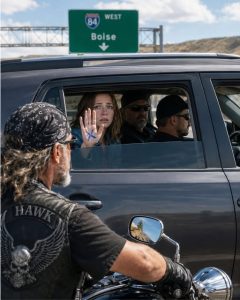
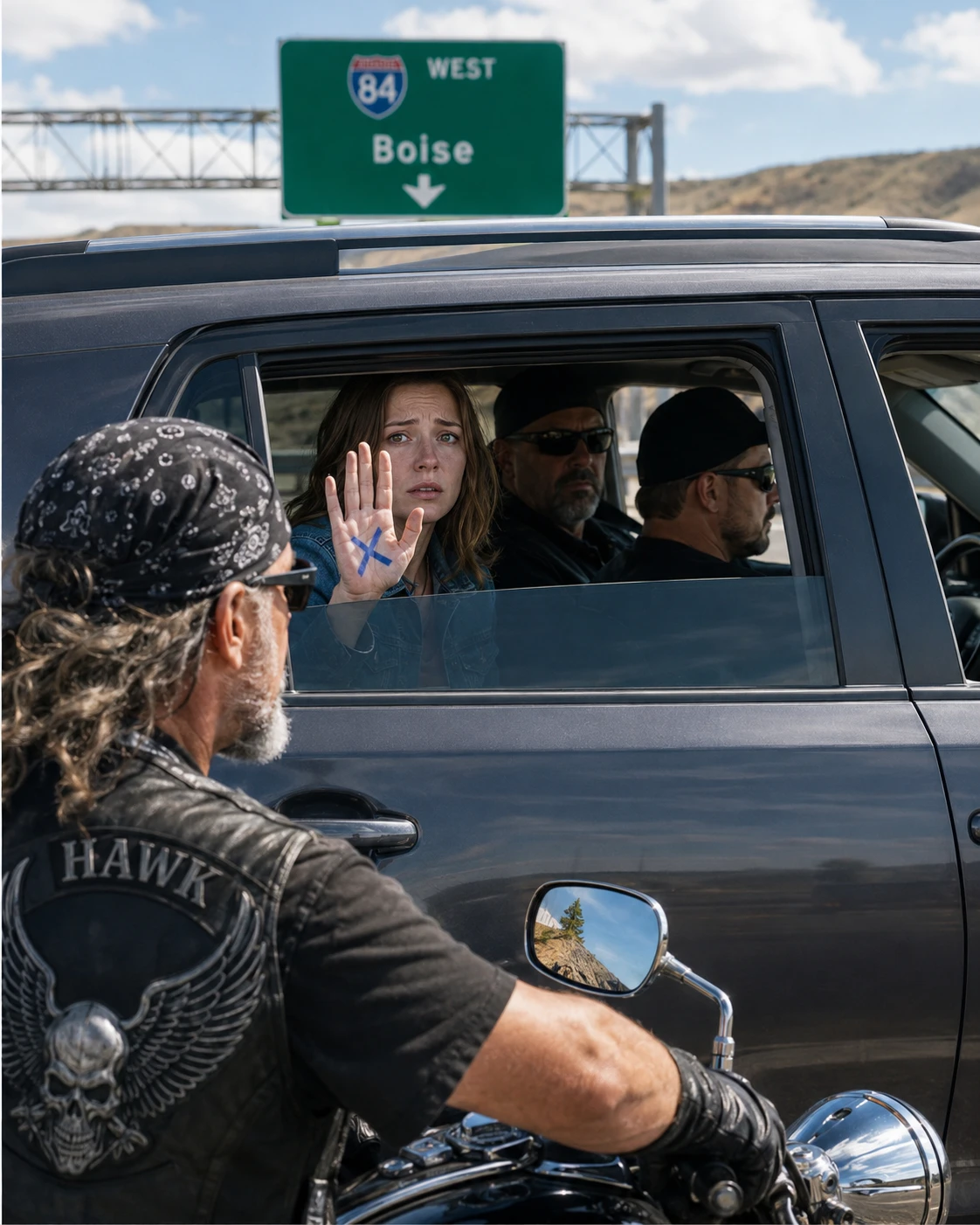
And then she saw him.
A motorcycle came up in the next lane.
Its rider was an older man in a black helmet, gray beard visible beneath the chin strap, shoulders broad under a worn leather vest. He rode with the calm balance of a man who knew weather, pavement, and trouble. There was nothing showy in the way he handled the bike. He did not weave. He did not posture. He simply appeared beside the rear window like an answer no one had promised.
Paige looked at him.
For one second, she was ashamed of how badly she needed him to look back.
For another second, he did not.
Then morning light struck the SUV’s rear window, and the biker’s head turned.
His eyes met hers.
Paige lifted her hand.
She pressed the blue X flat against the glass.
The biker’s expression changed.
Not dramatically. Not enough for the men in front to notice. But Paige saw it. Something in his face locked into place. A softness disappeared. A decision arrived.
His hand moved slightly toward the communication device clipped near his vest.
He did not speed forward.
He did not swing in front of the SUV.
He did not become foolish.
He looked once more at Paige, then ahead at the road.
“Please,” Paige mouthed.
The motorcycle moved forward.
For a horrible moment, she thought she had lost him.
Then, less than a minute later, another motorcycle appeared in the lane beyond them.
Then another.
Then one more behind.
Paige lowered her hand, folded her fingers over the blue X, and tried not to cry.
In the front seat, the passenger noticed the bikes.
“Lot of riders today,” he muttered.
The driver’s jaw tightened.
“Don’t look at them,” he said.
But Paige did look.
She looked because for the first time since the farmhouse door slammed shut behind her, the highway no longer felt empty.
PART 2: HAWK
Everett “Hawk” Tanner had learned long ago that panic was loud, but rescue had to be quiet.
At sixty-four, he had the weathered face of a man who had spent most of his life outdoors and most of his nights sleeping badly. His beard had gone from brown to iron gray. His hands had the thick knuckles of a mechanic and the careful steadiness of someone who had once held people together until ambulances came.
Hawk had been many things.
Army medic.
Long-haul hauler.
Volunteer searcher.
Widower.
Father.
And, though he rarely said it out loud, a man who had failed to save the one person whose voice still woke him in the dark.
His daughter, Rebecca, had been twenty-three when she disappeared near Interstate 84.
That was twenty-six years ago.
Back then, no one talked much about silent signals. No one taught cashiers or gas station attendants to notice the woman who smiled too hard. No one told bikers that a hand against glass might be a prayer.
Rebecca had called him from a pay phone outside Mountain Home. Her voice had trembled.
“Daddy, I think I made a mistake.”
Those were the last words he ever heard from her.
By the time he reached the pay phone, she was gone.
Her car was found two days later. Her purse was not. Her body was never recovered. The case became a box in a county building, then a rumor, then a grief Hawk carried like a stone under his ribs.
In the years after Rebecca vanished, Hawk became a man of highways. He rode them not because he loved freedom, though he did, but because roads remembered things people forgot. He joined with other riders, truckers, retired officers, dispatchers, and mothers who had lost daughters. They formed an informal watch network called Mile Eyes.
Not vigilantes.
Not heroes.
Just witnesses who refused to look away.
That morning, when Hawk saw the young woman’s face in the back of the SUV, something old moved in him.
At first it was only a flicker.
Pale face. Still body. No phone. Two men in front.
Then came the hand.
The blue X.
Hawk’s throat closed.
Not because he recognized the mark from a flyer. He recognized it because he had helped spread it.
The idea had begun at a church basement in Nampa, after a retired nurse asked, “What can someone do if speaking makes things worse?” Someone suggested tapping the window. Someone else suggested mouthing help. Hawk had taken out a blue shop pencil and drawn an X on his palm.
“Make it plain,” he had said. “Not pretty. Plain.”
Years later, younger volunteers like Paige Sullivan had turned that rough suggestion into community training.
Now the mark was on the window.
Now a woman was staring at him the way Rebecca had sounded on the phone.
Hawk pressed his mic.
“Charcoal SUV, westbound on I-84. Young woman in the back. Blue X on her palm.”
Owen Briggs answered almost immediately.
Owen was three miles back on a matte-black Indian, with a retired dispatcher named Lila riding in the support van behind him. Owen had spent thirty years as an Idaho state trooper before his knees gave out and his temper got too honest for promotion. He trusted Hawk more than he trusted most official reports.
“You certain?” Owen asked.
“I saw her face.”
“What mile marker?”
“Just passed forty-seven. Vehicle plate partially covered. Two men up front. Woman in back left. No visible phone.”
There was a short pause.
Then Owen’s voice dropped into the old command tone. “We’re close. Don’t crowd them. Keep eyes only.”
“I know.”
“Hawk.”
“What?”
“You know why I’m saying it.”
Hawk looked at the SUV ahead of him.
Because of Rebecca, he thought.
Because if he let anger touch the throttle, the young woman in that back seat might pay for it.
“I know,” Hawk said again.
He eased forward, letting another rider take the rear position. He memorized the SUV’s scratches, the dent near the left taillight, the strip of duct tape half-covering the plate. Traffic thickened near a construction merge. The driver of the SUV avoided eye contact with every vehicle around him.
That told Hawk plenty.
He clicked the mic again. “Lila, you got county?”
Lila’s voice came through, crisp and steady. “Already talking to dispatch. State police notified. They want confirmation before marked units engage.”
“The woman gave confirmation.”
“I agree,” Lila said. “They still want eyes from law enforcement.”
Owen cut in. “There’s a rest area nine miles ahead. If they take it, we hold back. If they don’t, state can roll a slowdown near the next exit.”
Hawk watched the passenger in the SUV turn around.
The young woman looked down at once.
Good girl, he thought.
Not because she was weak.
Because she was thinking.
The passenger said something to the driver. The SUV drifted slightly, then corrected. Hawk saw the driver glance at the motorcycles now spaced around him like ordinary traffic.
Too many to be chance.
Not enough to be a wall.
The balance had to be perfect.
Hawk’s hands remained loose on the bars, but inside him, twenty-six years gathered like thunder.
“Paige,” Lila said suddenly.
Hawk frowned. “What?”
“The community program reported one of their volunteers missing from a welfare meeting this morning. Paige Sullivan. Twenty-six. Denim jacket. Brown hair. Last known heading toward a property outside Meridian.”
Hawk’s breath caught.
Paige Sullivan.
He knew the name.
Not personally, but he had seen her on training materials, smiling beside folding tables and coffee urns, teaching people to notice what most of the world missed.
“She teaches the blue X,” Lila said softly.
Hawk looked at the SUV.
“Not today,” he whispered.
Owen heard him. “Say again?”
Hawk swallowed.
“I said not today.”
PART 3: PAIGE
Paige had always believed kindness was a kind of courage.
Her mother, Ellen Sullivan, had taught her that at the kitchen table, usually while slicing apples with a paring knife worn thin by use.
“Being careful doesn’t mean being cold,” Ellen would say. “It means keeping your eyes open while your heart stays open.”
Paige had tried to live that way.
She visited widows who were afraid to drive at night. She helped older men understand phone scams without making them feel foolish. She delivered safety cards to diners, libraries, and churches. She listened when people told her things they were embarrassed to admit.
She knew loneliness could make a person answer the wrong call.
That was why the message that morning had reached her.
The woman on the phone had called herself Caroline. Her voice had been shaky, breathless, threaded with shame.
“I got your number from the road-safety office,” Caroline had whispered. “They said you help women plan safe exits.”
Paige had sat up straighter at her small kitchen table, the light over Meridian coming in pale through the curtains.
“Are you in immediate danger?”
A pause.
“I don’t know.”
That answer had pulled Paige in more surely than a scream.
People in real danger often did not know where the line was. They lived so long inside fear that disaster felt like weather.
Paige had asked the right questions. Address. Other people present. Whether weapons were involved. Whether Caroline could call law enforcement.
“No police,” Caroline had said quickly. “Please. Not yet. I just need to talk to someone first. Please don’t send a man.”
Paige should have called her supervisor.
She should have taken a partner.
She should have followed every protocol she had helped write.
But Caroline had sounded older, maybe in her fifties, and so tired that Paige imagined her standing in a kitchen with bruised hope and packed bags. Paige thought of her own mother, gone now three years, who had once cried quietly in the laundry room when medical bills piled too high.
So Paige went.
The farmhouse was quiet when she arrived.
Too quiet.
The woman who opened the door wore a scarf over her hair and large sunglasses though they were indoors. She was small, hunched, and trembling.
“Caroline?” Paige asked gently.
The woman nodded once.
Then the two men stepped from behind the door.
Everything after that became fragments.
A hand over her mouth.
Her phone hitting the floor.
A voice saying, “Where is it?”
Paige gasping, “Where is what?”
The woman in sunglasses turning away.
That was the part that haunted her most in the SUV.
Not the men.
The woman.
Paige had seen her hand shake on the doorknob. She had seen tears under the sunglasses. Caroline, or whoever she was, had not looked cruel. She had looked trapped.
Now, in the back seat, Paige stared at the back of the passenger’s head and tried to understand what they wanted.
“Call him again,” the driver said.
The passenger held up Paige’s phone. “It’s locked.”
“Then make her open it.”
“No,” Paige said before she could stop herself.
The driver’s eyes snapped to the mirror.
“What did you say?”
Her heart pounded. She forced herself to speak evenly.
“I said no.”
The passenger laughed nervously. “She’s got some spine.”
The SUV swerved slightly as the driver’s hand tightened on the wheel.
“You think this is a negotiation?”
“I think if you needed me hurt, you would have done it already,” Paige said.
The words surprised her. They sounded like someone braver than she felt.
The passenger looked back.
Paige met his eyes and saw fear there.
That mattered.
People who were certain did not look afraid.
“What do you think we need?” he asked.
“I don’t know.”
“Then stop talking.”
The driver cursed under his breath. “Enough. We get off at Caldwell and switch vehicles.”
Paige’s stomach dropped.
Switch vehicles.
A moving highway had witnesses. A rest stop had cameras. An exit had gas stations, clerks, truckers, people.
But a second vehicle could vanish.
She looked out the window.
The motorcycles were still there.
One ahead.
One behind.
One far left.
They moved with unnerving patience, never too close, never too far.
The passenger saw her looking.
“Are they with you?”
Paige let her eyes go blank. “Who?”
“The bikers.”
“I don’t know any bikers.”
That was true.
The driver glanced toward the mirror again.
“Don’t play games.”
“I’m not.”
But something inside Paige had shifted.
She was still afraid. Fear had not left her body. It moved through her hands, her throat, her knees. But beneath it now was a narrow plank of steadiness.
Someone had seen.
Someone had believed her.
The driver reached for the exit lane.
At the same moment, brake lights appeared ahead.
Not sudden. Not dangerous. Just a slow red blooming across the highway.
Traffic began to compress.
The motorcycles adjusted.
The SUV slowed.
“What the hell?” the driver muttered.
Up ahead, orange cones narrowed the lanes near a maintenance vehicle. A state police cruiser sat angled on the shoulder, lights flashing lazily, as if this were routine roadwork.
The passenger straightened.
“That wasn’t there before.”
The driver’s jaw flexed.
“Shut up.”
Paige watched the cruiser.
A trooper stood beside it, one hand on his belt, sunglasses hiding his eyes. He did not look at the SUV directly. That made him look even more dangerous.
The driver kept moving with traffic, but the exit lane was blocked by a county truck.
Another cruiser appeared behind them.
The passenger whispered, “Dean.”
So that was the driver’s name.
Dean said, “Don’t say my name.”
The passenger swallowed.
Paige’s palm burned where the blue ink had dried.
The SUV crawled forward.
A motorcycle rolled up beside Paige’s window again.
It was Hawk.
He did not look at the men. He looked only at Paige.
Then he lifted his own left hand from the handlebar for one brief second.
On his palm, drawn in blue, was an X.
Paige’s breath broke.
The driver saw it.
“What is that?” he snapped.
The passenger twisted around. “What did you do?”
Paige said nothing.
Dean jerked the wheel toward the shoulder.
But the shoulder was no longer open.
A utility van blocked part of it. Another motorcycle filled the gap behind. The state cruiser ahead came alive, lights flashing hard now, siren whooping once.
“Hands visible!” a voice boomed through a loudspeaker. “Driver, put the vehicle in park!”
Dean slammed his palm against the wheel.
The passenger raised both hands at once. “I’m not dying for this.”
“Shut up!”
“I said I’m not dying for this!”
The SUV stopped.
For one second, no one moved.
Then Paige heard Hawk’s motorcycle cut off beside her.
The sudden silence was enormous.
PART 4: THE WOMAN AT THE FARMHOUSE
The rescue did not feel like rescue at first.
It felt like noise, commands, doors opening, boots on pavement, engines idling, and too much sky.
A trooper opened Paige’s door and crouched low so his face was level with hers.
“Ma’am, my name is Trooper Alvarez. You’re safe. Can you step out?”
Paige tried.
Her legs refused.
The trooper did not rush her.
“That’s all right,” he said. “Take your time.”
Across the SUV, Dean shouted something as officers pulled him from the driver’s seat. The younger passenger was already crying, babbling that he had not known, that Dean said it was only a scare, that nobody was supposed to get hurt.
Paige looked past them.
Hawk stood ten feet away, helmet under one arm, gray hair flattened, leather vest dusty from the road. He did not approach. He seemed to understand that after locked doors and strange men, even a rescuer could feel like too much.
Paige stepped onto the pavement.
Her knees buckled.
Trooper Alvarez caught her elbow.
“I’m sorry,” Paige whispered.
“For what?”
“I teach this. I should have—”
“No,” the trooper said firmly. “You survived this.”
The words entered her slowly.
You survived this.
An ambulance arrived. A blanket settled around her shoulders though the day was warm. Someone offered water. Someone asked medical questions. Someone else photographed the blue X on her palm.
Finally, Hawk came closer.
He stopped a few feet away.
“Paige Sullivan?” he asked.
She nodded.
“I’m Everett Tanner. Folks call me Hawk.”
“I know,” she said.
He looked surprised.
“You do?”
“You came to one of our trainings,” Paige said, her voice still thin. “At the VFW hall. You told everyone not to be heroes. You said being seen was sometimes enough.”
His eyes softened.
“I’m glad you remembered.”
“I remembered because you sounded angry when you said it.”
A shadow crossed his face.
“I suppose I was.”
Paige looked down at her palm.
“You had one too,” she said.
He opened his hand. The blue X was still there, darker and steadier than hers.
“Didn’t want you thinking you were alone.”
That was when Paige began to cry.
Not loudly. Not dramatically. Just a trembling collapse of the face, the kind that comes when the body finally believes danger has passed.
Hawk looked away to give her privacy, and that kindness only made it worse.
At the hospital in Boise, Paige told her story three times.
First to a nurse.
Then to Trooper Alvarez.
Then to a woman in a navy suit who introduced herself as Special Agent Maribel Chen.
Agent Chen had calm eyes and a folder already thick with papers.
“Paige,” she said, sitting beside the bed, “I know you’re exhausted. But I need to ask about the woman at the farmhouse.”
“Caroline,” Paige said.
“Was that the name she gave?”
“Yes. But I don’t think it was her real name.”
“Why?”
Paige closed her eyes.
“She looked frightened. Not like she was acting. Like she was being watched.”
Agent Chen exchanged a glance with Alvarez.
“What?” Paige asked.
The agent opened the folder and slid a photograph across the blanket.
It showed a woman in her late fifties, hair silver at the temples, eyes tired but gentle.
Paige stared.
The hospital sounds faded.
“That’s her,” she whispered. “That’s Caroline.”
“Her name is Nora Vale,” Agent Chen said. “She disappeared from Oregon eleven years ago.”
Paige’s throat tightened.
“Disappeared?”
“She was believed to be part of a larger group operating along interstate corridors. At first, we thought she was a victim. Later, evidence suggested she may have been helping them.”
“No,” Paige said.
“Paige—”
“No. I saw her face.”
Agent Chen did not argue.
Instead she asked, “Did she say anything after the men came in?”
Paige searched the broken pieces of memory.
The farmhouse.
The hand over her mouth.
Her phone falling.
The woman turning away.
Then something else.
A whisper near Paige’s ear while the men argued.
Not loud enough for them to hear.
Paige had missed it in the terror.
Now it returned.
“She said, ‘I’m sorry, little bird.’”
Hawk, who had been standing near the doorway with Owen, went completely still.
Agent Chen turned to him.
“Mr. Tanner?”
But Hawk was not looking at the agent.
He was looking at Paige as if the floor had vanished between them.
“What did you say?” he asked.
Paige frowned.
“She said, ‘I’m sorry, little bird.’”
Hawk’s face changed so deeply that he seemed to age ten years in one breath.
“My daughter used to say that,” he whispered.
No one spoke.
Paige felt something cold move through the room.
“What daughter?” she asked.
Hawk’s hand gripped the back of a chair.
“Rebecca.”
Agent Chen’s eyes sharpened. “Rebecca Tanner?”
Hawk nodded slowly.
“She disappeared twenty-six years ago,” he said. “Near I-84.”
Paige knew the story. Everyone in the program did. Not all the details, but enough. Hawk’s daughter. A pay phone. A cold case that had turned a grieving father into a highway watcher.
Agent Chen looked down at her folder, then back at Paige.
“Paige, were you adopted?”
The question struck like a slap.
“My parents were Ellen and Mark Sullivan,” Paige said.
“That’s not what I asked.”
Paige sat upright.
“My parents were my parents.”
“I understand.”
“No, you don’t.” Her voice shook. “My mother packed my lunches. My father taught me to change a tire. They were there.”
Hawk stepped back as though he had been the one struck.
Agent Chen softened her voice.
“I’m not trying to take them from you. I’m asking because Nora Vale was questioned years ago in connection with illegal private adoptions across state lines. Babies moved through rural clinics. Records altered. Mothers listed under false names.”
Paige’s mouth went dry.
“That has nothing to do with me.”
“Maybe not.”
But the room knew it might.
Hawk whispered, “Little bird.”
Paige looked at him.
“My Rebecca called her baby that before she was born,” Hawk said.
The words fell into the room one at a time.
Before she was born.
Paige could hear her own heartbeat.
“No,” she said, but it had no strength.
Agent Chen said, “When we searched the SUV, we found your phone, your purse, and a torn envelope. It had one line written on it.”
She showed Paige a clear evidence bag.
Inside was a scrap of paper.
The handwriting was shaky.
Give the girl to Hawk before Walt finds her.
Paige stared until the words blurred.
“Who is Walt?” she asked.
Hawk answered, but his voice was almost gone.
“Walt Dunn. Retired sheriff. Founder of your road-safety program.”
PART 5: THE BLUE LEDGER
By evening, the story Paige thought she knew about her life had begun to split down the middle.
Walt Dunn had been a hero in Meridian.
That was what everyone said.
Retired sheriff. Church deacon. Founder of the Horizon Road Safety Program. A man with a silver mustache, polished boots, and a way of placing his hand on your shoulder that made people feel chosen.
He had recruited Paige after her mother died.
“You have a gift,” he had told her. “People trust you.”
She had believed him.
Why wouldn’t she?
Grief makes certain voices sound like shelter.
Now Agent Chen sat beside Paige’s hospital bed and told her the shelter might have been a cage.
“We’ve been looking at Dunn for eighteen months,” she said. “Missing funds, altered call logs, volunteer reports that disappeared after being filed. We believe he used the road-safety program as a listening post.”
Paige felt sick.
“A listening post?”
“People in trouble called for help. Some were referred to legitimate resources. Some were not.”
Hawk stood by the window, arms folded tightly, his reflection pale in the glass.
Paige thought of Caroline’s trembling voice.
She thought of every time Walt had said, “Leave the complicated ones to me.”
“What did he want from me?” she asked.
Agent Chen hesitated.
“We think you found something.”
Paige frowned.
“I didn’t.”
“Maybe you didn’t know what it was.”
Owen, who had been quiet until then, stepped forward.
“Paige, did you ever copy files from the office? Reports, old call logs, anything like that?”
“I backed up training materials last week,” she said. “Walt asked me to clean out the old desktop before the grant audit.”
“What kind of backup?” Chen asked.
“A flash drive.”
“Where is it?”
“At home. In a blue folder on my desk.”
Agent Chen’s expression changed.
Hawk turned from the window.
Paige looked between them.
“What?”
Chen said, “The younger man from the SUV told us Dean kept saying, ‘She has the blue ledger.’ We thought he meant a notebook.”
Paige almost laughed, but it came out as a broken breath.
“A blue folder,” she said.
Within an hour, agents had the folder.
Within two, they had enough to arrest Walt Dunn.
The old desktop files Paige had copied contained more than brochures. They contained archived calls, payment records, old scanned documents, sealed adoption references, and notes from cases that should have gone to law enforcement but had been diverted.
One file was labeled R.TANNER_1999.
Hawk refused to sit when Agent Chen opened it.
Paige wished he would. She wished all of them could sit. She wished the world would stop producing doors that led to darker rooms.
The file contained a photograph of Rebecca Tanner, young and smiling, one hand resting on her pregnant belly.
There was also a clinic intake form.
Mother: Rebecca Tanner.
Infant: Female.
Status: transferred.
Beside the word transferred was a handwritten note.
Sullivan placement approved. Dunn notified.
Paige could not breathe.
Her parents had not stolen her.
That mattered. Agent Chen made it clear. Ellen and Mark Sullivan had believed they were adopting through a legal emergency placement. The documents they received had been forged by people they trusted.
“They loved you,” Hawk said hoarsely.
Paige turned to him.
He looked wrecked, but there was no accusation in him.
“They were your parents,” he said. “Don’t let wicked people dirty that.”
That was the sentence that broke her.
She covered her face with both hands, blue ink faded now to shadows in her palm, and sobbed for Ellen, for Mark, for Rebecca, for Hawk, and for the young woman she had been that morning before a car door locked and her past came calling.
Two days later, Paige insisted on seeing Nora Vale.
Agent Chen advised against it.
Hawk did too.
But Paige had survived the SUV, the highway, and the truth. She needed to look at the woman from the farmhouse and ask one question.
They met in a county interview room with a camera in the corner and a table bolted to the floor.
Nora Vale looked smaller without the sunglasses. Her silver hair was pinned back. Her hands trembled in her lap.
Paige sat across from her.
Hawk stood behind Paige, not touching her, but close enough that she could feel him there.
Nora looked at Hawk first.
“I’m sorry,” she whispered.
Hawk’s voice was rough. “For which part?”
Nora flinched.
“All of it.”
Paige leaned forward.
“Why did you call me little bird?”
Nora’s eyes filled.
“Because your mother did.”
“My mother was Ellen Sullivan.”
“Yes,” Nora said gently. “She was. But Rebecca was too.”
Paige absorbed the answer with a pain that was almost tenderness.
“Did you know who I was when you called me to that farmhouse?”
Nora nodded.
“Did you set me up?”
Tears slipped down Nora’s face.
“Yes.”
Hawk made a sound low in his throat.
Nora lifted both hands, shackles clinking.
“I did. And I hated myself for it before you ever knocked. Walt found out the federal people were circling. He thought you had copied the old records. He ordered Dean to take you somewhere quiet until he knew what you had. He told me if I didn’t make the call, he would send someone who wouldn’t leave you breathing.”
Paige went cold.
“So you chose the softer trap.”
“Yes,” Nora whispered. “And then I tried to give you the only chance I could.”
“The envelope,” Agent Chen said from the wall.
Nora nodded.
“I knew Hawk watched I-84. Walt hated that about him. Said the old biker was a ghost that wouldn’t stop haunting the road. I couldn’t call Hawk. Walt watched my calls. So I wrote the note and tore it when Dean saw me. I thought I failed.”
Paige stared at her.
“The blue X,” Nora said. “That was Rebecca’s idea first.”
Hawk’s head snapped up.
Nora looked at him with grief older than the room.
“The night she disappeared, she marked the pay phone glass with a blue grease pencil from her glove box. An X. She told me later she hoped someone would know she had been there.”
Hawk’s face emptied.
“You saw her later?”
Nora nodded, crying harder.
“She gave birth in a closed clinic outside Ontario. She was weak, but alive. Walt told me the baby would be placed safely and Rebecca would be taken home after she recovered. I believed him because I wanted to. Because I was afraid. Because I was a coward.”
“What happened to my daughter?” Hawk asked.
Nora bowed her head.
“I don’t know. I swear before God, I don’t know. The next morning she was gone. Walt said she ran. I never believed him.”
The silence that followed was terrible.
Then Paige asked, “Why come forward now?”
Nora looked at her.
“Because I saw you at a training last month,” she said. “You were teaching seniors at the church hall. You smiled just like Rebecca. And when you drew the blue X on your hand, I knew the road had given Hawk back what Walt stole from him.”
Paige’s eyes burned.
Nora swallowed.
“I couldn’t save your mother. I couldn’t save myself. But I thought maybe, if I could get the truth close enough to the surface, someone better than me would save you.”
Paige sat back.
She wanted to hate Nora.
Part of her did.
But another part saw the trembling woman from the farmhouse, trapped for decades in the machinery of a stronger man’s evil, and understood that guilt could be a prison too.
Forgiveness did not come.
Not then.
But understanding stood at the door.
Three weeks later, Walt Dunn’s arrest shook Idaho harder than any storm.
People who had praised him lowered their eyes in grocery stores. County officials denied knowing anything. Old cases reopened. Families who had been told to stop asking questions started asking again.
And Hawk Tanner received a call from Agent Chen.
They found Rebecca.
Not alive.
Hawk had not allowed himself that kind of hope.
But they found where she had been buried, beneath a false name, in a small cemetery near the Oregon line. The grave had been paid for in cash twenty-six years earlier.
On the day Hawk visited it, Paige went with him.
The cemetery sat under a wide sky. Wind moved through the grass. Hawk stood before the temporary marker with his helmet in one hand and a photograph of Rebecca in the other.
Paige stood beside him, wearing the denim jacket with the marker still in its pocket.
For a long time, neither spoke.
Finally Hawk said, “I missed everything.”
Paige shook her head.
“No.”
“I missed her childhood. I missed your birth. I missed your whole life.”
“You didn’t miss the highway,” Paige said.
He looked at her.
She took out the blue marker and held it between them.
“You saw me.”
Hawk’s face crumpled.
For the first time since Paige had met him, the old biker cried openly.
She stepped into his arms.
He held her gently at first, as if afraid history might punish him for wanting anything. Then his arms tightened, and Paige felt in that embrace not a replacement for the parents who raised her, not an erasure of the life she had lived, but an addition.
A root she had not known was hers.
A grief that had been waiting to become love.
Months later, Interstate 84 looked much the same to strangers.
Cars still hurried west outside Boise. Truckers still chased schedules. Families still passed snacks from front seats to back seats. People still worried about work, dinner, errands, and ordinary days.
But something had changed.
At rest stops, gas stations, diners, churches, VFW halls, senior centers, and truck plazas, blue X cards appeared beside cash registers and coffee pots.
Not official magic.
Not a guarantee.
Just a reminder.
Look twice.
Believe what you see.
Help without making danger worse.
Paige returned to the road-safety program under a new name and new leadership. She spoke more slowly now. She no longer pretended courage felt clean. When she stood before a room full of older volunteers, retired nurses, widowers, veterans, grandmothers, and truckers, she told them the truth.
“I was afraid,” she would say. “I was trained, and I was still afraid. So please remember this. Fear does not mean you failed. Silence does not mean there is no message. And one person paying attention can change the ending.”
Hawk attended every training he could.
He sat in the back, arms folded, pretending not to be proud.
At the end, Paige always asked him to stand.
“This is Everett Tanner,” she would say. “Most folks call him Hawk. He saw a blue X on a car window when everyone else missed it.”
Hawk would grumble, “I wasn’t the only one.”
Paige would smile.
“No. But you were the first.”
And every time, the room would rise for him.
The twist no one expected was not simply that Hawk had rescued his granddaughter without knowing her.
It was that Rebecca Tanner, gone for twenty-six years, had saved them both.
Her frightened mark on a pay phone had become her father’s mission.
Her father’s mission had become Paige’s training.
Paige’s training had become the blue X on the SUV window.
And that blue X had finally led the truth home.
One morning in late autumn, Paige and Hawk rode together to the place near mile marker forty-seven where he had first seen her hand against the glass. Paige was not on the back of his motorcycle. Hawk had taught her to ride her own.
She was careful. He was unbearable about safety. She loved him for it.
They parked on a quiet overlook above the highway. The land stretched gold and brown beneath the Idaho sky. Traffic whispered below.
Paige removed her glove and looked at her palm.
There was no ink there now.
No mark.
No plea.
Hawk stood beside her.
“You all right, little bird?” he asked.
The name still hurt.
It also healed.
Paige looked at the highway, at the shining stream of strangers, at all the windows behind which a life might be changing without anyone knowing.
Then she reached into her jacket and took out the blue marker.
She drew an X on her palm, steady this time.
Clean.
Bold.
Plain.
She pressed it gently against Hawk’s hand.
“I am now,” she said.
Far below, the traffic kept moving.
But Paige knew better than most that a highway was never just a highway.
It was a place where people vanished.
It was a place where people were found.
And sometimes, if one pair of eyes refused to look away, it was the place where a broken family came back together at last.