The night I earned one of the greatest honors of my military career, my husband looked across our candlelit dinner table and told me it meant nothing.
Not less than I thought.
Not he needed time to process it.
Nothing.
The fork slipped from Wesley’s fingers and struck the porcelain with a faint metallic clink.
That tiny sound divided my life into two pieces: the woman I had been before it, and the woman I became afterward.
My name is Andrea Miller. I was thirty-six years old, and I had spent fifteen years in the United States Army.
Two deployments.
Disaster-response missions.
Months in command centers where night and morning were distinguished only by the coffee pot.
Birthdays missed.
Christmases watched through video calls.
Friends buried.
Soldiers sent home alive because somebody had made the right decision when everything was going wrong.
That morning, my commanding officer had stood and extended his hand.
“Congratulations, Andrea. You’ve been selected for promotion to lieutenant colonel.”
For one second, I forgot how to breathe.
Then he smiled.
“Every hard decision, every soldier you protected, every holiday you sacrificed brought you here. You earned this.”
I carried those words home like treasure.
I wanted Wesley to be proud.
I bought steaks, asparagus, rosemary potatoes, and the expensive red wine he loved. I used our wedding china and lit two candles beneath the chandelier we had chosen nine years earlier.
Wesley walked in, glanced at the table, then checked his phone.
“What’s all this?”
“I have something to tell you.”
Twenty minutes later, after I described the promotion ceremony and confessed that my hands had actually shaken when I saw my name on the official list, Wesley chewed his steak and shrugged.
“So?”
I stared at him.
“So?”
“Your military rank means nothing to me.”
The pride inside me collapsed.
“Excuse me?”
“You heard me.”
Then he leaned back.
“Actually, the promotion makes what I need to tell you more important.”
My stomach tightened.
“My mother and Gwen are moving in tomorrow.”
His mother, Beulah, had never entered our home without criticizing something. She opened drawers, rearranged my kitchen, mocked my uniforms, and referred to my career as “playing soldier.”
Gwen, Wesley’s younger sister, was quieter but carried the same entitlement.
“How long?” I asked.
“Indefinitely.”
“You decided this without me?”
“They’re family.”
“This is my home too.”
Wesley’s expression hardened.
“That’s your problem, Andrea. You spend all day giving orders and come home forgetting you’re supposed to be a wife.”
I went very still.
“My mother is struggling financially,” he continued. “Gwen’s divorce has been difficult. They need stability. You have steady income, excellent benefits, and plenty of room.”
“My schedule is unpredictable.”
“Then make it predictable.”
I almost laughed.
But he wasn’t joking.
“You’ll cook,” Wesley continued. “Do the laundry. Keep the house clean. Mother has dietary requirements, so you’ll make separate meals for her. Gwen needs time to recover, so don’t pressure her to help.”
“You want me to wait on three adults while commanding a military unit?”
“I expect you to remember what matters.”
“The soldiers under my command matter.”
“And I’m your husband.”
His voice rose.
“You can refuse temporary assignments. Maybe this promotion will finally force you to get your priorities straight.”
And suddenly, nine years of excuses shattered.
When Wesley complained about my deployments, I had told myself he missed me.
When he mocked my medals, I blamed insecurity.
When he used money from our joint account without telling me, I called it compromise.
When he discouraged friendships and questioned late meetings, I convinced myself civilian life beside a career officer was difficult.
But now I understood.
Wesley did not hate the Army because it took me away.
He hated it because it reminded me I was capable of standing without him.
I rose and cleared the table.
A satisfied smile touched his lips.
He thought I had surrendered.
“What time are you leaving tomorrow?”
“Before six.”
“You’ll be back with them around eight?”
“Probably.”
“Understood.”
“That’s more like it.”
I lay beside him that night without sleeping.
At 5:42 a.m., Wesley kissed my forehead.
“See you tonight.”
The door closed.
I waited until his car disappeared.
Then I got up.
By seven, cardboard boxes covered our bedroom.
By nine, every possession belonging exclusively to Wesley had been separated from mine.
Clothes.
Shoes.
Computers.
Fishing equipment.
Photographs.
Nine years of marriage looked remarkably small once it was stacked inside boxes.
Then I reached into the back of the closet and touched something I had almost forgotten.
A black metal case.
My father’s.
He had given it to me shortly before his death six years earlier.
“Keep this somewhere safe,” he had told me.
“What is it?”
“Something I hope you never need.”
I laughed.
He didn’t.
Then he said something that had bothered me ever since.
“If your marriage ever becomes something you don’t recognize, open it.”
That morning, I finally did.
Inside were folders, photographs, financial records, photocopied birth certificates, newspaper articles, and an old cassette tape.
And one envelope.
My name was written across it in my father’s handwriting.
Andrea—
If you are reading this, Wesley’s family has finally shown you who they are.
My hands began trembling.
My father had worked in Army Criminal Investigation before retiring. He rarely spoke about old cases.
According to the documents, one case had never truly ended.
Thirty-one years earlier, a young accountant named Eleanor Graves discovered that her husband’s business partners were laundering money through shell companies using stolen identities.
One partner was Beulah Miller’s husband, Charles.
Eleanor intended to testify.
Then her husband died in what police called a boating accident.
Three weeks later, Eleanor disappeared.
The investigation collapsed.
Beulah claimed Eleanor had fled the country.
My father had believed otherwise.
A photograph showed Eleanor standing beside a dark-haired toddler.
Written beneath it were three words.
Wesley. Age two.
I stopped breathing.
I turned the page.
A birth certificate listed Eleanor Graves as Wesley’s mother.
Not Beulah.
The next document was worse.
A confidential report stated that investigators believed Beulah and Charles had taken the child after Eleanor disappeared and raised him under a modified identity.
Why?
Money.
Eleanor’s husband had established a substantial trust for his son.
Control of it passed to the child’s legal guardian if both parents died.
Except Eleanor hadn’t died.
She had vanished.
I grabbed the envelope again.
My father’s letter continued.
Eleanor survived.
We moved her under federal protection after an attempt was made on her life. She refused to return while the corruption investigation remained compromised. We never had enough evidence to remove Wesley safely from the household.
My throat tightened.
Then I reached the final paragraph.
Beulah knows I was involved.
If she ever realizes I preserved the evidence, she may come looking for it.
And Andrea—
I do not believe your meeting Wesley was accidental.
I sat on the floor.
For several minutes, I could hear nothing except my own heartbeat.
Wesley and I had met at a veterans’ charity event eleven months after my father retired.
He had spilled wine near my dress.
Apologized.
Bought me coffee.
A coincidence.
I had always called it fate.
Now it looked like something else entirely.
I made my first phone call to a military attorney I trusted.
The second was to a federal investigator whose name appeared inside my father’s files.
The third was to a telephone number written on the back of Eleanor Graves’s photograph.
I expected it to be disconnected.
A woman answered.
“Hello?”
My mouth went dry.
“Is this Eleanor?”
Silence.
Then:
“Who is this?”
“My name is Andrea Miller.”
Another silence.
Longer.
I forced myself to continue.
“I’m married to Wesley.”
The woman gasped.
Three hours later, she was on a flight.
At 7:53 that evening, headlights washed across my living-room wall.
Wesley had returned.
Beulah climbed from the passenger side while Gwen stepped from the rear.
They were laughing.
Wesley opened the front door.
“Andrea? Come help with these bags.”
He stopped.
His suitcases stood in a neat row beside the entrance.
“What the hell is this?”
Beulah pushed around him.
“What did she do now?”
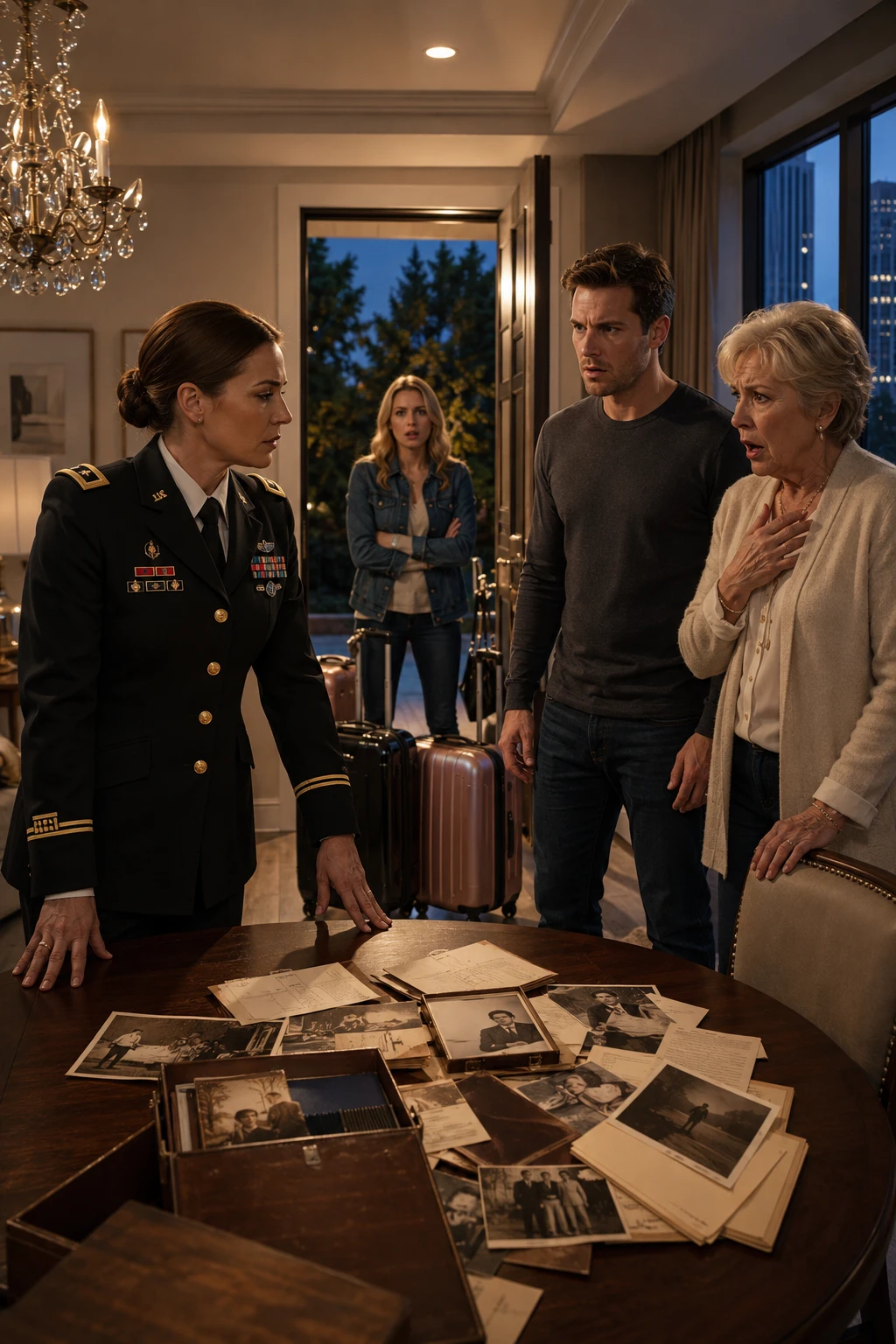
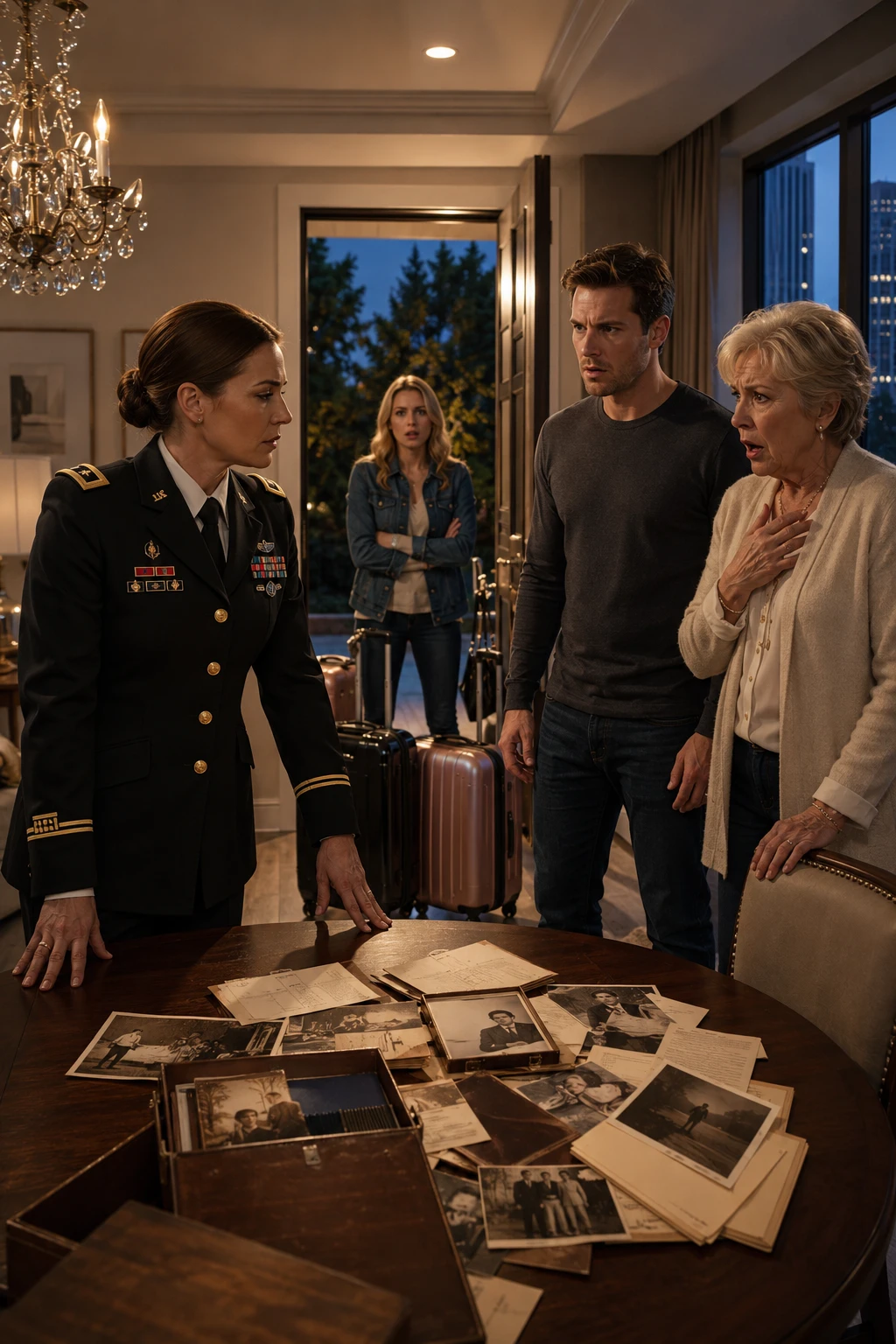
I stood beside the dining table.
My father’s files covered the polished wood.
Wesley looked at the papers.
Then his face changed.
“Andrea…”
Beulah saw the photograph.
Every trace of color left her face.
“No.”
Gwen frowned.
“Mom?”
Beulah grabbed the table.
“No. No, no, no.”
Headlights appeared outside.
Another car.
A gray-haired woman stepped from the passenger seat.
Beulah made a sound somewhere between a gasp and a scream.
The woman entered slowly.
Wesley stared at her.
She stared back.
For thirty years, she had imagined this moment.
“You have your father’s eyes,” Eleanor whispered.
Wesley looked at Beulah.
“My father?”
Beulah said nothing.
“Who is she?”
Eleanor’s eyes filled with tears.
“I’m your mother.”
Wesley laughed once.
A broken, disbelieving sound.
“No.”
“I gave birth to you on April seventeenth, 1995. You had pneumonia when you were fourteen months old. You couldn’t sleep unless someone hummed ‘You Are My Sunshine.’ You had a small crescent-shaped birthmark behind your left knee.”
Wesley stepped backward.
His hand unconsciously touched his leg.
Gwen whispered, “Mom, tell him she’s lying.”
Beulah’s mouth opened.
Nothing came out.
Then three hard knocks struck the door.
Federal agents entered.
Beulah immediately recovered enough to become furious.
“You manipulative little bitch,” she hissed at me.
One agent stepped between us.
“Beulah Miller, don’t move.”
She laughed.
“You have nothing.”
The lead investigator placed a folder on the table.
“Actually, we have quite a lot.”
Bank transfers.
Forgery.
Identity theft.
Fraud.
Conspiracy.
And newly recovered evidence relating to the death of Eleanor’s husband.
Gwen collapsed into a chair.
Wesley turned toward his mother—toward the woman he had believed was his mother.
“Did you kill him?”
Beulah stared at Eleanor.
“No.”
Eleanor answered quietly.
“You didn’t have to.”
She looked at Wesley.
“Charles sabotaged your father’s boat.”
Beulah exploded.
“You don’t know that!”
“I heard you arguing the night before.”
“You disappeared!”
“Because someone tried to kill me three weeks later.”
Beulah went silent.
The agents moved toward her.
Then Wesley said something that froze everyone.
“Wait.”
His voice was strangely calm.
“There’s something Andrea doesn’t know.”
I turned.
Wesley looked at me.
For the first time that evening, I saw something worse than fear in his eyes.
Shame.
“I knew your father investigated my family.”
My chest tightened.
“What?”
“I didn’t know all of this. I didn’t know Eleanor was my mother. But I knew your father kept something.”
My hands curled into fists.
“You knew?”
“Beulah told me years ago.”
Eleanor stared at him.
Wesley continued.
“She said your father ruined our family. She told me he had documents that could destroy us.”
The room seemed to tilt.
“And the charity event?” I asked.
Wesley closed his eyes.
Beulah shouted, “Don’t!”
That told me everything.
“You didn’t meet me by accident.”
“No.”
One word.
Nine years disappeared.
Wesley stepped toward me.
“Andrea, listen—”
“Don’t touch me.”
“I was supposed to get close enough to find out whether your father left evidence.”
Eleanor covered her mouth.
Gwen began crying.
“But then I fell in love with you,” Wesley said.
I laughed bitterly.
“Is that what tonight was? Love?”
“I became angry because you kept becoming stronger. Every promotion made leaving harder to control.”
The brutality of his honesty stunned even him.
One agent muttered, “That’s enough.”
But I wasn’t finished.
“So moving Beulah into my house?”
Wesley looked at the floor.
“She thought the evidence was here.”
Beulah’s eyes burned with hatred.
“She was right.”
My voice came out steady.
“The only thing she got wrong was assuming I would remain weak enough to let her search for it.”
The agents handcuffed Beulah.
Gwen was escorted outside for questioning.
Wesley remained standing in the living room while Eleanor watched the son stolen from her three decades earlier.
Then Eleanor did something I did not expect.
She walked toward him.
Wesley’s chin trembled.
“I’m sorry.”
Eleanor stopped.
“You were a child when they took you.”
Hope flickered across his face.
Then she continued.
“But you were a man when you chose what to do to Andrea.”
His face crumpled.
“Being harmed does not give you permission to become the person who harmed you.”
I would remember that sentence for the rest of my life.
Wesley looked at me.
“What happens now?”
I pointed toward the boxes.
“You leave.”
“And us?”
“There is no us.”
His shoulders fell.
I removed my wedding ring.
For years, I had imagined that taking it off would feel like failure.
Instead, it felt like removing something heavy from my hand.
Wesley left shortly after midnight.
But the final shock came three days later.
The investigator called me into his office.
“We found something in Beulah’s storage unit.”
He handed me an envelope.
It was addressed to my father.
Inside was a photograph taken six years earlier—the week before my father died.
Beulah stood outside his house.
On the back, my father had written:
If anything happens to me, it was never about the old case. It was about protecting Andrea.
I looked up.
“Are you saying she killed my father?”
The investigator shook his head.
“No.”
Then he placed another photograph beside it.
My entire body went cold.
The image showed my father sitting at a café.
Across from him sat Wesley.
The date was six days before Dad’s death.
“There’s surveillance video,” the investigator said.
I couldn’t breathe.
“Wesley met your father secretly.”
“Why?”
The investigator pushed a transcript toward me.
My father’s final recorded conversation had not been with Beulah.
It had been with Wesley.
I read Wesley’s words.
I can’t keep doing this. Andrea doesn’t deserve it. Tell me how to help you bring them down.
I stared at the page.
The investigator continued.
“Your husband had been cooperating with your father.”
Everything inside me stopped.
“What?”
“He planned to expose Beulah. Your father was helping him.”
“But Wesley said—”
“He lied tonight.”
“Why?”
“Because Beulah’s attorney had already contacted him. She threatened Eleanor.”
I looked up sharply.
The investigator nodded.
“Wesley knew Eleanor was alive.”
My knees weakened.
“He pretended to confess to targeting you so Beulah would believe he was still loyal to her. Federal investigators had been recording the entire confrontation.”
I could barely speak.
“So the cruelty? Moving them in? Everything he said at dinner?”
The investigator’s expression hardened.
“That part was real.”
And somehow, that hurt differently.
Wesley had tried to expose criminals.
He had also become controlling, bitter, and cruel.
Both things could be true.
There was no magical revelation that transformed abuse into love.
No secret mission that erased nine years of manipulation.
But there was one final page.
My father had written it before his death.
Andrea,
If Wesley ever chooses truth, help him if you can.
But never confuse helping someone with surrendering yourself.
You are not responsible for saving a man who refuses to become better.
I cried for the first time since promotion night.
Not because my marriage was ending.
Because my father had known exactly what lesson I would someday need.
Six months later, Beulah accepted a plea agreement tied to fraud, conspiracy, and obstruction charges while investigators reopened the circumstances surrounding Eleanor’s husband’s death.
Eleanor began rebuilding a cautious relationship with Wesley.
Gwen entered therapy and testified against the financial network that had supported her family for decades.
And Wesley?
He signed the divorce papers without contest.
The last time I saw him, he stood outside the courthouse.
“I did love you,” he said.
“I know.”
He looked surprised.
“Then why can’t you forgive me?”
“I can forgive you.”
His eyes lifted.
“But forgiveness doesn’t mean returning.”
He nodded slowly.
“I understand.”
“Do you?”
He looked toward the street where Eleanor waited.
“I’m learning.”
I walked away.
Three weeks later, I stood before hundreds of soldiers in dress uniform.
My promotion ceremony had been postponed because of the investigation.
When my new lieutenant colonel insignia was pinned into place, applause filled the hall.
For one second, I thought of the dinner table.
Your rank means nothing to me.
Then I heard my commanding officer’s voice.
“Lieutenant Colonel Miller, your command is yours.”
I looked across the soldiers waiting for me.
At the people who respected discipline without demanding submission.
Who understood that leadership was not control.
And in the front row sat Eleanor.
Beside her was an empty chair.
On it rested my father’s old Army cap.
I touched the new insignia at my collar.
For years, I had believed strength meant enduring whatever life placed in front of me.
I had been wrong.
Sometimes strength is staying.
Sometimes strength is fighting.
And sometimes the bravest order you will ever give is the one that tells you to walk away.
I stepped toward the podium.
And for the first time in nine years, I did not wonder whether someone at home would be angry about the woman I had become.
I simply became her.