The moment my father saw the truck turn onto our street, he dropped his keys and whispered the name of a dead woman.
“Claire.”
The keys struck the driveway with a metallic crack.
My mother froze beside him.
My younger brother Tyler stopped polishing his pearl-white Mercedes and slowly lowered the cloth in his hand.
I stood on the porch in my grocery-store uniform, a paper birthday crown crooked on my head. My manager had made me wear it during the morning shift, and I had forgotten to remove it before walking home.
It was my eighteenth birthday.
There had been no balloons waiting for me. No cake. No presents.
Mom had left a note on the refrigerator telling me to pick up milk.
Then the flatbed arrived.
It was enormous—a black tractor-trailer with chrome exhaust pipes and a silver star painted across the cab. Chained to the trailer behind it was a midnight-blue semi truck, beautifully restored, its long hood gleaming beneath the October sun.
Silver letters were painted across its doors:
BENNETT FREIGHT — TRUCK NO. 1
The driver climbed down, removed his cap, and looked toward the house.
“Are you Mara Bennett?”
I stepped off the porch.
“Yes.”
He smiled and held out a clipboard.
“Then this belongs to you.”
Behind me, Dad made a strangled sound.
“That truck was destroyed,” he said.
The driver glanced at him.
“Apparently not.”
Two years earlier, when Tyler turned sixteen, another vehicle had arrived on a flatbed.
That one had cost ninety-two thousand dollars.
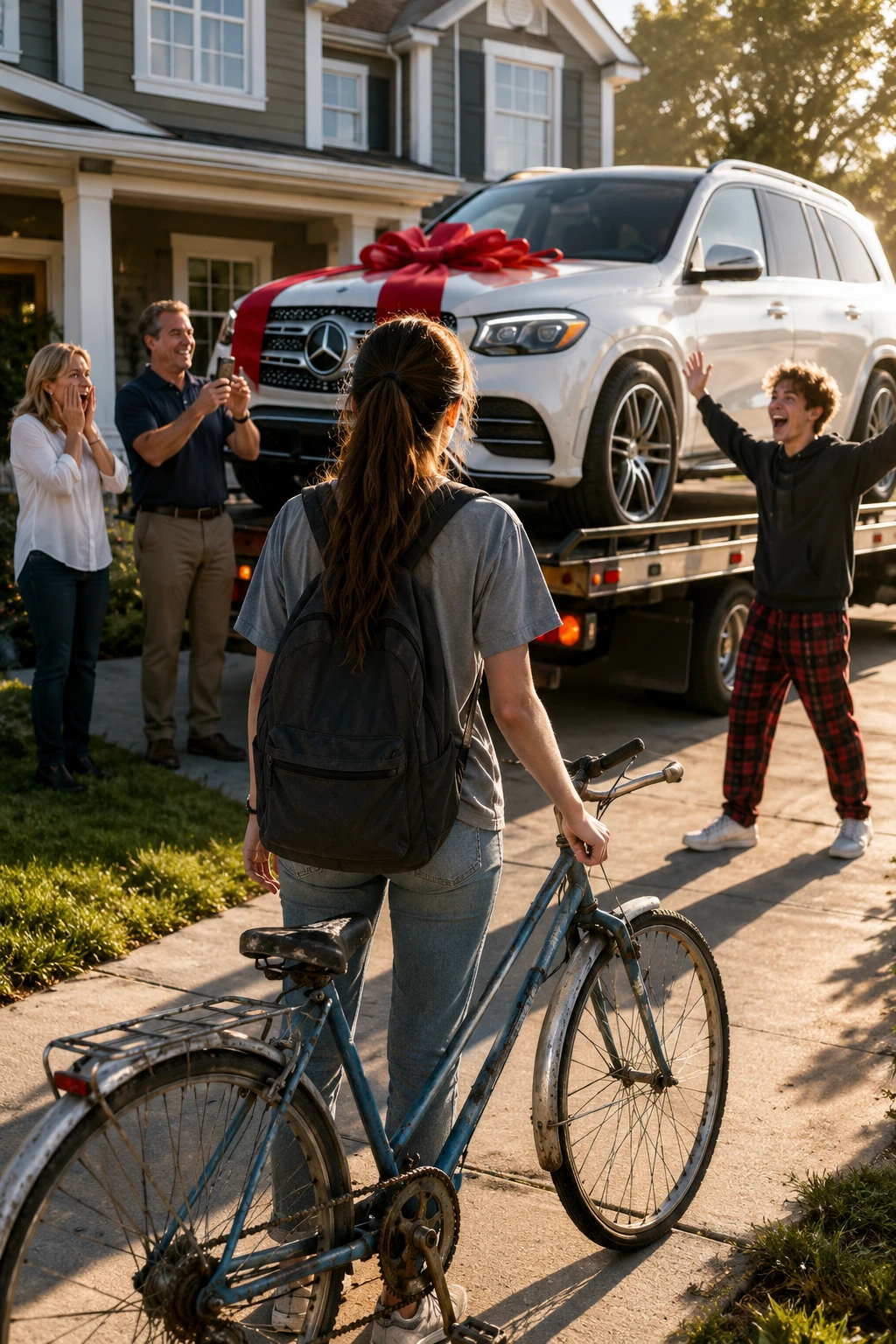
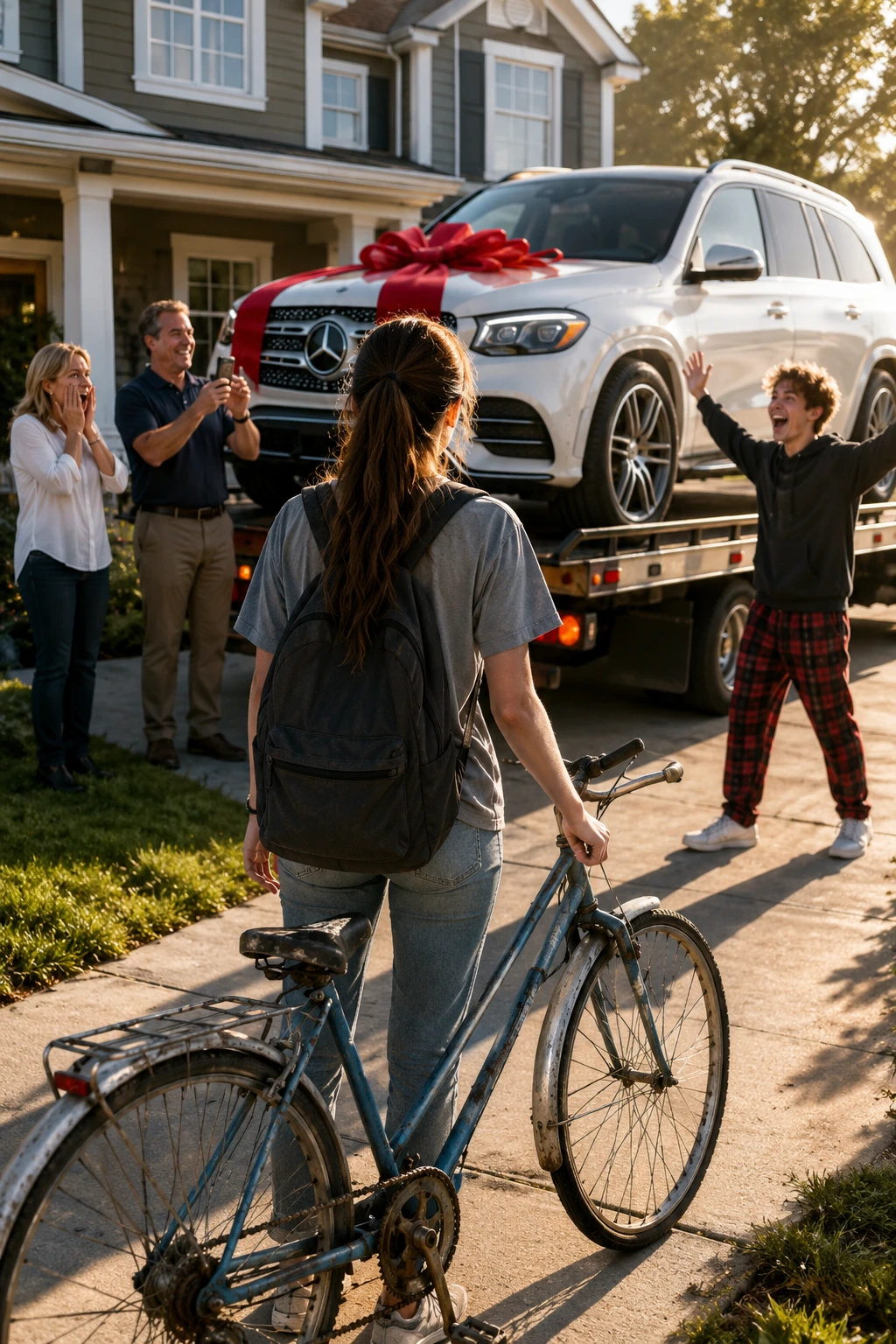
The entire neighborhood had gathered to watch it descend into our driveway: a pearl-white Mercedes SUV wrapped in a gigantic red bow.
Mom cried.
Dad photographed Tyler from every angle.
Mrs. Wilkins watched from across the street with her coffee. Children rode their scooters past our house three or four times, pretending they weren’t staring.
Tyler ran outside in plaid pajama pants.
“No way!” he shouted. “You actually bought it!”
Dad threw an arm around him.
“Nothing but the best for my boy.”
I stood near the sidewalk with my backpack over one shoulder, waiting to walk two miles to my shift at the grocery store.
No one looked at me.
No one remembered that, two years earlier, my own sixteenth birthday present had been a thirty-four-dollar bicycle with a flat tire.
Dad had called me into the garage that morning.
A faded blue women’s ten-speed leaned against the wall. Rust covered the chain. The rubber grips were peeling away, and a thrift-store sticker clung stubbornly to the frame.
$34.
The rear tire was completely flat.
Dad folded his arms.
“Learn how to struggle, Mara.”
That was all he said.
No cake.
No candles.
No hug.
Through the kitchen window, Grandma Ruth had watched him.
She stood perfectly still, holding a dish towel.
She didn’t defend me. She didn’t confront Dad. At dinner, she quietly passed the potatoes and looked at him only once.
For years, I believed the expression in her eyes had been disappointment.
I was wrong.
It had been recognition.
Now, on my eighteenth birthday, the restored Bennett Freight truck sat in our driveway like something risen from a grave.
The flatbed driver handed me the clipboard.
Dad rushed forward.
“Don’t sign anything.”
The driver pulled it away from him.
“Sir, this delivery is for Mara.”
“You don’t understand,” Dad said. “That vehicle belonged to my family.”
A black sedan turned onto our street before he could say more.
It parked behind the flatbed.
Grandma Ruth emerged from the passenger side wearing a gray wool coat. A tall woman with a leather briefcase followed her. Two police cars stopped at the curb behind them.
Mom gripped Dad’s arm.
“Dennis,” she whispered, “what is happening?”
Dad stared at Grandma.
“You.”
Grandma walked toward us without hurrying.
She looked smaller than I remembered. Her silver hair moved gently in the wind, but her eyes were sharp.
“I told you,” she said to Dad, “that stealing has a way of becoming visible.”
Tyler stepped away from his Mercedes.
“Grandma?”
The woman beside her opened the briefcase.
“My name is Rachel Cohen. I represent Ruth Bennett, the Bennett family trust, and, as of nine o’clock this morning, Mara Bennett.”
I looked from her to Grandma.
“What trust?”
Dad lunged for the clipboard.
One of the officers moved between us.
“Mr. Bennett, step back.”
“This is family business!”
“No,” Grandma said. “This is criminal business.”
The street had gone silent.
Curtains shifted in neighboring windows. Mrs. Wilkins stood on her porch again, holding another cup of coffee, as though she had been waiting two years for the second act.
Grandma stopped in front of me.
“Sign for the truck, sweetheart.”
My hand trembled as I took the pen.
Dad’s voice cracked.
“Mara, don’t.”
I signed.
The driver gave me a ring containing one large silver key and a smaller brass one.
“Happy birthday.”
Then he lowered the ramps.
Grandma touched the blue truck’s fender with her fingertips.
“Your mother drove this truck.”
I almost laughed.
“My mother drives a Honda Civic.”
Elaine flinched.
Grandma looked directly at me.
“Elaine is not your biological mother.”
The driveway seemed to tilt beneath my feet.
Mom—or Elaine—covered her mouth.
Dad closed his eyes.
Grandma continued before either of them could interrupt.
“Your mother’s name was Claire Bennett. She was my daughter. Dennis’s older sister.”
I stared at Dad.
“My father is my uncle?”
“Yes.”
The word struck harder than any slap.
I looked at Elaine.
“You knew?”
She began crying.
“We raised you. That has to count for something.”
“You lied to me for sixteen years.”
“We were trying to give you a normal life.”
Dad found his voice.
“Claire died when Mara was two. Someone had to take her.”
Grandma’s expression hardened.
“And someone had to control Claire’s money.”
Rachel removed several folders from her briefcase.
Claire Bennett, Grandma explained, had founded Bennett Freight with her father at twenty-one. She began with the blue truck now sitting in our driveway and built the company into a regional shipping business.
When my grandfather died, Claire became majority owner.
Dad received a smaller share.
He resented her for it.
After Claire’s death in a highway accident, her controlling shares were placed in trust for me. Dad and Elaine became my legal guardians. Dad was appointed temporary trustee because he worked in insurance and claimed to understand finances.
“He was required to preserve the trust until you turned eighteen,” Rachel said. “Instead, he treated it like his personal account.”
Dad shook his head.
“That’s a lie.”
Rachel opened the first folder.
“Private-school tuition for Tyler. Family vacations. Mortgage payments. A boat registered under your coworker’s name. And, two years ago, a ninety-two-thousand-dollar Mercedes SUV.”
Tyler looked at the vehicle behind him.
The color vanished from his face.
“No,” he whispered.
Rachel produced a bank statement.
“The money came from Mara’s education fund.”
I remembered standing beside the sidewalk while Dad photographed Tyler.
I remembered my worn sneakers, my grocery-store uniform and the cold pavement under my feet.
My brother’s Mercedes had not merely cost ninety-two thousand dollars. It had been purchased with money stolen from me.
Tyler turned on Dad.
“You said you got a bonus.”
“I did what was necessary for this family.”
“For this family?” I asked. “Or for the child you actually wanted?”
Dad’s jaw tightened.
“You always were ungrateful.”
Grandma stepped between us.
“No, Dennis. She was observant.”
Then she looked at the garage.
“Where is the bicycle?”
My stomach tightened.
“What?”
“The blue bicycle he gave you.”
“It’s in the garage.”
Dad suddenly moved.
He sprinted toward the side door.
The nearest officer caught him before he made it three steps.
“Let go of me!” Dad shouted. “That bicycle belongs to me!”
Grandma’s face became terrifyingly calm.
“No,” she said. “It belonged to Claire.”
Everyone fell silent.
I opened the garage.
The bicycle stood behind the lawn mower, exactly where I had left it. The tire was still flat. The chain remained rusted. The $34 sticker was still attached to the frame.
Grandma approached it as if approaching an old friend.
“Claire rode this bicycle in college,” she said. “She painted it herself. That uneven silver line beneath the seat was her idea of decoration.”
She pointed to a faded mark I had never noticed.
“A month before Claire died, she came to me frightened. She believed Dennis was manipulating company insurance claims and moving money through false repair accounts.”
Dad struggled against the officer.
“You’re insane.”
“Claire planned to report him,” Grandma continued. “Then her brakes failed on Interstate 94.”
Elaine made a faint, wounded sound.
The official investigation had called Claire’s death an accident. A damaged brake line. An old vehicle. Tragic timing.
The insurance claim had been processed by Dad’s own office.
He had helped arrange the inspection.
“There was never enough evidence,” Grandma said. “Claire’s files disappeared. Her office was emptied. Her personal belongings were donated before I could examine them.”
She touched the bicycle’s handlebar.
“When Dennis gave you this bicycle, I recognized it through the kitchen window. He must have found it mixed with Claire’s remaining possessions and taken it to the thrift store years earlier. Then he bought it back without realizing what it was.”
“Why would the bicycle matter?” I asked.
“Because Claire always hid spare keys inside the left handlebar.”
Dad stopped fighting.
Grandma peeled away the cracked rubber grip.
Inside the hollow metal tube was a tiny roll of waxed cloth.
She slid it out and unwrapped it.
A brass key fell into her palm.
It matched the smaller key the delivery driver had given me.
Grandma smiled sadly.
“I searched for this for sixteen years.”
The brass key opened a compartment beneath the blue truck’s sleeper cab.
The driver released two locks and raised a narrow steel panel. Behind it stood an old gray safe bolted to the frame.
Grandma inserted both brass keys—Claire’s and mine.
The safe opened.
Inside were three ledgers, a stack of photographs, a sealed envelope and a small cassette recorder wrapped in plastic.
Dad’s knees buckled.
One officer caught him.
Elaine backed away as though the safe contained something alive.
Grandma lifted the recorder.
“Claire knew Dennis had begun searching her office. She put copies of everything inside this truck, then hid the truck in a leased warehouse under her friend’s name.”
“Why wasn’t it found?” Tyler asked.
“Because Claire’s friend died before she could tell me. The storage company sold its property last year. When the new owners checked the abandoned units, they found the truck.”
Grandma pressed Play.
Static filled the driveway.
Then a woman’s voice spoke.
My mother’s voice.
Even through the crackling tape, I heard determination—and fear.
“My name is Claire Bennett. It is March 11, 2008. If this recording is found, my brother Dennis has discovered what I know.”
Dad began shaking his head.
“No.”
The recording continued.
“Dennis has been filing fraudulent accident claims through Bennett Freight. When I confronted him, he said the company should have belonged to him. Yesterday, I found the brake warning light disconnected in my car.”
Elaine stared at Dad.
“You told me she was paranoid.”
“I told her to have the car inspected,” Claire’s voice said. “The mechanic found a clean cut in the rear brake line. Dennis was the only other person with access to my garage.”
One of the officers reached for his radio.
Dad shouted over the recording.
“This proves nothing! She could have recorded that anytime!”
Claire’s voice continued.
“I am taking the car to the police tomorrow. Until then, the original mechanic’s report, photographs and financial ledgers are inside Truck Number One. The ownership certificate transferring my voting shares to my daughter is here too.”
Grandma opened the envelope.
Inside was a document bearing Claire’s signature.
Rachel looked at me.
“Your mother placed fifty-one percent of Bennett Freight into an irrevocable trust for you. Under its terms, any trustee found to have stolen from you forfeits all family shares and must repay the trust at triple damages.”
Dad stared at me with naked hatred.
“You think you can run a freight company?”
“I didn’t even know it existed ten minutes ago.”
“Exactly.”
Tyler stepped forward.
“She won’t have to learn alone.”
Dad stared at him.
“What did you say?”
Tyler looked sick, but his voice held.
“I found Mara’s name on the Mercedes paperwork last winter. The dealership sent a service notice, and Dad told me to throw it away. I opened it.”
He reached into his jacket and removed a folded envelope.
“The financing account was linked to her trust. I took pictures and sent them to Grandma.”
I stared at him.
“You knew?”
“Not when they bought it.” His eyes filled with tears. “I swear. I thought they were spoiling me because they loved me more.”
He looked back at the Mercedes.
“For a while, I liked believing that.”
Then his voice broke.
“But after I found out, every time I drove it, it felt like I was driving around in something stolen from you.”
Dad laughed bitterly.
“And yet you kept driving.”
“Grandma told me to act normal while she built the case.”
The spoiled smiles, the complaints, the photographs—Tyler had continued playing the role Dad expected.
Even the missing floor mats.
All of it had kept our parents from realizing anyone knew.
Rachel nodded toward the flatbed.
“The Mercedes is being seized as an asset purchased with misappropriated funds. The house is also subject to recovery.”
Elaine sank onto the porch steps.
“Our house?”
“Twenty-six mortgage payments came from Mara’s trust.”
Dad looked around wildly.
“You can’t take everything.”
Grandma’s voice softened, but only slightly.
“You took everything from Claire.”
The officers handcuffed him.
As they led him toward the police car, Dad looked at me.
For one desperate moment, I expected an apology.
Instead, he said, “You were always weak.”
I looked at the broken bicycle, the truck and the neighbors watching from their porches.
Then I looked at him.
“No,” I said. “You just needed me to believe I was.”
He was charged with fraud, embezzlement, evidence tampering and, after the mechanic’s report was authenticated, murder.
Elaine accepted a plea agreement for helping conceal the stolen trust funds. She admitted she had always known I was Claire’s daughter. She claimed fear had kept her silent.
Perhaps that was true.
But silence, I learned, could be many things.
It could be fear.
It could be cowardice.
Or, in Grandma Ruth’s case, it could be a weapon being sharpened.
Bennett Freight was smaller than it had been during Claire’s lifetime, but it was still profitable. Grandma became my adviser. Rachel helped recover the stolen money and restructure the company.
Tyler surrendered the Mercedes voluntarily.
With part of his savings, he bought a ten-year-old pickup truck. He began working after school in the Bennett Freight warehouse, loading pallets beside men who did not care what he had received on his sixteenth birthday.
We did not become close immediately.
Some wounds require more than one honest conversation.
But he showed up.
Again and again.
That mattered.
The following spring, Grandma and I restored Claire’s bicycle together.
We removed the rust. Replaced the chain. Wrapped the handlebars in soft black tape. I kept the faded blue paint and the silver line beneath the seat.
I also kept the thrift-store sticker.
$34.
People often asked why the majority owner of a shipping company rode an old bicycle to work when a restored truck worth hundreds of thousands of dollars sat in the company museum.
I never explained.
The bicycle was not a symbol of how little I had once been worth.
It was proof that value could survive neglect.
It could survive rust, abandonment and years spent hidden in the dark.
On the first anniversary of Dad’s arrest, Grandma handed me one final envelope found inside Claire’s safe.
The letter contained only three lines.
My dearest Mara,
Someday, someone may try to convince you that struggle is all you deserve.
Never confuse what they give you with what you are worth.
I read it twice.
Then I turned the page over.
A photograph had been taped to the back.
It showed Claire at nineteen, laughing as she stood beside the blue bicycle.
Next to her stood a much younger Grandma Ruth.
And between them, wearing an oil-stained mechanic’s uniform, was a teenage boy I recognized immediately.
My father.
All three were smiling.
For years, I had imagined Dad had never loved me because I wasn’t good enough.
The truth was stranger and crueler.
He had hated me because every time he looked at me, he saw the sister he could never defeat.
He had taken her company.
Her money.
Her life.
Then he had tried to take my sense of worth.
But Claire had left me the truck.
Grandma had found the truth.
Tyler had chosen a side.
And I had kept the bicycle.
In the end, the broken thing Dad gave me as an insult became the one piece of my mother he had failed to destroy.
The Mercedes disappeared from our driveway. The house was sold. My parents’ photographs vanished from the mantel.
But the bicycle remained.
And every morning, before entering the company my mother had built, I passed it in the glass lobby beneath a small silver plaque.
The plaque did not mention its price.
It carried only six words:
SHE KEPT GOING. SO DID I.