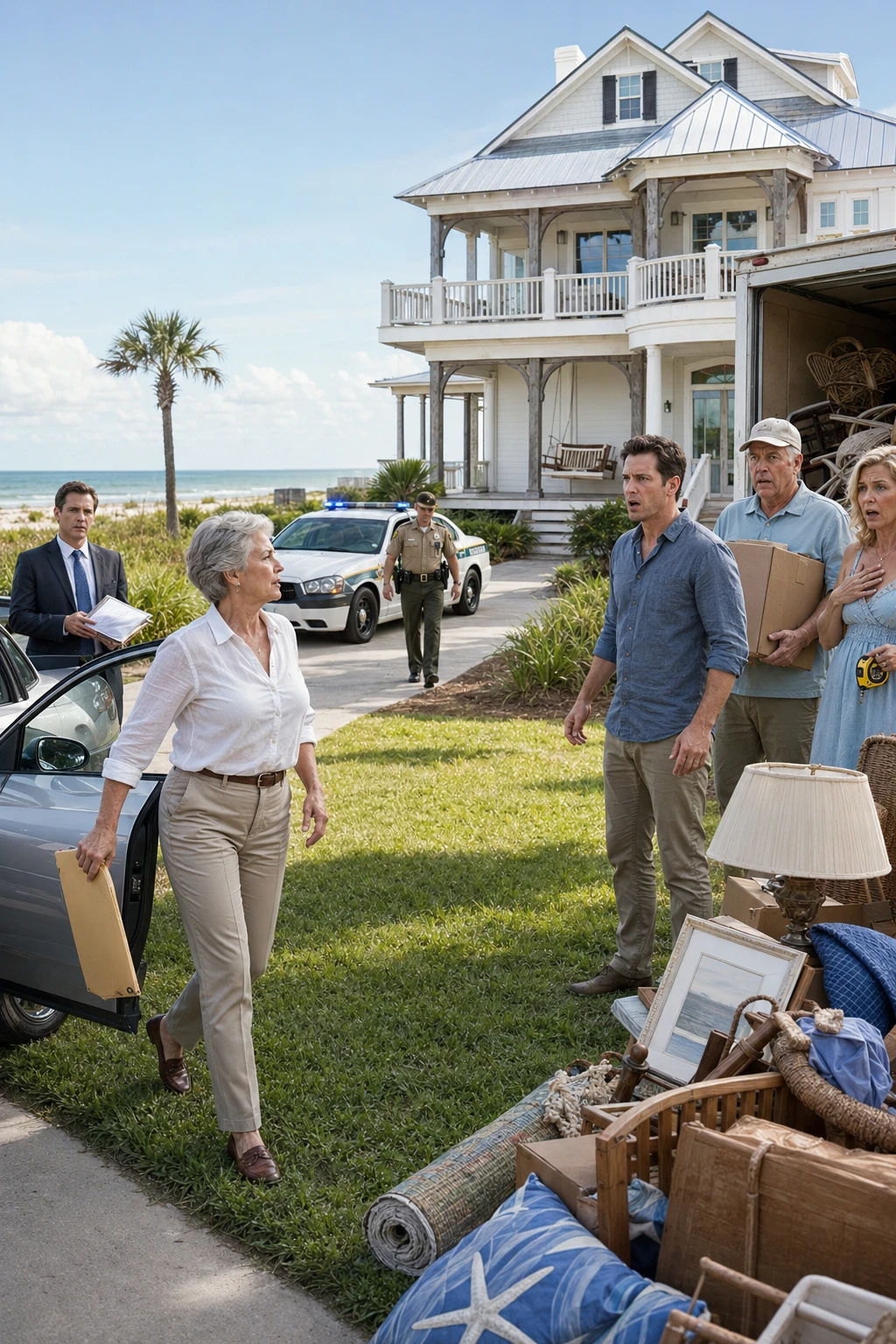
My son waited until the sun was turning the Gulf of Mexico the color of melted copper to tell me he had given my house away.
Not sold it.
Not borrowed it.
Given it away.
“Mom, Megan’s parents are moving into the villa,” Derek said.
I sat motionless on the white-oak porch swing I had built with my own hands, listening to pelicans cry over the water.
For a moment, I thought I had misunderstood him.
“What did you say?”
“Megan’s parents lost their lease. They need somewhere permanent. You still have the apartment in Mobile, so this makes the most sense.”
I lowered the paperback resting in my lap.
“You decided who gets my house?”
There was a sigh on the other end.
The impatient kind people use when explaining something obvious to a child.
“Mom, you don’t need two homes.”
I looked through the porch railing toward the dunes.
“Derek, I built this house.”
Silence.
Long enough for me to hear my only son deciding how cruel he was willing to be.
Then he made his choice.
“It belongs to them now.”
Another pause.
“And honestly, you’re not welcome there anymore.”
The words should have shattered me.
Instead, something inside me became perfectly still.
I thought about the rotten cottage I had bought twenty years earlier.
The summers I spent covered in sawdust.
The nails I drove.
The cabinets I sanded.
The bathroom floor I tiled while my right shoulder was strapped because of a torn rotator cuff.
Then I heard another voice.
Not Derek’s.
Arthur’s.
My husband had been dead nearly twenty-two years, but sometimes his voice still arrived in my mind with astonishing clarity.
Never surrender your home because somebody shares your blood, Viv. Property can reveal things love keeps hidden.
I inhaled slowly.
“All right, sweetheart,” I said.
Derek sounded surprised.
“That’s it?”
“I understand.”
I ended the call.
Then I dialed my attorney.
My name is Vivien Ivers.
I am sixty-seven years old.
And until three weeks ago, I believed there was almost nothing my son could do that would make me stop loving him.
I was wrong.
Twenty years earlier, the Gulf Shores villa had been a condemned cottage priced at $85,000.
The front porch sagged six inches.
Raccoons had nested in the attic.
Mold crept behind the bathroom sink.
The kitchen cabinets smelled like seawater and cigarettes.
Everyone who toured it saw demolition.
I saw Arthur.
Before cancer took him, we had planned to retire near the Gulf. Arthur used to sketch houses on restaurant napkins.
“Big porch,” he would say.
“Too expensive.”
“Then I’ll build it.”
“You can’t even hang a picture straight.”
“That’s because your pictures are crooked.”
That was Arthur.
He could make an argument sound like flirting.
After he died, I could not bring myself to use the life-insurance money.
It sat untouched for two years.
Then one August afternoon I walked through that ruined beach cottage, stepped onto the unstable porch, and watched the Gulf through three live oaks.
I knew.
This was the house Arthur never got to build.
So I bought it.
And I rebuilt it for both of us.
I replaced floor joists.
I repaired the foundation.
I framed two additional bedrooms.
I learned drywall.
I learned tile.
I took a weekend electrical course so I could assist with the rough wiring.
My neighbor, Tommy Guidry, a licensed contractor with forearms like fence posts and the vocabulary of a pirate, handled whatever the county required a professional to touch.
“You realize normal widows take cruises?” he once told me.
“I get seasick.”
“You live beside the ocean.”
“I don’t live on it.”
By the third summer, the cottage had become a four-bedroom villa with a wraparound porch, reclaimed cypress cabinets, pale coral bedroom walls, and gardenias along the rear fence.
The final thing I built was the swing.
White oak.
Six feet wide.
Arthur and I had talked about building one together.
When I hung it, I sat alone until midnight.
I cried harder that night than I had at his funeral.
But in the morning, I made coffee.
And the house became mine.
Not because of the deed.
Because of what it cost me to become the woman capable of finishing it.
Still, I kept paperwork.
Every receipt. Every permit. Every inspection report. Every tax statement.
Arthur had been an accountant.
He believed paperwork was simply memory that could testify.
That habit eventually saved me.
Six years before Derek’s phone call, he arrived at the villa carrying grocery-store carnations and a manila envelope.
He was thirty-five then.
Still handsome in the way his father had been.
Same brown eyes.
Same easy smile.
He kissed my cheek.
“Brought your favorites.”
“You brought carnations.”
“You like carnations.”
“I like peonies.”
“Close enough.”
He laughed and sat at the kitchen table.
Then he slid the envelope toward me.
Inside was a quitclaim deed.
He explained that adding his name to the house would make things easier if I became ill.
“No probate mess. No legal fight. I could take care of everything.”
I stared at the document.
Something tightened beneath my ribs.
“Why now?”
He smiled.
“Because I worry about you.”
Then he said the one sentence that almost made me sign without thinking.
“Dad would want me protected.”
My hand froze.
Arthur’s old warning flashed through my memory.
Never put the house in anyone else’s name.
Not even Derek’s.
Property changes people.
But Derek was my only child.
I had raised him.
Bandaged his knees.
Paid for college.
Sat beside his hospital bed when he had appendicitis at fourteen.
How could I look at my son and treat him like a threat?
So I signed.
He hugged me.
“You’ll never regret trusting me.”
I regretted it before his taillights disappeared.
I called Doris Palmer.
Doris had been my closest friend since we were twenty-eight. By then, she was a retired family-court judge with white hair, sharp glasses, and no patience for sentiment disguised as logic.
“Did he record it?” she asked immediately.
“I don’t know.”
“Find out.”
The next morning, we did.
He had not.
Derek apparently believed my signature alone had transferred the property.
Doris stared at me over her glasses.
“Your son is either careless or stupid.”
“Doris.”
“I spent thirty-four years listening to people destroy themselves because nobody loved them enough to call them stupid.”
Within two weeks, with the help of estate attorney Martin Coyle, the property was placed into the Vivien A. Ivers Revocable Living Trust.
Sole trustee: Vivien Ivers.
Sole beneficiary: Vivien Ivers.
Derek never knew.
I kept the documents in a safe-deposit box.
For six years, I hoped that decision had been unnecessary.
Then came the phone call.
Two weeks after Derek told me I was no longer welcome in my own house, Megan’s father arrived to inspect his “new place.”
Ray Proctor did not knock.
He walked through the kitchen opening cabinets and testing faucets.
Then he sat on Arthur’s porch swing, put both boots on the railing, and opened a beer.
He called his wife on speaker.
“Donna, you’re gonna love this. Four bedrooms, ocean view, wraparound porch.”
Then he laughed.
“We hit the jackpot.”
Jackpot.
As though twenty years of work had fallen out of a vending machine.
I stood in the doorway taking photographs.
Ray lifted his beer.
“Don’t worry about clearing out all the kitchen stuff, Vivien. Donna’s bringing her own dishes.”
I smiled.
“How thoughtful.”
The next day, Donna arrived carrying fabric samples and a tape measure.
She walked directly into my bedroom.
“These coral walls have to go.”
She measured the windows.
“Gray,” she announced.
“What?”
“We’re painting everything gray. More modern.”
Then she found old paint cans in the garage.
Seafoam.
Coral.
Driftwood.
Colors I had chosen while kneeling beside Arthur’s old box of house sketches.
“These are ancient,” Donna said to Megan on speakerphone.
Then she touched my curtains between two fingers.
“And these smell like an old woman.”
I was six feet behind her.
She never looked at me.
That was when my hurt began turning into something colder.
Not revenge.
Clarity.
A week later Megan placed a photocopy of the quitclaim deed on my kitchen table.
She had dressed for the occasion.
Cream blouse.
Gold bracelet.
Perfect hair.
The uniform of someone who believed paperwork made cruelty respectable.
“Derek took your name off this property six years ago.”
“No, he didn’t.”
Her smile tightened.
“His name is on the deed.”
“My signature is on the deed.”
“Same difference.”
“No. It isn’t.”
She leaned back.
“My parents need the villa more than you do.”
I studied her.
“The right thing for which family, Megan?”
“The family that needs it most.”
Then something strange happened.
Her phone lit up.
She flipped it facedown almost instantly.
But not before I saw the name.
PETER HOLLIS.
I knew that name.
I did not yet know why.
“I’m glad we understand each other,” I said.
She collected her purse.
When she left, I photographed the deed.
Then I photographed the name I had written on a grocery receipt.
Peter Hollis.
That name would matter.
More than any of us realized.
While Donna shopped for gray paint, I met with Tommy.
He still had copies of the renovation permits.
Together, we assembled two binders.
Purchase price: $85,000.
Renovation expenses: $247,000.
Taxes and insurance across twenty years: approximately $120,000.
More than $450,000 invested through my savings, work, and Arthur’s insurance.
Martin, my attorney, expected the ownership question to be simple.
Then he found the loan.
Derek had listed the villa as a personal asset on a business credit application eighteen months earlier.
Not merely mentioned it.
He had represented it as collateral.
Martin removed his glasses.
“This is no longer just a family property dispute.”
“What does that mean?”
“It means somebody used a property Derek doesn’t own to support a loan.”
My stomach turned.
“Could he go to jail?”
“Potentially.”
Despite everything, the word hurt.
He was still my child.
Martin must have seen it.
“Vivien, I need you to understand something. Protecting yourself is not the same as wanting him destroyed.”
I nodded.
But when I drove home that evening, I pulled over twice because I could not see through my tears.
The Proctors scheduled their move for Saturday.
They terminated their lease.
Rented a seventeen-foot U-Haul.
Invited six friends.
They even told neighbors they had inherited the villa.
I let them.
Saturday morning, Tommy stationed himself across the street pretending to repair a fence.
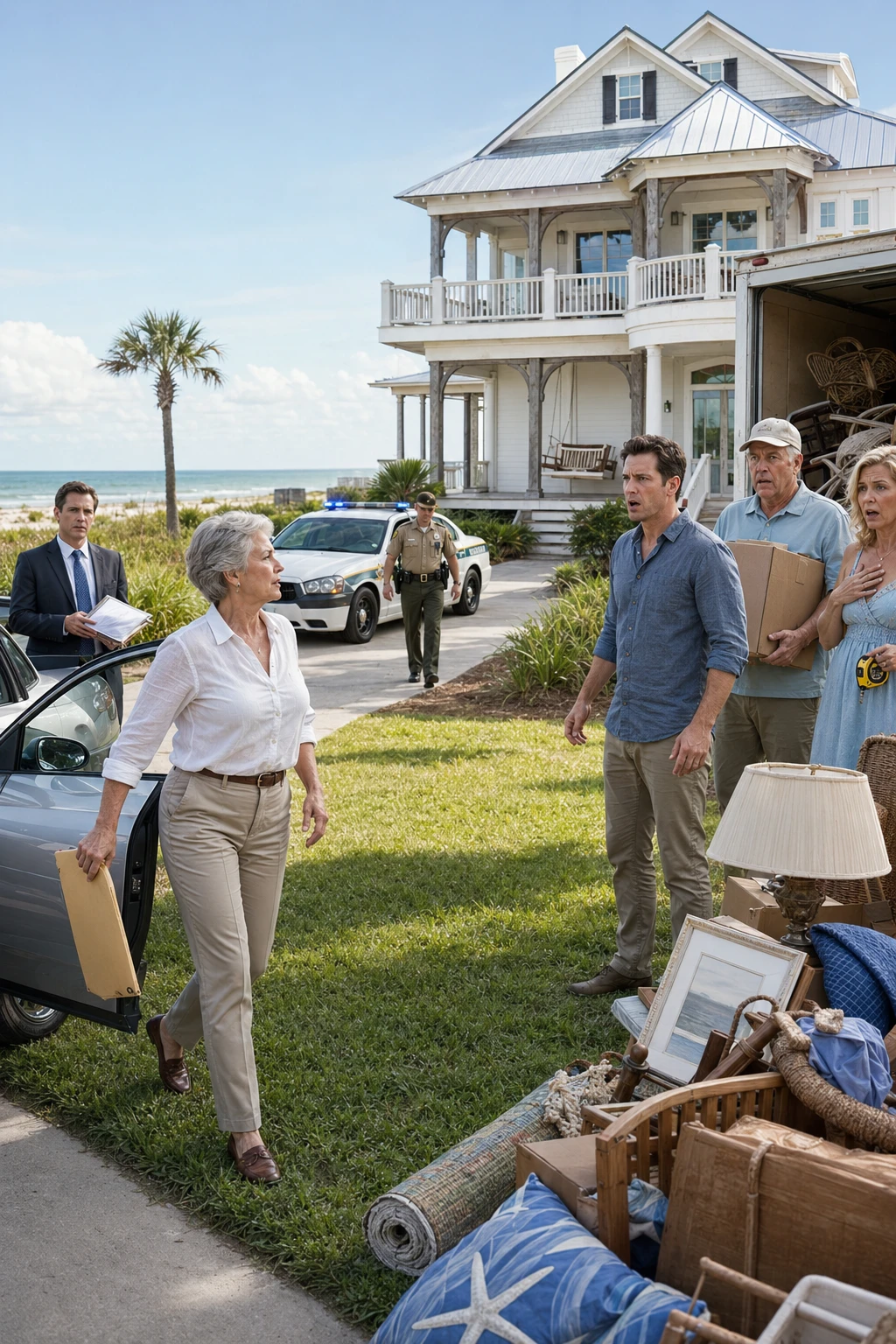
At 7:30, the truck arrived.
By eight, boxes covered my lawn.
MASTER BEDROOM.
KITCHEN.
DONNA—CLOSET.
Ray’s friends carried coolers and folding chairs.
Donna wore a yellow sundress.
Derek and Megan arrived at 8:15.
At 8:52, Tommy texted me.
They’re all here.
I was parked at a gas station off Highway 59.
Pressed khakis.
White linen blouse.
Manila folder beside me.
I’ll be there at nine.
At exactly nine, I turned onto Gulf Shore Drive.
I parked behind the U-Haul.
Derek saw me get out.
His expression changed.
“Mom? What are you doing here?”
I looked at the boxes.
The strangers.
Arthur’s swing buried behind furniture.
“Good morning, Derek.”
He lowered his voice.
“We talked about this.”
“Yes.”
“You agreed.”
“No. I said I understood.”
His face tightened.
“What’s that supposed to mean?”
“It means I understand exactly who you are now.”
Then a Baldwin County sheriff’s cruiser entered the cul-de-sac.
Every conversation stopped.
A silver Lexus followed.
Martin stepped out carrying the trust documents.
Ray lowered the box in his arms.
Donna’s tape measure hung motionless from one hand.
Megan stared at me.
The deputy stopped beside Derek.
“Mr. Derek Ivers?”
Derek swallowed.
“Yes.”
Martin opened his folder.
“This property is owned by the Vivien A. Ivers Revocable Living Trust. Mrs. Ivers remains sole trustee and beneficiary.”
Megan shook her head.
“No. We have a deed.”
“You have an unrecorded quitclaim deed that never transferred legal title.”
Ray stared at Derek.
“You said the place was yours.”
Derek turned toward me.
“You tricked me?”
I almost laughed.
“No, sweetheart. I protected myself.”
Then the deputy removed another document.
“We also need to discuss a financial application associated with a loan issued through Gulf Atlantic Commercial Credit.”
Megan’s face changed.
“What loan?”
Derek went completely still.
Martin continued.
“The villa was listed as collateral.”
Megan stared at her husband.
“Derek?”
“I can explain.”
“How much?”
He said nothing.
The deputy answered.
“Four hundred and eighty thousand dollars.”
Donna gasped.
Ray whispered something I will not repeat.
Megan backed away from Derek.
“You told me the loan was seventy-five thousand.”
That surprised me.
Then Martin looked at her.
“You knew there was a loan?”
Megan realized too late that she had spoken.
The deputy turned toward her.
“Mrs. Ivers, we’ll need to ask you several questions as well.”
Derek’s face drained.
“Megan, don’t.”
She looked at him.
And something passed between them.
Not affection.
Fear.
The deputy noticed it too.
So did I.
Then Megan said, “I want an attorney.”
That was the moment everything changed.
Because innocent people may ask for attorneys.
Smart people often do.
But Derek looked at his wife as though she had just stabbed him.
The Proctors did not move in that day.
The U-Haul left full.
Ray and Donna went to a motel.
Derek left with the deputy voluntarily for questioning.
Megan drove away alone.
I should have felt victorious.
Instead, I stood among flattened grass and scraps of packing tape wondering how my family had become evidence.
Martin touched my shoulder.
“There’s something else.”
I looked at him.
“The loan officer who approved Derek’s application was named Peter Hollis.”
The name from Megan’s phone.
I felt a chill despite the August heat.
“You’re sure?”
“Yes.”
“Why was Megan talking to him?”
“We don’t know.”
But Doris did.
Or at least she knew how to find out.
That evening, we sat at my kitchen table while rain struck the windows.
Doris had made three phone calls.
Then she placed her cell phone down.
“Peter Hollis and Megan Proctor dated in college.”
I stared at her.
“For how long?”
“Nearly four years.”
My stomach dropped.
“Before Derek?”
“Yes.”
Martin leaned forward.
“And Hollis personally handled the loan.”
The room went quiet.
Then another fact arrived.
A devastating one.
The loan proceeds had not gone to Derek’s business.
Most of the money had been transferred through two shell companies.
One was linked to Peter.
The other—
to Megan.
Derek called me from Martin’s office the following afternoon.
“Mom.”
His voice sounded twenty years younger.
Terrified.
“Did you know?” I asked.
“No.”
“About Megan?”
“No.”
“About Peter?”
A pause.
“I knew they dated. Years ago.”
“Did you know she was still seeing him?”
Silence.
Then he began crying.
My son had not cried in front of me since Arthur’s funeral.
“She handled the paperwork,” he whispered. “She said Peter could get us better terms.”
“For what?”
“My construction company was failing.”
That was the first I had heard of it.
He had hidden everything.
Losses.
Debts.
Unpaid subcontractors.
The polished life Derek and Megan showed everyone was collapsing.
“I thought the villa was mine,” he said.
“You wanted it to be yours.”
“I thought the deed—”
“You never checked.”
“I know.”
“And you gave my home to her parents.”
His crying stopped.
That silence hurt more.
Finally he said, “She told me if they moved in, selling later would be easier. She said you’d eventually accept it.”
There it was.
The part that belonged entirely to him.
Megan might have manipulated him.
But he had still chosen to throw his mother out of her own home.
“I’m sorry,” he whispered.
“I know.”
“Can you forgive me?”
I closed my eyes.
“Someday.”
That was all I could give him.
Three days later, investigators confirmed the scheme.
Megan and Peter had inflated the valuation of assets associated with Derek’s company.
The villa was the strongest piece.
Peter approved the loan using fraudulent documentation.
Money flowed through Derek’s company and then outward into accounts he barely monitored.
Megan planned to leave him.
Peter planned to leave his wife.
And my villa was supposed to become something else entirely.
Not Donna and Ray’s retirement home.
A staging ground.
Once they occupied it, Megan intended to pressure Derek into selling.
The proceeds would supposedly repay company debt.
Instead, investigators believed the money would disappear.
Derek had been arrogant.
Entitled.
Careless.
But he had also been used.
It would have been easy to make Megan the final villain.
She wasn’t.
Because the most shocking thing was still inside Arthur’s old paperwork.
Martin and I were preparing documents for the investigation when he opened a sealed envelope from the safe-deposit box.
I had seen it before.
Never opened it.
Arthur had written on the front:
FOR VIVIEN—ONLY IF THE HOUSE IS EVER THREATENED.
My heart stopped.
“Arthur wrote that.”
Martin frowned.
“You’ve never opened it?”
“No.”
My hands shook as I broke the seal.
Inside was a letter.
And another document.
The letter began:
Viv,
If you are reading this, then something I hoped would never matter has finally mattered.
I need you to forgive me for keeping one last secret.
I sat down.
Martin said nothing.
Arthur’s letter explained that, shortly before his cancer diagnosis, he had discovered something while reviewing family financial records.
Derek, then seventeen, had needed blood after a serious car accident.
Arthur learned his blood type made biological paternity impossible.
He never confronted me.
Because there was nothing to confront.
I had never been unfaithful.
Arthur knew that.
So he investigated quietly.
And discovered the truth.
At the hospital where Derek had been born, two infant identification records had been corrected after a documentation error.
Arthur had spent months tracing it.
Then he found another family.
Another baby boy born six minutes after Derek.
Arthur believed the babies had been switched.
My vision blurred.
“No.”
Martin leaned toward me.
“Vivien?”
I could barely breathe.
Arthur’s letter continued.
He had arranged private DNA testing without telling me.
Hair from Derek’s childhood brush.
A sample from himself.
Later, with permission disguised as a genealogy project, a sample from the other family’s son.
The results were conclusive.
Derek was not biologically ours.
The other man was.
My hands began shaking so violently the pages rattled.
Arthur had made one final decision.
He refused to tell me while he was dying.
He wrote:
You are Derek’s mother in every way that matters.
I am his father in every way that mattered to me.
Do not let biology steal the years we chose him every morning.
But I created a private trust from funds you do not know about.
If Derek ever tries to take your home from you, open the attached document.
Because there is one person who deserves to know the truth then.
The attached document contained a name.
Peter Hollis.
I stopped breathing.
Martin stood.
“Oh my God.”
Peter Hollis.
Megan’s former lover.
The loan officer.
The man helping steal money through Derek’s business.
Arthur’s investigation said Peter was the biological child born to me that night.
DNA testing was repeated under legal supervision.
There was no mistake.
Peter Hollis was my biological son.
Derek had been raised by me.
Peter had been raised by another family.
And somehow, more than forty years later, my two sons had become opposite sides of the same crime without knowing they were connected at all.
But the final shock belonged to Megan.
When confronted with the DNA evidence, she broke.
She admitted she had discovered the hospital-switch possibility almost two years earlier while researching Derek’s family medical history.
Then she searched for Peter.
She found him.
She learned who he was.
And she never told either man.
Instead, she used the secret.
Peter believed Megan had reconnected with him because she loved him.
Derek believed his wife was saving his company.
Neither knew she had deliberately placed them in the same financial scheme.
Why?
Because Arthur’s hidden trust contained nearly $1.8 million in investments.
The beneficiary clause was unusual.
The funds would pass to Vivien during her lifetime.
Afterward, they would be divided between “the son raised by Arthur and Vivien Ivers and any biological child of Vivien Ivers later conclusively identified.”
Megan had discovered enough old records to suspect the money existed.
She planned to control both men.
Derek through marriage.
Peter through romance.
Eventually, she expected access to both sides of the inheritance.
The villa was only the beginning.
Six months later, Megan pleaded guilty to multiple financial crimes.
Peter cooperated with investigators and received a reduced sentence, though he lost his career.
Derek avoided prison but spent nearly a year rebuilding his company under court supervision and repaying creditors.
Ray and Donna moved to Pensacola.
I heard they rented a two-bedroom condo.
Gray walls.
I hope they were happy with them.
As for Peter—
there is no simple ending when you discover your son at sixty-seven.
The first time we sat together alone, he stared at my hands.
“I have your fingers,” he said.
I laughed.
Then I cried.
So did he.
He did not call me Mom.
I did not ask him to.
Some relationships begin with birth.
Others begin with truth.
Derek came to the villa several weeks later.
He stood on the porch but would not enter.
“I don’t know what I am anymore,” he said.
I walked toward him.
“You’re my son.”
“But Peter—”
“Is also my son.”
“What does that make me?”
I touched his face.
“The boy I raised. The man who hurt me. The man who now has to decide what kind of person he wants to become.”
He looked down.
“Do you still love me?”
That question broke what remained of my anger.
“Yes.”
“After everything?”
“Yes.”
“But you don’t trust me.”
“No.”
He nodded slowly.
“I guess I earned that.”
“You did.”
Then he surprised me.
“I’ll earn something better.”
It was the first promise he made that I did not immediately believe.
But I wanted to.
A year after the U-Haul arrived, I hosted dinner at the villa.
Tommy grilled red snapper.
Doris brought pecan pie.
Martin brought wine that cost too much.
Peter came.
Derek came.
They stood awkwardly beside the porch railing, two men connected by an accident neither had caused and a betrayal both had survived.
At one point Derek looked toward the white-oak swing.
“Dad built that?”
I shook my head.
“I did.”
Peter smiled.
“Was Arthur handy?”
“Absolutely not.”
Derek laughed.
A real laugh.
For the first time in a long while, I heard his father in it.
Then something occurred to me.
All those years, I had believed blood created the deepest claim.
Then I believed deeds did.
Then trusts.
Then DNA.
I had been wrong every time.
Ownership is not love. Blood is not loyalty. And family is not proven by what someone can legally take from you.
Family is revealed when taking becomes possible—
and they choose not to.
That evening, after everyone left, I sat alone on the porch swing.
The Gulf turned copper again.
Just as it had the afternoon Derek called.
Only now two framed photographs rested on the table beside me.
One showed Derek at seven, missing both front teeth, sitting on Arthur’s shoulders.
The other showed Peter and me on the beach three months earlier, both laughing because a wave had soaked our shoes.
Different lives.
Different histories.
Both mine.
I thought about Arthur’s final secret.
For years I might have called it betrayal.
Now I understood why he had waited.
He had not hidden the truth to protect himself.
He had hidden it because he believed being a father was something he had already chosen.
A breeze moved through the gardenias.
The swing creaked beneath me.
And I smiled.
Derek had once told me the villa belonged to someone else.
He had been wrong.
But in a strange way, so had I.
The house had never belonged only to me.
It belonged to the widow who rebuilt herself inside it.
To the husband whose dream survived him.
To the frightened boy I raised.
To the son I never knew I had.
To every nail, scar, mistake, betrayal, forgiveness, and second chance that had led us back to that porch.
But the deed?
The deed remained exactly where it belonged.
Vivien A. Ivers Revocable Living Trust.
Sole trustee:
Me.
And after everything my family had taught me, there was one thing I knew with absolute certainty.
Love could reopen my door.
Forgiveness could earn a seat at my table.
But nobody—blood relative or otherwise—was ever getting my house again.