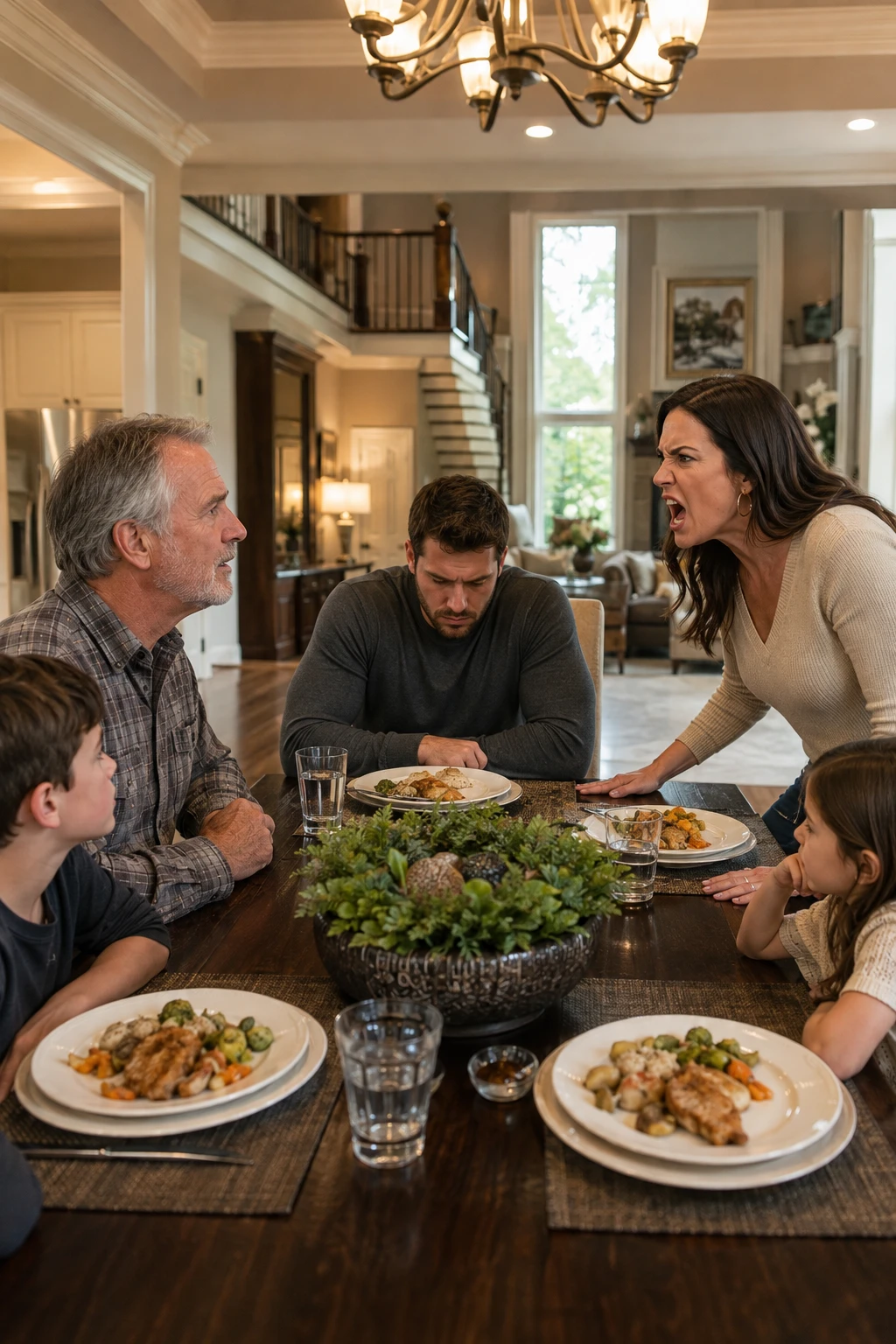
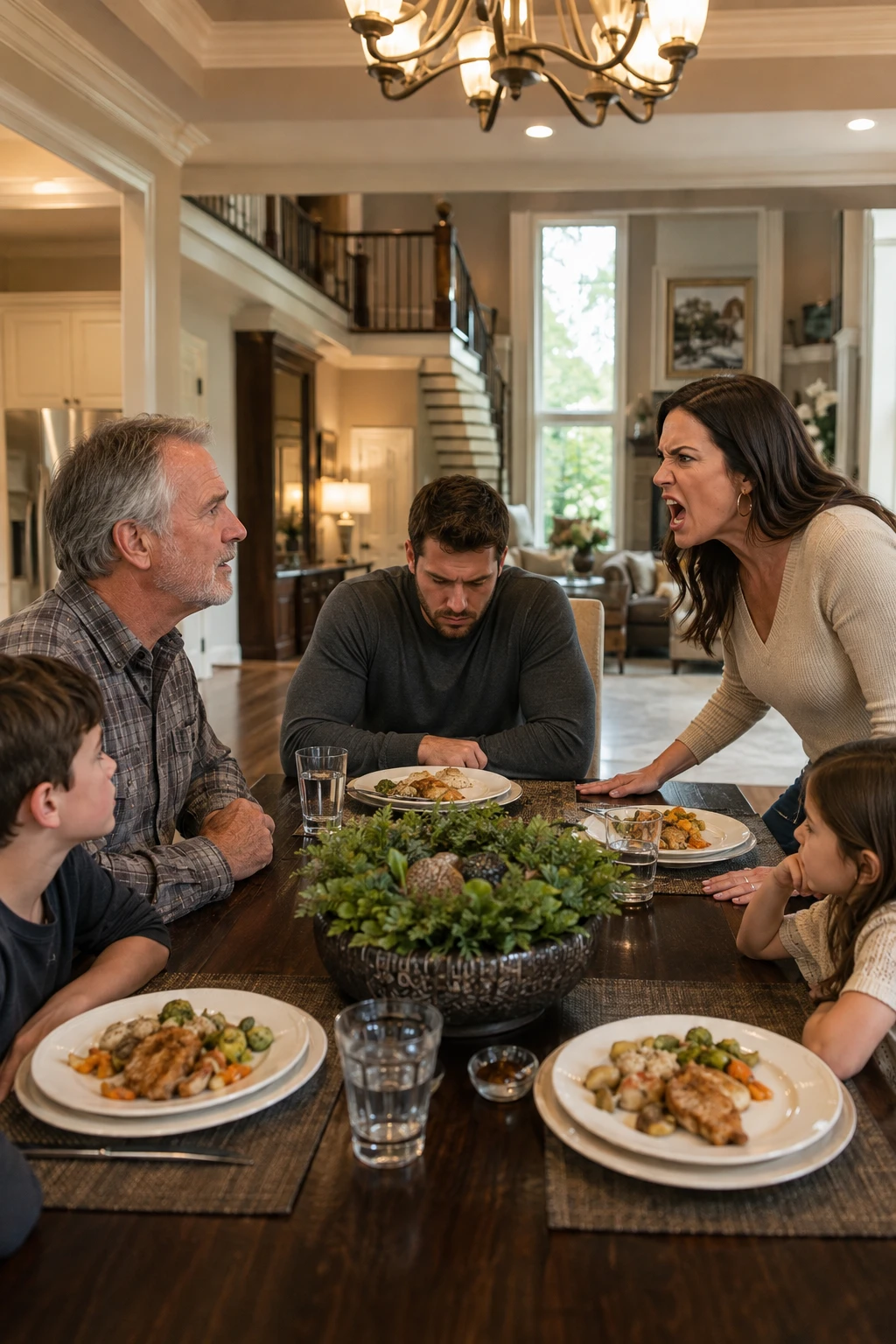
For one second, nobody moved.
Then my daughter-in-law leaned toward me, her face tight with anger.
“If you’re staying here, Walter, you’re paying two thousand dollars a month.”
Vanessa’s voice carried across the dining room like a judge handing down a sentence.
“You’ll clean all three floors, mow the front and back yards, and drive the kids to school. We have jobs. We have responsibilities.” She gave me a thin smile. “We are not supporting a useless freeloader.”
I looked at my son.
Ethan was thirty-six years old, but in that moment I saw the little boy who used to fall asleep on my shoulder during baseball games.
I waited for him to laugh.
To defend me.
To say, Dad isn’t a freeloader.
Instead, Ethan lowered his eyes.
Then he nodded.
That nod hurt more than Vanessa’s words ever could.
I picked up my water glass.
“All right.”
Vanessa blinked.
“What?”
“I said all right.”
Apparently, she expected a fight.
I gave her a small smile instead.
She had no idea how expensive that dinner was about to become.
My name is Walter Hayes.
I was sixty years old, recently retired, and tired in the way a man gets tired after spending forty years building something from nothing.
My knees hurt in cold weather. My hands stiffened before sunrise. My back occasionally reminded me of every crate of potatoes I had lifted when I was twenty-two.
Three nights earlier, I had arrived at Ethan’s house with one suitcase and said, “I’m retiring. Thought I might stay with you for a while.”
That was all.
I didn’t say I was broke.
I didn’t say I needed money.
But Vanessa apparently filled in those blanks herself.
Maybe I had encouraged the misunderstanding.
I wore fifteen-dollar flannel shirts.
My pickup was twelve years old.
I still clipped grocery coupons even though I hadn’t needed to worry about a grocery bill in decades.
Whenever Ethan asked about work, I said, “I help out at the stores.”
That was technically true.
What he never asked was how many stores there were.
Thirty-eight.
The little neighborhood grocery I opened after his mother and I married had become Hayes Family Markets, then Hayes Food Group.
Over the years came distribution centers, commercial properties, warehouses, and investments.
I had never told Ethan what everything was worth.
Not because I distrusted him.
Because I loved him.
Money can turn children into professional heirs. I wanted my son to build a life instead of waiting for mine to end.
So Ethan grew up knowing Dad had a grocery business.
He did not know Dad had quietly become worth more than thirty million dollars.
And Vanessa certainly didn’t know.
Three days after that dinner, I moved into their smallest bedroom.
A sheet of paper was taped to the door.
HOUSE RULES FOR RESIDENT
Wake at 5:00.
Clean all floors before breakfast.
No food from refrigerator without permission.
Lawn maintenance weekly.
School transportation daily.
Meals self-provided.
I read the paper twice.
Not Dad.
Not Grandpa.
Resident.
I folded it and slipped it into my pocket.
Then I followed every rule.
At five each morning, I cleaned.
By seven, my knees burned from climbing three flights of stairs.
Vanessa occasionally inspected a countertop with one finger.
“You missed something.”
“Where?”
She would point at a spot invisible to anyone without laboratory equipment.
Then she’d walk away.
Ethan usually said nothing.
That silence became harder to understand every day.
The children were different.
Nine-year-old Noah talked nonstop about soccer.
Seven-year-old Emma followed me around the house asking questions.
“Grandpa, how do refrigerators make cold?”
“Grandpa, can fish get thirsty?”
“Grandpa, why does Mom always look angry?”
That one stopped me.
“She works hard, sweetheart.”
Emma considered that.
“So do you.”
I smiled.
Children notice more than adults think.
One evening, I found bruised apples in the discount section of a grocery store.
I bought them for $2.13.
After everyone went upstairs, I made my mother’s apple pie.
Cinnamon.
Brown sugar.
Butter worked through the crust by hand.
The smell filled the kitchen.
Noah appeared in pajamas.
“Grandpa?”
“You’re supposed to be asleep.”
He stared at the pie.
“I smelled happiness.”
I laughed so loudly I had to cover my mouth.
I cut him one tiny piece.
He ate it standing beside the counter.
“This is the best thing I’ve ever eaten.”
“Don’t tell your mother.”
He grinned.
The next morning, Vanessa discovered the remaining pie.
“What’s this?”
“Apple pie.”
“I can see that.”
“I made it for the kids.”
Her expression changed.
“There’s no label.”
I frowned.
“Vanessa, I made it last night.”
“I don’t know what you put in things.”
“Apples?”
“I’m not feeding my children random food.”
Then she lifted the pie.
And dropped it directly into the trash.
The entire pie.
Noah was behind her.
His backpack slipped from his shoulder.
“Mom!”
Vanessa turned.
“What?”
“Grandpa made that.”
“I know.”
Noah looked at me.
“Grandpa…”
“It’s okay, buddy.”
But something inside me changed.
Not because of the pie.
Because cruelty becomes revealing when it is unnecessary.
That afternoon, our neighbor Margaret Bell stopped me by the mailbox.
“I heard you made that apple pie.”
I laughed.
“How?”
“My grandson got a piece from Noah before school.”
“Oh, Lord.”
“He said it was amazing.”
Margaret reached into her handbag.
“I’m hosting my garden club Saturday. I’ll give you fifty dollars for one.”
“Fifty?”
“It tasted like my grandmother’s.”
I looked at the house behind me.
Vanessa had thrown something away without tasting it.
Margaret valued it after one bite.
Funny how people do that with more than pie.
As Margaret walked away, my eyes drifted across the street.
Beneath a huge sycamore tree stood a beautiful brick house.
Four bedrooms.
Deep front porch.
Large garage.
A bright red sign stood on the lawn.
FOR SALE.
I stared at it.
Then I took out my phone.
My plan stopped being an idea.
It became a timetable.
The following morning, I sat inside my pickup at 5:12 and called my attorney.
Daniel Mercer had represented me for twenty-four years.
“Walter,” he answered sleepily, “either someone is dead or you found another building you want.”
“Neither.”
“Good.”
“I want the house across from Ethan’s.”
There was silence.
“Address?”
I gave it to him.
I heard typing.
“Listed yesterday. Six hundred eighty-nine thousand.”
“Offer seven hundred. Cash. No financing contingency.”
Daniel laughed.
“Retirement suits you.”
“Close Friday if they’ll do it.”
“That’s aggressive.”
“So is charging your father-in-law two thousand dollars to vacuum your stairs.”
He stopped laughing.
“What happened?”
“I’ll explain later.”
By noon, a red PENDING sticker appeared on the sign.
Vanessa noticed immediately.
“Finally,” she said. “Hopefully someone respectable bought it.”
I almost choked on my coffee.
That afternoon, I delivered Margaret’s pie.
She paid me fifty dollars despite my protests.
Then my phone rang.
Daniel.
His voice had changed.
“Walter, we need to talk.”
I stepped onto Margaret’s porch.
“What is it?”
“It concerns Ethan.”
My stomach tightened.
“And his house.”
“What about it?”
“You remember seven years ago when his mortgage was transferred?”
Of course I did.
Ethan had lost his job shortly after Emma was born.
He never asked me for money.
Instead, he worked nights and took contract jobs.
I admired his pride.
Without telling him, I had one of my investment companies purchase his mortgage from the lender.
His statements continued arriving under the servicing company’s name.
The interest rate stayed low.
Ethan never knew.
“I remember.”
Daniel continued.
“They’re ninety-four days delinquent.”
My chest went cold.
“That can’t be right.”
“There’s more.”
I looked through Margaret’s window toward Ethan’s house.
“Tell me.”
“A home equity application was filed four months ago.”
“So?”
“It includes Ethan’s signature.”
My attorney paused.
“Ethan says he never signed it.”
I gripped the phone.
“How do you know?”
“Because I called him.”
“You called Ethan?”
“I had to. Walter, the application is potentially fraudulent.”
“How much?”
“Two hundred forty thousand dollars.”
I felt sick.
“Where did it go?”
“We’re tracing it.”
“Does Vanessa know?”
Another pause.
“Walter, the application was submitted from Vanessa’s email address.”
I stared at the ground.
Friday suddenly seemed very far away.
That night, I watched Ethan differently.
He came home at almost nine.
His shoulders sagged.
Vanessa immediately said, “Did you transfer money for the electric bill?”
“I told you, Friday.”
“You always say Friday.”
“I’m handling it.”
“You’re handling nothing.”
Noah and Emma were upstairs.
I stood at the sink washing dishes.
Vanessa went into the living room.
Ethan stayed behind.
For several seconds neither of us spoke.
Then he whispered, “Dad?”
“Yes?”
“I’m sorry.”
I turned.
“For what?”
His eyes were red.
“For dinner. For letting her talk to you like that.”
“Then why did you?”
He rubbed his face.
“I don’t know anymore.”
That answer worried me more than an excuse would have.
I dried my hands.
“Are you in trouble?”
His eyes snapped toward mine.
“No.”
“Ethan.”
“I said no.”
He walked away.
But I recognized fear.
I had seen it in employees who knew they had made terrible mistakes.
I had seen it in friends waiting for test results.
My son wasn’t embarrassed. He was terrified.
The following morning Daniel called again.
“We traced part of the money.”
“And?”
“One hundred eighty thousand went through an LLC registered six months ago.”
“To whom?”
“A company called Blue Heron Holdings.”
“Who owns it?”
“Paperwork says Vanessa Hayes.”
I closed my eyes.
“And the rest?”
“Transferred to another account.”
“Whose?”
“We’re working on that.”
“Is she having an affair?”
“Walter, don’t jump.”
“I’m asking.”
“No evidence of that.”
For some reason, that made the situation feel stranger.
Why secretly borrow $240,000?
Why stop paying the mortgage?
Why hide it from Ethan?
Friday arrived.
Closing took forty-seven minutes.
At 10:16 a.m., I became the owner of the house across the street.
I walked through the empty rooms alone.
Sunlight poured across hardwood floors.
From the upstairs window I could see Ethan’s home almost perfectly.
I imagined Noah running across the yard.
Emma decorating the porch at Christmas.
For the first time since retiring, I felt excited.
Then Daniel called.
“We found the second account.”
My heart accelerated.
“Who?”
He exhaled.
“You should come to my office.”
“Tell me now.”
“Walter—”
“Tell me.”
The answer left me speechless.
The remaining money had been transferred into an account in Ethan’s name.
I confronted him that evening.
Vanessa had taken the children to her sister’s house.
Ethan sat alone at the kitchen table.
I placed the home equity documents in front of him.
His face drained of color.
“Where did you get those?”
“Answer me.”
“Dad—”
“Did you know?”
He stared at the papers.
Then he nodded.
My stomach dropped.
“So you lied.”
“It’s not what you think.”
“Two hundred forty thousand dollars disappears, your mortgage goes unpaid, and your wife tells me to clean toilets for the privilege of sleeping upstairs.”
I slapped my hand against the documents.
“Tell me what I’m supposed to think.”
Ethan stood.
“You weren’t supposed to be here!”
The words echoed through the kitchen.
I froze.
He realized what he had said.
“Dad, I didn’t mean—”
“You’re right.”
I picked up the papers.
“I wasn’t.”
He grabbed my arm.
“Please.”
I pulled free.
For the second time that week, my son had broken something inside me.
The first time had been with a nod.
The second was with the truth.
Or what I thought was the truth.
I packed my suitcase.
Vanessa returned as I carried it downstairs.
“Where are you going?”
“Across the street.”
She laughed.
“Very funny.”
I opened the front door.
She followed me.
I walked across the road.
Up the porch.
And unlocked the front door.
Vanessa stopped on the sidewalk.
Her expression was priceless.
“You…”
“Yes.”
“You bought this?”
“Yes.”
“With what money?”
I looked at her.
“My money.”
She stared at the house.
Then at my truck.
Then back at me.
“How much money do you have?”
“Enough.”
Her entire tone changed.
“Walter, I think we’ve had a misunderstanding.”
I nearly laughed.
“No, Vanessa. For the first time, I think we understand each other perfectly.”
Ethan stood behind her.
He looked devastated.
I closed the door.
Saturday morning, somebody knocked.
Margaret stood outside holding a cardboard box.
Inside were twenty-four handwritten order cards.
“What is this?”
“My garden club.”
I stared.
“They want pies.”
She smiled.
“Apparently retirement is over.”
Making those pies saved me.
For two days, I stopped thinking about mortgages and betrayal.
Noah and Emma came over secretly to help.
Emma sprinkled cinnamon.
Noah folded boxes.
By Sunday afternoon my kitchen looked like a small bakery.
Then Noah said something that changed everything.
“Grandpa?”
“Yes?”
“Are you mad at Dad?”
I stopped rolling dough.
“Why?”
“He cries in the garage.”
I stared at him.
“Your dad cries?”
Noah nodded.
“He told Mom he can’t do this anymore.”
My pulse quickened.
“Do what?”
“I don’t know.”
That night, I called Daniel.
“Something’s wrong.”
“I agree.”
“No. Bigger.”
Daniel hesitated.
“There is something else I haven’t told you.”
My jaw tightened.
“I’m getting tired of that sentence.”
“The account in Ethan’s name wasn’t opened by Ethan.”
“What?”
“It was opened online using his identification.”
“Vanessa?”
“We believe so.”
“Then why did he admit knowing?”
“That’s what we need to determine.”
Monday morning, everything exploded.
A black SUV pulled into Ethan’s driveway.
Two investigators got out.
Vanessa opened the door.
Ten minutes later, she was screaming.
“You did this!”
She pointed across the street at me.
Neighbors watched from windows.
Ethan stood behind her.
Pale.
Silent.
I crossed the road.
Vanessa stormed toward me.
“You rich old bastard!”
“Vanessa.”
“You think you can take my house?”
“It isn’t your house to take.”
Her face twisted.
“What does that mean?”
Daniel stepped from the SUV.
He carried a folder.
“This property’s mortgage is currently held by Hayes Residential Assets.”
Vanessa stared.
Daniel nodded toward me.
“Mr. Hayes’s company.”
Her mouth opened.
Even Ethan looked shocked.
I turned to him.
“You didn’t know.”
“No.”
Vanessa laughed hysterically.
“So this was some test?”
“No.”
I stepped closer.
“Seven years ago, Ethan was struggling. I bought the mortgage so no bank could throw my grandchildren into the street.”
Vanessa went still.
“You own our mortgage?”
“I thought I did.”
Daniel looked at me.
That phrase made me turn.
“What?”
He opened the folder.
“There’s something Walter doesn’t know either.”
Now everyone stared at him.
Daniel pulled out an old trust document.
“Seven years ago, after purchasing the mortgage, Walter signed estate restructuring papers.”
I remembered.
We had moved several assets for tax planning.
Daniel continued.
“The mortgage note was transferred.”
“To where?” Vanessa demanded.
Daniel looked toward Noah and Emma, who were watching through the upstairs window.
Then he said the words none of us expected.
“Into the irrevocable trust belonging to Noah and Emma Hayes.”
Silence.
I actually laughed once because my brain couldn’t process it.
“You’re telling me…”
“You don’t own Ethan’s mortgage, Walter.”
Daniel closed the folder.
“The children do.”
Vanessa’s face went completely white.
The money she had borrowed fraudulently against the property…
The payments she had withheld…
The equity she had tried to extract…
She hadn’t been stealing from me.
Daniel looked directly at her.
“Legally, you attempted to encumber assets held for your own children.”
Ethan sat down on the porch steps.
Vanessa whispered, “Oh my God.”
But the worst revelation was still coming.
Daniel handed me another sheet.
“Blue Heron Holdings purchased a property three months ago.”
I looked at Vanessa.
“A second house?”
She said nothing.
“Where?”
Daniel answered.
“Ohio.”
That made no sense.
We lived hundreds of miles from Ohio.
“Who lives there?”
Daniel’s expression softened.
“Vanessa’s mother.”
Vanessa suddenly began crying.
Real crying.
Not angry tears.
Broken ones.
“My mother has Alzheimer’s,” she whispered.
Everyone froze.
She covered her face.
“My father died last year. She couldn’t stay alone. The facility she needed cost more than we could afford.”
Ethan looked up at her.
“You told me insurance covered it.”
“I lied.”
“Why?”
“Because you were already drowning!”
She pointed toward the house.
“You lost your contract. We had bills. Noah needed dental work. Emma had therapy. Your father never offered anything because you kept saying you didn’t want his help!”
She turned toward me.
“And I hated you for it.”
Her voice cracked.
“You walked around in your old shirts pretending you had nothing while we were terrified every month.”
I stared at her.
“You could have asked.”
She laughed bitterly.
“Would you have helped me?”
“Yes.”
“No questions?”
“No judgment?”
I didn’t answer quickly enough.
That was answer enough.
Vanessa wiped her face.
“I forged Ethan’s signature.”
Ethan closed his eyes.
“I took the money.”
“Why was part of it sent to an account in Ethan’s name?” I asked.
Her mouth trembled.
“Because I was putting it back.”
I frowned.
“What?”
“I sold jewelry. My car. Everything I could. That account had forty-one thousand dollars in it last week.”
Daniel checked the paperwork.
She was telling the truth.
“I was trying to repay it before anyone discovered what I’d done.”
Ethan stood slowly.
“You knew the whole time?” I asked him.
He nodded.
“Two weeks before you arrived, I found the documents.”
“Why didn’t you tell me?”
He looked toward the upstairs window.
“Because if Vanessa went to prison, what happened to Mom?”
Vanessa’s mother.
“And the kids?” he continued. “And Vanessa?”
His eyes filled.
“I was trying to fix it.”
“By letting her humiliate me?”
“No.”
His voice broke.
“By keeping you angry enough to leave.”
That stunned me.
“What?”
Ethan swallowed.
“Vanessa was panicking when you said you were moving in. She thought you’d discover the bills.”
“So you nodded.”
“I thought if you hated staying with us, you’d go.”
I stared at him.
“You deliberately let me believe you were ashamed of me?”
“I thought protecting my family meant handling everything myself.”
He looked down.
“I guess I learned that from you.”
Those words hit harder than anything else.
Because they were true.
I had spent decades hiding money so Ethan would be independent.
Ethan hid his problems because he thought independence meant never asking me for help.
Vanessa hid her mother’s illness.
Everyone had been protecting everyone else with secrets.
And the secrets nearly destroyed us.
The legal situation was complicated.
Forgery doesn’t disappear because the motive is understandable.
Daniel arranged for Vanessa to cooperate fully.
The fraudulent lien was unwound.
We sold the Ohio property and moved her mother into a reputable memory-care community near us.
Vanessa accepted responsibility and entered a restitution agreement rather than facing the worst possible outcome.
The marriage survived—but barely.
Ethan and Vanessa began counseling.
For several months, they lived separately.
Ethan and the kids moved across the street.
Into my new house.
Vanessa remained in the old one while everything was sorted out.
One evening she knocked on my door.
She held something in both hands.
A pie.
The crust leaned badly to one side.
Juice had leaked onto the tin.
“I tried your recipe.”
I smiled despite myself.
“Looks dangerous.”
She laughed nervously.
Then her eyes filled with tears.
“I’m sorry, Walter.”
I said nothing.
“For the rules. The cleaning. The things I said.”
She swallowed.
“Especially the pie.”
“That was a good pie.”
“I know.”
“How?”
“Noah reminds me twice a week.”
I stepped aside.
“Come in.”
Forgiveness wasn’t instant.
It shouldn’t be.
But sometimes forgiveness begins with leaving the door unlocked.
Months passed.
Margaret’s twenty-four pie orders became eighty.
Then two hundred.
One of my former grocery managers called.
“Walter, why are customers asking when we’re stocking ‘Grandpa Hayes Apple Pie’?”
I laughed.
Within a year, Hayes Family Markets carried my mother’s pie in thirty-eight stores.
We put her photograph on every box.
Not mine.
Hers.
Noah designed the little apple logo.
Emma insisted every package include the sentence:
“Made to smell like happiness.”
The first year’s profits went entirely into the grandchildren’s trust.
The same trust that owned their parents’ mortgage.
Which brings me to the final surprise.
On my sixty-first birthday, Daniel came to the house.
Ethan, Vanessa, Noah, Emma, Margaret and I were eating pie on the porch.
Daniel handed me an envelope.
“What now?”
“Something you requested years ago.”
I opened it.
Inside was a copy of my original estate instructions.
I read them.
Then read them again.
At the bottom was a clause I had completely forgotten.
If Hayes Food Group was ever sold after my retirement, my controlling shares were not supposed to pass to Ethan.
Nor to Noah.
Nor Emma.
They were to go into an employee trust.
Ethan smiled.
“I know.”
“You know?”
“I found out last month.”
I studied his face.
“You’re not upset?”
He laughed.
“Dad, for most of my life I thought you owned a little grocery store.”
Everyone laughed.
Then he became serious.
“I don’t want your company.”
“What do you want?”
He looked around the porch.
At Vanessa.
At his children.
At me.
“This.”
My throat tightened.
Daniel cleared his throat.
“There’s one additional detail.”
We all groaned.
“Not again,” I said.
He smiled.
“The employee trust held its first vote yesterday.”
“And?”
“They elected their chairman.”
I shrugged.
“Who?”
Daniel looked directly at Ethan.
My son’s smile disappeared.
“Me?”
Daniel nodded.
Years earlier, without knowing who owned the company, Ethan had spent summers working warehouse shifts under a different division name.
He had earned the respect of people I never told were my employees.
Later, during difficult years, he had quietly consulted for the company’s logistics department.
He never once asked me for a promotion.
Never used my name.
The employees had chosen him without knowing he was my son until after the ballots were counted.
For forty years, I had worried that giving Ethan wealth would destroy his character.
So I had hidden everything.
And in the end, the strangest thing happened.
He inherited nothing.
Yet he earned something far greater.
Trust.
I looked across the street at the three-story house where Vanessa once taped rules to my bedroom door.
The mortgage was current now.
The lawn was freshly cut.
Not by me.
Vanessa did it herself every Saturday.
Sometimes when she saw me watching, she raised the mower handle and shouted, “No freeloaders!”
We both laughed.
I still drive my old pickup.
I still wear flannel shirts.
And every Wednesday, I pick Noah and Emma up from school.
Not because a house rule says I have to.
Because they race toward my truck like I’m the richest man in the world.
Maybe I am.
Just not for the reason anyone thought.
Because that terrible dinner taught me something thirty million dollars never could:
People reveal themselves when they believe you have nothing to offer them.
But I learned something else too.
Sometimes the person behaving badly isn’t hiding greed.
Sometimes they’re hiding fear.
Sometimes the son who disappoints you isn’t rejecting you.
He’s drowning and too proud to ask you to throw him a rope.
And sometimes the pie someone throws into the garbage becomes the recipe that puts a family back together.
The house across the street was supposed to be my escape.
Instead, it became the place where my family started over.
As for that original sheet of house rules?
I still have it.
It hangs framed in my kitchen.
Underneath it, Emma added one final rule in purple marker: