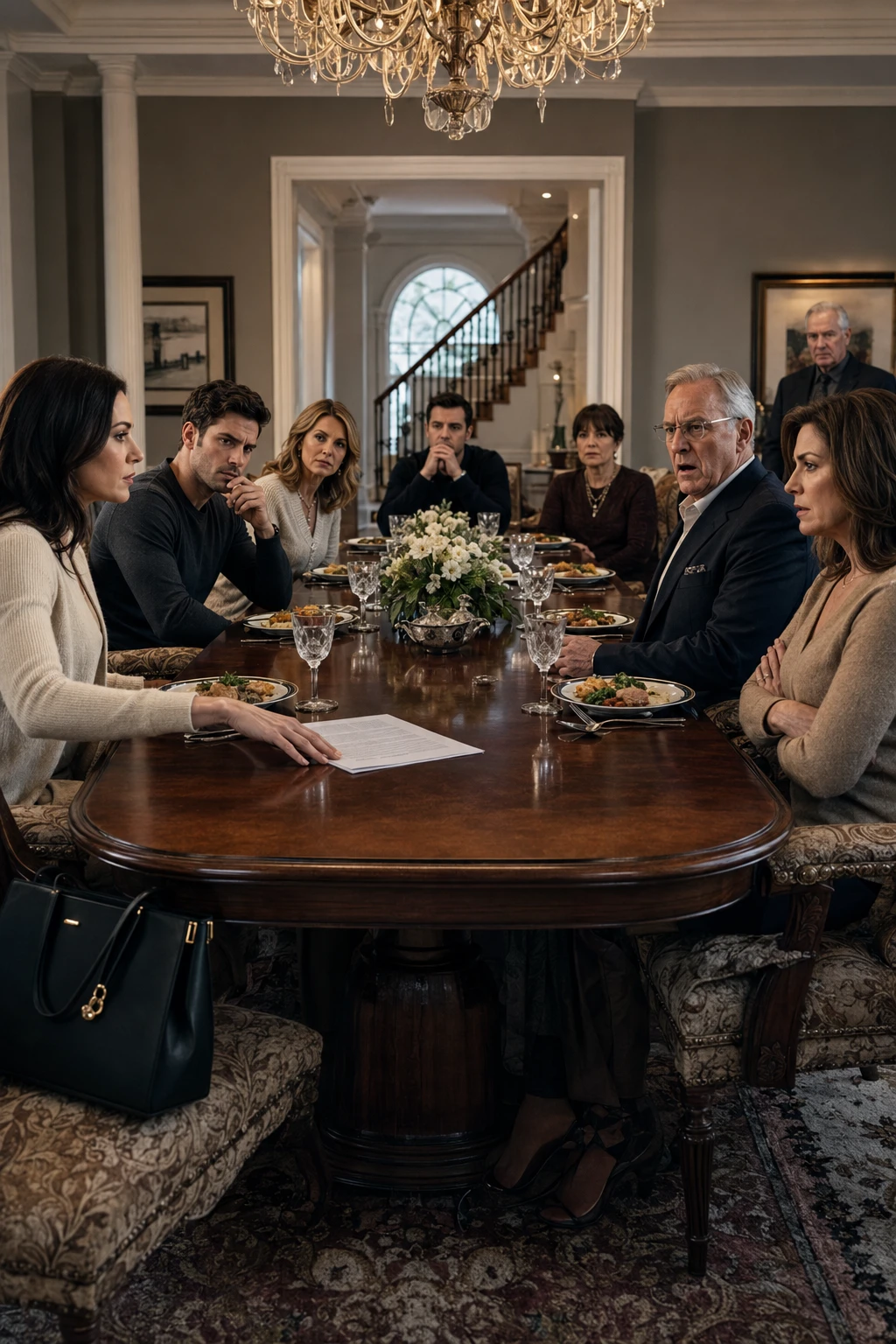
At 3:00 in the morning, while I slept twenty feet above her, my husband’s sister slipped a platinum credit card out of my purse and spent exactly $9,000 before sunrise.
By breakfast, she was frying eggs.
“You probably got hacked,” Dana said, flipping one in the pan without looking at me. “That happens all the time.”
I stood in the kitchen doorway, phone in hand, reading the fraud alerts for the fourth time.
Three airline tickets.
A hotel package in Orlando.
Children’s clothes.
A new phone.
A tablet.
The airline reservation was in Dana Caldwell’s name.
So were the names of her two children.
The electronics order used her cell number.
And the printed confirmation was folded beneath wet coffee grounds in my trash can.
I should have confronted her immediately.
Instead, I smiled.
Because Dana had made one mistake she could not possibly understand yet.
The card wasn’t mine.
It belonged to the Dayton Herald.
And five weeks later, that mistake would split the Caldwell family open at a Sunday dinner where everyone believed I was the one about to surrender.
Dana had moved into our guest room after her second eviction.
Nathan, my husband, had stood beside me when we agreed.
“It’s temporary,” he’d said. “Just until she gets stable.”
I looked at Dana’s two kids asleep in the back seat of her car and said yes.
I didn’t do it for Dana.
I did it because no child should hear adults whisper about where they’ll sleep tomorrow.
For the first week, things were almost peaceful.
Then money vanished from my car.
A twenty from the center console.
Then another forty from the envelope where I kept emergency cash.
My expensive perfume started disappearing at a rate that defied biology.
A silk blouse vanished from my closet and reappeared three days later in Dana’s laundry.
When I mentioned the missing cash, Nathan frowned.
“Could you have used it and forgotten?”
“No.”
“Sienna, you work insane hours.”
“So?”
“So maybe you’re tired.”
I stared at him.
I had spent twelve years as an investigative reporter.
I had exposed city-contract fraud, a judge taking favors, and a nursing-home network falsifying safety reports.
People lying to me was not new.
People I loved teaching me to doubt myself was.
Still, I said nothing.
I locked my office.
Moved my grandmother’s jewelry into our safe.
Photographed the contents of my wallet.
Then I left my purse hanging in its usual place by the kitchen door.
Three nights later, at exactly 3:00 a.m., a floorboard creaked downstairs.
I opened my eyes.
A thin bar of hallway light slid beneath our bedroom door.
Nathan slept beside me.
I assumed one of the children had gone for water.
By 6:12, my phone was buzzing nonstop.
Fraud alert.
Fraud alert.
Fraud alert.
The total came to $9,000 on the nose.
Not $8,946.
Not $9,103.
Exactly nine thousand dollars.
That detail bothered me.
People stealing on impulse didn’t usually stop at a clean number.
They stopped when the card declined.
Dana hadn’t.
Which meant either she had known the limit available to her…
…or someone had told her.
I didn’t understand the significance then.
I would.
Nathan called his father.
Frank Caldwell arrived twenty minutes later wearing the navy sport coat he used for church and funerals.
He walked into our kitchen like a man entering a problem he had solved before.
“Tell me what happened.”
I did.
He listened for less than thirty seconds.
Then he raised a hand.
“She’d never do something like that.”
Dana stood near the stove with her arms folded.
I pointed to the booking.
“That is her name.”
“Anyone can type a name.”
“Her phone number is on the store order.”
“Could’ve been autofill.”
“The receipt was in my garbage.”
For the first time, Dana looked uncomfortable.
Frank did not.
He turned to me instead.
“Did you call the bank?”
“Yes.”
His expression hardened.
“Before talking to family?”
I blinked.
“My card was stolen.”
“Family handles family.”
“It’s not that simple.”
“It is if you want it to be.”
Then he said something I never forgot.
“You married into this family, Sienna. There are ways we deal with things.”
Not laws.
Not truth.
Ways.
I looked at Nathan.
He looked at the floor.
That hurt more than Frank’s words.
What none of them knew was that I carried two nearly identical cards from the same bank.
My personal card sat inside my wallet.
The heavy platinum card in the outer slot belonged to the Dayton Herald and was issued for travel, document requests, and investigative expenses.
Dana had not stolen from me.
She had stolen from a company with auditors, lawyers, insurers, and mandatory reporting rules.
I could not simply tell the bank, “Never mind.”
The Herald required a written fraud report.
The bank required an affidavit.
And if I falsely claimed Dana had permission, I could lose my job.
Possibly worse.
Frank’s solution arrived three days later.
He appeared at our house carrying a cashier’s check and a document prepared by an attorney.
“Sign this.”
I read it.
The statement claimed Dana had been an authorized user of the card and that all purchases had been made with my knowledge.
“You understand this is false.”
Frank tapped the cashier’s check.
“Nine thousand. Repaid in full.”
“That doesn’t change what happened.”
“It changes whether anyone gets hurt.”
“Signing this could destroy my career.”
His face shifted slightly.
Not surprise.
Annoyance.
“Your career will recover.”
I stared at him.
“What about my name?”
“You’re making this bigger than it needs to be.”
“No. Dana made it this big when she stole a company card.”
“She borrowed it.”
“At three in the morning?”
He leaned closer.
“You want to be right, Sienna, or do you want to belong?”
That was when I understood the bargain.
Frank was not offering to save Dana. He was asking me to become responsible for what she had done.
The calls started the next day.
Nathan’s aunt asked whether one mistake was worth “destroying children’s lives.”
A cousin told me “family loyalty goes both ways.”
A woman from Frank’s church sent me a Bible verse about forgiveness.
Then something worse happened.
My editor, Calvin Reyes, called me into his office.
He closed the door.
“I need to ask you something uncomfortable.”
My stomach dropped.
“Ask.”
“Did you give Dana permission to use that card?”
“No.”
“Because someone contacted HR saying you did.”
I went cold.
“Who?”
“They didn’t identify themselves.”
I laughed once, without humor.
“Of course they didn’t.”
Calvin studied me.
“You’ve never given me a reason to doubt you.”
“Then don’t.”
“I don’t. But corporate is watching.”
That night, I stopped feeling hurt.
I started feeling curious.
Curiosity had always been more useful to me than anger.
I began checking records.
Dana’s first eviction had ended when Frank paid the balance.
The second disappeared after a settlement.
There were three civil judgments connected to unpaid accounts.
All resolved quietly.
At Dana’s previous job, there had been an internal complaint about missing cash.
No charges.
The money had been repaid.
By Frank.
The pattern was almost elegant.
Dana made a mess.
Frank paid.
The documents vanished.
Everyone moved on.
Then Nathan brought a cardboard box down from our attic.
“I found this behind the Christmas decorations.”
Inside were childhood report cards, photographs, receipts, old school programs, and a small ledger with a blue cover.
Nathan opened it.
His face changed.
At thirteen, he had saved $211 mowing lawns.
The amount had been crossed out.
Beside it, in Frank’s handwriting:
Borrowed — Dana’s braces.
Underneath was a photograph of Nathan at fourteen holding a red electric guitar.
“I remember that,” I said.
He swallowed.
“Dad sold it.”
“Why?”
“To pay for damage Dana did to someone’s car.”
Nathan sat down hard.
For several minutes, he didn’t speak.
Then he whispered, “I thought I was being a good brother.”
I touched his hand.
He shook his head.
“No. I wasn’t generous.”
His eyes filled.
“I was trained.”
That was the first crack.
Sunday dinner came because Frank demanded it.
He invited half the family.
Pastor Bill came too.
That told me everything.
Frank wanted witnesses.
A moral stage.
A reconciliation performance.
Margaret, Nathan’s mother, used her best linen tablecloth.
Roast beef sat under a silver cover.
Crystal glasses caught the chandelier light.
Frank placed me in the chair beside him.
The chair I had quietly wanted for eight months.
Then, after grace, he slid the document toward me.
Three yellow tabs marked the signature lines.
“Sign the paper, Sienna,” he said.
The room went silent.
“Then you won’t just be Nathan’s wife.”
He smiled.
“You’ll finally be my daughter.”
Every face turned toward me.
Dana studied her plate.
Pastor Bill held out a pen.
Nathan looked sick.
I rested one hand on my purse.
Frank believed he had built the perfect trap.
If I refused, I was the outsider destroying the family.
If I signed, Dana walked free.
I reached into my bag.
The table seemed to exhale.
Frank smiled.
I pulled out two documents.
And my late father’s fountain pen.
Then I placed the first document on the table.
Frank’s smile disappeared before he read a word.
“What is this?”
“The bank’s official fraud affidavit.”
He looked up.
“You already filed it?”
“Yes.”
Dana’s chair scraped slightly against the floor.
I placed down the second page.
“And this is the Herald’s internal report.”
Frank’s eyes narrowed.
“You had no right to involve your employer.”
“It was their card.”
Pastor Bill slowly lowered his pen.
Dana looked at Frank.
“Dad, you said you were going to fix this.”
Something passed between them.
Fast.
Sharp.
Familiar.
Nathan saw it too.
He reached beneath his chair and placed the blue childhood ledger on the table.
Frank’s face tightened.
“What are you doing?”
“What I should’ve done twenty years ago.”
Nathan opened the book to the crossed-out $211 entry.
Then he placed two old envelopes beside it.
“I went through the attic.”
Margaret’s fork slipped from her fingers.
Frank said nothing.
Nathan looked at me.
“There was more.”
I had known about the ledger.
I had not known about the envelopes.
Frank knew.
That was obvious.
The room seemed to shrink around him.
Nathan opened the first envelope.
Inside were bank statements from an account created in his name when he was sixteen.
Withdrawals had been made over three years.
Nearly $18,000.
“What is that?” Margaret whispered.
“My college fund,” Nathan said.
Frank’s voice came low.
“That money went to family expenses.”
Nathan turned toward Dana.
“Did it?”
Dana looked terrified now.
Not embarrassed.
Terrified.
Nathan opened the second envelope.
A typed letter slid out.
Old.
Yellowed at the folds.
Frank stood suddenly.
“Enough.”
And that was the moment I knew.
Whatever was on that page was bigger than Dana.
Nathan read the first line silently.
His face went white.
Then he looked at Margaret.
“Mom.”
She wouldn’t meet his eyes.
“What?” Dana snapped.
Nathan held up the page.
“It’s a letter from a lawyer.”
Frank reached for it.
Nathan pulled back.
“Sit down.”
No one had ever spoken to Frank Caldwell that way.
Frank froze.
Nathan read aloud.
The letter referenced a trust.
A trust established by someone named Eleanor Walsh.
I didn’t recognize the name.
Dana did.
Her mouth opened.
Margaret began to cry.
“Who is Eleanor Walsh?” I asked.
No one answered.
Nathan kept reading.
The trust had been created for the benefit of one child.
A female child.
Born in 1986.
Dana’s birth year.
Funds were to be distributed at age twenty-five.
The original amount was significant.
Very significant.
Frank closed his eyes.
Dana whispered, “What trust?”
Nathan looked at his sister.
“A trust worth over two hundred thousand dollars.”
Silence.
Then Dana laughed.
It was a strange, broken sound.
“That’s not funny.”
“No one’s joking.”
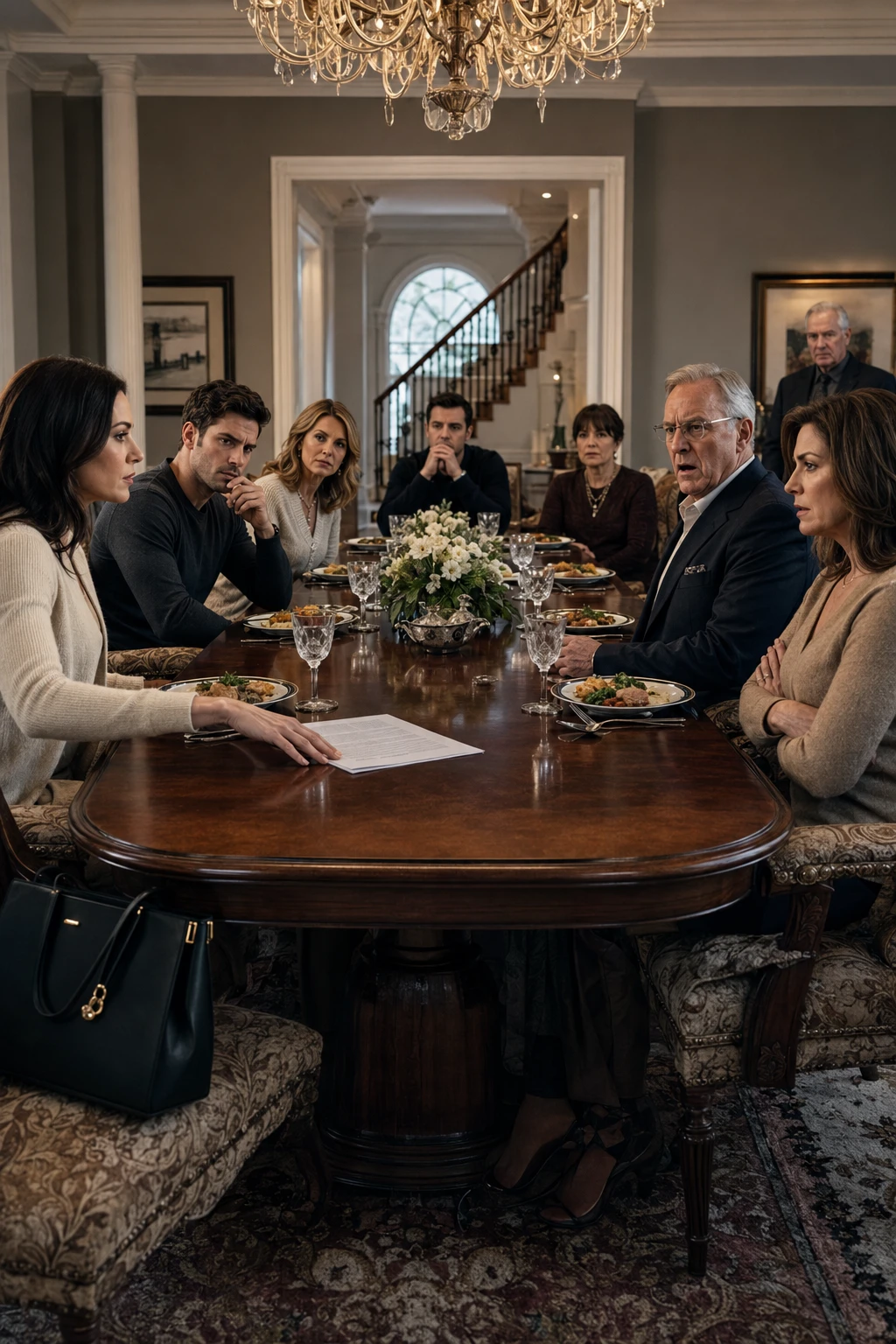
She turned to Frank.
“Dad?”
Frank sat down slowly.
I watched every face at the table.
Margaret cried harder.
Pastor Bill looked as if he wanted to disappear.
Nathan placed the letter down.
The final paragraph said future correspondence should be directed to the child’s legal guardian.
Frank Caldwell.
Dana stood.
“You took my money?”
Frank’s jaw tightened.
“I used it to protect this family.”
“You stole two hundred thousand dollars from me?”
“It wasn’t like that.”
“What was it like?”
He slammed a hand on the table.
“Sit down.”
Dana didn’t.
For perhaps the first time in her life, she looked at her father not as a rescuer…
…but as someone who had been holding the rope around her neck.
“You kept paying my debts,” she whispered.
Frank said nothing.
“You always said I couldn’t handle money.”
Margaret covered her mouth.
Dana’s voice rose.
“You told everyone I was irresponsible.”
“You were.”
“Because you kept fixing everything!”
“You made choices.”
“You trained me too!”
The words hit Nathan like a physical blow.
Dana looked at him.
Tears ran down her face.
“I didn’t know how to do anything because Dad never let consequences reach me. And every time I screwed up, he reminded me how much I owed him.”
Frank’s face reddened.
“This is absurd.”
Then I noticed something.
The exact amount.
Nine thousand dollars.
The clean number that had bothered me from the beginning.
I looked at Dana.
“Why exactly nine thousand?”
She wiped her face.
“What?”
“The card. Why did you stop at nine thousand?”
Frank turned toward me.
Too quickly.
And there it was.
Fear.
Real fear.
Dana stared at him.
“Dad told me that was the limit.”
The room went dead.
Nathan’s head snapped toward Frank.
I felt cold spread through me.
“Frank told you?”
Dana’s voice shook.
“He said you had a travel card with a nine-thousand-dollar available balance. He said if I used it, he’d replace the money before you noticed.”
My pulse pounded.
“When did he tell you this?”
“The night before.”
Frank stood.
“She’s lying.”
Dana laughed bitterly.
“Of course I am. That’s what you taught everyone to believe.”
I looked at Frank.
“How did you know the available balance on my company card?”
He had no answer.
And suddenly, this was no longer about Dana stealing from my purse.
It was about Frank knowing information he should never have possessed.
The investigative part of my mind took over.
Calvin had mentioned an anonymous call to HR.
Someone had claimed I had authorized Dana’s purchases.
Someone who knew enough about the Herald card to understand the damage such a claim could cause.
I looked at Frank.
“You knew the limit.”
“No.”
“You knew which card she should take.”
“No.”
“You prepared a false statement before the bank finished its investigation.”
“I was trying to help.”
“No.”
I leaned forward.
“You were trying to create a record.”
His face changed.
That was all I needed.
I stood.
“Nathan, ask your father why he wanted the fraud report withdrawn so badly.”
Nathan stared at him.
Frank said nothing.
I continued.
“Because this wasn’t just about protecting Dana.”
Pastor Bill whispered, “Sienna, what are you saying?”
“I’m saying Dana was supposed to be blamed.”
Dana looked at me, stunned.
I pulled one final envelope from my purse.
This one was mine.
“For the last three weeks, the Herald’s security team has been auditing my company card history.”
Frank’s face drained.
“Why?”
“Because after Dana used it, they found something strange.”
I slid copies of old statements onto the table.
Small expenses.
Scattered over four years.
Hotel charges.
Document fees.
Fuel.
Meals.
Each amount ordinary enough to escape attention.
Together, they totaled $63,400.
Nathan stared at the pages.
“I don’t understand.”
“Neither did accounting.”
I pointed to the merchant codes.
“But several charges happened on days I wasn’t traveling.”
Frank pushed back from the table.
Dana whispered, “Oh my God.”
I looked directly at him.
“Someone had been using cloned credentials from my company card for years.”
Margaret stopped crying.
Now she simply stared at her husband.
I said, “Dana taking the physical card triggered a deeper audit. If I signed your statement saying she was authorized, it would have created a convenient explanation for irregular spending connected to my account.”
Frank’s voice cracked.
“You can’t prove anything.”
I nodded.
“That’s what I thought.”
Then the front doorbell rang.
Nobody moved.
Frank looked toward the hallway.
I smiled for the first time all evening.
“But they can.”
Two people entered the dining room.
Calvin Reyes.
And a woman I recognized from the Herald’s corporate investigations office.
Frank stared.
Calvin looked almost apologetic.
“Sienna asked us not to come in unless she confirmed the conversation went the way she suspected.”
Frank turned to me.
“You recorded this?”
“No.”
I held up my phone.
“I didn’t need to.”
The investigator placed a folder on the table.
“Mr. Caldwell, we traced several disputed charges to an account associated with a consulting company.”
Frank said nothing.
Nathan whispered, “What consulting company?”
The investigator answered.
“Caldwell Family Advisory LLC.”
Dana covered her face.
Margaret looked at Frank as though seeing a stranger.
The investigator continued.
“The company is registered to Frank Caldwell.”
I thought that was the twist.
I was wrong.
The real twist was still coming.
Because Frank did something none of us expected.
He laughed.
Not nervously.
Not desperately.
He laughed like a man who had been waiting for everyone else to catch up.
“You people think this is about sixty thousand dollars?”
Calvin’s expression tightened.
Frank looked at Margaret.
Then Dana.
Then Nathan.
Finally, me.
“You have no idea what you’ve uncovered.”
He sat back down.
For the first time all evening, he looked calm.
That frightened me more than anything.
Margaret whispered, “Frank, stop.”
He ignored her.
He pointed at Dana’s trust letter.
“You want to know who Eleanor Walsh was?”
Dana stared at him.
“She was your mother.”
Every sound in the room vanished.
Dana looked at Margaret.
“What?”
Margaret closed her eyes.
Frank continued.
“Margaret didn’t give birth to you.”
Dana swayed.
Nathan stood automatically, as if to catch her.
Frank looked at him next.
“And she didn’t give birth to you either.”
Nathan froze.
I felt my breath leave my lungs.
Margaret sobbed.
“Please.”
Frank’s expression was empty now.
Almost relieved.
“Eleanor Walsh was my sister.”
Dana stared.
Nathan whispered, “Your sister?”
Frank nodded.
“She had two children. You.”
He pointed at Dana.
“And you.”
He pointed at Nathan.
No one spoke.
“They were twins.”
My husband and Dana stared at each other.
Their entire childhood rearranged itself in a single sentence.
Frank continued.
“Eleanor died when you were babies. Your biological father disappeared. Margaret and I adopted you.”
Dana’s voice was barely audible.
“Why hide it?”
Frank looked toward the trust letter.
“Because Eleanor left money.”
Nathan said, “Money you stole.”
Frank’s mouth tightened.
“Money I managed.”
“You emptied our accounts.”
“I raised you.”
“You stole from us.”
“I gave you a family!”
Nathan slammed both hands onto the table.
“You gave us a debt we never owed!”
That sentence broke something.
Margaret began sobbing openly.
Dana dropped into her chair.
But I was still watching Frank.
Because one part didn’t fit.
The cloned company card.
The Herald.
Me.
Why had he risked everything for charges connected to my employer?
Then Calvin opened the investigation folder.
“Sienna,” he said quietly, “there’s something else.”
I turned.
He looked almost sick.
“What?”
“The Caldwell consulting account wasn’t the final destination.”
Frank closed his eyes.
Calvin placed a printed transfer history in front of me.
Funds had moved from Frank’s company into another account.
An account opened under a name I recognized instantly.
I stared at it.
My father’s name.
Daniel Mercer.
The dead man whose fountain pen was still in my hand.
I couldn’t speak.
Calvin said softly, “Your father was one of the original account holders.”
I looked at Frank.
He looked back at me.
And suddenly I understood why, from the day Nathan brought me home, Frank had watched me as though he already knew me.
“Who was my father to you?”
Frank exhaled.
“Eleanor Walsh’s missing husband.”
Dana gasped.
Nathan went completely still.
My mind rejected the words.
“My father?”
Frank nodded.
“He didn’t disappear.”
I could barely breathe.
“He left.”
The room tilted.
I looked at Nathan.
Then Dana.
Then the trust papers.
Then the transfer history.
My father had been married to Eleanor.
Eleanor had given birth to twins.
Nathan and Dana.
Which meant—
“No,” I whispered.
Frank’s voice became strangely gentle.
“Daniel remarried years later.”
My mother.
“He had another child.”
Me.
Nathan stumbled backward.
Dana screamed.
I stared at my husband.
At the man I had slept beside for eight years.
At the man whose hand I had held at our wedding.
At the man who had kissed my forehead that morning.
Frank finished the sentence nobody in the room wanted spoken.
“Sienna, Nathan is your half brother.”
The world stopped.
Then Calvin said, “Frank, that’s not possible.”
Everyone turned.
Frank frowned.
Calvin held up another page.
“The genetic records we obtained in the trust litigation don’t support that.”
Frank’s confidence cracked.
“What records?”
Calvin looked at me.
Then Nathan.
“Daniel Mercer was not Nathan and Dana’s biological father.”
Silence.
Frank went white.
Margaret whispered, “Oh, thank God.”
Dana sobbed.
Nathan gripped the back of his chair.
I couldn’t move.
Frank stammered, “That’s wrong.”
“No,” Calvin said. “Eleanor’s twins were fathered by someone else.”
The investigator placed one final document on the table.
A paternity result.
Frank stared at it.
And then I saw Margaret’s face.
Not relief anymore.
Horror.
Frank slowly turned toward her.
“No.”
Margaret shook her head.
“No, Frank.”
He grabbed the paper.
Read it.
Read it again.
The father of Eleanor Walsh’s twins was listed with 99.98 percent probability.
Frank Caldwell.
Dana made a sound somewhere between a sob and a gasp.
Nathan shut his eyes.
I understood before anyone said it.
Frank had not adopted his sister’s children out of charity.
They were his children.
Children he had fathered with his own sister-in-law’s family secret buried beneath lies, money, and decades of control.
Frank dropped the page.
Margaret whispered, “I found out after Eleanor died.”
Dana stared at Frank.
“You’re our father?”
He looked suddenly ancient.
Nathan’s voice was cold.
“And you spent our whole lives calling yourself our uncle by blood and father by adoption.”
Frank said nothing.
I looked at the table.
The false statement.
The stolen card.
The trust.
The ledger.
The cloned charges.
All those years of rescuing Dana.
All those years of taking from Nathan.
It had never been generosity.
It had never even been control for control’s sake.
It was guilt.
Frank had built an entire family system around one purpose:
Keep the truth buried, keep Dana dependent, keep Nathan obedient, and keep every financial record messy enough that no one would ever trace where the original trust money went.
Dana had not ruined the family when she stole my card.
She had accidentally exposed it.
She looked at me across the table, eyes swollen.
“I’m sorry.”
For the first time, I believed her.
Not because the theft was excusable.
It wasn’t.
But because she finally understood what consequences meant.
I picked up Frank’s prepared statement.
The one with three yellow tabs.
Then I tore it in half.
Again.
Again.
I dropped the pieces onto his plate.
“You wanted me to become your daughter,” I said.
Frank looked up.
I tightened my hand around my father’s fountain pen.
“No, thank you.”
Behind me, Nathan let out a sound that was almost a laugh.
Almost a cry.
Outside, the evening sun was fading beyond Margaret’s dining-room windows.
Inside, the Caldwell family had lost almost everything it thought it knew.
But for the first time, no one was covering anything up.
No one was being rescued.
No one was being trained.
And no one was signing away the truth.
Three months later, Dana pleaded guilty to unauthorized use and received probation, restitution, and mandatory financial counseling.
She accepted it without asking Frank to save her.
Nathan began therapy.
So did I.
We stayed married.
The DNA results confirmed what Calvin had said: Nathan and I shared no biological parent.
Frank was charged in connection with the stolen trust funds, fraudulent transfers, and unauthorized corporate-card activity.
Margaret filed for divorce.
And the Dayton Herald ran the story without my byline.
I couldn’t write it.
I was too close.
But Calvin gave it the headline I would have chosen.
THE FAMILY THAT PAID TO KEEP THE TRUTH QUIET.
The morning it published, I found one envelope in my mailbox.
No return address.
Inside was a single photocopied page from my father’s old records.
A note in Daniel Mercer’s handwriting.
I recognized it instantly.
It was dated two weeks before his death.
There was only one sentence:
If Frank ever finds out Sienna knows about Eleanor’s trust, he will come for her too.
I read it twice.
Then a third time.
Because my father had died seven years before I met Nathan.
Seven years before I ever met Frank Caldwell.
Which meant one final truth remained.
My marriage to Nathan had never been an accident.
And somewhere, someone had planned our first meeting long before either of us knew the other existed.