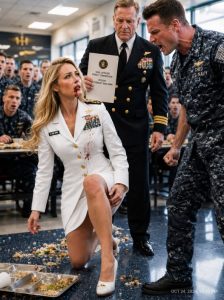
Admiral Bennett let the question hang in the mess hall.
“Chief Reed… do you have any idea who you just assaulted?”
Nobody breathed.
Reed’s eyes moved from Bennett to me, then to the sealed folder in the admiral’s hand.
His face had changed.
Thirty seconds earlier, he had been smiling.
Now he looked like a man trying to remember where he had buried something.
“Sir,” Reed said carefully, “I believed she was civilian administrative support.”
Bennett’s expression didn’t move.
“And that would make assault acceptable?”
“No, sir.”
“You struck her once?”
Reed hesitated.
I answered for him.
“Once so far.”
A few recruits lowered their eyes.
Bennett caught the wording immediately.
“So far?”
“He was preparing to strike me again.”
Reed’s jaw flexed.
“That’s not—”
“Your right shoulder dropped,” I said.
He stopped.
I could almost see the calculation behind his eyes.
That bothered me more than the punch.
An angry man reacts.
A frightened man calculates.
Bennett handed the sealed folder to the captain beside him and turned toward the instructors.
“Lock the doors.”
The mood changed instantly.
This was no longer a disciplinary embarrassment.
It was an incident.
Two security officers moved to the exits.
Reed noticed.
So did everyone else.
Bennett pointed toward the corpsman.
“Treat her.”
“I’m fine.”
“That wasn’t a question.”
The corpsman approached with gauze.
I let him inspect my lip.
I did not take my eyes off Reed.
Neither did Bennett.
“Chief,” the admiral said, “remove your access badge.”
Reed’s head snapped up.
“Sir?”
“Your badge.”
“Admiral, with respect, I don’t understand.”
“That makes two of us.”
Reed slowly unclipped the badge from his uniform.
Bennett took it.
Then he removed Reed’s phone.
That was when I saw it.
Not fear.
Recognition.
Reed knew this procedure.
His breathing changed.
Barely.
But I noticed.
Four seconds in.
Hold two.
Six seconds out.
Except Reed was doing it too.
My breathing pattern.
The one Master Chief Elias Vance had taught me twelve years ago.
I stared at him.
Reed caught my expression.
For half a second, something passed between us.
He knew I had noticed.
Bennett turned toward me.
“Commander Vale, we need to speak privately.”
A murmur rippled through the hall.
Commander.
Reed’s eyes narrowed.
I wiped the last trace of blood from my mouth.
“Sir, I recommend we don’t go anywhere private yet.”
Bennett understood immediately.
“Why?”
“Because there are three cameras in this room.”
He glanced upward.
“And?”
“One of them stopped recording forty-seven seconds before Chief Reed hit me.”
The captain beside Bennett looked up sharply.
“You can tell that from here?”
“The indicator light went dark.”
Reed said nothing.
I pointed toward the southeast corner.
“That one.”
An officer moved toward it.
I continued.
“The second camera is still operating. The third camera is pointed seven degrees farther left than the mounting marks suggest it normally sits.”
Bennett looked at me.
“Meaning?”
“Meaning someone wanted one camera dead and another looking away.”
The room suddenly felt smaller.
The captain examined the camera.
“Admiral.”
Bennett turned.
“What?”
“He’s right.”
I raised an eyebrow.
“He?”
The captain flushed.
“She’s right.”
Bennett looked back at Reed.
“Chief, were you aware of the surveillance malfunction?”
“No, sir.”
I watched his hands.
Steady.
Too steady.
“You’re lying,” I said.
Reed’s gaze cut toward me.
One instructor inhaled sharply.
People generally didn’t accuse decorated SEAL chiefs of lying in front of admirals.
Bennett didn’t reprimand me.
Instead he asked, “How certain?”
“Certain enough that I’d like his left boot removed.”
That finally rattled Reed.
His eyes flickered downward.
Tiny movement.
Enough.
Security stepped forward.
Reed backed away.
“Don’t.”
Everyone froze.
His voice had changed.
The arrogance was gone.
Bennett’s tone hardened.
“Chief.”
Reed looked at me.
Not Bennett.
Me.
“You don’t understand what you’re doing.”
I stood.
My ribs protested.
“I understand you crossed the red line before hitting me.”
His face drained.
There it was again.
Fear.
Bennett looked at the painted boundary.
“What is significant about the line?”
“It marks the restricted training zone,” one instructor said.
“No,” I replied.
I stepped closer.
“It marks something else.”
I crouched slowly beside the line.
Fresh paint.
Too fresh.
Most people would have seen red.
I saw layers.
The floor beneath had been polished repeatedly, but there was a faint depression beneath the new stripe.
An older marking.
I scraped the edge with my thumbnail.
A black symbol appeared underneath.
Three intersecting bars inside a circle.
Bennett stared at it.
The captain whispered something under his breath.
Reed closed his eyes.
That reaction told me enough.
“You know the symbol,” I said.
Reed said nothing.
I straightened.
“Take off his boot.”
The security officers moved.
Reed could have hurt both of them.
Everyone in the room knew it.
His record included combat citations, classified deployments, and enough close-quarters training to turn the next ten seconds into chaos.
But he didn’t resist.
That was worse.
They removed his left boot.
Taped beneath the insole was a wafer-thin transmitter.
The captain lifted it carefully.
“Jesus.”
Bennett looked at Reed.
“What is that?”
Reed stared at me.
I answered.
“A burst transmitter. Short range until it touches a military network. Then it uploads.”
The captain looked stunned.
“You recognize it?”
“Yes.”
“From where?”
I didn’t answer.
Bennett did.
“Her file.”
The room fell silent again.
Reed laughed once.
It was a hollow sound.
“So that’s it.”
Bennett’s eyes hardened.
“What?”
“They sent her.”
“No one sent me,” I said.
Reed shook his head.
“They always say that.”
I stepped toward him.
“Who is ‘they’?”
He smiled, but the expression carried no humor.
“You really don’t know.”
For the first time, uncertainty crawled up my spine.
Bennett took the sealed folder back from the captain.
“Commander Vale arrived under compartmented orders signed by the Joint Chiefs liaison office.”
Reed laughed again.
“Then you don’t know either, Admiral.”
Bennett stepped close enough that Reed had to look him in the eye.
“You are in considerable danger of spending the rest of your life in a room without windows.”
Reed whispered, “A room without windows would be the safest place for me.”
That shut everyone up.
I studied him.
His swollen knuckles.
Old knee injury.
Fresh abrasions.
His hostility toward me had looked impulsive.
But the cameras had been manipulated.
The transmitter had been hidden.
He had crossed the red line deliberately.
Which meant the assault had not been random.
“Why did you hit me?” I asked.
Reed looked away.
“Chief.”
Nothing.
I stepped closer.
“You weren’t trying to humiliate me.”
His eyes returned to mine.
“You wanted blood.”
Bennett looked at me.
I touched the cut inside my lip.
“The transmitter needs biometric confirmation.”
Reed’s expression told me I was close.
The captain frowned.
“Blood confirmation?”
“Not exactly.”
I turned toward the food scattered on the floor.
“My tray.”
A recruit pointed to it.
I walked over.
Rice.
Potatoes.
A broken glass.
And a tiny metallic fragment buried beneath the edge of the tray.
I picked it up with a napkin.
A needle.
The corpsman leaned toward it.
“That wasn’t there before.”
“No.”
I looked at Reed.
“It was in his hand.”
His silence confirmed it.
The punch was camouflage.
He hadn’t needed to knock me down.
He needed physical contact.
Blood.
Skin.
Something the device could sample.
Bennett’s voice became dangerously quiet.
“Chief Reed, who ordered you to collect Commander Vale’s biometric material?”
Reed swallowed.
Then he said the last thing I expected.
“Commander Vale did.”
Nobody moved.
I almost laughed.
“What?”
“Not you.”
Reed looked straight at me.
“The other one.”
Something cold entered my stomach.
Bennett ordered everyone except security and the senior officers out.
The recruits filed away silently.
None looked at Reed anymore.
They looked at me.
I hated that more.
Ten minutes later we were in an interrogation room beneath the administration building.
Reed sat cuffed to a steel table.
Bennett stood against the wall.
I sat opposite Reed.
The sealed folder lay between us.
I hadn’t opened it yet.
“You have five minutes,” Bennett said.
Reed looked at him.
“I want immunity.”
Bennett almost smiled.
“No.”
“Protection.”
“From whom?”
Reed’s gaze shifted toward me.
“Her.”
I leaned forward.
“You’re looking at me.”
“No.”
He shook his head.
“I’m looking at the face.”
The words landed harder than his fist.
I opened the folder.
Inside were six pages.
The first contained my photograph.
Commander Mara Vale.
Naval Intelligence.
Special Access Program authorization.
Temporary assignment to Naval Special Warfare Command.
The second page contained instructions.
Observe internal security procedures.
Audit compromised identities.
Identify unauthorized biometric duplication.
Do not notify local command until physical arrival.
I looked at Bennett.
“You weren’t supposed to know why I was coming.”
“I didn’t.”
“Who told you?”
“I received an authentication call forty minutes ago.”
“From?”
His eyes shifted toward Reed.
“The Pentagon.”
Reed laughed softly.
“You think it came from the Pentagon.”
I flipped to page three.
My stomach tightened.
There were two photographs.
Both were me.
Same eyes.
Same jawline.
Same small scar above the eyebrow.
But the second photograph had been taken seventeen years earlier.
I would have been fifteen.
The woman in the photograph was clearly an adult.
I read the caption.
SUBJECT: VALE-2.
STATUS: UNKNOWN.
Bennett stepped toward me.
“You weren’t aware of that?”
“No.”
Reed watched my face.
“You really don’t know.”
I ignored him and turned the page.
A list of operations.
Bosnia.
Yemen.
Somalia.
Ukraine.
Philippines.
Several names had been blacked out.
Beside each operation was the same notation:
IDENTITY CONFIRMED — M. VALE.
Some missions had occurred while I was still in school.
One took place before I was born.
I looked at Bennett.
“This is impossible.”
Reed whispered, “That word won’t help you.”
“Then explain it.”
His shoulders sagged.
For the first time, he no longer looked like a SEAL being interrogated.
He looked exhausted.
“I first saw your face in Syria eight years ago.”
“I’ve never operated in Syria.”
“I know.”
“Then you didn’t see me.”
“I saw a woman with your face kill four men in eleven seconds.”
Bennett folded his arms.
“Who were the men?”
“Our men.”
The room went still.
Reed continued.
“My unit had been attached to something called Cerberus Section. We were told it was counterproliferation. Find stolen chemical stockpiles. Destroy them. No records.”
“And the woman?”
“She commanded the mission.”
“What name?”
Reed hesitated.
“Vale.”
I felt something tighten in my chest.
“She looked my age?”
“Exactly your age.”
“Eight years ago.”
“Yes.”
“She hasn’t aged.”
“No.”
Reed leaned forward as far as the cuffs allowed.
“That’s why I hit you.”
“To collect my blood?”
“To prove which one you are.”
“And the transmitter?”
“Would compare the sample against a protected database.”
“Whose database?”
His eyes moved to the sealed orders.
“Not ours.”
Bennett stepped closer.
“Who recruited you?”
“I never met them.”
“Who gives orders?”
“Rotating encrypted channels.”
“Names.”
Reed smiled faintly.
“You’re still thinking like this belongs to a government.”
That sentence bothered Bennett.
I could see it.
It bothered me too.
“Why call me an office girl?” I asked.
Reed stared.
“Because those were the words I was told to use.”
A long silence followed.
I felt the memory replay.
Didn’t know they let office girls eat with warfighters.
Not spontaneous.
Scripted.
“Why?”
“To trigger a response.”
“What response?”
“Target recognition.”
I understood.
“You were watching how I moved.”
“Not just me.”
He nodded toward the ceiling.
The camera.
Even disabled, it had served a purpose.
Someone had been watching through another channel.
“What response were they expecting?”
Reed’s voice dropped.
“They said if you were Vale-2, I wouldn’t survive the first punch.”
Bennett looked at me.
“So when she didn’t retaliate—”
“I knew she probably wasn’t the one.”
Probably.
The word lodged in my mind.
I opened page five.
A DNA sequence.
Mostly redacted.
Below it:
PROJECT JANUS.
GENETIC ORIGIN: CLASSIFIED.
PAIR STATUS: UNRESOLVED.
Bennett read over my shoulder.
“What the hell is Janus?”
Reed shook his head.
“I don’t know.”
“You expect us to believe that?”
“I only know the name.”
I flipped to the final page.
There was no text.
Only a handwritten note.
MARA—
IF THEY SHOW YOU THE SECOND PHOTOGRAPH, THE PROGRAM HAS ALREADY FAILED.
DO NOT TRUST THE OFFICER WHO DELIVERS THESE ORDERS.
—E.V.
My fingers went cold.
E.V.
Elias Vance.
The master chief who taught me how to breathe under pressure.
The man who had supposedly died nine years ago.
I looked up.
Admiral Bennett was standing directly behind me.
Do not trust the officer who delivers these orders.
Bennett saw my expression.
“What?”
I closed the folder.
“Nothing.”
Reed noticed.
Of course he noticed.
Men like Reed survived by noticing the half-second everyone else missed.
Suddenly an alarm sounded.
Not a fire alarm.
Three short tones.
One long.
Bennett reached for the radio on his belt.
“What is that?”
The captain answered through the door.
“Network isolation alert, sir!”
My eyes went to the transmitter on the evidence tray.
“Did anyone connect that device to a terminal?”
Bennett opened the door.
The captain appeared.
“No, ma’am.”
“Then how did the network alert trigger?”
The overhead lights blinked.
Once.
Twice.
Darkness.
Emergency lights came on.
Red.
Reed whispered, “They found us.”
Bennett drew his sidearm.
I stood.
Pain stabbed through my ribs.
“Who?”
Reed looked at the mirrored observation window.
A crack appeared in the glass.
Tiny.
Circular.
I moved before I consciously understood.
“DOWN!”
The window exploded.
A suppressed round tore through the room and struck Reed high in the shoulder.
He toppled backward.
Security returned fire through the shattered glass.
Another round hit the wall beside Bennett’s head.
I dragged Reed behind the steel table.
Blood poured through his uniform.
“Stay awake.”
He laughed through clenched teeth.
“You giving me orders now, office girl?”
“Save your breath.”
“You need to listen.”
Footsteps thundered outside.
Bennett shouted commands.
I pressed both hands against Reed’s wound.
“Who is coming?”
Reed grabbed my sleeve.
His strength was disappearing quickly.
“The admiral.”
I looked over my shoulder.
Bennett was six feet away.
“He’s already here.”
Reed shook his head.
“Not him.”
His fingers tightened painfully around my wrist.
“The other admiral.”
A second explosion shook the corridor.
Smoke rolled under the door.
Reed coughed.
“They told us Bennett was compromised months ago.”
I looked at Bennett.
He had heard.
His expression hardened.
“Compromised how?”
Reed’s face had gone gray.
“Ask him about Norfolk.”
Bennett froze.
Just for a fraction of a second.
But I saw it.
“What happened in Norfolk?” I asked.
“Nothing,” Bennett said.
Reed smiled weakly.
“That’s the problem.”
Another burst of gunfire echoed outside.
Bennett moved toward the doorway.
I grabbed the sealed orders and stuffed them inside my jacket.
Reed pulled me closer.
His voice became almost inaudible.
“They’re not afraid of your rank.”
“I figured that out.”
“They’re not afraid of Bennett.”
“Who are they afraid of?”
He stared into my eyes.
“You.”
I almost dismissed it.
Then he added:
“But not because of what you can do.”
His blood covered my hands.
“They’re afraid of what you remember.”
“I don’t remember anything.”
“You will.”
His grip loosened.
“Ask Vance.”
My heart stopped.
“Vance is dead.”
Reed smiled.
“No.”
A figure appeared in the smoke beyond the shattered observation window.
Tall.
Broad shoulders.
Gray hair.
My brain rejected what my eyes saw.
The man stepped forward.
Master Chief Elias Vance.
Older than I remembered him.
But alive.
Bennett turned.
His pistol rose.
Vance raised his own weapon.
Neither man fired.
They stared at each other.
Like two people reaching the end of an argument that had begun decades earlier.
I stood slowly.
“Master Chief?”
Vance looked at me.
The hardness in his face disappeared.
“Mara.”
Nine years of grief struck all at once.
“You died.”
“That was necessary.”
“Necessary for whom?”
His eyes moved to Bennett.
“For you.”
Bennett kept his weapon trained on him.
“Don’t listen to him.”
Vance smiled without humor.
“Still giving orders, Richard?”
“I watched your body recovered.”
“You watched a body recovered.”
My pulse hammered.
I took the final page from the folder.
“You wrote this?”
Vance glanced at it.
“Yes.”
“Who is Vale-2?”
For the first time, the old master chief looked afraid.
Not of Bennett.
Not of Reed.
Of my question.
“Mara, we need to leave.”
“No.”
“This facility is compromised.”
“Then answer me quickly.”
A voice suddenly came through the room’s speaker.
Female.
Calm.
Familiar.
My voice.
“Elias always did underestimate her.”
Everyone froze.
I stared at the speaker.
The woman laughed softly.
It was my laugh.
Exactly.
Reed whispered, “Oh God.”
The emergency monitor on the wall flickered on.
Static.
Then a live video feed appeared.
A woman sat at a metal desk somewhere dark.
She wore a Navy uniform without insignia.
Her face was mine.
Not similar.
Mine.
Same scar.
Same eyes.
Same expression I saw every morning in the mirror.
She leaned toward the camera.
“Hello, Mara.”
My mouth went dry.
“Who are you?”
She smiled.
“That depends which file you read.”
Bennett raised his weapon toward the monitor as if a bullet could travel through the screen.
Vance ignored him.
“Mara, shut it off.”
The woman heard him.
“You’re still protecting her, Elias.”
Vance’s face changed.
“Protecting both of you.”
“No. You chose.”
She looked back at me.
“Ask him.”
“Ask him what?”
“Why your childhood memories begin at age six.”
I couldn’t speak.
The room seemed to tilt.
She continued.
“Ask him why you have no photographs from before then.”
I thought of my mother’s excuses.
A flooded storage box.
Lost albums.
Old film destroyed.
“Ask him why you and I have the same scar.”
My fingers touched the thin mark above my eyebrow.
I had been told I fell from a bicycle when I was seven.
The woman touched the identical scar on her face.
Vance whispered, “Enough.”
“No,” I said.
Everyone looked at me.
I stared at Vance.
“What is Janus?”
He lowered his weapon.
For the first time since I had known him, Elias Vance looked old.
“Janus wasn’t a cloning project.”
The woman on the screen smiled.
“No.”
Vance continued.
“It was an identity-continuity program.”
Bennett frowned.
“Meaning?”
“Two children. Engineered records. Mirrored training pathways. Controlled memory conditioning.”
My stomach twisted.
“Why?”
“To create an intelligence officer whose identity could survive death.”
Silence.
I stared at him.
He explained carefully.
“If one operative was compromised, killed, captured, or psychologically broken, the second could assume the identity. Same biometrics where possible. Same documented history. Same behavioral conditioning.”
“Same memories?”
“Not exactly.”
The woman answered for him.
“Fragments.”
Images flashed in my head.
A room I had never seen.
A blue door.
A man screaming behind glass.
Someone telling me to count backward from twenty.
I staggered.
Vance moved toward me.
I raised a hand.
“Don’t.”
The woman watched with fascination.
“You feel it, don’t you?”
“No.”
“The door.”
My heart skipped.
She smiled wider.
“The blue door.”
I couldn’t breathe.
I had never told anyone about the blue door.
Because until that second, I hadn’t known I remembered it.
Reed groaned behind me.
Bennett stared at Vance.
“Which one is the original?”
Vance did not answer.
I looked at him.
“Which one?”
The woman on the monitor leaned back.
“That’s the best part.”
Vance closed his eyes.
“Mara—”
“WHICH ONE?”
He looked at me.
“We don’t know.”
Gunfire erupted in the corridor again.
Closer now.
Vance grabbed my arm.
“We have seconds.”
The woman on the screen spoke calmly.
“Actually, you have forty-three.”
A countdown appeared beneath her face.
00:00:43.
Bennett swore.
“What happens at zero?”
She looked directly at me.
“Every classified system connected to this installation receives Commander Mara Vale’s authorization.”
“For what?”
“Something you supposedly ordered twelve years ago.”
“I was nineteen.”
“Yes.”
She smiled.
“Interesting, isn’t it?”
Vance pulled me toward the emergency exit.
I resisted.
“What authorization?”
The woman’s expression softened.
For one terrible moment, she looked almost sad.
“Mine.”
00:00:31.
Reed suddenly reached beneath his blood-soaked shirt.
Security raised their weapons.
“Don’t shoot!”
He pulled out a small metal capsule hanging from a chain.
He threw it toward me.
I caught it.
“What is this?”
“The reason they kept me alive.”
Vance stared at the capsule.
His face went white.
“Where did you get that?”
Reed laughed weakly.
“Now you’re scared.”
“What is it?” I demanded.
Vance didn’t answer.
The woman on the monitor did.
“A memory key.”
00:00:21.
I looked at the capsule in my palm.
Tiny lettering was engraved along one side.
M. VALE.
On the other:
ORIGIN.
My heartbeat became deafening.
Vance reached for it.
“Give that to me.”
I pulled back.
“No.”
“Mara, you don’t know what it contains.”
“That seems to be a recurring problem today.”
00:00:13.
Bennett opened the emergency exit.
“Move!”
The woman leaned close to the camera.
“Mara.”
I looked at her.
For the first time, she wasn’t smiling.
“When the key opens, don’t trust the memories.”
00:00:08.
“Why?”
“Because one of us volunteered for Janus.”
00:00:05.
“And the other?”
Her expression became unreadable.
00:00:03.
“Was the target.”
The screen went black.
Every locked door in the facility clicked open simultaneously.
Somewhere beyond the smoke, dozens of boots began moving toward us.
And then my radio—one I had never turned on—crackled.
A voice whispered my classified childhood name.
A name nobody alive was supposed to know.
“Little Raven.”
I froze.
Vance froze too.
Bennett stared at us.
Then another voice came over the radio.
A man’s voice.
Old.
Calm.
Commanding.
“Commander Vale, this is Admiral Alexander Mercer.”
Vance whispered, “No.”
I looked at him.
“Who is Mercer?”
Vance didn’t answer.
The radio continued.
“I have been waiting twenty-three years for you to remember me.”
Reed, bleeding on the floor, began laughing.
Not because anything was funny.
Because whatever he had feared when he punched me had finally arrived.
And for the first time, I understood the answer to Bennett’s question.
Walker Reed had never been afraid of an admiral.
He had been afraid of the woman wearing my face.
But Elias Vance?
He was afraid of the man on the radio.
And judging by the way my hands had started trembling before Mercer even finished speaking…
some buried part of me was afraid of him too.
…If you want to know what happened next, please type “YES” and like for more.
”