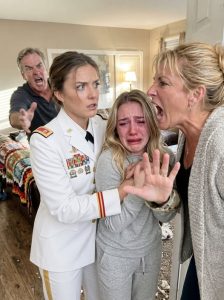
The handcuffs clicked around my wrists at 6:41 on a Thursday morning.
For eleven years, I had worn Army uniforms, cleared weapons, supervised convoys, signed accountability sheets worth millions of dollars, and taught young soldiers how to keep their heads when everything around them went wrong.
Now I was standing barefoot in my own living room while a county deputy held a handgun sealed inside an evidence bag.
A handgun I had never seen before.
“Staff Sergeant Callahan,” the deputy said, “you have the right to remain silent.”
I stopped listening.
Not because I was panicking.
Because I was thinking.
The pistol was black. Compact. Semi-automatic.
No visible holster wear.
No dust.
And the deputy had known exactly where to look.
Between the two center cushions of my couch.
Captain Maya Torres finally looked at me.
Her expression hurt worse than the cuffs.
“Erin,” she said quietly, “is there anything you need to tell me?”
“No, ma’am.”
The deputy glanced toward her.
I kept my voice steady.
“I want an attorney.”
That ended the conversation.
Mostly.
One of the MPs walked through my apartment photographing everything: the broken front-door chain, the damaged bookshelf, my desk, my government laptop.
I stared at that laptop.
Then I remembered.
The tiny green light.
Two days earlier, after my family had forced their way inside, I had checked the laptop for physical damage.
I had not checked whether its security software had logged anything.
Military systems do not behave like ordinary home computers.
My laptop had encrypted endpoint protection, login records, tamper alerts, network logs, and—because I handled certain logistics systems—additional security monitoring.
Kelsey had reached directly toward it.
Dad had shoved me backward.
Mom had grabbed me.
The entire confrontation had happened less than six feet from government equipment.
Maybe that mattered.
Maybe it didn’t.
But it was something.
The deputy began escorting me toward the door.
I stopped.
“Captain.”
Torres looked at me.
“My laptop needs to be secured by the unit cybersecurity representative.”
The deputy frowned.
“We have a warrant.”
“For my residence,” I said. “Not authorization to access classified or controlled government systems.”
Torres straightened.
For the first time since she arrived, she looked like my commander instead of someone attending my funeral.
“She’s right.”
The deputy’s jaw tightened.
“I’m not trying to access it.”
“Then there’s no problem,” Torres said. “An Army representative can take custody.”
He didn’t argue.
As I passed the couch, I looked once more at the gun.
And something cold settled inside me.
My family had planned this.
Not during an argument.
Not impulsively.
They had gone home after invading my apartment.
Then someone had returned.
Someone had planted that weapon.
Someone had coordinated three matching statements.
And they believed that would be enough.
—
I spent nine hours in county custody.
Nine hours beneath fluorescent lights.
Nine hours answering nothing.
My appointed civilian attorney arrived just after noon.
Her name was Denise Park.
She was small, maybe forty-five, with dark hair cut sharply at her jaw and the expression of someone who considered every conversation an interrogation.
She sat across from me in the consultation room.
“Your family says you threatened them with a pistol during the incident Tuesday morning.”
“They’re lying.”
“Your father says you took the weapon from your desk.”
“Lie.”
“Your mother says you pressed it against your sister’s chest.”
“Lie.”
“Your sister says you told her, ‘I’ll bury you before I give you another dollar.’”
I stared at Denise.
“That line sounds like my father.”
She wrote something down.
“Do you own firearms?”
“No.”
“Ever owned one?”
“No.”
“Army qualification?”
“Obviously.”
“That means the prosecution will say you know weapons.”
“I also know forklifts. Doesn’t mean I keep one behind my couch.”
Her pen stopped.
Then the corner of her mouth moved.
Almost a smile.
“Good,” she said. “Stay angry. Just don’t get stupid.”
She slid photographs across the table.
The weapon.
A Glock 19.
Magazine inserted.
No round chambered.
Serial number intact.
“They’re running ownership now.”
“I’ve never touched it.”
“We’ll find out.”
She leaned back.
“Here’s your bigger problem. Your family’s statements are unusually consistent.”
“How consistent?”
“Almost identical.”
I looked at her.
She noticed.
“Yes,” Denise said. “That caught my attention too.”
Witnesses remembering the same event rarely use the same words.
Soldiers learn that quickly.
Ask five people to describe a vehicle accident and you get five versions.
Same event.
Different angles.
Different details.
Dad, Mom, and Kelsey had apparently remembered the exact same phrases.
That wasn’t memory.
That was rehearsal.
Denise continued.
“The prosecutor hasn’t filed final charges. They’re waiting on forensics and your military status. But your commander informed them the Army has opened an inquiry.”
“My clearance?”
“Flagged pending investigation.”
My stomach tightened.
A flag could stop promotions, awards, transfers.
My reputation would move faster than any paperwork.
By sunset, half the brigade would know.
Staff Sergeant Callahan arrested after allegedly threatening family with firearm.
Nobody remembers the word allegedly.
They remember the gun.
“What happened to the weapon after they found it?” I asked.
“Evidence processing.”
“Fingerprints?”
“Yes.”
“DNA?”
“Probably.”
“Good.”
Denise studied me.
“You sound confident.”
“I’ve never touched it.”
That answer should have made everything simple.
It didn’t.
Because at 4:17 that afternoon, Denise returned with a different expression.
“They found partial fingerprints.”
“Not mine.”
“No.”
Relief hit me.
Then disappeared when she continued.
“They belong to your sister.”
I stared at her.
“Kelsey?”
“Yes.”
Denise leaned forward.
“That should help us.”
“No.”
Her eyes narrowed.
“Why no?”
“Because she’ll say I forced her to hold it.”
Denise was silent.
Exactly.
By evening, Kelsey had amended her statement.
She claimed I had shoved the gun into her hands during the argument and screamed at her to “feel how real it was.”
It was absurd.
It was also clever enough to explain her prints.
Dad and Mom backed her version.
Three witnesses.
One planted gun.
One arrested soldier.
My family had built a cage around me.
But they had made mistakes.
People always do when they lie too much.
—
I was released pending investigation that night.
No weapon charge had been filed yet.
My command placed me on administrative duties.
No access to weapons.
No sensitive systems.
No soldiers under my direct supervision.
The following morning, I reported to Captain Torres at 0800.
She closed her office door.
I stood at parade rest.
“Sit down, Erin.”
I sat.
She looked exhausted.
“I’m going to tell you something off the record.”
I waited.
“I don’t believe your family.”
I said nothing.
“But belief is irrelevant,” she continued. “Evidence matters.”
“Yes, ma’am.”
“Our cyber warrant officer pulled the security logs from your laptop.”
My heartbeat changed.
Torres turned her monitor.
“There was a proximity-triggered security event Tuesday at 05:09.”
I leaned closer.
“What kind?”
“Camera activation.”
I froze.
Government laptops in our section had automated security monitoring for unauthorized access attempts.
If the lid opened incorrectly or repeated authentication failures occurred, the webcam could capture still images.
Torres clicked.
A photograph appeared.
Timestamp: 05:09:32.
My apartment.
My desk.
Kelsey’s face.
She was leaning over my laptop.
Dad stood behind her.
And in the background I could see myself struggling with Mom.
It did not show a gun.
But it proved something important.
The family’s sworn statements said Dad remained near the front door during the entire confrontation.
He hadn’t.
The second image was better.
05:09:47.
Kelsey’s hand was on the laptop.
Dad stood beside the couch.
His right hand was inside his jacket pocket.
Captain Torres zoomed in.
“What’s that?” I asked.
“We don’t know.”
Neither of us said what we were thinking.
The shape under his jacket could have been anything.
Phone.
Wallet.
Gun.
Torres clicked again.
05:10:01.
Dad’s jacket was open now.
Nothing visible.
Then another image.
05:10:14.
Mom staring directly toward the desk.
Kelsey reaching for my wallet.
Me between them.
Still no gun.
No weapon in my hands.
No weapon on the desk.
No weapon anywhere.
I exhaled slowly.
“That destroys their story.”
“Part of it.”
Captain Torres faced me.
“But it doesn’t prove the pistol was planted later.”
“I know.”
“There’s more.”
She pulled out a printed sheet.
“Your apartment complex has electronic access control.”
“Yes.”
“Individual unit doors don’t. But the exterior building entrances do.”
My mind jumped ahead.
“Key fobs.”
Torres nodded.
“Your family left at 05:14 Tuesday.”
I waited.
She pointed at another line.
“Someone entered your building again Tuesday night at 22:38.”
“Who?”
“A resident held the door open. No fob registered.”
My hope dropped.
Then Torres continued.
“But the lobby camera captured a vehicle outside.”
She turned the monitor again.
A dark pickup truck sat beneath a streetlight.
My father’s truck.
I knew the dent in the rear bumper.
The silver toolbox.
The university decal Kelsey had stuck crookedly on the back window.
At 22:41, a figure in a hooded sweatshirt entered the building.
At 22:47, the figure left.
Six minutes.
Dad’s truck drove away.
My hands tightened.
“Can you see the face?”
“No.”
“Build?”
“Could be your father. Could be your sister.”
I stared at the frozen image.
Six minutes was plenty of time.
My broken door chain had been repaired temporarily by maintenance, but the lock itself still worked.
Only two people other than me had ever possessed a spare key.
My parents.
I had given it to them three years earlier when I deployed overseas.
I had forgotten all about it.
Apparently they hadn’t.
—
Denise obtained the footage before noon.
By evening, investigators searched my father’s truck.
They found nothing.
Dad hired a lawyer.
Mom stopped answering calls.
Kelsey posted something online about “surviving abuse from someone everyone else thinks is a hero.”
She never used my name.
She didn’t need to.
Mutual relatives began texting me.
Aunt Linda:
*Your mother is devastated.*
Cousin Paul:
*Whatever happened, threatening Kelsey was too far.*
Grandma’s sister:
*Family problems shouldn’t involve police.*
I answered none of them.
Then the money attacks started.
Dad filed a civil claim saying the $61,400 I had sent over five years had been part of an informal agreement giving me responsibility for household expenses.
He demanded another $18,000 for “anticipated family support.”
It was ridiculous.
But ridiculous legal filings still require responses.
Then my parents produced screenshots.
Messages supposedly from me.
*I’ll always cover the mortgage.*
*Don’t worry about bills.*
*You can depend on me.*
Some were real.
Some were edited.
One had been completely fabricated.
Denise looked almost delighted.
“Why are you smiling?”
“Because people who fake evidence usually think screenshots are magic.”
She subpoenaed carrier records.
The fake message had never existed.
Now we had more than lies.
Potential evidence fabrication.
But Dad still wasn’t finished.
Three days later, Captain Torres called me into her office again.
This time an Army Criminal Investigation Division special agent was waiting.
Special Agent Ruben Shaw.
Late thirties.
Gray suit.
Eyes that gave away nothing.
He placed a folder on the table.
“Staff Sergeant Callahan, do you recognize this?”
Inside was a photograph of the Glock.
“No.”
He turned the page.
Purchase record.
The gun had been bought eleven months earlier.
Buyer:
**Thomas Callahan.**
My father.
I stared at the paper.
Shaw watched me.
“He reported it stolen two months ago.”
“From where?”
“His truck.”
“Police report?”
“No.”
I looked up.
“He reported a stolen firearm but didn’t file a police report?”
“He claims he verbally informed an insurance representative.”
Denise, seated beside me, actually laughed.
Just once.
Shaw didn’t.
“We contacted the insurer. There’s no record.”
My pulse thudded in my ears.
Dad owned the gun.
Kelsey’s fingerprints were on it.
Dad’s truck had been outside my apartment the night before police found it.
The family’s stories contradicted the laptop images.
The fake text messages could be disproven.
For the first time, the cage around me had a crack.
Then Shaw closed the folder.
“But that’s not why I’m here.”
The room seemed to get colder.
“Why are you here?”
He slid another photograph forward.
It showed the bottom of the pistol’s magazine.
A tiny white inventory label.
Numbers handwritten in black ink.
I leaned closer.
My throat tightened.
The handwriting looked familiar.
Not Dad’s.
Mom’s.
She labeled everything.
Storage bins.
Christmas decorations.
Freezer bags.
Even leftovers.
“What does the number mean?” I asked.
“We were hoping you could tell us.”
I read it again.
**C-17.**
I shook my head.
“No idea.”
Shaw opened another file.
“Your parents own a storage unit?”
“I didn’t know that.”
“They do.”
He tapped the folder.
“Unit C-17.”
Nobody spoke.
The search warrant was executed that afternoon.
Inside Unit C-17 investigators found furniture, old tax documents, Kelsey’s childhood boxes, tools, and several locked plastic containers.
One container held ammunition matching the caliber of the Glock.
Another held documents.
Bank statements.
Insurance papers.
Copies of my military orders.
Copies of my Leave and Earnings Statements.
Copies of my social security card.
My birth certificate.
My Army emergency contact forms.
Even an expired photocopy of my military ID.
Denise called me at 7:20 that evening.
Her voice had changed.
“Erin, your case is no longer just about the gun.”
I sat on the edge of my bed.
“What did they find?”
“Financial documents.”
“What kind?”
“Accounts.”
My stomach tightened.
“What accounts?”
“Several credit products opened using your information.”
For a moment I couldn’t understand the sentence.
Then I did.
“How much?”
“We don’t know yet.”
“Denise.”
“Preliminary number?”
“Yes.”
She hesitated.
“About eighty-seven thousand dollars.”
The room went silent around me.
Credit cards.
A personal loan.
A home improvement line.
An online lending account.
Some had been opened while I was overseas.
Payments had been made regularly enough to avoid immediate detection.
The mailing addresses went to my parents’ house or electronic accounts I had never seen.
My family hadn’t merely spent the money I willingly sent.
They had been borrowing under my identity.
And someone had kept detailed records.
There was worse.
One file contained a spreadsheet.
My name at the top.
Monthly income.
Allowances.
Deployment pay.
Projected promotions.
Retirement estimates.
Beside certain months were notes:
**“Erin can cover.”**
**“Ask after bonus.”**
**“Deployment = extra.”**
**“Do not tell Kelsey total.”**
I read the printed copy in Denise’s office the next morning.
My hands shook.
Not from fear.
From fury.
Five years of phone calls rearranged themselves in my memory.
Mom crying about electricity.
Dad saying the truck needed a transmission.
Kelsey needing tuition money.
Emergency dental work.
Property taxes.
A leaking roof.
Every crisis had arrived conveniently near payday.
They hadn’t been calling their daughter.
They had been managing an income stream.
Me.
Denise pointed to the bottom.
“There’s another worksheet.”
She flipped the page.
**ESTATE PLAN**
Kelsey: House.
Kelsey: Investment account.
Kelsey: Personal property.
Erin: $0.
Beside my name:
**Already compensated through independence.**
I laughed.
A single ugly sound.
I had sent them $61,400.
They had stolen another $87,000 under my name.
And somehow I was the one considered compensated.
Then I noticed another line.
My laughter stopped.
**Life insurance — Erin.**
“What’s this?”
Denise frowned.
“We’re checking.”
“Checking what?”
She closed the folder.
“Whether anyone purchased a policy connected to you.”
My body went still.
“You can’t just buy life insurance on somebody without them knowing.”
“You generally need insurable interest and underwriting requirements vary. Sometimes employer-related information or forged documentation complicates things.”
“Forged.”
“That word is appearing frequently.”
By afternoon, investigators found it.
A private life insurance policy.
$500,000.
Insured:
**Erin Marie Callahan.**
Beneficiary:
**Margaret Callahan.**
My mother.
The application contained an electronic signature bearing my name.
I had never signed it.
The policy had been active for nineteen months.
Premiums had been paid from an account belonging to my parents.
When Special Agent Shaw told me, I didn’t speak for almost a minute.
Finally I asked the only question that mattered.
“Did my family know the policy was still active?”
“Yes.”
My skin prickled.
The gun.
The false statements.
The claims that I was unstable.
The threats against my career.
Suddenly the conspiracy felt larger than money.
“What happens if I’m convicted of a violent felony?” I asked.
Shaw considered the question.
“That depends.”
“What happens to my Army career?”
“You know the answer.”
Discharge.
Lost benefits.
Lost stability.
Lost credibility.
Someone could paint every future accusation against me with the same brush.
Unstable veteran.
Violent.
Armed.
Dangerous.
Easy to disbelieve.
Easy to isolate.
Easy to destroy.
Shaw leaned forward.
“I need you not to speculate.”
I looked at him.
“I’m a logistics NCO. Speculation is half my job. You look at movement, resources, timing, intent.”
“Then look carefully.”
“I am.”
Something in his expression told me he already had.
—
My father was arrested Friday morning.
Not for attempted murder.
Not for the gun.
Not yet.
He was arrested on identity theft and fraud-related charges connected to one of the accounts investigators could establish quickly.
Kelsey was brought in for questioning.
Mom hired another attorney.
For six hours, nobody knew what Kelsey said.
Then my phone rang.
Denise.
“Your sister wants to cooperate.”
I almost dropped the phone.
“What?”
“She says your father planned the firearm setup.”
“And Mom?”
“She says your mother knew.”
“Why is Kelsey talking?”
“Because Kelsey just learned something.”
I waited.
Denise exhaled.
“Your parents were going to blame everything on her.”
Of course they were.
Kelsey had been their favorite for twenty-three years.
Until she became useful as a sacrifice.
Investigators showed her documents from the storage unit.
Several fraudulent accounts had electronic applications traced to a laptop registered to Kelsey.
Dad had apparently used it.
The Glock carried Kelsey’s fingerprints.
Security footage potentially showed someone her size entering my building.
And among Dad’s papers was a handwritten note.
**If gun becomes issue: Kelsey handled it.**
That sentence broke her.
Kelsey confessed that Dad drove her to my apartment Tuesday night.
She used the spare key.
She planted the Glock beneath my couch cushions.
Dad waited outside.
Mom had rehearsed their statements with them.
Kelsey claimed she didn’t know about the identity theft.
She said she believed they were only trying to scare me into restoring the monthly payments.
I didn’t know whether to believe her.
I wasn’t sure I cared.
The county prosecutor withdrew the investigation against me.
My command lifted most restrictions.
The flag took longer because Army paperwork moves like frozen syrup, but Captain Torres personally briefed the brigade commander.
My reputation would survive.
Eventually.
My family?
That was another matter.
Dad remained in custody pending bond.
Mom faced questioning over forged financial documents.
Kelsey negotiated through her attorney.
For the first time in years, nobody asked me for money.
The silence felt strange.
Then, twelve days after the 5 A.M. invasion, Denise called.
“I need you in my office.”
“What happened?”
“You need to see it.”
The last time she said that, I discovered someone had taken a half-million-dollar insurance policy on my life.
So I drove there immediately.
Special Agent Shaw was already waiting.
A banker sat beside him.
On the table was a sealed evidence bag containing a small red notebook.
I sat.
“What is that?”
Shaw answered.
“Recovered from a safe-deposit box registered jointly to your parents.”
He put on gloves and opened the notebook.
Most pages contained numbers.
Dates.
Amounts.
Initials.
Then he turned to one near the middle.
My name appeared.
**ERIN**
Below it were dates.
My deployments.
My homecoming dates.
My training rotations.
My addresses.
Even the date my current apartment lease began.
I looked up.
“Why were they tracking this?”
Shaw turned another page.
There were three columns.
**DATE**
**EVENT**
**PAYMENT**
Some payments matched money I had sent.
Others did not.
Then I saw a name repeated in the payment column.
**R. Mercer**
Again.
And again.
Eight payments over fourteen months.
Amounts ranging from $600 to $2,400.
“Who is Mercer?”
“That’s the question,” Shaw said.
The banker shifted uncomfortably.
Denise looked at Shaw.
“You know something.”
He hesitated.
Then slid a photograph across the table.
It came from an ATM camera.
Dad stood beside a man wearing a baseball cap.
The image was grainy.
But the man’s face was visible.
Something about him felt familiar.
I stared.
Then my blood went cold.
I had seen him before.
Not at my parents’ house.
Not with Kelsey.
At Fort Bragg.
Three months earlier.
Standing across the parking lot from my unit headquarters.
At the time, I assumed he was a contractor.
Then I remembered another place.
The grocery store near my apartment.
Two weeks later.
Same man.
I had noticed him because he was wearing the same dark cap.
My mouth went dry.
“He was following me.”
Nobody answered.
That was answer enough.
Shaw turned the notebook one final time.
At the bottom of the last written page was a date.
Next Friday.
Eight days away.
Beside it:
**E.C. — FINAL**
Underneath:
**$15,000 on completion.**
I stared at those words until they blurred.
The staged gun had not been the end of my family’s plan.
It might not even have been the worst part.
Then Shaw placed a second photograph on the table.
Taken that morning.
The man called R. Mercer walking out of a motel forty miles away.
He was carrying a duffel bag.
And according to investigators, inside the room he had left behind were photographs of me.
My apartment.
My car.
My unit headquarters.
My running route.
And one picture that had been taken less than twenty-four hours earlier.
Me standing outside Denise Park’s office.
Someone had drawn a red circle around my head.
At the bottom, in black marker, were four words:
**FRIDAY. NO MORE MISTAKES.**
Special Agent Shaw looked at me.
“Staff Sergeant Callahan, we believe your family hired him.”
I could barely hear him over the pounding of my own heartbeat.
“For what?”
Shaw closed the evidence folder.
“We’re trying to determine whether the original assignment was to frighten you…”
He paused.
“…or whether you were never supposed to survive long enough to expose any of this.”
And somewhere in North Carolina, R. Mercer had already disappeared.
…If you want to know what happened next, please type “YES” and like for more.
”