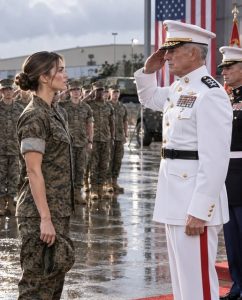
I stared at the document in my hands long enough for the words to blur.
At the top was the official seal of the United States Marine Corps.
Below it, in language so formal it almost felt unreal, was my name.
CORPORAL JENNA M. REYNOLDS.
And beneath that:
SPECIAL SELECTION — LEADERSHIP DEVELOPMENT AND ASSESSMENT DETAIL.
I read it twice.
Then a third time.
I still didn’t understand.
“Sir,” I said carefully, “I don’t know what this is.”
The four-star general leaned back in his chair.
“That is precisely why you’re here.”
My commanding officer, Colonel Marcus Hale, folded his hands on the desk.
I had served under Colonel Hale for nearly two years. He was not a man who wasted expressions. If something was funny, you might get half a smile. If something impressed him, you might get one slow nod.
Right now, he was watching me with a look I had never seen before.
Respect.
And something else.
Concern.
That second part bothered me.
General Thomas Mercer tapped the document with one finger.
“You’ve been selected for a temporary assignment,” he said.
“What kind of assignment, sir?”
“A difficult one.”
That told me nothing.
Apparently my face said so.
The general almost smiled.
“You’re direct, Corporal.”
“Yes, sir.”
“Good. You’ll need to be.”
He stood and crossed toward the window.
Rain streaked the glass.
For a strange second, it reminded me of the diner.
The old jacket.
The faded Vietnam cap.
The declined credit card.
I wondered if any of that had been real.
Maybe I should have been focused on the four stars on his uniform.
Instead, I found myself thinking about his wallet.
“Sir?”
He glanced back.
“Yes?”
“Was your card actually declined?”
Colonel Hale looked down immediately.
The general stared at me.
I was suddenly very aware that I had just asked one of the most senior officers in the United States military about his credit card.
“Yes,” Mercer said.
I blinked.
“It wasn’t a test?”
“No.”
“Oh.”
“My bank froze the card after unusual travel activity. I had cash, but not enough. I’d left my phone in the vehicle.”
Colonel Hale finally lost the battle with his expression.
The corner of his mouth twitched.
General Mercer noticed.
“Something amusing, Colonel?”
“No, General.”
“Excellent.”
Then Mercer looked at me again.
“That night wasn’t arranged, Reynolds. I didn’t manufacture some ridiculous morality test.”
“Yes, sir.”
“I despise those stories.”
That nearly made me laugh.
Nearly.
“What happened afterward,” he continued, “was different.”
He returned to the desk and opened my personnel folder.
“I remembered your name.”
His finger moved across the pages.
“Then I asked about you.”
My stomach tightened again.
“You’ve never received a disciplinary action.”
“No, sir.”
“Two letters of appreciation from civilian organizations.”
I said nothing.
“Three informal commendations that never became formal awards.”
I glanced at Colonel Hale.
He avoided my eyes.
The general continued.
“You volunteered for storm evacuation support last year.”
“Yes, sir.”
“You pulled an injured motorist from a vehicle before emergency crews arrived.”
“Yes, sir.”
“You stayed behind during a barracks electrical fire to make sure two junior Marines made it out.”
I shifted slightly.
“That sounds more dramatic than it was, sir.”
Mercer looked up sharply.
“Does it?”
“Yes, sir.”
“Your smoke inhalation report disagrees.”
I didn’t answer.
He flipped another page.
“During a field exercise eight months ago, a sergeant made a navigation error that placed your unit nearly five kilometers off route.”
My jaw tightened.
I remembered that day.
Everyone remembered that day.
Temperatures had dropped hard after sunset. We had been wet, tired, and carrying too much gear.
The mistake could have turned ugly.
Mercer continued.
“You recognized the error.”
“Yes, sir.”
“You corrected it.”
“Yes, sir.”
“You did not report the sergeant responsible.”
“No, sir.”
“Why?”
I hesitated.
Colonel Hale’s eyes lifted.
This was not casual conversation anymore.
“Because he corrected himself once I showed him the problem,” I said.
“And?”
“And because embarrassing him in front of the entire platoon wouldn’t have gotten us home faster.”
The general watched me.
“You protected him.”
“I protected the mission, sir.”
Something changed in Mercer’s expression.
Very slightly.
Like a door opening one inch.
He flipped to another report.
“You also turned down a recommendation for early promotion.”
I stiffened.
I had not expected that to be in there.
Colonel Hale spoke for the first time.
“I told him.”
I looked at him.
“Sir?”
“I told General Mercer.”
The general folded his arms.
“Why did you refuse?”
I chose my words carefully.
“There were Marines in my section with more experience.”
“That wasn’t the question.”
“No, sir.”
“Why did you refuse?”
I looked down at the document in my hand.
Then back at him.
“Because I didn’t think I was ready.”
Silence.
The general nodded once.
Not approval.
Recognition.
“That,” he said, “was the first thing in your record that interested me.”
I frowned.
“Not the commendations?”
“No.”
“The fitness scores?”
“No.”
“The evaluations?”
“Useful. Not interesting.”
I must have looked confused because he continued.
“The military is full of ambitious people, Reynolds. Ambition is not a defect. We need people who want responsibility.”
He paused.
“But occasionally, we find someone who understands responsibility before they desire authority.”
Colonel Hale leaned back.
General Mercer tapped my folder.
“That is rarer.”
I swallowed.
“Sir, what exactly am I being selected for?”
He looked at Hale.
The colonel nodded.
Mercer closed the folder.
“You’ll be attached for thirty days to an experimental leadership exercise being conducted through Marine Corps headquarters.”
I waited.
“That sounds intentionally vague, sir.”
“It is.”
“Why?”
“Because most of the participants don’t know the real purpose.”
My skin prickled.
“What do they think the purpose is?”
“A multinational readiness assessment.”
“And what is it actually?”
The general held my gaze.
“To determine who can be trusted when rank stops being useful.”
I didn’t understand.
He saw that.
“Imagine a crisis,” he said. “Communications are fragmented. Senior leadership is unavailable. Orders conflict. Information is incomplete. Political consequences are significant. Lives depend on decisions made quickly.”
“That sounds like war, sir.”
“Sometimes.”
His tone made the room colder.
“Sometimes it looks nothing like war.”
Colonel Hale stood.
“Reynolds, sit down.”
That worried me more than anything else.
I sat.
The general did too.
“You’ve heard of command-post exercises,” Mercer said.
“Yes, sir.”
“This will look like one. But the evaluations will be different from anything you’ve experienced.”
“How?”
“You will be working with officers.”
I blinked.
“What rank?”
“Captains. Majors. Lieutenant colonels.”
For a second I thought I had misheard him.
“Sir, I’m a corporal.”
“I’m aware.”
“They’re not going to listen to me.”
“Probably not.”
There it was again.
That almost-smile.
“They may resent you,” he continued.
“Probably.”
“They may assume your presence is administrative.”
“Probably.”
“They may order you out of rooms.”
“Probably.”
“And I’m supposed to do what?”
Mercer’s expression became serious.
“Pay attention.”
I waited.
“That’s it?”
“No. But it begins there.”
He slid a thinner envelope across the desk.
I opened it.
Inside was a temporary set of orders.
REPORTING LOCATION: QUANTICO, VIRGINIA.
My stomach dropped.
Quantico.
“What happens after thirty days?” I asked.
“If you wash out, you return here.”
“And if I don’t?”
The general did not answer immediately.
Colonel Hale did.
“You may be offered a commission.”
I stopped breathing.
Not literally.
But close enough.
I looked at him.
Then at the general.
“A commission?”
Mercer nodded.
“Possibly.”
My first reaction was disbelief.
My second was suspicion.
My third was irritation.
I hated myself for the third one.
“Sir, respectfully…”
“Say it.”
“This sounds insane.”
Colonel Hale coughed.
Mercer grinned.
Actually grinned.
“Excellent.”
I stared at him.
“You’re not supposed to agree with that part, sir.”
“I’ve been arguing exactly that for six months.”
Now I was completely lost.
Mercer leaned forward.
“This program isn’t mine.”
That surprised me.
“Whose is it?”
“Originally? A joint task force.”
He paused.
“Currently, no one wants to claim ownership.”
That was not reassuring.
“What happened?”
“Last year, several training exercises exposed an uncomfortable pattern. When senior officers were given incomplete information, most became slower, more cautious, and more dependent on hierarchy.”
“That sounds normal.”
“In moderation.”
He folded his hands.
“But when situations became chaotic, some participants stopped solving problems and started protecting careers.”
The room became very quiet.
Mercer continued.
“They delayed decisions. Shifted accountability. Waited for permission they knew would not come.”
I thought about field exercises.
About people waiting for someone else to speak first.
About the strange silence that sometimes happened when everyone knew something was wrong but no one wanted to own it.
“The task force began examining junior personnel,” Mercer said. “Not because junior Marines are magically wiser. They aren’t.”
Colonel Hale gave a faint nod.
“But because lower-ranking personnel spend much of their lives operating without control. They improvise. They observe. They solve problems while someone else gets the briefing.”
I understood that part.
Very well.
“So you need enlisted Marines.”
“We need a handful.”
“Why me?”
Mercer’s eyes narrowed slightly.
“I already answered that.”
“No, sir.”
He studied me.
“That’s dangerous.”
“Yes, sir.”
“You’re telling a four-star general he didn’t answer your question.”
“Yes, sir.”
Colonel Hale closed his eyes.
I continued before courage deserted me.
“You told me what you found in my record. You didn’t tell me why that makes me qualified to advise officers ten ranks above me.”
The general stared at me for a long moment.
Then he leaned back.
“Because you just did that.”
I said nothing.
“You disagreed without becoming disrespectful. You recognized the power difference. You considered your words. Then you said what needed saying.”
His expression hardened.
“That is exactly what the exercise measures.”
A strange weight settled in my chest.
“Sir…”
“And for the record,” Mercer added, “you will not be advising senior officers.”
“Then what will I be doing?”
“Competing with them.”
That was worse.
Much worse.
I looked at Colonel Hale.
He did not appear to be joking.
“When do I report?”
Mercer checked his watch.
“Monday. 0600.”
That gave me four days.
“Your participation is voluntary,” he said.
I looked down.
“For how long do I have to decide?”
“You already have.”
I looked up sharply.
He pointed toward my hands.
I was still holding the orders.
“You took the paper.”
“That counts?”
“For people like you?”
The faint smile returned.
“Usually.”
I barely slept for the next three nights.
By Monday morning, I had convinced myself of two things.
First, the entire program was probably a bureaucratic disaster.
Second, I was going anyway.
Quantico greeted me with gray skies, cold wind, and the smell of wet pavement.
The building listed on my orders was nowhere near the impressive headquarters facility I had imagined.
It was a low, windowless training structure tucked behind a larger administrative complex.
No sign outside.
No unit designation.
Just a door and a Marine captain holding a clipboard.
“Name?”
“Corporal Jenna Reynolds.”
He looked at the list.
Then at me.
Then back at the list.
Something like confusion crossed his face.
“Corporal?”
“Yes, sir.”
“You’re in the wrong building.”
“I don’t think so, sir.”
He examined my orders.
His expression changed.
Not much.
Just enough.
“Apparently not.”
He stepped aside.
Inside, I found seventeen people.
Sixteen officers.
And me.
Every conversation stopped.
I saw captains.
Majors.
Two lieutenant colonels.
One Navy commander.
An Army major.
A Coast Guard lieutenant commander.
A Royal Marine officer from the United Kingdom.
And at the far end of the room, a woman in civilian clothes who introduced herself only as Dr. Miriam Shaw.
No one introduced themselves to me.
Not at first.
I took an empty seat.
A Marine major beside me glanced at my rank insignia.
“Administrative support?”
“No, sir.”
“Observer?”
“I don’t believe so.”
He frowned.
“What are you here for?”
“Same reason you are, I assume.”
His face changed.
Across the room, someone laughed quietly.
Not cruelly.
But not kindly either.
Dr. Shaw walked to the front.
She was in her early fifties, with silver-streaked dark hair and the relaxed posture of someone completely unimpressed by uniforms.
“Good morning.”
The room settled.
“You have all been selected based on previous performance.”
Her eyes moved across us.
“You were told this is a leadership development assessment.”
Everyone nodded.
“That is partially true.”
Of course it was.
“You will participate in a thirty-day sequence of exercises.”
She clicked a remote.
A map appeared on the wall.
An island.
Fictional.
At least I hoped so.
“You will be assigned rotating command roles. Each scenario will involve military, humanitarian, diplomatic, logistical, and civilian complications.”
A Marine lieutenant colonel raised his hand.
“What are the evaluation criteria?”
Dr. Shaw smiled.
“You’ll find out afterward.”
Nobody liked that.
I could feel it.
She continued.
“There is one rule.”
The slide changed.
MISSION OUTCOME IS NOT THE PRIMARY METRIC.
That created immediate murmuring.
Dr. Shaw waited.
Then she said, “Your decisions matter. But we are more interested in why you make them.”
An Army major asked, “Then what’s the objective?”
“To show us who you are under pressure.”
That silenced the room.
“Your formal rank remains in effect for safety and administrative purposes,” she said. “Inside the exercise, authority will be assigned independently.”
I knew what was coming before she said it.
I hated that I knew.
“First scenario leader…”
She looked down at her tablet.
“Corporal Reynolds.”
Silence.
Absolute silence.
The Marine major beside me turned slowly.
I wanted the floor to open.
It didn’t.
Dr. Shaw looked directly at me.
“Front of the room, Corporal.”
I stood.
My legs felt strangely disconnected from the rest of me.
As I walked forward, I passed officers with fifteen, eighteen, twenty years of service.
Some watched curiously.
Some looked amused.
One looked insulted.
That man was Lieutenant Colonel Adrian Vale.
I would remember his face.
He was tall, sharp-featured, decorated, and perfectly composed.
And he looked at me like someone had put a child in the pilot’s seat.
Dr. Shaw handed me the remote.
“You have command.”
I turned toward the room.
Nobody spoke.
The first scenario began.
A fictional cyclone had devastated the island’s southern coast.
Thousands displaced.
Communications damaged.
A hostile armed faction had begun blocking aid routes.
A U.S. amphibious unit stood offshore.
A foreign government was demanding assistance but refusing permission for armed forces to enter certain districts.
Food supplies were running out.
Then the complications started.
A bridge collapsed.
A hospital lost power.
An allied helicopter went missing.
A report suggested insurgents had entered a refugee camp.
I tried to assign tasks.
People responded.
Technically.
But I could feel the resistance.
Not open insubordination.
Something more dangerous.
Polite delay.
Questions.
Clarifications.
Requests for confirmation.
Officers examining my every sentence for weakness.
Ten minutes in, I was drowning.
Lieutenant Colonel Vale watched silently.
Then he leaned back and crossed his arms.
I knew exactly what he was doing.
Waiting.
Waiting for me to fail.
I almost did.
Then a message arrived.
Two hundred civilians were trapped near the collapsed bridge.
Military engineers could reach them.
But doing so would delay movement toward the hospital.
I asked for recommendations.
Three officers spoke at once.
Then two contradicted them.
Another wanted aerial reconnaissance.
Someone requested updated casualty figures.
Someone else argued that jurisdiction remained unclear.
The clock kept running.
I heard General Mercer’s voice in my head.
Some people stop solving problems and start protecting careers.
I looked around the room.
“Enough.”
The room went silent.
“We don’t have complete information.”
No one moved.
“We’re not going to get complete information.”
Vale’s expression shifted.
I pointed toward one captain.
“Get engineers moving to the bridge.”
He nodded.
I pointed to the Navy commander.
“Redirect shipboard medical support toward the hospital.”
Then toward the Army major.
“Find the helicopter.”
“Yes, Corporal.”
I looked at everyone else.
“If something changes, we adjust. But we are not leaving people trapped because we’re afraid the next update might make us look wrong.”
No one spoke.
Then Vale said quietly, “That decision could expose the engineering team to hostile forces.”
“Yes, sir.”
“You’re accepting that risk?”
I met his eyes.
“Yes, sir.”
“And if they’re attacked?”
“I’ll own the decision.”
Something flickered across his face.
I expected anger.
Instead, I saw surprise.
The exercise continued for another four hours.
We made mistakes.
Several.
I made more than anyone.
At the end, the fictional casualty count was higher than I wanted.
The hospital survived.
Most civilians were evacuated.
The missing helicopter crew was found alive.
Dr. Shaw ended the simulation.
Nobody applauded.
Nobody congratulated me.
I returned to my seat exhausted.
Vale passed behind me.
“Corporal.”
I looked up.
“Sir?”
“You made seven major procedural errors.”
“I counted nine, sir.”
His mouth almost moved.
Then he walked away.
I couldn’t tell whether I had impressed him or irritated him more.
That evening, individual scores were posted.
Mine was not first.
Or second.
Or third.
I ranked eleventh.
Out of seventeen.
I stared at the screen.
Somehow, I felt relieved.
Then I noticed something.
There were two columns.
MISSION PERFORMANCE.
And LEADERSHIP RESILIENCE.
Mission performance: eleventh.
Leadership resilience: first.
By a significant margin.
I stood there alone in the corridor, trying to understand what that meant.
“Interesting, isn’t it?”
I turned.
Dr. Shaw stood behind me.
“What does leadership resilience mean?”
“You recover quickly.”
“From mistakes?”
“From uncertainty.”
She studied the score screen.
“You don’t become emotionally attached to appearing correct.”
I frowned.
“Is that unusual?”
“Yes.”
“That seems depressing.”
“It often is.”
She walked away.
Then stopped.
“Oh. One more thing.”
“Yes, ma’am?”
“Tomorrow’s scenario is classified differently.”
My stomach tightened.
“What does that mean?”
“You’ll see.”
By the end of the second week, I understood why the program had no obvious owner.
Nobody could agree on what it was supposed to produce.
Some instructors evaluated tactics.
Others evaluated communication.
Psychologists watched emotional responses.
Analysts recorded decision speed.
Civilian specialists introduced ethical problems that had no clean solution.
One day, I commanded a simulated evacuation.
The next, I worked logistics.
Then I was deliberately placed under officers who hated being questioned.
Lieutenant Colonel Vale and I clashed repeatedly.
He was smarter than I was.
More experienced.
More knowledgeable.
And incredibly difficult to read.
During one scenario, he ordered us to hold a position while waiting for authorization.
I believed the delay would strand civilians.
I challenged him.
He rejected my recommendation.
I challenged him again.
Afterward, he found me outside.
“You enjoyed that.”
“No, sir.”
“You challenged me twice in front of the entire command group.”
“Yes, sir.”
“You realize I could end your career.”
I looked at him.
“With respect, sir, I assumed that’s why they put me here.”
He stared.
Then, to my complete surprise, he laughed.
It was the first time I saw him behave like a normal human being.
“Reynolds, you are either exceptionally brave or profoundly foolish.”
“I’m starting to suspect the second one, sir.”
He nodded.
“So am I.”
After that, something changed.
Not friendship.
But trust.
Then, on day sixteen, the program changed too.
We entered the briefing room at 0500.
No map was displayed.
No fictional island.
No scenario packet.
General Mercer was standing at the front.
Everyone came to attention.
“As you were.”
We sat.
Mercer looked different.
No faint smile.
No relaxed tone.
A red folder rested in his hand.
“I need everyone to listen carefully.”
He placed the folder on the desk.
“The exercise is suspended.”
No one moved.
“For what reason, General?” Vale asked.
Mercer looked at him.
“Because twelve hours ago, something happened that was not part of the exercise.”
The room became still.
Dr. Shaw stood against the wall.
Her face had gone pale.
Mercer continued.
“A defense contractor supporting this program discovered unauthorized access to the simulation network.”
Someone swore quietly.
Mercer ignored it.
“Initially, we believed it was a cybersecurity breach.”
“Initially?” the Navy commander asked.
Mercer nodded.
“Then we found evidence that someone had accessed personnel files.”
My stomach dropped.
“Whose files?” Vale asked.
Mercer looked across the room.
“All of yours.”
Nobody spoke.
I felt cold.
Mercer opened the folder.
“Training records. Evaluations. Financial history. Medical readiness data. Family contacts.”
Every word made the air heavier.
“Why?” someone asked.
“We don’t know.”
Then the general looked directly at me.
“And one participant’s file was accessed more than all the others combined.”
I already knew.
“Mine,” I said.
Mercer nodded.
The room turned toward me.
I felt seventeen sets of eyes.
“What were they looking for?” Vale asked.
Mercer hesitated.
That frightened me more than anything else.
“We think they were looking for a connection.”
“To what?” I asked.
The general pulled out a photograph.
He walked across the room.
Placed it in front of me.
For several seconds I couldn’t understand what I was seeing.
It was an old photograph.
Vietnam.
Young Marines standing beside a damaged helicopter.
Mud.
Weapons.
Exhausted faces.
Then I saw one of them.
A young Thomas Mercer.
Maybe nineteen.
Maybe twenty.
Standing beside him was another Marine.
Tall.
Dark-haired.
A crooked smile.
My chest tightened.
I knew that face.
Not from memory.
From photographs in my mother’s house.
Family photographs.
A man who had died before I was born.
I looked at Mercer.
My voice came out barely above a whisper.
“That’s my grandfather.”
General Mercer nodded.
“Yes.”
The room disappeared around me.
“My grandfather knew you?”
Mercer stared at the photograph.
“He saved my life.”
I couldn’t speak.
“He never told my family.”
“No.”
“Why not?”
Mercer’s jaw tightened.
“Because officially, the incident that nearly killed me never happened.”
Vale stood.
“What incident?”
Mercer did not answer him.
He looked only at me.
“Your grandfather, Gunnery Sergeant Daniel Reynolds, was part of a small Marine advisory operation in 1974.”
“I thought he served earlier.”
“He did.”
The general’s voice became quieter.
“He went back.”
Something inside me shifted.
Every family story I knew about my grandfather suddenly felt incomplete.
“How did he save you?”
Mercer looked toward the door.
Then at Dr. Shaw.
She nodded once.
The general sat across from me.
“We were ordered to evacuate intelligence personnel from a remote site after a political situation collapsed.”
He paused.
“The mission went wrong.”
“How?”
“Our extraction was compromised.”
His eyes returned to the photograph.
“We were supposed to leave with six Americans.”
He paused again.
“We found eleven.”
Vale frowned.
“Who were the others?”
Mercer answered quietly.
“People who officially did not exist.”
Nobody moved.
“A local interpreter. His wife. Two children.”
He stopped.
“And a young American civilian attached to an intelligence program.”
I leaned forward.
“What happened?”
“We were ordered to leave them.”
The words landed hard.
“Your grandfather refused.”
My throat tightened.
“He disobeyed an order?”
“Yes.”
“Did you?”
Mercer looked at me.
“I was nineteen.”
That was not an answer.
And it was.
“He put all eleven aboard the helicopter,” Mercer continued. “When hostile forces attacked the landing site, he stayed behind long enough to cover the aircraft.”
I looked at the photograph again.
“He survived.”
“Yes.”
“But he was never decorated for it.”
“No.”
“Because the mission didn’t exist.”
Mercer nodded.
I understood something then.
The diner.
The file.
The questions.
“This whole program,” I whispered. “You recognized my name because of him.”
“At first.”
“So that’s why I’m here.”
Mercer’s expression hardened.
“No.”
“But—”
“No, Reynolds.”
His voice filled the room.
“I noticed you because of your grandfather.”
He tapped my file.
“You stayed because of you.”
I looked down.
Then something occurred to me.
“Who accessed my file?”
“We don’t know.”
“Why would anyone care about something that happened in 1974?”
Mercer said nothing.
And that silence answered more than I wanted.
“You know,” I said.
His jaw tightened.
“Part of it.”
“What part?”
Mercer slowly turned the old photograph over.
There was handwriting on the back.
Faded.
Uneven.
A list of names.
I recognized my grandfather’s handwriting from old letters.
Daniel Reynolds.
Thomas Mercer.
Edward Lane.
Samuel Pike.
Five local names I didn’t recognize.
And one more.
A woman.
ELIZABETH HARPER.
I stared at it.
“Who is she?”
Mercer’s face changed.
It was the first time I had seen fear in the four-star general’s eyes.
Not battlefield fear.
Something older.
Something personal.
“The civilian we evacuated.”
I looked at the name again.
“What happened to her?”
Mercer’s answer came slowly.
“We were told she died in 1977.”
“Told?”
“Yes.”
“You don’t believe it?”
He reached into the red folder.
Removed another photograph.
This one was new.
Timestamped three days earlier.
A surveillance photograph.
An elderly woman stepping out of a black SUV somewhere in Europe.
Gray hair.
Dark glasses.
Two security personnel beside her.
Below the photograph was a name.
Not Elizabeth Harper.
ELENA HARROW.
My pulse began hammering.
“What does she have to do with me?”
General Mercer looked directly at me.
“We don’t know yet.”
Then Dr. Shaw stepped forward.
“There’s something else.”
She placed a printout on the table.
It showed the network intrusion timeline.
My file had been opened repeatedly.
Hundreds of times.
But the last entry contained a manually typed search.
Not a file request.
Not a database code.
A question.
IS JENNA REYNOLDS HIS GRANDDAUGHTER?
My hands went cold.
“Whose granddaughter?” I asked.
Nobody answered.
I looked at Mercer.
“You said Daniel Reynolds was my grandfather.”
“Yes.”
“Then why would someone ask it like that?”
Mercer did not respond.
Dr. Shaw looked away.
Lieutenant Colonel Vale slowly sat down.
And suddenly I understood why Mercer had stopped the exercise.
This wasn’t about leadership anymore.
It wasn’t about my career.
Someone had been looking for me.
Someone who knew about a mission my own family had never heard of.
Someone who knew my grandfather.
And perhaps someone who knew something about my family that I didn’t.
I looked at the old photograph again.
My grandfather’s face.
General Mercer beside him.
Then the five strangers.
Then Elizabeth Harper.
I turned the picture toward the light.
That was when I noticed something hidden in the damaged corner.
Another Marine stood behind my grandfather.
Most of his face was obscured.
But his name tape was visible.
REYNOLDS.
I stopped breathing.
I pointed at him.
“General.”
Mercer didn’t look.
“Sir.”
Still nothing.
My voice sharpened.
“Who is that?”
The entire room went silent.
General Mercer finally looked at the photograph.
For several seconds, he said nothing.
Then he closed his eyes.
And I knew.
Whatever came next, everyone in that room had been waiting for him to say it.
When Mercer opened his eyes again, the four-star general was gone.
For one moment, he was simply an old man carrying something for fifty years.
“Jenna,” he said quietly.
It was the first time he had used my first name.
“The man standing behind your grandfather…”
He swallowed.
“…was his younger brother.”
I stared at him.
“My grandfather didn’t have a brother.”
“That is what your family was told.”
My heart pounded.
“Then who was he?”
Mercer looked at Dr. Shaw.
She walked to the door and locked it.
Click.
Every officer in the room noticed.
Mercer lowered his voice.
“His name was Nathan Reynolds.”
I felt dizzy.
“And according to the official record…”
The general slid one final document across the table.
I looked down.
The paper was older than the others.
Declassified markings covered half the page.
Near the bottom was one line.
STATUS: MISSING — PRESUMED DECEASED.
I looked up.
Mercer finished the sentence.
“…Nathan Reynolds died during that evacuation.”
I glanced back at the network report.
Then at the question typed by whoever had accessed my file.
IS JENNA REYNOLDS HIS GRANDDAUGHTER?
A terrible possibility opened in my mind.
“That question wasn’t about Daniel.”
General Mercer said nothing.
“It was about Nathan.”
Still nothing.
I felt my pulse pounding behind my eyes.
“But Nathan died.”
Mercer stared at me.
“No,” he said.
The word seemed to change the temperature of the room.
“We thought he did.”
I looked at the recent surveillance photograph of Elizabeth Harper.
Then at the old photograph.
Then at the hidden Marine whose existence had been erased from my family history.
“How do you know he didn’t?”
General Mercer reached into the red folder one last time.
He removed a small transparent evidence bag.
Inside was a handwritten note.
Fresh ink.
Only six words.
TELL JENNA I REMEMBER THE RAIN.
My blood turned cold.
The diner.
That rainy night.
My first meeting with General Mercer.
Something I had believed was random.
Something nobody should have known about except me, the diner staff, and the general.
I looked at Mercer.
His face was pale.
“Where did this come from?”
“It was left outside my hotel room yesterday morning.”
“Who left it?”
“We don’t know.”
I stared at the message.
TELL JENNA I REMEMBER THE RAIN.
Then I noticed the handwriting.
The R curved strangely.
The J dipped below the line.
I had seen handwriting like that before.
Not exactly the same.
But close.
On birthday cards.
Old Christmas notes.
Letters saved in a wooden box at my mother’s house.
I whispered, “No.”
Mercer leaned forward.
“What?”
I looked at him.
“My grandfather wrote like this.”
The room went completely still.
“Daniel?” Mercer asked.
“No.”
My mouth went dry.
I suddenly remembered something my mother had said years ago.
Something I had never questioned.
Your grandfather had terrible handwriting. Your father inherited it.
My father.
I stood so quickly the chair scraped backward.
Mercer rose.
“Reynolds?”
I barely heard him.
My father had died when I was eleven.
Car accident.
Closed casket.
I had believed that story my entire life.
But now another sentence surfaced from memory.
Something my mother had once whispered during an argument with my grandmother.
Something I had been too young to understand.
He should never have come back.
At the time, I thought she meant my father had returned home drunk.
Now those words felt completely different.
General Mercer watched my face.
“What is it?”
I looked at the hidden Marine in the photograph.
Nathan Reynolds.
Missing.
Presumed dead.
Then at the note.
Then at Mercer.
“My father’s middle name,” I said.
Mercer froze.
“What about it?”
I heard my own heartbeat.
“His name was Michael Nathan Reynolds.”
Nobody moved.
General Mercer’s expression changed.
Shock.
Not recognition.
Shock.
That terrified me more than anything.
Because it meant this was new to him too.
I stepped toward the table.
“If Nathan Reynolds survived…”
Mercer looked at the photograph.
Then at me.
And I finished the thought neither of us wanted to say aloud.
“…then maybe he wasn’t my grandfather’s brother.”
The room felt suddenly too small.
Maybe the family tree I had known my entire life was wrong.
Maybe the dead weren’t dead.
Maybe the four-star general hadn’t found me by accident.
And maybe the rainy night at that diner had never been an accident either.
Before anyone could speak, Dr. Shaw’s phone vibrated.
She looked down.
All color drained from her face.
“What?” Mercer asked.
She turned the screen toward him.
A security alert.
Someone had breached the outer checkpoint at the Quantico facility.
Not with stolen credentials.
With valid credentials.
The name attached to the access badge appeared on the screen.
Colonel Hale.
My commanding officer.
The man who had sent me into General Mercer’s office.
The man who had known about the program.
The man who had known where I was.
I stared at the screen.
“That’s impossible.”
General Mercer’s expression became hard.
“Why?”
“Because Colonel Hale called me this morning.”
Mercer looked at me sharply.
“From where?”
“My base.”
“When?”
“About forty minutes ago.”
Dr. Shaw looked at the security timestamp.
Then she whispered:
“That badge was used here forty-eight minutes ago.”
Nobody spoke.
Someone who looked like Colonel Hale had entered Quantico before the real Colonel Hale had called me from Norfolk.
Then the lights went out.
Complete darkness.
For half a second nobody moved.
Then emergency lights flickered red.
A siren began somewhere in the building.
Lieutenant Colonel Vale stood.
“General, we need to move.”
Mercer grabbed the red folder.
The door handle turned.
Once.
Slowly.
Everyone stared at it.
Then someone knocked.
Three times.
Mercer’s face changed.
I had seen that expression before.
In the diner.
When he had repeated my name.
Corporal Reynolds.
But now I understood what I had mistaken for curiosity.
Recognition.
The knocking came again.
Three times.
Pause.
Two times.
Mercer whispered something.
“What?” I asked.
He looked at me.
“That was your grandfather’s signal.”
My blood ran cold.
The handle began to turn again.
And from the other side of the locked door, an old man’s voice said:
“Tom.”
General Mercer stopped breathing.
Nobody called him Tom.
Nobody in this building would dare.
The voice continued.
“You’ve kept her in the dark long enough.”
Mercer stared at me.
And for the first time since I had met him, the four-star general looked completely powerless.
Then the voice outside the door said my name.
Not Corporal Reynolds.
Not Reynolds.
“Jenna.”
I could not move.
“I knew your father.”
My hands started trembling.
General Mercer whispered, “Do not open that door.”
But the man outside laughed softly.
“You still giving orders, Tommy?”
Mercer went pale.
Then came the sentence that changed everything.
“Ask the girl why her father’s coffin was empty.”
I stared at Mercer.
He stared back.
The red emergency lights pulsed across his face.
And in that moment, I understood the truth was no longer buried in a fifty-year-old classified mission.
It was standing on the other side of the door.
Waiting for me to open it.
…If you want to know what happened next, please type “YES” and like for more.”