The morning my younger sister tried to take my mountain home, the rain came down over King County like heaven itself had chosen sides and was too heartbroken to say which one.
I sat alone at the defendant’s table in a Washington courtroom that smelled of damp wool, old paper, and polished wood. The kind of smell that belongs to places where strangers settle what families were too cruel to settle at the kitchen table. A blank yellow legal pad rested in front of me, though I had not written a single word on it. My hands were folded so tightly in my lap that my knuckles had turned pale.
Across the aisle, my sister Nicole Irving sat in a cream designer suit, her legs crossed neatly, her chin lifted as if she were attending a charity luncheon instead of accusing her own blood of being unfit to own a house. Her blond hair was swept into a smooth twist. Her pearls glowed softly beneath the courtroom lights. Everything about her said grace, good breeding, and victory.
But I knew Nicole.
I knew the little girl who used to cry until our mother gave her the larger slice of birthday cake. I knew the teenager who borrowed my clothes, ruined them, and then told our parents I had given them to her. I knew the woman who could turn tears on and off like a faucet, who had learned early that if she looked fragile enough, the world would hand her a weapon and call it sympathy.
Beside her sat her husband, Chris Irving, a broad-shouldered man with polished shoes and a smile that always seemed to arrive half a second before the insult.
He leaned toward me over the aisle and murmured, “Your small real-estate kingdom ends today.”
I did not look at him.
That was the first thing I had learned after fifty-six years of being Tracy Manning: not every barking dog deserved the satisfaction of seeing you flinch.
Behind Nicole sat our parents, Richard and Susan Manning. They looked older than the last time I had seen them at Thanksgiving two years earlier, but not softer. My father still wore his navy blazer like armor. My mother still carried herself with the wounded dignity of a woman who believed every disappointment in life had been personally delivered by her eldest daughter.
They had not come to support me.
They had come to witness my correction.
In the Manning family, there had always been two daughters, but only one child.
Nicole was the golden one.
I was the difficult one.
Nicole gave my parents what they understood: marriage, children, Sunday brunches, Christmas cards, a husband who played golf with my father, and a house in a neighborhood where everyone’s lawn looked trimmed with scissors. She smiled in photographs. She remembered birthdays. She let our mother rearrange her furniture and call it helping.
I gave them questions.
I never married. I built my own company. I bought neglected properties, fixed them, rented them, sold them, reinvested, and slowly—quietly—became wealthy enough that people stopped calling me stubborn and started calling me disciplined.
My parents never forgave me for that.
Success, in their minds, was acceptable only when it made them look right. Mine made them look unnecessary.
And nothing offended them more.
The property at the center of the lawsuit was 48 Hollow Pine Road, a cedar-and-glass mountain home above Lake Wenatchee, with tall windows facing a glacier-fed lake and a stone fireplace wide enough to warm a room full of ghosts. I had bought the land when I was forty-eight, after a decade of saving, and built the house slowly, carefully, painfully.
I had skipped vacations. Sold my car. Lived in a rented studio with cracked linoleum while putting every extra dollar into beams, permits, insulation, and windows. I had stood there in the mud with contractors, rain dripping from my hood, choosing the angle of the deck so the morning light would fall across the kitchen.
That house was not just property.
It was proof.
Proof that I could survive my family’s coldness. Proof that peace could be built board by board. Proof that a woman alone in middle age was not incomplete, pitiful, or waiting to be rescued.
And now Nicole wanted it.
Not because she needed it. Not because she had suffered for it. Not even because she loved it.
She wanted it because I had it.
Judge Elena Brown entered at exactly nine o’clock. Everyone rose. The room quieted into the heavy silence of official consequences.
She was a composed woman with silver-threaded dark hair and sharp, watchful eyes. She did not waste time smiling for anyone. When she sat, the whole room seemed to settle around her.
“Be seated,” she said.
Nicole’s attorney, Arthur Bell, rose first. He was a lean man with a sympathetic voice and an expensive watch, the sort of attorney who could make theft sound like family concern.
“Your Honor,” he began, “this is a painful matter involving two sisters. My client, Mrs. Nicole Irving, comes before the court not out of greed, but out of necessity. Her older sister, Miss Tracy Manning, has become increasingly unstable, isolated, and incapable of maintaining the property known as 48 Hollow Pine Road.”
I felt Nicole’s eyes on me.
Unstable.
There it was.
The word families use when a woman stops obeying.
Arthur Bell continued. “We will present a signed transfer agreement indicating that Miss Manning voluntarily assigned ownership interest in the Hollow Pine property to Mrs. Irving for the benefit of the family, particularly Mrs. Irving’s children.”
My mother dabbed at her eyes with a tissue.
I nearly smiled.
She had always been good at crying before the wound was even delivered.
Arthur lifted a document from his file and handed copies to the judge and to my attorney, Daniel Cho, who sat beside me in calm silence. Daniel was in his early sixties, with silver glasses and the stillness of a man who preferred facts to theatrics. He glanced at the document without changing expression.
Arthur said, “The agreement bears Miss Manning’s professional letterhead and signature.”
Nicole turned slightly toward me.
Her face was soft. Almost sorrowful.
But her eyes gleamed.
Finally, they seemed to say. Finally, your house belongs to me.
The judge studied the document for a long moment.
Then she lifted her gaze.
“Miss Manning,” she said, “did you sign this agreement?”
My throat felt dry, but my voice came out steady.
“No, Your Honor.”
Arthur Bell sighed, as though disappointed by my stubbornness. “Miss Manning has a history of denying commitments once they become inconvenient.”
Daniel Cho rose slowly. “Objection. Argumentative and unsupported.”
“Sustained,” Judge Brown said.
Arthur gave a small bow of his head. “Apologies, Your Honor.”
But the damage had been offered. That was the game. Toss poison into the room, then apologize for the stain.
Judge Brown looked at me again. “Miss Manning, the court has also received statements questioning your capacity to manage real estate assets. How many properties are currently in your name?”
A faint smile touched Chris’s mouth. He thought the question would embarrass me. Perhaps he imagined I owned one house and had invented the rest of my life to sound important.
I breathed once.
Then I answered.
“Twelve, Your Honor.”
The courtroom went still.
Even the rain seemed to pause against the glass.
Judge Brown’s pen stopped moving. “Twelve?”
“Yes, Your Honor. Four residential rentals in Tacoma, three duplexes in Spokane, two mixed-use buildings in Everett, one commercial warehouse in Kent, one cabin near Cle Elum, and Hollow Pine.”
Nicole’s lips parted.
Chris blinked.
Behind them, my father shifted in his seat.
My mother looked suddenly less tearful.
Judge Brown turned to Arthur Bell. “Counsel, were you aware of the scope of Miss Manning’s holdings?”
Arthur’s smile tightened. “We were aware she possessed certain assets, Your Honor, though we believe that strengthens our concern regarding her judgment.”
Daniel Cho stood again.
“Your Honor, with permission, I would like to address the so-called transfer agreement.”
Judge Brown nodded. “Proceed.”
Daniel lifted the document between two fingers.
“This agreement is fraudulent.”
A murmur moved through the courtroom.
Nicole whispered sharply to Chris, but he did not answer.
Daniel continued, “My client’s letterhead was copied from an old business invoice. The signature is not hers. The notary stamp belongs to a woman who retired three years before the alleged signing. And the parcel number listed on page two refers not to Hollow Pine, but to a vacant lot my client sold in 2017.”
Arthur Bell’s face lost color.
Judge Brown leaned forward. “Mr. Cho, do you have evidence supporting this?”
“Yes, Your Honor.”
Daniel opened a folder and placed several documents before the court.
“Certified notary records. County property records. Metadata from the original PDF file. And a forensic handwriting analysis.”
Nicole’s face had gone white beneath her makeup.
Chris’s jaw worked as if he were chewing glass.
Judge Brown looked at the fraudulent agreement, then at Nicole.
“Mrs. Irving,” she said quietly, “who prepared this document?”
Nicole’s mouth trembled.
For the first time that morning, she looked at me not like a sister winning a game, but like a child caught holding a match beside a burning curtain.
“I… I don’t know,” she said.
Chris leaned toward her. “Don’t answer that.”
Judge Brown’s eyes sharpened.
Daniel Cho looked at me, and I gave him the smallest nod.
He reached into his leather case and removed one final envelope.
“Your Honor,” he said, “there is more.”
PART 2 — THE FAMILY ACCOUNTING
Before the judge opened that envelope, I found myself remembering a winter evening from 1978, when Nicole was seven and I was twelve.
Our father had taken us to a diner after church. Nicole spilled chocolate milk down the front of her dress, burst into tears, and blamed me. I had been sitting three feet away, eating fries, but my mother slapped my hand under the table and hissed, “Why do you always upset her?”
That was my childhood in miniature.
Nicole cried.
I paid.
By the time I graduated high school, I had learned to apologize for things I had not done because it was quicker than proving innocence to people invested in my guilt. I left home at eighteen with two suitcases, $312, and a scholarship to Washington State. My mother cried when I left, but not because she would miss me.
“You’re abandoning this family,” she said.
My father stood behind her with his arms crossed. “Don’t expect us to rescue you when you realize the world doesn’t care how smart you think you are.”
He was wrong about the rescue.
He was right about the world.
The world did not care.
So I learned not to need it to.
I worked nights at a pharmacy, weekends at a motel desk, summers painting apartment units with men who called me “kid” until they realized I could climb ladders faster than they could. I studied finance because numbers did not pout, lie, or revise history. Numbers told the truth if you had the courage to read them.
By thirty, I bought my first duplex.
It had a sagging porch, mold behind the bathroom wall, and tenants who paid late but tried hard. I repaired what I could myself. I learned plumbing from library books and roofing from a retired contractor named Earl, who lived downstairs and paid half rent in exchange for teaching me how not to get cheated.
“Property is memory,” Earl told me once, squinting at a rotten beam. “A house remembers every corner somebody cut. You fix it right, it’ll remember that too.”
I never forgot those words.
By forty, I owned five buildings.
By fifty, nine.
Every Christmas, Nicole would tilt her head and say, “It must be lonely, all those houses and no family of your own.”
My mother would sigh. “Tracy has always preferred things to people.”
That was not true.
I preferred peace to performance.
There is a difference.
At fifty-six, I had finally begun to believe I was free of them. Then Nicole called one summer afternoon, her voice syrupy sweet.
“Trace, we should all go up to Hollow Pine sometime. The kids would love it.”
“No,” I said.
A pause.
Then laughter, thin and bright. “No?”
“It’s my private home, Nicole. Not a family vacation rental.”
“You don’t have to be so cold.”
“I’m not cold. I’m clear.”
Two weeks later, our mother called.
“Your sister is hurt.”
“She’ll recover.”
“She has children, Tracy. You have to think about someone besides yourself.”
“I built that house for myself.”
“That’s exactly the problem,” my mother said.
A month after that, I received the lawsuit.
Nicole claimed I had promised her Hollow Pine. She claimed I was mentally unstable, financially reckless, and increasingly paranoid. She claimed my refusal to transfer the property proved I was unwell.
And my parents signed statements supporting her.
My father wrote that I had always shown “unusual hostility toward family unity.”
My mother wrote that I was “emotionally erratic” and “obsessed with ownership.”
I read those statements at my kitchen table with a cup of coffee going cold beside me. I did not cry. That surprised me. A younger version of myself might have shattered.
But pain changes as you age.
At twenty, betrayal feels like a knife.
At fifty-six, it feels like a receipt.
Proof of something you already paid for.
In court, Judge Brown opened the envelope Daniel had provided. The room seemed to lean toward her.
Inside were bank records, email printouts, and a sworn statement from a paralegal named Marissa Dale, who had worked temporarily for Arthur Bell’s office.
Daniel spoke with measured care.
“Your Honor, we became aware last week that the forged transfer agreement may not be an isolated document. There is evidence suggesting Mr. and Mrs. Irving attempted to use similar documents to secure loans against my client’s properties.”
Nicole gasped. “That is not true.”
Chris muttered, “Shut up, Nicole.”
But the judge heard him.
Her gaze moved to him. “Mr. Irving, you will not instruct anyone in my courtroom to be silent.”
Chris leaned back, face flushed.
Daniel continued, “The documents include falsified authorization letters, forged signatures, and loan inquiries submitted to three private lenders. One lender flagged the materials and contacted my client’s office.”
Arthur Bell stood. “Your Honor, my clients were acting under the belief that Miss Manning had given verbal authorization—”
“No,” I said.
The word came out sharper than I intended.
Everyone turned.
Judge Brown studied me. “Miss Manning?”
I stood slowly.
For a moment, I saw not a courtroom, but every dining room table where I had swallowed the truth to keep peace. Every birthday where I had smiled while Nicole took credit. Every family gathering where my mother called cruelty concern and my father called obedience love.
“No,” I repeated, quieter now. “They did not believe they had authorization. They believed I would be too ashamed to fight. They believed if they called me unstable loudly enough, people would stop listening to what I could prove.”
Nicole’s eyes filled with tears.
“Tracy, how can you say that? I’m your sister.”
I looked at her.
“You were my sister when you lied. You were my sister when you filed this case. You were my sister when you sat here smiling while your attorney called me unstable.”
Her lips trembled. “We were only trying to help.”
“Help yourself,” I said.
My mother rose behind her. “That is enough.”
Judge Brown’s voice cut through the room. “Mrs. Manning, sit down.”
My mother froze, humiliated, then lowered herself back onto the bench.
I had never seen anyone stop my mother mid-performance before. It was almost beautiful.
Judge Brown turned to Nicole. “Mrs. Irving, did you submit any documents to lenders using Miss Manning’s name?”
Nicole shook her head too quickly. “No. I mean—I don’t know what Chris did. I didn’t handle the financial parts.”
Chris stared at her.
Something ugly passed between them.
For years, I had assumed Chris controlled Nicole, or at least encouraged her worst instincts. But in that moment, I saw something else. He was angry, yes. Frightened too. But more than that, he looked surprised.
As if Nicole had just moved a piece on the board he did not know she possessed.
Daniel placed another page before the judge.
“This is an email from Mrs. Irving to Mr. Irving dated March 14. The subject line reads, ‘Use this version.’ Attached is the forged agreement.”
Nicole whispered, “Oh God.”
Chris stood abruptly. “She told me Tracy agreed. She told me the whole thing was settled.”
Nicole turned on him. “You said no one checks notaries that closely!”
Arthur Bell put a hand to his forehead.
Judge Brown’s expression hardened into something cold and final.
“I am referring this matter to the King County Prosecuting Attorney’s Office for investigation of possible forgery, attempted fraud, and conspiracy,” she said. “The civil claim regarding 48 Hollow Pine Road is dismissed pending criminal review.”
The gavel came down.
For one second, I felt relief.
Then my father stood.
His face was red. Not with shame.
With rage.
“You couldn’t just let her have one thing, could you?” he said.
The courtroom fell silent again.
I turned to him slowly.
“One thing?” I asked.
His voice shook. “You have twelve properties. Twelve. Nicole has children. A family. Responsibilities. You sit up there in that house alone like some queen, while your sister struggles.”
Nicole began to cry, but I no longer believed in her tears.
I looked at my father, then at my mother, and something inside me finally unclenched.
“You never wanted fairness,” I said. “You wanted me small enough to make Nicole comfortable.”
My mother’s mouth twisted. “After everything we did for you—”
“What did you do for me?” I asked.
She looked offended. “We raised you.”
“No,” I said. “You housed me. You corrected me. You blamed me. You taught me that love had to be earned and then changed the price every time I got close.”
My father pointed at me. “Don’t you speak to your mother that way.”
I smiled then, not because anything was funny, but because I had waited fifty-six years to say the next words.
“You don’t get to command me anymore.”
He looked as if I had slapped him.
Maybe I had.
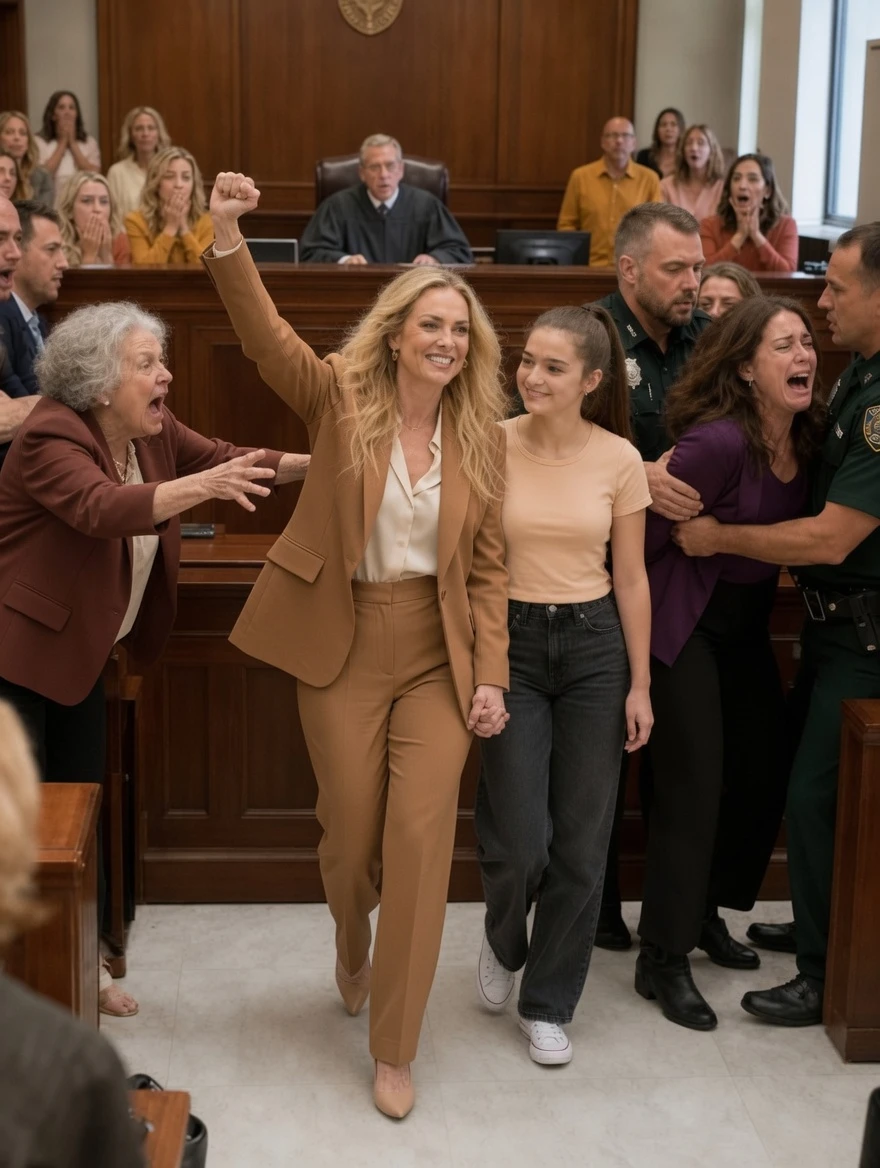
Not with a hand.
With freedom.
PART 3 — HOLLOW PINE
The investigation began the following week, but the true unraveling took longer.
Fraud is like dry rot in an old house. At first, you see only one soft board. Then someone pulls it back and discovers the whole wall has been quietly eaten from within.
Detectives contacted me twice. A forensic accountant called three times. Daniel advised me not to speak with Nicole or my parents, which was the easiest legal advice I had ever followed.
Still, silence did not protect me from memory.
I went to Hollow Pine two days after the hearing.
The drive from Seattle into the mountains had always soothed me. City noise thinned. Traffic loosened. The air changed first, growing colder and sharper, carrying the scent of fir and rain-soaked stone. By the time the road curled above the lake, I could feel my shoulders lowering.
Hollow Pine stood at the end of a gravel drive, its cedar siding darkened by weather, its windows reflecting the gray sky. I parked beneath the old hemlock and sat for a moment, hands on the steering wheel.
No one had taken it.
The thought should have comforted me.
Instead, I began to shake.
All those years, I had told myself the house was my victory. But sitting there, I understood it had also been my fortress. I had built walls not just against winter, but against wanting. Against family. Against the humiliating hope that someday they might see me clearly and say, Tracy, we were wrong.
Inside, the house was quiet. I lit the fireplace, put water on for tea, and stood before the tall windows watching mist drift over the lake.
Then my phone rang.
Nicole.
I let it ring.
It stopped.
Then started again.
I turned the phone face down on the counter.
A minute later, a text appeared.
Please. I need to talk to you.
Then another.
Chris is blaming everything on me.
Then another.
Mom and Dad won’t answer my calls.
I stared at the messages without touching the phone.
For most of my life, Nicole’s distress had been treated as an emergency that required my sacrifice. If she cried, I apologized. If she failed, I softened the landing. If she wanted something, I was expected to call my refusal selfish.
But I was tired.
At our age, people like to say blood is everything. Usually they say it when they are asking someone else to bleed.
I made tea.
The next morning, Daniel called.
“There’s something you need to hear,” he said.
I sat at the kitchen island. “Go ahead.”
“The lender who flagged the fraudulent documents found another file. It references something called the Manning Family Trust.”
I frowned. “There is no family trust.”
“That’s what I thought. But the document claims your parents transferred certain assets into a trust years ago, with Nicole as primary beneficiary.”
“My parents don’t have assets worth trusting,” I said.
“That may be the point.”
I looked out at the lake.
Daniel continued. “The trust documents appear to list one of your properties as collateral.”
My fingers tightened around the mug. “Which property?”
“Hollow Pine.”
“That’s impossible.”
“Yes,” Daniel said. “Legally impossible. But fraud often begins with impossible documents and hopes no one reads them.”
I closed my eyes.
There are betrayals that shock you.
Then there are betrayals so perfectly shaped to your history that they feel almost inevitable.
“Who signed it?” I asked.
A pause.
“Your mother.”
For a long moment, I heard only the fire shifting in the hearth.
“My mother forged my name?”
“Not exactly,” Daniel said. “She signed as trustee.”
“I told you there is no trust.”
“I know.”
I laughed once. It sounded empty.
Of course.
Of course my mother would invent a structure in which she still had authority over what belonged to me.
That afternoon, I called her.
She answered on the second ring, voice stiff.
“Well. Have you called to apologize?”
I nearly hung up.
Instead, I said, “Tell me about the Manning Family Trust.”
Silence.
Then, “I don’t know what you mean.”
“Yes, you do.”
A chair scraped in the background. “Your father and I only wanted to make sure the family was protected.”
“Protected from whom?”
“From your selfishness.”
The word landed without force. It had been thrown at me too many times to cut anymore.
“There is no trust, Mother.”
“There should have been.”
I looked around the house I had built. The stone. The cedar. The windows facing sky and water.
“You signed documents claiming authority over my property.”
“You never should have had so much while your sister had so little.”
“Nicole lives in a five-bedroom house in Bellevue.”
“She has expenses. Children. A husband whose business has been struggling.”
“So you committed fraud.”
Her voice sharpened. “Don’t use that word with me.”
“That is the word.”
“I am your mother.”
“And I am not your possession.”
She inhaled sharply.
For years, I had imagined that saying those words would make me tremble. Instead, I felt calm.
Then my mother said something I did not expect.
“You were never supposed to know.”
A chill moved through me.
“Know what?”
She did not answer.
“Mother.”
Her voice dropped. “Ask your father.”
Then she hung up.
I stood in the kitchen with the phone in my hand, staring at nothing.
Ask your father.
Those three words followed me through the rest of the day. They sat beside me at dinner. They kept me awake after midnight, while rain tapped lightly on the roof.
At two in the morning, I went into the storage room and pulled out the old metal file box I kept under a shelf. Inside were birth certificates, tax returns, insurance policies, property records, and a few family documents I had taken when I left home decades ago.
I did not know what I was looking for.
That is often how the truth finds you.
Not by name.
By pressure.
At the bottom of the box, beneath my college transcripts, I found a yellow envelope labeled in my grandmother’s handwriting.
For Tracy, when needed.
My grandmother, Evelyn Manning, had died when I was twenty-three. She was the only person in my family who ever seemed to love me without measuring me against Nicole. She had taught me to make biscuits, to balance a checkbook, and to sit up straight when men tried to speak over me.
Inside the envelope was a letter.
My hands shook as I unfolded it.
Dear Tracy,
If you are reading this, it means the truth has begun pushing its way out.
I should have told you while I was alive, but I was afraid of what your parents would do. That is my shame, and I carry it with me.
Your parents did not build the foundation beneath you. Someone else did.
The letter blurred before my eyes.
I sat down hard on the floor.
PART 4 — THE DAUGHTER THEY USED
My grandmother’s letter was five pages long.
By the time I finished reading, dawn had begun to pale the windows.
The truth was this:
My mother had not inherited money from her parents. My father had not saved enough to help me through college. The scholarship I believed had covered my tuition had been only partial.
The rest had come from my grandmother.
More than that, when I was a child, my grandmother had placed a small investment account in my name, funded by money left from her second husband’s estate. She had intended it to help me when I turned twenty-five.
But my parents had gained access to it before then.
They had used it.
Not for me.
For Nicole.
Page after page, my grandmother explained what she had discovered near the end of her life: withdrawals, forged permissions, altered mailing addresses. Money meant for my education had helped pay for Nicole’s wedding, Nicole’s first home down payment, Chris’s failed business venture, and my parents’ debts.
When my grandmother confronted them, my father promised to repay it.
He never did.
Instead, they told the family I was ungrateful for wanting independence.
They made me the villain before I ever knew there had been a crime.
At the end of the letter, my grandmother had written:
You were not difficult, Tracy. You were robbed, and then punished for noticing the missing pieces.
I pressed the paper to my chest and wept.
Not politely.
Not gracefully.
I cried like the twelve-year-old girl in the diner who had been slapped under the table for something she did not do. I cried for the young woman working nights while money that belonged to her had been spent on flowers and champagne for Nicole’s wedding. I cried for every year I had believed I was alone because I was too hard to love.
When the tears finally stopped, I called Daniel.
By noon, I was back in Seattle.
By three, Daniel had contacted a forensic accountant.
By Friday, the criminal investigation had expanded.
The past, it turned out, leaves paperwork.
Old banks merge, records archive, signatures remain. What my parents thought had vanished into family memory still existed in microfilm, estate files, and tax documents.
Nicole called me seventeen times that week.
I answered on the eighteenth.
“What do you want?” I asked.
She was crying.
Not courtroom crying. Real crying. Messy, frightened, breathless.
“Tracy, I didn’t know about Grandma’s account.”
I sat in Daniel’s office, staring at a framed print of Mount Rainier on the wall.
“But you knew about Hollow Pine.”
She sobbed. “Chris said we were drowning. He said if we could just secure one property, we could refinance everything. He said you had so much, and I thought… I thought you would never really be hurt by losing one house.”
I closed my eyes.
There it was.
The family arithmetic.
My loss was never counted because I had learned to survive it.
“You thought wrong,” I said.
“I know.”
“No. You don’t. You thought my peace was extra. You thought because I don’t have children, because I don’t host Thanksgiving, because I don’t cry on command, that what I built mattered less.”
Nicole’s crying quieted.
“I was jealous,” she whispered.
That was the first honest thing she had said in years.
“I know,” I replied.
“You always seemed so free.”
I almost laughed. “Free?”
“You didn’t have Mom calling every day. You didn’t have Dad criticizing your husband, your house, your kids, your weight, your choices. You just left.”
“I was pushed out.”
“You escaped.”
“No, Nicole. I survived differently.”
She was silent for a long time.
Then she said, “Chris is going to prison, isn’t he?”
“Maybe.”
“And me?”
“I don’t know.”
Her voice became small. “Do you hate me?”
I looked down at my grandmother’s letter, lying on Daniel’s desk in a protective sleeve.
“No,” I said.
She exhaled shakily.
“But I am finished protecting you from the consequences of being loved more.”
She began crying again.
This time, I hung up.
The preliminary hearing for the criminal matter took place three months later.
By then, the case had grown teeth.
Chris had attempted to use forged authorization documents to obtain loans against three of my properties. Nicole had provided scanned signatures and old business letterhead. My mother had signed false trust papers. My father had helped redirect old financial notices to their address years earlier.
Arthur Bell withdrew as counsel and hired his own attorney.
The courtroom was different this time.
No smug smiles.
No cream suit.
Nicole wore gray and looked ten years older. Chris sat apart from her, his face hollow and angry. My parents sat behind them, stiff and silent.
I sat with Daniel.
This time, I had written something on my yellow legal pad.
Not notes.
A sentence.
I am not here to be chosen. I am here to be free.
The prosecutor laid out the evidence with calm precision. Forged signatures. False notarization. Attempted financial gain. Pattern of conduct. Historical misappropriation.
Then came the surprise.
The prosecutor called my father to answer questions regarding the old investment account.
He walked to the stand like a man heading toward a firing squad but still hoping someone would admire his posture.
After preliminary questions, the prosecutor asked, “Mr. Manning, did you access funds from an account established for Tracy Manning by Evelyn Manning?”
My father’s jaw tightened. “My mother gave money to the family.”
“That was not my question.”
He glanced at my mother.
She stared straight ahead.
“Yes,” he said finally.
“For what purpose?”
“To meet family obligations.”
“Such as?”
He swallowed.
“Nicole’s wedding. Some household expenses. A business loan.”
“To Chris Irving?”
“Yes.”
“Was Tracy Manning aware these funds existed?”
“No.”
The word echoed.
No.
One syllable.
Fifty years of fog, cleared.
The prosecutor asked, “Why was she not informed?”
My father’s mouth twisted.
Then, with the bitterness of a man who still believed theft was discipline, he said, “Because Tracy would have wasted it proving she didn’t need us.”
I felt Daniel’s hand lightly touch my arm.
Not restraint.
Support.
The prosecutor paused.
Then asked, “And what did Nicole do with the money?”
My father looked down.
“She needed it.”
There was no apology in his voice.
Only allegiance.
Judge Brown, presiding again, watched with unreadable eyes.
When my mother was called, she tried tears first.
“I only wanted to keep the family together,” she said.
The prosecutor asked, “By forging documents?”
“I did not think of it that way.”
“How did you think of it?”
My mother looked at me then.
For one moment, I thought she might break. I thought age, fear, or shame might finally strip her down to honesty.
Instead, she lifted her chin.
“Tracy never cared about family. Someone had to.”
There it was.
The last card.
The oldest lie.
But this time, nobody reached for it.
PART 5 — WHAT HOLLOW PINE REMEMBERED
The plea deals came in winter.
Chris took one first. He agreed to testify that Nicole and my parents knew the documents were false. In exchange, several charges were reduced. He would still serve time, but less than he deserved.
Nicole held out longer.
Then her attorney showed her the email trail.
She pleaded guilty to attempted fraud and forgery-related charges. Because she had no prior record and cooperated late, she received a sentence that included house arrest, probation, restitution, and community service. She lost her reputation, most of her friends, and eventually her marriage.
My parents were charged for the older financial fraud connected to my grandmother’s account, though the age of the case complicated prosecution. In the end, they agreed to a civil settlement using what remained of their retirement savings and the sale of their home.
People asked me if that felt good.
It did not.
Justice rarely feels like fireworks when the people being punished are the ones who taught you your own name.
It felt quiet.
It felt like a door closing on a room where I had once spent too much of my life waiting to be invited to the table.
In March, I returned to Hollow Pine alone.
Snow still clung to the shaded slopes, but the lake had begun to thaw around the edges. Sunlight slipped through the tall windows and laid itself across the floorboards like a blessing.
I had planned to sell the house.
That may surprise you.
After everything, I thought perhaps Hollow Pine had become too heavy with memory. A stolen thing, even unsuccessfully stolen, can feel touched by dirty hands. I told Daniel to arrange appraisals. I spoke to a broker. I even walked through the rooms making a list of what furniture I would keep.
Then a letter arrived.
It came in a plain white envelope, forwarded from Daniel’s office. The handwriting was unfamiliar, careful, old-fashioned.
Dear Miss Manning,
My name is Margaret Ellis. I am eighty-one years old, and I was a friend of your grandmother Evelyn. I saw a notice about the case in the paper and debated whether to write. But there is something you should know.
Your grandmother did not only leave you money.
She left you a promise.
I sat down before finishing.
Margaret wrote that my grandmother had once owned a small cabin near Lake Wenatchee with her second husband. Not Hollow Pine, of course. That house had not existed yet. But the land nearby had been special to her. She used to say the mountains were where a woman could hear herself think.
Before she died, she had told Margaret, “Someday Tracy will build something near the water. She has that look in her eye. She thinks she is running away, but she is really going home.”
I covered my mouth with my hand.
Margaret’s letter continued.
Evelyn believed you would need a place your family could not touch. She said, “That child has been blamed for storms she did not make. One day she’ll build a roof strong enough to stop standing in the rain.”
For a long time, I could not move.
Then I did something I had not done since childhood.
I spoke aloud to my grandmother.
“You were right,” I whispered.
The twist, the true twist, was not that Nicole had forged papers.
It was not that Chris had tried to steal from me.
It was not even that my parents had robbed me decades earlier and dressed it up as family duty.
The true shock was this: the house they tried to take from me had been my grandmother’s dream for me before I even knew I needed it.
Hollow Pine had not begun with my loneliness.
It had begun with someone’s love.
That realization changed everything.
I did not sell.
Instead, I created the Evelyn House Fund, using part of the restitution money and income from my rental properties. Its purpose was simple: to provide temporary housing grants for older women leaving abusive families, coercive marriages, or financial control. Women over fifty. Women who had been told it was too late to begin again. Women who needed one clean room, one locked door, one month of peace.
The first recipient was a sixty-eight-year-old widow named Carol, whose son had drained her savings and told everyone she was confused. She stayed in the small cabin near Cle Elum for six weeks while legal aid helped recover her accounts.
The second was a retired school secretary named June, who left a husband who had spent forty years calling her useless.
The third was a woman named Marlene who cried when I handed her the keys and said, “I forgot what quiet sounded like.”
I understood that.
A year after the courtroom hearing, Nicole asked to see me.
Daniel advised against it, but I agreed to one meeting at a café in Tacoma, public and brief.
She arrived without makeup, wearing jeans and a plain sweater. Her hair had gone darker at the roots. She looked less polished, more human, and far more tired.
We sat across from each other near the window.
For a while, neither of us spoke.
Finally, Nicole said, “I’m working at a garden center.”
I nodded.
“I like it,” she added, as if surprised by her own words. “Plants don’t care who you used to be.”
“That sounds peaceful.”
She looked down at her coffee.
“Mom still says you destroyed the family.”
“I know.”
“Dad doesn’t talk much anymore.”
“I’m sorry.”
Nicole’s eyes lifted. “Are you?”
I thought about lying. Then decided we had both had enough of that.
“Not in the way you want me to be.”
She nodded slowly.
“I deserved that.”
A silence passed between us. Not warm, but not sharp either.
Then she said, “I spent my whole life thinking you had escaped responsibility. Now I think maybe I was the one who never had any.”
I studied her face, searching for performance. I found exhaustion. Shame. Maybe the beginning of truth.
“That’s something,” I said.
“I’m sorry, Tracy.”
The words came plainly.
No tears.
No reaching across the table.
No request folded inside them.
Just three words, set down carefully between us.
For the first time, I believed she had carried them herself.
“I hear you,” I said.
Her face crumpled slightly, but she held herself together.
“Can we ever be sisters again?”
I looked out the window. A man with white hair helped his wife step around a puddle. Cars hissed along the wet street. Life kept moving, indifferent and merciful.
“I don’t know,” I said.
Nicole nodded, crying silently now.
I softened, but I did not surrender.
“Maybe someday we can become two women who tell the truth in the same room.”
She wiped her eyes.
“That would be more than we ever were.”
“Yes,” I said. “It would.”
When I returned to Hollow Pine that evening, sunset had turned the lake copper and rose. I stood on the deck wrapped in a wool coat, listening to the wind move through the trees.
For years, I had believed victory would mean they finally admitted I was worthy.
But that was not victory.
Victory was no longer needing their admission.
I thought of my grandmother’s letter. Of Earl teaching me how to repair rotten beams. Of Judge Brown’s steady eyes. Of the women who had slept safely because a house could become more than shelter. It could become testimony.
Inside, the fireplace waited. The windows reflected the last light. The house stood firm against the cold.
My phone buzzed.
A message from Nicole.
Thank you for meeting me.
I read it once, then set the phone down.
No reply yet.
Maybe later.
Maybe not.
Outside, the mountains held their silence, vast and ancient, asking nothing from me.
For the first time in my life, I understood that peace was not something you won in court, inherited from blood, or begged from those who had withheld it.
Peace was something you built.
And if you built it honestly—beam by beam, boundary by boundary, truth by truth—it remembered you.
Hollow Pine remembered me.
And at last, so did I.